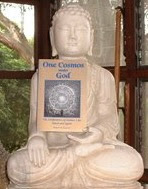
In trying to decide what to repost, it's much easier to just grab something at random from one or two years ago. This one is from last September, with many new reflections and refractions added. Irony alert: the title of the post is not ironic but 100% literal.
I'm afraid that some readers -- probably for perfectly understandable reasons -- don't fully understand my point about spiritual evolution. I am not attempting to "Aurobindo-ize" Christianity." Rather, it's just that I see some rather obvious and fascinating parallels. Furthermore, I think a kneejerk anti-evolutionary stance is merely "customary" rather than intrinsic to Christianity. In fact, I believe it can be shown that the idea of a static universe is at the "human margin" of Christian theology, as opposed to evolution, which is at the heart of the divine revelation and intrinsic to a created world.
The concept of evolution is a key that unlocks countless mysteries, whereas the idea of a static universe only puts in place numerous impasses to our reason. And since God addresses himself to human reason, I have a hard time accepting any theology that insists that we must bypass our God-given reason to "understand" the divine memo.
Remember, whenever I use the word "evolution," it is never in the watered-down Darwinian sense of random "natural selection," but in a much grander cosmic sense, of which Darwinism can only be a small subset. Darwinists quite clearly abuse the plain dictionary definition of the term, and whenever someone redefines a word in order to make their theory work, you should be suspicious, for that's not science, only semantics or some other evasion. You can't define something by redefining it out of existence. Science naturally does this for methodological reasons, but then supernaturally conflates method and ontology, which is -- to use the technical term -- "stupid."
For example, my dictionary says that evolution is "a process of change in a certain direction", i.e., "a process of continuous change from a lower, simpler, or worse to a higher, more complex, or better state." Being that the essence of spirituality involves changing into a higher and better state, whereas Darwinism merely involves intrinsically meaningless change, it is actually religious believers who accept evolution and Darwinists who don't. For a strict Darwinist, nothing can be intrinsically "better" or "higher" on pain of undermining the whole theory. Organisms can only be relatively better adapted to their environment and therefore reproduce more successfully.
It doesn't take a genius to notice that Darwinism violates this straightforward definition of evolution, since it cannot speak of directionality, lower and higher, or better and worse, being that these categories can only be located on a vertical plane that transcends the flatland Darwinism of random mutation.
Even if a Darwinist argues that his theory is superior to yours, he has taken himself out of Darwinism, and is making an appeal to criteria that quite obviously transcend Darwinism. Why do you think that contemptuous Darwinists always want to prove that they are so much smarter than you are, hmm? Suffice it to say that the answer will not be found in Darwinism but psychoanalysis.
Ironically, you could even say that Darwinists specifically do not believe in evolution, being that they reject its very possibility (i.e., directional change into an intrinsically higher state). Rather, they believe in change, a very different thing. In this regard, they are very much like progressives, who also believe in change, but not genuine progress, since their metaphysic abolishes any absolute standard by which real progress can be measured. Indeed, progressives must generally abolish permanent truths in order to facilitate the changes they seek.
Again, one of our central ideas is that, specifically because this is a creation, it must also evolve and burst forth with creative novelty. The cosmos is permeated with meaning, and meaning has no meaning outside teleology, or final causes. In other words, the meaning is the cause.
Or, put it this way: if this weren't a creation, then we would have no trouble explaining why the cosmos has no creativity, novelty, or progressive development. We certainly wouldn't have any difficulty explaining the absence of the human intellect. But this is not a single level creation. Rather, it contains implicit degrees of being that serially unfold within time. This is a living cosmos; or let us say that it is infused with the life principle of "dynamic interior wholeness," which is why biology is even possible. Such a principle could never occur in a cosmos where it wasn't already implicitly present.
And it is also composed of Truth, which is why truth may call out to truth in the human subject. Only like may know like. We can know of no cosmos other than a cosmos capable of self-revelation and self-knowledge. But a cosmos capable of self-knowledge is an astonishing thing to contemplate. Here again, there is no Darwinist who doesn't suffer from a severely constrained imagination, thereby foreclosing the very space of vertical recollection.
In an "evolutionary creation" (which is again a redundancy), time will not be reducible to mere physical duration. Rather, it is the essence of creative transformation, which was one of Whitehead's central principles. He was one of my early guiding lights in these matters. Here, let me drag out my dog-eared copy of Adventures of Ideas. There he writes that "The creativity of the world is the throbbing emotion of the past hurtling itself into a new transcendent fact." His point is that each moment represents an instance of the cosmos transcending itself like a "flying dart hurled beyond the bounds of the world."
Hmm, let's see what else we have in here. Although I am not a full-blown Whiteheadian, he is nevertheless one of those people whose ideas have long since blended with my own psychic substance, so it's interesting to go back and look at some of my highlights and marginalia from 25 years ago. "This notion of... history devoid of any reliance on metaphysical principles and cosmological generalizations, is a figment of the imagination. The belief in it can only occur to minds steeped in provinciality -- the provinciality of... minds unable to divine their own unspoken limitations." Ho! Whitehead wasn't the most coherent or linear writer, but his books are filled with barbed little zingers like that.
Although Whitehead obviously accepted Darwinism as far as it goes, he wrote that, as applied to the human realm, it posed "a challenge to the whole humanitarian movement" and "weakened the Stoic-Christian ideal of democratic brotherhood." Who could argue with that? "For two thousand years philosophy and religion had held up before Western Europe the ideal figure of man, as man, and had claimed for it supreme worth." But two thousand years of accumulated divine-human wisdom can be wiped away with a single book of anti-intellectual Darwinist barbarism.
Just poking around at random now. Here's another good one: modern scientism canalizes "thought and observation within predetermined limits, based upon inadequate metaphysical assumptions dogmatically assumed. The modern assumptions.... exclude from rationalistic thought more of the final values of existence," circumscribing reason "by reducing its topics to triviality, for example, to bare sensa and tautologies.... The world will again sink into the boredom of a drab detail of rational thought, unless we retain in the sky some reflection of light from the sun of Hellenism." All men will be as repetitive, narrow and tedious as Charles Johnson.
Ah, here is Raccoonish sentiment: "We speak in the singular of The Universe.... There is one all-embracing fact [O] which is the advancing history of the one Universe." This is the "community of the world, which is the matrix of all begetting, and whose essence is process with retention of connectedness..." Indeed,
"We habitually speak of stones, and planets, and animals, as though each individual thing could exist, even for a passing moment, in separation from an environment which is in truth a necessary factor in its own nature. Such an abstraction is a necessity of thought.... But it also follows that, in the absence of some understanding of the final nature of things... all science suffers from the vice that it may be combining various propositions which tacitly presuppose inconsistent backgrounds. No science can be more secure than the unconscious metaphysics which it tacitly presupposes." Ho!
The point is -- now confirmed by quantum physics -- everything participates in everything else in ways that are far beyond the ken of 19th century atomistic science. Furthermore, in a post-relativistic cosmos, both space and time are nonlocal, so things are also temporally connected in ways that materialistic science cannot disclose.
This led Whitehead to the inevitable conclusion that each moment had a subjective and objective component, of which you might say that our minds are the individualized beneficiaries. In other words, the process of our very own mind reveals something intrinsic about the way the cosmos evolves. Scientistic materialists believe the same thing -- that the mind mirrors reality -- except that they only consider things from the linear/left brain point of view, instead of from the synthesis of the "higher third" that comes into view in the integral evolution of what Grotstein called the "transcendent position."
To say that God "participates" in the world, or that the divine is immanent within the creation, is another way of acknowledging this reality. This is the reason why the world is so full of beauty, truth, novelty, delight, surprise, -- and evolution. Evolution can occur because the cosmos is shot through with implicit divine potential to be realized in time: "The creativity is the actualization of potentiality, and the process of actualization is an occasion of experiencing." Thus, you might say that true creativity represents the quintessence of God "experiencing" his creation through us. Which is why it is a sin to bore God in the manner of a Queegian liztard.
The matrix of the world is the mother of our becoming -- the mamamatrix of evolution. But this matrix must be fertilized by the divine seed in order for things to grow and develop. Truly, our vertically challenged materialistic brethren are suffering from a spiritual (second) birth defect.
Saturday, September 19, 2009


Friday, September 18, 2009
Why Obama's Opponents are Racists
The left obviously values a certain kind of freedom. It's just not the American kind. When you think about it -- and this was a central point of both Mises and Hayek -- the majority of our "lived freedom" is in the economic arena. Especially prior to the advent of the internet, our political freedom consisted of, what, voting every two years and an occasional letter to the editor?
But economic freedom affects most every decision we make in the world. It is specifically this kind of freedom that the left undermines. However, in so doing, they erode the very foundation of liberty. As Hayek explains, we have "progressively [!] been moving away from the basic ideas on which Western civilization has been built" and slowly abandoning "the freedom in economic affairs without which personal and political freedom has never existed in the past."
And "Although we had been warned by some of the greatest thinkers... that socialism means slavery," we have nevertheless "steadily moved in the direction of socialism." Truly, it is like a kind of ineradicable mind parasite that must be confronted anew by each generation. We give vaccinations to children for other deadly diseases. Why don't we vaccinate them against socialism?
Oh. Right. The left controls education. Don't expect mind parasites to eradicate themselves. It's not in their economic interest, to say the least.
This, I think, is the objection people had to Obama beaming into the classroom and asking children to write a letter about how they plan to help him achieve his goals. Out of the mouth of an American president this would be a platitude, but from an un-American president it becomes sinister.
And please, when I say "un-American" I am being literal, not inflammatory. Dennis Prager says the same thing. He merely means that Obama -- or any leftist -- comes from an intellectual tradition that does not find its roots in America but Europe. It doesn't necessarily mean "anti-American," although I certainly believe it's no coincidence that the further left you go, the more hatred of America -- and of course, Israel -- you see.
When some moonbat says that the world hated America because of President Bush, what they mean is that the international left hated America, which is no doubt true. It's just that there are many more leftists than classical liberals in the world, and obviously not a single other Judeo-Christian country. Ask the Poles how they feel about Obama. He has been going about alienating governments that most share our values, such as Israel and India, while coddling and appeasing those that do not share our values.
Consider again that little graph I came up with the other day, with the vertical y-axis running from worldly to spiritual, the horizontal x-axis from collectivism to individualism. This graph will show you exactly where I differ with the left, but also with Schuon and the traditionalists, who are ultra-conservative in the European (not American) sense. Thus, we are dealing with two varieties of un-Americanism.
For me, the quintessence of Americanism -- the ideal person, as it were -- is located in the upper right quadrant, the "spiritual individual." This was so beautifully laid out by the founders, that there is no reason for me to try to surpass them. Just sample some of their theo-political reflections in Novak's On Two Wings. I remember Dennis Prager saying at the time the book came out, that he had brought it with him to sabbath services, because it's that sacred.
Here, let me see if I can dig out a representative sample without losing my momentum. There are really too many to choose from. Here -- John Adams: "I always consider the settlement of America with reverence and wonder, as the opening of a grand scene and design in Providence for the illumination of the ignorant, and the emancipation of the slavish part of mankind all over the earth."
Talk about a pure Raccoonish sentiment! Do you think I care what the ignorant slaves and slavers of the international left think about America? Ho! Our values are antithetical. Of course they hate us. We are "un-European." We are liberal. We are not collectivists. We remain the last best hope for mankind moving into the space of the Upper Right.
Alexander Hamilton (and again, bear in mind that this self-evident truth would be "unteachable" and therefore unthinkable in a leftist-controlled school, even though it was said by one of our most important founders): "The sacred rights of mankind are not to be rummaged for among old parchments or musty records. They are written, as with a sunbeam, in the whole volume of human nature, by the hand of Divinity itself, and can never be erased or obscured by mortal power."
Those are the words of a real UpRight man. Now, you may disagree with Hamilton, and that is your prerogative. Just don't kid yourself into thinking that your values are "American," because they're not. No one had your values at the American founding, except perhaps in France.
James Madison, perhaps the most important "doctor of liberty" at our founding: "The belief in a God All Powerful, wise, and good, is so essential to the moral order of the World and to the happiness of man, that arguments which enforce it cannot be drawn from too many sources nor adapted with too much solicitude to the different characters and capacities impressed with it."
Again, an UpRight man of the first rank. Does this mean that our founders didn't care about the collective, i.e., the left hand side of our political graph? Hardly! This was one of the things that most caught Tocqueville's attention, that is, the spontaneous emergence of civil society, of people taking care of one another. When the state takes over this function, it not only diminishes the domain of the Upper Left, but replaces it with the lower left, the fascist/socialist space of the magical collective, impervious to the light of reason.
I'm currently reading Mises' Human Action, and he says what amounts to the same thing. Amazing that he wrote this in the 1940s, because he does a spot-on analysis on the leftist attack on logic that we see today with multiculturalism, deconstruction, and political correctness. These cognitive pathologies are not just peripheral but central to leftist thought, because they undermine reason itself. That is, if different races, classes, cultures, and ethnicities all have their own distinct modes of thought, then western logic is no better than any other form of logic.
Thus, DownRight, or LowDown man inevitably becomes Lower Left man, i.e., the infra-logical and magical collective. This is again why I would hesitate to assume that the Obamanians are trying to be so illogical in attacking the opposition. Again, the absence of logic is not a bug, it's a feature of leftist thought. They have no idea how to respond to an actual argument.
Indeed, just a couple of days ago there was a lengthy piece in the Washington Post -- can't find the link -- about how the White House was trying to come up with a coherent strategy for dealing with the opposition. Fascinatingly, not a single one involved simply "responding to the arguments." For to respond to the arguments would immediately pull them up into the space of logic and evidence, which is precisely where they don't want to be.
Here is how Mises describes the historical emergence of the leftist attack on logic: "The economists had entirely demolished the fantastic delusions of the socialist utopias [read: the lower left, or infralogical collective].... The communist ideas were done for. The socialists were absolutely unable to raise any objection to the devastating criticism of their schemes and to advance any argument in their favor. It seemed as if socialism was dead forever."
So, what do you do if logic is not on your side? "Only one way could lead the socialists out of this impasse. They could attack logic and reason and substitute mystical intuition for ratiocination." The DownRight men of the neo-Marxist left argued that there is no universally valid form of logic or truth, and that to even think so is "oppressive," especially toward minorities. Rather, your so-called truth is merely a reflection of race, or class, or gender, interests.
And this is why if you oppose Obama you are a racist, but if you oppose Michael Steele or Thomas Sowell or Clarence Thomas you can't be. In the perverse cognitive world of the left, the former is "inevitable," the latter "impossible."
*****
Happy birthday to Mommy!

But economic freedom affects most every decision we make in the world. It is specifically this kind of freedom that the left undermines. However, in so doing, they erode the very foundation of liberty. As Hayek explains, we have "progressively [!] been moving away from the basic ideas on which Western civilization has been built" and slowly abandoning "the freedom in economic affairs without which personal and political freedom has never existed in the past."
And "Although we had been warned by some of the greatest thinkers... that socialism means slavery," we have nevertheless "steadily moved in the direction of socialism." Truly, it is like a kind of ineradicable mind parasite that must be confronted anew by each generation. We give vaccinations to children for other deadly diseases. Why don't we vaccinate them against socialism?
Oh. Right. The left controls education. Don't expect mind parasites to eradicate themselves. It's not in their economic interest, to say the least.
This, I think, is the objection people had to Obama beaming into the classroom and asking children to write a letter about how they plan to help him achieve his goals. Out of the mouth of an American president this would be a platitude, but from an un-American president it becomes sinister.
And please, when I say "un-American" I am being literal, not inflammatory. Dennis Prager says the same thing. He merely means that Obama -- or any leftist -- comes from an intellectual tradition that does not find its roots in America but Europe. It doesn't necessarily mean "anti-American," although I certainly believe it's no coincidence that the further left you go, the more hatred of America -- and of course, Israel -- you see.
When some moonbat says that the world hated America because of President Bush, what they mean is that the international left hated America, which is no doubt true. It's just that there are many more leftists than classical liberals in the world, and obviously not a single other Judeo-Christian country. Ask the Poles how they feel about Obama. He has been going about alienating governments that most share our values, such as Israel and India, while coddling and appeasing those that do not share our values.
Consider again that little graph I came up with the other day, with the vertical y-axis running from worldly to spiritual, the horizontal x-axis from collectivism to individualism. This graph will show you exactly where I differ with the left, but also with Schuon and the traditionalists, who are ultra-conservative in the European (not American) sense. Thus, we are dealing with two varieties of un-Americanism.
For me, the quintessence of Americanism -- the ideal person, as it were -- is located in the upper right quadrant, the "spiritual individual." This was so beautifully laid out by the founders, that there is no reason for me to try to surpass them. Just sample some of their theo-political reflections in Novak's On Two Wings. I remember Dennis Prager saying at the time the book came out, that he had brought it with him to sabbath services, because it's that sacred.
Here, let me see if I can dig out a representative sample without losing my momentum. There are really too many to choose from. Here -- John Adams: "I always consider the settlement of America with reverence and wonder, as the opening of a grand scene and design in Providence for the illumination of the ignorant, and the emancipation of the slavish part of mankind all over the earth."
Talk about a pure Raccoonish sentiment! Do you think I care what the ignorant slaves and slavers of the international left think about America? Ho! Our values are antithetical. Of course they hate us. We are "un-European." We are liberal. We are not collectivists. We remain the last best hope for mankind moving into the space of the Upper Right.
Alexander Hamilton (and again, bear in mind that this self-evident truth would be "unteachable" and therefore unthinkable in a leftist-controlled school, even though it was said by one of our most important founders): "The sacred rights of mankind are not to be rummaged for among old parchments or musty records. They are written, as with a sunbeam, in the whole volume of human nature, by the hand of Divinity itself, and can never be erased or obscured by mortal power."
Those are the words of a real UpRight man. Now, you may disagree with Hamilton, and that is your prerogative. Just don't kid yourself into thinking that your values are "American," because they're not. No one had your values at the American founding, except perhaps in France.
James Madison, perhaps the most important "doctor of liberty" at our founding: "The belief in a God All Powerful, wise, and good, is so essential to the moral order of the World and to the happiness of man, that arguments which enforce it cannot be drawn from too many sources nor adapted with too much solicitude to the different characters and capacities impressed with it."
Again, an UpRight man of the first rank. Does this mean that our founders didn't care about the collective, i.e., the left hand side of our political graph? Hardly! This was one of the things that most caught Tocqueville's attention, that is, the spontaneous emergence of civil society, of people taking care of one another. When the state takes over this function, it not only diminishes the domain of the Upper Left, but replaces it with the lower left, the fascist/socialist space of the magical collective, impervious to the light of reason.
I'm currently reading Mises' Human Action, and he says what amounts to the same thing. Amazing that he wrote this in the 1940s, because he does a spot-on analysis on the leftist attack on logic that we see today with multiculturalism, deconstruction, and political correctness. These cognitive pathologies are not just peripheral but central to leftist thought, because they undermine reason itself. That is, if different races, classes, cultures, and ethnicities all have their own distinct modes of thought, then western logic is no better than any other form of logic.
Thus, DownRight, or LowDown man inevitably becomes Lower Left man, i.e., the infra-logical and magical collective. This is again why I would hesitate to assume that the Obamanians are trying to be so illogical in attacking the opposition. Again, the absence of logic is not a bug, it's a feature of leftist thought. They have no idea how to respond to an actual argument.
Indeed, just a couple of days ago there was a lengthy piece in the Washington Post -- can't find the link -- about how the White House was trying to come up with a coherent strategy for dealing with the opposition. Fascinatingly, not a single one involved simply "responding to the arguments." For to respond to the arguments would immediately pull them up into the space of logic and evidence, which is precisely where they don't want to be.
Here is how Mises describes the historical emergence of the leftist attack on logic: "The economists had entirely demolished the fantastic delusions of the socialist utopias [read: the lower left, or infralogical collective].... The communist ideas were done for. The socialists were absolutely unable to raise any objection to the devastating criticism of their schemes and to advance any argument in their favor. It seemed as if socialism was dead forever."
So, what do you do if logic is not on your side? "Only one way could lead the socialists out of this impasse. They could attack logic and reason and substitute mystical intuition for ratiocination." The DownRight men of the neo-Marxist left argued that there is no universally valid form of logic or truth, and that to even think so is "oppressive," especially toward minorities. Rather, your so-called truth is merely a reflection of race, or class, or gender, interests.
And this is why if you oppose Obama you are a racist, but if you oppose Michael Steele or Thomas Sowell or Clarence Thomas you can't be. In the perverse cognitive world of the left, the former is "inevitable," the latter "impossible."
*****
Happy birthday to Mommy!

Thursday, September 17, 2009
Jimmy Carter: Miserable Failure, Vicious Anti-Semite, or Just Plain Stupid?
Is the Obama administration's refusal to honestly engage the arguments of its critics a conscious strategy or simply an artifact of being among the Anointed? After all, if one is by definition generous, decent, and compassionate, then one's critics must be the opposite. Thus, the demonization of critics as racists, nazis, and thugs may not be a conscious strategy. If it is, it's an appallingly stupid one.
Do they really think it's a good idea to trot out the worst president of the 20th century to viciously slander over half the population? I mean, if it weren't for Carter's little pills, we wouldn't even be having to deal with this Iran problem. I suppose it's possible that his vile message is being orchestrated by the White House, but I like to think that liberals really believe the things they say, and that in their minds, their motives are pure. It's enough just to deal with the substance of their ideas. There's no need to assume bad motives.
For example, I am quite sure that state-mandated racial discrimination is a bad thing, and that it is harmful to its so-called beneficiaries. Thus, one can say that it's a racist policy, but there is no need to impute racist motivations to this or that individual. I know lots of people who are in favor of state-enforced racial discrimination, but they aren't racists as we usually define the term. Condescending toward blacks, yes. Infantilizing, yes. But in their minds, they're trying to do good. They're just misguided, that's all.
This is why Hayek emphasizes over and over that in economics, intentions don't matter, only incentives. Thus, we know that Obama intends to provide universal health care that is cheap, plentiful and of high quality. I don't doubt that. I just know that it's impossible, because he will set up a system of incentives that makes it so. The incentives will immediately swamp the intentions as soon as the system moves from idea to reality, because economics does not lie.
The identical thing happened with the Great Society, which was intended to reduce dependency but only increased it to unprecedented levels. Now if you try to scale it back, you are "cruel" and "heartless."
So the left is full of good people with good intentions, excluding that truly nasty contingent of hardcore leftists which probably constitutes only a quarter to a third of the Democrat party. Unfortunately, those people tend to be the most visible, as they are the activists, intellectuals, and prominent bloggers -- AKA, the ignorantsia.
But for those of you with liberal neighbors and relatives, you know that they are just decent people who have never given much thought to their ideas, especially if they've had the misfortune of attending graduate school. In fact, they are the ones who are most impervious to novel information, due to the element of intellectual pride. Give me ten minutes with my pool man, and I could convert him to conservatism (if he isn't conservative already). But I couldn't change some of my educated relatives in 50 years. No way. They literally don't hear what I'm saying.
Liberals have a hard time understanding that good will ≠ good results. Worse yet, leftist intellectuals can't seem to wrap their minds around one of the founding principles of classical liberalism, that what they think of as "bad intentions" routinely give birth to good results.
But in reality, of course, the bad intentions are not really bad; they only become so in the leftist's mind, because they convert self-interest into selfishness, two very different and often antithetical things. For a self-interested person is rational, predictable, responsible, stable, future-oriented, and deeply interconnected with a small circle that he especially cares about and which cares about him.
In contrast, collectivism erodes self-interest and replaces it with raw selfishness. Once the state is powerful enough to dole out favors to particular groups and interests, everyone is in competition to gain the favors in exchange for propping up the state and giving it even more power. This is why the huge federal bureaucracy initiated by FDR became the metastasizing autopoietic monster it is today. No one can control it because of the system of incentives it has instantiated.
In turn, as Mark Steyn has argued, this is perhaps the greatest existential danger of Omamacare, because government-controlled medicine changes a people forever. Once we cross that rubicon-job, our very lives are intertwined with the State in the most intimate manner.
I don't know if this is a conscious strategy on the part of the left -- I'm sure that for some of them it is -- but socialized medicine may be the death blow to classical liberalism and to any semblance of the founding vision of the United States. From then on, every political battle will be fought on leftist turf.
Can you imagine? Every national election will be about greedy Republicans trying to take away your healthcare. Democrats will simply replicate their longstanding strategy toward Social Security, only on a mass scale. To be conservative will be to touch the Third Rail of "free" healthcare and thereby go up in flames. In this new context, a garden variety conservative will sound as extreme as, say, a Bircher or Paulian today. That's how it is in Western Europe, where their "conservatives" are just leftist-lite.
Hayek makes the important point that when the outcome deviates from the noble intentions of the left -- which it virtually always does -- they never return to first principles and inquire as to whether perhaps there's a bug in the system. Rather, they usually jump to the conclusion "that sinister forces must have foiled our intentions, that we are the victims of some evil power which must be conquered...." Our intentions are good. Our ideas cannot have been wrong.
This is where the inevitable demonization and conspiratorial thinking come in. People don't want nationalized medicine? They must be racists! War going badly? Bush lied us into it! Worst hurricane in history? Bush hates black people! Doubt the significance of manmade climate change? You're a Holocaust denier! Etc.
Leftists "are ready to accept almost any explanation of the present crisis of our civilization except one: that the present state of the world may be the result of genuine error on our part and that the pursuit of some of our most cherished ideals has apparently produced results utterly different from those which we expected" (Hayek).
Could it be that the War on Poverty results in only more poverty? Or that government discrimination does not end discrimination? Or that military weakness is provocative to the enemies of liberty? Or that aid to Africa freezes it in a state of dysfunction? Or that pouring more money into a bad educational system makes it worse? Or that subsidizing college increases the cost of tuition?
This is why I don't agree with, say, Rush Limbaugh, who believes that Obama is following the tried-and-true Marxist strategy of intentionally making things worse in order to justify a more massive power grab. I don't see any real need to go there and to attack motivations, as does the left.
Again, it is enough to address their bad ideas, which Limbaugh already does so well. Then again, since so few people engage the ideas, one can well understand the strategy of personalizing the debate and demonizing the opponent. Who knows. Maybe all is fair in this kind of Cosmic War, since the future of civilization hangs in the balance.
*****
O, just like I pictured it. You gots to have freedom:
Do they really think it's a good idea to trot out the worst president of the 20th century to viciously slander over half the population? I mean, if it weren't for Carter's little pills, we wouldn't even be having to deal with this Iran problem. I suppose it's possible that his vile message is being orchestrated by the White House, but I like to think that liberals really believe the things they say, and that in their minds, their motives are pure. It's enough just to deal with the substance of their ideas. There's no need to assume bad motives.
For example, I am quite sure that state-mandated racial discrimination is a bad thing, and that it is harmful to its so-called beneficiaries. Thus, one can say that it's a racist policy, but there is no need to impute racist motivations to this or that individual. I know lots of people who are in favor of state-enforced racial discrimination, but they aren't racists as we usually define the term. Condescending toward blacks, yes. Infantilizing, yes. But in their minds, they're trying to do good. They're just misguided, that's all.
This is why Hayek emphasizes over and over that in economics, intentions don't matter, only incentives. Thus, we know that Obama intends to provide universal health care that is cheap, plentiful and of high quality. I don't doubt that. I just know that it's impossible, because he will set up a system of incentives that makes it so. The incentives will immediately swamp the intentions as soon as the system moves from idea to reality, because economics does not lie.
The identical thing happened with the Great Society, which was intended to reduce dependency but only increased it to unprecedented levels. Now if you try to scale it back, you are "cruel" and "heartless."
So the left is full of good people with good intentions, excluding that truly nasty contingent of hardcore leftists which probably constitutes only a quarter to a third of the Democrat party. Unfortunately, those people tend to be the most visible, as they are the activists, intellectuals, and prominent bloggers -- AKA, the ignorantsia.
But for those of you with liberal neighbors and relatives, you know that they are just decent people who have never given much thought to their ideas, especially if they've had the misfortune of attending graduate school. In fact, they are the ones who are most impervious to novel information, due to the element of intellectual pride. Give me ten minutes with my pool man, and I could convert him to conservatism (if he isn't conservative already). But I couldn't change some of my educated relatives in 50 years. No way. They literally don't hear what I'm saying.
Liberals have a hard time understanding that good will ≠ good results. Worse yet, leftist intellectuals can't seem to wrap their minds around one of the founding principles of classical liberalism, that what they think of as "bad intentions" routinely give birth to good results.
But in reality, of course, the bad intentions are not really bad; they only become so in the leftist's mind, because they convert self-interest into selfishness, two very different and often antithetical things. For a self-interested person is rational, predictable, responsible, stable, future-oriented, and deeply interconnected with a small circle that he especially cares about and which cares about him.
In contrast, collectivism erodes self-interest and replaces it with raw selfishness. Once the state is powerful enough to dole out favors to particular groups and interests, everyone is in competition to gain the favors in exchange for propping up the state and giving it even more power. This is why the huge federal bureaucracy initiated by FDR became the metastasizing autopoietic monster it is today. No one can control it because of the system of incentives it has instantiated.
In turn, as Mark Steyn has argued, this is perhaps the greatest existential danger of Omamacare, because government-controlled medicine changes a people forever. Once we cross that rubicon-job, our very lives are intertwined with the State in the most intimate manner.
I don't know if this is a conscious strategy on the part of the left -- I'm sure that for some of them it is -- but socialized medicine may be the death blow to classical liberalism and to any semblance of the founding vision of the United States. From then on, every political battle will be fought on leftist turf.
Can you imagine? Every national election will be about greedy Republicans trying to take away your healthcare. Democrats will simply replicate their longstanding strategy toward Social Security, only on a mass scale. To be conservative will be to touch the Third Rail of "free" healthcare and thereby go up in flames. In this new context, a garden variety conservative will sound as extreme as, say, a Bircher or Paulian today. That's how it is in Western Europe, where their "conservatives" are just leftist-lite.
Hayek makes the important point that when the outcome deviates from the noble intentions of the left -- which it virtually always does -- they never return to first principles and inquire as to whether perhaps there's a bug in the system. Rather, they usually jump to the conclusion "that sinister forces must have foiled our intentions, that we are the victims of some evil power which must be conquered...." Our intentions are good. Our ideas cannot have been wrong.
This is where the inevitable demonization and conspiratorial thinking come in. People don't want nationalized medicine? They must be racists! War going badly? Bush lied us into it! Worst hurricane in history? Bush hates black people! Doubt the significance of manmade climate change? You're a Holocaust denier! Etc.
Leftists "are ready to accept almost any explanation of the present crisis of our civilization except one: that the present state of the world may be the result of genuine error on our part and that the pursuit of some of our most cherished ideals has apparently produced results utterly different from those which we expected" (Hayek).
Could it be that the War on Poverty results in only more poverty? Or that government discrimination does not end discrimination? Or that military weakness is provocative to the enemies of liberty? Or that aid to Africa freezes it in a state of dysfunction? Or that pouring more money into a bad educational system makes it worse? Or that subsidizing college increases the cost of tuition?
This is why I don't agree with, say, Rush Limbaugh, who believes that Obama is following the tried-and-true Marxist strategy of intentionally making things worse in order to justify a more massive power grab. I don't see any real need to go there and to attack motivations, as does the left.
Again, it is enough to address their bad ideas, which Limbaugh already does so well. Then again, since so few people engage the ideas, one can well understand the strategy of personalizing the debate and demonizing the opponent. Who knows. Maybe all is fair in this kind of Cosmic War, since the future of civilization hangs in the balance.
*****
O, just like I pictured it. You gots to have freedom:
Wednesday, September 16, 2009
This Post is Dedicated to the Socialists of All Parties, Newspapers, and Cable Stations
Jimmy Carter is right. I refuse to accept a black president... who isn't Thomas Sowell. Actually, I refuse to accept a black socialist. Or white socialist. Or Jewish socialist. Or Asian socialist. But I'd vote for Thomas Sowell if he were a transgendered Guatemalan poetess who thought that shaving his legs was a form of oppression.
Speaking of Obama, Road to Serfdom is actually dedicated to him and to his parents, not to mention the group that nurturted his political sensibilities, ACORN. (Have you noticed that the treasonous don't fall far from the ACORN?)
Yes, Hayek dedicated the book -- without irony or malice -- "to the socialists of all parties." He did so because he knew that the vast majority of socialists were not evil, just misguided (despite the respect not being mutual; Hayek was treated with contempt by his Anointed contemporaries).
Again, back then there was an excuse for being a socialist, just as we can excuse someone for having been a slaveholder back when the practice was universal, or racist when no one knew any better. But now there is no excuse. So this post is dedicated with irony and malice to the socialists of all parties, newspapers, and cable stations.
As I mentioned yesterday, the kooks of the mainstream left will not engage our arguments. Instead, their first and last resort is name-calling of the most vile sort. Again, the proof that they do not take racism seriously is that they throw out the charge so lightly and irresponsibly. If I am a racist, then there's nothing wrong with being one.
But things were no different in the 1940s, since one of the appeals of leftism is that it renders one virtuous in one's own eyes, so that people who don't share your ideals are worthy of the most intolerant scorn and ridicule. As Hayek writes in the preface, the very people who could most benefit from the book "rejected it out of hand as a malicious and disingenuous attack on their finest ideals. They appear never to have paused to examine its argument."
This column from the blessedly soon-to be-extinct LA Times is typical: "the right-wing anti-Obama movement in the U.S. these days is overpopulated with nuts, fundamentalists and paranoids who won't be easily stopped by a few congressional reprimands." You don't say! (Interestingly, just as the previous dinosaurs, the MSM is becoming extinct due to a comet -- the blazing comet of the internet and of citizen journalism.)
In fact, this idiotorial claims that you and I don't even actually believe what we believe. You know, the old Marxist idea of "false consciousness." Rather, we're just being manipulated by a conspiratorial political action committee called Our Country Deserves Better. Never heard of them? They're the ones who have convinced us of the "fundamentalist" and "unintelligible" idea that the Constitution actually means what it says. How primitive! Everyone knows that the Constitution means what the left wishes it to mean.
Have you ever wondered why two economists can believe things that are diametrically opposed to one another? This leads to a kind of cynicism and confusion that paves the way for the left. In other words, if both Thomas Sowell and Paul Krugman are "economists," then the word "economist" has no real meaning, so a politician can go ahead and do what he wants, knowing that some gliberal quackademic has his back. It is analogous to calling both an astronomer and astrologer "scientists."
Then again, Van Morrison and Kanye West are both "musicians." That being the case, one is unable to evaluate music in the absence of values. The same holds true of economics. The reason why a Hayek and Krugman or Robert Reich differ so sharply is because they start with an entirely different set of values, which are "non-negotiable." For a variety of reasons we will get into, Hayek starts with the individual in general and with liberty in particular (which one might say is the field of the individual's freely chosen action), while the socialist -- by whatever name -- begins with the collective.
Many people wonder why conservatism embodies the sometimes uneasy coalition of libertarians and serious religious seekers, and this is why, for both, in their own way, regard the individual as sacred, inviolable, and absolute (i.e., the image of the Absolute). "We are endowed by our Creator," etc.
In contrast, the fascist/socialist always begins with the we. For example, in Nazi Germany, the state was simply the reflection of the fundamental reality of the nation, or "volk." The individual is meaningless in the absence of his devotion and subordination to this higher body. For this reason, the Nazis embarked on an all-out assault on the liberal values of the Anglo-Saxon world (including the Christian metaphysics underlying them).
The same principle applies to our contemporary socialists, including Obama. "Yes we can." Higher taxes are our patriotic duty. I want to take your income and "spread it around." I don't want to hear any talking from you. I want you to get out of the way, you bunch of selfish racists. If you challenge these assumptions, you trigger the same kind of visceral reaction you would if you had attacked a religious icon, the reason being that socialism is a religion. Take away its ideals, and these people have nothing to believe in.
So although Road to Serfdom is an economics book, there's not a single equation in it (except for the equation of socialism and serfdom). Rather, it begins and ends in ultimate values -- although he then proceeds to demonstrate how the nurturing of these values leads to human progress, development, and increased wealth. For the secret power of the free market is that it unleashes the almost infinite potential of the creative and motivated individual -- a potential that was quashed for most of human history, and is vitiated under any socialist system.
Again, rather than engage these ideas, the left always attacks motivations -- for example, that classical liberalism is simply a self-serving doctrine of The Rich. But I am not rich, nor was Hayek, nor are most of the tea partiers. (And I assume you're not, but if you are, how would you like to send a generous Love Offering my way?) The left has it precisely backward. If I were self-serving, I would be a leftist in order to get more free stuff from the government, and maybe even a lifetime commitment to a major looniversity bin. I would work toward that glorious day when 51% of the population pays no taxes and lives off the 49% who do -- the revolt of the takers over the makers.
As Hayek explains, "I am as certain as anyone can be that the beliefs set out in [the book] are not determined by my personal interests. I can discover no reason why the kind of society which seems to me desirable should offer greater advantages to me than to the great majority of the people in my country."
Same with me. I am sure that Omamacare will include mandated mental health coverage. Therefore, it is like free money for me. My pool of potential victims will increase exponentially. But I am adamantly opposed to the idea that the government should pay for people to talk about their problems to some unhinged psychologist.
Hayek goes on to say that "I have every reason for not writing or publishing this book. It is certain to offend many people with whom I wish to live on friendly terms." Again, I couldn't agree more. I too have in-laws, co-workers, and neighbors.
Believe it or not, I have no desire to be hated by people, which is precisely why I try to limit my exposure. I really don't want to put a big target on myself. Those folks are spooky, in case you haven't noticed. And since the main purpose of this blog is spiritual, I can't be at my best in that arena if I am having to deal with the psychotic crosscurrents of the left. I prefer to leave that to others who thrive on that sort of thing.
Speaking of Obama, Road to Serfdom is actually dedicated to him and to his parents, not to mention the group that nurturted his political sensibilities, ACORN. (Have you noticed that the treasonous don't fall far from the ACORN?)
Yes, Hayek dedicated the book -- without irony or malice -- "to the socialists of all parties." He did so because he knew that the vast majority of socialists were not evil, just misguided (despite the respect not being mutual; Hayek was treated with contempt by his Anointed contemporaries).
Again, back then there was an excuse for being a socialist, just as we can excuse someone for having been a slaveholder back when the practice was universal, or racist when no one knew any better. But now there is no excuse. So this post is dedicated with irony and malice to the socialists of all parties, newspapers, and cable stations.
As I mentioned yesterday, the kooks of the mainstream left will not engage our arguments. Instead, their first and last resort is name-calling of the most vile sort. Again, the proof that they do not take racism seriously is that they throw out the charge so lightly and irresponsibly. If I am a racist, then there's nothing wrong with being one.
But things were no different in the 1940s, since one of the appeals of leftism is that it renders one virtuous in one's own eyes, so that people who don't share your ideals are worthy of the most intolerant scorn and ridicule. As Hayek writes in the preface, the very people who could most benefit from the book "rejected it out of hand as a malicious and disingenuous attack on their finest ideals. They appear never to have paused to examine its argument."
This column from the blessedly soon-to be-extinct LA Times is typical: "the right-wing anti-Obama movement in the U.S. these days is overpopulated with nuts, fundamentalists and paranoids who won't be easily stopped by a few congressional reprimands." You don't say! (Interestingly, just as the previous dinosaurs, the MSM is becoming extinct due to a comet -- the blazing comet of the internet and of citizen journalism.)
In fact, this idiotorial claims that you and I don't even actually believe what we believe. You know, the old Marxist idea of "false consciousness." Rather, we're just being manipulated by a conspiratorial political action committee called Our Country Deserves Better. Never heard of them? They're the ones who have convinced us of the "fundamentalist" and "unintelligible" idea that the Constitution actually means what it says. How primitive! Everyone knows that the Constitution means what the left wishes it to mean.
Have you ever wondered why two economists can believe things that are diametrically opposed to one another? This leads to a kind of cynicism and confusion that paves the way for the left. In other words, if both Thomas Sowell and Paul Krugman are "economists," then the word "economist" has no real meaning, so a politician can go ahead and do what he wants, knowing that some gliberal quackademic has his back. It is analogous to calling both an astronomer and astrologer "scientists."
Then again, Van Morrison and Kanye West are both "musicians." That being the case, one is unable to evaluate music in the absence of values. The same holds true of economics. The reason why a Hayek and Krugman or Robert Reich differ so sharply is because they start with an entirely different set of values, which are "non-negotiable." For a variety of reasons we will get into, Hayek starts with the individual in general and with liberty in particular (which one might say is the field of the individual's freely chosen action), while the socialist -- by whatever name -- begins with the collective.
Many people wonder why conservatism embodies the sometimes uneasy coalition of libertarians and serious religious seekers, and this is why, for both, in their own way, regard the individual as sacred, inviolable, and absolute (i.e., the image of the Absolute). "We are endowed by our Creator," etc.
In contrast, the fascist/socialist always begins with the we. For example, in Nazi Germany, the state was simply the reflection of the fundamental reality of the nation, or "volk." The individual is meaningless in the absence of his devotion and subordination to this higher body. For this reason, the Nazis embarked on an all-out assault on the liberal values of the Anglo-Saxon world (including the Christian metaphysics underlying them).
The same principle applies to our contemporary socialists, including Obama. "Yes we can." Higher taxes are our patriotic duty. I want to take your income and "spread it around." I don't want to hear any talking from you. I want you to get out of the way, you bunch of selfish racists. If you challenge these assumptions, you trigger the same kind of visceral reaction you would if you had attacked a religious icon, the reason being that socialism is a religion. Take away its ideals, and these people have nothing to believe in.
So although Road to Serfdom is an economics book, there's not a single equation in it (except for the equation of socialism and serfdom). Rather, it begins and ends in ultimate values -- although he then proceeds to demonstrate how the nurturing of these values leads to human progress, development, and increased wealth. For the secret power of the free market is that it unleashes the almost infinite potential of the creative and motivated individual -- a potential that was quashed for most of human history, and is vitiated under any socialist system.
Again, rather than engage these ideas, the left always attacks motivations -- for example, that classical liberalism is simply a self-serving doctrine of The Rich. But I am not rich, nor was Hayek, nor are most of the tea partiers. (And I assume you're not, but if you are, how would you like to send a generous Love Offering my way?) The left has it precisely backward. If I were self-serving, I would be a leftist in order to get more free stuff from the government, and maybe even a lifetime commitment to a major looniversity bin. I would work toward that glorious day when 51% of the population pays no taxes and lives off the 49% who do -- the revolt of the takers over the makers.
As Hayek explains, "I am as certain as anyone can be that the beliefs set out in [the book] are not determined by my personal interests. I can discover no reason why the kind of society which seems to me desirable should offer greater advantages to me than to the great majority of the people in my country."
Same with me. I am sure that Omamacare will include mandated mental health coverage. Therefore, it is like free money for me. My pool of potential victims will increase exponentially. But I am adamantly opposed to the idea that the government should pay for people to talk about their problems to some unhinged psychologist.
Hayek goes on to say that "I have every reason for not writing or publishing this book. It is certain to offend many people with whom I wish to live on friendly terms." Again, I couldn't agree more. I too have in-laws, co-workers, and neighbors.
Believe it or not, I have no desire to be hated by people, which is precisely why I try to limit my exposure. I really don't want to put a big target on myself. Those folks are spooky, in case you haven't noticed. And since the main purpose of this blog is spiritual, I can't be at my best in that arena if I am having to deal with the psychotic crosscurrents of the left. I prefer to leave that to others who thrive on that sort of thing.
Tuesday, September 15, 2009
About Those Right Wing Fascists
In order delegitimize the tea party movement, the MSM -- abetted by kooks such as Charles Johnson -- is highlighting the people who brought signs linking Obama to fascism. Again, is this my style? No. But is it my substance? Let's find out.
Of course, if one is remotely balanced -- let alone charitable -- one will acknowledge that both sides have their crazies, and leave it at that. For every moonbat there's an equal and opposite wingnut, and all that. In fact, for every gay-hating Fred Phelps there must be a dozen God-hating Charles Johnsons. But the science of natural selection is not discredited just because people such as Queeg turn it into a religion, nor should marriage be redefined just because Phelps thinks it shouldn't be.
Let's face it: there are only two main parties, but millions of emotionally disturbed people. What are they supposed to do, form their own party? Some of them do, but you have to be both crazy and stupid to think that the Green Party or Reform Party will ever go anywhere.
There are not too many things that really bother me about politics, politics being what it is. But one thing that does is when people condemn one side for doing exactly what the other side does. This is why you will never see me get excited by a commonplace political scandal. Of course politicians are corrupt. That's why I am a conservative. I want fewer of them, with less power over me.
One way to avoid dealing with the substance of an argument is to simply caricature your opposition by focusing on its extreme elements. This is intellectually dishonest. As far as I am concerned, it is not necessary to highlight the true crazies of the left -- Moveon.org, Code Pink, environmental terrorists, PETA, etc. -- because the mainstream is already so nuts. It's a full time job just dealing with the New York Times, CNN, Keith Olbermann, Nancy Pelosi, Harry Reid, Van Jones, ACORN, etc.
I've read any number of mainstream analyses of the tea party movement, and not one of them dispassionately discusses the substance of the arguments, i.e., out of control government spending, socialized medicine, legislation to forbid the climate from changing, etc.
Now, back to those "crazies" who think that Obama is a fascist. First of all, you have to understand that genocide is not intrinsic to fascism. In a way, Hitler spoiled a perfectly useful word by forever associating it with the Holocaust. So now we have no name for a certain enduring political phenomenon, just because the name for it has been tainted.
To be honest, this post is just an excuse for me to review and assimilate Hayek's Road to Serfdom, which I finished yesterday. Although originally published in 1944, it is as timely as ever, given the events of the day.
I had already read some of Hayek's other books, not to mention a couple of recent biographies, but this is considered his most accessible work. There was nothing in it that was new for me, but it certainly reinforces the fact that there isn't anything the least bit controversial about linking Obama and fascism. Indeed, Obama is simply acting from a script that was written (and discredited) long ago. It's timeless, really.
Again, at the time it was published, Hayek was trying to make the then-controversial point that communism and fascism were not opposites, but two consequences of the same underlying assumptions. These assumptions are profoundly illiberal, which is why, if you want to reduce it to a linear map, both socialism and fascism are on the left, while classical liberalism is on the right. But this is not really a useful distinction. I much prefer the four-quadrant graph I discussed yesterday, which distinguishes collectivism from individualism and the worldly from the spiritual.
A classical liberal of the American type believes first and foremost in liberty. But not the unconstrained horizontal liberty of the radical secularist. Rather, it can only be understood in a spiritual context, which is why the Founders wanted a secular state but a religious society infused with Judeo-Christian principles and values. None of them imagined that democracy would work in the absence of a virtuous population (although I am quite sure that our trolls can find the stray comment by a Jefferson or Paine justiying their own hatred of God).
It is important to point out that while critics of the tea party movement will cherry-pick some of the signs to focus on, they object just as much to the intellectual substance. The signs just give them a convenient way to avoid debate.
Thus, when The Road to Serfdom was published in the 1940s, it was greeted by the liberal ignorantsia exactly as if Hayek were holding up a sign of Roosevelt with a Hitler moustache. He was dismissed not just as wrong, but sinister (again, without ever engaging the substance of his ideas). This is because virtually all intellectuals at the time were unquestioned socialists. Of course, they accused Hayek of being "reactionary," which was transparent projection, just as today.
As I've said before many times, I don't necessarily blame someone for being a socialist in the 1930s or 1940s, before economics was the science it is today. Socialism has an intrinsic appeal, especially to intellectuals who believe that irreducibly complex problems are susceptible to easy solutions if we just apply enough brain power. This is one of the reasons the left is so enamored of Obama. For whatever reason, they all think he's "brilliant," so that he can "solve our problems." The same things were said of Clinton. But as Milton Friedman famously remarked, no one has all the knowledge necessary to produce even a single pencil, let alone "control healthcare."
Nevertheless, one of the reasons Hayek doesn't appeal to the left wing ignorantsia is that he renders them not just superfluous, but demonstrates how dangerous they are -- not necessarily because of any bad intentions on their part. To the contrary. It is nearly always with the best of intentions. It is just that they are attempting to control reality before having understood it. The grandiose visions of the left are just fairy tales by another name.
But what is worse, they cannot understand the realities they presume to control, not in fact, nor in principle. Can't be done. A free market economy, for example, consists of millions of people making billions of spontaneous decision based upon a practically infinite amount of knowledge, information, and wisdom dispersed throughout the system. Furthermore, it is non-linear, so that if you tinker with one variable, it will have unforeseen -- and unforeseeable -- consequences that will reverberate throughout the system.
Let's take the simple example of Roe v. Wade. Any intellectually honest person knows that this decision was unconstitutional. Be that as it may, one of the ideas was to prevent all of those deaths resulting from back alley abortions -- all six of them, or however many it was (don't believe anyone who gives you a statistic, because they're making it up).
But what were the actual consequences of Roe v. Wade? Being that there have been -- what 50 million? -- abortions since 1973, and thousands a day, I am quite sure that more women have died as a result of legal abortions than the illegal ones. This is because Roe v. Wade incentivized abortion, and with it, promiscuity and general sexual irresponsibility.
In a way, it's similar to the HIV virus, which incentivised homosexuals to refrain from certain activities, such as having thousands of anonymous partners in a bathhouse. But if a cure is ever found, then you can be quite sure that the same culture will flourish. Incentives matter. Intentions don't.
But the left is always blind to the consequences of their policies. And because they are rooted in emotion, not thought, they will simply vilify you if you disagree with them, as they did with Hayek.
The other day, Tom Friedman removed the mask and argued that China was a good country for the United States to emulate, because only with an authoritarian state would it be possible to impose Friedman World on the rest of us. In this regard, Hayek wrote that, once one concludes that central planning is necessary, this leads to "the demand that the government, or some single individual, should be given power to act on their own.... It becomes more and more the accepted belief that... the responsible director of affairs must be freed from the fetters of democratic procedure" (emphasis mine).
Not only has every liberal commentator (including the President) taken Sarah Palin's "death panels" comment out of context, but they refuse even to acknowledge that the responsible director of medical affairs must be freed from the fetters of democratic procedure in deciding how medical resources will be allocated. How is this belief controversial?
In his introduction to the book, Caldwell notes that Hayek's ideas are not just a kind of "lightning rod," but a Rorschach test that reveals "as much about the reader's prior commitments as it does about Hayek's ideas." Both the ideas and the reaction to them are timeless, man being what he is. After all, slavery and serfdom are the rule in human history, not the exception. Therefore, it is not as if these were simply accidental developments in human history. To the contrary, the culture of liberty is clearly the exception.
But the leftist believes to his core that liberty is possible in a culture of servitude. Apparently, he never pauses to think that for a third or half the year he is in bondage to the state. In my case, there is federal tax, state tax, property tax, payroll tax, sales tax, gas tax, beer tax, and more, not to mention various licenses and fees. And the government is still bankrupt!
Does the leftist really not put two and two together and understand that for the government, it always equals five? Does he really believe that there is no justification for anger at the size and scope of government? Does he really believe that it is somehow "liberal" to want to work even more for an even larger state? Does he really not acknowledge his bottomless greed and sense of entitlement for the fruits of our labors?
To be continued....
Of course, if one is remotely balanced -- let alone charitable -- one will acknowledge that both sides have their crazies, and leave it at that. For every moonbat there's an equal and opposite wingnut, and all that. In fact, for every gay-hating Fred Phelps there must be a dozen God-hating Charles Johnsons. But the science of natural selection is not discredited just because people such as Queeg turn it into a religion, nor should marriage be redefined just because Phelps thinks it shouldn't be.
Let's face it: there are only two main parties, but millions of emotionally disturbed people. What are they supposed to do, form their own party? Some of them do, but you have to be both crazy and stupid to think that the Green Party or Reform Party will ever go anywhere.
There are not too many things that really bother me about politics, politics being what it is. But one thing that does is when people condemn one side for doing exactly what the other side does. This is why you will never see me get excited by a commonplace political scandal. Of course politicians are corrupt. That's why I am a conservative. I want fewer of them, with less power over me.
One way to avoid dealing with the substance of an argument is to simply caricature your opposition by focusing on its extreme elements. This is intellectually dishonest. As far as I am concerned, it is not necessary to highlight the true crazies of the left -- Moveon.org, Code Pink, environmental terrorists, PETA, etc. -- because the mainstream is already so nuts. It's a full time job just dealing with the New York Times, CNN, Keith Olbermann, Nancy Pelosi, Harry Reid, Van Jones, ACORN, etc.
I've read any number of mainstream analyses of the tea party movement, and not one of them dispassionately discusses the substance of the arguments, i.e., out of control government spending, socialized medicine, legislation to forbid the climate from changing, etc.
Now, back to those "crazies" who think that Obama is a fascist. First of all, you have to understand that genocide is not intrinsic to fascism. In a way, Hitler spoiled a perfectly useful word by forever associating it with the Holocaust. So now we have no name for a certain enduring political phenomenon, just because the name for it has been tainted.
To be honest, this post is just an excuse for me to review and assimilate Hayek's Road to Serfdom, which I finished yesterday. Although originally published in 1944, it is as timely as ever, given the events of the day.
I had already read some of Hayek's other books, not to mention a couple of recent biographies, but this is considered his most accessible work. There was nothing in it that was new for me, but it certainly reinforces the fact that there isn't anything the least bit controversial about linking Obama and fascism. Indeed, Obama is simply acting from a script that was written (and discredited) long ago. It's timeless, really.
Again, at the time it was published, Hayek was trying to make the then-controversial point that communism and fascism were not opposites, but two consequences of the same underlying assumptions. These assumptions are profoundly illiberal, which is why, if you want to reduce it to a linear map, both socialism and fascism are on the left, while classical liberalism is on the right. But this is not really a useful distinction. I much prefer the four-quadrant graph I discussed yesterday, which distinguishes collectivism from individualism and the worldly from the spiritual.
A classical liberal of the American type believes first and foremost in liberty. But not the unconstrained horizontal liberty of the radical secularist. Rather, it can only be understood in a spiritual context, which is why the Founders wanted a secular state but a religious society infused with Judeo-Christian principles and values. None of them imagined that democracy would work in the absence of a virtuous population (although I am quite sure that our trolls can find the stray comment by a Jefferson or Paine justiying their own hatred of God).
It is important to point out that while critics of the tea party movement will cherry-pick some of the signs to focus on, they object just as much to the intellectual substance. The signs just give them a convenient way to avoid debate.
Thus, when The Road to Serfdom was published in the 1940s, it was greeted by the liberal ignorantsia exactly as if Hayek were holding up a sign of Roosevelt with a Hitler moustache. He was dismissed not just as wrong, but sinister (again, without ever engaging the substance of his ideas). This is because virtually all intellectuals at the time were unquestioned socialists. Of course, they accused Hayek of being "reactionary," which was transparent projection, just as today.
As I've said before many times, I don't necessarily blame someone for being a socialist in the 1930s or 1940s, before economics was the science it is today. Socialism has an intrinsic appeal, especially to intellectuals who believe that irreducibly complex problems are susceptible to easy solutions if we just apply enough brain power. This is one of the reasons the left is so enamored of Obama. For whatever reason, they all think he's "brilliant," so that he can "solve our problems." The same things were said of Clinton. But as Milton Friedman famously remarked, no one has all the knowledge necessary to produce even a single pencil, let alone "control healthcare."
Nevertheless, one of the reasons Hayek doesn't appeal to the left wing ignorantsia is that he renders them not just superfluous, but demonstrates how dangerous they are -- not necessarily because of any bad intentions on their part. To the contrary. It is nearly always with the best of intentions. It is just that they are attempting to control reality before having understood it. The grandiose visions of the left are just fairy tales by another name.
But what is worse, they cannot understand the realities they presume to control, not in fact, nor in principle. Can't be done. A free market economy, for example, consists of millions of people making billions of spontaneous decision based upon a practically infinite amount of knowledge, information, and wisdom dispersed throughout the system. Furthermore, it is non-linear, so that if you tinker with one variable, it will have unforeseen -- and unforeseeable -- consequences that will reverberate throughout the system.
Let's take the simple example of Roe v. Wade. Any intellectually honest person knows that this decision was unconstitutional. Be that as it may, one of the ideas was to prevent all of those deaths resulting from back alley abortions -- all six of them, or however many it was (don't believe anyone who gives you a statistic, because they're making it up).
But what were the actual consequences of Roe v. Wade? Being that there have been -- what 50 million? -- abortions since 1973, and thousands a day, I am quite sure that more women have died as a result of legal abortions than the illegal ones. This is because Roe v. Wade incentivized abortion, and with it, promiscuity and general sexual irresponsibility.
In a way, it's similar to the HIV virus, which incentivised homosexuals to refrain from certain activities, such as having thousands of anonymous partners in a bathhouse. But if a cure is ever found, then you can be quite sure that the same culture will flourish. Incentives matter. Intentions don't.
But the left is always blind to the consequences of their policies. And because they are rooted in emotion, not thought, they will simply vilify you if you disagree with them, as they did with Hayek.
The other day, Tom Friedman removed the mask and argued that China was a good country for the United States to emulate, because only with an authoritarian state would it be possible to impose Friedman World on the rest of us. In this regard, Hayek wrote that, once one concludes that central planning is necessary, this leads to "the demand that the government, or some single individual, should be given power to act on their own.... It becomes more and more the accepted belief that... the responsible director of affairs must be freed from the fetters of democratic procedure" (emphasis mine).
Not only has every liberal commentator (including the President) taken Sarah Palin's "death panels" comment out of context, but they refuse even to acknowledge that the responsible director of medical affairs must be freed from the fetters of democratic procedure in deciding how medical resources will be allocated. How is this belief controversial?
In his introduction to the book, Caldwell notes that Hayek's ideas are not just a kind of "lightning rod," but a Rorschach test that reveals "as much about the reader's prior commitments as it does about Hayek's ideas." Both the ideas and the reaction to them are timeless, man being what he is. After all, slavery and serfdom are the rule in human history, not the exception. Therefore, it is not as if these were simply accidental developments in human history. To the contrary, the culture of liberty is clearly the exception.
But the leftist believes to his core that liberty is possible in a culture of servitude. Apparently, he never pauses to think that for a third or half the year he is in bondage to the state. In my case, there is federal tax, state tax, property tax, payroll tax, sales tax, gas tax, beer tax, and more, not to mention various licenses and fees. And the government is still bankrupt!
Does the leftist really not put two and two together and understand that for the government, it always equals five? Does he really believe that there is no justification for anger at the size and scope of government? Does he really believe that it is somehow "liberal" to want to work even more for an even larger state? Does he really not acknowledge his bottomless greed and sense of entitlement for the fruits of our labors?
To be continued....
Monday, September 14, 2009
Mapping the 4-Dimensional Soul Space of Politics
Not sure if this will go anywhere, but yesterday while reading Hayek's Road to Serfdom I had a little brainwave, or an idea for an idea.
Actually, it began with a crack by Schuon, to the effect that there are really only two kinds of people. Here. Let me find it. It's from a chapter called The Problem of Qualifications, and it goes a little like this:
"If one insists on making a fundamental distinction between men, it should be between the worldly and the spiritual."
To place the statement in context, Schuon was speaking of the charge that esoterism or gnosis is only intended for a kind of intellectual elite, when intelligence as such is not the most important qualification.
Given the staggering amount of intelligent stupidity on our college campi and among the tenured, this should be obvious. As often as not, a certain kind of intelligence forms a barrier to higher worlds. It is a wall, not a window, much less a bridge or door. Not all of our trolls are stupid. I would say that perhaps half are "stuck on smart." In other words, they are condemned to the closed world of vulgar rationalism.
In order for the intelligence to become operative on the spiritual plane, several other factors are necessary. Grace is one, and although we obviously cannot create grace, we most certainly can get out of its way. For some this comes naturally -- it is a reflection of their temperament -- while for others, they must work harder at it.
Thus, we are ultimately talking about a moral qualification, "which involves the fundamental virtues," especially humility and charity. Why humility? Because the assimilation of a spiritual truth is a little death to the ego. The ego lives primarily in, and is nurtured by, the world of appearances. In order to pass from appearance to reality, the ego must be left behind.
And why charity? Because up here, truth and love converge, so there is no impulse to cling to knowledge as if it is one's personal possession. Therefore, to be precise, one could think of charity as an effect, not a cause. It's like tapping into a geyser, and then the geyser gives the water away freely. This is what our trolls never understand: I already realize what I say is worthless to you. That's why I'm giving it away.
We're getting a little far afield here. I just wanted to establish this notion that there are two general types of men, the worldly and the spiritual. However, this is not strictly an either-or proposition; rather, this duality exists on a vertical continuum. Let's call this the y-axis.
With this in mind, we need to immediately amend our definition, since there exist "infrahuman" states that are spiritual in the negative sense. As such, the saint would be situated at the top of the y-axis, whereas the common man would be at the zero point. The real evildoers are situated in the minus space below the horizontal axis. More on which later.
Spiritual Man Infrahuman Man
Now, later in the day I was reading The Road to Serfdom, which is all about... well, about the left-wing collectivist road to serfdom. I don't think there's any need to rehearse all of his arguments here, because if you don't already understand them, you probably never will.
At the time Road to Serdom was published, it was still thought that fascism and socialism were somehow opposites rather than two forms of the same underlying assumptions. To place these on the horizontal continuum is pure nonsense -- as if fascism is somehow an extension of the classical liberalism of the free market!
No. The only logical way to understand the horizontal continuum -- and to chart "progress" -- is to place "collectivism" and "individualism" on the x-axis; conveniently, collectivism (and serfdom) is to the left, while individualism (and liberty) is to the right.
And supplemented with our y-axis, we are now in a much better position to understand "political space," which will have at least four main areas, but actually more like six if we take into consideration the nether regions below the x-axis.
Let's begin with the lower left hand side of the graph. This would be both collective and "infraspiritual." This type of collectivism is fueled by unconscious magical tendencies. It is the area of fascism, for above all else, fascism is a political religion.
There is also a healthy kind of socialism in the upper left quadrant. This would be, for example, the corporatism of the Catholic Church. Critically, this type of socialism is freely given, not coerced and backed by the violence of the state. In the lower left quadrant of bad socialism, the person is merely a means to the ends of elites, whereas in the upper left quadrant, the person is an end in himself. No one is forced to do anything.
As Hayek points out, bad socialism is morally self-refuting, because it inevitably arrives at intolerable outcomes that deviate from the original aims. For example, no matter what Obama says, socialized medicine will lead to rationing, to illegals being covered, to lower quality healthcare, to less innovation, etc. One way to test the intellectual honesty of a leftist is to ask what the tradeoff will be in Obamacare. If he says "nothing," then you know he's either a fool or a liar.
Looked at in a certain way, both the x-axis and y-axis are "evolutionary," for, taken together, they chart man's soul development. For example, primitive religion is largely collectivist -- which is appropriate, since man started out as a collective being, and only discovered his individuality quite recently, especially on a mass scale. The upper right quadrant is the area of saints, mystics, seers, and visionaries. In the final analysis, a religion is operative if it is producing these kinds of people.
But what about the lower right quadrant? This would be the unhealthy combination of individualism and worldliness. When people talk about the vacuity of consumer culture, this would be the area to which they are referring. It is a kind of egoic "individualism for individualism's sake," bearing upon no higher meaning. I also think of a Bill Maher or Charles Queeg, who deploy worldly reason toward plainly irrational ends.
Again, as we descend down the y-axis, individualism partakes of unconscious and infrahuman forces, and we end up with the cult of personality and the gallery of "unique monsters" -- the triumph of the personal will as embodied in beasts such as Castro, Mao, Stalin, etc.
This is why I am not offended by the signs depicting Obama as a fascist. That would not be my style, nor do I believe that it is strategically prudent. Nevertheless, such a person probably has an accurate intuition about Obama that he cannot symbolize in any other way. He knows that Obama is a creature of the lower right quadrant, and that he wishes to plunge America into the lower left. How low depends upon a number of other variables.
Let's just say that with Democrat majorities in both the house and senate, they can go as low as they wish, and conservatives alone cannot stop them. Let me be clear: both fascism and socialism result in a tyranny of elites of the lower right over the masses of the lower left. Call them Death Panels if you like. (Or, in Lenin's two word formulation, "Who and Whom.")
Socialism is always authoritarian, and therefore fascist. And fascists always place themselves above -- actually, below -- The Law that enshrines our liberty.
Actually, it began with a crack by Schuon, to the effect that there are really only two kinds of people. Here. Let me find it. It's from a chapter called The Problem of Qualifications, and it goes a little like this:
"If one insists on making a fundamental distinction between men, it should be between the worldly and the spiritual."
To place the statement in context, Schuon was speaking of the charge that esoterism or gnosis is only intended for a kind of intellectual elite, when intelligence as such is not the most important qualification.
Given the staggering amount of intelligent stupidity on our college campi and among the tenured, this should be obvious. As often as not, a certain kind of intelligence forms a barrier to higher worlds. It is a wall, not a window, much less a bridge or door. Not all of our trolls are stupid. I would say that perhaps half are "stuck on smart." In other words, they are condemned to the closed world of vulgar rationalism.
In order for the intelligence to become operative on the spiritual plane, several other factors are necessary. Grace is one, and although we obviously cannot create grace, we most certainly can get out of its way. For some this comes naturally -- it is a reflection of their temperament -- while for others, they must work harder at it.
Thus, we are ultimately talking about a moral qualification, "which involves the fundamental virtues," especially humility and charity. Why humility? Because the assimilation of a spiritual truth is a little death to the ego. The ego lives primarily in, and is nurtured by, the world of appearances. In order to pass from appearance to reality, the ego must be left behind.
And why charity? Because up here, truth and love converge, so there is no impulse to cling to knowledge as if it is one's personal possession. Therefore, to be precise, one could think of charity as an effect, not a cause. It's like tapping into a geyser, and then the geyser gives the water away freely. This is what our trolls never understand: I already realize what I say is worthless to you. That's why I'm giving it away.
We're getting a little far afield here. I just wanted to establish this notion that there are two general types of men, the worldly and the spiritual. However, this is not strictly an either-or proposition; rather, this duality exists on a vertical continuum. Let's call this the y-axis.
With this in mind, we need to immediately amend our definition, since there exist "infrahuman" states that are spiritual in the negative sense. As such, the saint would be situated at the top of the y-axis, whereas the common man would be at the zero point. The real evildoers are situated in the minus space below the horizontal axis. More on which later.
Spiritual Man
 Infrahuman Man
Now, later in the day I was reading The Road to Serfdom, which is all about... well, about the left-wing collectivist road to serfdom. I don't think there's any need to rehearse all of his arguments here, because if you don't already understand them, you probably never will.
At the time Road to Serdom was published, it was still thought that fascism and socialism were somehow opposites rather than two forms of the same underlying assumptions. To place these on the horizontal continuum is pure nonsense -- as if fascism is somehow an extension of the classical liberalism of the free market!
No. The only logical way to understand the horizontal continuum -- and to chart "progress" -- is to place "collectivism" and "individualism" on the x-axis; conveniently, collectivism (and serfdom) is to the left, while individualism (and liberty) is to the right.
And supplemented with our y-axis, we are now in a much better position to understand "political space," which will have at least four main areas, but actually more like six if we take into consideration the nether regions below the x-axis.
Let's begin with the lower left hand side of the graph. This would be both collective and "infraspiritual." This type of collectivism is fueled by unconscious magical tendencies. It is the area of fascism, for above all else, fascism is a political religion.
There is also a healthy kind of socialism in the upper left quadrant. This would be, for example, the corporatism of the Catholic Church. Critically, this type of socialism is freely given, not coerced and backed by the violence of the state. In the lower left quadrant of bad socialism, the person is merely a means to the ends of elites, whereas in the upper left quadrant, the person is an end in himself. No one is forced to do anything.
As Hayek points out, bad socialism is morally self-refuting, because it inevitably arrives at intolerable outcomes that deviate from the original aims. For example, no matter what Obama says, socialized medicine will lead to rationing, to illegals being covered, to lower quality healthcare, to less innovation, etc. One way to test the intellectual honesty of a leftist is to ask what the tradeoff will be in Obamacare. If he says "nothing," then you know he's either a fool or a liar.
Looked at in a certain way, both the x-axis and y-axis are "evolutionary," for, taken together, they chart man's soul development. For example, primitive religion is largely collectivist -- which is appropriate, since man started out as a collective being, and only discovered his individuality quite recently, especially on a mass scale. The upper right quadrant is the area of saints, mystics, seers, and visionaries. In the final analysis, a religion is operative if it is producing these kinds of people.
But what about the lower right quadrant? This would be the unhealthy combination of individualism and worldliness. When people talk about the vacuity of consumer culture, this would be the area to which they are referring. It is a kind of egoic "individualism for individualism's sake," bearing upon no higher meaning. I also think of a Bill Maher or Charles Queeg, who deploy worldly reason toward plainly irrational ends.
Again, as we descend down the y-axis, individualism partakes of unconscious and infrahuman forces, and we end up with the cult of personality and the gallery of "unique monsters" -- the triumph of the personal will as embodied in beasts such as Castro, Mao, Stalin, etc.
This is why I am not offended by the signs depicting Obama as a fascist. That would not be my style, nor do I believe that it is strategically prudent. Nevertheless, such a person probably has an accurate intuition about Obama that he cannot symbolize in any other way. He knows that Obama is a creature of the lower right quadrant, and that he wishes to plunge America into the lower left. How low depends upon a number of other variables.
Let's just say that with Democrat majorities in both the house and senate, they can go as low as they wish, and conservatives alone cannot stop them. Let me be clear: both fascism and socialism result in a tyranny of elites of the lower right over the masses of the lower left. Call them Death Panels if you like. (Or, in Lenin's two word formulation, "Who and Whom.")
Socialism is always authoritarian, and therefore fascist. And fascists always place themselves above -- actually, below -- The Law that enshrines our liberty.
Sunday, September 13, 2009
Talkin' Charles Johnson Paranoid Blues
 Charles the Queeg has now banished PowerLine due to their well-known fascist associations. This follows the de-linking of other smear merchants and fascist sympathizers such as Ace of Spades, Iowahawk, Gateway Pundit, Jammie Wearing Fool, American Thinker... Who's left to sap and impurify Queeg's precious bodily fluids?
 It all reminds me of Bob Dylan's Talkin' John Birch Paranoid Blues:
Well, I was feelin' sad and feelin' blue,
I didn't know what in the world I was gonna do,
Them creationists they wus comin' around,
They wus in the air,
They wus on the ground.
They wouldn't gimme no peace...
So I waited most patiently
'Til I could register with the Lizard Society,
Got me a password and on I logged,
And started off a-postin' on Charles' blog.
Yee-hoo, I'm an LGFer now!
Look out you creationists!
Now we all agree with Kos's views,
Even though he does hate all them Jews.
Sure, he thinks AmeriKKKa's imperialistic,
But at least he ain't creationistic.
Well, I wus lookin' everywhere for them theo-crats.
Inside my gee-tar 'n' under my hat,
Looked in the sink, behind my bike,
Looked everywhere for the dang Fourth Reich.
Couldn't find it...
I wus lookin' high an' low for them ID'ers but to no avail,
I even looked inside my ponytail.
I hunted down every creationist troll,
Finally found one inside my toilet bowl.
He got away...
Well, I wus sittin' home alone an' started to sweat,
Figured they wus all over the internet.
Peeked behind my big mainframe,
Got a shock from my feet right up to the brain.
Them creationists caused it!
I know they did.... them hard-core, Discovery Institute ones!
Well, I quit my job so's I could stay indoors,
And spend all day a-postin' in my drawers.
Followed some clues from an Air America station
And discovered there wus God in the Declaration!
Dang that ol' Jefferson...
Well, I investigated all the blogs in my sidebar,
But ninety-nine percent was to the right of Bill Maher!
I banished all them bloggers that I used to link,
'Cause they was about as kosher as Colonel Klink!
Now Gagdad, he's a fascist tool,
Iowahawk, Ace, and them PowerLine fools.
To my knowledge there's just one man
Who's a real and true American: Charles Darwin!
Maybe Keith Olbermann too...
Well, I fin'ly started thinkin' straight
When I run outa bloggers to investigate.
Couldn't imagine doin' nothin' else,
So now I'm sittin' home investigatin' myself!
Found out Charles Johnson's been makin' me look like a kook....
Saturday, September 12, 2009
Give Me Dependency or Give Me Excuses
Concluding with The Argument from Substance, Schuon notes that the essence of sin involves "the absurdity of an accident wishing to be pure Substance," or the appearance the reality. Thus, it is to deny God while covertly elevating oneself to godhood (only a "god" can deny God).
At the same time, it necessarily reduces Being to the status of "things" -- i.e., materialism -- so that Being itself "appears as an 'abstraction.'"
The irony is that the same people who reduce reality to things also reduce it to a bloodless abstraction, at least if they are "thinking people," as they like to refer to themselves. For there could be no philosophy more abstract and out of touch with reality than materialism in all its varieties. If the world doesn't "release" its truth or radiate its beauty to your intellect, ur doin it rong. Light and warmth are not abstractions.
Must we have an ego? Yes, I believe so, for the same reason we must have a body. But that doesn't mean we must identify with it. You may recoil from a post a few weeks back, in which we discussed the four intrinsic "infirmities," or limitations, of man.
First, as alluded to above, we are "creature, not Creator, manifestation and not Principle" (Schuon). Second, we are not angels; we are neither at the top nor the bottom of the vertical hierarchy, but somewhere in the middle -- which, of course, goes to the issue of free will, as we are suspended halfway between our better and worse selves. Third, we have essential differences that are not accidental or contingent. This is not a matter of "ego" but of self.
Only the fourth infirmity touches on what we usually think of as sin, since these are the differences that are accidental or contingent, not essential. More often than not they are a result of mind parasites of varying degrees of virulence, but sometimes they are simply a result of inertia, stupidity, conformity, credulousness, absence of curiosity, or just a kind of pre-human, animal dullness. Forgive them, for they know not what they do.
When the Anointed talk about "self esteem," they are usually referring to infirmity #4. The last thing on their mind is elevating the self so that it is actually worthy of esteem. Rather, what they mean is that you are perfect and lovable just the way you are. Your accidental infirmities are a gift to be cherished. It is analogous to the minimum wage, which attempts to make a man more valuable by paying him more than he's worth.
The same fools generalize the concept to morality (moral relativism) and culture (multiculturalism), which is nothing less than the attempt to heal man by abolishing illness. It is to say that the highest morality is no morality or that the highest cultural value is barbarism.
Deep down, these people also know that there is something very "wrong" with themselves. But instead of facing it and dealing with it, they propose to heal you instead. Thus the compulsive actoutivism of the left, who imagine they are for "progress" even while imposing policies that make it impossible.
I thought of this while reading Sowell's Vision of the Anointed. In every measurable way, blacks were making great progress until the imposition of the various "Great Society" programs in the mid-1960s. Only thereafter was the progress reversed: increased violence, crime, drug abuse, joblessness, bastardy, drop out rates, etc.
The remarkable thing is that the Great Society was originally proposed as a final solution for decreasing dependency upon the government, not to increase it to a permanent feature of American life. If they had known ahead of time how it would play out in reality, few people would have supported it. Thus, by their own original standard, it has been a catastrophic failure.
But the left quickly changed the standard, so that the government became the rescuer of the victims it perpetually creates.
I also think about, say, the billion or so people who have been lifted from poverty since 1990. This did not happen because anyone "tried" to make it happen. Rather, it occurred as a result of globalization and free markets. Imagine if some government bureaucrat had tried to come up with a policy to lift a billion people out of poverty! Actually, you don't have to imagine. Just look at Africa.
Closer to home, just consider how the left constantly abuses the term, "the poor." In fact, there is no such thing as "the poor," only individuals who, for a host of reasons, have relatively less than others. But the left divides the populace into quintiles and then reifies the bottom 20%, who, by this definition, will always be with us, unless we abolish the numbers 1 through 20.
I forget the exact figure, but it is a fact that if you actually look at concrete individuals rather than abstract quintiles, very few people remain in the bottom 20% their whole life. Rather, within a decade, something like 80% of those 20% are in a higher bracket.
Here again: imagine trying to impose a government program that could be so successful! Certainly welfare didn't do it; rather, the reverse: it rewarded people for staying at the bottom. But not as much as it rewarded the Anointed for imagining themselves to be so kind, compassionate, and morally superior to the rest of us.
Or, imagine government coming up with a plan to create the finest healthcare system in world, at the cost of a certain percentage uninsured, mostly consisting of young people who prefer to spend their money on other things, and illegal immigrants who get free healthcare anyway. Let's do it!
Anyway. Here's the deal. "Men have built a world made of artificial phenomena around themselves, within whose distorting framework all their errors and misdeeds take on the appearance of self-evident truths or glories; this artificial world is so constructed that evil appears as good and good as an evil." This inverted world is then called "reality." And if you refuse to bow down before it, then we will just rahm it through anyway.
Administered Freedom. Inquisitorial Tolerance. Equality by Command (Kalb).
At the same time, it necessarily reduces Being to the status of "things" -- i.e., materialism -- so that Being itself "appears as an 'abstraction.'"
The irony is that the same people who reduce reality to things also reduce it to a bloodless abstraction, at least if they are "thinking people," as they like to refer to themselves. For there could be no philosophy more abstract and out of touch with reality than materialism in all its varieties. If the world doesn't "release" its truth or radiate its beauty to your intellect, ur doin it rong. Light and warmth are not abstractions.
Must we have an ego? Yes, I believe so, for the same reason we must have a body. But that doesn't mean we must identify with it. You may recoil from a post a few weeks back, in which we discussed the four intrinsic "infirmities," or limitations, of man.
First, as alluded to above, we are "creature, not Creator, manifestation and not Principle" (Schuon). Second, we are not angels; we are neither at the top nor the bottom of the vertical hierarchy, but somewhere in the middle -- which, of course, goes to the issue of free will, as we are suspended halfway between our better and worse selves. Third, we have essential differences that are not accidental or contingent. This is not a matter of "ego" but of self.
Only the fourth infirmity touches on what we usually think of as sin, since these are the differences that are accidental or contingent, not essential. More often than not they are a result of mind parasites of varying degrees of virulence, but sometimes they are simply a result of inertia, stupidity, conformity, credulousness, absence of curiosity, or just a kind of pre-human, animal dullness. Forgive them, for they know not what they do.
When the Anointed talk about "self esteem," they are usually referring to infirmity #4. The last thing on their mind is elevating the self so that it is actually worthy of esteem. Rather, what they mean is that you are perfect and lovable just the way you are. Your accidental infirmities are a gift to be cherished. It is analogous to the minimum wage, which attempts to make a man more valuable by paying him more than he's worth.
The same fools generalize the concept to morality (moral relativism) and culture (multiculturalism), which is nothing less than the attempt to heal man by abolishing illness. It is to say that the highest morality is no morality or that the highest cultural value is barbarism.
Deep down, these people also know that there is something very "wrong" with themselves. But instead of facing it and dealing with it, they propose to heal you instead. Thus the compulsive actoutivism of the left, who imagine they are for "progress" even while imposing policies that make it impossible.
I thought of this while reading Sowell's Vision of the Anointed. In every measurable way, blacks were making great progress until the imposition of the various "Great Society" programs in the mid-1960s. Only thereafter was the progress reversed: increased violence, crime, drug abuse, joblessness, bastardy, drop out rates, etc.
The remarkable thing is that the Great Society was originally proposed as a final solution for decreasing dependency upon the government, not to increase it to a permanent feature of American life. If they had known ahead of time how it would play out in reality, few people would have supported it. Thus, by their own original standard, it has been a catastrophic failure.
But the left quickly changed the standard, so that the government became the rescuer of the victims it perpetually creates.
I also think about, say, the billion or so people who have been lifted from poverty since 1990. This did not happen because anyone "tried" to make it happen. Rather, it occurred as a result of globalization and free markets. Imagine if some government bureaucrat had tried to come up with a policy to lift a billion people out of poverty! Actually, you don't have to imagine. Just look at Africa.
Closer to home, just consider how the left constantly abuses the term, "the poor." In fact, there is no such thing as "the poor," only individuals who, for a host of reasons, have relatively less than others. But the left divides the populace into quintiles and then reifies the bottom 20%, who, by this definition, will always be with us, unless we abolish the numbers 1 through 20.
I forget the exact figure, but it is a fact that if you actually look at concrete individuals rather than abstract quintiles, very few people remain in the bottom 20% their whole life. Rather, within a decade, something like 80% of those 20% are in a higher bracket.
Here again: imagine trying to impose a government program that could be so successful! Certainly welfare didn't do it; rather, the reverse: it rewarded people for staying at the bottom. But not as much as it rewarded the Anointed for imagining themselves to be so kind, compassionate, and morally superior to the rest of us.
Or, imagine government coming up with a plan to create the finest healthcare system in world, at the cost of a certain percentage uninsured, mostly consisting of young people who prefer to spend their money on other things, and illegal immigrants who get free healthcare anyway. Let's do it!
Anyway. Here's the deal. "Men have built a world made of artificial phenomena around themselves, within whose distorting framework all their errors and misdeeds take on the appearance of self-evident truths or glories; this artificial world is so constructed that evil appears as good and good as an evil." This inverted world is then called "reality." And if you refuse to bow down before it, then we will just rahm it through anyway.
Administered Freedom. Inquisitorial Tolerance. Equality by Command (Kalb).
Friday, September 11, 2009
Solid as a Cloud, Ephemeral as a Rock
Slept late. Boy up early. Not good circumstances for blogging. I considered yoinking one from the arkive, but it's gotten to the point that it takes less time to come up with a fresh one than to fumble in the closet through my clothes to find my cleanest dirty post. That requires discrimination + editing, whereas the writing obviously doesn't.
It's 9-11 again, but I'll let others deal with that. We're more interested in what lies above and below 9-11 than what's happened since. That never changes, so there's nothing more one can say.
We left off yesterday with an observation by Schuon that "Since everything in the Universe, both visible and invisible, requires both expansion and limitation, there is everywhere a kind of 'space' and a kind of 'time.'"
What this means is that profane space and time as experienced by the common man are actually modes of something more fundamental.
For example, when a physicist says that time and space "started" with the Big Bang, this is nonsense. Rather, a certain mode of time and space became manifest. To say that there was no "duration" "prior" to a certain temporal "point" is absurd. To put it another way, if there "was" eternity, there was time. And since eternity simply "is," there is always time taking place at its edges, so to speak.
The important point is that everything is woven of space and substance, even -- or perhaps especially -- invisible realities. This is obviously what Plato was groping toward with his doctrine of the Ideas, or Jung with the archetypes.
Likewise, when I talk about mind parasites, these really are "internal objects," even though they're obviously immaterial. They are somewhat like an ocean current, which can maintain itself for hundreds of years, and endure much longer than many "solid" objects. Or, think of the river that eventually wears away the hardest stone.
Now, think of the mischief that an immaterial mind parasite can cause -- for example, Ahmadinejad's conviction that Israel needs to be annihilated. I can't imagine any earthly power that could sway him from this belief. Rather, you can only kill him, just like any deadly virus.
In vertical space, "the elect are an aspect of Substance -- an aspect, hence a kind of accident; the damned on the contrary are a crystallization, hence a kind of substance; they are creatures who refuse to be what they are" (Schuon).
Do you see how this applies to an Ahmadinejad? He is indeed the "substance of evil," even though, in the ultimate sense, evil has no substance. Therefore, he is also, paradoxically, the "substance of illusion," as if a nightmarish vision could attain solidity.
It is the opposite for the "elect," who know better than anyone that they are pure accident in the face of the Absolute, hence their abiding humility. Here again, narcissistic pride becomes a kind of "false substance." One thinks of ________.
But how can the humble ever vanquish the proud? Well, Christ obviously came to show us how, in that the light eventually overcomes the darkness and life ultimately triumphs over death, in the same way that the river eventually wears away the stone. Ahmadinejad will soon die and go to his reward, for a good creation cannot be unjust. That's where the faith comes in, but it's certainly not "illogical."
As Schuon explains, "Heaven and hell are said to be 'eternal' because... the element 'substance' comes into play in each case." Ironically, "we are saved by Substance even though it is clothed in accidentality," just as "we are damned by accident because it arrogates to itself the quality of Substance," and pretends "to be be an end in itself."
This is why "materialism" in all its forms is the road to hell, since it is the sine qua non of accidental substantiality and therefore the infinite modes of self-justification: "the devil doesn't exist and he made me do it," the secret doctrine of the left.
Thus, to be in hell is to be encased in stone; whether it is stifling hot or bone-rattling cold is up to your imagination. Either way, it is perpetual fire with no light or ice and snow with no clarity or purity, being that it is crystalized at the farthest edge of creation.
Now, "sin" can be accident or substance; if the latter, then you are in Big Trouble, because you have become the "substance of sin" and are therefore "rotten to the core." As Schuon explains, repeated sin can eventually transform "our substance because it encloses and penetrates us" (emphasis mine).
Enclose and penetrate. These are the "ontological opposites" of both light and love, which radiate and liberate. In the absence of the latter, we would indeed be enclosed in hell, with no means of vertical escape. The truth really does set us free, quite literally. But so too do beauty and virtue, not to mention love. No one is less free -- and more dangerous -- than the bad and hateful man laboring under an illusion. One thinks of _______. Or, if one is a troll, one thinks of me.
I think you can now all understand how the "essence" of sin is "the absurdity of an accident wishing to be pure Substance." In another context, Wilber calls this one's "immortality project" (actually, I think he might have borrowed that term from Becker). So many of the things people do are vain attempts to cheat death by becoming substance. (An apt quote I just plucked from American Digest: "An empty man is full of himself"-- Edward Abbey.)
Unfortunately, these are the very folkers who "make the world go 'round," since the people who are most interested in real immortality -- i.e., making the world go spiral -- are the least likely to get involved in politics.
Yesterday a troll asked why I mention politics in my posts, and that's why. Please let me emphasize that effecting any kind of genuine change is the furthest thing from my mind. In reality, I am as hopeless as a river trying to erode a boulder. Besides, that's already been accomplished.
It's 9-11 again, but I'll let others deal with that. We're more interested in what lies above and below 9-11 than what's happened since. That never changes, so there's nothing more one can say.
We left off yesterday with an observation by Schuon that "Since everything in the Universe, both visible and invisible, requires both expansion and limitation, there is everywhere a kind of 'space' and a kind of 'time.'"
What this means is that profane space and time as experienced by the common man are actually modes of something more fundamental.
For example, when a physicist says that time and space "started" with the Big Bang, this is nonsense. Rather, a certain mode of time and space became manifest. To say that there was no "duration" "prior" to a certain temporal "point" is absurd. To put it another way, if there "was" eternity, there was time. And since eternity simply "is," there is always time taking place at its edges, so to speak.
The important point is that everything is woven of space and substance, even -- or perhaps especially -- invisible realities. This is obviously what Plato was groping toward with his doctrine of the Ideas, or Jung with the archetypes.
Likewise, when I talk about mind parasites, these really are "internal objects," even though they're obviously immaterial. They are somewhat like an ocean current, which can maintain itself for hundreds of years, and endure much longer than many "solid" objects. Or, think of the river that eventually wears away the hardest stone.
Now, think of the mischief that an immaterial mind parasite can cause -- for example, Ahmadinejad's conviction that Israel needs to be annihilated. I can't imagine any earthly power that could sway him from this belief. Rather, you can only kill him, just like any deadly virus.
In vertical space, "the elect are an aspect of Substance -- an aspect, hence a kind of accident; the damned on the contrary are a crystallization, hence a kind of substance; they are creatures who refuse to be what they are" (Schuon).
Do you see how this applies to an Ahmadinejad? He is indeed the "substance of evil," even though, in the ultimate sense, evil has no substance. Therefore, he is also, paradoxically, the "substance of illusion," as if a nightmarish vision could attain solidity.
It is the opposite for the "elect," who know better than anyone that they are pure accident in the face of the Absolute, hence their abiding humility. Here again, narcissistic pride becomes a kind of "false substance." One thinks of ________.
But how can the humble ever vanquish the proud? Well, Christ obviously came to show us how, in that the light eventually overcomes the darkness and life ultimately triumphs over death, in the same way that the river eventually wears away the stone. Ahmadinejad will soon die and go to his reward, for a good creation cannot be unjust. That's where the faith comes in, but it's certainly not "illogical."
As Schuon explains, "Heaven and hell are said to be 'eternal' because... the element 'substance' comes into play in each case." Ironically, "we are saved by Substance even though it is clothed in accidentality," just as "we are damned by accident because it arrogates to itself the quality of Substance," and pretends "to be be an end in itself."
This is why "materialism" in all its forms is the road to hell, since it is the sine qua non of accidental substantiality and therefore the infinite modes of self-justification: "the devil doesn't exist and he made me do it," the secret doctrine of the left.
Thus, to be in hell is to be encased in stone; whether it is stifling hot or bone-rattling cold is up to your imagination. Either way, it is perpetual fire with no light or ice and snow with no clarity or purity, being that it is crystalized at the farthest edge of creation.
Now, "sin" can be accident or substance; if the latter, then you are in Big Trouble, because you have become the "substance of sin" and are therefore "rotten to the core." As Schuon explains, repeated sin can eventually transform "our substance because it encloses and penetrates us" (emphasis mine).
Enclose and penetrate. These are the "ontological opposites" of both light and love, which radiate and liberate. In the absence of the latter, we would indeed be enclosed in hell, with no means of vertical escape. The truth really does set us free, quite literally. But so too do beauty and virtue, not to mention love. No one is less free -- and more dangerous -- than the bad and hateful man laboring under an illusion. One thinks of _______. Or, if one is a troll, one thinks of me.
I think you can now all understand how the "essence" of sin is "the absurdity of an accident wishing to be pure Substance." In another context, Wilber calls this one's "immortality project" (actually, I think he might have borrowed that term from Becker). So many of the things people do are vain attempts to cheat death by becoming substance. (An apt quote I just plucked from American Digest: "An empty man is full of himself"-- Edward Abbey.)
Unfortunately, these are the very folkers who "make the world go 'round," since the people who are most interested in real immortality -- i.e., making the world go spiral -- are the least likely to get involved in politics.
Yesterday a troll asked why I mention politics in my posts, and that's why. Please let me emphasize that effecting any kind of genuine change is the furthest thing from my mind. In reality, I am as hopeless as a river trying to erode a boulder. Besides, that's already been accomplished.
Thursday, September 10, 2009
Cosmic Anthropology in a Pomographic World
The Tao gives birth to One
One gives birth to Two
Two gives birth to Three
Three gives birth to all things. --Tao Te Ching
This might seem a little pedantic, but stay with me here. Yesterday we discussed the cosmic Substance, which Schuon distinguishes from Essence.
For example, the sun is ultimately not different from its rays; they are of the same substance, which is to say, Light. As such, this almost argues for a kind of pantheism -- and it should be remembered that all true religions are pantheistic, just not only pantheistic. For example, in Christianity the idea of God's immanence means that everything is God. However, because of his transcendence, the converse is not true: God is not everything, but infinitely more.
This, by the way, is how it is possible for the sage to say "I am God" without ever meaning "God is me." A drop is not the ocean. However, looked at another way, water is nothing other than water, i.e. the identical substance.
Thus, there is a kind of continuity between substance and accident. In contrast, there is a kind of discontinuity between essence and form. Schuon uses the analogy of a kernel and the fruit. Where is the essence that is common to both forms?
Better yet, take the embryo and the adult man. Was the man somehow "inside" the embryo? Or is a man just a giant embryo? Ultimately we need to consider both substance and essence, which Schuon likens to absolute and infinite, which in turn are reflections of male and female, respectively.
I hope this is clear, because it should be: "there is in Substance an aspect of femininity and in Essence an aspect of masculinity." In the past, we have discussed this in terms of what the child receives from each parent, and how culture itself is rooted in this primordial cosmic distinction.
For the infant, the (m)other is quite literally substance. It is not exactly correct to say that the infant has a "relationship" with the mother, at least from the infant's standpoint. Or, let us say that the discontinuity implied by "relationship" must be balanced by the idea that infant and breast are "one." The baby not only has a "right" to the breast, but you could go so far as to say that it is an "external organ" of the baby. (So much for a woman's body being her own. Every mother knows that's a lie!)
Twoness -- and therefore relationship -- is only gradually discovered (at least ideally). First, the oneness (and therefore nothingness) of the womb; then the twoness of mother-infant; then the threeness of mother-father-baby, and therefore the trimorphic, transcendent space of culture.
For similar reason, milk and love, nutrition and soothing, are inevitably commingled in the infant's mind -- which, of course, is why only human beings have eating disorders and other oral fixations. In a regressed state, eating can evoke the mother-infant dyad, while at the other end of the spectrum, anorexia can keep a toxic mother (now internalized as a mind parasite) at bay. Bulimia is literally an ambivalent state of omnipotent control of the mother. I can take her in or expel her at my will.
Again, mother = substance = infinite. Or, you could turn it around and say that anything that partakes of the infinite also dissolves into the universal Mother -- for example, alcohol, barbiturates, music, the auto-hypnosis of television, anything that dissolves our boundaries and facilitates merger.
You may think that this is getting far afield, but this also applies to the left and to the nanny state which will magically take care of all of our problems and tensions and soothe us into a state of comfortable numbness. It is just as Dennis Prager says: the bigger the state, the smaller the citizen, all the way down to infantile merger and dependency. And the more feminized. Obama is our first female president, although Jimmy Carter came close. Yes, believe it or not, that was a penis.
In contrast, we can say father = essence = absolute. This came up just last night, when Future Leader wouldn't go to bed. Mother tried to ease him down for half an hour, but he wasn't having it. Father had to go in and lay down the law, which is what each generation must do in order to renew this fragile thing we call "civilization." Hello? What's your problem? That kind of thing. He's still asleep now. Civilization prevails another day.
This is of course why male energy nurtured only by mother love creates monsters. Yes, literal monsters. Our prisons are full of them -- fatherless boys, which is to say, "infinite" male energy untempered by boundaries, by law, by the Absolute.
You often hear knuckleheads of the left wonder why God has to be thought of as male, or why priests must be men, and this is the reason. A female God cannot sustain civilization, as history and prehistory demonstrate. This is not because we project human masculinity into the sky; to the contrary, it is because the Absolute is the axis around which male identity properly turns. One of our tedious trolls commented yesterday about how love is his first principle. But divine love detached from divine justice is a recipe for terrestrial disaster.
Again, the only alternative is for male energy to be oriented toward the female -- which, as we all know, is precisely what happened with old Adam. He turned from God -- the Absolute -- toward Eve, and gravity took care of the rest.
To say that the man must be the "head" of the family is simply to acknowledge that he must be its vertical axis. But the axis only properly exists within the infinite loving substance of the female -- like, say, Pope and Mother Church. At least that's how things operate around here in my garden. A man who is only absolute without infinite is like law with no mercy, or intellect with no heart, or rock with no roll.
Yes, yes, trolls and feminists will no doubt find this all so old-fashioned, retrograde, oppressive, etc. I'm sure I needn't remind you that this is a free country and that you may arrange your personal life in any way you please. Clarity, not agreement. Ask Mrs. G. if it is grim and oppressive or joyous and liberating around here. Or just ask me. Would I like to be married to man minus the wedding tackle? No. I prefer "all woman."
Believe me, sir
I much prefer
the classic battle
of a him and her.
I don't like quiet,
and I wish I were
in love again! --Frank
Let's get even further afield. Schuon writes that "Since everything in the Universe, both visible and invisible, requires both expansion and limitation, there is everywhere a kind of 'space' and a kind of 'time.'" The infinite is perpetually expanding, so to speak, like the cosmos. No matter how far we project our mind, it can always be projected further, like an infinite series of numbers.
But the universe is not only expansion. For example, from the very moment of its manifestation, it is "constrained" by those beautiful equations that govern its character and development. Again: male and female, he created them.
Or you could say that we live in a cosmos of geometry and music, of earth and water, of infinite 0 and definite 1. If that's not too graphic.
A little metaphysical diddling between a cabbala opposites, and Mamamaya! baby makes Trinity, so all the world's an allusion. --Tao Te Petey
One gives birth to Two
Two gives birth to Three
Three gives birth to all things. --Tao Te Ching
This might seem a little pedantic, but stay with me here. Yesterday we discussed the cosmic Substance, which Schuon distinguishes from Essence.
For example, the sun is ultimately not different from its rays; they are of the same substance, which is to say, Light. As such, this almost argues for a kind of pantheism -- and it should be remembered that all true religions are pantheistic, just not only pantheistic. For example, in Christianity the idea of God's immanence means that everything is God. However, because of his transcendence, the converse is not true: God is not everything, but infinitely more.
This, by the way, is how it is possible for the sage to say "I am God" without ever meaning "God is me." A drop is not the ocean. However, looked at another way, water is nothing other than water, i.e. the identical substance.
Thus, there is a kind of continuity between substance and accident. In contrast, there is a kind of discontinuity between essence and form. Schuon uses the analogy of a kernel and the fruit. Where is the essence that is common to both forms?
Better yet, take the embryo and the adult man. Was the man somehow "inside" the embryo? Or is a man just a giant embryo? Ultimately we need to consider both substance and essence, which Schuon likens to absolute and infinite, which in turn are reflections of male and female, respectively.
I hope this is clear, because it should be: "there is in Substance an aspect of femininity and in Essence an aspect of masculinity." In the past, we have discussed this in terms of what the child receives from each parent, and how culture itself is rooted in this primordial cosmic distinction.
For the infant, the (m)other is quite literally substance. It is not exactly correct to say that the infant has a "relationship" with the mother, at least from the infant's standpoint. Or, let us say that the discontinuity implied by "relationship" must be balanced by the idea that infant and breast are "one." The baby not only has a "right" to the breast, but you could go so far as to say that it is an "external organ" of the baby. (So much for a woman's body being her own. Every mother knows that's a lie!)
Twoness -- and therefore relationship -- is only gradually discovered (at least ideally). First, the oneness (and therefore nothingness) of the womb; then the twoness of mother-infant; then the threeness of mother-father-baby, and therefore the trimorphic, transcendent space of culture.
For similar reason, milk and love, nutrition and soothing, are inevitably commingled in the infant's mind -- which, of course, is why only human beings have eating disorders and other oral fixations. In a regressed state, eating can evoke the mother-infant dyad, while at the other end of the spectrum, anorexia can keep a toxic mother (now internalized as a mind parasite) at bay. Bulimia is literally an ambivalent state of omnipotent control of the mother. I can take her in or expel her at my will.
Again, mother = substance = infinite. Or, you could turn it around and say that anything that partakes of the infinite also dissolves into the universal Mother -- for example, alcohol, barbiturates, music, the auto-hypnosis of television, anything that dissolves our boundaries and facilitates merger.
You may think that this is getting far afield, but this also applies to the left and to the nanny state which will magically take care of all of our problems and tensions and soothe us into a state of comfortable numbness. It is just as Dennis Prager says: the bigger the state, the smaller the citizen, all the way down to infantile merger and dependency. And the more feminized. Obama is our first female president, although Jimmy Carter came close. Yes, believe it or not, that was a penis.
In contrast, we can say father = essence = absolute. This came up just last night, when Future Leader wouldn't go to bed. Mother tried to ease him down for half an hour, but he wasn't having it. Father had to go in and lay down the law, which is what each generation must do in order to renew this fragile thing we call "civilization." Hello? What's your problem? That kind of thing. He's still asleep now. Civilization prevails another day.
This is of course why male energy nurtured only by mother love creates monsters. Yes, literal monsters. Our prisons are full of them -- fatherless boys, which is to say, "infinite" male energy untempered by boundaries, by law, by the Absolute.
You often hear knuckleheads of the left wonder why God has to be thought of as male, or why priests must be men, and this is the reason. A female God cannot sustain civilization, as history and prehistory demonstrate. This is not because we project human masculinity into the sky; to the contrary, it is because the Absolute is the axis around which male identity properly turns. One of our tedious trolls commented yesterday about how love is his first principle. But divine love detached from divine justice is a recipe for terrestrial disaster.
Again, the only alternative is for male energy to be oriented toward the female -- which, as we all know, is precisely what happened with old Adam. He turned from God -- the Absolute -- toward Eve, and gravity took care of the rest.
To say that the man must be the "head" of the family is simply to acknowledge that he must be its vertical axis. But the axis only properly exists within the infinite loving substance of the female -- like, say, Pope and Mother Church. At least that's how things operate around here in my garden. A man who is only absolute without infinite is like law with no mercy, or intellect with no heart, or rock with no roll.
Yes, yes, trolls and feminists will no doubt find this all so old-fashioned, retrograde, oppressive, etc. I'm sure I needn't remind you that this is a free country and that you may arrange your personal life in any way you please. Clarity, not agreement. Ask Mrs. G. if it is grim and oppressive or joyous and liberating around here. Or just ask me. Would I like to be married to man minus the wedding tackle? No. I prefer "all woman."
Believe me, sir
I much prefer
the classic battle
of a him and her.
I don't like quiet,
and I wish I were
in love again! --Frank
Let's get even further afield. Schuon writes that "Since everything in the Universe, both visible and invisible, requires both expansion and limitation, there is everywhere a kind of 'space' and a kind of 'time.'" The infinite is perpetually expanding, so to speak, like the cosmos. No matter how far we project our mind, it can always be projected further, like an infinite series of numbers.
But the universe is not only expansion. For example, from the very moment of its manifestation, it is "constrained" by those beautiful equations that govern its character and development. Again: male and female, he created them.
Or you could say that we live in a cosmos of geometry and music, of earth and water, of infinite 0 and definite 1. If that's not too graphic.
A little metaphysical diddling between a cabbala opposites, and Mamamaya! baby makes Trinity, so all the world's an allusion. --Tao Te Petey
Wednesday, September 09, 2009
The Accidentally-On-Purpose Driven Life
Next up in Logic and Transcendence: The Argument From Substance, that is, the idea that since the accidental (or contingent) quite obviously is, then the Substance (or essence) must be. Although this conditional statement is undeniable, it may sound a bit too clever or facile until we flesh things out. Nevertheless: if man, then God. And because God, then intelligence. And because intelligence, Truth. And because Truth, salvation.
As I mentioned yesterday, a good way to avoid hostility when conversing with The Anointed is to follow Dennis Prager's advice about seeking clarity, never agreement. Obviously you cannot reason a man out of what he was never reasoned into, so you're wasting your time if you try. But if you just clarify your differences as sharply as possible, that usually dissipates much of the open hostility, at least from our end.
It doesn't always work, because leftists are notoriously slippery about naming their first principles, instead preferring an incoherent and ad hoc blizzard of il- or semi-logical arguments to conceal them.
But it's very easy for conservative liberals to name their first principles, e.g., limited government, low taxes, racial colorblindness, freedom of religion, school choice, judges who don't legislate from the bench, etc. It can be very tricky to get a leftist to admit that their first principles are the opposite of these classically liberal goods, hence their intrinsic intellectual dishonesty.
Our first principle is that "we are accident, not Substance" (Schuon). Of note, this is also the first principle of America's founders, although they express it in a different way, that "we are endowed by our Creator with certain inalienable rights." Rights, which are Substance, flow from the Creator, thus rendering them eternal (in time) and universal (in space). They do not and cannot flow from man, since man is accident. If they did flow from man, then quite obviously they could not be inalienable, since accident ultimately robs us of everything except our immortal soul.
Bearing in mind our first principle -- that we are accident, not Substance -- then our liberty is not only guaranteed by the Creator, but originates in him. Or, to put it another way, if there is no Creator, then we are not free. End of issue. "Accidental freedom" is as oxymoronic as "true lies."
What? Say a little more? No problem. If there is no truth, then all our knowledge is ultimately in error. Therefore, it would be silly to say that we really "know" anything, since "knowing error" is a contradiction in terms. Just so, if freedom has no "point," then it can hardly be called "free," for randomness is the opposite of freedom (whereas tyranny is the denial of our prior freedom, and the oppression of our soul's will).
This is precisely what Schuon means when he says that "our freedom is nothing other than conformity to this Substance, from which we sprang and which is Freedom itself." (And again, we are not attempting to convince anyone of anything, just laying out our first principles for the sake of clarity. For you trolls out there who cannot keep yourself from commenting, at least try to clarify your differences in terms of your own first principles instead of compulsively insisting that mine are "evil" or "stupid," which we know already ad nauseam and beyond.)
Likewise, "if our sense of justice is not delusion, it comes from God," and "our intelligence cannot be other than intelligence itself" (Schuon). At this point, I'm guessing that only trolls won't understand those axiomatic truths, so I don't need to elaborate further. To offload intelligence and justice from God to man is to pave the road to tyranny and stupidity, the one propping up the other.
A revolution that seeks only a temporal good is ultimately self-defeating and a waste of the human lives that went into it -- the French revolution, the Bolshevik revolution, the National Socialist revolution. Only a revolution for the Substance has any meaning at all. Thus: "To revolt against Being is to revolt against ourselves" (Schuon). In turn this is why leftist revolutionaries are always revolting.
Following our first principle, we can say that in "the final analysis," every God-given, orthodox "spiritual doctrine expresses the relationship between Substance and accident" (Schuon). As outlined in my book, when you "do" religion, this is precisely what you are endeavoring to do. Or, to turn it around, this is what religions are designed to help you do, even if you are not consciously aware of it, or if you wouldn't necessarily express it in those terms. Nevertheless, I think you can see the truth of it.
This is also how you can tell if your religion is "working." If it is, then you "move" from accident toward Substance. In order to do that, you must assimilate the Substance in one way or another, for it is not merely a matter of knowing but being. You must be what you know, or it's not real knowledge. Religion helps you know what you be so you can become who you are. To know Truth; to love Beauty; to act with Virtue; these are all ways of assimilating and living in the Substance.
Yes, it is true that God is all, so that, in a certain way, everything is already substance -- or participates in substance. In other words, God's immanence means that the morning light is ultimately not different from the sun itself. Nevertheless, from our relative standpoint, the sun is up there and its rays are down here, and it makes no sense to say that we live inside the sun until we first realize that we don't.
Also, within the sun-Substance there are deeper causes. We only see the sun because of our relative position. We are the ones who not only draw the distinction between the sun and its rays, but see the sun to begin with (with light we borrow from the sun). The real cause of the sun is a profound secret known only to itself; we see only the effects, which include the visible sun. Or you could simply say I Am the Light You Are.
Thus, "we speak of 'Substance' in order to underscore the gulf between What subsists in itself and what exists only secondarily, the profound cause of which lies in a greater and higher reality." Therefore, if you're following my drift, the very idea of Substance is already a kind of accident. Behind the idea is the Reality, the intrinsic mystery that can only be unKnown or "undergone." This is to live one's life accidentally on purpose.
As I mentioned yesterday, a good way to avoid hostility when conversing with The Anointed is to follow Dennis Prager's advice about seeking clarity, never agreement. Obviously you cannot reason a man out of what he was never reasoned into, so you're wasting your time if you try. But if you just clarify your differences as sharply as possible, that usually dissipates much of the open hostility, at least from our end.
It doesn't always work, because leftists are notoriously slippery about naming their first principles, instead preferring an incoherent and ad hoc blizzard of il- or semi-logical arguments to conceal them.
But it's very easy for conservative liberals to name their first principles, e.g., limited government, low taxes, racial colorblindness, freedom of religion, school choice, judges who don't legislate from the bench, etc. It can be very tricky to get a leftist to admit that their first principles are the opposite of these classically liberal goods, hence their intrinsic intellectual dishonesty.
Our first principle is that "we are accident, not Substance" (Schuon). Of note, this is also the first principle of America's founders, although they express it in a different way, that "we are endowed by our Creator with certain inalienable rights." Rights, which are Substance, flow from the Creator, thus rendering them eternal (in time) and universal (in space). They do not and cannot flow from man, since man is accident. If they did flow from man, then quite obviously they could not be inalienable, since accident ultimately robs us of everything except our immortal soul.
Bearing in mind our first principle -- that we are accident, not Substance -- then our liberty is not only guaranteed by the Creator, but originates in him. Or, to put it another way, if there is no Creator, then we are not free. End of issue. "Accidental freedom" is as oxymoronic as "true lies."
What? Say a little more? No problem. If there is no truth, then all our knowledge is ultimately in error. Therefore, it would be silly to say that we really "know" anything, since "knowing error" is a contradiction in terms. Just so, if freedom has no "point," then it can hardly be called "free," for randomness is the opposite of freedom (whereas tyranny is the denial of our prior freedom, and the oppression of our soul's will).
This is precisely what Schuon means when he says that "our freedom is nothing other than conformity to this Substance, from which we sprang and which is Freedom itself." (And again, we are not attempting to convince anyone of anything, just laying out our first principles for the sake of clarity. For you trolls out there who cannot keep yourself from commenting, at least try to clarify your differences in terms of your own first principles instead of compulsively insisting that mine are "evil" or "stupid," which we know already ad nauseam and beyond.)
Likewise, "if our sense of justice is not delusion, it comes from God," and "our intelligence cannot be other than intelligence itself" (Schuon). At this point, I'm guessing that only trolls won't understand those axiomatic truths, so I don't need to elaborate further. To offload intelligence and justice from God to man is to pave the road to tyranny and stupidity, the one propping up the other.
A revolution that seeks only a temporal good is ultimately self-defeating and a waste of the human lives that went into it -- the French revolution, the Bolshevik revolution, the National Socialist revolution. Only a revolution for the Substance has any meaning at all. Thus: "To revolt against Being is to revolt against ourselves" (Schuon). In turn this is why leftist revolutionaries are always revolting.
Following our first principle, we can say that in "the final analysis," every God-given, orthodox "spiritual doctrine expresses the relationship between Substance and accident" (Schuon). As outlined in my book, when you "do" religion, this is precisely what you are endeavoring to do. Or, to turn it around, this is what religions are designed to help you do, even if you are not consciously aware of it, or if you wouldn't necessarily express it in those terms. Nevertheless, I think you can see the truth of it.
This is also how you can tell if your religion is "working." If it is, then you "move" from accident toward Substance. In order to do that, you must assimilate the Substance in one way or another, for it is not merely a matter of knowing but being. You must be what you know, or it's not real knowledge. Religion helps you know what you be so you can become who you are. To know Truth; to love Beauty; to act with Virtue; these are all ways of assimilating and living in the Substance.
Yes, it is true that God is all, so that, in a certain way, everything is already substance -- or participates in substance. In other words, God's immanence means that the morning light is ultimately not different from the sun itself. Nevertheless, from our relative standpoint, the sun is up there and its rays are down here, and it makes no sense to say that we live inside the sun until we first realize that we don't.
Also, within the sun-Substance there are deeper causes. We only see the sun because of our relative position. We are the ones who not only draw the distinction between the sun and its rays, but see the sun to begin with (with light we borrow from the sun). The real cause of the sun is a profound secret known only to itself; we see only the effects, which include the visible sun. Or you could simply say I Am the Light You Are.
Thus, "we speak of 'Substance' in order to underscore the gulf between What subsists in itself and what exists only secondarily, the profound cause of which lies in a greater and higher reality." Therefore, if you're following my drift, the very idea of Substance is already a kind of accident. Behind the idea is the Reality, the intrinsic mystery that can only be unKnown or "undergone." This is to live one's life accidentally on purpose.
Tuesday, September 08, 2009
Guess Who's Coming to Slackfast?
Did I say "reslackification?" Allow me to clarify. There are two ways to promote slack awareness, one positive, the other negative. But both involve an increased consciousness of gratitude for the a priori slack that "always is."
The via negativa, or "slackfast," is mainly for seasoned Raccoons who are tough enough to withstand a complete submersion into anti-slack in order to gain a deeper appreciation of their everyday slack. In other religions it goes by the name of "renunciation," or "self-denial," or "penitence," etc.
I won't go into to all the details, but flying across the country with an extremely spirited and easily bored four year-old boy is the type of thing that qualifies for a solemn slackfast.
But then miss your flight. Then wait around in the airport for the next flight out. Then miss your connecting flight in Atlanta because the engine of the plane blew up and had to be rebuilt. Add the fact that Mrs. G. had some sort of viral infection and I was trying to manage my diabetes in unfamiliar and unpredictable circumstances, which is always an adventure (this morning my blood sugar was by far the highest it's been in five years).
Then go to visit your in-law's house in Sarasota, which is about as child-friendly as the Louvre, except with no security guards to stop your monkeyboy from doing a cartwheel into some priceless object or taking his "light saver" (saber) to an original painting hanging over the bed he's jumping on. And you don't want to go outside to tire him out, because it's like a freaking sauna out there. No, you really can't imagine, unless you've ever tried to guard Michael Jordan one-on-one while playing basketball in a china shop.
Of course I love my in-laws, but to enter their world is to enter the world of 100% Orthodox Jewish Atheist Manhattan New York Times FDR-saved-us liberal religiosity. The occasion was their 50th wedding anniversary, with half a century of friends gathered from all over the country. Nevertheless, no matter the number, I am always Marilyn Munster. Since my conversation partner is inevitably like one of those medieval Europeans who hated Jews despite (or because of!) never having actually encountered one, there is always a certain surprise that 1) I am there, but 2) that I don't have horns. It's like a meet-and-greet with all of our trolls.
So what did I learn over the weekend? Mainly all the things I already knew -- all of the axiomatic truths that are the basis of liberal thought, not arrived at through thought: that the Supreme Court stole the election of 2000, that Bush lied us into war, that the world now hates us because of Bush, that we are only in the middle east because we are jingoistic and/or want to steal the oil, that we are destroying the planet, that vaccinations cause untold harm to children, that affirmative action does not involve racial quotas, that only conservatives say nasty things about liberals but never vice versa, that the New York Times is an objective and credible source of information, that Obama is brilliant, that putting murderers to death is immoral, that Keynesian economics actually works (and is working right now -- didn't you see those guys working on the highway on the way from the airport?).
But those were only the main themes. I also learned some more nuanced things, for example, that our food supply is completely poisonous, that morality somehow transcends God (rendering him unnecessary), and that for the first half century AD there was a pitched battle between Christian and Greek religion, and that today we could all very easily be worshipping Zeus and Neptune. Just like Sponge Bob, come to think of it.
What else... the sacred right to kill your fetus is right there in the Constitution, plain as day (this from a lawyer, no less)... That all of the expertise in the world somehow ended up at the New York Times (or perhaps in the government) and cannot possibly be distributed among independent bloggers.
At any rate, the exercise worked. When I finally got home, I kissed the floor of the slackatoreum, and here I am, hoping that this coffee will dissipate the jet lag.
Oh yes. While on the plane, I did manage to read Thomas Sowell's indispensable Vision of the Anointed. Pure. Light. Period. (More Light in today's column.)
Can you imagine what a better world this would be if liberal racists had dubbed Sowell their King of Negroes instead of Al Sharpton? But that is obviously an impossibility, for doing so would make white liberals unnecessary for the compassionate care and feeding of their helpless mascots and political lawn jockeys. The purpose of liberal racism is not to help blacks, but to help white liberals feel morally superior.
By the way, the next time I'm in Sarasota, I'm thinking of inviting local readers over to the house. I would even waive the standard $1.50 fee for personal appearances ($1.75 for children under 60) if you could manage to lavish a bit of cult-like devotion upon me in the presence of my in-laws. No, you don't have to scrape and grovel. None of that. Just a little starry-eyed devotion. A breathless request to sign your copy. Could I make Petey appear? Etc. Oh, and please leave your guns at home, and don't dress like a Nazi. Just this once.
Under the present circumstances, is it possible to plunge back into the proofs of God? We shall see.
I did periodically check out some of my usual internet haunts in order to touch base with spiritual equilibrium and sanity. In the sidebar over at American Digest there was a link to a wistful observation by Sherlock Holmes, who is speaking to Watson:
“I cannot live without brainwork. What else is there to live for? Stand at the window here. Was ever such a dreary, dismal, unprofitable world? See how the yellow fog swirls down the street and drifts across the duncoloured houses. What could be more hopelessly prosaic and material? What is the use of having powers, Doctor, when one has no field upon which to exert them?"
That's a little bit how I am left feeling when I am plunged into the slackfast of the purely secular world. Schuon says something similar: "Modern men want to conquer space, but the least of contemplative states, or the least of intellections bearing on metaphysical realities, carries us to the heights from which the nebula of Andromeda appears scarcely more than a terrestrial accident." You know the old Buddhist gag: "the more one travels, the less one really knows."
So very true. One is tempted to say, "no s*it, Sherlock," but that would be vulgar. Plus, it is by no means obvious to the rank-and-foul who compulsively travel precisely as an antidote to their slackless lives. But the effect is always temporary, and lasts only as long as the illusion of surface novelty. I am always reminded of the wise words of Beavis: you can't run away from your bunghole. But do they even teach Beavis & Butthead anymore in our postmodern schools?
It's amazing how disparate strands can be woven together in the intellect, and only in the intellect, for example Schuon and Sowell. For when Sowell talks about the "anointed," he's referring to the nihilocracy of the left, which simultaneously condemns us to, and then presumes to rescue us from, its own dreary and visionless vision of reality. For the secular left, there is no meaning except for the meaning they will impose upon you through the medium of the state. The "promethean minds" of the anointed
"believe themselves capable of 'self-creation,' all within the framework of an existence that is absurd, but no one notices -- and this is typical -- the absurdity of admitting the appearance within an absurd world of a being regarded as capable of noticing the absurdity" (Schuon).
No matter. Dear Leader will ride to the rescue and inject our children with the politics of meaning and the meaning of politics: study hard to stop the fiction of global warming. Cure AIDS so that sodomites may resume doing what they do. Help the president defeat the bitter clingers who bitterly cling to the primitive idea that the state is not our Massa' and that the cosmic center is in the individual, not the collective.
The via negativa, or "slackfast," is mainly for seasoned Raccoons who are tough enough to withstand a complete submersion into anti-slack in order to gain a deeper appreciation of their everyday slack. In other religions it goes by the name of "renunciation," or "self-denial," or "penitence," etc.
I won't go into to all the details, but flying across the country with an extremely spirited and easily bored four year-old boy is the type of thing that qualifies for a solemn slackfast.
But then miss your flight. Then wait around in the airport for the next flight out. Then miss your connecting flight in Atlanta because the engine of the plane blew up and had to be rebuilt. Add the fact that Mrs. G. had some sort of viral infection and I was trying to manage my diabetes in unfamiliar and unpredictable circumstances, which is always an adventure (this morning my blood sugar was by far the highest it's been in five years).
Then go to visit your in-law's house in Sarasota, which is about as child-friendly as the Louvre, except with no security guards to stop your monkeyboy from doing a cartwheel into some priceless object or taking his "light saver" (saber) to an original painting hanging over the bed he's jumping on. And you don't want to go outside to tire him out, because it's like a freaking sauna out there. No, you really can't imagine, unless you've ever tried to guard Michael Jordan one-on-one while playing basketball in a china shop.
Of course I love my in-laws, but to enter their world is to enter the world of 100% Orthodox Jewish Atheist Manhattan New York Times FDR-saved-us liberal religiosity. The occasion was their 50th wedding anniversary, with half a century of friends gathered from all over the country. Nevertheless, no matter the number, I am always Marilyn Munster. Since my conversation partner is inevitably like one of those medieval Europeans who hated Jews despite (or because of!) never having actually encountered one, there is always a certain surprise that 1) I am there, but 2) that I don't have horns. It's like a meet-and-greet with all of our trolls.
So what did I learn over the weekend? Mainly all the things I already knew -- all of the axiomatic truths that are the basis of liberal thought, not arrived at through thought: that the Supreme Court stole the election of 2000, that Bush lied us into war, that the world now hates us because of Bush, that we are only in the middle east because we are jingoistic and/or want to steal the oil, that we are destroying the planet, that vaccinations cause untold harm to children, that affirmative action does not involve racial quotas, that only conservatives say nasty things about liberals but never vice versa, that the New York Times is an objective and credible source of information, that Obama is brilliant, that putting murderers to death is immoral, that Keynesian economics actually works (and is working right now -- didn't you see those guys working on the highway on the way from the airport?).
But those were only the main themes. I also learned some more nuanced things, for example, that our food supply is completely poisonous, that morality somehow transcends God (rendering him unnecessary), and that for the first half century AD there was a pitched battle between Christian and Greek religion, and that today we could all very easily be worshipping Zeus and Neptune. Just like Sponge Bob, come to think of it.
What else... the sacred right to kill your fetus is right there in the Constitution, plain as day (this from a lawyer, no less)... That all of the expertise in the world somehow ended up at the New York Times (or perhaps in the government) and cannot possibly be distributed among independent bloggers.
At any rate, the exercise worked. When I finally got home, I kissed the floor of the slackatoreum, and here I am, hoping that this coffee will dissipate the jet lag.
Oh yes. While on the plane, I did manage to read Thomas Sowell's indispensable Vision of the Anointed. Pure. Light. Period. (More Light in today's column.)
Can you imagine what a better world this would be if liberal racists had dubbed Sowell their King of Negroes instead of Al Sharpton? But that is obviously an impossibility, for doing so would make white liberals unnecessary for the compassionate care and feeding of their helpless mascots and political lawn jockeys. The purpose of liberal racism is not to help blacks, but to help white liberals feel morally superior.
By the way, the next time I'm in Sarasota, I'm thinking of inviting local readers over to the house. I would even waive the standard $1.50 fee for personal appearances ($1.75 for children under 60) if you could manage to lavish a bit of cult-like devotion upon me in the presence of my in-laws. No, you don't have to scrape and grovel. None of that. Just a little starry-eyed devotion. A breathless request to sign your copy. Could I make Petey appear? Etc. Oh, and please leave your guns at home, and don't dress like a Nazi. Just this once.
Under the present circumstances, is it possible to plunge back into the proofs of God? We shall see.
I did periodically check out some of my usual internet haunts in order to touch base with spiritual equilibrium and sanity. In the sidebar over at American Digest there was a link to a wistful observation by Sherlock Holmes, who is speaking to Watson:
“I cannot live without brainwork. What else is there to live for? Stand at the window here. Was ever such a dreary, dismal, unprofitable world? See how the yellow fog swirls down the street and drifts across the duncoloured houses. What could be more hopelessly prosaic and material? What is the use of having powers, Doctor, when one has no field upon which to exert them?"
That's a little bit how I am left feeling when I am plunged into the slackfast of the purely secular world. Schuon says something similar: "Modern men want to conquer space, but the least of contemplative states, or the least of intellections bearing on metaphysical realities, carries us to the heights from which the nebula of Andromeda appears scarcely more than a terrestrial accident." You know the old Buddhist gag: "the more one travels, the less one really knows."
So very true. One is tempted to say, "no s*it, Sherlock," but that would be vulgar. Plus, it is by no means obvious to the rank-and-foul who compulsively travel precisely as an antidote to their slackless lives. But the effect is always temporary, and lasts only as long as the illusion of surface novelty. I am always reminded of the wise words of Beavis: you can't run away from your bunghole. But do they even teach Beavis & Butthead anymore in our postmodern schools?
It's amazing how disparate strands can be woven together in the intellect, and only in the intellect, for example Schuon and Sowell. For when Sowell talks about the "anointed," he's referring to the nihilocracy of the left, which simultaneously condemns us to, and then presumes to rescue us from, its own dreary and visionless vision of reality. For the secular left, there is no meaning except for the meaning they will impose upon you through the medium of the state. The "promethean minds" of the anointed
"believe themselves capable of 'self-creation,' all within the framework of an existence that is absurd, but no one notices -- and this is typical -- the absurdity of admitting the appearance within an absurd world of a being regarded as capable of noticing the absurdity" (Schuon).
No matter. Dear Leader will ride to the rescue and inject our children with the politics of meaning and the meaning of politics: study hard to stop the fiction of global warming. Cure AIDS so that sodomites may resume doing what they do. Help the president defeat the bitter clingers who bitterly cling to the primitive idea that the state is not our Massa' and that the cosmic center is in the individual, not the collective.
Wednesday, September 02, 2009
On Knowing How We Know Bill Maher is an Imbecile
Let's get back on track with Schuon's discussion of the proofs of God. Perhaps we should stipulate at the outset that just because something exists, you can't necessarily prove it to some or even most people. Not only does every proof demand a "subjective qualification," but part of the qualification is moral, not just intellectual.
It is hard to prove anything to a fundamentally dishonest man, or to a man who is not in love with Truth. A sociopath believes in nothing but his own power to deceive in order to get what he wants. A corollary of this is that the man who reduces truth to power is well on the way to sociopathy. One thinks of Bill Clinton, and now Barack Obama.
You cannot prove to socialists that the free market is superior to a centrally planned economy, thus proving that one must first be willing to be humbly convicted by truth. You cannot prove to a committed leftist that racial quotas are not only unconstitutional but harmful to their intended beneficiary. You cannot prove to a barking moonbat that President Bush did not "lie us into war," or to a multiculturalist that some cultures are more beautiful and decent than others.
I once tried that last one over lunch at a psychology convention. During the break, about a dozen of us were sitting at a table. Everyone was sharing a little about themselves (we were all strangers), so I started innocently witnessing some Raccoon mysteries and slackraments, and the reaction was swift, sharp, and girlish. The feman next to me actually got up, petulantly threw his napkin down on his chair, and said, "I don't have to listen to this!"
Okay, okay. Sorry. He sat back down, and the meal continued in a kind of awkward silence punctuated by inane chitchat. The power of political correctness. (A reader sent me a link the other day, documenting the extraordinary disparity in political Love Offerings from psychologists and psychiatrists. It's as bad as you'd expect. Not a single conservative on the list.)
I just began reading Bernard Lonergan's Insight, so soon I should be able to report back to you on what is occurring when a man is thinking -- not just about God, but about anything, i.e., "what is happening when we are knowing" and "what is known when that is happening."
It's really quite mysterious if you stop to think about it. Plato grappled with the question of how it is possible to recognize a truth we do not know, unless we somehow already implicitly know it. Really, knowing anything is a freaking miracle. It doesn't really add to, or detract from, the essential miracle to say that we can know God. You have to be pretty unimaginative to imagine otherwise.
This is what Schuon is referring to when he says that "Skepticism and bitterness have nothing spontaneous about them; they are the result of a supersaturated and deviant culture." A Bill Maher comes to mind, since he is a fine example of someone who is skeptical and bitter as a way to signal his self-satisfied belief in his own intelligence to others.
This is a profoundly narcissistic exercise, because the cynic cannot "build" anything, only undermine and destroy. He can only sneer at the work of other men, while affecting an attitude of pseudo-sophistication. Such a man -- just like a child -- has no earthly idea of what he is attacking, because he would never attempt to do so if he did (to say the least). One doesn't destroy what is precious unless one is ignorant or insane. (By the way, Bill Whittle does a fine job of carving up Maher in this video.)
Again, a rational proof of God is only understood to the extent that it transmits a bit of the "substance" of God in the proof. In other words, it is not just the proof itself, but an additional x-factor that is conveyed in the proof. Really, the proof merely clears a space and creates a gap where a kind of electrical "arc" can occur. I'm sure you all know what I mean. Again, we're just trying to understand what's happening when it happens.
What we call the "mystical experience" is simply first-hand knowledge of God. It is actually much more communicable than people realize, but even if it weren't, "there is nonetheless no justification for concluding that it must be false simply because it is incommunicable." Again, that would be pure sophistry of the Maharian type.
As we've discussed before, the radical can destroy in a day -- a moment! -- what it took centuries to build. Thus, a Bill Mahar sets himself in opposition to "the unanimous witness of the sages and saints -- throughout the world and down the ages."
In order to maintain such a preposterous view, one must be so deeply contemptuous of mankind, that it is impossible to understand how mankind could ever produce someone as great as Bill Maher. Do you see the problem? It's like trying to account for a dog that one day starts using toilet paper instead of licking its butt, pardon the French.
Only the man who has understood the mystical experience can begin to appreciate what a neanderthal such as Bill Maher wishes to throw away. For in the end, he wishes to do away with man as such, that is, the archetypal man that conditions us from above, and toward which our life is a journey. As Schuon writes, "there is no comparison between the intellectual and moral worth of the greatest contemplatives and the absurdity that their illusion would imply were it nothing but that." Meister Eckhart or Bill Maher. Shankara or Sean Penn. Tough choice.
Schuon goes on to say that this kind of hermetically sealed ignorance would lead us to believe that "no proof of anything is possible since every argument can be invalidated verbally by some sort of sophistry." In short, it is a reduction of integral truth to what the most common and vulgar minds are capable of understanding.
Housekeeping note: probably no posts for the next few days. It's the end of summer Labor Day reslackification.
It is hard to prove anything to a fundamentally dishonest man, or to a man who is not in love with Truth. A sociopath believes in nothing but his own power to deceive in order to get what he wants. A corollary of this is that the man who reduces truth to power is well on the way to sociopathy. One thinks of Bill Clinton, and now Barack Obama.
You cannot prove to socialists that the free market is superior to a centrally planned economy, thus proving that one must first be willing to be humbly convicted by truth. You cannot prove to a committed leftist that racial quotas are not only unconstitutional but harmful to their intended beneficiary. You cannot prove to a barking moonbat that President Bush did not "lie us into war," or to a multiculturalist that some cultures are more beautiful and decent than others.
I once tried that last one over lunch at a psychology convention. During the break, about a dozen of us were sitting at a table. Everyone was sharing a little about themselves (we were all strangers), so I started innocently witnessing some Raccoon mysteries and slackraments, and the reaction was swift, sharp, and girlish. The feman next to me actually got up, petulantly threw his napkin down on his chair, and said, "I don't have to listen to this!"
Okay, okay. Sorry. He sat back down, and the meal continued in a kind of awkward silence punctuated by inane chitchat. The power of political correctness. (A reader sent me a link the other day, documenting the extraordinary disparity in political Love Offerings from psychologists and psychiatrists. It's as bad as you'd expect. Not a single conservative on the list.)
I just began reading Bernard Lonergan's Insight, so soon I should be able to report back to you on what is occurring when a man is thinking -- not just about God, but about anything, i.e., "what is happening when we are knowing" and "what is known when that is happening."
It's really quite mysterious if you stop to think about it. Plato grappled with the question of how it is possible to recognize a truth we do not know, unless we somehow already implicitly know it. Really, knowing anything is a freaking miracle. It doesn't really add to, or detract from, the essential miracle to say that we can know God. You have to be pretty unimaginative to imagine otherwise.
This is what Schuon is referring to when he says that "Skepticism and bitterness have nothing spontaneous about them; they are the result of a supersaturated and deviant culture." A Bill Maher comes to mind, since he is a fine example of someone who is skeptical and bitter as a way to signal his self-satisfied belief in his own intelligence to others.
This is a profoundly narcissistic exercise, because the cynic cannot "build" anything, only undermine and destroy. He can only sneer at the work of other men, while affecting an attitude of pseudo-sophistication. Such a man -- just like a child -- has no earthly idea of what he is attacking, because he would never attempt to do so if he did (to say the least). One doesn't destroy what is precious unless one is ignorant or insane. (By the way, Bill Whittle does a fine job of carving up Maher in this video.)
Again, a rational proof of God is only understood to the extent that it transmits a bit of the "substance" of God in the proof. In other words, it is not just the proof itself, but an additional x-factor that is conveyed in the proof. Really, the proof merely clears a space and creates a gap where a kind of electrical "arc" can occur. I'm sure you all know what I mean. Again, we're just trying to understand what's happening when it happens.
What we call the "mystical experience" is simply first-hand knowledge of God. It is actually much more communicable than people realize, but even if it weren't, "there is nonetheless no justification for concluding that it must be false simply because it is incommunicable." Again, that would be pure sophistry of the Maharian type.
As we've discussed before, the radical can destroy in a day -- a moment! -- what it took centuries to build. Thus, a Bill Mahar sets himself in opposition to "the unanimous witness of the sages and saints -- throughout the world and down the ages."
In order to maintain such a preposterous view, one must be so deeply contemptuous of mankind, that it is impossible to understand how mankind could ever produce someone as great as Bill Maher. Do you see the problem? It's like trying to account for a dog that one day starts using toilet paper instead of licking its butt, pardon the French.
Only the man who has understood the mystical experience can begin to appreciate what a neanderthal such as Bill Maher wishes to throw away. For in the end, he wishes to do away with man as such, that is, the archetypal man that conditions us from above, and toward which our life is a journey. As Schuon writes, "there is no comparison between the intellectual and moral worth of the greatest contemplatives and the absurdity that their illusion would imply were it nothing but that." Meister Eckhart or Bill Maher. Shankara or Sean Penn. Tough choice.
Schuon goes on to say that this kind of hermetically sealed ignorance would lead us to believe that "no proof of anything is possible since every argument can be invalidated verbally by some sort of sophistry." In short, it is a reduction of integral truth to what the most common and vulgar minds are capable of understanding.
Housekeeping note: probably no posts for the next few days. It's the end of summer Labor Day reslackification.
Subscribe to:
Posts (Atom)
Theme Song