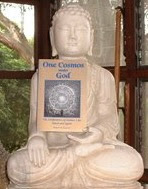
Concluding with The Argument from Substance, Schuon notes that the essence of sin involves "the absurdity of an accident wishing to be pure Substance," or the appearance the reality. Thus, it is to deny God while covertly elevating oneself to godhood (only a "god" can deny God).
At the same time, it necessarily reduces Being to the status of "things" -- i.e., materialism -- so that Being itself "appears as an 'abstraction.'"
The irony is that the same people who reduce reality to things also reduce it to a bloodless abstraction, at least if they are "thinking people," as they like to refer to themselves. For there could be no philosophy more abstract and out of touch with reality than materialism in all its varieties. If the world doesn't "release" its truth or radiate its beauty to your intellect, ur doin it rong. Light and warmth are not abstractions.
Must we have an ego? Yes, I believe so, for the same reason we must have a body. But that doesn't mean we must identify with it. You may recoil from a post a few weeks back, in which we discussed the four intrinsic "infirmities," or limitations, of man.
First, as alluded to above, we are "creature, not Creator, manifestation and not Principle" (Schuon). Second, we are not angels; we are neither at the top nor the bottom of the vertical hierarchy, but somewhere in the middle -- which, of course, goes to the issue of free will, as we are suspended halfway between our better and worse selves. Third, we have essential differences that are not accidental or contingent. This is not a matter of "ego" but of self.
Only the fourth infirmity touches on what we usually think of as sin, since these are the differences that are accidental or contingent, not essential. More often than not they are a result of mind parasites of varying degrees of virulence, but sometimes they are simply a result of inertia, stupidity, conformity, credulousness, absence of curiosity, or just a kind of pre-human, animal dullness. Forgive them, for they know not what they do.
When the Anointed talk about "self esteem," they are usually referring to infirmity #4. The last thing on their mind is elevating the self so that it is actually worthy of esteem. Rather, what they mean is that you are perfect and lovable just the way you are. Your accidental infirmities are a gift to be cherished. It is analogous to the minimum wage, which attempts to make a man more valuable by paying him more than he's worth.
The same fools generalize the concept to morality (moral relativism) and culture (multiculturalism), which is nothing less than the attempt to heal man by abolishing illness. It is to say that the highest morality is no morality or that the highest cultural value is barbarism.
Deep down, these people also know that there is something very "wrong" with themselves. But instead of facing it and dealing with it, they propose to heal you instead. Thus the compulsive actoutivism of the left, who imagine they are for "progress" even while imposing policies that make it impossible.
I thought of this while reading Sowell's Vision of the Anointed. In every measurable way, blacks were making great progress until the imposition of the various "Great Society" programs in the mid-1960s. Only thereafter was the progress reversed: increased violence, crime, drug abuse, joblessness, bastardy, drop out rates, etc.
The remarkable thing is that the Great Society was originally proposed as a final solution for decreasing dependency upon the government, not to increase it to a permanent feature of American life. If they had known ahead of time how it would play out in reality, few people would have supported it. Thus, by their own original standard, it has been a catastrophic failure.
But the left quickly changed the standard, so that the government became the rescuer of the victims it perpetually creates.
I also think about, say, the billion or so people who have been lifted from poverty since 1990. This did not happen because anyone "tried" to make it happen. Rather, it occurred as a result of globalization and free markets. Imagine if some government bureaucrat had tried to come up with a policy to lift a billion people out of poverty! Actually, you don't have to imagine. Just look at Africa.
Closer to home, just consider how the left constantly abuses the term, "the poor." In fact, there is no such thing as "the poor," only individuals who, for a host of reasons, have relatively less than others. But the left divides the populace into quintiles and then reifies the bottom 20%, who, by this definition, will always be with us, unless we abolish the numbers 1 through 20.
I forget the exact figure, but it is a fact that if you actually look at concrete individuals rather than abstract quintiles, very few people remain in the bottom 20% their whole life. Rather, within a decade, something like 80% of those 20% are in a higher bracket.
Here again: imagine trying to impose a government program that could be so successful! Certainly welfare didn't do it; rather, the reverse: it rewarded people for staying at the bottom. But not as much as it rewarded the Anointed for imagining themselves to be so kind, compassionate, and morally superior to the rest of us.
Or, imagine government coming up with a plan to create the finest healthcare system in world, at the cost of a certain percentage uninsured, mostly consisting of young people who prefer to spend their money on other things, and illegal immigrants who get free healthcare anyway. Let's do it!
Anyway. Here's the deal. "Men have built a world made of artificial phenomena around themselves, within whose distorting framework all their errors and misdeeds take on the appearance of self-evident truths or glories; this artificial world is so constructed that evil appears as good and good as an evil." This inverted world is then called "reality." And if you refuse to bow down before it, then we will just rahm it through anyway.
Administered Freedom. Inquisitorial Tolerance. Equality by Command (Kalb).
Saturday, September 12, 2009


Friday, September 11, 2009
Solid as a Cloud, Ephemeral as a Rock
Slept late. Boy up early. Not good circumstances for blogging. I considered yoinking one from the arkive, but it's gotten to the point that it takes less time to come up with a fresh one than to fumble in the closet through my clothes to find my cleanest dirty post. That requires discrimination + editing, whereas the writing obviously doesn't.
It's 9-11 again, but I'll let others deal with that. We're more interested in what lies above and below 9-11 than what's happened since. That never changes, so there's nothing more one can say.
We left off yesterday with an observation by Schuon that "Since everything in the Universe, both visible and invisible, requires both expansion and limitation, there is everywhere a kind of 'space' and a kind of 'time.'"
What this means is that profane space and time as experienced by the common man are actually modes of something more fundamental.
For example, when a physicist says that time and space "started" with the Big Bang, this is nonsense. Rather, a certain mode of time and space became manifest. To say that there was no "duration" "prior" to a certain temporal "point" is absurd. To put it another way, if there "was" eternity, there was time. And since eternity simply "is," there is always time taking place at its edges, so to speak.
The important point is that everything is woven of space and substance, even -- or perhaps especially -- invisible realities. This is obviously what Plato was groping toward with his doctrine of the Ideas, or Jung with the archetypes.
Likewise, when I talk about mind parasites, these really are "internal objects," even though they're obviously immaterial. They are somewhat like an ocean current, which can maintain itself for hundreds of years, and endure much longer than many "solid" objects. Or, think of the river that eventually wears away the hardest stone.
Now, think of the mischief that an immaterial mind parasite can cause -- for example, Ahmadinejad's conviction that Israel needs to be annihilated. I can't imagine any earthly power that could sway him from this belief. Rather, you can only kill him, just like any deadly virus.
In vertical space, "the elect are an aspect of Substance -- an aspect, hence a kind of accident; the damned on the contrary are a crystallization, hence a kind of substance; they are creatures who refuse to be what they are" (Schuon).
Do you see how this applies to an Ahmadinejad? He is indeed the "substance of evil," even though, in the ultimate sense, evil has no substance. Therefore, he is also, paradoxically, the "substance of illusion," as if a nightmarish vision could attain solidity.
It is the opposite for the "elect," who know better than anyone that they are pure accident in the face of the Absolute, hence their abiding humility. Here again, narcissistic pride becomes a kind of "false substance." One thinks of ________.
But how can the humble ever vanquish the proud? Well, Christ obviously came to show us how, in that the light eventually overcomes the darkness and life ultimately triumphs over death, in the same way that the river eventually wears away the stone. Ahmadinejad will soon die and go to his reward, for a good creation cannot be unjust. That's where the faith comes in, but it's certainly not "illogical."
As Schuon explains, "Heaven and hell are said to be 'eternal' because... the element 'substance' comes into play in each case." Ironically, "we are saved by Substance even though it is clothed in accidentality," just as "we are damned by accident because it arrogates to itself the quality of Substance," and pretends "to be be an end in itself."
This is why "materialism" in all its forms is the road to hell, since it is the sine qua non of accidental substantiality and therefore the infinite modes of self-justification: "the devil doesn't exist and he made me do it," the secret doctrine of the left.
Thus, to be in hell is to be encased in stone; whether it is stifling hot or bone-rattling cold is up to your imagination. Either way, it is perpetual fire with no light or ice and snow with no clarity or purity, being that it is crystalized at the farthest edge of creation.
Now, "sin" can be accident or substance; if the latter, then you are in Big Trouble, because you have become the "substance of sin" and are therefore "rotten to the core." As Schuon explains, repeated sin can eventually transform "our substance because it encloses and penetrates us" (emphasis mine).
Enclose and penetrate. These are the "ontological opposites" of both light and love, which radiate and liberate. In the absence of the latter, we would indeed be enclosed in hell, with no means of vertical escape. The truth really does set us free, quite literally. But so too do beauty and virtue, not to mention love. No one is less free -- and more dangerous -- than the bad and hateful man laboring under an illusion. One thinks of _______. Or, if one is a troll, one thinks of me.
I think you can now all understand how the "essence" of sin is "the absurdity of an accident wishing to be pure Substance." In another context, Wilber calls this one's "immortality project" (actually, I think he might have borrowed that term from Becker). So many of the things people do are vain attempts to cheat death by becoming substance. (An apt quote I just plucked from American Digest: "An empty man is full of himself"-- Edward Abbey.)
Unfortunately, these are the very folkers who "make the world go 'round," since the people who are most interested in real immortality -- i.e., making the world go spiral -- are the least likely to get involved in politics.
Yesterday a troll asked why I mention politics in my posts, and that's why. Please let me emphasize that effecting any kind of genuine change is the furthest thing from my mind. In reality, I am as hopeless as a river trying to erode a boulder. Besides, that's already been accomplished.
It's 9-11 again, but I'll let others deal with that. We're more interested in what lies above and below 9-11 than what's happened since. That never changes, so there's nothing more one can say.
We left off yesterday with an observation by Schuon that "Since everything in the Universe, both visible and invisible, requires both expansion and limitation, there is everywhere a kind of 'space' and a kind of 'time.'"
What this means is that profane space and time as experienced by the common man are actually modes of something more fundamental.
For example, when a physicist says that time and space "started" with the Big Bang, this is nonsense. Rather, a certain mode of time and space became manifest. To say that there was no "duration" "prior" to a certain temporal "point" is absurd. To put it another way, if there "was" eternity, there was time. And since eternity simply "is," there is always time taking place at its edges, so to speak.
The important point is that everything is woven of space and substance, even -- or perhaps especially -- invisible realities. This is obviously what Plato was groping toward with his doctrine of the Ideas, or Jung with the archetypes.
Likewise, when I talk about mind parasites, these really are "internal objects," even though they're obviously immaterial. They are somewhat like an ocean current, which can maintain itself for hundreds of years, and endure much longer than many "solid" objects. Or, think of the river that eventually wears away the hardest stone.
Now, think of the mischief that an immaterial mind parasite can cause -- for example, Ahmadinejad's conviction that Israel needs to be annihilated. I can't imagine any earthly power that could sway him from this belief. Rather, you can only kill him, just like any deadly virus.
In vertical space, "the elect are an aspect of Substance -- an aspect, hence a kind of accident; the damned on the contrary are a crystallization, hence a kind of substance; they are creatures who refuse to be what they are" (Schuon).
Do you see how this applies to an Ahmadinejad? He is indeed the "substance of evil," even though, in the ultimate sense, evil has no substance. Therefore, he is also, paradoxically, the "substance of illusion," as if a nightmarish vision could attain solidity.
It is the opposite for the "elect," who know better than anyone that they are pure accident in the face of the Absolute, hence their abiding humility. Here again, narcissistic pride becomes a kind of "false substance." One thinks of ________.
But how can the humble ever vanquish the proud? Well, Christ obviously came to show us how, in that the light eventually overcomes the darkness and life ultimately triumphs over death, in the same way that the river eventually wears away the stone. Ahmadinejad will soon die and go to his reward, for a good creation cannot be unjust. That's where the faith comes in, but it's certainly not "illogical."
As Schuon explains, "Heaven and hell are said to be 'eternal' because... the element 'substance' comes into play in each case." Ironically, "we are saved by Substance even though it is clothed in accidentality," just as "we are damned by accident because it arrogates to itself the quality of Substance," and pretends "to be be an end in itself."
This is why "materialism" in all its forms is the road to hell, since it is the sine qua non of accidental substantiality and therefore the infinite modes of self-justification: "the devil doesn't exist and he made me do it," the secret doctrine of the left.
Thus, to be in hell is to be encased in stone; whether it is stifling hot or bone-rattling cold is up to your imagination. Either way, it is perpetual fire with no light or ice and snow with no clarity or purity, being that it is crystalized at the farthest edge of creation.
Now, "sin" can be accident or substance; if the latter, then you are in Big Trouble, because you have become the "substance of sin" and are therefore "rotten to the core." As Schuon explains, repeated sin can eventually transform "our substance because it encloses and penetrates us" (emphasis mine).
Enclose and penetrate. These are the "ontological opposites" of both light and love, which radiate and liberate. In the absence of the latter, we would indeed be enclosed in hell, with no means of vertical escape. The truth really does set us free, quite literally. But so too do beauty and virtue, not to mention love. No one is less free -- and more dangerous -- than the bad and hateful man laboring under an illusion. One thinks of _______. Or, if one is a troll, one thinks of me.
I think you can now all understand how the "essence" of sin is "the absurdity of an accident wishing to be pure Substance." In another context, Wilber calls this one's "immortality project" (actually, I think he might have borrowed that term from Becker). So many of the things people do are vain attempts to cheat death by becoming substance. (An apt quote I just plucked from American Digest: "An empty man is full of himself"-- Edward Abbey.)
Unfortunately, these are the very folkers who "make the world go 'round," since the people who are most interested in real immortality -- i.e., making the world go spiral -- are the least likely to get involved in politics.
Yesterday a troll asked why I mention politics in my posts, and that's why. Please let me emphasize that effecting any kind of genuine change is the furthest thing from my mind. In reality, I am as hopeless as a river trying to erode a boulder. Besides, that's already been accomplished.
Thursday, September 10, 2009
Cosmic Anthropology in a Pomographic World
The Tao gives birth to One
One gives birth to Two
Two gives birth to Three
Three gives birth to all things. --Tao Te Ching
This might seem a little pedantic, but stay with me here. Yesterday we discussed the cosmic Substance, which Schuon distinguishes from Essence.
For example, the sun is ultimately not different from its rays; they are of the same substance, which is to say, Light. As such, this almost argues for a kind of pantheism -- and it should be remembered that all true religions are pantheistic, just not only pantheistic. For example, in Christianity the idea of God's immanence means that everything is God. However, because of his transcendence, the converse is not true: God is not everything, but infinitely more.
This, by the way, is how it is possible for the sage to say "I am God" without ever meaning "God is me." A drop is not the ocean. However, looked at another way, water is nothing other than water, i.e. the identical substance.
Thus, there is a kind of continuity between substance and accident. In contrast, there is a kind of discontinuity between essence and form. Schuon uses the analogy of a kernel and the fruit. Where is the essence that is common to both forms?
Better yet, take the embryo and the adult man. Was the man somehow "inside" the embryo? Or is a man just a giant embryo? Ultimately we need to consider both substance and essence, which Schuon likens to absolute and infinite, which in turn are reflections of male and female, respectively.
I hope this is clear, because it should be: "there is in Substance an aspect of femininity and in Essence an aspect of masculinity." In the past, we have discussed this in terms of what the child receives from each parent, and how culture itself is rooted in this primordial cosmic distinction.
For the infant, the (m)other is quite literally substance. It is not exactly correct to say that the infant has a "relationship" with the mother, at least from the infant's standpoint. Or, let us say that the discontinuity implied by "relationship" must be balanced by the idea that infant and breast are "one." The baby not only has a "right" to the breast, but you could go so far as to say that it is an "external organ" of the baby. (So much for a woman's body being her own. Every mother knows that's a lie!)
Twoness -- and therefore relationship -- is only gradually discovered (at least ideally). First, the oneness (and therefore nothingness) of the womb; then the twoness of mother-infant; then the threeness of mother-father-baby, and therefore the trimorphic, transcendent space of culture.
For similar reason, milk and love, nutrition and soothing, are inevitably commingled in the infant's mind -- which, of course, is why only human beings have eating disorders and other oral fixations. In a regressed state, eating can evoke the mother-infant dyad, while at the other end of the spectrum, anorexia can keep a toxic mother (now internalized as a mind parasite) at bay. Bulimia is literally an ambivalent state of omnipotent control of the mother. I can take her in or expel her at my will.
Again, mother = substance = infinite. Or, you could turn it around and say that anything that partakes of the infinite also dissolves into the universal Mother -- for example, alcohol, barbiturates, music, the auto-hypnosis of television, anything that dissolves our boundaries and facilitates merger.
You may think that this is getting far afield, but this also applies to the left and to the nanny state which will magically take care of all of our problems and tensions and soothe us into a state of comfortable numbness. It is just as Dennis Prager says: the bigger the state, the smaller the citizen, all the way down to infantile merger and dependency. And the more feminized. Obama is our first female president, although Jimmy Carter came close. Yes, believe it or not, that was a penis.
In contrast, we can say father = essence = absolute. This came up just last night, when Future Leader wouldn't go to bed. Mother tried to ease him down for half an hour, but he wasn't having it. Father had to go in and lay down the law, which is what each generation must do in order to renew this fragile thing we call "civilization." Hello? What's your problem? That kind of thing. He's still asleep now. Civilization prevails another day.
This is of course why male energy nurtured only by mother love creates monsters. Yes, literal monsters. Our prisons are full of them -- fatherless boys, which is to say, "infinite" male energy untempered by boundaries, by law, by the Absolute.
You often hear knuckleheads of the left wonder why God has to be thought of as male, or why priests must be men, and this is the reason. A female God cannot sustain civilization, as history and prehistory demonstrate. This is not because we project human masculinity into the sky; to the contrary, it is because the Absolute is the axis around which male identity properly turns. One of our tedious trolls commented yesterday about how love is his first principle. But divine love detached from divine justice is a recipe for terrestrial disaster.
Again, the only alternative is for male energy to be oriented toward the female -- which, as we all know, is precisely what happened with old Adam. He turned from God -- the Absolute -- toward Eve, and gravity took care of the rest.
To say that the man must be the "head" of the family is simply to acknowledge that he must be its vertical axis. But the axis only properly exists within the infinite loving substance of the female -- like, say, Pope and Mother Church. At least that's how things operate around here in my garden. A man who is only absolute without infinite is like law with no mercy, or intellect with no heart, or rock with no roll.
Yes, yes, trolls and feminists will no doubt find this all so old-fashioned, retrograde, oppressive, etc. I'm sure I needn't remind you that this is a free country and that you may arrange your personal life in any way you please. Clarity, not agreement. Ask Mrs. G. if it is grim and oppressive or joyous and liberating around here. Or just ask me. Would I like to be married to man minus the wedding tackle? No. I prefer "all woman."
Believe me, sir
I much prefer
the classic battle
of a him and her.
I don't like quiet,
and I wish I were
in love again! --Frank
Let's get even further afield. Schuon writes that "Since everything in the Universe, both visible and invisible, requires both expansion and limitation, there is everywhere a kind of 'space' and a kind of 'time.'" The infinite is perpetually expanding, so to speak, like the cosmos. No matter how far we project our mind, it can always be projected further, like an infinite series of numbers.
But the universe is not only expansion. For example, from the very moment of its manifestation, it is "constrained" by those beautiful equations that govern its character and development. Again: male and female, he created them.
Or you could say that we live in a cosmos of geometry and music, of earth and water, of infinite 0 and definite 1. If that's not too graphic.
A little metaphysical diddling between a cabbala opposites, and Mamamaya! baby makes Trinity, so all the world's an allusion. --Tao Te Petey
One gives birth to Two
Two gives birth to Three
Three gives birth to all things. --Tao Te Ching
This might seem a little pedantic, but stay with me here. Yesterday we discussed the cosmic Substance, which Schuon distinguishes from Essence.
For example, the sun is ultimately not different from its rays; they are of the same substance, which is to say, Light. As such, this almost argues for a kind of pantheism -- and it should be remembered that all true religions are pantheistic, just not only pantheistic. For example, in Christianity the idea of God's immanence means that everything is God. However, because of his transcendence, the converse is not true: God is not everything, but infinitely more.
This, by the way, is how it is possible for the sage to say "I am God" without ever meaning "God is me." A drop is not the ocean. However, looked at another way, water is nothing other than water, i.e. the identical substance.
Thus, there is a kind of continuity between substance and accident. In contrast, there is a kind of discontinuity between essence and form. Schuon uses the analogy of a kernel and the fruit. Where is the essence that is common to both forms?
Better yet, take the embryo and the adult man. Was the man somehow "inside" the embryo? Or is a man just a giant embryo? Ultimately we need to consider both substance and essence, which Schuon likens to absolute and infinite, which in turn are reflections of male and female, respectively.
I hope this is clear, because it should be: "there is in Substance an aspect of femininity and in Essence an aspect of masculinity." In the past, we have discussed this in terms of what the child receives from each parent, and how culture itself is rooted in this primordial cosmic distinction.
For the infant, the (m)other is quite literally substance. It is not exactly correct to say that the infant has a "relationship" with the mother, at least from the infant's standpoint. Or, let us say that the discontinuity implied by "relationship" must be balanced by the idea that infant and breast are "one." The baby not only has a "right" to the breast, but you could go so far as to say that it is an "external organ" of the baby. (So much for a woman's body being her own. Every mother knows that's a lie!)
Twoness -- and therefore relationship -- is only gradually discovered (at least ideally). First, the oneness (and therefore nothingness) of the womb; then the twoness of mother-infant; then the threeness of mother-father-baby, and therefore the trimorphic, transcendent space of culture.
For similar reason, milk and love, nutrition and soothing, are inevitably commingled in the infant's mind -- which, of course, is why only human beings have eating disorders and other oral fixations. In a regressed state, eating can evoke the mother-infant dyad, while at the other end of the spectrum, anorexia can keep a toxic mother (now internalized as a mind parasite) at bay. Bulimia is literally an ambivalent state of omnipotent control of the mother. I can take her in or expel her at my will.
Again, mother = substance = infinite. Or, you could turn it around and say that anything that partakes of the infinite also dissolves into the universal Mother -- for example, alcohol, barbiturates, music, the auto-hypnosis of television, anything that dissolves our boundaries and facilitates merger.
You may think that this is getting far afield, but this also applies to the left and to the nanny state which will magically take care of all of our problems and tensions and soothe us into a state of comfortable numbness. It is just as Dennis Prager says: the bigger the state, the smaller the citizen, all the way down to infantile merger and dependency. And the more feminized. Obama is our first female president, although Jimmy Carter came close. Yes, believe it or not, that was a penis.
In contrast, we can say father = essence = absolute. This came up just last night, when Future Leader wouldn't go to bed. Mother tried to ease him down for half an hour, but he wasn't having it. Father had to go in and lay down the law, which is what each generation must do in order to renew this fragile thing we call "civilization." Hello? What's your problem? That kind of thing. He's still asleep now. Civilization prevails another day.
This is of course why male energy nurtured only by mother love creates monsters. Yes, literal monsters. Our prisons are full of them -- fatherless boys, which is to say, "infinite" male energy untempered by boundaries, by law, by the Absolute.
You often hear knuckleheads of the left wonder why God has to be thought of as male, or why priests must be men, and this is the reason. A female God cannot sustain civilization, as history and prehistory demonstrate. This is not because we project human masculinity into the sky; to the contrary, it is because the Absolute is the axis around which male identity properly turns. One of our tedious trolls commented yesterday about how love is his first principle. But divine love detached from divine justice is a recipe for terrestrial disaster.
Again, the only alternative is for male energy to be oriented toward the female -- which, as we all know, is precisely what happened with old Adam. He turned from God -- the Absolute -- toward Eve, and gravity took care of the rest.
To say that the man must be the "head" of the family is simply to acknowledge that he must be its vertical axis. But the axis only properly exists within the infinite loving substance of the female -- like, say, Pope and Mother Church. At least that's how things operate around here in my garden. A man who is only absolute without infinite is like law with no mercy, or intellect with no heart, or rock with no roll.
Yes, yes, trolls and feminists will no doubt find this all so old-fashioned, retrograde, oppressive, etc. I'm sure I needn't remind you that this is a free country and that you may arrange your personal life in any way you please. Clarity, not agreement. Ask Mrs. G. if it is grim and oppressive or joyous and liberating around here. Or just ask me. Would I like to be married to man minus the wedding tackle? No. I prefer "all woman."
Believe me, sir
I much prefer
the classic battle
of a him and her.
I don't like quiet,
and I wish I were
in love again! --Frank
Let's get even further afield. Schuon writes that "Since everything in the Universe, both visible and invisible, requires both expansion and limitation, there is everywhere a kind of 'space' and a kind of 'time.'" The infinite is perpetually expanding, so to speak, like the cosmos. No matter how far we project our mind, it can always be projected further, like an infinite series of numbers.
But the universe is not only expansion. For example, from the very moment of its manifestation, it is "constrained" by those beautiful equations that govern its character and development. Again: male and female, he created them.
Or you could say that we live in a cosmos of geometry and music, of earth and water, of infinite 0 and definite 1. If that's not too graphic.
A little metaphysical diddling between a cabbala opposites, and Mamamaya! baby makes Trinity, so all the world's an allusion. --Tao Te Petey
Wednesday, September 09, 2009
The Accidentally-On-Purpose Driven Life
Next up in Logic and Transcendence: The Argument From Substance, that is, the idea that since the accidental (or contingent) quite obviously is, then the Substance (or essence) must be. Although this conditional statement is undeniable, it may sound a bit too clever or facile until we flesh things out. Nevertheless: if man, then God. And because God, then intelligence. And because intelligence, Truth. And because Truth, salvation.
As I mentioned yesterday, a good way to avoid hostility when conversing with The Anointed is to follow Dennis Prager's advice about seeking clarity, never agreement. Obviously you cannot reason a man out of what he was never reasoned into, so you're wasting your time if you try. But if you just clarify your differences as sharply as possible, that usually dissipates much of the open hostility, at least from our end.
It doesn't always work, because leftists are notoriously slippery about naming their first principles, instead preferring an incoherent and ad hoc blizzard of il- or semi-logical arguments to conceal them.
But it's very easy for conservative liberals to name their first principles, e.g., limited government, low taxes, racial colorblindness, freedom of religion, school choice, judges who don't legislate from the bench, etc. It can be very tricky to get a leftist to admit that their first principles are the opposite of these classically liberal goods, hence their intrinsic intellectual dishonesty.
Our first principle is that "we are accident, not Substance" (Schuon). Of note, this is also the first principle of America's founders, although they express it in a different way, that "we are endowed by our Creator with certain inalienable rights." Rights, which are Substance, flow from the Creator, thus rendering them eternal (in time) and universal (in space). They do not and cannot flow from man, since man is accident. If they did flow from man, then quite obviously they could not be inalienable, since accident ultimately robs us of everything except our immortal soul.
Bearing in mind our first principle -- that we are accident, not Substance -- then our liberty is not only guaranteed by the Creator, but originates in him. Or, to put it another way, if there is no Creator, then we are not free. End of issue. "Accidental freedom" is as oxymoronic as "true lies."
What? Say a little more? No problem. If there is no truth, then all our knowledge is ultimately in error. Therefore, it would be silly to say that we really "know" anything, since "knowing error" is a contradiction in terms. Just so, if freedom has no "point," then it can hardly be called "free," for randomness is the opposite of freedom (whereas tyranny is the denial of our prior freedom, and the oppression of our soul's will).
This is precisely what Schuon means when he says that "our freedom is nothing other than conformity to this Substance, from which we sprang and which is Freedom itself." (And again, we are not attempting to convince anyone of anything, just laying out our first principles for the sake of clarity. For you trolls out there who cannot keep yourself from commenting, at least try to clarify your differences in terms of your own first principles instead of compulsively insisting that mine are "evil" or "stupid," which we know already ad nauseam and beyond.)
Likewise, "if our sense of justice is not delusion, it comes from God," and "our intelligence cannot be other than intelligence itself" (Schuon). At this point, I'm guessing that only trolls won't understand those axiomatic truths, so I don't need to elaborate further. To offload intelligence and justice from God to man is to pave the road to tyranny and stupidity, the one propping up the other.
A revolution that seeks only a temporal good is ultimately self-defeating and a waste of the human lives that went into it -- the French revolution, the Bolshevik revolution, the National Socialist revolution. Only a revolution for the Substance has any meaning at all. Thus: "To revolt against Being is to revolt against ourselves" (Schuon). In turn this is why leftist revolutionaries are always revolting.
Following our first principle, we can say that in "the final analysis," every God-given, orthodox "spiritual doctrine expresses the relationship between Substance and accident" (Schuon). As outlined in my book, when you "do" religion, this is precisely what you are endeavoring to do. Or, to turn it around, this is what religions are designed to help you do, even if you are not consciously aware of it, or if you wouldn't necessarily express it in those terms. Nevertheless, I think you can see the truth of it.
This is also how you can tell if your religion is "working." If it is, then you "move" from accident toward Substance. In order to do that, you must assimilate the Substance in one way or another, for it is not merely a matter of knowing but being. You must be what you know, or it's not real knowledge. Religion helps you know what you be so you can become who you are. To know Truth; to love Beauty; to act with Virtue; these are all ways of assimilating and living in the Substance.
Yes, it is true that God is all, so that, in a certain way, everything is already substance -- or participates in substance. In other words, God's immanence means that the morning light is ultimately not different from the sun itself. Nevertheless, from our relative standpoint, the sun is up there and its rays are down here, and it makes no sense to say that we live inside the sun until we first realize that we don't.
Also, within the sun-Substance there are deeper causes. We only see the sun because of our relative position. We are the ones who not only draw the distinction between the sun and its rays, but see the sun to begin with (with light we borrow from the sun). The real cause of the sun is a profound secret known only to itself; we see only the effects, which include the visible sun. Or you could simply say I Am the Light You Are.
Thus, "we speak of 'Substance' in order to underscore the gulf between What subsists in itself and what exists only secondarily, the profound cause of which lies in a greater and higher reality." Therefore, if you're following my drift, the very idea of Substance is already a kind of accident. Behind the idea is the Reality, the intrinsic mystery that can only be unKnown or "undergone." This is to live one's life accidentally on purpose.
As I mentioned yesterday, a good way to avoid hostility when conversing with The Anointed is to follow Dennis Prager's advice about seeking clarity, never agreement. Obviously you cannot reason a man out of what he was never reasoned into, so you're wasting your time if you try. But if you just clarify your differences as sharply as possible, that usually dissipates much of the open hostility, at least from our end.
It doesn't always work, because leftists are notoriously slippery about naming their first principles, instead preferring an incoherent and ad hoc blizzard of il- or semi-logical arguments to conceal them.
But it's very easy for conservative liberals to name their first principles, e.g., limited government, low taxes, racial colorblindness, freedom of religion, school choice, judges who don't legislate from the bench, etc. It can be very tricky to get a leftist to admit that their first principles are the opposite of these classically liberal goods, hence their intrinsic intellectual dishonesty.
Our first principle is that "we are accident, not Substance" (Schuon). Of note, this is also the first principle of America's founders, although they express it in a different way, that "we are endowed by our Creator with certain inalienable rights." Rights, which are Substance, flow from the Creator, thus rendering them eternal (in time) and universal (in space). They do not and cannot flow from man, since man is accident. If they did flow from man, then quite obviously they could not be inalienable, since accident ultimately robs us of everything except our immortal soul.
Bearing in mind our first principle -- that we are accident, not Substance -- then our liberty is not only guaranteed by the Creator, but originates in him. Or, to put it another way, if there is no Creator, then we are not free. End of issue. "Accidental freedom" is as oxymoronic as "true lies."
What? Say a little more? No problem. If there is no truth, then all our knowledge is ultimately in error. Therefore, it would be silly to say that we really "know" anything, since "knowing error" is a contradiction in terms. Just so, if freedom has no "point," then it can hardly be called "free," for randomness is the opposite of freedom (whereas tyranny is the denial of our prior freedom, and the oppression of our soul's will).
This is precisely what Schuon means when he says that "our freedom is nothing other than conformity to this Substance, from which we sprang and which is Freedom itself." (And again, we are not attempting to convince anyone of anything, just laying out our first principles for the sake of clarity. For you trolls out there who cannot keep yourself from commenting, at least try to clarify your differences in terms of your own first principles instead of compulsively insisting that mine are "evil" or "stupid," which we know already ad nauseam and beyond.)
Likewise, "if our sense of justice is not delusion, it comes from God," and "our intelligence cannot be other than intelligence itself" (Schuon). At this point, I'm guessing that only trolls won't understand those axiomatic truths, so I don't need to elaborate further. To offload intelligence and justice from God to man is to pave the road to tyranny and stupidity, the one propping up the other.
A revolution that seeks only a temporal good is ultimately self-defeating and a waste of the human lives that went into it -- the French revolution, the Bolshevik revolution, the National Socialist revolution. Only a revolution for the Substance has any meaning at all. Thus: "To revolt against Being is to revolt against ourselves" (Schuon). In turn this is why leftist revolutionaries are always revolting.
Following our first principle, we can say that in "the final analysis," every God-given, orthodox "spiritual doctrine expresses the relationship between Substance and accident" (Schuon). As outlined in my book, when you "do" religion, this is precisely what you are endeavoring to do. Or, to turn it around, this is what religions are designed to help you do, even if you are not consciously aware of it, or if you wouldn't necessarily express it in those terms. Nevertheless, I think you can see the truth of it.
This is also how you can tell if your religion is "working." If it is, then you "move" from accident toward Substance. In order to do that, you must assimilate the Substance in one way or another, for it is not merely a matter of knowing but being. You must be what you know, or it's not real knowledge. Religion helps you know what you be so you can become who you are. To know Truth; to love Beauty; to act with Virtue; these are all ways of assimilating and living in the Substance.
Yes, it is true that God is all, so that, in a certain way, everything is already substance -- or participates in substance. In other words, God's immanence means that the morning light is ultimately not different from the sun itself. Nevertheless, from our relative standpoint, the sun is up there and its rays are down here, and it makes no sense to say that we live inside the sun until we first realize that we don't.
Also, within the sun-Substance there are deeper causes. We only see the sun because of our relative position. We are the ones who not only draw the distinction between the sun and its rays, but see the sun to begin with (with light we borrow from the sun). The real cause of the sun is a profound secret known only to itself; we see only the effects, which include the visible sun. Or you could simply say I Am the Light You Are.
Thus, "we speak of 'Substance' in order to underscore the gulf between What subsists in itself and what exists only secondarily, the profound cause of which lies in a greater and higher reality." Therefore, if you're following my drift, the very idea of Substance is already a kind of accident. Behind the idea is the Reality, the intrinsic mystery that can only be unKnown or "undergone." This is to live one's life accidentally on purpose.
Tuesday, September 08, 2009
Guess Who's Coming to Slackfast?
Did I say "reslackification?" Allow me to clarify. There are two ways to promote slack awareness, one positive, the other negative. But both involve an increased consciousness of gratitude for the a priori slack that "always is."
The via negativa, or "slackfast," is mainly for seasoned Raccoons who are tough enough to withstand a complete submersion into anti-slack in order to gain a deeper appreciation of their everyday slack. In other religions it goes by the name of "renunciation," or "self-denial," or "penitence," etc.
I won't go into to all the details, but flying across the country with an extremely spirited and easily bored four year-old boy is the type of thing that qualifies for a solemn slackfast.
But then miss your flight. Then wait around in the airport for the next flight out. Then miss your connecting flight in Atlanta because the engine of the plane blew up and had to be rebuilt. Add the fact that Mrs. G. had some sort of viral infection and I was trying to manage my diabetes in unfamiliar and unpredictable circumstances, which is always an adventure (this morning my blood sugar was by far the highest it's been in five years).
Then go to visit your in-law's house in Sarasota, which is about as child-friendly as the Louvre, except with no security guards to stop your monkeyboy from doing a cartwheel into some priceless object or taking his "light saver" (saber) to an original painting hanging over the bed he's jumping on. And you don't want to go outside to tire him out, because it's like a freaking sauna out there. No, you really can't imagine, unless you've ever tried to guard Michael Jordan one-on-one while playing basketball in a china shop.
Of course I love my in-laws, but to enter their world is to enter the world of 100% Orthodox Jewish Atheist Manhattan New York Times FDR-saved-us liberal religiosity. The occasion was their 50th wedding anniversary, with half a century of friends gathered from all over the country. Nevertheless, no matter the number, I am always Marilyn Munster. Since my conversation partner is inevitably like one of those medieval Europeans who hated Jews despite (or because of!) never having actually encountered one, there is always a certain surprise that 1) I am there, but 2) that I don't have horns. It's like a meet-and-greet with all of our trolls.
So what did I learn over the weekend? Mainly all the things I already knew -- all of the axiomatic truths that are the basis of liberal thought, not arrived at through thought: that the Supreme Court stole the election of 2000, that Bush lied us into war, that the world now hates us because of Bush, that we are only in the middle east because we are jingoistic and/or want to steal the oil, that we are destroying the planet, that vaccinations cause untold harm to children, that affirmative action does not involve racial quotas, that only conservatives say nasty things about liberals but never vice versa, that the New York Times is an objective and credible source of information, that Obama is brilliant, that putting murderers to death is immoral, that Keynesian economics actually works (and is working right now -- didn't you see those guys working on the highway on the way from the airport?).
But those were only the main themes. I also learned some more nuanced things, for example, that our food supply is completely poisonous, that morality somehow transcends God (rendering him unnecessary), and that for the first half century AD there was a pitched battle between Christian and Greek religion, and that today we could all very easily be worshipping Zeus and Neptune. Just like Sponge Bob, come to think of it.
What else... the sacred right to kill your fetus is right there in the Constitution, plain as day (this from a lawyer, no less)... That all of the expertise in the world somehow ended up at the New York Times (or perhaps in the government) and cannot possibly be distributed among independent bloggers.
At any rate, the exercise worked. When I finally got home, I kissed the floor of the slackatoreum, and here I am, hoping that this coffee will dissipate the jet lag.
Oh yes. While on the plane, I did manage to read Thomas Sowell's indispensable Vision of the Anointed. Pure. Light. Period. (More Light in today's column.)
Can you imagine what a better world this would be if liberal racists had dubbed Sowell their King of Negroes instead of Al Sharpton? But that is obviously an impossibility, for doing so would make white liberals unnecessary for the compassionate care and feeding of their helpless mascots and political lawn jockeys. The purpose of liberal racism is not to help blacks, but to help white liberals feel morally superior.
By the way, the next time I'm in Sarasota, I'm thinking of inviting local readers over to the house. I would even waive the standard $1.50 fee for personal appearances ($1.75 for children under 60) if you could manage to lavish a bit of cult-like devotion upon me in the presence of my in-laws. No, you don't have to scrape and grovel. None of that. Just a little starry-eyed devotion. A breathless request to sign your copy. Could I make Petey appear? Etc. Oh, and please leave your guns at home, and don't dress like a Nazi. Just this once.
Under the present circumstances, is it possible to plunge back into the proofs of God? We shall see.
I did periodically check out some of my usual internet haunts in order to touch base with spiritual equilibrium and sanity. In the sidebar over at American Digest there was a link to a wistful observation by Sherlock Holmes, who is speaking to Watson:
“I cannot live without brainwork. What else is there to live for? Stand at the window here. Was ever such a dreary, dismal, unprofitable world? See how the yellow fog swirls down the street and drifts across the duncoloured houses. What could be more hopelessly prosaic and material? What is the use of having powers, Doctor, when one has no field upon which to exert them?"
That's a little bit how I am left feeling when I am plunged into the slackfast of the purely secular world. Schuon says something similar: "Modern men want to conquer space, but the least of contemplative states, or the least of intellections bearing on metaphysical realities, carries us to the heights from which the nebula of Andromeda appears scarcely more than a terrestrial accident." You know the old Buddhist gag: "the more one travels, the less one really knows."
So very true. One is tempted to say, "no s*it, Sherlock," but that would be vulgar. Plus, it is by no means obvious to the rank-and-foul who compulsively travel precisely as an antidote to their slackless lives. But the effect is always temporary, and lasts only as long as the illusion of surface novelty. I am always reminded of the wise words of Beavis: you can't run away from your bunghole. But do they even teach Beavis & Butthead anymore in our postmodern schools?
It's amazing how disparate strands can be woven together in the intellect, and only in the intellect, for example Schuon and Sowell. For when Sowell talks about the "anointed," he's referring to the nihilocracy of the left, which simultaneously condemns us to, and then presumes to rescue us from, its own dreary and visionless vision of reality. For the secular left, there is no meaning except for the meaning they will impose upon you through the medium of the state. The "promethean minds" of the anointed
"believe themselves capable of 'self-creation,' all within the framework of an existence that is absurd, but no one notices -- and this is typical -- the absurdity of admitting the appearance within an absurd world of a being regarded as capable of noticing the absurdity" (Schuon).
No matter. Dear Leader will ride to the rescue and inject our children with the politics of meaning and the meaning of politics: study hard to stop the fiction of global warming. Cure AIDS so that sodomites may resume doing what they do. Help the president defeat the bitter clingers who bitterly cling to the primitive idea that the state is not our Massa' and that the cosmic center is in the individual, not the collective.
The via negativa, or "slackfast," is mainly for seasoned Raccoons who are tough enough to withstand a complete submersion into anti-slack in order to gain a deeper appreciation of their everyday slack. In other religions it goes by the name of "renunciation," or "self-denial," or "penitence," etc.
I won't go into to all the details, but flying across the country with an extremely spirited and easily bored four year-old boy is the type of thing that qualifies for a solemn slackfast.
But then miss your flight. Then wait around in the airport for the next flight out. Then miss your connecting flight in Atlanta because the engine of the plane blew up and had to be rebuilt. Add the fact that Mrs. G. had some sort of viral infection and I was trying to manage my diabetes in unfamiliar and unpredictable circumstances, which is always an adventure (this morning my blood sugar was by far the highest it's been in five years).
Then go to visit your in-law's house in Sarasota, which is about as child-friendly as the Louvre, except with no security guards to stop your monkeyboy from doing a cartwheel into some priceless object or taking his "light saver" (saber) to an original painting hanging over the bed he's jumping on. And you don't want to go outside to tire him out, because it's like a freaking sauna out there. No, you really can't imagine, unless you've ever tried to guard Michael Jordan one-on-one while playing basketball in a china shop.
Of course I love my in-laws, but to enter their world is to enter the world of 100% Orthodox Jewish Atheist Manhattan New York Times FDR-saved-us liberal religiosity. The occasion was their 50th wedding anniversary, with half a century of friends gathered from all over the country. Nevertheless, no matter the number, I am always Marilyn Munster. Since my conversation partner is inevitably like one of those medieval Europeans who hated Jews despite (or because of!) never having actually encountered one, there is always a certain surprise that 1) I am there, but 2) that I don't have horns. It's like a meet-and-greet with all of our trolls.
So what did I learn over the weekend? Mainly all the things I already knew -- all of the axiomatic truths that are the basis of liberal thought, not arrived at through thought: that the Supreme Court stole the election of 2000, that Bush lied us into war, that the world now hates us because of Bush, that we are only in the middle east because we are jingoistic and/or want to steal the oil, that we are destroying the planet, that vaccinations cause untold harm to children, that affirmative action does not involve racial quotas, that only conservatives say nasty things about liberals but never vice versa, that the New York Times is an objective and credible source of information, that Obama is brilliant, that putting murderers to death is immoral, that Keynesian economics actually works (and is working right now -- didn't you see those guys working on the highway on the way from the airport?).
But those were only the main themes. I also learned some more nuanced things, for example, that our food supply is completely poisonous, that morality somehow transcends God (rendering him unnecessary), and that for the first half century AD there was a pitched battle between Christian and Greek religion, and that today we could all very easily be worshipping Zeus and Neptune. Just like Sponge Bob, come to think of it.
What else... the sacred right to kill your fetus is right there in the Constitution, plain as day (this from a lawyer, no less)... That all of the expertise in the world somehow ended up at the New York Times (or perhaps in the government) and cannot possibly be distributed among independent bloggers.
At any rate, the exercise worked. When I finally got home, I kissed the floor of the slackatoreum, and here I am, hoping that this coffee will dissipate the jet lag.
Oh yes. While on the plane, I did manage to read Thomas Sowell's indispensable Vision of the Anointed. Pure. Light. Period. (More Light in today's column.)
Can you imagine what a better world this would be if liberal racists had dubbed Sowell their King of Negroes instead of Al Sharpton? But that is obviously an impossibility, for doing so would make white liberals unnecessary for the compassionate care and feeding of their helpless mascots and political lawn jockeys. The purpose of liberal racism is not to help blacks, but to help white liberals feel morally superior.
By the way, the next time I'm in Sarasota, I'm thinking of inviting local readers over to the house. I would even waive the standard $1.50 fee for personal appearances ($1.75 for children under 60) if you could manage to lavish a bit of cult-like devotion upon me in the presence of my in-laws. No, you don't have to scrape and grovel. None of that. Just a little starry-eyed devotion. A breathless request to sign your copy. Could I make Petey appear? Etc. Oh, and please leave your guns at home, and don't dress like a Nazi. Just this once.
Under the present circumstances, is it possible to plunge back into the proofs of God? We shall see.
I did periodically check out some of my usual internet haunts in order to touch base with spiritual equilibrium and sanity. In the sidebar over at American Digest there was a link to a wistful observation by Sherlock Holmes, who is speaking to Watson:
“I cannot live without brainwork. What else is there to live for? Stand at the window here. Was ever such a dreary, dismal, unprofitable world? See how the yellow fog swirls down the street and drifts across the duncoloured houses. What could be more hopelessly prosaic and material? What is the use of having powers, Doctor, when one has no field upon which to exert them?"
That's a little bit how I am left feeling when I am plunged into the slackfast of the purely secular world. Schuon says something similar: "Modern men want to conquer space, but the least of contemplative states, or the least of intellections bearing on metaphysical realities, carries us to the heights from which the nebula of Andromeda appears scarcely more than a terrestrial accident." You know the old Buddhist gag: "the more one travels, the less one really knows."
So very true. One is tempted to say, "no s*it, Sherlock," but that would be vulgar. Plus, it is by no means obvious to the rank-and-foul who compulsively travel precisely as an antidote to their slackless lives. But the effect is always temporary, and lasts only as long as the illusion of surface novelty. I am always reminded of the wise words of Beavis: you can't run away from your bunghole. But do they even teach Beavis & Butthead anymore in our postmodern schools?
It's amazing how disparate strands can be woven together in the intellect, and only in the intellect, for example Schuon and Sowell. For when Sowell talks about the "anointed," he's referring to the nihilocracy of the left, which simultaneously condemns us to, and then presumes to rescue us from, its own dreary and visionless vision of reality. For the secular left, there is no meaning except for the meaning they will impose upon you through the medium of the state. The "promethean minds" of the anointed
"believe themselves capable of 'self-creation,' all within the framework of an existence that is absurd, but no one notices -- and this is typical -- the absurdity of admitting the appearance within an absurd world of a being regarded as capable of noticing the absurdity" (Schuon).
No matter. Dear Leader will ride to the rescue and inject our children with the politics of meaning and the meaning of politics: study hard to stop the fiction of global warming. Cure AIDS so that sodomites may resume doing what they do. Help the president defeat the bitter clingers who bitterly cling to the primitive idea that the state is not our Massa' and that the cosmic center is in the individual, not the collective.
Wednesday, September 02, 2009
On Knowing How We Know Bill Maher is an Imbecile
Let's get back on track with Schuon's discussion of the proofs of God. Perhaps we should stipulate at the outset that just because something exists, you can't necessarily prove it to some or even most people. Not only does every proof demand a "subjective qualification," but part of the qualification is moral, not just intellectual.
It is hard to prove anything to a fundamentally dishonest man, or to a man who is not in love with Truth. A sociopath believes in nothing but his own power to deceive in order to get what he wants. A corollary of this is that the man who reduces truth to power is well on the way to sociopathy. One thinks of Bill Clinton, and now Barack Obama.
You cannot prove to socialists that the free market is superior to a centrally planned economy, thus proving that one must first be willing to be humbly convicted by truth. You cannot prove to a committed leftist that racial quotas are not only unconstitutional but harmful to their intended beneficiary. You cannot prove to a barking moonbat that President Bush did not "lie us into war," or to a multiculturalist that some cultures are more beautiful and decent than others.
I once tried that last one over lunch at a psychology convention. During the break, about a dozen of us were sitting at a table. Everyone was sharing a little about themselves (we were all strangers), so I started innocently witnessing some Raccoon mysteries and slackraments, and the reaction was swift, sharp, and girlish. The feman next to me actually got up, petulantly threw his napkin down on his chair, and said, "I don't have to listen to this!"
Okay, okay. Sorry. He sat back down, and the meal continued in a kind of awkward silence punctuated by inane chitchat. The power of political correctness. (A reader sent me a link the other day, documenting the extraordinary disparity in political Love Offerings from psychologists and psychiatrists. It's as bad as you'd expect. Not a single conservative on the list.)
I just began reading Bernard Lonergan's Insight, so soon I should be able to report back to you on what is occurring when a man is thinking -- not just about God, but about anything, i.e., "what is happening when we are knowing" and "what is known when that is happening."
It's really quite mysterious if you stop to think about it. Plato grappled with the question of how it is possible to recognize a truth we do not know, unless we somehow already implicitly know it. Really, knowing anything is a freaking miracle. It doesn't really add to, or detract from, the essential miracle to say that we can know God. You have to be pretty unimaginative to imagine otherwise.
This is what Schuon is referring to when he says that "Skepticism and bitterness have nothing spontaneous about them; they are the result of a supersaturated and deviant culture." A Bill Maher comes to mind, since he is a fine example of someone who is skeptical and bitter as a way to signal his self-satisfied belief in his own intelligence to others.
This is a profoundly narcissistic exercise, because the cynic cannot "build" anything, only undermine and destroy. He can only sneer at the work of other men, while affecting an attitude of pseudo-sophistication. Such a man -- just like a child -- has no earthly idea of what he is attacking, because he would never attempt to do so if he did (to say the least). One doesn't destroy what is precious unless one is ignorant or insane. (By the way, Bill Whittle does a fine job of carving up Maher in this video.)
Again, a rational proof of God is only understood to the extent that it transmits a bit of the "substance" of God in the proof. In other words, it is not just the proof itself, but an additional x-factor that is conveyed in the proof. Really, the proof merely clears a space and creates a gap where a kind of electrical "arc" can occur. I'm sure you all know what I mean. Again, we're just trying to understand what's happening when it happens.
What we call the "mystical experience" is simply first-hand knowledge of God. It is actually much more communicable than people realize, but even if it weren't, "there is nonetheless no justification for concluding that it must be false simply because it is incommunicable." Again, that would be pure sophistry of the Maharian type.
As we've discussed before, the radical can destroy in a day -- a moment! -- what it took centuries to build. Thus, a Bill Mahar sets himself in opposition to "the unanimous witness of the sages and saints -- throughout the world and down the ages."
In order to maintain such a preposterous view, one must be so deeply contemptuous of mankind, that it is impossible to understand how mankind could ever produce someone as great as Bill Maher. Do you see the problem? It's like trying to account for a dog that one day starts using toilet paper instead of licking its butt, pardon the French.
Only the man who has understood the mystical experience can begin to appreciate what a neanderthal such as Bill Maher wishes to throw away. For in the end, he wishes to do away with man as such, that is, the archetypal man that conditions us from above, and toward which our life is a journey. As Schuon writes, "there is no comparison between the intellectual and moral worth of the greatest contemplatives and the absurdity that their illusion would imply were it nothing but that." Meister Eckhart or Bill Maher. Shankara or Sean Penn. Tough choice.
Schuon goes on to say that this kind of hermetically sealed ignorance would lead us to believe that "no proof of anything is possible since every argument can be invalidated verbally by some sort of sophistry." In short, it is a reduction of integral truth to what the most common and vulgar minds are capable of understanding.
Housekeeping note: probably no posts for the next few days. It's the end of summer Labor Day reslackification.
It is hard to prove anything to a fundamentally dishonest man, or to a man who is not in love with Truth. A sociopath believes in nothing but his own power to deceive in order to get what he wants. A corollary of this is that the man who reduces truth to power is well on the way to sociopathy. One thinks of Bill Clinton, and now Barack Obama.
You cannot prove to socialists that the free market is superior to a centrally planned economy, thus proving that one must first be willing to be humbly convicted by truth. You cannot prove to a committed leftist that racial quotas are not only unconstitutional but harmful to their intended beneficiary. You cannot prove to a barking moonbat that President Bush did not "lie us into war," or to a multiculturalist that some cultures are more beautiful and decent than others.
I once tried that last one over lunch at a psychology convention. During the break, about a dozen of us were sitting at a table. Everyone was sharing a little about themselves (we were all strangers), so I started innocently witnessing some Raccoon mysteries and slackraments, and the reaction was swift, sharp, and girlish. The feman next to me actually got up, petulantly threw his napkin down on his chair, and said, "I don't have to listen to this!"
Okay, okay. Sorry. He sat back down, and the meal continued in a kind of awkward silence punctuated by inane chitchat. The power of political correctness. (A reader sent me a link the other day, documenting the extraordinary disparity in political Love Offerings from psychologists and psychiatrists. It's as bad as you'd expect. Not a single conservative on the list.)
I just began reading Bernard Lonergan's Insight, so soon I should be able to report back to you on what is occurring when a man is thinking -- not just about God, but about anything, i.e., "what is happening when we are knowing" and "what is known when that is happening."
It's really quite mysterious if you stop to think about it. Plato grappled with the question of how it is possible to recognize a truth we do not know, unless we somehow already implicitly know it. Really, knowing anything is a freaking miracle. It doesn't really add to, or detract from, the essential miracle to say that we can know God. You have to be pretty unimaginative to imagine otherwise.
This is what Schuon is referring to when he says that "Skepticism and bitterness have nothing spontaneous about them; they are the result of a supersaturated and deviant culture." A Bill Maher comes to mind, since he is a fine example of someone who is skeptical and bitter as a way to signal his self-satisfied belief in his own intelligence to others.
This is a profoundly narcissistic exercise, because the cynic cannot "build" anything, only undermine and destroy. He can only sneer at the work of other men, while affecting an attitude of pseudo-sophistication. Such a man -- just like a child -- has no earthly idea of what he is attacking, because he would never attempt to do so if he did (to say the least). One doesn't destroy what is precious unless one is ignorant or insane. (By the way, Bill Whittle does a fine job of carving up Maher in this video.)
Again, a rational proof of God is only understood to the extent that it transmits a bit of the "substance" of God in the proof. In other words, it is not just the proof itself, but an additional x-factor that is conveyed in the proof. Really, the proof merely clears a space and creates a gap where a kind of electrical "arc" can occur. I'm sure you all know what I mean. Again, we're just trying to understand what's happening when it happens.
What we call the "mystical experience" is simply first-hand knowledge of God. It is actually much more communicable than people realize, but even if it weren't, "there is nonetheless no justification for concluding that it must be false simply because it is incommunicable." Again, that would be pure sophistry of the Maharian type.
As we've discussed before, the radical can destroy in a day -- a moment! -- what it took centuries to build. Thus, a Bill Mahar sets himself in opposition to "the unanimous witness of the sages and saints -- throughout the world and down the ages."
In order to maintain such a preposterous view, one must be so deeply contemptuous of mankind, that it is impossible to understand how mankind could ever produce someone as great as Bill Maher. Do you see the problem? It's like trying to account for a dog that one day starts using toilet paper instead of licking its butt, pardon the French.
Only the man who has understood the mystical experience can begin to appreciate what a neanderthal such as Bill Maher wishes to throw away. For in the end, he wishes to do away with man as such, that is, the archetypal man that conditions us from above, and toward which our life is a journey. As Schuon writes, "there is no comparison between the intellectual and moral worth of the greatest contemplatives and the absurdity that their illusion would imply were it nothing but that." Meister Eckhart or Bill Maher. Shankara or Sean Penn. Tough choice.
Schuon goes on to say that this kind of hermetically sealed ignorance would lead us to believe that "no proof of anything is possible since every argument can be invalidated verbally by some sort of sophistry." In short, it is a reduction of integral truth to what the most common and vulgar minds are capable of understanding.
Housekeeping note: probably no posts for the next few days. It's the end of summer Labor Day reslackification.
Tuesday, September 01, 2009
Riding the Cosmic Treadmill to Nowhere while Gorging on the Rotten Fruit of Statism
New reader RS likes what he's hearing so far. For, unlike my competitors, my evolutionary cosmic vision offers a treadmill that actually goes somewhere. Or, you could say that it is a rat race you can actually win, or an eternal Groundhog Day in which you are forever trapped in the same happy ending. Or, you could just say that it is an ascending spiral.
Again, nihilsim or theism, absolutism or relativism. If everything reduces to matter, then things are very FUBAR, and nothing's gonna be okay. Conversely, if everything is God, then it's all gonna work out. No, we don't know exactly how or when, but that's were faith comes in, for once you have determined that God cannot not be, then it's usually not too long before you also discover that he cannot not be Good, passing appearances to the contrary notwithstanding.
That being the case, then there is no real ontological basis for worry, despair, whining, etc. I mean, you are still free to indulge in them, but they certainly give no added value. Unless one is a leftist, in which case they become one's primary mode of being, as they are the deathline to the state. The squeaky constituency gets the pork.
This, by the way, is one of the reasons I don't do a great deal of psychotherapy anymore. In order to be an effective therapist, one must have empathy. But I have quite literally lost my ability to empathize with most human problems. You just have no idea of the sorts of peripheral things the rank-and-foul worry about. Perhaps you do, since you no doubt have relatives. Their lives are entirely beside the point.
But most people live in a world of trivia and drama. There is no real movement (except downward), only agitation. What their trivial pursuits rob from them in terms of depth, the drama confers in terms of intensity, or affect. Thus, it's very much like TV, which I described in my book as "a nihilocracy of urgent nonsense." That's the other kind of treadmill -- the kind that goes nowhere fast.
Again, there is only one adventure, the Adventure of Consciousness. Either you are on this adventure, or you are not. I have no real problem with the grazing multitude of unadventurous cosmic placemarkers. The worst offenders are the people who displace the spiritual adventure to the political plane. They cause most of the mischief in the world, whether in Iran or in the United States. Here again, this is where the political religion of Islamism converges with the political religion of leftism.
In reading this excellent new book on Reagan's presidency, I've really come to appreciate the near impossibility of a "conservative revolution." Make no mistake: there was no "conservative revolution" in the 1980s. Rather, there was only a Reagan revolution.
Among other sources, Reagan's diaries show the extent to which he had to do battle with Republicans just as much as Democrats. Quite often, he stood alone amidst all the abuse hurled at him from the Democrat media-academic complex plus members of own party -- even his own cabinet! There was quite literally no distinction between his American critics and Soviet propaganda (often the Soviets got their talking points from the American left, as do Islamists today).
It's just very, very difficult to promise people nothing but their God-given liberty. First of all, people who love liberty rarely get involved with politics. Rather, politics attracts people who are interested in power. And a person who is primarily interested in power is most likely going to be a lost soul at best. Such a person "finds" himself through the exercise of power, in the same way that any mentally and spiritually unbalanced person does. That is, they get an emotional charge that confers a temporary sense of meaning.
But this is transient and must be reenacted again and again. I was reading the other day that over the course of his diabolical career, Ted Kennedy was responsible for helping to pass something like 5,000 laws (I think that was the figure -- correct me if I'm wrong). Some of them were no doubt helpful, but I'm guessing that the vast majority may be likened to endless links in burdensome chain we all must drag around for the sake of the state. With the forging of each of those links, Ted Kennedy no doubt felt good about himself. To our everlasting detriment.
Yes, this does all return to the subject of the proofs of God, for the ontological bifurcation alluded to above -- i.e., theism or nihilism -- results in very different fruits. Kennedy's lifetime achievement reduces to the rotten fruit of statism, the religion of nihilists. For such an upside-down person, "Essence turns back toward form, Substance toward accident, the Center toward the periphery, Life toward death" (Schuon). Of course Kennedy was the very embodiment and bellowing spokeshole of the Culture of Death.
But for the properly oriented person, it's the opposite movement: "the Inward vivifies the outward and resurrects the kernels of which we are composed -- products on the one hand of creation, secondarily, of our own attitudes and actions." Here again, vertical and horizontal causation: we are the products, yes, of God, but also of our own choices. And the more our choices are constrained by the false god of the state, the more we handicap God, for we are less free to do good.
Again, nihilsim or theism, absolutism or relativism. If everything reduces to matter, then things are very FUBAR, and nothing's gonna be okay. Conversely, if everything is God, then it's all gonna work out. No, we don't know exactly how or when, but that's were faith comes in, for once you have determined that God cannot not be, then it's usually not too long before you also discover that he cannot not be Good, passing appearances to the contrary notwithstanding.
That being the case, then there is no real ontological basis for worry, despair, whining, etc. I mean, you are still free to indulge in them, but they certainly give no added value. Unless one is a leftist, in which case they become one's primary mode of being, as they are the deathline to the state. The squeaky constituency gets the pork.
This, by the way, is one of the reasons I don't do a great deal of psychotherapy anymore. In order to be an effective therapist, one must have empathy. But I have quite literally lost my ability to empathize with most human problems. You just have no idea of the sorts of peripheral things the rank-and-foul worry about. Perhaps you do, since you no doubt have relatives. Their lives are entirely beside the point.
But most people live in a world of trivia and drama. There is no real movement (except downward), only agitation. What their trivial pursuits rob from them in terms of depth, the drama confers in terms of intensity, or affect. Thus, it's very much like TV, which I described in my book as "a nihilocracy of urgent nonsense." That's the other kind of treadmill -- the kind that goes nowhere fast.
Again, there is only one adventure, the Adventure of Consciousness. Either you are on this adventure, or you are not. I have no real problem with the grazing multitude of unadventurous cosmic placemarkers. The worst offenders are the people who displace the spiritual adventure to the political plane. They cause most of the mischief in the world, whether in Iran or in the United States. Here again, this is where the political religion of Islamism converges with the political religion of leftism.
In reading this excellent new book on Reagan's presidency, I've really come to appreciate the near impossibility of a "conservative revolution." Make no mistake: there was no "conservative revolution" in the 1980s. Rather, there was only a Reagan revolution.
Among other sources, Reagan's diaries show the extent to which he had to do battle with Republicans just as much as Democrats. Quite often, he stood alone amidst all the abuse hurled at him from the Democrat media-academic complex plus members of own party -- even his own cabinet! There was quite literally no distinction between his American critics and Soviet propaganda (often the Soviets got their talking points from the American left, as do Islamists today).
It's just very, very difficult to promise people nothing but their God-given liberty. First of all, people who love liberty rarely get involved with politics. Rather, politics attracts people who are interested in power. And a person who is primarily interested in power is most likely going to be a lost soul at best. Such a person "finds" himself through the exercise of power, in the same way that any mentally and spiritually unbalanced person does. That is, they get an emotional charge that confers a temporary sense of meaning.
But this is transient and must be reenacted again and again. I was reading the other day that over the course of his diabolical career, Ted Kennedy was responsible for helping to pass something like 5,000 laws (I think that was the figure -- correct me if I'm wrong). Some of them were no doubt helpful, but I'm guessing that the vast majority may be likened to endless links in burdensome chain we all must drag around for the sake of the state. With the forging of each of those links, Ted Kennedy no doubt felt good about himself. To our everlasting detriment.
Yes, this does all return to the subject of the proofs of God, for the ontological bifurcation alluded to above -- i.e., theism or nihilism -- results in very different fruits. Kennedy's lifetime achievement reduces to the rotten fruit of statism, the religion of nihilists. For such an upside-down person, "Essence turns back toward form, Substance toward accident, the Center toward the periphery, Life toward death" (Schuon). Of course Kennedy was the very embodiment and bellowing spokeshole of the Culture of Death.
But for the properly oriented person, it's the opposite movement: "the Inward vivifies the outward and resurrects the kernels of which we are composed -- products on the one hand of creation, secondarily, of our own attitudes and actions." Here again, vertical and horizontal causation: we are the products, yes, of God, but also of our own choices. And the more our choices are constrained by the false god of the state, the more we handicap God, for we are less free to do good.
Monday, August 31, 2009
Darwin's Death Panels and the Spirit of '76
A brief sidebar as we amble through the proofs of God. I think I've just noticed a little inconsistency in Schuon's thought, which divides us on the issue of evolution. My views on evolution are of course explicated in my book and extended in many subsequent posts, but I think the one other person who shares my deep Coonfusion is our Unknown Friend.
I don't have time at the moment to dig out the exact reference, but UF talks about vertical and horizontal causation being unified in the Cross. A purely horizontal science is a metaphysical impossibility. Rather, it must be "crucified" to the vertical in order to arrive at a truly integral science. There's much more, but you get the essence of the gist of the nub of the drift: In the eternal beginning God creates the vertical and the horizontal (please note how the vertical must be in the present, not past, tense, since it is "outside" time).
Schuon writes -- accurately, in my view -- that "Divine causality may be said to have two dimensions, one relating to the nature of things, the other to their destinies: God is at once the cause of perfections and the cause of of their ultimate limit" (emphasis mine).
The static "nature of things" obviously abides outside or beyond the categories of time and space. This is the vertical. But if we only existed in the vertical, change -- and evolution -- obviously could not occur. Rather, it is only in the horizontal world that we can manifest our vertical destiny -- which you might say is the purpose of the world.
Once again we see that the vertical is the "condition without which" -- i.e., the necessary cause -- whereas the horizontal is the "condition with which" -- i.e., the sufficient cause.
I imagine God before Creation to be a little like Bob Dylan on Maggie's Farm: he has a headful of ideas that are drivin' him insane. The only way to express them all is to create, which he almost cannot help doing, being the kind of being he is, which is to say, Being.
But creation always requires time. Perfection does not simply fall out of us fully formed. To say that creation as such has a purpose is effectively to believe in evolution -- again, for the hundredth time, not the watered-down evolutionism of scientistic natural selection, but in the literal meaning of the word.
Natural selection is obviously a subset of evolution, not vice versa. To insist otherwise to believe merely in change, not in evolution. As I have mentioned before, anti-evolutuonary Darwinians have highjacked the word "evolution" in exactly the same manner that illiberal leftists have highjacked the word "liberal." And it is no coincidence that these are generally the same people, for clearly, there is no basis for [real] liberalism if we are simply horizontal replicating machines with no higher purpose. The implicit assumptions and aims of Darwinism and leftism converge.
There again, you can see how this critical distinction plays out in my political differences with Schuon, for as always, politics follows ontology and anthropology. Since Schuon overemphasizes the vertical to the exclusion of the horizontal (his above statement about the two forms of divine causation notwithstanding), he was an unapologetically anti-democratic royalist. Conversely, the illiberal leftist, since he is a purely horizontal beast, overemphasizes the horizontal to the exclusion of the vertical, since for the materialist, the vertical does not and cannot exist except as illusion.
But America is different. It is the only country that was explicitly and consciously founded upon both horizontal and vertical principles. Much of this formula was worked out in the Federalist Papers, which remains a timelessly true meditation on the nature of good governance, which must take into consideration both horizontal and vertical realities.
The Founders were very aware of the dangers of a purely horizontal democracy, which they knew would not work, and would devolve to tyranny. For them the idea of an irreligious and non-virtuous citizenry being capable of self-governance was a non-starter.
But how to incorporate the vertical without reverting to the static system of monarchy? This is, of course, the dynamic synthesis of classical liberalism, which balances the libertarian "creative destruction" of the free market with the vertical traditionalism of spiritually evolved (and evolving) man. Thus we can affirm: "To improve is to change; to be perfect is to change often" (Churchill). This truism is only paradoxical if you exclude either the vertical or horizontal.
Now, will this system devised by the Founders work? That's a whole different story. This delicate formula has only existed on earth for some 235 years, whereas some of those static vertical dynasties lasted for thousands, e.g., Egypt.
Imagine thousands of years with no change -- changelessness being the whole "point" of traditional cultures. For a traditional culture, change is always associated with decay and degeneracy, as it drifts away from its static archetype. There was not even the idea of "progress," i.e., that things could improve with time and bring us closer to the ideal.
You could say that classical liberalism "discovered" progress (which naturally brings with it the possibility of regress). As I mentioned in my book, if you go back to where things stood with man in 1600 or so, the future looked rather bleak. For the average man, things were no different than they were 1,000 or 2,000 years ago: famine, disease, illiteracy, tyranny, backbreaking toil, etc. For all you strict traditionalists out there, if that is your preferred mode of life, I say go for it! Don't just dress up like an Indian and a smoke peace pipe on weekends, go live like one. Stop reading. Stop eating modern food. Stop using air conditioning, antibiotics, analgesics, automobiles, audio systems. And that's just the A's!
The thing is, these people never have the courage of their convictions, any more than do the Darwinians. They too never (at least nowadays) draw out the implications of their metaphysic, that life is an utterly meaningless struggle for survival.
I say "nowadays" because in the not-too-distant past, progressives and fascists did indeed draw out these implications in the form of eugenics, forced sterility, abortion, etc. There is nothing in Darwinism that makes such practices -- or any practice -- "wrong," much less "evil." It is simply a truism that natural selection does not know right and wrong, only survival and death. And survival is merely "death delayed."
 But what if you don't want to spend your life standing in front of one of Darwin's death panels? Too bad. No primordial soup for you! No tenure, either!
Extremes meet. This is why a political system of purely horizontal causes ultimately leads to the various static leftist tyrannies that littered the 20th century. And now in the United States we have an illiberal, anti-American president who is the very embodiment of the horizontal divorced from the vertical. Only a revolution will save us: but it is simply the same vertical revolution that is always occuring in 1776.
I don't have time at the moment to dig out the exact reference, but UF talks about vertical and horizontal causation being unified in the Cross. A purely horizontal science is a metaphysical impossibility. Rather, it must be "crucified" to the vertical in order to arrive at a truly integral science. There's much more, but you get the essence of the gist of the nub of the drift: In the eternal beginning God creates the vertical and the horizontal (please note how the vertical must be in the present, not past, tense, since it is "outside" time).
Schuon writes -- accurately, in my view -- that "Divine causality may be said to have two dimensions, one relating to the nature of things, the other to their destinies: God is at once the cause of perfections and the cause of of their ultimate limit" (emphasis mine).
The static "nature of things" obviously abides outside or beyond the categories of time and space. This is the vertical. But if we only existed in the vertical, change -- and evolution -- obviously could not occur. Rather, it is only in the horizontal world that we can manifest our vertical destiny -- which you might say is the purpose of the world.
Once again we see that the vertical is the "condition without which" -- i.e., the necessary cause -- whereas the horizontal is the "condition with which" -- i.e., the sufficient cause.
I imagine God before Creation to be a little like Bob Dylan on Maggie's Farm: he has a headful of ideas that are drivin' him insane. The only way to express them all is to create, which he almost cannot help doing, being the kind of being he is, which is to say, Being.
But creation always requires time. Perfection does not simply fall out of us fully formed. To say that creation as such has a purpose is effectively to believe in evolution -- again, for the hundredth time, not the watered-down evolutionism of scientistic natural selection, but in the literal meaning of the word.
Natural selection is obviously a subset of evolution, not vice versa. To insist otherwise to believe merely in change, not in evolution. As I have mentioned before, anti-evolutuonary Darwinians have highjacked the word "evolution" in exactly the same manner that illiberal leftists have highjacked the word "liberal." And it is no coincidence that these are generally the same people, for clearly, there is no basis for [real] liberalism if we are simply horizontal replicating machines with no higher purpose. The implicit assumptions and aims of Darwinism and leftism converge.
There again, you can see how this critical distinction plays out in my political differences with Schuon, for as always, politics follows ontology and anthropology. Since Schuon overemphasizes the vertical to the exclusion of the horizontal (his above statement about the two forms of divine causation notwithstanding), he was an unapologetically anti-democratic royalist. Conversely, the illiberal leftist, since he is a purely horizontal beast, overemphasizes the horizontal to the exclusion of the vertical, since for the materialist, the vertical does not and cannot exist except as illusion.
But America is different. It is the only country that was explicitly and consciously founded upon both horizontal and vertical principles. Much of this formula was worked out in the Federalist Papers, which remains a timelessly true meditation on the nature of good governance, which must take into consideration both horizontal and vertical realities.
The Founders were very aware of the dangers of a purely horizontal democracy, which they knew would not work, and would devolve to tyranny. For them the idea of an irreligious and non-virtuous citizenry being capable of self-governance was a non-starter.
But how to incorporate the vertical without reverting to the static system of monarchy? This is, of course, the dynamic synthesis of classical liberalism, which balances the libertarian "creative destruction" of the free market with the vertical traditionalism of spiritually evolved (and evolving) man. Thus we can affirm: "To improve is to change; to be perfect is to change often" (Churchill). This truism is only paradoxical if you exclude either the vertical or horizontal.
Now, will this system devised by the Founders work? That's a whole different story. This delicate formula has only existed on earth for some 235 years, whereas some of those static vertical dynasties lasted for thousands, e.g., Egypt.
Imagine thousands of years with no change -- changelessness being the whole "point" of traditional cultures. For a traditional culture, change is always associated with decay and degeneracy, as it drifts away from its static archetype. There was not even the idea of "progress," i.e., that things could improve with time and bring us closer to the ideal.
You could say that classical liberalism "discovered" progress (which naturally brings with it the possibility of regress). As I mentioned in my book, if you go back to where things stood with man in 1600 or so, the future looked rather bleak. For the average man, things were no different than they were 1,000 or 2,000 years ago: famine, disease, illiteracy, tyranny, backbreaking toil, etc. For all you strict traditionalists out there, if that is your preferred mode of life, I say go for it! Don't just dress up like an Indian and a smoke peace pipe on weekends, go live like one. Stop reading. Stop eating modern food. Stop using air conditioning, antibiotics, analgesics, automobiles, audio systems. And that's just the A's!
The thing is, these people never have the courage of their convictions, any more than do the Darwinians. They too never (at least nowadays) draw out the implications of their metaphysic, that life is an utterly meaningless struggle for survival.
I say "nowadays" because in the not-too-distant past, progressives and fascists did indeed draw out these implications in the form of eugenics, forced sterility, abortion, etc. There is nothing in Darwinism that makes such practices -- or any practice -- "wrong," much less "evil." It is simply a truism that natural selection does not know right and wrong, only survival and death. And survival is merely "death delayed."
 But what if you don't want to spend your life standing in front of one of Darwin's death panels? Too bad. No primordial soup for you! No tenure, either!
 Extremes meet. This is why a political system of purely horizontal causes ultimately leads to the various static leftist tyrannies that littered the 20th century. And now in the United States we have an illiberal, anti-American president who is the very embodiment of the horizontal divorced from the vertical. Only a revolution will save us: but it is simply the same vertical revolution that is always occuring in 1776.
Sunday, August 30, 2009
Proof of God Announced Today: Media and Tenured Hardest Hit
The next chapter in Logic and Transcendence concerns the proofs of God. Now, like any proof, proof of God is not idiot-proof. The only final proof is personal experience, but this type of proof has no necessary purchase on another fellow's beliefs, unless the other fellow happens to have great faith in your credibility.
In fact, it is probably fair to say that most of our knowledge is of this order. During the course of our education, there are few things that we ever experience on a first hand basis. For example, I am not an economist. But I have faith in Ludwig von Mises, Fredrich Hayek, and Thomas Sowell, whereas I regard Paul Krugman as an ideological hack, even perhaps crazy. Similarly, I am not a quantum cosmologist, but I am quite certain that this field will never arrive at a "theory of everything," if only due to Gödels's theorems. I am not a biologist, but I have no doubt whatsoever that the theory of natural selection is absurdly incomplete. Etc.
So if some skeevy televangelist or door-to-door religious salesman tells me that God exists, I don't give it much weight. On the other hand, if a man of great intellect, erudition, experience, and virtue says so, then my ears perk up. As with most everything, one must consider the source. Our trolls do not consider me a credible source, which should be the end of their sophering fixation on this site, but for whatever tangled intrapsychic reason, it isn't. Which is fine. Truth being what it is, they teach us many valuable lessons.
But in any event, you will never hear me attempting to convince a reader of my credibility, which I could never do anyway. Either you regard me as credible, or you don't -- although I assume that this credibility has been slowly earned through time, based upon your own personal experience with the substance of these posts. It is perhaps similar to the good will one builds up with particular musical artists. If they come out with a new work that doesn't speak to us, we are willing to put in the effort required to penetrate it. For example, I initially didn't "get" modern jazz, but I accepted it on faith that these men weren't merely musical frauds trying to separate me from my cash.
And let me add for those readers who do regard me as credible -- which is always a leap -- I would never under any circumstances take this for granted or do anything to jeopardize it. We know you have a choice in your vertical travel, and we thank you for choosing trans-Bob airways. But the credibility can only be re-earned with every flying post. Besides, it's not the person, it's the fruits. If that weren't the case, I would have no credibility anyway. I'm not like that surly tree in the Wizard of Oz. Anyone is free to come by and pick an apple off me, because where I got 'em, they didn't cost a thing. Although gratitude would naturally compel you to purchase my book without my having to beg. What? Okay, I'll beg.
Schuon points out that the classical proofs of God occupy a kind of "in between" area on the vertical plane. Above them is the direct intellection or mystical experience of God, while below them is the profane rationalism of the flatlanders. Thus, we know in advance that these proofs can only "indicate" or support the journey. But that's actually saying a lot, because by dwelling in them, one may very well unexpectedly find oneself drawn up into the Great Attractor (more on which below). It's like innocently rubbing some sticks together at a gas station, and all of a sudden the whole place goes up in flames.
It should also be pointed out that man has a right to a God who doesn't offend his intellect. Clearly, not every man is in need of such a God, but some of us surely are. To ignore human diversity and say that God only cares for the stupid is to posit a god in whom I cannot believe.
One frequently encounters fundamentalists and fideists who distrust the intellect in general and gnosis in particular, as if we are the presumptuous ones. But it's actually the other way around. How dare they suggest that God cannot be known in ways other than scripture! There is no intrinsic reason for any ontological break between mind and spirit, psyche and pneuma. Great Neptune, you have no right to reject scholasticism before you have even deeply understood it, barnacle head!
Let us begin with a premise on which we can all agree, theist and atheist alike, for if it isn't true, then no real thought of any kind is possible (that is, if thought is adequate to truth): "it is necessary to begin with the idea that human intelligence coincides in its essence with certainty of the Absolute."
Please note that you don't necessarily have to have had a personal experience of the Absolute. Rather, you simply must posit it, and understand that no coherent thought or discourse is possible in its absence. It is the ontological "condition without which." In turn, the human subject is the "condition with which."
While the prior existence of the Absolute is self-evident to the even minimally awakened intellect, in our present Age of Stupidity, the "awareness of 'accidents' has stifled the intuitive awareness of 'Substance,' and from this has come an intelligence that is systematically superficial, fixed upon a fragmentary reality."
Do you see the problem? Either you are an absolutist or you are a relativist. And if the latter, you condemn yourself ahead of time to falsehood, fragmentation, disharmony, immorality, ugliness. Or at least you will have no ontological basis for distinguishing between these and their opposites. Rather, one can only appeal to tastes, fashions, authority, or the ubiquitous urge for conformity.
The Absolute simply is. It cannot be proven with logic, since it is its own proof, not to mention the fact that it is the basis for the existence of any proof at all -- obviously! For to affirm that anything is "absolutely true" is to have brought oneself into the orbit of the Absolute and outside the obit of relativism.
So it is with this prior understanding that one should approach the proofs of God. If you cannot make this leap, then you are excused. It will come as a surprise to our trolls that you are under no external compulsion to continue reading this evil and stupid blog.
{Are they gone? Good. Let's continue.}
To the stubbornly godless man, the following statement by Schuon will appear as a tautology or even a clever trick: "in the spiritual order a proof is of assistance only to the man who wishes to understand and who, because of this wish, has in some measure understood already." Conversely, "it is of no practical use to one who, deep in his heart, does not want to change his position and whose philosophy merely expresses this desire."
Reason flees from such a self-enclosed individual, who can easily find intellectual justification for his static condition. I remember it well! To say that the proofs are of no use because they don't work for everyone is like saying that ebonics should be taught because proper English grammar and syntax don't work for everyone.
As mentioned above, everything hinges upon that first ontological choice between Absolute and relative. Once you have chosen the latter, then there is no hope for you -- at least until you reverse course and undo what you done did. Upon this choice depends one's conception of truth. For the absolutist, truth is discovered; for the relativist, truth is created -- which is just another way of saying that there is no truth at all, only opinion.
For the absolutist, "truth does not depend on reasoning -- obviously truth is not created by reason." Rather, it "reveals itself or becomes explicit thanks to the key provided by the mental operation." Within this act of understanding, there is always something that "escapes the thinking process rather as light and color elude the grasp of geometry."
I'm sure all of you have felt this "something." Perhaps you are feeling it now. It is similar to that extra ingredient that elevates artistry over competence, the profound over the prosaic, Magnus over goddinpotty, etc. To suggest that this gulf could ever be reduced to "quantity" is absurd. And stupid.
Qualities are not arbitrary, or they wouldn't be qualties. Rather, to say that one thing is better, or truer, or more virtuous than another, is to acknowledge the vertical hierarchy that can only end (and begin) in the Absolute, on pain of our humanness being a pure miracle hanging suspended in mid-air, like, I don't know, like something just hanging there in mid-air suspended. Yes, we are suspended, but from above, like Larry King's pants. The alternative is just too hideous to contemplate -- i.e., a pantless Larry King.
To be continued... all quoted material taken from Frithjof Schuon's Logic and Transcendence...
In fact, it is probably fair to say that most of our knowledge is of this order. During the course of our education, there are few things that we ever experience on a first hand basis. For example, I am not an economist. But I have faith in Ludwig von Mises, Fredrich Hayek, and Thomas Sowell, whereas I regard Paul Krugman as an ideological hack, even perhaps crazy. Similarly, I am not a quantum cosmologist, but I am quite certain that this field will never arrive at a "theory of everything," if only due to Gödels's theorems. I am not a biologist, but I have no doubt whatsoever that the theory of natural selection is absurdly incomplete. Etc.
So if some skeevy televangelist or door-to-door religious salesman tells me that God exists, I don't give it much weight. On the other hand, if a man of great intellect, erudition, experience, and virtue says so, then my ears perk up. As with most everything, one must consider the source. Our trolls do not consider me a credible source, which should be the end of their sophering fixation on this site, but for whatever tangled intrapsychic reason, it isn't. Which is fine. Truth being what it is, they teach us many valuable lessons.
But in any event, you will never hear me attempting to convince a reader of my credibility, which I could never do anyway. Either you regard me as credible, or you don't -- although I assume that this credibility has been slowly earned through time, based upon your own personal experience with the substance of these posts. It is perhaps similar to the good will one builds up with particular musical artists. If they come out with a new work that doesn't speak to us, we are willing to put in the effort required to penetrate it. For example, I initially didn't "get" modern jazz, but I accepted it on faith that these men weren't merely musical frauds trying to separate me from my cash.
And let me add for those readers who do regard me as credible -- which is always a leap -- I would never under any circumstances take this for granted or do anything to jeopardize it. We know you have a choice in your vertical travel, and we thank you for choosing trans-Bob airways. But the credibility can only be re-earned with every flying post. Besides, it's not the person, it's the fruits. If that weren't the case, I would have no credibility anyway.
 I'm not like that surly tree in the Wizard of Oz. Anyone is free to come by and pick an apple off me, because where I got 'em, they didn't cost a thing. Although gratitude would naturally compel you to purchase my book without my having to beg. What? Okay, I'll beg.
 Schuon points out that the classical proofs of God occupy a kind of "in between" area on the vertical plane. Above them is the direct intellection or mystical experience of God, while below them is the profane rationalism of the flatlanders. Thus, we know in advance that these proofs can only "indicate" or support the journey. But that's actually saying a lot, because by dwelling in them, one may very well unexpectedly find oneself drawn up into the Great Attractor (more on which below). It's like innocently rubbing some sticks together at a gas station, and all of a sudden the whole place goes up in flames.
It should also be pointed out that man has a right to a God who doesn't offend his intellect. Clearly, not every man is in need of such a God, but some of us surely are. To ignore human diversity and say that God only cares for the stupid is to posit a god in whom I cannot believe.
One frequently encounters fundamentalists and fideists who distrust the intellect in general and gnosis in particular, as if we are the presumptuous ones. But it's actually the other way around. How dare they suggest that God cannot be known in ways other than scripture! There is no intrinsic reason for any ontological break between mind and spirit, psyche and pneuma. Great Neptune, you have no right to reject scholasticism before you have even deeply understood it, barnacle head!
Let us begin with a premise on which we can all agree, theist and atheist alike, for if it isn't true, then no real thought of any kind is possible (that is, if thought is adequate to truth): "it is necessary to begin with the idea that human intelligence coincides in its essence with certainty of the Absolute."
Please note that you don't necessarily have to have had a personal experience of the Absolute. Rather, you simply must posit it, and understand that no coherent thought or discourse is possible in its absence. It is the ontological "condition without which." In turn, the human subject is the "condition with which."
While the prior existence of the Absolute is self-evident to the even minimally awakened intellect, in our present Age of Stupidity, the "awareness of 'accidents' has stifled the intuitive awareness of 'Substance,' and from this has come an intelligence that is systematically superficial, fixed upon a fragmentary reality."
Do you see the problem? Either you are an absolutist or you are a relativist. And if the latter, you condemn yourself ahead of time to falsehood, fragmentation, disharmony, immorality, ugliness. Or at least you will have no ontological basis for distinguishing between these and their opposites. Rather, one can only appeal to tastes, fashions, authority, or the ubiquitous urge for conformity.
The Absolute simply is. It cannot be proven with logic, since it is its own proof, not to mention the fact that it is the basis for the existence of any proof at all -- obviously! For to affirm that anything is "absolutely true" is to have brought oneself into the orbit of the Absolute and outside the obit of relativism.
So it is with this prior understanding that one should approach the proofs of God. If you cannot make this leap, then you are excused. It will come as a surprise to our trolls that you are under no external compulsion to continue reading this evil and stupid blog.
{Are they gone? Good. Let's continue.}
To the stubbornly godless man, the following statement by Schuon will appear as a tautology or even a clever trick: "in the spiritual order a proof is of assistance only to the man who wishes to understand and who, because of this wish, has in some measure understood already." Conversely, "it is of no practical use to one who, deep in his heart, does not want to change his position and whose philosophy merely expresses this desire."
Reason flees from such a self-enclosed individual, who can easily find intellectual justification for his static condition. I remember it well! To say that the proofs are of no use because they don't work for everyone is like saying that ebonics should be taught because proper English grammar and syntax don't work for everyone.
As mentioned above, everything hinges upon that first ontological choice between Absolute and relative. Once you have chosen the latter, then there is no hope for you -- at least until you reverse course and undo what you done did. Upon this choice depends one's conception of truth. For the absolutist, truth is discovered; for the relativist, truth is created -- which is just another way of saying that there is no truth at all, only opinion.
For the absolutist, "truth does not depend on reasoning -- obviously truth is not created by reason." Rather, it "reveals itself or becomes explicit thanks to the key provided by the mental operation." Within this act of understanding, there is always something that "escapes the thinking process rather as light and color elude the grasp of geometry."
I'm sure all of you have felt this "something." Perhaps you are feeling it now. It is similar to that extra ingredient that elevates artistry over competence, the profound over the prosaic, Magnus over goddinpotty, etc. To suggest that this gulf could ever be reduced to "quantity" is absurd. And stupid.
Qualities are not arbitrary, or they wouldn't be qualties. Rather, to say that one thing is better, or truer, or more virtuous than another, is to acknowledge the vertical hierarchy that can only end (and begin) in the Absolute, on pain of our humanness being a pure miracle hanging suspended in mid-air, like, I don't know, like something just hanging there in mid-air suspended. Yes, we are suspended, but from above, like Larry King's pants. The alternative is just too hideous to contemplate -- i.e., a pantless Larry King.
To be continued... all quoted material taken from Frithjof Schuon's Logic and Transcendence...
Saturday, August 29, 2009
No God, No Me, No Justice, No Mary Jo
Let's finish up this chapter on the limits of pure rationalism.
By the way, our Peevish Traditionalist commenter points out that Schuon and I agree on only 2% of his views. Which in my view is not necessarily a bad thing, because if it were more than that, these posts would be even longer. As it is, it will require dozens of posts just to explicate this single 200+ page book. (I frankly think the 2% figure is absurdly low, but we'll give him the last word.)
It's also a good thing -- or possibly bad, depending upon one's point of view -- that I don't believe Schuon was omniscient, otherwise I would be devoid of my own creativity and reduced to scouring the internet for heretics and commenting on blogs that deviate from the 100% Standard of Agreement.
To put it another way, I will have failed as a cult leader if I become one -- that is, if any of my readers agree with me 100% of the time. In fact, "agreement" is not really the right word, for agreement is perfectly acceptable so long as one has arrived at the same conclusions independently. But there again, "conclusion" is not the correct word either, for what I mean is that, when it comes to realities that transcend the senses, agreement is acceptable so long as we are looking at the same object.
But of course, even then, your view will deviate at least slightly from mine, since you are you and not me. Furthermore, it will hopefully be expressed in your own "idiom," and idiom is indistinguishable from "self." As I mentioned a few posts back, I believe I've discovered a new idiom for expressing timeless truth -- or at least I've never encountered anyone else who rolls in the precise manner I do. But this is ultimately just another way of saying that I have discovered me. And if I have discovered me, then it follows -- logically -- that I have discovered God, since the true self is an "idea" of God -- or, let's keep it neutral and just say "an emanation of O". True, it is in a sense "my God," but God nonetheless.
Now, it goes without saying that only I can discover me. However, if you are a materialist of any sort, then the question doesn't even come up. There is no self to be discovered, and therefore no personal idiom that is its very life and expression. You are not a mode of the infinite, just a freak of the finite.
 Schuon uses the image of the circle with the central point radiating out in all direction. Imagine a series of concentric circles around the point. Each circle is a mode of reality, e.g., matter, life, mind, spirit.
  One of these circles is called "humanness." Thus, each of us is situated at a point on the circle of humanness. We are like different frogs looking at the same haystack from diverse spatial and temporal perspectives.
Being a point, we are our own center. But if you manage to grow to spiritual maturity, then you graduate from the geo-centric (or ego-centric) to the helio-centric view, and realize that your little point orbits around a vastly lager one (and without which there could be no subjective points at all).
Or, you regress to the ec-centric view that there is no center -- neither the little one nor the big One -- only periphery. Yes, it's a strange belief, but someone has to believe it, since this is a full employment cosmos, and it takes all kinds to make a world. In the long run, every insanity and inanity will be believed by someone, given enough monkeys and sufficient tenure. In our Age of Stupidity, belief in one of these impossible realities is often conflated with discovering one's unique idiom. But while "unique," these idioms have nothing universal about them, and cannot be reproduced by another person in his own unique way.
It reminds me somewhat of something Dennis Prager mentioned about how the left is guided by compassion, not standards. He was discussing a townhall meeting in which some poor woman had lost her health insurance and was hysterically weeping while incoherently relating her story. The moonstream media wanted to know: would this tragic tale change the heartless senator's view on the need for socialized medicine? "No."
The point is, compassion cannot be the guiding ideal of the state, since compassion is particular, not universal. Therefore, it is intrinsically unfair. For example, I am infinitely more compassionate toward my own child than I am toward millions of children in Africa. Therefore, if you want to be an idiot about it, you could say that in being compassionate toward my child, I am being cruel and uncompassionate toward the children of Africa.
But this is the nature of compassion. You cannot be equally compassionate toward everyone. And the moment the state tries, it becomes uncompassionate. If it chooses to be "compassionate" toward blacks by mandating racial quotas, then it is by definition uncompassionate toward Asians and Jews who will be displaced. If it lavishes money on AIDS research because of left wing homosexual activists, then there is less money for, say, diabetes research. If it gives "free" healthcare to millions of selfish people who refuse to purchase health insurance, it must take the money from someone else. Etc.
No, a government must be guided by universals, such as justice. Obviously no terrestrial justice can be perfect, nor is it possible to enforce it equally in a non-totalitarian state. But, say, a speed limit of 65 mph does not "discriminate" against people who like to drive 80 mph, even though they will be burdened with the bulk of the speeding tickets. Nor does capital punishment discriminate against blacks just because they commit a disproportionate number of the murders.
If you try to interpret justice through the lens of compassion -- as the left always does -- you unleash hell on earth. This is why the crime rate increased over 100% in the 1960s and then 50% on top of that in the 1970s. This is what happens when a government is motivated by compassion instead of justice.
Again, justice is universal, compassion is particular. A state can be just, but it cannot be compassionate in principle. This does not mean, of course, that it cannot engage in particular acts of compassion, only that this cannot be the first principle, for it inevitably ends in unfairness and lack of compassion. Institute racial quotas for blacks, and soon enough female losers want in on the deal. Then hispanic losers. Then homosexual losers. Then transgendered losers. Pretty soon you have a tyranny of losers whose only real power is the power of the state to discriminate against the worthy. "Social justice" is simply a systematic way for the left to deny justice by replacing it with compassion.
And this all goes back to our original theme on the limits of reason. Rationalism is universal only as it pertains to a single circle around the central point alluded to above. As soon as it tries to reason about those circles closer to the point, it goes off the rails -- literally! A total rationalism would be a totalitarianism, pure and simple, because it would represent a closed system with no center: Ø instead of ʘ.
It very much reminds me of the panic that was engendered in the Soviet Union when Pope John Paul II visited Poland in the early 1980s. It is impossible to convey the depth of what happened, but it was as if a divine ray from above broke thorough the dreary closed system of Marxist totalitarianism, or the spiritual center crashed into the material periphery of the world. People were quite literally revived. Suddenly there was hope. Hayward writes that after the Pope's visit, suicides fell by a third in Poland, while alcohol consumption dropped by a quarter. (Hayward's book, The Age of Reagan: The Conservative Counterrevolution, 1980-1989, is Highly Recommended.)
Indeed, it is becoming difficult to convey the depth of the transformation that occurred in this country with the ascendence of the cheerful, strong, confident, wise, and optimistic Ronald Reagan. Perhaps not. Just think of the dour, weak, humorless, pessimistic, and ignorant Obama, and imagine the opposite. It's like Welcome Back, Carter. Note that the latter character traits are privations, so that of the two, only Reagan approximates the universal. But in so being, he was paradoxically -- but nonetheless naturally -- "one of a kind."
Conversely, as one of our trolls recently reminded us, if one is only "compassionate" -- meaning, of course, liberal -- enough, one is free to betray one's country and transgress the most elementary standards of justice and decency. One can become a good monster.
By the way, our Peevish Traditionalist commenter points out that Schuon and I agree on only 2% of his views. Which in my view is not necessarily a bad thing, because if it were more than that, these posts would be even longer. As it is, it will require dozens of posts just to explicate this single 200+ page book. (I frankly think the 2% figure is absurdly low, but we'll give him the last word.)
It's also a good thing -- or possibly bad, depending upon one's point of view -- that I don't believe Schuon was omniscient, otherwise I would be devoid of my own creativity and reduced to scouring the internet for heretics and commenting on blogs that deviate from the 100% Standard of Agreement.
To put it another way, I will have failed as a cult leader if I become one -- that is, if any of my readers agree with me 100% of the time. In fact, "agreement" is not really the right word, for agreement is perfectly acceptable so long as one has arrived at the same conclusions independently. But there again, "conclusion" is not the correct word either, for what I mean is that, when it comes to realities that transcend the senses, agreement is acceptable so long as we are looking at the same object.
But of course, even then, your view will deviate at least slightly from mine, since you are you and not me. Furthermore, it will hopefully be expressed in your own "idiom," and idiom is indistinguishable from "self." As I mentioned a few posts back, I believe I've discovered a new idiom for expressing timeless truth -- or at least I've never encountered anyone else who rolls in the precise manner I do. But this is ultimately just another way of saying that I have discovered me. And if I have discovered me, then it follows -- logically -- that I have discovered God, since the true self is an "idea" of God -- or, let's keep it neutral and just say "an emanation of O". True, it is in a sense "my God," but God nonetheless.
Now, it goes without saying that only I can discover me. However, if you are a materialist of any sort, then the question doesn't even come up. There is no self to be discovered, and therefore no personal idiom that is its very life and expression. You are not a mode of the infinite, just a freak of the finite.
 Schuon uses the image of the circle with the central point radiating out in all direction. Imagine a series of concentric circles around the point. Each circle is a mode of reality, e.g., matter, life, mind, spirit.
  One of these circles is called "humanness." Thus, each of us is situated at a point on the circle of humanness. We are like different frogs looking at the same haystack from diverse spatial and temporal perspectives.
 Being a point, we are our own center. But if you manage to grow to spiritual maturity, then you graduate from the geo-centric (or ego-centric) to the helio-centric view, and realize that your little point orbits around a vastly lager one (and without which there could be no subjective points at all).
Or, you regress to the ec-centric view that there is no center -- neither the little one nor the big One -- only periphery. Yes, it's a strange belief, but someone has to believe it, since this is a full employment cosmos, and it takes all kinds to make a world. In the long run, every insanity and inanity will be believed by someone, given enough monkeys and sufficient tenure. In our Age of Stupidity, belief in one of these impossible realities is often conflated with discovering one's unique idiom. But while "unique," these idioms have nothing universal about them, and cannot be reproduced by another person in his own unique way.
It reminds me somewhat of something Dennis Prager mentioned about how the left is guided by compassion, not standards. He was discussing a townhall meeting in which some poor woman had lost her health insurance and was hysterically weeping while incoherently relating her story. The moonstream media wanted to know: would this tragic tale change the heartless senator's view on the need for socialized medicine? "No."
The point is, compassion cannot be the guiding ideal of the state, since compassion is particular, not universal. Therefore, it is intrinsically unfair. For example, I am infinitely more compassionate toward my own child than I am toward millions of children in Africa. Therefore, if you want to be an idiot about it, you could say that in being compassionate toward my child, I am being cruel and uncompassionate toward the children of Africa.
But this is the nature of compassion. You cannot be equally compassionate toward everyone. And the moment the state tries, it becomes uncompassionate. If it chooses to be "compassionate" toward blacks by mandating racial quotas, then it is by definition uncompassionate toward Asians and Jews who will be displaced. If it lavishes money on AIDS research because of left wing homosexual activists, then there is less money for, say, diabetes research. If it gives "free" healthcare to millions of selfish people who refuse to purchase health insurance, it must take the money from someone else. Etc.
No, a government must be guided by universals, such as justice. Obviously no terrestrial justice can be perfect, nor is it possible to enforce it equally in a non-totalitarian state. But, say, a speed limit of 65 mph does not "discriminate" against people who like to drive 80 mph, even though they will be burdened with the bulk of the speeding tickets. Nor does capital punishment discriminate against blacks just because they commit a disproportionate number of the murders.
If you try to interpret justice through the lens of compassion -- as the left always does -- you unleash hell on earth. This is why the crime rate increased over 100% in the 1960s and then 50% on top of that in the 1970s. This is what happens when a government is motivated by compassion instead of justice.
Again, justice is universal, compassion is particular. A state can be just, but it cannot be compassionate in principle. This does not mean, of course, that it cannot engage in particular acts of compassion, only that this cannot be the first principle, for it inevitably ends in unfairness and lack of compassion. Institute racial quotas for blacks, and soon enough female losers want in on the deal. Then hispanic losers. Then homosexual losers. Then transgendered losers. Pretty soon you have a tyranny of losers whose only real power is the power of the state to discriminate against the worthy. "Social justice" is simply a systematic way for the left to deny justice by replacing it with compassion.
And this all goes back to our original theme on the limits of reason. Rationalism is universal only as it pertains to a single circle around the central point alluded to above. As soon as it tries to reason about those circles closer to the point, it goes off the rails -- literally! A total rationalism would be a totalitarianism, pure and simple, because it would represent a closed system with no center: Ø instead of ʘ.
It very much reminds me of the panic that was engendered in the Soviet Union when Pope John Paul II visited Poland in the early 1980s. It is impossible to convey the depth of what happened, but it was as if a divine ray from above broke thorough the dreary closed system of Marxist totalitarianism, or the spiritual center crashed into the material periphery of the world. People were quite literally revived. Suddenly there was hope. Hayward writes that after the Pope's visit, suicides fell by a third in Poland, while alcohol consumption dropped by a quarter. (Hayward's book, The Age of Reagan: The Conservative Counterrevolution, 1980-1989, is Highly Recommended.)
Indeed, it is becoming difficult to convey the depth of the transformation that occurred in this country with the ascendence of the cheerful, strong, confident, wise, and optimistic Ronald Reagan. Perhaps not. Just think of the dour, weak, humorless, pessimistic, and ignorant Obama, and imagine the opposite. It's like Welcome Back, Carter. Note that the latter character traits are privations, so that of the two, only Reagan approximates the universal. But in so being, he was paradoxically -- but nonetheless naturally -- "one of a kind."
Conversely, as one of our trolls recently reminded us, if one is only "compassionate" -- meaning, of course, liberal -- enough, one is free to betray one's country and transgress the most elementary standards of justice and decency. One can become a good monster.
Friday, August 28, 2009
On the Certainty of Doubt and Vision of the Blind
Over 130 comments yesterday. Which once again proves -- as if it were necessary -- that there's just no end to the sophistries to which the godless cling in order to try to prove to themselves that God doesn't exist.
But there is no such proof, only adequation, so trying to "prove" something to the inadequate is obviously a complete and total waste of time. Unless you somehow enjoy the exercise. I do not. I haven't the slightest interest in the fantasies of the godless, except insofar as the manner in which they threaten my life, my property, and my liberty.
As Schuon explains, these relativists absurdly "dispute the value of metaphysical certainty" by setting it in opposition to the "certitude of error." For example, one familiar troll trotted out the old optical illusion argument -- as if the existence of illusions doesn't prove the reality!
Only a human being can say to himself, "I thought it was a _____, but dang, what it really was was a _____!" The illusion is dependent upon the reality, not vice versa. This is elementary. Not only did God become man so that man might become God, but more generally, reality becomes appearance so that appearance might become reality. In a way, we are all "optical illusions" until we see through the various layers of contingency and realize who and what we actually are. We are not an error, only in error -- which is always a privation, not an essence.
Doubt is not truth, only a way to truth, specifically, a forswearing of immediate appearances in order to await the arrival of truth, which is anterior to appearances. I doubt that the sun travels around the earth, but don't end my inquiry there. Rather, I eventually arrive at the truth that the earth travels around the sun, which is true enough in its own way, and is certainly adequate to get me through life. I don't really need to know that the Milky Way spirals around its own invisible center, and all the rest. It's all very nice, but it's not as if it's going to save my life or help the Dodgers fend off the Rockies.
It reminds me of an aesthetically needy friend who was hanging some of his wife's paintings in the office yesterday. He asked me how they looked, and I said "retarded" or "aesthetically dyslexic." He eagerly asked how and where they were supposed to go, and I explained that this one had to go there, that those two needed a third to balance them out, that this one should be in the middle, that that one needed to be closer to the light, and that the wall over there should remain empty in order to give him an occasional respite from thinking about Debbie all day. Fifteen hours a day should be enough for any woman.
Now, how did I know these things? I am not gay. Nor did anyone ever teach them to me. Frankly, given a little time, I could have fine-tuned things, but the point is, I just knew that the existing arrangement was not only retarded in its totality, but in so being, did damage to the individual paintings, which were unable to reveal their full potential as a result of being in the wrong place and in the wrong hands.
Does this little anecdote prove the existence of God? No. It's just one more little clue out of hundreds that routinely occur each day. Add up all the circumstantial evidence, and eventually the proof is overwhelming. Except to the jury nullification of atheism.
My friend was only mildly aesthetically bewildered, but certainly educable -- and not resentful, of all things, about the advice. Once the paintings were in place, he immediately apprehended the truth of the situation. Thus, we saw the same reality. But an aesthetically retarded individual can actually believe all kinds of things that cannot possibly be beautiful and therefore true. Much modern art falls into this category, but this type of infrahuman art is ultimately to beauty what atheism is to truth. It is parasitic, not symbiotic.
As Schuon explains -- and which our trolls prove -- "The fact that a lunatic feels certain he is something that he is not does not prevent us from being certain of what he is and what we ourselves are, and the fact that we are unable to prove to him that he is mistaken does not prevent us from being right." Perhaps it's my training and experience as a psychotherapist, but the idea of arguing with a troll is entirely foreign to me. It just doesn't come up as a viable option.
Again, in analytic therapy, there are always two things (actually, many more than two) going on. There is what you observe and verbally share; and there is what the patient does with it. The latter is particularly important and requires a lot of discipline, because you have to exit the everyday mode of semantic discourse, and "hover above" so as to observe what is going on from a meta-level. One must be particularly attentive to the myriad ways a patient "disunderstands" what you convey to them, for this disunderstanding is a consequence of their pathology. Generally, the sicker the person, the greater the disunderstanding.
So to continue with Schuon, "the fact that an unbalanced person may possibly have misgivings about his condition does not oblige us to have them about our own, even if we find it impossible to prove to him that our certainty is well founded." One can well imagine an angry patient firing back with words to the effect of, Oh, I see. You're right by definition. Everyone who disagrees with you has 'mind parasites.' Well, your clever insights into me might appeal to your other dim-witted patients, but you don't fool me. They probably all think you're some kind of perfect being, but I see what a pompous ass you are.
Again, far be it from me to argue with a patient's perceptions of me and farther be it to argue with the eccentric ravings of a troll, who is simply the inevitable illusion that proves the truth. Indeed, if I were to argue, I would simply reinforce them. At this point you will have a variety of options, but much depends upon the quality of the therapeutic relationship and the patient's capacity for insight. But in any case, you always come back to O, that is, to the emotional truth of the immediate situation, for example, "I see that you're very angry with me right now. Can you say more about what it feels like I'm doing to you at the moment?"
Ultimately you want to get beneath the surface into unconscious fantasy material that links up the past with the present emotions felt toward me. But the key point to bear in mind -- for it equally applies to supraconscious realities -- is that the type of truth we are discussing cannot be proved, only undergone. And more often than not, a truth must not only be "undergone," but even suffered. For as Bion said, if one cannot suffer pain, one cannot suffer pleasure. The most profound truths are truly "catastrophic" because they leave no lie standing. No wonder people resist them! Father let this cup pass, etc.
So as Schuon says, "the only proof of hidden realities... is the realities themselves." (Yes, I fully understand that Schuon did not approve of psychoanalysis, but I see no evidence that he was acquainted with any post-Freudian developments; rather, he only tilted his lance at Freud, which is easy enough to do.)
Again, there is always going to be a gap between the proof and the reality. There is always an element of volition that allows us to accept or reject a proof. Thus, in insisting that we "prove" the existence of God, the atheist is asking for something that cannot be. Rather, proofs are "only pointers or keys," and even then, only to the adequate person of good will who actually wishes to know. "[T]he inward discovery of truth is always a leap into the void -- a leap incommensurate with mental premises, concepts, or other symbols" (Schuon).
Only a human being can "take the leap." For even to doubt is to express the implicit idea that the mind "is competent to doubt." But who said so? Analogously, to paraphrase Schuon, it is like examining the optic nerve in order to make certain that it is competent to see. But who's doing the examining? Let's also examine his optic nerve, and his, and his, and his, all the way back to sightless matter.
Ah ha! I finally see that vision is an optical illusion!
But there is no such proof, only adequation, so trying to "prove" something to the inadequate is obviously a complete and total waste of time. Unless you somehow enjoy the exercise. I do not. I haven't the slightest interest in the fantasies of the godless, except insofar as the manner in which they threaten my life, my property, and my liberty.
As Schuon explains, these relativists absurdly "dispute the value of metaphysical certainty" by setting it in opposition to the "certitude of error." For example, one familiar troll trotted out the old optical illusion argument -- as if the existence of illusions doesn't prove the reality!
Only a human being can say to himself, "I thought it was a _____, but dang, what it really was was a _____!" The illusion is dependent upon the reality, not vice versa. This is elementary. Not only did God become man so that man might become God, but more generally, reality becomes appearance so that appearance might become reality. In a way, we are all "optical illusions" until we see through the various layers of contingency and realize who and what we actually are. We are not an error, only in error -- which is always a privation, not an essence.
Doubt is not truth, only a way to truth, specifically, a forswearing of immediate appearances in order to await the arrival of truth, which is anterior to appearances. I doubt that the sun travels around the earth, but don't end my inquiry there. Rather, I eventually arrive at the truth that the earth travels around the sun, which is true enough in its own way, and is certainly adequate to get me through life. I don't really need to know that the Milky Way spirals around its own invisible center, and all the rest. It's all very nice, but it's not as if it's going to save my life or help the Dodgers fend off the Rockies.
It reminds me of an aesthetically needy friend who was hanging some of his wife's paintings in the office yesterday. He asked me how they looked, and I said "retarded" or "aesthetically dyslexic." He eagerly asked how and where they were supposed to go, and I explained that this one had to go there, that those two needed a third to balance them out, that this one should be in the middle, that that one needed to be closer to the light, and that the wall over there should remain empty in order to give him an occasional respite from thinking about Debbie all day. Fifteen hours a day should be enough for any woman.
Now, how did I know these things? I am not gay. Nor did anyone ever teach them to me. Frankly, given a little time, I could have fine-tuned things, but the point is, I just knew that the existing arrangement was not only retarded in its totality, but in so being, did damage to the individual paintings, which were unable to reveal their full potential as a result of being in the wrong place and in the wrong hands.
Does this little anecdote prove the existence of God? No. It's just one more little clue out of hundreds that routinely occur each day. Add up all the circumstantial evidence, and eventually the proof is overwhelming. Except to the jury nullification of atheism.
My friend was only mildly aesthetically bewildered, but certainly educable -- and not resentful, of all things, about the advice. Once the paintings were in place, he immediately apprehended the truth of the situation. Thus, we saw the same reality. But an aesthetically retarded individual can actually believe all kinds of things that cannot possibly be beautiful and therefore true. Much modern art falls into this category, but this type of infrahuman art is ultimately to beauty what atheism is to truth. It is parasitic, not symbiotic.
As Schuon explains -- and which our trolls prove -- "The fact that a lunatic feels certain he is something that he is not does not prevent us from being certain of what he is and what we ourselves are, and the fact that we are unable to prove to him that he is mistaken does not prevent us from being right." Perhaps it's my training and experience as a psychotherapist, but the idea of arguing with a troll is entirely foreign to me. It just doesn't come up as a viable option.
Again, in analytic therapy, there are always two things (actually, many more than two) going on. There is what you observe and verbally share; and there is what the patient does with it. The latter is particularly important and requires a lot of discipline, because you have to exit the everyday mode of semantic discourse, and "hover above" so as to observe what is going on from a meta-level. One must be particularly attentive to the myriad ways a patient "disunderstands" what you convey to them, for this disunderstanding is a consequence of their pathology. Generally, the sicker the person, the greater the disunderstanding.
So to continue with Schuon, "the fact that an unbalanced person may possibly have misgivings about his condition does not oblige us to have them about our own, even if we find it impossible to prove to him that our certainty is well founded." One can well imagine an angry patient firing back with words to the effect of, Oh, I see. You're right by definition. Everyone who disagrees with you has 'mind parasites.' Well, your clever insights into me might appeal to your other dim-witted patients, but you don't fool me. They probably all think you're some kind of perfect being, but I see what a pompous ass you are.
Again, far be it from me to argue with a patient's perceptions of me and farther be it to argue with the eccentric ravings of a troll, who is simply the inevitable illusion that proves the truth. Indeed, if I were to argue, I would simply reinforce them. At this point you will have a variety of options, but much depends upon the quality of the therapeutic relationship and the patient's capacity for insight. But in any case, you always come back to O, that is, to the emotional truth of the immediate situation, for example, "I see that you're very angry with me right now. Can you say more about what it feels like I'm doing to you at the moment?"
Ultimately you want to get beneath the surface into unconscious fantasy material that links up the past with the present emotions felt toward me. But the key point to bear in mind -- for it equally applies to supraconscious realities -- is that the type of truth we are discussing cannot be proved, only undergone. And more often than not, a truth must not only be "undergone," but even suffered. For as Bion said, if one cannot suffer pain, one cannot suffer pleasure. The most profound truths are truly "catastrophic" because they leave no lie standing. No wonder people resist them! Father let this cup pass, etc.
So as Schuon says, "the only proof of hidden realities... is the realities themselves." (Yes, I fully understand that Schuon did not approve of psychoanalysis, but I see no evidence that he was acquainted with any post-Freudian developments; rather, he only tilted his lance at Freud, which is easy enough to do.)
Again, there is always going to be a gap between the proof and the reality. There is always an element of volition that allows us to accept or reject a proof. Thus, in insisting that we "prove" the existence of God, the atheist is asking for something that cannot be. Rather, proofs are "only pointers or keys," and even then, only to the adequate person of good will who actually wishes to know. "[T]he inward discovery of truth is always a leap into the void -- a leap incommensurate with mental premises, concepts, or other symbols" (Schuon).
Only a human being can "take the leap." For even to doubt is to express the implicit idea that the mind "is competent to doubt." But who said so? Analogously, to paraphrase Schuon, it is like examining the optic nerve in order to make certain that it is competent to see. But who's doing the examining? Let's also examine his optic nerve, and his, and his, and his, all the way back to sightless matter.
Ah ha! I finally see that vision is an optical illusion!
Thursday, August 27, 2009
The Business of Isness: What Is Is and Isn't
Some of the comments yesterday prove that no matter how clearly one says something, a willful mind will see in it what it wishes to see. I understand the stupidity, but why the arrogant stupidity? I am speaking of the people who persistently conflate science and scientism, and then accuse us of somehow being "anti-science." I don't see how Schuon could be more clear:
"Our principle criticism of modern philosophy and science is that they venture directly or indirectly onto planes beyond their compass and operate without regard to indispensable data." This statement should qualify as a truism, but apparently it is not. I suppose the reason for this is that the materialist simply doesn't know what he doesn't know, and when he is reminded of this fact, his only defense is that his interlocutor is "anti-science," or "anti-reality," or even "hateful."
One must always begin somewhere. But that doesn't mean one must end there. However, in the case of materialism, it is very difficult, if not impossible, to escape its initial assumptions -- assumptions that are of course not warranted or justified by the philosophy of materialism.
In other words, matter cannot say "only matter exists," for as soon as it says so, it has surely transcended matter -- unless we radically redefine what matter "is." But in order do this, one must also redefine what "is" is, because the materialist's first assumption is that matter is reality. Therefore, in order to be consistent, he would have to say something along the lines of "matter contemplating itself is reality" (and vice versa, since "is" is a statement of equivalence).
Here again, Schuon could hardly be more clear: "rationalism itself starts fairly and squarely with a 'dogma,' namely, its gratuitous axiom that nothing exists except what is supplied to us by the reason in service to its sensible perceptions."
At One Cosmos, we always try to be fair to our ideological adversaries -- fairness meaning to swiftly give them what they deserve, right in the nuts -- so I'd like to know just what about Schuon's formulation is unfair? How could anyone in good faith object to it, unless they are so dogmatic that they don't even understand that they have a dogma? For materialism isn't special. It is a philosophy just like any other, only much worse.
Here is Schuon's next premise, which again strikes me as unassailable, whatever your belief system: "Whoever wants to be a realist must resign himself to the obvious fact that all thought has to start from an initial premise, which cannot come from thought itself but which must include an element of certainty whose soundness thought cannot delineate."
To my knowledge, Schuon never mentioned Gödel's theorems in his writings, but he is essentially affirming the identical truth -- which only proves that you needn't be a genius logician to arrive at principial truth and therefore reality. You must only think to the end (and therefore beginning) of thought; or to the Alpha and OMega, if you like.
Anti-religious human beastlings routinely -- again gratuitously -- conflate the supernatural and the irrational, which only results in the collapse of the vertical, which is man's proper home. It is his true environment, as he is perfectly capable of living in a variety of geographic climates by taking the climate with him, so to speak. For example, if it is too cold outside, I simply turn up the heat and recreate a mediterranean climate indoors.
But what about the subjective climate? A culture is the creation of a human climate. Thus, we have "climates of opinion" and such. For example, the liberal climate of opinion makes it difficult utter a simple truth, such as "Ted Kennedy was a drunken, monstrous, sleazy, and misogynistic sexual predator." Such things are only permitted "outside" official liberal reality.
Culture operates exactly like the unconscious mind, in that it defends its "truths" with great force and punishes transgressors ("political correctness" is simply the sum total of leftist defenses against reality). The purpose of a psychological defense mechanism is actually to prevent the truth from even being seen or known to begin with. You know what they say: out of mind, out of insight. If the truth does accidentally come out, that signifies a failure of the defense mechanism, and therefore the need for even more repression, splitting, or denial.
This is why the left treats a Rush Limbaugh the way it does. First of all, it is a "mistake" that he ever came into existence to begin with, that is, a failure of the various layers of liberal ideological defense mechanisms, i.e., media, academia, entertainment, etc. But now that he does exist, he is treated exactly like an unwanted symptom of a neurotic person.
More generally, this is why Obama -- and the left in general -- simply cannot function without enemies, whether the CIA agents who protect us from terror, insurance companies, doctors, whatever. The point is that having enemies is not an effect, but a cause. The whole point is to have enemies to project into and therefore preserve their illusions -- again, exactly like a neurotic person.
I remember when I realized this about a certain person in my life who always likes to argue. Eventually it dawned on me that the arguing actually had no point. Rather, it was the point. It was just a way to manage his own psychic life. Truth was utterly beside the point. Or, one might say that the energy produced by arguing was the "emotional truth" of the situation.
It is actually not uncommon to encounter patients with this problem. To use a gustatory analogy, they will do anything with the truth you give them but swallow it -- play with it, spit it out, throw it back at you, bite it, turn their head away from it, ask for dessert first, etc.
Schuon had nothing personal against Descartes in particular or the French in general. Nevertheless, he points out that "the rationalism of a frog living at the bottom of a well is to deny the existence of mountains: perhaps this is 'logic,' but it has nothing to do with reality." To think otherwise is to put Descartes before 'da hearse, for it is a philosophy of death -- death to the soul and death to the intellect. This is the kind of climate change that actually does kill man -- vertical man, or man-as-such.
Although we cannot directly know the thing-in-itself, we can know that we don't know it, which is certainly good enough for me, for to know that fact is to have transcended it, and to have participated in absoluteness. In other words, to know one is relative is a to have already transcended relativity, at least to a degree. Thus, "to declare that our perceptions fail to convey the whole object amounts to saying that things are not perceived by the whole Subject." Therefore, it is just another way of acknowledging that we are not God. But we knew that already. It's the atheists who don't know.
It reminds me of how human beings are able to recognize faces that they have never actually seen. I think I'm remembering the experiment correctly, but researchers demonstrated that human beings are able to see the profile of another person they've never seen before, and match it up with the frontal view (and vice versa). The point is that even a very partial view is able to reveal the totality. We can see a circular object approaching us, and do not have to view it from every conceivable angle to know it is a sphere. Indeed, man would be paralyzed if he had to do this in order to act or think.
The reason why this works so smoothly is that the world is in the soul, not vice versa. We are actually at a higher dimension than the world, so we have no problem embracing the lower dimensions. We live in eternity, so we know time; our minds are infinite, so we know finite space; we live in truth, so we know facts; etc.
Now.... now I think I'll stop for today. That should be enough to keep you rascals busy 'til tomorrow.
"Our principle criticism of modern philosophy and science is that they venture directly or indirectly onto planes beyond their compass and operate without regard to indispensable data." This statement should qualify as a truism, but apparently it is not. I suppose the reason for this is that the materialist simply doesn't know what he doesn't know, and when he is reminded of this fact, his only defense is that his interlocutor is "anti-science," or "anti-reality," or even "hateful."
One must always begin somewhere. But that doesn't mean one must end there. However, in the case of materialism, it is very difficult, if not impossible, to escape its initial assumptions -- assumptions that are of course not warranted or justified by the philosophy of materialism.
In other words, matter cannot say "only matter exists," for as soon as it says so, it has surely transcended matter -- unless we radically redefine what matter "is." But in order do this, one must also redefine what "is" is, because the materialist's first assumption is that matter is reality. Therefore, in order to be consistent, he would have to say something along the lines of "matter contemplating itself is reality" (and vice versa, since "is" is a statement of equivalence).
Here again, Schuon could hardly be more clear: "rationalism itself starts fairly and squarely with a 'dogma,' namely, its gratuitous axiom that nothing exists except what is supplied to us by the reason in service to its sensible perceptions."
At One Cosmos, we always try to be fair to our ideological adversaries -- fairness meaning to swiftly give them what they deserve, right in the nuts -- so I'd like to know just what about Schuon's formulation is unfair? How could anyone in good faith object to it, unless they are so dogmatic that they don't even understand that they have a dogma? For materialism isn't special. It is a philosophy just like any other, only much worse.
Here is Schuon's next premise, which again strikes me as unassailable, whatever your belief system: "Whoever wants to be a realist must resign himself to the obvious fact that all thought has to start from an initial premise, which cannot come from thought itself but which must include an element of certainty whose soundness thought cannot delineate."
To my knowledge, Schuon never mentioned Gödel's theorems in his writings, but he is essentially affirming the identical truth -- which only proves that you needn't be a genius logician to arrive at principial truth and therefore reality. You must only think to the end (and therefore beginning) of thought; or to the Alpha and OMega, if you like.
Anti-religious human beastlings routinely -- again gratuitously -- conflate the supernatural and the irrational, which only results in the collapse of the vertical, which is man's proper home. It is his true environment, as he is perfectly capable of living in a variety of geographic climates by taking the climate with him, so to speak. For example, if it is too cold outside, I simply turn up the heat and recreate a mediterranean climate indoors.
But what about the subjective climate? A culture is the creation of a human climate. Thus, we have "climates of opinion" and such. For example, the liberal climate of opinion makes it difficult utter a simple truth, such as "Ted Kennedy was a drunken, monstrous, sleazy, and misogynistic sexual predator." Such things are only permitted "outside" official liberal reality.
Culture operates exactly like the unconscious mind, in that it defends its "truths" with great force and punishes transgressors ("political correctness" is simply the sum total of leftist defenses against reality). The purpose of a psychological defense mechanism is actually to prevent the truth from even being seen or known to begin with. You know what they say: out of mind, out of insight. If the truth does accidentally come out, that signifies a failure of the defense mechanism, and therefore the need for even more repression, splitting, or denial.
This is why the left treats a Rush Limbaugh the way it does. First of all, it is a "mistake" that he ever came into existence to begin with, that is, a failure of the various layers of liberal ideological defense mechanisms, i.e., media, academia, entertainment, etc. But now that he does exist, he is treated exactly like an unwanted symptom of a neurotic person.
More generally, this is why Obama -- and the left in general -- simply cannot function without enemies, whether the CIA agents who protect us from terror, insurance companies, doctors, whatever. The point is that having enemies is not an effect, but a cause. The whole point is to have enemies to project into and therefore preserve their illusions -- again, exactly like a neurotic person.
I remember when I realized this about a certain person in my life who always likes to argue. Eventually it dawned on me that the arguing actually had no point. Rather, it was the point. It was just a way to manage his own psychic life. Truth was utterly beside the point. Or, one might say that the energy produced by arguing was the "emotional truth" of the situation.
It is actually not uncommon to encounter patients with this problem. To use a gustatory analogy, they will do anything with the truth you give them but swallow it -- play with it, spit it out, throw it back at you, bite it, turn their head away from it, ask for dessert first, etc.
Schuon had nothing personal against Descartes in particular or the French in general. Nevertheless, he points out that "the rationalism of a frog living at the bottom of a well is to deny the existence of mountains: perhaps this is 'logic,' but it has nothing to do with reality." To think otherwise is to put Descartes before 'da hearse, for it is a philosophy of death -- death to the soul and death to the intellect. This is the kind of climate change that actually does kill man -- vertical man, or man-as-such.
Although we cannot directly know the thing-in-itself, we can know that we don't know it, which is certainly good enough for me, for to know that fact is to have transcended it, and to have participated in absoluteness. In other words, to know one is relative is a to have already transcended relativity, at least to a degree. Thus, "to declare that our perceptions fail to convey the whole object amounts to saying that things are not perceived by the whole Subject." Therefore, it is just another way of acknowledging that we are not God. But we knew that already. It's the atheists who don't know.
It reminds me of how human beings are able to recognize faces that they have never actually seen. I think I'm remembering the experiment correctly, but researchers demonstrated that human beings are able to see the profile of another person they've never seen before, and match it up with the frontal view (and vice versa). The point is that even a very partial view is able to reveal the totality. We can see a circular object approaching us, and do not have to view it from every conceivable angle to know it is a sphere. Indeed, man would be paralyzed if he had to do this in order to act or think.
The reason why this works so smoothly is that the world is in the soul, not vice versa. We are actually at a higher dimension than the world, so we have no problem embracing the lower dimensions. We live in eternity, so we know time; our minds are infinite, so we know finite space; we live in truth, so we know facts; etc.
Now.... now I think I'll stop for today. That should be enough to keep you rascals busy 'til tomorrow.
Wednesday, August 26, 2009
A Critique of the Critique of Pure Reason
Continuing with Schuon's discussion of rationalism and its defects, he implicitly addresses Kant's belief that we cannot know the thing-in-itself -- the noumena, O -- only the phenomena, Ø. (In reality, "noumena" should be noumenon, since it cannot be plural, but we will respect Kant's terminology.)
Stay with me, folks, because this is important. Kant really represents the turning point in the stream of philosophy, which runs down into all the creeks, crocks, and sewer lines we know of today. On the one hand, it ushered in the pseudo-philosophy of scientistic materialism in all its varieties, on the other, the many forms of irrational romanticism (leftism combines the worst of each).
Whitehead once said that the history of Western philosophy is just a footnote on Plato. However, I think it would be equally accurate to say that all postmodern philosophy is simply a footnote on Kant, since Kant opened up that annoying abyss between human beings and reality. Up until Kant, it was assumed -- yes, sometimes naively -- that human beings could know reality. But Kant's philosophy begins and ends with the undermining of that sanguine view. Hence the "critique" of pure reason, and the strict demarcation of its limits.
I think one must concede that Kant's critique has a certain superficial appeal, especially for the spiritually untutored man. A very accessible book on the subject is Confessions of a Philosopher, by Bryan Magee. And his book on Schopenhauer is a classic.
Don't worry, I don't want to get too pedantic here and put our troll to sleep again. Let me just say that I was never a Kantian, but I was a Schopenhauerian, in that I felt that he had addressed the limitations of Kant by essentially arguing that we could not know the thing-in-itself -- the noumenon -- but we could be it, so to speak, since it is our prior reality.
This view is superficially similar to the Upanishads, and indeed Schopenhauer was happily flabbergeisted when he stumbled upon one of the first copies of the Upanishads translated into German. He thought that the Vedic seers were saying the same thing he was.
But they weren't. In Vedanta, the distinction between noumena and phenomena -- or appearance and reality -- is more or less conveyed by the terms maya and brahman. The ultimate goal of the spiritual ascent is to climb from the former to the latter, which is none other than "liberation," or the realization of the Real (i.e., there is Reality, and there is realizing it, two different things that are ultimately ʘne, or not-two, to be precise).
But the Upanishads are not actually as dualistic as this division of appearance and reality implies. Long story short, maya may be "illusion" in a certain sense, but it is actually quite real. It is just not ultimate reality. So long as we are not God, we must necessarily live in "maya." But this hardly implies that there is a strict duality between Reality and fantasy, with no connecting link between them. In fact -- and we will get more into this later -- there are no "gaps" at all between God and everything else, due to God's immanence.
Here again, this is what I was endeavoring to convey nonverbally in my book, with the chapters running together and divided in mid-sentence. In other words, from the relative point of view, certain things appear "impossible" to man's reason, most notably, that dead matter can suddenly come alive and become conscious of itself.
In short, the world clearly appears discontinuous to our reason, e.g., "mind and matter." Reason can and does invent all kinds of speculative fantasies to fill the gap -- e.g., reductionistic Darwinism -- but such a person is in the final analysis constrained by Kant's critique. So the point of my structuring the chapters in that discontinuously continuous way was to explicitly note the ontological divisions in reality -- i.e., matter, life, mind, and spirit -- even while implicitly conveying their actual unity. And the unity can only flow from the top, never the bottom. The latter is literally unthinkable, which is why so much nonsense is generated if one tries to get around Kant (much less Gödel) with any form of pure reason.
So, how do we get around Kant? Easy. We do it all the time, every day, in varying degrees. Once you have inverted the cosmos (or yourself) back to its proper orientation, then you begin with wholeness and unity, not multiplicity and fragmentation. The unity is indeed our prior condition. Again, as I have argued in the past, this is the "purpose" of our right cerebral hemisphere, which intuits and lives in unity, while the right brain discloses multiplicity. To be "healthy" is to live in the dynamic transcendent space that is always unifying the two.
With this tedious preface, I believe we are in a better position to understand what Schuon means when he says that "the whole point of knowledge is the perception of the thing-in-itself," without which "the very notion of perception could not exist." He points out that "the inherent nature of things" is to "pierce through their appearances." In other words, the form conveys something of the essence, which is knowledge, precisely.
Now, there are naturally degrees of adequation, but kantrary to Manny, this does not render our knowledge false or illusory. Again, it is not a matter of either/or, but of our depth of penetration into the thing-in-itself. From a philosophical standpoint, I believe that Polanyi has most ably developed this idea of science as a kind of inward journey into the Real, thus giving us a coherent post-critical philosophy that transcends Kant and is easily able to reconcile science and religion in their highest aspirations.
Recall my description of the deep continuity of the cosmos, which can only come from "above." Schuon points out that every form of rationalism ignores the fact that reason flows in two directions, one ascending, the other descending.
The descending form tries to deploy reason to describe or convey what is known through the direct perception of intellection. For example, this is how the classic proofs of God are to be understood. They are showing with reason what can ultimately only be known directly by the higher mind/heart. The perception of God is by no means "proved" -- much less disproved -- through the dialectic of reason. As Schuon has remarked elsewhere, something is not true because it is rational, but rather, the reverse: it is rational because it is true.
Thus, the descending from of reason is "communicating." In contrast, the ascending form is "actualizing." By participating "in the intellection that is being communicated," one is able to actualize a truth. Therefore, it is completely erroneous and wrongheaded to reduce reason to a kind of linear and mechanical operation, as if we are mere robots or computers or trolls. If such were the case, "then discoveries would be mere conclusions. Were there percepts for genius, then men of genius would be hacks" (Lonergan).
But of course, in our topsy-turvy postmodern world, our wack & hackademics are considered men of genius -- all those radical secularists, materialists, and metaphysical Darwinians who know everything about nothing. Schuon:
"The position of science is exactly like that of a man who could grasp only two dimensions of space and denied the third because he was unable to imagine it; now, what one spatial dimension is to another, so is the suprasensible to the sensible, or more precisely: so is the animic to the corporeal, the spiritual to the animic, and the Divine to the humanly spiritual."
In short, One Cosmos Under God, however you slice it.
Stay with me, folks, because this is important. Kant really represents the turning point in the stream of philosophy, which runs down into all the creeks, crocks, and sewer lines we know of today. On the one hand, it ushered in the pseudo-philosophy of scientistic materialism in all its varieties, on the other, the many forms of irrational romanticism (leftism combines the worst of each).
Whitehead once said that the history of Western philosophy is just a footnote on Plato. However, I think it would be equally accurate to say that all postmodern philosophy is simply a footnote on Kant, since Kant opened up that annoying abyss between human beings and reality. Up until Kant, it was assumed -- yes, sometimes naively -- that human beings could know reality. But Kant's philosophy begins and ends with the undermining of that sanguine view. Hence the "critique" of pure reason, and the strict demarcation of its limits.
I think one must concede that Kant's critique has a certain superficial appeal, especially for the spiritually untutored man. A very accessible book on the subject is Confessions of a Philosopher, by Bryan Magee. And his book on Schopenhauer is a classic.
Don't worry, I don't want to get too pedantic here and put our troll to sleep again. Let me just say that I was never a Kantian, but I was a Schopenhauerian, in that I felt that he had addressed the limitations of Kant by essentially arguing that we could not know the thing-in-itself -- the noumenon -- but we could be it, so to speak, since it is our prior reality.
This view is superficially similar to the Upanishads, and indeed Schopenhauer was happily flabbergeisted when he stumbled upon one of the first copies of the Upanishads translated into German. He thought that the Vedic seers were saying the same thing he was.
But they weren't. In Vedanta, the distinction between noumena and phenomena -- or appearance and reality -- is more or less conveyed by the terms maya and brahman. The ultimate goal of the spiritual ascent is to climb from the former to the latter, which is none other than "liberation," or the realization of the Real (i.e., there is Reality, and there is realizing it, two different things that are ultimately ʘne, or not-two, to be precise).
But the Upanishads are not actually as dualistic as this division of appearance and reality implies. Long story short, maya may be "illusion" in a certain sense, but it is actually quite real. It is just not ultimate reality. So long as we are not God, we must necessarily live in "maya." But this hardly implies that there is a strict duality between Reality and fantasy, with no connecting link between them. In fact -- and we will get more into this later -- there are no "gaps" at all between God and everything else, due to God's immanence.
Here again, this is what I was endeavoring to convey nonverbally in my book, with the chapters running together and divided in mid-sentence. In other words, from the relative point of view, certain things appear "impossible" to man's reason, most notably, that dead matter can suddenly come alive and become conscious of itself.
In short, the world clearly appears discontinuous to our reason, e.g., "mind and matter." Reason can and does invent all kinds of speculative fantasies to fill the gap -- e.g., reductionistic Darwinism -- but such a person is in the final analysis constrained by Kant's critique. So the point of my structuring the chapters in that discontinuously continuous way was to explicitly note the ontological divisions in reality -- i.e., matter, life, mind, and spirit -- even while implicitly conveying their actual unity. And the unity can only flow from the top, never the bottom. The latter is literally unthinkable, which is why so much nonsense is generated if one tries to get around Kant (much less Gödel) with any form of pure reason.
So, how do we get around Kant? Easy. We do it all the time, every day, in varying degrees. Once you have inverted the cosmos (or yourself) back to its proper orientation, then you begin with wholeness and unity, not multiplicity and fragmentation. The unity is indeed our prior condition. Again, as I have argued in the past, this is the "purpose" of our right cerebral hemisphere, which intuits and lives in unity, while the right brain discloses multiplicity. To be "healthy" is to live in the dynamic transcendent space that is always unifying the two.
With this tedious preface, I believe we are in a better position to understand what Schuon means when he says that "the whole point of knowledge is the perception of the thing-in-itself," without which "the very notion of perception could not exist." He points out that "the inherent nature of things" is to "pierce through their appearances." In other words, the form conveys something of the essence, which is knowledge, precisely.
Now, there are naturally degrees of adequation, but kantrary to Manny, this does not render our knowledge false or illusory. Again, it is not a matter of either/or, but of our depth of penetration into the thing-in-itself. From a philosophical standpoint, I believe that Polanyi has most ably developed this idea of science as a kind of inward journey into the Real, thus giving us a coherent post-critical philosophy that transcends Kant and is easily able to reconcile science and religion in their highest aspirations.
Recall my description of the deep continuity of the cosmos, which can only come from "above." Schuon points out that every form of rationalism ignores the fact that reason flows in two directions, one ascending, the other descending.
The descending form tries to deploy reason to describe or convey what is known through the direct perception of intellection. For example, this is how the classic proofs of God are to be understood. They are showing with reason what can ultimately only be known directly by the higher mind/heart. The perception of God is by no means "proved" -- much less disproved -- through the dialectic of reason. As Schuon has remarked elsewhere, something is not true because it is rational, but rather, the reverse: it is rational because it is true.
Thus, the descending from of reason is "communicating." In contrast, the ascending form is "actualizing." By participating "in the intellection that is being communicated," one is able to actualize a truth. Therefore, it is completely erroneous and wrongheaded to reduce reason to a kind of linear and mechanical operation, as if we are mere robots or computers or trolls. If such were the case, "then discoveries would be mere conclusions. Were there percepts for genius, then men of genius would be hacks" (Lonergan).
But of course, in our topsy-turvy postmodern world, our wack & hackademics are considered men of genius -- all those radical secularists, materialists, and metaphysical Darwinians who know everything about nothing. Schuon:
"The position of science is exactly like that of a man who could grasp only two dimensions of space and denied the third because he was unable to imagine it; now, what one spatial dimension is to another, so is the suprasensible to the sensible, or more precisely: so is the animic to the corporeal, the spiritual to the animic, and the Divine to the humanly spiritual."
In short, One Cosmos Under God, however you slice it.
Subscribe to:
Posts (Atom)
Theme Song