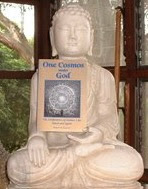
Saturday, February 14, 2009

Darwin Day: Kwanzaa for the Metaphysically Retarded

I guess I let the Darwin assholyday slip by without a comment, didn't I? Here's something from two years ago. In the interim, I've probably written dozens of better posts on the subject, but this will do. I don't want to deviate from my Saturday policy of reposting things from 24 months ago, or else I'll be overwhelmed by the choices -- 1,200 now, to be exact.

Again, to remind the pathetic victims of materialitis and reductionosis: you needn't bother commenting, because I have no objection to natural selection so long as it confines itself to the children's table, and doesn't elevate itself to a faux religion, a la Queeg -- i.e., metaphysical Darwinism, which is another thing altogether. Even less do I have a problem with evolution, which easily transcends anything Darwin had to say about it.

*****

The minds of these people [the scientists] are too much accustomed to deal with physical things and things measurable by instruments and figures to be much good for any other provinces. Einstein's views outside his domain are crude and childish, a sort of unsubstantial commonplace idealism without grasp on realities. As a man can be a great scholar and yet simple and foolish, so a man can be a great scientist but his mind and ideas negligible in other things. --Sri Aurobindo, Letters on Yoga

I'm going spend one more post wrapping up our discussion of Before the Dawn before moving on -- or in. And when I say "moving in," I mean that literally, for one of the interesting things about reading a book such as this is the exteriorizing effect it has on one's consciousness. Immersion in this kind of gross materialism really can destroy a soul. I do not mean that in the way that a spluttering creationist might mean it, but in a much more subtle way.

However, I do sympathize with the simple person of faith who objects to being bullied by this kind of ham-handed, totalitarian scientistic ideology. (I think this is the true meaning behind the surveys showing that most Americans "do not believe in evolution," for they probably mean the boneheaded and/or totalitarian kind.)

The uncorrupted soul naturally recoils at the idea that Matter is All. As I mentioned a couple of days ago, I can well understand how a religious person might read just a few paragraphs of this book and dismiss it as "satanic," because in a very real sense, it is -- at least without the proper cognitive safeguards. It's very creepy to immerse oneself in this desolate, simplistic, and one-dimensional world that is so disproportionate to the beauty, nobility, and majesty of the human soul.

You needn't believe in the literal existence of satan in order to know that satan is a deceiver, and that the most dangerous deceivers are the terrible simplifiers -- i.e., Hitler, Stalin, and less radical but still extraordinarily dangerous demagogues such as Barack Obama (relax, troll, I am not comparing Obama to Hitler, even though his simplistically appealing radical agenda would destroy the United States as we know it). I forget who coined the term "terrible simplifiers," but I just googled it and came up with this relevant passage (on an unrelated topic) that gives a sense of what I'm talking about:

"The lack of a correspondence between abstraction and reality is all the more significant, since the real world is profoundly complex and contingent and an abstraction is inevitably simple. The terrible simplifiers who love abstractions cannot stand conditions and conventions muddling their perfect, clear theory. If life does not fit the theory, then it is life that has gone awry and must be made to fit. The terrible simplifiers are always perfectly willing, then, to embrace ideological crusades, violence and upheaval to better realise their 'principles'...."

The promise of violence always follows in the wake of the terrible simplifiers, but the violence to the soul actually occurs at the outset, and sets the stage for the physical violence or coercion. The physical violence is a consequence of the rebarbarization that goes hand in hand with the simplification which sanctions the violence by encouraging man to be less than he is.

[Just recently I have been reading a book by Charles DeKoninck which makes the same argument in a different way. In fact, it is similar to an argument I put forth in my book. That is, the scientist begins with the concrete human world (for where else could he begin?). Being that we are human, we are able to abstract things from this world. But the reductionist then makes the wholly unwarranted leap of taking his abstractions to be more real than the real world from which they are abstracted (similar to Whitehead's fallacy of misplaced concreteness). Metaphysical Darwinism is a fine example of this. Again: consciousness can explain much more about Darwinism than Darwinism will ever explain about consciousness. That is, unless you happen to be a terribly simple person.]

I am not accustomed to reading a book this simple and "mechanical." Although I breezed through hundreds of them in the course of writing my own, it's been awhile. Naturally, in order to complete chapters 1, 2, and 3 of One Cosmos, I had to familiarize myself with the latest findings in cosmology, theoretical biology, paleoanthropology, etc. But my specific concern in writing those chapters was mainly one thing: origins. What is the origin of the cosmos? Of life? Of the human subject? Existence, life and mind; or being, will, and interiority; and eventually freedom, truth and love. What is the nature of these things? What do they imply about the cosmos?

In posing these questions, my view was much wider than the scientist, for I didn't just want to know how life arose, but what it means that a supposedly dead cosmos can spontaneously come to life and then understand its own truth. What does this say about the kind of cosmos we inhabit? Is it just a meaningless and trivial fact, or does it cause us to rethink what sort of cosmos this is from the ground up (or top down)? Indeed, it would imply that that is the wrong question, for to the extent that we are able to understand it, the cosmos would have to be a form of the soul's sensibility, not vice versa.

Irrespective of whether humans became human 45,000 years ago or 15,000 years ago or 6,000 years ago, what does it mean that our cosmos has an interior horizon -- this calm, reflective center in the midst of swirling creation -- in which it may contemplate its deepest truths? For I can well understand how humans could change as a result of becoming better adapted to their changing environment. But the random change of natural selection can tell us nothing about our miraculous capacity for transcendence of everything, including ourselves, in the light of a priori truth.

Only man is built for transcendence. A man who fails to transcend himself sinks beneath himself. He is not a proper man, but a beast among beasts. What can it mean that the cosmos has produced a being who hangs halfway suspended between what he is and what he is to become, between is and ought, between our genetic blueprints and a transcendent blue prince?

For there is no humanness in the absence of the ought. But here again, subverting this reality is behind the agenda of the materialists, for there can be no "ought" in a purely material world. Rather, there is only is. With this brutal reduction, man, whose roots are aloft, is severed from himself and condemned to a narrow ideological prison of his own making.

It is instructive that one can rapidly skim a book such as Before the Dawn in one's spare time in a day or two, and fully understand it. There is nothing remotely difficult about it or about Darwinism in general. Queeg and his liztards are proof of this.

On the other hand, not only can one not skim, say, Meditations on the Tarot or casually enter the spiritual cathedral of Meister Eckhart, but it takes a lifetime of preparation and "interior work" in order to appreciate them at all. They will be entirely opaque to the uninitiated, regardless of what they think they understand. Furthermore, any work of a true spiritual master is infused with a light and a force that facilitates a direct transformation of consciousness, and mysteriously keeps their words both fresh and inexhaustible, so that one may return to them time and again for new insights. At different times in your life and at different levels of spiritual maturity, they will speak to different parts of you. This is axiomatic: "When I was a child, I understood as a child." (A fine example of the type of higher evolution routinely discussed in the Bible.)

Back to the terrible simplification of the modern Darwinian synthesis. This is it: Everything = Random Error + Environmental Selection (E = RE + ES). Got it? That is all you need to know because that is all you can know -- although just how you can know it is a bit of a mystery, since it too must ultimately be reducible to RE + ES.

Nevertheless, it easily answers all questions. Religion? E = RE + ES. Human groups that endulged in this fantasy somehow had more reproductive fitness, that's all. Language? E = RE + ES. Apes that spoke had more babies. Love? E = RE + ES. A trick of the genes. Just a way to get you to reproduce. Beauty? E = RE + ES. The creation of illusion in order to make the pursuit seem worthwhile. Intelligence? E = RE + ES. Intelligence implies progress, something which is strictly forbidden in the Darwinian view. Nothing is any more or less intelligent, only better adapted to its environment. Wisdom? Don't even go there. No, can't even go there.

E = RE + ES. Got it? Now that you've got it, please bear in mind that you are not permitted to have any other thoughts about reality, because this is the answer that exhausts all questions. It is the graveyard of real curiosity, which is now rendered a pointless hindrance to your reproductive fitness.

Ironically, this satanic reductionism cannot avoid carrying a sacred ought of its own, as reflected in the anti-religious jihad of the obligatory atheists -- the simple Dennetts and even simpler Queegs. Yes, The Gospel According to Darwin (Tail wiggle: Walt) insists that the good news of E = RE + ES should be celebrated on Darwin Day, February 12, the day our scientistic savior was born. For this is the day that the word -- the only word there actually is, E = RE + ES -- became flesh. Naturally, before that, the word existed -- it cannot not exist -- but no one knew it.

But why a celebration, unless it is a funeral, since E = RE + ES spells the end of our humanness as such?

Because it's built into our genes, silly. Celebration increases social solidarity and therefore reproductive fitness. Pretty pathetic way for these beta males to try to meet women, if you ask me.

Blue prince:


Get-a-clue prince:

Friday, February 13, 2009

On Successfully Gaining No Faith in Oneself

Again, nine out of ten transcendentists agree that if we wish to prevent truth decay, the eye of spirit must become proportionate to the divine reality, and that faith is a necessary component of this. For this reason we insist that the act of faith in the divine reality is wholly rational, being that it has a rational end.

In other words, the rationality of faith depends upon its object, not the faith itself. After all, people have faith in Obama, or Al Gore, or the New York Times, but that is hardly rational. Such a misplaced faith actually shrinks the being and arrests the deepening of one's interior, so one remains a child forever.

In short, be careful what you have faith in, because faith creates an empty space for the Other to operate. And there are some bad otherf*ckers out there in the cosmos who are just waiting to hijack your soul.

Importantly, faith is not necessarily synonymous with "belief," the latter of which may simply be an overly-saturated dogma with no possibility of evolution. In fact, you might say that faith can clear a space for a kind of dynamic unbelief (not disbelief), which in turn makes it possible to possess something deeper and more robust than mere belief.

Here again, I don't have time to dig out exhumeples, but one will find many in the Gospels or Tao Te Ching, e.g., "blessed are the poor in spirit," or "to become full you must become empty," etc. This is why in my own godspiel, I employ the symbols (---) and (o) to signify this dynamic faith, or the silence and openness necessary to receive (↓).

To employ a computer banalogy, you could even say that this is the means through which we download the Word into our flesh, or the ultimate sophware into our hardheart. In turn, this would be how we begin to allow the Cosmic Center to reside in us, out here at the periphery. Then it is just as Paul said: it is longer I who live, but Christ lives in me; and the life which I now live in the flesh I live by faith in the Son of God. Again, perfect nonsense, no?

It is not so much that we become the center of the cosmos, but that we participate in the center. Or, you could say that we are "not two," because for one thing, we are three. Here is how Balthasar describes the satchituation:

"God can be known only by God. Faith, along with love and hope, is infused divine life in us, which cannot be detached from God's eternal life, but which draws back and incorporates into this life the creature that has become detached" (emphasis mine). In other words, it is not so much we who are "born again," but God who is born again in the ground of the soul who extends the invitation.

Or, you could say that O is the Great Attractor, and as we participate in this fideal attraction, we are slowly converted into that which attracts us. In ether worlds, we might think we are attracted to God -- which we are -- but that is like saying that the earth is attracted to the sun. In reality, the sun is doing most of the heavy lifting and heavenly gifting.

In the fallen manalysis, "faith" is not even ours. Rather, it belongs to God. This reminds me of how, in reality, the breast does not belong to the mother. Rather, it belongs to the infant. The mother is "responsible" for it, but nevertheless, the infant is enteatled to it. The breast is as much a part of the infant as it is the mother. In fact, more so, since the baby will die without it, whereas the mother can go on living with fake ones.

So, we are responsible for our faith, but it really belongs to God. Again, Balthasar: "As long as he continues to treat 'his faith' as his own possibility, he still does not believe at all, but is perhaps still debating whether he ought to risk the leap of faith."

Only after we have reached the nul de slack of our own (merely) human possibilities -- i.e., spiritual blankruptcy -- can the Divine presence begin to get the upper hand. As Balthasar describes it, realization cannot occur in the believer until it becomes a "real event by his self-abandonment to Jesus Christ, who alone can help his unbelief" (emphasis mine).

Just as we cannot "see" reason, we cannot see faith, because both represent the light by which we see their respective spheres. The faith of the authentic lumen being "can never become objectified," but "shines forth only in the realization of either the act of faith or the act of knowledge when it is objectively oriented."

But here again, just as it is not wholly our faith, neither is it our knowledge -- which is no different than in science, since a scientific truth by definition cannot belong to the individual; rather, if it is true, then it is universal.

Balthasar: "[I]n man's turning to Christ what shines forth is not man's own aptitude for faith, but rather Christ's aptitude to give to the inept a share of his own light and power. The light of being envelops both subject and object, and, in the act of cognition, it becomes the overarching identity between the two."

And here's the money quote: "The light of faith stems from the object which, revealing itself to the subject, draws it out beyond itself into the sphere of the object."

This is how we cross the bridge of darkness to the father shore, and end up out here, floating upstream beyond the subjective horizon in Upper Tonga.

Thursday, February 12, 2009

Objective Fantasy vs. Subjective Reality

As our culture and its products become increasingly ugly and stupid, it is no wonder that people lose their feel for the divine intellect and beauty. Likewise, with no developmental telos, we can hardly be surprised that chronological adults remain developmentally adolescent, and therefore never acquire the sophistication necessary to develop themselves spiritually. Indeed, why grow into adulthood if, in the absence of vertical development, it is just a horizontal "dead end," whereas the adolescent lives in a kind of faux eternity (or false verticality), since his potential remains forever latent? In being "nothing," he can feel as if he is "everything."

Regarding the problem of terminal adolescence, it has reached a kind of nadir in the election of our first teenage president (although I suppose Clinton broke some important ground in that regard). Along with this has come the descent of the moonstream media to a new low, which no one thought possible, i.e., a bunch of breathless teeny-bopper fanzines. Seriously, when they start publishing articles about women who fantasize about having sex with the president, it is difficult to imagine any further devolution.

Adolescents make up for in enthusiasm what they lack in substance, depth, and wisdom. As Balthasar writes, they also tend to generalize this enthusiasm, so that the world is not seen objectively, but subjectively. If you give it some thought, I think you'll realize that this is one of the real problems in trying to have a rational conversation with a liberal. In fact, I well remember what this was like from the other side, back when I was a liberal. The main problem with conservatives was that they threw water on your enthusiastic state of subjective fantasy, so I had no use for them.

But fantasies are otherwise ephemeral things that do not endure if they aren't reinforced by a large collective. In fact, being what they are, fantasies are threatened by even one person who isn't on board with it, which is why totalitarian governments and liberal universities function the way they do.

Likewise, it is why the adolescents of the left want to resurrect the Orwellian "fairness doctrine" in order to eliminate one of the remaining institutions that resists their fantasy. The very existence of talk radio is a threat to the fantasy, and must be stopped.

In just three weeks, Barack Obama has already attacked Rush Limbaugh, Fox News, and Sean Hannity. Does the press care that they are under assault? No, of course not, because that isn't the point. Rather, Obama and the MSM have a common interest in perpetuating their mutual fantasy. Likewise, George Bush was attacked for quashing dissent, when he obviously did no such thing. For the MSM, anyone who does not share their common fantasy is not a part of the legitimate press.

I had no intention to get sidetracked by politics here. My only point is to highlight the discrimination it requires in order to begin to apprehend the objective and the real, the very source and possibility of which is God -- or, let us say, the "principial realm," so as to not prematurely saturate the subject.

As Balthasar writes, "People who cling to this view of the subjective nature of taste's judgment have remained immature adolesescents." But "by developing his soul according to the images of the objectively beautiful, the maturing person gradually learns to acquire the art of discrimination, that is, the art of perceiving what is beautiful in itself." Critically, although this is obviously a subjective operation, "in the process of their development, the subjective elements of perception... more and more pass into the service of objective perception."

I would say that this is because maturity can be gauged by a gradual "withdrawal" of projection, so that we begin to see the world as it is, rather than how we would like for it to be. In other words, our subjectivity takes on a more passive, "female" role in receiving the world rather than forcing the world into our projected categories. I don't have the time to dig out examples, but one will find many, many references to this in the Christian and Taoist literature.

The world in itself is neither "objective" nor "subjective." Rather, these are human categories that we use in order to understand our experience. In reality, these two categories are complementary and give rise to one another. I would say that "objectivity" simply refers to the exterior of the world, subjectivity to its interior, and there can be no outside in the absence of an inside. Both art and religion specialize in disclosing the "cosmic interior," so it is no wonder that the skill required to deepen one's understanding of them has a similar aesthetic form.

As Balthasar describes it, "Even in the case of a masterpiece, the mature observer of art can without difficulty give an objective and largely conceptual basis for his judgment." For example, yesterday evening I was watching Olivier's 1948 production of Hamlet, and was blown away by the screenplay. I didn't catch the name -- William something-or-other -- but the way he used language was... I don't know what else to call it but godlike. His mastery of language was so complete, that it was almost a distraction from the plot.

The question is, was my aesthetic assessment of William something-or-other objective? Or "merely" subjective? Or, is it possible to use one's subjectivity in such a way that it discloses objective reality? Let's say some lowbrow atheist comes along and says that there's nothing special going on here -- just a story about a dead Danish king and his crazy son. Yes, that is objectively true, but is it true?

Or -- you will forgive me -- one could say that the Gospels are about a delusional Jewish carpenter who gets rubbed out by the Roman authorities. Is that true? Yes, in the same way that the theory of natural selection explains our humanness. The point is, to live in a state of "mere"objectivity is to plunge oneself into the deepest and darkest of fantasies, where no light can enter, since all light is subjective (i.e., only subjects can experience it).

A metaphysical Darwinist is living in a state of "objective fantasy," since he regards his abstractions as more real than the concrete reality from which they are taken. And this is why one cannot be a consistent Darwinist and remain human, because no human can sanely treat other humans as mere "replicating machines." Rather, the moment you appreciate the infinite value of the individual -- an example of a truly objective subjective fact, by the way -- you have left Darwinism behind. It's just a matter of explaining why human beings are so infinitely precious. I know why. The metaphysical Darwinist can never know.

Balthasar contrasts the two uses of imagination. The more immature way is to project and externalize from within to the exterior. An extreme case of this would be the psychotic, but the schlock-in-tirade of the psychotherapist is less obvious forms of this same process.

Conversely, the more mature use of imagination involves a kind of metabolic process "in which the objective content of images is assimilated from the outside toward the interior" (Balthasar). I think it is fair to say that this is how the the spiritually mature person "uses" scripture and religion in general.

This is how Balthasar describes it: "the believer indeed possesses in advance the fundamental possibility of believing which has been implanted in him; but this possibility does not exempt him from the human effort of searching with a probing gaze for the correct form of what he is to believe and, having found it, from the effort of integrating it existentially into his very self" (emphasis mine).

Again: the form is objective, but its assimilation is subjective; indeed, the former must be assimilated into our subjective being in order both for it and for ourselves to truly "live" in the dialectical space between them. You could say that this is the eternal space of both kenosis and theosis, which are two sides of the same divine reality, in that His flowing out is our flowing in.

Wednesday, February 11, 2009

Where There is No Vision, the People Need their Third Eyes Examined

Here's a good rule of thumb: the light of grace "strengthens and deepens the power of sight," and "makes the eye proportionate to what is being shown" (Balthasar).

Or, you could say that faith "essentially consists in an ability to see what God chooses to show and which cannot be seen without faith." In fact, this very much reminds me of Polanyi's theory of scientific vision, only transposed to a higher key. The messy book of history is lettered with little divine hints and clues, but "the spirit searching for meaning requires a higher light of grace in order to synthesize the signs" (Balthasar).

This is something I discussed on page something or other of my book. It seems that non-believers begin with the idea of trying to rationally prove the existence of God -- which they fail to do -- and then conclude that he doesn't exist. But this makes about as much sense as me taking a few awkward hacks against a major league pitcher, and concluding on that basis that home runs don't exist. Plus, Babe Ruth was a liar. No one can hit a ball out of the yard.

Forget about God's existence. That's for God to worry about. If he doesn't exist, only he knows it. Rather, our job is simply to develop that "part" of ourselves that is capable of initially "detecting" and increasingly understanding the divine. After all, we don't speculate about realities for which we don't have the requisite sensory apparatus to detect. For example, humans -- at least since the 1960s -- don't bother thinking about the sound of red, or what music looks like.

As far as I am concerned, it's just flat out strange that we are able to understand the divine at all, much less to deepen and expand our understanding. I mean, if God did not exist, we couldn't say that this person over there has a childlike understanding, while that person over there has an exquisitely subtle understanding. Nor would there be any "inter-rater reliability," which there surely is, especially the further one ascends up the sacred mountain (cf. the Spiritual Ascent for mountains of evidence of the mountain).

The point is, as I put it on page 194, "Even if we assume that scripture is a revelation of God, it seems axiomatic that it still has to be revealed to someone," so that the meaning will vary widely from person to person, partly depending upon their capacity to receive it.

In a way, it is analogous to physics, which is way beyond the point that it is dealing with any ponderable human reality. Rather, it must employ elaborate particle accelerators that span several miles in order to create very special circumstances for the desired reality to make itself manifest. In short, change the experimental situation, and a novel reality emerges -- or, features of reality emerge that would otherwise go undetected.

Why should it be any different with the study of consciousness? Obviously, strange things occur inside an atom smasher. But even stranger things occur inside an ego-smasher -- and perhaps for similar reasons. After all the ego is a cluster of energy, a "knot" in consciousness, something like a virtual molecule. Blow it apart, and what happens? Well, usually the neutron bomb of psychosis, which destroys the mind but leaves the body standing. But splitting the atom can also result in heating your home. Is it possible that splitting Adam can result from bleating the Om? So we have heard from the wise.

To a certain extent, the nonlocal God "requires" us in order to manifest locally. Or, you could say that God is not known unless we do the not knowing. And we must not know what we think we know in order to begin unKnowing the unknowable One, that's for sure.

So, as Balthasar says, "the signs of revelation crystalize about a center which becomes visible in the light of faith." This, I think, is a key point. Just as in science, as one synthesizes more and more, the resulting "center" becomes deeper, more interconnected, more robust, more enduring. Once this begins to take place, then you cannot isolate just one component, because you appreciate its part in the whole existentialada.

But how does one begin to coonfur this vision upon the willfully blind? I just don't see how it is possible unless they leave their ego at the door and surrender to B'ob. Why? Because I'm trying to show you what I see, and you won't see it if you don't drop what you're doing and see things from my perspective.

Obviously, I don't mean that in any grandiose way. I only mean it in the sense that it is true of any philosopher or artist. In order to understand any metacosmic vision, one must abandon oneself and deeply enter into it. Only afterwards do you return to yourself, so to speak, and reassess.

This is what I do, whomever I am studying. That is, I extend the courtesy of plunging heartfirst into their world. If it is a valid world, several things will become evident. At the very least, it will be both internally and externally consistent. Also, it will have a "richness" and "texture" that will only be present if the guide in question really knows what he is talking about from the inside out. In other words, "second hand" theological writing will lose this fineness of detail [you could say that it becomes (k) rather than (n)]. The life is drained from it.

Another thing that becomes evident is a communication of the light necessary to "see" within the given structure. No divine structure can be seen without a source of divine light. All pneumanauts are aware of the fact that this Light is every bit as evident as the light that illumines the physical world.

Here, I didn't even see this coming, and Balthasar confirms it: "The interior light of faith and the external historical revelation confront, recognize, and strengthen one another." Indeed, "the active synthesis of the signs of revelation and the light that makes them possible" are both understood "from the spirit's perspective of self-realization in its striving toward God as he is in himself," but also "the genuine expression of the divine Being." This is again none other than the ascending spiral of (↑↓), as the divine glowtons bang up against (¶).

Tuesday, February 10, 2009

On Developing 20/∞ Vision

As I said, I'll continue with volume one of The Glory of the Lord, which, at almost 700 pages, should be enough for anyone. When I do these multi-post book reviews, the main purpose is to assimilate what I've just read, otherwise it can be like having never read the book, so you end up being hungry again an hour later. You know, like Chinese theology.

In the end -- and this is something Bion knew -- intellection really isn't that different from digestion, being that it consists of identifying what is healthy to eat, chewing it thoroughly, swallowing, breaking down, assimilating, and then, most importantly, utilizing or becoming.

In other words, the "end result" of food is either energy for action or else renewed substance for your being. (I guess we left out elimination, didn't we? In that case it's best to either not ingest useless crap to begin with, or else spit it out right away. Otherwise, you risk years of "detoxification," for example, the years it takes to undo a higher education.)

Now, one thing we really need to chew on is this thing called "history," for history is somewhat like a symphony.... No, wait a minute. I'll just stick with what I know best. Let's say history is like a small jazz combo, in which case you have cycles or rhythms (the drummer), certain ground notes that hold the musical structure together and unify rhythm and harmony (the bass), the chordal structure (the piano), and the soloists who use the other three as the basis for free improvisation -- the latter of which being rooted in the structure while "floating above" it. You could say that improvisation is simultaneously immanent and transcendent, or within and beyond the musical structure.

For Balthasar, "the revelation of Biblical salvation-history is a form set before mankind's eyes, implanted in the midst of mankind's historical evolution." In other words, profane history is one thing -- you might say the rhythm and bass -- over which God improvises his divine melody. And like any melody, it can only be discerned in time. This is the difference between "horizontal" and "vertical" in music. A chord consists of multiple notes that are played all at once, i.e., vertically. But a melody can only disclose its pattern in time. A single note of a melody is "nothing." In fact, a melody can't really be discerned absent the modes of memory and anticipation.

You might say that Balthasar's central concern is the beauty of this divine melody as it appears in time, beginning with the old covenant and extending through the new and beyond. The point is, it is a form, a form that is surely as real as physical or biological form. And like any form, if you break it up into its constituent parts, the form disappears. This is especially true of scripture, which any yahoo can "disprove" to himself by focusing on a single element and removing it from its overall context. This is a favorite approach of the atheistic barbarians. In fact, here's an apt quote by Schuon:

"In the opinion of all unbelievers, it is the absurdities contained in the sacred Scriptures which primarily stand in the way of the credibility of the Message.... First of all, it is necessary to envisage a Scripture in its totality and not be hypnotized, with perfect myopia, by a fragmentary difficulty, which after all is the perspective of the devil, who disparages a mountain because of a fissure and, conversely, praises an evil because of an inevitable particle of good." (In fact, this is why Satan loves the Porkulus bill.)

But "when Scripture is envisaged in its totality it imparts a global value and its supernatural character to whomever is not blinded by prejudice and who has been able to preserve intact the normally human sensibility for the majestic and the sacred.... [W]hat cannot be imitated [in scripture] is the depth of the meanings and the theurgic radiation of divinely inspired texts" (Schuon; emphases mine).

Schuon mentions our sensibility for the majestic and sacred, which are examples of the types of "aesthetic" categories Balthasar uses to understand the Divine message in its totality, not just in terms of a momentary or isolated fragment. And in considering this totality, he observes that its "contour-lines have been drawn with such mastery that not the smallest detail can be altered. The weights have been poised in such a way that their balance extends to infinity, and they resist any displacement. God's art in the midst of history is irreproachable, and any criticism of his masterpiece immediately rebounds on the fault-finder" (Balthasar; emphasis mine).

Like any truly great work of art, we must "elevate" ourselves in order to apprehend it. Yes, the artist "reaches down," so to speak, but surely not "all the way," on pain of becoming what he is not. Christ "became man"; but he did not become an evil or sinful man, just so you could better relate to him.

Now, a great work of art is surely "rational," but that is not all it is. This is why, as applied to scripture, "the mere light of reason clearly does not suffice to illumine this work, and it can be irrefutably established that anyone who seeks to comprehend it with this light cannot do it justice." Yes, there is an elegant mathematical structure to Bach's fugues, but an "x-factor" is added by actually listening to them in their wholeness, for the "math" is in service to the overall form, not vice versa.

As it pertains to the form of revelation, "faith" is the appropriate mode in which to apprehend the form in its totality. As Balthasar writes, "the light of God which faith has sees the form as it is, and, indeed, it can demonstrate that the evidence of the thing's rightness emerges from the thing itself and sheds its light outwards from it.... The decisive thing is that this form presents itself as the revelation of the inner depth of God" (emphasis mine).

I think Balthasar would agree that the Christian revelation represents a kind of totality -- the whole symphony, as it were -- that other revelations only express in parts. This is not to put them down. To the contrary, it is to give them a new kind of value by realizing that these fragments -- various chords, melodies, themes and rhythms -- were valid intuitions of the totality. But when a part is elevated to the whole, then you're going to run into problems.

Does this sound overly abstract? Possibly so. Let me provide a concrete example. As a child, Christianity was presented to me in such a piecemeal way that it was just too easy to reject. I won't dwell on the details. My point is that I eventually began re-exploring Christianity from the "outside in," so to speak, beginning with some of its greatest thinkers. In so doing, I began to increasingly appreciate the beautiful contours of this magnificent edifice.

But there was a curious thing. That is, there was still a big hole in the middle of this beautiful structure. And what might that be? It was the Crucifixion and Resurrection -- the very things that made the whole thing seem so implausible if presented up front, totally out of context. In other words, once I began to appreciate the incredibly rich totality, I began to see how the Incarnation is the pillar holding up the whole beautiful structure. What emerges is a new kind of "necessity" that clearly transcends logic, for it is more like the necessity of the artist who knows that this note, or this line of color, must go right there and nowhere else.

Thus, for Balthasar, the central problem of perceiving the form is an aesthetic one. To ignore this critical dimension can reduce scripture to a kind of crude materialism, which many fundamentalists tend to do. And along with materialism comes a misguided application of reason which exists side-by-side with a kind of dopey fideism; in other words, belief in frank absurdities backed by the misapplication of reason. The left never tires of trotting out such idiots in order to satisfy themselves that religion is for morons.

As Balthasar notes, to try to comprehend religion with the categories of materialism is to have conceded up front: "What basis acceptable to reason can we give to [Christ's] authoritative claims? Anyone asking the question in this way has really already formed an answer, because he is at once enmeshed in an insoluble dilemma." If he tries to believe on the basis of reason alone, then he is ignoring the dimensions of divine authority and aesthetic contemplation. But nor does Christian faith consist of renouncing reason in order to prop it up in the teeth of all reasonable objections.

Again Balthasar emphasizes the importance of seeing the whole. "Torn between knowing and believing," the critical rationalist will be "no longer able to see anything." Rather, "the spirit searching for meaning requires a higher light of grace in order to synthesize the signs.... Allowing that this point of convergence is supernatural and that it lies in the sphere of the properly divine, then it is clear that the spirit searching for the meaning of these signs will totally (not merely partly) fail to find it as long as it seeks for the point of unity in the realm of the natural."

This is why no rational argument will convince the skeptic. Rather, "the light of grace comes to the aid" of our "natural inabilty" and "strengthens the power of sight," thereby bestowing vision and making "the eye proportionate to what is being shown." Only then do you see the One Cosmos Under God.

Monday, February 09, 2009

Flood Lights and Laser Beams

Well, I'm getting a little burned out on the Balthasar. To review where we stand, I made the deadly solemn vow to wondertake an exhumination of his main body of work, the fifteen volume systematics (plus an appendectomous epilogue, so sixteen), and I'm now turning the coroner on volume four.

But I have to admit, at this point, I'm seeing a lot of pointless pedantry that's not really moving the argument along. It feels like we're in dryasdust flyover country now, with a long way to go before we flow into our deustinocean.

You might call it argument by volume rather than weight, just piling one endless paragraph upon another. I'm not getting any feeling of forward momentum at all. He's one of those writers who has no sense of rhythm or drive. Probably a German thing. A key point might be buried in the middle of a two page paragraph. There's no building up to the "ah ha!" experience, much less the sacred guffah-ha! I mean, 1500 pages so far. That's a long tome to go with out a single gag.

This reminds me that, when purusha comes to shiva, I would have to admit that I'm not a scholar, but more of a mystickle innertainer. But darn it, there's no reason at all why one can't combine both. It's just convention, really. That and a lack of talent. Most academics are dreadful writers, but turn it into a virtue. And then they marginalize the ones who do know how to communicate, with the epithet "popularizer." But I'm obviously not that. If anything, I'm an unpopularizer. Nevertheless, to quote Petey's scryptural exejesus, our yokes are easy, our words enlight.

It seems to me that Balthasar's essential argument is laid out in volume one, with the subsequent volumes just filling it out. So I may just finish posting on that, and then move on.

Brevity. That's what it is. Don't give me the dissertation. It just makes it look like you've got something to hide. Out with it. Get to the freaking point.

I don't mean to fawn, but this is why I am so drawn to Schuon, who never makes me yawn. It's as if he's done you the courtesy of assimilating everything beforehand, so he can rewordgitate it back to you in the form of a highly polished gem of wisdom that you can turn around in your mind and examine from various angles. Unsaturated, don't you know.

Jules: Example

Vincent: Okay, here's the first sentence from perhaps Schuon's most accessible book, Spiritual Perspectives & Human Facts. Truly a model of brevity and unsaturated clarity, like a righteous pimp slap from above:

Metaphysical knowledge is one thing and its actualization in the mind is quite another. All the knowledge the brain can hold is as nothing in light of Truth even if it is immeasurably rich from a human point of view.

Ah, refreshing! Balthasar gives us all [if not more than] the knowledge the brain can hold, whereas Schuon facilitates the direct actualization of metaphysical knowedge, i.e., O-->(n).

Second and third sentences: Do you know what they call a Quarter Pounder with cheese in France? Royale with cheese. Do you know why they call it a Royale with cheese?

Oops. Wrong text. Try it again: Metaphysical knowledge is like a divine seed in the heart; thoughts represent only faint glimmers of it. The imprint of the divine Light in human darkness, the passage from the Infinite to the finite, the contact between the Absolute and the contingent -- this is the whole mystery of intellection...

Bingo! The rest is up to you.

This is good for me. Like a refreshing rinse after a lot of transcen dental work:

A proof is not convincing because it is absolute -- for this it could never be -- but because it actualizes something self-evident in the mind.

Ahhhhhhh. Frankly, you could summarize the entire argument of Balthasar's theological aesthetics with that one sentence, for he is essentially making the point that the divine beauty -- the Glory of God's revelation in time -- provides its own proof, a type of proof that clearly transcends mere reason, for it is seen and apprehended whole, not argued in any linear sense (although it does disclose itself in the form of the theodramatic "arc of salvation").

Correlative to every proof is an element eluding the determinism of mere logic and consisting of either an intuition or a grace; now this element [what I would call (↓)] is everything. In the intellectual order logical proof is no more than a thoroughly provisional crystallization of intuition.... One can most certainly prove every truth; but not every proof is accessible to every mind.

Indeed, the need for logical satisfaction "increases in proportion to ignorance, not in proportion to knowledge."

Balthasar definitely says the same thing but in a different way. For example, God's being "can encounter us centrally only from within the a priori of spiritual being itself -- as the deepening of the spiritual being worked by grace." In receiving this Mystery, man "conforms the proportions of his own thought and work to the proportions of the object of faith which are determined by God." Through this process we are led to "an ever deeper awareness of the experience both of the presence within... of God's being and the depth of the divine truth, goodness, and beauty in the mystery of God," i.e., (↑↓).

In this regard, there is a "deepening of a merely notional apprehension into an experiential apperception by the whole person" (Balthasar). At the same time, it is the movement from an exterior relationship to an interior relationship with God, in particular, as the "interior light" begins to shine in the dark.

And just as physical light is never seen -- rather, it is merely photons banging against our neurological apparatus -- the Divine Light is not so much seen as that by which we see -- especially that by which we see God, or the very source of the Light which shines forth its own radiant proof.

And only in man can the fullness of this light become apparent. Or ignored.

Sunday, February 08, 2009

I Once Was Blind, But Now I See

As I mentioned last week, February '07 was a fairly fruitful month, so I think I'll repost things on both Saturday and Sunday until further gnosis.

Or, since we had more stale comments than usual for a Saturday, just consider this a fresh open thread.

FYI, here is part III of David Klinghoffer's takedown of Queeg and his crude scientistic anti-intellectualism.

******

When we talk about "leading a spiritual life," we are not necessarily referring to a conventionally religious life per se; nor do we wish to confuse it with any kind of new age exercise in larcenous pneumapathy, a la Deepak and Tony Robbins. Rather, what we are really talking about is vertical transformation and the conditions that make this transformation possible. Those conditions are embodied in religion, but it is clearly possible to practice a religion and miss out on the transformative element.

While religion obviously involves "faith" and "belief," these are not intended to be merely static and saturated "containers." Rather, properly understood, they should be fungible into a different sort of experiential (or ontonoetic) knowledge and should facilitate a real transformation. In other words, it seems that dogma is not the end of religious knowledge, but only the beginning. Truly, we believe in order that we may know.

In the past, I have discussed dogma in terms of Polanyi's analysis of scientific models, which he compares to the cane of a blind person -- to a probe in the dark. If you can imagine being blind for a moment -- which, of course, you are -- think of how the cane would quickly become an extension of your hand. At some point, you wouldn't even be aware of the cane's impact on your hand. Rather, these raw sensations would be instantaneously transformed by the brain into a three-dimensional image of your spatial surroundings. At the same time, it would expand your world and allow you to move through it in such a way that you could further expand your world by degree.

Clearly, scientific knowledge works in this way. Consider, for example, the equations of subatomic physics or quantum cosmology. In the case of the former, this mathematical language allows us to extend our senses and see "beyond" or "behind" the solid material world the senses give to us. Likewise, these scientific probes allow us to "visualize" the temporal arc of the cosmos, extending back to a time long before human beings even existed -- in fact, to the very timelessness that begot time, when One's upin a timeless, without a second to spore, and noplace to bang anyway.

But you will notice that we always convert this scientific knowledge -- again, think of the probe in the dark -- into a human vision. When we think of a "big bang," that's what we think of, even though, if you could somehow have been there at the moment of the big bang, you would have been too small to have been anywhere, plus you wouldn't see any banging anyway, for the same reason you don't see it happening now. After all, the cosmos is still banging away at this moment -- i.e., it is expanding -- but we don't experience this through our senses. Rather, we only know it by using the scientific equations as a probe in the dark to extend our senses.

But the universe is not merely a form of our sensibility. In other words, no matter how far science extends its probe into the dark, it is still going to be a human hand grasping a slightly longer cane. And, needless to say, the universe is what it is, regardless of -- or in addition to -- what we say or think it is. This is something materialists and metaphysical Darwinists always forget -- that is, they confuse their probes with reality.

To put it another way, science extends our senses forward, backward, and below, in so doing "widening" our conception of the cosmos, both spatially and temporally. But religion serves a different purpose. It too is a probe in the dark, but it specifically probes the inward and the upward. This is the great confusion of both scientific fundamentalists and religious literalists. The former imagine that the horizontal probes of science exhaust all that may be probed, whereas the latter imagine that religion is meant to probe the material world. Thus, for example, they attempt to use Genesis to probe the horizontal, just as scientists imagine that they can explain anything of a non-trivial nature about the vertical by relying solely upon their sensory probes.

This is something I actually understood when I began studying psychoanalysis. I began doing so at a time when psychoanalysis had fallen out of favor among strict scientific types, who regarded it more as a "mythology," even a sort of cult invented by Freud. What I realized is that the concepts of psychoanalysis are precisely analogous to probes we may use to explore consciousness, as we try to extend our knowledge from the well-lit area of the ego, across the subjective horizon into the darkness of the unconscious. There are a number of different psychoanalytic schools, and they each "work." Why is this? How can this be?

I believe it is because it is not so much the explicit theory that counts, so long as it may be used as a probe to explore the unconscious and to widen that part of consciousness that we have "colonized." The unconscious is just as dark and silent as the subatomic world until we have developed a "language of achievement" with which to probe and illuminate it. (I might add that one of the virtues of Bion is that he attempted to convert these "concrete" theoretical probes into something more abstract, which is precisely what science does as it moves from induction to deduction, or from particular, to general, and back to particular.)

I don't want to get sidetracked into a discussion of psychoanalysis, but let us transfer the same general idea to religion. To try to understand psychoanalytic concepts as an objective description of the mind is to misunderstand them, precisely. Again, they are subjective probes we use to reach into the darkness of the unconscious mind. Likewise, a religious system must be similarly understood as probe we may fruitfully use to reach into eternity, the vertical, the interior, the great within, heaven, whatever you wish to call it. Even if you don't consciously realize you are doing this, this is what you are doing when you "indwell" religion. You are expanding your consciousness and thinking about things that are otherwise unthinkable in the absence of the religious system.

Indeed, this is why religion persists and will always persist, because human beings, alone among the animals, have a built in need to reconcile themselves to the vertical, on pain of no longer being human. I was thinking about this the other day, in considering the first humans who awakened to the vertical. In fact, in every sense, "awakening to the vertical" is synonymous with "becoming human." I am currently reading a book, Before the Dawn, that I will soon be reporting to you on. It goes into the latest research on human origins, and I wanted to use it to update or correct any outdated information in Chapter 3 of One Cosmos.

The author confirms one of my main points, that anatomically modern humans emerged by approximately 100,000 years ago, and yet, there was no evidence of what we call genuine "humanness" -- which coincides with the discovery of the interior vertical world -- until it suddenly burst upon the scene some 50,000 years ago. Just as we have forgotten the experiential intensity of the early Christians, it's easy to dismiss the intensity of what it must have felt like for the earliest humans to awaken to the vertical -- the mother of all (?!)s, as it were. As Joyce said in his meandertale, they must have been completely astoneaged!

Consider some of the famous cave art that emerged in Europe after our great awakening. What force prompted our furbears to do this? Consider the fact that some of these caves are accessible only by long tunnels that extend deep into the earth, and are hardly wider than a human body, not as bad as boarding an airplane, but close.

Someone -- again, compelled by what mythterious force? -- had to be the first to wriggle down that tunnel into pure darkness, where he was eventually released into an underground cavern. His newly awakened soul then felt compelled to adorn the walls of this cavern temple with beautiful, fully realized works of art -- with mankind's first "masterpieces." Upon seeing the Altamira paintings, Picasso -- who was in a position to know about decadence -- famously remarked, "after Altamira, all is decadence." For this was art in its purest sense, in that it was obviously completely divorced from any commercial or egotistical motives. Rather, it was a purely spontaneous attempt to probe the interior reality to which humans had gained unique access, and to reconcile man to the vertical.

Now, where was I? Something about leading a spiritual life in the modern world. Now that we have more of an idea of what spirituality is intended to do, we are in a better position to come up with a way to organize our life around that endeavor -- to create conditions in which we may experientially "probe the vertical" with our cooncanes, so to speak.

Frithjof Schuon has said that "The chief difficulty of the spiritual life is to maintain a simple, qualitative, heavenly position in a complex, quantitative, earthly setting." When we chase after the exterior world and its shadowy phenomena, this has the effect of both externalizing and dispersing our consciousness, when the essence of a spiritual practice involves centration, interiorization, and assimilation -- as mentioned a couple of days ago, living from the top down and inside out. It is an "ascending descent" or "descending ascent."

In externalizing and dispersing our consciousness, science tends to get lost in time, in phenomena. But the vertical is only accessible in the present moment that is given to us, and the present is not actually a part of time, but at a right angle to it. A kind of remembrance must take place in this present moment -- vertical remembrance, which is what prayer, meditation, and contemplation are all about. This is what Schuon calls the "liberating center," but it is only available to us through 1) centration, by whatever means necessary, and 2), ascent (of the awakened soul) and/or descent (of grace).

It follows that a simple life, free of needless distractions, is best. I see it very much as creating stable boundary conditions so that something higher may emerge from the lower -- just as we can only speak meaningfully by relying upon stable rules of grammar, or create music by relying upon fixed scales. This is why I mentioned yesterday that my outward life may not look like much -- trophy wife, accessory baby, and bitchin' stereo notwithstanding -- but is in fact a continuous interior adventure that would be impossible if my life were more complicated, or if I were married to someone who, say, preferred fancy restaurants over the NHL playoffs. The one reality would eclipse the other, and I'd be blind as a moonbat.

Saturday, February 07, 2009

On the Spiritual Insanity of the Left: Who'll Stop their Reign?

Here's your weekly rewordgitation from two years past. "Spiritual insanity" will no doubt sound polemical to some, but I mean it quite literally and matter-of-factly, since it should go without saying that one who denies or distorts the reality of spirit is by definition spiritually insane. Or, to turn it around, if the radical secularists and metaphysical Darwinists are correct, then our knowledge and experience of spirit merely represent a kind of stubborn pathology that cannot possibly be valid. Being that "loss of reality testing" is the sine qua non of mental illness, we can't both be sane.

*****

I went down Virginia, seekin' shelter from the storm
Caught up in the fable, I watched the tower grow
Five year plans and new deals, wrapped in golden chains
And I wonder, still I wonder, who'll stop the rain
--John Fogerty, Who'll Stop the Rain

I suppose what bothers me most about the left except for the bad hygiene is that it institutionalizes man's fall and reverses the cosmic order. This order can be known with the higher intellect, which is why "job one" of leftism is always the elimination of the intellect properly so-called. Leftism is intrinsically anti-intellectual, in that it must abolish that part of man which is capable of seeing the error of leftism in a direct and unmediated way.

In fact, a major part of the leftist agenda involves displacing the higher mind by the lower, that is, "small r" reason in its mechanical sense. Worse than the ideological takeover of academia has been the simultaneous eclipse of the higher mind, thus reducing man to a cultured beast.

The leftist program follows the split in the western world which occurred with the Enlightenment, which had its radical version in France and its skeptical version in England and Scotland. America has been by far the most successful nation in history because it was a product of the skeptical Enlightenment (i.e., classical liberals such as Adam Smith) and because our founders -- since they were so securely anchored in Judeo-Christian metaphysics and therefore "innoculated" against leftism -- categorically rejected the savagely utopian schemes of the romantic radicals.

Now, all purely secular philosophies that exclude the vertical are more or less error a grandiose scale, but at least most of these philosophies do not include -- as part of their intrinsic philosophy -- the imposition of their philosophy on everyone else. The whole point about being a classically liberal conservative is that it preserves at its very heart the right of anyone to reject it. It doesn't impose anything on anyone, which is what is so ironic about paranoid leftists who constantly fantasize about the imminent Christian fascist takeover! [Gee, how did that turn out, anyway?]

The pneumapathology at the heart of leftism always includes acting out, which is one of the more primitive defense mechanisms, as it bypasses thought altogether and replaces it with action. This is why leftist intellectuals are always activists, which simply means that they are more concerned with changing the world than understanding it. The gargantuan Generational Theft Act of 2009 is a case in point. Our children's children's children will be paying for this liberal interest group smash-and-grab legislation for the rest of their lives. (As Lucianne put it, The first terrorist attack on American soil since 9-11.)

Naturally, classical liberals have no objection to change, but only so long as the change is rooted in understanding, including especially an understanding of human nature. For if your understanding of human nature is faulty or grossly incomplete, then your political philosophy is going to be nothing less than a disaster. The disaster may happen quickly or it may slowly unfold with time, but the disaster is inevitable.

Anyone who lives in error eventually receives sharp blows from the world. But another purpose of leftism is to rescue people from the disasters caused by leftism, thus ensuring a steady stream of people to rescue, and therefore a greater need for the left. In short, the purpose of the left is to fail, as its success is built on the wreckage of its own failures. Its very foundation is failure, through which it gains more power, and the accumulation of power can be the only end for a half-animal who has rejected the vertical for the horizontal.

A couple of days ago while driving to work I was listening to Air America and caught a bit of the abysmally tedious program of professional unfunnyman Al Franken. The guest was a gold-plated leftist bull-goose paranoiac, Joe Conason, who has published a new cry for help with the harrowing title, It Can Happen Here: Authoritarian Peril in the Age of Bush!!! The shrill and paranoid title is just a measure of how free of irony the left has become -- as if we didn't just have a freaking election a couple of months ago that effectively undermines Conason's entire thesis. But reality is hardly a consideration for the reality-based community. As any competent psychologist can tell you, truth is irrelevant when someone has an emotional need to believe in its alternatives.

Conason's unintentionally ironic title is a takeoff on uber-moonbat Sinclair Lewis' 1935 screed, It Can't Happen Here. Lewis is revered by contemporary moonbats for his boneheaded dailykosian remark that "When fascism comes to America, it will be wrapped in the flag and carrying a cross." Brilliant! Sean Penn couldn't have said it better! As always, the left confuses hysteria with "courage" or "insight," so that Lewis stands in a long line of courageous leftists such as Cindy Sheehan and Al Franken who don't speak "truth to power" but excitedly bark at their own psychological projections.

Like all leftists, Lewis seems to have merely externalized his own existential misery and called it a political philosophy. I can't say I know much about his personal life, but his Wikipedia entry is instructive: "Alcohol played a dominant role in his life; he died of advanced alcoholism in Rome." If so, we can be fairly certain that Lewis was 1) miserable, 2) weak, 3) a slave who was not psychologically mature enough to handle spiritual liberty and who squandered his own, and therefore 4) in need of a political system to save himself from himself. Please feel free to correct me if he wasn't a total idiot, but I have never been drawn to didactic "realist" literature. Exterior reality can speak for itself, and doesn't require "artists" to represent it. Rather, the artist reveals the interior of the exterior.

All leftists must know that somewhere deep inside, beneath the histrionic bluster, they are weak, dependent, envious, racist, and so on, because they wish to impose a political system on those of us who do not have those particular problems. If you are not envious, you don't give much thought to CEOs who earn more money than you do. If you are not a racist, it doesn't occur to you that Barack Obama is half white, nor would you ever conceive the sinister idea that the Constitution mandates racial discrimination or equates a human fetus with a decayed tooth. If you love women, you would not be drawn to the loathsome philosophy of radical feminism; etc.

The description of Conason's book on amazon sounds like it is taken from the nursing notes of a recent psychiatric hospitalization for acute paranoia:

"Despite recent election, patient still believes America in great danger. Hopeless re future. Doubts existence of democracy. Government conspiring with 'big business' and 'big evangelism.' Asked him 'what about big entertainment, big media, big labor, big education and big trial lawyers?,' but patient incorporated me into paranoid delusions. 'You're just part of Big Health! You're not helping me! You only care about bottom line!, etc.' Obsessed with nameless ideologues and religious zealots 'attacking logic' and 'scientific method.' Asked patient if he meant Al Gore -- became extremely hostile. Incoherent babbling: 'ruling party encourages xenophobic nationalism based on irrational, manufactured fear.' Confusing -- asked him if he meant irrational manufactured fear of Bush. Patient became agitated -- required sedation and restraints. Carotid veins visible, face flushed like Howard Dean, screaming something about 'party in power seeks perpetual state of war to maintain power -- willing to lie, cheat, and steal to achieve ends.' Empathically suggest to him can't happen here. More agitation -- 'it can happen here, damn you! My 'book' says so -- select group of extremely powerful right-wing ideologues driving us ever closer to precipice, etc., etc., etc.' Intravenous push of thorazine; patient now watching Keith Olbermann and quietly mumbling to self."

At American Thinker there is an article entitled Cultural Marxism that demonstrates how Marxism hardly died with the dramatic fall of the Berlin wall in 1989. As it so happens, Raccoon lore maintains that leftism can trace its squalid genealogy all the way back to the origin of mankind. For the "fall of mankind" was specifically a rejection of the divine-cosmic order (and partnership) in favor of a wholly man-made one. This lesson is reinforced time and again in scripture (and its shadow in the herebelow, history), as man repeats his fall, 32 feet per second per second, and suffers the ineveateapple consequences.

Kimball traces the various permutations of the leftist mind parasite which, like all parasites, knows how to survive. Although the "New Left" of the 1960's collapsed and fell apart, it simply underwent what I would call an "interior diaspora" into various ideologies that all have roots in the same infrahuman ideological swamp: leftist "revolutionaries reorganized themselves into a multitude of single issue groups. Thus we now have, for example, radical feminists, black extremists, anti-war ‘peace' activists, animal rights groups, radical environmentalists, and ‘gay' rights groups. All of these groups pursue their piece of the radical agenda through a complex network of organizations such as the Gay Straight Lesbian Educators Network..., the ACLU, People for the American Way, United for Peace and Justice, Planned Parenthood, Sexuality Information and Education Council of the United States..., and Code Pink for Peace."

This is why if you attack leftism frontally, it will simply mutate into all of these other viruses. The only way to effectively confront it is from "above" and "below." In other words, its common root must be attacked at its base, but only from a higher psychospiritual perspective. Their strategy is to "divide themselves" in order to conquer us, so the solution must be a unified theory of the left, so we can apprehend the one beast beneath all of its pseudo-diversity.

As Kimball notes, neo-Marxism thrives partly because it has mutated into various superficially appealing code words such as "tolerance, social justice, economic justice, peace, reproductive rights, sex education and safe sex, safe schools, inclusion, diversity, and sensitivity." All of these words and phrases imply one thing but actually mean the opposite -- i.e., tolerance is intolerance, social justice is economic tyranny, sex education is the re-barbarization of sexuality, diversity is uniformity, sensitivity is a censorship of unwanted truth, etc.

Kimball goes into the intellectual history of Marxism, noting its intrinsic hostility to the Christianized West. If Marxism is to succeed, then the Christian West must fall. It is an either-or proposition: the West must be "de-Christianized, said Gramsci, by means of a 'long march through the culture.' The new battleground... must become the culture, starting with the traditional family and completely engulfing churches, schools, media, entertainment, civic organizations, literature, science, and history. All of these things must be radically transformed and the social and cultural order gradually turned upside-down with the new proletariat placed in power at the top."

One of the most important points raised by Kimball is that, for the left to succeed, "intellectual firepower was required: a theory to pathologize what was to be destroyed." As such, "Christianity, capitalism, and the traditional family create a character prone to racism and fascism. Thus, anyone who upholds America's traditional moral values and institutions is both racist and fascist." The human being is "but a soulless animal," so it naturally follows that contingent existence (or existential contingencies such as skin color) determines essence, rather than vice versa. Again, this is a complete rejection and reversal of the cosmic order upon which the American founders based our government.

And so we come full circle to Joe Conason raving in his hospital bed and chaneling the paranoid alcoholic Sinclair Lewis in the Al Franken nuthouse. An empathic and disinterested psychoanalyst would deal with Conason by respectfully acknowledging the urgency of his concerns and reflecting back to him an innocent but loaded observation, such as "I hear what you're saying. An extremely frightening and hostile force is trying to take over your world. Let's stand back a bit and try to understand who or what this force could be, shall we?"

Things are going to slide, slide in all directions
Won't be nothing
Nothing you can measure anymore
The blizzard, the blizzard of the world
has crossed the threshold
and it has overturned
the order of the soul
When they said REPENT
I wonder what they meant
When they said REPENT
I wonder what they meant
When they said REPENT
I wonder what they meant
--Leonard Cohen, The Future

Friday, February 06, 2009

From Egocentric to Cosmocentric

[T]he contradiction of wanting to be... the whole of reality and one's own self... is transcended first and foremost in Christ... --Balthasar

A few more thoughts on Soloviev before returning to where we were a few days ago, back in volume one. (And you folks should be grateful that I'm making my way through these dense volumes on your bewhole; it's quite a slog!)

I'm pleased to see that Soloviev highlights the importance of the individual to the cosmic spiritual economy, because this is again something that tends to be devalued among those who emphasize the obliteration of the ego. In other words, they conflate "ego" with "individual," which legitimizes either a state of boundaryless blobhood or a hypernarcissistic denial of one's hypernarcissism.

Most of the new-age gurus fall into the latter category (if they aren't borderline sociopaths like a Deepak or Tony Robbins). The blob-types tend to be those who can't tolerate the rigors of of mature functioning (like having a job), and therefore take refuge in a detached, prepersonal cloud of "spirit," while the narcissistic types always require "disciples," which keeps alive the dialectic of their fantasized superiority, which is simultaneously overwrought and brittle.

I suppose one must begin with the question, "just what is the proper role of individuation in the psychic economy?" Of Soloviev, Balthasar writes that "for him it is precisely the personal that is truly and properly 'ideal,' while, conversely, that which is purely generic and anonymous is assigned to matter." Therefore, to deny the individual is to negate one of the highest expressions -- a miracle, really -- of the divine creativity. What seems like an "ascent" into spirit can actually be a regression into matter, if it means tossing aside this divine gift of a unique self.

One critical concern is the very real danger of spiritual inflation that necessarily attaches to the individual. Thus, at every stage of the ascent, an attitude of deep humility is both the seed and fruit, for no one who begins to apprehend the contours of the Divine can possibly retain his grandiosity and hubris. Thus the well-known "paradox" -- which isn't really a paradox at all -- that those most aware of their sinful nature are the saints. In a certain sense, the higher you go, the smaller you get. Conversely, the lower you descend, the more inflated you become.

Think of Queeg, whose contemptuous superiority is sealed by his profound ignorance of both science and spirit. That is the bad kind of individuality. And what makes it bad? First, it is a caricature of individuality, because it exists in a stunted, reactionary, and especially closed form.

In other words, no one who is in a "vertically open" state (↑↓) could possibly maintain such a cramped and desiccated worldview. Such a person must literally die to spirit in order to "live" as a metaphysical Darwinist. In turn, his "self" can only be identified with matter -- for with what else could it be identified? -- which makes him a kind of generic character, superficial and worthless eccentricities notwithstanding. There is no uniqueness about him, just a bundle of horizontal reactions. This is the madness that results from believing that Darwin has counted every hair on your head.

In contrast, God loves people. Real people. But that presupposes "being" or "becoming" real, doesn't it? Now, all Raccoons will have pondered the fact that there are certain people with whom you walk away and say to yourself, "damn, now that's a real person." But what does that mean? Is it just a figure of speech, or is it an actual observation, albeit of a higher dimensional reality?

Obviously the latter. The real person has many subtle-but-obvious characteristics which can certainly be detected with cOOnvision (and scent), but can also sometimes even be literally seen (i.e., the "glow worm" effect). What are these characteristics? To a certain extent I touched on them on pp. 221-224 of the Coonifesto. Since I probably wrote that passage a decade ago, it might be interesting to review it to see if any of it still holds holy water.

Let's see. We begin with an observation by Unknown Friend, who says that "Real contact with the spiritual world always engenders the influx of forces." This is the grace or the subtle force, symbolized by (↓).

By the way, I often get emails from people, essentially asking "what's the secret," and as far as I'm concerned, that's it. Surrender + Grace is the only path I know. As Aurobindo wrote, once we enter this state, our "old predetermined destiny [I would say "fate"] begins to recede. There comes in a new factor, a Divine Grace, the help of a higher Divine Force other than the force of Karma, which can lift the sadhak beyond the present possibilities in his nature."

Amen to that. How could I, on my own, ever lift myself by my own buddhastraps beyond my present possibilities? I tried. I couldn't. If others can, go for it. But it is not the Raccoon Way.

Another important point is that while (↓) is (super)naturally ubiquitous, we must become conscious of it; we must prepare ourselves both to be worthy of receiving it and able to detect it when it comes. Here I might compare it to Polanyi's description of scientific discovery, which seems to be "guided," as it were, by a subtle intuition of an approaching breakthrough -- as if the future can cast its shadow back into the present.

I would say that the same applies to O. How can you know when you are "near" it? I think by something analogous. However, how it specifically manifests will partly depend upon how it is "inflected" through the lens of the individual. For example, for me, when I write these posts, I am clearly non-trying to enter that receptive space in which I conform myself to O. I'm definitely not "thinking" in the usual sense, just trying to "amplify" a kind of flow between O and (¶). And when it's really working, I hope it comes out in a way that is simultaneously universal even while being individual.

Now normally, one would think that those two categories would be mutually exclusive. For example, a valid scientific theory can only be universal, and must be cleansed of its individuality. Not so with the realm of Spirit. This is because physics describes a relatively simple reality consisting of only four dimensions, whereas the self abides in a bi-logical space that transcends but includes the world of physics (and from which the world of physics is a declension).

Here again, think of Christianity: the ultimate truth is a function of Word + flesh, of the ultimate universal being inflected through a particular human being. But is Jesus a generic son of a nobodaddy? Hardly! He is a quite vivid somebody and somabuddhi, a unique individual with a distinct manner of expressing himself and idiom all his own. He is not some anonymous sage spouting platitudes, nor is he a post-personal blob of holy goo. And frankly, he wouldn't mean anything to us if he weren't such a man. Which is why Petey says, Ascent you a son, amen for a child's job!

Here is a quote by Smoley from my book. It could hardly be more accurate:

"[Y]our whole body and soul are merely a sort of telescope through which something much larger and wiser and more powerful is peering out at the world. As such a realization grows and deepens, you may increasingly sense that you know certain things without knowing how you know them. You begin to have access to the knowledge that is common to the whole human race."

Think about the profound changes that occurred in you the first time you fell in love and became a deeply open system on the horizontal plane. Now, apply that same idea to the vertical plane. When we become open to the Divine, what is the result? Let's see, "lightness" of being, innocence, transparency, spontaneity, and simplicity, to which I might add presence, "flow," gratitude, humility, and a lot of why me?!, i.e., ongoing repentance and metanoia.

Also, I've noticed that figure and ground tend to be reversed, so that one lives from the inside out and top down, which results in a sense that time is leisurely flowing out from a center of eternity, instead of just "rushing by" and hurtling us toward our doom. In short, one becomes a "mode of the infinite," emphasis on both.

Thursday, February 05, 2009

Antichrist vs. Antimarx

As I mentioned yesterday, the later Soloviev tempered his optimystic side with some more sober pessimysticism. While the cosmos would eventually be deified, it first had to make it through the gauntlet of various opposing forces in the world. But instead of "unifying," or "integrating," these forces, it would be as if these opposing forces would be dramatically heightened and finally "revealed in all their contradictoriness." As you may have noticed, this is something our Minister of Docrinal Enforcement often brings up, which means there's a good chance there's something to it.

I don't want to be like one of those guys who is constantly predicting the apocalypse, or second coming of Toots, or X-day, but one can't help thinking of the way things are going here in the United States.

For example, I can remember back, say, in the mid-1970's, when it seemed as if it was the end of ideological division, since everyone (at least everyone I knew) was pretty much on the same page except for maybe a few right wing religious kooks (who back then actually supported the "born again" Carter!) and National Review subscribers. Then, within just a few years, the left wing anti-antichrist appeared, Ronulus Maximus, which brought out an extraordinarily deep and essentially unbridgeable cultural divide that the left will never stop resenting.

Likewise, after the fall of the Berlin Wall in 1989, it seemed for awhile as if we might even have reached the "end of history," in the sense that it was finally settled that history was inevitably moving in the slackward direction of individualism, liberal democracy, and free markets. Oops. Islamic supremacy and the resurgence of the lunatic left but the kibosh on that fantasy. Not to mention the Chinese hybrid model that combines free market capitalism with authoritarian control.

So now it seems that the world-historical outlines are more stark than ever. I have nothing whatsoever in common with a dailykos reader, Air America listener, or New York Times subscriber. Seriously, we might as well be a different species. Furthemore, I see no possibilty of reconciliation, because our first principles are completely and irrevocably at odds with theirs, and one doesn't compromise on first principles.

Which in turn is why the idea of Obama being "bipartisan" or a "uniter" is pure fantasy. Already, in just two weeks, we see that George Bush was far more of a uniter than Barry & crew. After all, did George Bush ever propose anything which every single Democrat voted against? Maybe he did, but I can't remember one. Despite all the hysteria, the war has remained bipartisan, in that congress has to keep appropriating the money. FISA passed easily, as did the Patriot Act. Rendition will continue, as will "torture," except now the press will call it "vigorous interrogation." Etc.

Blah blah blah. My only point is that the divisions in the country are as sharp as ever -- as sharp as the difference between the children of earth and the children of Light. Which Soloviev would probably say is the whole point, for "the ways of history do not lead directly upwards to the Kingdom of God," but "pass by way of the final unveiling of the Antichrist, who conceals himself under the last mask to be stripped away, the mask of what is good and what is Christian."

Now, as you know, my preference is always to "demythologize" -- or at least unsaturate -- these things and look for the deeper principles they instantiate. I'm not saying it is the correct way, but it may be the more effective way, because as soon as you mention "Antichrist," it's pretty much of a conversation killer. Most people will dismiss you out of hand, while the rest will assume you mean it in the way they do. In short, the word has become too saturated to serve as a basis for exploration and thought, at least in terms of communicating novel insights. Which is why I prefer abstract symbols such as O and Ø. As outlined in my book, O is to (¶) as Ø is to (•) -- or more likely, (•••), i.e., a person with either no center or multiple centers.

Looked at this way, evil is not just a "lack" or "absence." Ultimately it is that, but it nevertheless takes on an ontological weight here in Middle Earth, since it "metabolizes" people and ideas, and therefore seems to grow (which it does). And as it grows, its mass produces a "spiritual gravity" that continues to draw people into its circular obit, where they "die to heaven" -- the opposite movement of the spiritual person who "dies to the world." And once that happens, you have a "creature of the Antichrist," so to speak, or someone who has been "born again" from below.

You will have noticed that not only are these people different from us, but they draw nourishment from a different source, which ensures that the demon they harbor will continue to grow. Specifically, they draw their nourishment from "the world," plus several gradations below that. These gradations are not "real" -- i.e., they are not a true part of the cosmic hierarchy, but are analogous to "false angels," or what we might call "collective mind parasites." That monster that the Islamic supremacists worship is a fine example, but the left also has its lowerarchy of demon-angels that a normal person simply does not comprehend -- in particular, why they should be in any way respected, let alone enforced by the bullies of political correctness.

(Here, check out this bizarre but typical example of a leftwing religious service. Yes, it's hilarious, until you realize that this diabolical ideology has completely penetrated academia. Note that this is literally the death of education -- and therefore its sufficient reason, the search for Truth -- and its replacement with a parasitic double. It literally prevents the possibility of pure thought breaking through into Being, and actually turns thought into an infectious spiritual illness. Colleges become centers of disease incubation and propagation, like the bathhouses of San Francisco or Barney Frank's basement.)

This will only sound polemical to people who already have the disease. To the rest of you, it will sound quite matter-of-fact. Not only that, but I think you'll find that the left describes us in the identical way. Examples are far too numerous to mention, but one thinks of Bill Moyers referring to Rush Limbaugh or Sean Hannity as "political porn." Websites such as dailykos and huffpo are nothing more than unbound hatred given form by a fantasied projection of conservatism. And there is no need for a troll to leave a comment to the effect that I represent "unbound hatred given form by a fantasied projection of leftism," because we already know you feel that way. Let's just stipulate that only one of us can be correct.

One of the persistent metaphysical errors that assures the dysfunction of the left is the absurd elevation of matter to the ultimate ground of reality. Once this is done, then there is no way to adjudicate between competing ideas of reality, so it becomes easy to latch onto an abstract ideal, such as Marxism, and proceed to superimpose it on reality. In other words, the leftist lurches between bonehead materialism and hamhanded idealism in a completely incoherent way.

At risk of belaboring the pain, only Christianity gives birth to a (the) unity of idealism and materialism at a higher level, which is what the United States is supposed to be about in practice, what with the harmonious interplay of free markets operating within the boundary conditions of Judeo-Christian principles. Not surprisingly, the left attacks and undermines both, which can only result in decadence and dysfunction: the realm of Ø.

Furthermore, the doctrine of multiculturalism is a direct attack on the spiritual unity of Man, for man can only be unified on a spiritual level. Instead, the left wants to unify man on a material level, for example, by stealing from some people in order to give money away to people who don't even pay taxes, under the guise of "equality." But if equality is only material equality, it not only destroys the realm of spirit, but ensures tyranny: the tyranny of the takers over the makers and parasites over their hosts.

Oops. Out of time. See you tomorrow.

Wednesday, February 04, 2009

God and His Jnâni Quest

The Boy woke up early at the same time I did, so I'm blogging under somewhat trying, and even three ring, circustances this morning. Let's see if we can get anywhere. (First of all, for those who don't know their sanskrit from a sand crab: Jnâna.)

Hmm. Return to our previously scheduled program, or continue with Soloviev? Magnus made a comment that is worth highlighting. He likes "the idea of the 'conquest of the nondivine,'", and sees "everything since the onset of the Big Bang (at least) as part of a relentless expansion of God into the void of utter nonexistence. First space and time, then matter, then life and mind etc., culminating with the Kingdom of Heaven on Earth (and the cosmos in general), until it is leavened all the way through and God is all in all, every bit of creation glowing with divine beauty, harmony and sheer rightness."

So is the creation ascending toward the divine, or is the divine coondescending toward the creation? I would suggest that they are ultimately the same movement looked at from different angles. God kenotically pours himself into creation, while we pour ourselves back into God, in a mutual surrender. But only if we are already partially divinized can we surrender at all.

Again, that is just one of the startling innovations of Christianity -- the idea that God "surrenders" and turns himself in to fallen man, in the hope of raising him up again. Our task is to surrender to the surrender, so to speak. As Balthasar describes it, "the divine and integral wholeness is answered from the side of created reality by a progressive integration into that integral wholeness," but not before the "glorious descent of Agape," which makes "humanity the object of God's quest." In contrast to the blues musicians of old, we have a heavenhound on our trail.

Magnus continues: "I may be wrong, though. There are only a few passages to this effect in the Bible, while there are chapter after chapter with threats of death and destruction and going on about how angry God is and [the] good reason He has for it. The conquest of the nondivine must be pretty hard work -- if not at the still center of the Godhead then certainly out here at the frontier (though I suppose some of us are more frontier than others...)"

Re God's "anger," elsewhere in The Glory of the Lord, Balthasar speaks of a progressive "demythologization" of God that occurs in the Old Testament, so that the God of Proverbs or Wisdom has quite a different character than the earlier, more anthropocentric depictions. Eventually Judaism is essentially completely cleansed of mythology, and develops a fully apophatic notion of the divine, to such an extent that this sacred cow can't even be uddered (i.e., G-d).

In turn, once the idea of God is completely demythologized -- or what we would call "unsaturated" -- the historical stage is set for God to appear as he is, as opposed to how we would like for him to be.

In other words, not only did God have to prepare a people for the divine descent, he had to create an "empty space," a literal void, a "higher nothingness" (which in a way parallels the original creatio ex nihilo). This is why Jesus' appearance was so unexpected (to say the least) and unprecedented (although in hindsight, we can see that there were hints and clues all along). Those who did nurture the idea of a specific messiah obviously didn't envision anything like Jesus. No one saw it coming in this particular form. Only after the fact did the apostles begin putting two and two together; or perhaps we should say three and one.

Also, as Magnus suggests, the divine descent is not the end, but only the beginning. And while in some sense the "victory" over matter is assured, this hardly means that it will be a smooth ride from here to the eshchaton.

Rather -- and I mentioned this in a comment yesterday -- it seems that the later Soloviev (1890-1900) was considerably more pessimystic than the early, more optimystic Soloviev (1873-1883), which is a good thing. While he never abandoned his Christocentric cosmic evolutionism, as he matured, he developed a much greater appreciation of the Hostile Forces that oppose the evolution, both individually and collectively. Balthasar feels this makes him a much deeper thinker than Teilhard, who had a fair amount of new-age fuzziness and happy talk about him. Teilhard definitely failed to appreciate the Dark Side.

This is also what elevates Soloviev above Hegel, as well as the upside-down Hegelians, i.e., the left. In the case of Hegel, his idea of the Absolute is far too abstract, and tends to blot out both the individual and the historical landscape, as if we are all just riding on the dialectic that inevitably returns us to Absolute Spirit.

And in the case of the left -- and we see this in an astonishingly immature form in the Obama cult -- people really believed that the election of this cunning and transparently mendacious politician would lead to some kind of "transformation of consciousness," or Deepak's "quantum leap in awareness." Please. Leftism can only create a heap of ants, not any true interior unity.

Here again, this emphasizes the importance of demythologizing the spiritual space, because if you don't, you will simply fill it with your own retrograde fantasies, as does the left. One would hope that no true conservative is foolish enough to believe that the evil in man can be transformed by electing this or that politician. If anything, a noble man such as Ronald Reagan only makes them hate that more fervently. The left despises nobility in all its forms, and nobility is one of the first fruits of Spirit. In reducing man to matter, they rob him of his nobility and try to make up for the loss with stolen goodies, thus plunging him further into the abyss.

The "principle of progress" can only be located in the individual, and only then because he is embedded in a deeper movement of "the evolution of nature towards man, of history towards Christ, and the Church toward the Kingdom of God in its completeness." Absent this movement, there is no progress, only agitation and change. Nor is there any true hope, only a counterfeit and reactionary hope that obscures their cosmic hopelessness.

Like me, it seems that Soloviev tried to playgiarize with everyone and everything in order to Bobtize the cosmos. Thus, "he fully appropriates" these sources for himself; "the muddy stream runs through him as if through a purifying agent and is distilled in crystal-clear, disinfected waters," so these sources might "live and breath... in an atmosphere of unqualified transparency and intelligibility."

Regarding mind parasites, Soloviev came to appreciate that "the forces of egotism are given to man not to be destroyed but to be transformed, just as God himself creates good out of evil. The dark 'ground' is constantly in need of being brought to illumination." Illuminate and eliminate, as Petey always says.

But the main point is that we do not escape from matter, but transform it: "Christianity sees material life as the necessary foundation for the realization of divine truth, the embodiment of divine spirit.... [I]t is only the acknowledgment of matter in its true significance that sets us free from actual slavish dependence upon it, from an involuntary materialism." Indeed, "so long as man does not feel material nature in himself and outside himself as something that is his own, something akin to him, he does not love it, and he is not yet free from it" (emphasis mine).

So real freedom is identified with love, but especially in the "sacred marriage of Heaven and earth," or the union "between the fully incarnate deity and divinized reality of the world." "Sophia is the eternal feminine in the world, the eternal object of God's love." In their eternal union, God and Sophia become "one flesh," or Theosophia (in its proper sense, not the brand name).

Again, this is why Christian wisdom is always embodied wisdom, not some abstract ideal that is imposed upon reality. No: "the understanding alone is in no way the organ by means of which we can know any actual reality. Such reality can be known only through genuine experience," i.e., O-->(n).

Theme Song

Theme Song