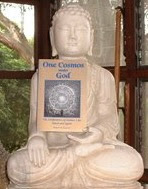
In a comment yesterday, Dupree linked to one of those cringe-inducing integralists whose writing is so bad that it causes physical pain in the aesthetically -- let alone, spiritually -- sensitive. As you know, unlike my competitors, when I speak of spiritual matters, I try to do so with precision and clarity, because so many of these creeps and con-men hide behind a bloviating cloud of cliché -ridden drivel, thereby giving God and religion a bad name to anyone with a functioning intellect.
While casting about the arkive for a Saturday repost, I found this one from two years ago, which fortuitously addresses some of these concerns.
****
For all that is good, or true, or beautiful, there exist counterfeit versions. In fact, this is one of the surest ways to know that objective truth, beauty and morality exist, because uncorrupted human beings have a built in way to recognize sham versions of them. But the operative word is “uncorrupted,” because it seems that most people actually prefer the counterfeit to the real -- which is odd, because why would someone prefer a cheap and tawdry imitation? There must be something about real truth, beauty, and goodness that cuts both ways, and makes the corrupt soul recoil and draw away from them.
Consider the fact, for example, that nearly all totalitarian regimes, such as Iran, hold “elections.” They also have a person called “president,” as if there is any analogy at all between an Iranian president and a United States president -- but he’s just a counterfeit version. Obviously there is no meaningful liberty or democracy in Iran, but the Mullahs must nevertheless pretend they exist. Who -- or what -- are they trying to fool? In other words, why don’t they just come out and say what they actually believe? Why the tribute that totalitarianism needs to pay to liberty? No matter how deeply the mullahs are plunged into the Lie, it seems that they still know the Truth -- just as the Soviets knew the truth. They also held sham elections to give the appearance of democracy.
And it is the same way with the American left, which is why they must always either lie about their ideas or couch them in more acceptable terms -- i.e., "undoing the Bush tax cuts" instead of raising your taxes, “redeployment” instead of surrendering to our enemies, “affirmative action” instead of racial discrimination, “civil rights” instead of special rights, “speech codes” instead of censoring non-leftist thought. When the left uses the tired phrase “speaking truth to power,” they nearly always mean “speaking seductive lies to the powerless in order to gain power over them.”
And the left certainly has its sham versions of courage, for example, giving a “free speech” award to a crude thug such as Sean Penn -- as if great courage, rather than craven conformity, is required for a Hollywood celebrity to criticize President Bush. He'd better be careful -- if he's any more critical of the President, he may be in danger of winning another Oscar.
Obviously counterfeit money can only work if there exists real money somewhere. The counterfeit money is entirely parasitic on the existence of sound money. Which makes the situation in American academia so ironic. American universities have become great bastions of counterfeit truth. What makes secular academia (again, we are always speaking of the liberal arts, not the sciences) such a spiritually sick institution is that it is as if only counterfeit truth is allowed. Imagine banning real money, but only allowing counterfeiters. Obviously, the counterfeit money would soon be valueless, because you couldn’t pass it off as “the real thing.” With multiculturalism, moral relativism, and deconstruction, each professor can be his own counterfeiter. Only monopoly money exists. But in order to make sure that your children obtain their share of this worthless monopoly money, it costs you real money -- what, $40,000 a year? Madness!
Yesterday [Political Correctness: Hammer of the Godless] I cited the example of how Dr. Dobson naively tried beat the intellectual bullies at their own game by using some of their academic funny money in support of real truth, and was soon attacked by the counterfeiters. The same thing would happen in Iran if a citizen there were to try to take their counterfeit democracy seriously. They would be liquidated by the counterfeiters. If people learn to recognize real money, then the counterfeiters are out of business.
Likewise, the U.N. is an entirely counterfeit institution that allows dictators and tyrants to be placed on the same moral plane as their liberal democratic counterparts. But who do the leftist counterfeiters denounce? John Bolton, because he sees the U.N. for the den of iniquity that it is, and seems constitutionally incapable of uttering counterfeit words. In the bizarro leftist world of Time Magazine, Ahmadinejad is a "champion of the dispossessed, a global Everyman." Can you imagine them saying that of John Bolton, who is a genuine champion of the dispossessed -- including those who are condemned to live under the global everymonster Ahamdinejad?
Counterfeiters have always flourished in the spiritual and religious arenas. But here again there is an upside, for the existence of these phony gurus and sham versions of religion let us know that the real things exist. The “new age” movement is overflowing with counterfeit spirituality, which bears the same relationship to real spirituality as the Iranian mullahs do to real democracy, or the left does to the truly liberal vision of America’s founders.
Yesterday we were visited by one of these types, who tried to pass some counterfeit bills in the Cosmos. One thing you will notice about the discerning Raccoon is that he is something of a spiritual treasury agent, like a regular Eliot Nous. For him, it is the work of an instant to detect a counterfeiter trying to pass phony spiritual ideas. Most of my readers are undoubtedly rather humble, so they may not stop to think about the implications of this ability, but it obviously means that they may be more in touch with the Treasury of Truth than even they realize. For if you can know it by its absence, you clearly have implicit knowledge of Truth. It’s just a matter of fleshing it out and making it more explicit.
This disingenuous counterfeiter, who called himself “Integralist” this time, wrote, “Wow, I'm a bit surprised. After reading Mr. Godwin's book about a year ago and seeing his name related with the budding ‘integral movement,’ I was rather surprised to find his blog such a haven of vitriol and non-integralism (I only just discovered it after reading his enjoyable interview in What Is Enlightenment?).”
We know right off the moonbat that this person is a liar and a counterfeiter, even if he doesn’t know it. Just because he “read” my book doesn’t mean he actually read it, much less understood it, for if he had understood it, he would know that it is part of no movement to integrate lies and truth. He claims that he is not a leftist but an “integralist” who aspires “towards a synthesis of liberalism and conservatism, the best of both -- not an outright castigation of one extreme in favor of the other.” He says “I've only browsed your website for about an hour, but please point me to a post that embodies an integral embrace of the important aspects of Left and Right? From what I've seen it is almost a spitting image of the same sort of vitriol that you and others here seem to revile in the Dark and Evil Leftist Empire.”
The whole point of leftism is that it is a counterfeit ideology par excellence. Any truth or beauty it possesses is merely a reflection of the real thing, nothing intrinsic to it, for it must always pretend that it is promulgating ideals that it specifically rejects -- just like the mullahs. In effect, what this reader would like for me to do is integrate the counterfeiters into my world view -- the phony image of truth with Truth -- and call it “integral.”
Let’s just look at some of the institutions that have already been taken over by the left, such as academia. Is it any coincidence that universities have become such factories of foolishness? There is no idea so crazy, vile, or stupid that it isn’t taught in a major university. And this is only possible because the university continues to benefit from its historical association with genuine liberalism, which promoted the disinterested pursuit of objective and timeless truth in order to actualize what is latent in the soul so as to be able to realize the good. Truth must always precede goodness. Political correctness is the very opposite of liberalism, for, as we saw yesterday, it dictates a certain narrow outcome ahead of time, thereby displacing both truth and being (from which truth flows) in one fallen swoop.
Of course, leftism also represents counterfeit compassion -- which is what is so annoying about the inane term “compassionate conservatism.” For in coining this misleading term, it was as if the treasury were trying to imitate the counterfeiters, instead of vice versa. There is nothing compassionate about racial discrimination masquerading as affirmative action, or economic innumeracy masquerading as “caring for the little guy,” or attacks on the foundations of civilization masquerading as “gay rights,” or judicial tyranny masquerading as “anti-discrimination,” or state censorship of ideological opponents masquerading as a "Fairness Doctrine." In each case the Truth must be known by the liar prior to the Lie.
Again, these leftist shams are only effective because they are parasites on the real thing: liberty, justice, the rule of law, compassion, free speech, etc. There is nothing “compassionate” about instituting a single payer health care system in which health care is rationed in the form of a six month wait to get an MRI for that tumor that is growing inside of you. There is nothing “just” about causing serious damage to the world’s economy based upon fanciful weather reports, thereby killing and impoverishing millions more people than if you do nothing. There is nothing “humane” about morally equating the only liberal democracy in the whole of the Middle East with the genocidal barbarians who wish to destroy it. And there is certainly nothing equitable about forcing people of modest means to subsidize the union greed that results in unskilled laborers receiving $70 an hour, or whatever it is. Talk about bad carma.
The leftist counterfeiters rely on your very liberality to elevate the lies that are death to real liberalism. These phony “integralists” attack me for my classical liberalism, as if they have the slightest interest in integrating my views with theirs. That’s just a lie. I challenge any of them to find an “integralist” who is as angry and hostile toward leftists as they are toward me. Let’s see the “integralist” who uses the same terms to attack a real monomaniacal nut like Al Gore, or a vicious anti-Semite like Jimmy Carter, or a paranoid, America-hating crank like Noam Chomsky, as they do to discredit me.
They’re not integralists. They’re just leftist counterfeiters trafficking in reflected light.
An astute reader pointed this out a couple of weeks ago. Truth is not a bottom-up, inductive, sum total of all the truths, half truths, lies, and stupid ideas of the world. Rather, truth is anterior to the minds that think it. As Bion wrote in his paradoxical way, the thinker is only required for the lie, in the sense that he must first know the truth in order to lie about it. Truth only requires that we conform ourselves to it. This is why most of the thinkers of the left are merely liars. And only a fool would mingle lies with truth and label it “integralism.”
Saturday, December 13, 2008


Friday, December 12, 2008
Come For the Fate, Stay for the Destiny (1.05.12)
That could be the motto of the coonical pslackologist, for our mind parasites subject us to fate, while our true self reveals our destiny. Fate and destiny, although often used in the same way, are actually -- for our purposes, anyway -- opposites. You might say that fate is the destiny imposed by your dead past, while destiny is the fate opened up by your living future. Let me explain.
Or better yet, let Bollas explain. The term "destiny drive" is taken from his book, Forces of Destiny, but he's really reframing established psychoanalytic ideas in a more modern theoretical context that sees the mind as intrinsically intersubjective and "object related" as opposed to being more like a hydraulic machine driven to discharge instinctual tension.
(I hate to get all pedantic on your asses, but this is an important point to get out of the way. In modern psychoanalytic theory, "object" mainly means "subject"; this is because classical psychoanalysis regarded subjects as merely the object of an instinctual discharge. When they shifted the focus to the subject, they retained the old nomenclature. Hence, modern psychoanalysis is confusingly called "object relations," when it would be more accurate to call it "subject relations." The shift is as profound as the move, say, from Newtonian to quantum physics, but it is as if they retained the old language.)
I don't want to get too bogged down in theory, but the point is that modern psychoanalysis focuses much more on the discovery, articulation, and elaboration of the true self, as opposed, say, to instinctual conflict between id and ego. Instincts are still important, but they are understood to operate in an irreducibly interpersonal field.
Now, the question is, how does the true self actualize and grow? Bollas's thesis is that it is through the discovery of one's unique idiom, which you might say is the signature of the true self: human idiom is that peculiarity of person(ality) that finds its own being through the particular selection and use of the object. In this sense, to be and to appropriate are one.
In other words, you might say that the true self is a preconceptual logos, or clueprint, that must find the objects it requires in order to elaborate itself and "live." In this regard, Bollas says that the self's idiom is "akin to a kind of personality speech, in which the lexical elements are not word signifiers but factors of personality."
There is no real being in the absence of this articulation of one's idiom, only a kind of paradoxical "negative being." Or, to turn it around, when you cannot articulate your idiom, your life will feel like a stifling prison, whatever the outward circumstances.
Hence what I was saying yesterday about the centrality of liberty. In the absence of liberty, it is very unlikely that you will be able to discover your own unique idiom, which is again the key to the articulation of the true self. Private property is a fundamental expression of (and requirement for) liberty, and the most precious property is one's self. But without secure private property, how can the self appropriate what it needs to speak its idiom? If those things are determined by the state, or by political correctness, the self is sharply constrained in its ability to find its real idiom.
You could also say that when you fail to find your idiom, you will feel as if you are haunted by a kind of fate that blankets your life, and from which you cannot escape. More on which below.
In the introduction to the book, Bollas speaks of his own child, and I am sure most of you parents out there will fully relate: "What struck me was how he was who he is from scratch. He seemed to be in possession of his own personality, his very own unique configuration in being (what I term an idiom) that has never really changed in itself."
In cogitating on this common observation, Bollas simply transferred this awareness to the therapeutic setting, and realized that one of his primary functions as a therapist was to be of assistance to the patient "for private articulations of his personality potential -- which could only be accomplished by eliciting different elements of my own personality." Bollas realized that in order to do this, he had to temporarily ignore his own idiom so as to "be" what the patient required of him at any given time. (Here again, you parents out there will relate.)
Here you can see the problem. A patient comes into therapy because they are bogged down by their fate. Something happened early in life that foreclosed their destiny, and now they don't know how to find it, because it is buried beneath so much life history, forced choices, defensive adaptations, etc. But the true self is still there, seeking a way to express itself and be. This innate urge to articulate the true self is what Bollas calls the destiny drive. The therapist's job is to serve as a mediator, or midwife, in the birth of this latent self.
Now, what is this true self, phenomenologically speaking? I would say that it is aliveness itself, only transposed to the key of mind, or consciousness. Although difficult to define, one can see it as a kind of red thread that runs through one's life. You definitely know when it has been touched, and it is obviously critical to pay attention to these sometimes subtle moments of contact, in order to "find your way."
The odd thing is that the true self is obviously a form of "knowledge," but it is more in terms of inclinations to "perceive, organize, remember, and use" the world in a certain way. When there is a good fit between idiom and world, it brings with it a very specific form of "joy," which Bollas has elsewhere called "the erotics of being." For example, the joy some people find in this blog is simply a case of finding your idiom mirrored to you in a satisfying way, so that you become aware of your own true self. One can only wonder why our jester is addicted to a foreign idiom that can bring him no joy or peace.
We not only require people to articulate our idiom, but material objects, books, films, music, hobbies. As Bollas says, we could conduct a kind of "person anthropology" by paying attention to the objects chosen by this or that person. I know that this blog is as unique as my fingerprint, in that it represents the fruit of my own inimitable selection of objects and subjects for the articulation of my being. I don't have many readers, but I suppose it's surprising that I have any, given how personal it is.
Back to the idea of destiny vs. fate. According to Bollas, only in modern times do we begin to see an increasing distinction between the two terms, so that destiny begins to take on more positive connotations -- the idea that "one can fulfill one's destiny if one is fortunate, if one is determined, if one is aggressive enough" The whole idea of destiny could only take root once people gained a degree of economic and cultural freedom, and were "able to take some control of their lives and chart their future." (One can well understand why America is the land of the "true self," at least for conservatives, whereas liberal victimology represents the perverse erotics of fate; don't think for one moment that people do not take perverse and sadistic pleasure in their victim status.)
But fate has very different connotations. Again, it results in being "pushed around" by the past instead of "lured" by the future. The more one is fated -- in particular, by mind parasites -- the less one can manifest one's destiny. (I am sure it would be fruitful to meditate on the implications of this as they pertain to the idea of predestination, which can either be enslaving or liberating, depending upon how it is understood.)
Now, when a patient comes in for treatment, it is often because they are a victim of fate, or the Curse of the Mind Parasites: "The person who is ill and comes to analysis either because of neurotic symptoms, or characterological fissures, or psychotic ideas and pains, can be described as a fated person. That is, he is suffering from something which he can specify and which has a certain power in his life to seriously interfere with his capacity to work, find pleasure, or form intimate relationships."
Bollas says that "we can use the idea of fate to describe the sense a person may have, determined by a life history, that his true self has not been met and facilitated into lived experience. A person who feels fated is already someone who has not experienced reality as conducive to the fulfillment of his inner idiom."
Okay, let's pause, take a breath, and reflect on these ideas in more personal terms.
Nah, let's just stop for now. To be continued.
***
Related idiom @ American Digest, The Star:
To see something special. To see something beyond yourself and your imaginings. To follow it wherever it leads. To always remain prepared for miracle[s]. That is the inner music of the story of The Star. Like all stories that survive, it is the music of the heart and not of the head, and like the heart, it will endure.
Or better yet, let Bollas explain. The term "destiny drive" is taken from his book, Forces of Destiny, but he's really reframing established psychoanalytic ideas in a more modern theoretical context that sees the mind as intrinsically intersubjective and "object related" as opposed to being more like a hydraulic machine driven to discharge instinctual tension.
(I hate to get all pedantic on your asses, but this is an important point to get out of the way. In modern psychoanalytic theory, "object" mainly means "subject"; this is because classical psychoanalysis regarded subjects as merely the object of an instinctual discharge. When they shifted the focus to the subject, they retained the old nomenclature. Hence, modern psychoanalysis is confusingly called "object relations," when it would be more accurate to call it "subject relations." The shift is as profound as the move, say, from Newtonian to quantum physics, but it is as if they retained the old language.)
I don't want to get too bogged down in theory, but the point is that modern psychoanalysis focuses much more on the discovery, articulation, and elaboration of the true self, as opposed, say, to instinctual conflict between id and ego. Instincts are still important, but they are understood to operate in an irreducibly interpersonal field.
Now, the question is, how does the true self actualize and grow? Bollas's thesis is that it is through the discovery of one's unique idiom, which you might say is the signature of the true self: human idiom is that peculiarity of person(ality) that finds its own being through the particular selection and use of the object. In this sense, to be and to appropriate are one.
In other words, you might say that the true self is a preconceptual logos, or clueprint, that must find the objects it requires in order to elaborate itself and "live." In this regard, Bollas says that the self's idiom is "akin to a kind of personality speech, in which the lexical elements are not word signifiers but factors of personality."
There is no real being in the absence of this articulation of one's idiom, only a kind of paradoxical "negative being." Or, to turn it around, when you cannot articulate your idiom, your life will feel like a stifling prison, whatever the outward circumstances.
Hence what I was saying yesterday about the centrality of liberty. In the absence of liberty, it is very unlikely that you will be able to discover your own unique idiom, which is again the key to the articulation of the true self. Private property is a fundamental expression of (and requirement for) liberty, and the most precious property is one's self. But without secure private property, how can the self appropriate what it needs to speak its idiom? If those things are determined by the state, or by political correctness, the self is sharply constrained in its ability to find its real idiom.
You could also say that when you fail to find your idiom, you will feel as if you are haunted by a kind of fate that blankets your life, and from which you cannot escape. More on which below.
In the introduction to the book, Bollas speaks of his own child, and I am sure most of you parents out there will fully relate: "What struck me was how he was who he is from scratch. He seemed to be in possession of his own personality, his very own unique configuration in being (what I term an idiom) that has never really changed in itself."
In cogitating on this common observation, Bollas simply transferred this awareness to the therapeutic setting, and realized that one of his primary functions as a therapist was to be of assistance to the patient "for private articulations of his personality potential -- which could only be accomplished by eliciting different elements of my own personality." Bollas realized that in order to do this, he had to temporarily ignore his own idiom so as to "be" what the patient required of him at any given time. (Here again, you parents out there will relate.)
Here you can see the problem. A patient comes into therapy because they are bogged down by their fate. Something happened early in life that foreclosed their destiny, and now they don't know how to find it, because it is buried beneath so much life history, forced choices, defensive adaptations, etc. But the true self is still there, seeking a way to express itself and be. This innate urge to articulate the true self is what Bollas calls the destiny drive. The therapist's job is to serve as a mediator, or midwife, in the birth of this latent self.
Now, what is this true self, phenomenologically speaking? I would say that it is aliveness itself, only transposed to the key of mind, or consciousness. Although difficult to define, one can see it as a kind of red thread that runs through one's life. You definitely know when it has been touched, and it is obviously critical to pay attention to these sometimes subtle moments of contact, in order to "find your way."
The odd thing is that the true self is obviously a form of "knowledge," but it is more in terms of inclinations to "perceive, organize, remember, and use" the world in a certain way. When there is a good fit between idiom and world, it brings with it a very specific form of "joy," which Bollas has elsewhere called "the erotics of being." For example, the joy some people find in this blog is simply a case of finding your idiom mirrored to you in a satisfying way, so that you become aware of your own true self. One can only wonder why our jester is addicted to a foreign idiom that can bring him no joy or peace.
We not only require people to articulate our idiom, but material objects, books, films, music, hobbies. As Bollas says, we could conduct a kind of "person anthropology" by paying attention to the objects chosen by this or that person. I know that this blog is as unique as my fingerprint, in that it represents the fruit of my own inimitable selection of objects and subjects for the articulation of my being. I don't have many readers, but I suppose it's surprising that I have any, given how personal it is.
Back to the idea of destiny vs. fate. According to Bollas, only in modern times do we begin to see an increasing distinction between the two terms, so that destiny begins to take on more positive connotations -- the idea that "one can fulfill one's destiny if one is fortunate, if one is determined, if one is aggressive enough" The whole idea of destiny could only take root once people gained a degree of economic and cultural freedom, and were "able to take some control of their lives and chart their future." (One can well understand why America is the land of the "true self," at least for conservatives, whereas liberal victimology represents the perverse erotics of fate; don't think for one moment that people do not take perverse and sadistic pleasure in their victim status.)
But fate has very different connotations. Again, it results in being "pushed around" by the past instead of "lured" by the future. The more one is fated -- in particular, by mind parasites -- the less one can manifest one's destiny. (I am sure it would be fruitful to meditate on the implications of this as they pertain to the idea of predestination, which can either be enslaving or liberating, depending upon how it is understood.)
Now, when a patient comes in for treatment, it is often because they are a victim of fate, or the Curse of the Mind Parasites: "The person who is ill and comes to analysis either because of neurotic symptoms, or characterological fissures, or psychotic ideas and pains, can be described as a fated person. That is, he is suffering from something which he can specify and which has a certain power in his life to seriously interfere with his capacity to work, find pleasure, or form intimate relationships."
Bollas says that "we can use the idea of fate to describe the sense a person may have, determined by a life history, that his true self has not been met and facilitated into lived experience. A person who feels fated is already someone who has not experienced reality as conducive to the fulfillment of his inner idiom."
Okay, let's pause, take a breath, and reflect on these ideas in more personal terms.
Nah, let's just stop for now. To be continued.
***
Related idiom @ American Digest, The Star:
To see something special. To see something beyond yourself and your imaginings. To follow it wherever it leads. To always remain prepared for miracle[s]. That is the inner music of the story of The Star. Like all stories that survive, it is the music of the heart and not of the head, and like the heart, it will endure.
Thursday, December 11, 2008
Normal, Anti-Normal, and Trans-Normal (1.04.12)
There seems to have been a bit of confusion yesterday in at least one reader, who compares our approach to that of the psycho-cultural left, but there is really no similarity. The whole point of my thesis (or Bollas's thesis) is that the normotic is not normal; rather, he has a pseudo-normality that conceals and oppresses a true self which has been developmentally stunted somewhere along the way. As the reader sarcaustically put it, "Normality is oppression! Be a non-conformist! Free your authentic self from the constraints of bourgeois morality!"
Please. This is not my point. Rather, I am coming at it from a conservative classical liberal point of view, in which (to paraphrase someone), individuality is freedom lived. But one might just as well say that freedom is individuality lived. It should go without saying that you are only truly free when you are yourself. Otherwise, who is free? And for what?
Actually, I prefer "liberty," which is perhaps the second most important Raccoon macro-value after truth (in fact, you cannot have one without the other, for one must be free to discover truth, and truth is what sets one free; this is why the compulsory truth of political correctness, or of reductionistic Darwinism, is an intrinsic contradiction).
You might say that Truth + Liberty = Authentic Being. Being that the left denies absolute or transcendental truth, you can see that we have nothing in common. And being that they believe in positive liberties granted by the state instead of negative ones conferred by the Creator, there is again no common measure between us. The leftist substitutes for timeless truth the petty dictates of time-bound political correctness, which strangles the self and nourishes the hardened collective ego.
I could go on, but you get the point. Belief in permanent truths results in the ordered liberty, or "disciplined mischief," of the Raccoon. To deny them results in mere horizontal license, and in a system that cannot be sustained. To the extent that these people appear "unconventional," it is in an entirely conventional and drearily conformist manner (the "herd of independent minds"). There is nothing creative about a Madonna. She can only engage in a kind of parasitic "anti-normotic" illness that mimics actual creativity and true selfhood.
It is the same with many homosexual disturbances, which may superficially seem so "out there" but are really just a form of psychic slave rebellion. As Bollas writes, "the homosexual's adornment in exaggerated representations of the subjective element can be a defiance of the normotic way of life. Where the normotic parent may have stressed 'reasonable' thinking, the homosexual may espouse the superiority of anti-reason. Where the normotic parent never tolerated the controversial, the homosexual may become perversely addicted to collecting controversies."
Bollas adds that compulsive sexual promiscuity among homosexuals "has the character of a material phenomenon, and is in part an inverted representation of the normotic illness." Honest and self-aware homosexuals will know exactly what Bollas is referring to. The rest will feel victimized, which is to take a secret pleasure in participating in one's own self-subjection. It is also abnormal, so you can't win.
It seems that this topic of normotic illness struck a resonant chord in many readers, which surprises me, since I was just riffing off the top of my head as a prelude to moving on to the last arcanum, The World. We'll get to that later, but I think you'll see that the two themes tie together, because the point of that card is to meditate on the idea of the world as a work of art, and the real artist is an example of "freedom lived," or of potential actualized, at least in the aesthetic sphere.
For example, in a banalogy I have used before, I am "free" to play the saxophone, but not in any meaningful way, unless I undergo the years of discipline it takes to transcend "mere freedom" and transform it into something higher. Although, say, Hank Mobley, was much more constrained than I am when he picked up a sax, those musical constraints -- or boundary conditions -- are precisely analogous to the intrinsic truths that allow the self to ascend to its proper soul station.
Just so, to deny the intrinsic spiritual truths that in-form the soul is like trying to play the sax without harmony, melody, chords, etc. But conversely, to only conform to these moral truths in a rigid, exterior way, without realizing and assimilating their inner meaning, can result in a superficially good and decent person, but still, something will be missing. That something is the true self. And for the true self, truth, virtue, and beauty are consciousness of a plane of reality, not conformity to a rigid exterior model. I don't just want my son to "be good." Rather, I want him to understand goodness. Nor do I want him to merely obtain good grades without being intelligent.
So we see right away that our essentialist idea of a true self parts ways with the existentialists in all their variety, who believe that the self is entirely self-made, so to speak. First of all, the true self cannot possibly be self-made -- any more than you could make your liver or kidneys. It is an organ, except that it is a multi-dimensional organ that transcends space and time, at least to a certain extent. But the fact that the self may know timeless truth proves that its ultimate source is outside time.
Like all other organs, the self requires time in order to reach maturity. But the function of the self is much more complex compared to, say, the kidneys, which mostly filter blood. The self, on the other hand, has the ongoing task of metabolizing and synthesizing internal, external, past, present, and transpersonal experience into a higher subjective unity. This is why you might say that the self is man's first "hyperdimensional virtual organ," so to speak. It is just as busy as the heart or lungs, except that it accomplishes its feats in a higher space that obviously exceeds three or four dimensions (cf. the phenomenon of dreaming).
In turn, this is why the normotic personality may appear outwardly normal, even while living a life in which he systematically denies the sufficient reason for man's existence. From the human standpoint, it can never be "normal" to be a radical atheist or leftist, for both of these categories prevent man from discovering transcendent truth and becoming what he is -- from actualizing his real nonlocal potential.
Yesterday I mentioned the "destiny drive," which is to the self as final cause is to biology. Biology is incoherent in the absence of final causation, in that each organ obviously has a function to fulfill within the context of the whole, and failure to achieve this function is the very definition of pathology. In other words, we can only know about sickness because there is a thing called "health" (which with good reason is etymologically related to wholeness). For example, I have a diseased pancreas, because it doesn't spit out insulin in the way it was designed to.
But what was the Self designed to do? If you are a Darwinist, it is a moot question, because the self reduces to biology, which in turn reduces to physics, which has no purpose. This down-and-backward looking metaphysic hurls the self against the dead rocks of the cosmic past, so it can actualize no intrinsically real future, i.e., destiny.
Let's talk about the self's destiny drive, and define it with more precision. Tomorrow.
Please. This is not my point. Rather, I am coming at it from a conservative classical liberal point of view, in which (to paraphrase someone), individuality is freedom lived. But one might just as well say that freedom is individuality lived. It should go without saying that you are only truly free when you are yourself. Otherwise, who is free? And for what?
Actually, I prefer "liberty," which is perhaps the second most important Raccoon macro-value after truth (in fact, you cannot have one without the other, for one must be free to discover truth, and truth is what sets one free; this is why the compulsory truth of political correctness, or of reductionistic Darwinism, is an intrinsic contradiction).
You might say that Truth + Liberty = Authentic Being. Being that the left denies absolute or transcendental truth, you can see that we have nothing in common. And being that they believe in positive liberties granted by the state instead of negative ones conferred by the Creator, there is again no common measure between us. The leftist substitutes for timeless truth the petty dictates of time-bound political correctness, which strangles the self and nourishes the hardened collective ego.
I could go on, but you get the point. Belief in permanent truths results in the ordered liberty, or "disciplined mischief," of the Raccoon. To deny them results in mere horizontal license, and in a system that cannot be sustained. To the extent that these people appear "unconventional," it is in an entirely conventional and drearily conformist manner (the "herd of independent minds"). There is nothing creative about a Madonna. She can only engage in a kind of parasitic "anti-normotic" illness that mimics actual creativity and true selfhood.
It is the same with many homosexual disturbances, which may superficially seem so "out there" but are really just a form of psychic slave rebellion. As Bollas writes, "the homosexual's adornment in exaggerated representations of the subjective element can be a defiance of the normotic way of life. Where the normotic parent may have stressed 'reasonable' thinking, the homosexual may espouse the superiority of anti-reason. Where the normotic parent never tolerated the controversial, the homosexual may become perversely addicted to collecting controversies."
Bollas adds that compulsive sexual promiscuity among homosexuals "has the character of a material phenomenon, and is in part an inverted representation of the normotic illness." Honest and self-aware homosexuals will know exactly what Bollas is referring to. The rest will feel victimized, which is to take a secret pleasure in participating in one's own self-subjection. It is also abnormal, so you can't win.
It seems that this topic of normotic illness struck a resonant chord in many readers, which surprises me, since I was just riffing off the top of my head as a prelude to moving on to the last arcanum, The World. We'll get to that later, but I think you'll see that the two themes tie together, because the point of that card is to meditate on the idea of the world as a work of art, and the real artist is an example of "freedom lived," or of potential actualized, at least in the aesthetic sphere.
For example, in a banalogy I have used before, I am "free" to play the saxophone, but not in any meaningful way, unless I undergo the years of discipline it takes to transcend "mere freedom" and transform it into something higher. Although, say, Hank Mobley, was much more constrained than I am when he picked up a sax, those musical constraints -- or boundary conditions -- are precisely analogous to the intrinsic truths that allow the self to ascend to its proper soul station.
Just so, to deny the intrinsic spiritual truths that in-form the soul is like trying to play the sax without harmony, melody, chords, etc. But conversely, to only conform to these moral truths in a rigid, exterior way, without realizing and assimilating their inner meaning, can result in a superficially good and decent person, but still, something will be missing. That something is the true self. And for the true self, truth, virtue, and beauty are consciousness of a plane of reality, not conformity to a rigid exterior model. I don't just want my son to "be good." Rather, I want him to understand goodness. Nor do I want him to merely obtain good grades without being intelligent.
So we see right away that our essentialist idea of a true self parts ways with the existentialists in all their variety, who believe that the self is entirely self-made, so to speak. First of all, the true self cannot possibly be self-made -- any more than you could make your liver or kidneys. It is an organ, except that it is a multi-dimensional organ that transcends space and time, at least to a certain extent. But the fact that the self may know timeless truth proves that its ultimate source is outside time.
Like all other organs, the self requires time in order to reach maturity. But the function of the self is much more complex compared to, say, the kidneys, which mostly filter blood. The self, on the other hand, has the ongoing task of metabolizing and synthesizing internal, external, past, present, and transpersonal experience into a higher subjective unity. This is why you might say that the self is man's first "hyperdimensional virtual organ," so to speak. It is just as busy as the heart or lungs, except that it accomplishes its feats in a higher space that obviously exceeds three or four dimensions (cf. the phenomenon of dreaming).
In turn, this is why the normotic personality may appear outwardly normal, even while living a life in which he systematically denies the sufficient reason for man's existence. From the human standpoint, it can never be "normal" to be a radical atheist or leftist, for both of these categories prevent man from discovering transcendent truth and becoming what he is -- from actualizing his real nonlocal potential.
Yesterday I mentioned the "destiny drive," which is to the self as final cause is to biology. Biology is incoherent in the absence of final causation, in that each organ obviously has a function to fulfill within the context of the whole, and failure to achieve this function is the very definition of pathology. In other words, we can only know about sickness because there is a thing called "health" (which with good reason is etymologically related to wholeness). For example, I have a diseased pancreas, because it doesn't spit out insulin in the way it was designed to.
But what was the Self designed to do? If you are a Darwinist, it is a moot question, because the self reduces to biology, which in turn reduces to physics, which has no purpose. This down-and-backward looking metaphysic hurls the self against the dead rocks of the cosmic past, so it can actualize no intrinsically real future, i.e., destiny.
Let's talk about the self's destiny drive, and define it with more precision. Tomorrow.
Wednesday, December 10, 2008
Will You Join Me in My Fight Against the Scourge of Normality? (1.04.12)
What causes the tragedy of normality? You might say that it is a result of an immaculate conception, minus the conception. Or perhaps a misconception. That is, as Bollas explains, "it is striking how this person [the Normal] seems to be unborn." They often appear to be "content and happy" on the surface, but are "lost in the concrete," so to speak, and never make the full leap into the "originating subjectivity which informs our use of the symbolic."
And "since he does not perceive himself as a subject, he does not ask to be seen by the other," nor is he able to look deeply into the other. That italicized part is key, for these people have no conscious desire for true subject-to-subject contact. They cannot make real contact with themselves, and therefore, others.
In the past, I have posted about how quickly one may determine this capacity in the other, as it will be felt as an almost physical constraint that you cannot get past. The real tragedy is that you have to imagine what it is like for an infant -- who knows no such restrictions -- to be raised by such a constricted parent. In order to adapt to this kind of parent, the infant will have to gradually excise parts of himself, so that he too becomes a psychic stillborn.
I am aware of a vast difference between my parents' ability to know me, vs. my ability to know my child. I was very aware from an early age that my parents mostly interacted with an image of me instead of the actual me, and I think this is what saved me. Had I not been aware of this failure on their part, I too may have met the fate of the unborn. My son won't have that problem. But, of course, what he does with his birth is another thing altogether. Being vibrantly alive is not necessarily synonymous with being virtuous. It just saves you from being among the ranks of the living dead.
Here is how Bollas describes it: "At the most fundamental level, the normotic was only partly seen by the mother and father, mirrored by parents whose reflective ability was dulled, yielding only the glimmer of an outline of self to a child." This is an example of something that is as deeply problematic as, say, the need to vaccinate all children against various diseases. But because it is in the realm of the subjective, no one really talks about it.
Furthermore, it is not particularly dramatic, being that such children typically do not suffer material deprivation. The problem is that "neither of the parents is inclined towards the celebration of the child's imaginative life." And when they do enter play, it has a kind of covert sadism that terminates the play and brings the child back to reality instead of further into imagination.
Have you ever seen this take place? I certainly have. Again, we have already lost friends because we let our child play with imaginary guns to shoot imaginary bad guys. With relish. But to deny a boy his manly aggressiveness is a psychic castration. The aggression won't just magically disappear, but return in a disguised and dysfunctional form; I'm thinking of someone like Keith Olbermann, who just bristles with a kind of toxic, infantile rage. But he seems emblematic of much of the "new castrati" (as Vanderleun calls them) of the left. One could say the same of dailykos.
Now that I have a child, I am even more aware of how some parents interact with their children in such a way as to guarantee a psychic catastrophe. Frankly, it is quite painful to observe, because you naturally empathize with the poor child, who is undergoing a slow psychic death before your eyes. When the parent fails to respond to who the child actually is, the unrecognized parts become "negative hallucinations," or "not there" particles that float aimlessly around the psyche. Then, when the child reaches adolescence, he is suddenly thrust into "the horrifying dilemma of being unable to symbolize his pain." Predictable consequences follow.
It's not really a big mystery why humans are the way they are, and why they are such persistent underachievers. They just keep doing to the next generation what was done to them. True, mankind is "fallen," but there are nevertheless covert mechanisms through which the fall operates. It's not just magic.
There is a "dialectic of death" between the normotic parent and child, which conspires to suppress "the creative expression of the inner core of the self." Looking back on it, I believe this is why my first real relationship was such a catastrophe, because I was so "hungry" for this kind of contact, in a way that far exceeded the bounds of the relationship. Therefore, when the relationship ended, it was like the conscious experience of a psychic death that must have actually occurred previously, only unconsciously. In hindsight, I can see that this was totally inevitable. I'm just glad I got it out of the way at 18 instead of 40 or 50.
Bollas says that he does not fully understand "why some children give in to such a family atmosphere and become normotic, and why others do not." Psychology is not deterministic. For example, while most children are naturally traumatized by abuse, some children seem to emerge unscathed. Likewise, some children are just so temperamentally sensitive that they are crushed by the most benign empathic failures on the part of the parents. So a lot of this is no doubt temperamental, to differing degrees in different people. Some people are born with such a strong "destiny drive," that it seems that nothing can stop them from becoming what they were meant to be. Other people can be blessed with ideal circumstances and become nothing.
Many people escape normotic parents by becoming rebellious. One thinks of the drug-addicted child of a robot such as Al Gore, or the delinquent child of a fundamentalist preacher. But rebellion is not freedom; rather, it is a kind of knee-jerk reaction to unfreedom, which is what makes it so infantile and wearisome, like the entirely predictable lives of rock stars and other celebrities. It's hard to think of anything more pathetic than, say, the Rolling Stones, still singing their adolescent songs of rebellion at the age of 65 or 70. Creepy.
Bollas suggests that perhaps the children who escape normotic parents "find a way to be mirrored even if the parents are not providing this." I am quite sure that this is what happened with me. I found other models that served this mirroring function, and in looking back on it, I can see that it clearly wasn't a chance phenomenon, at least not totally. That is, my unborns were looking for particular exemplars to assist in their own birth. A fair number of people have testified that this very blog has been instrumental in helping to bring their unborns into the world, and for that I am profoundly grateful. Didn't Socrates consider himself to be nothing more than a humble midwife?
Here is another subtle point that I am sure is accurate: "I think it is highly likely that the children who give in to the normotic element perceive in the parents' way of being a form of hate that we might conceptualize as a death instinct." It is not necessarily the case that the child feels hated by the parent. Rather, "it may be more accurate to say that the child experiences the parents' attack on life itself, and that such a parent is trying to squeeze the life out of existence."
It is more the case that the intense frustration provoked by the normotic parents engenders a kind of hatred that can at times boil over. To this day, I still have the occasional dream in which my parents simply do not understand, which always causes a kind of unbearable frustration. Again, I hate to think what would have become of me had I not been consciously aware of this frustration early on, or if I had blamed myself for it.
I think of the British royal family, which seems like a vast, intergenerational conspiracy of psychic murder -- which in turn leads to all the crazy acting out. Princess Di was unwelcome in this environment, because her craziness was way too close to the surface, and unable to be tamped down by the royal death instinct. She was the wrong kind of crazy. In such a psychic environment, "parent and child organize a foreclosure of the human mentality. They find a certain intimacy in shutting down life together, and in mastering existence with the unconscious skill of a military operation."
Have you all seen the outstanding film, The Queen? I think it captures this beautifully. In fact, come to think of it, so too does the film Ordinary People, which uses the literal death of a child as a metaphor for the psychic death of the family. And just as in this post, the psychologist is the gallant superhero who slays the unconscious dragon.
And "since he does not perceive himself as a subject, he does not ask to be seen by the other," nor is he able to look deeply into the other. That italicized part is key, for these people have no conscious desire for true subject-to-subject contact. They cannot make real contact with themselves, and therefore, others.
In the past, I have posted about how quickly one may determine this capacity in the other, as it will be felt as an almost physical constraint that you cannot get past. The real tragedy is that you have to imagine what it is like for an infant -- who knows no such restrictions -- to be raised by such a constricted parent. In order to adapt to this kind of parent, the infant will have to gradually excise parts of himself, so that he too becomes a psychic stillborn.
I am aware of a vast difference between my parents' ability to know me, vs. my ability to know my child. I was very aware from an early age that my parents mostly interacted with an image of me instead of the actual me, and I think this is what saved me. Had I not been aware of this failure on their part, I too may have met the fate of the unborn. My son won't have that problem. But, of course, what he does with his birth is another thing altogether. Being vibrantly alive is not necessarily synonymous with being virtuous. It just saves you from being among the ranks of the living dead.
Here is how Bollas describes it: "At the most fundamental level, the normotic was only partly seen by the mother and father, mirrored by parents whose reflective ability was dulled, yielding only the glimmer of an outline of self to a child." This is an example of something that is as deeply problematic as, say, the need to vaccinate all children against various diseases. But because it is in the realm of the subjective, no one really talks about it.
Furthermore, it is not particularly dramatic, being that such children typically do not suffer material deprivation. The problem is that "neither of the parents is inclined towards the celebration of the child's imaginative life." And when they do enter play, it has a kind of covert sadism that terminates the play and brings the child back to reality instead of further into imagination.
Have you ever seen this take place? I certainly have. Again, we have already lost friends because we let our child play with imaginary guns to shoot imaginary bad guys. With relish. But to deny a boy his manly aggressiveness is a psychic castration. The aggression won't just magically disappear, but return in a disguised and dysfunctional form; I'm thinking of someone like Keith Olbermann, who just bristles with a kind of toxic, infantile rage. But he seems emblematic of much of the "new castrati" (as Vanderleun calls them) of the left. One could say the same of dailykos.
Now that I have a child, I am even more aware of how some parents interact with their children in such a way as to guarantee a psychic catastrophe. Frankly, it is quite painful to observe, because you naturally empathize with the poor child, who is undergoing a slow psychic death before your eyes. When the parent fails to respond to who the child actually is, the unrecognized parts become "negative hallucinations," or "not there" particles that float aimlessly around the psyche. Then, when the child reaches adolescence, he is suddenly thrust into "the horrifying dilemma of being unable to symbolize his pain." Predictable consequences follow.
It's not really a big mystery why humans are the way they are, and why they are such persistent underachievers. They just keep doing to the next generation what was done to them. True, mankind is "fallen," but there are nevertheless covert mechanisms through which the fall operates. It's not just magic.
There is a "dialectic of death" between the normotic parent and child, which conspires to suppress "the creative expression of the inner core of the self." Looking back on it, I believe this is why my first real relationship was such a catastrophe, because I was so "hungry" for this kind of contact, in a way that far exceeded the bounds of the relationship. Therefore, when the relationship ended, it was like the conscious experience of a psychic death that must have actually occurred previously, only unconsciously. In hindsight, I can see that this was totally inevitable. I'm just glad I got it out of the way at 18 instead of 40 or 50.
Bollas says that he does not fully understand "why some children give in to such a family atmosphere and become normotic, and why others do not." Psychology is not deterministic. For example, while most children are naturally traumatized by abuse, some children seem to emerge unscathed. Likewise, some children are just so temperamentally sensitive that they are crushed by the most benign empathic failures on the part of the parents. So a lot of this is no doubt temperamental, to differing degrees in different people. Some people are born with such a strong "destiny drive," that it seems that nothing can stop them from becoming what they were meant to be. Other people can be blessed with ideal circumstances and become nothing.
Many people escape normotic parents by becoming rebellious. One thinks of the drug-addicted child of a robot such as Al Gore, or the delinquent child of a fundamentalist preacher. But rebellion is not freedom; rather, it is a kind of knee-jerk reaction to unfreedom, which is what makes it so infantile and wearisome, like the entirely predictable lives of rock stars and other celebrities. It's hard to think of anything more pathetic than, say, the Rolling Stones, still singing their adolescent songs of rebellion at the age of 65 or 70. Creepy.
Bollas suggests that perhaps the children who escape normotic parents "find a way to be mirrored even if the parents are not providing this." I am quite sure that this is what happened with me. I found other models that served this mirroring function, and in looking back on it, I can see that it clearly wasn't a chance phenomenon, at least not totally. That is, my unborns were looking for particular exemplars to assist in their own birth. A fair number of people have testified that this very blog has been instrumental in helping to bring their unborns into the world, and for that I am profoundly grateful. Didn't Socrates consider himself to be nothing more than a humble midwife?
Here is another subtle point that I am sure is accurate: "I think it is highly likely that the children who give in to the normotic element perceive in the parents' way of being a form of hate that we might conceptualize as a death instinct." It is not necessarily the case that the child feels hated by the parent. Rather, "it may be more accurate to say that the child experiences the parents' attack on life itself, and that such a parent is trying to squeeze the life out of existence."
It is more the case that the intense frustration provoked by the normotic parents engenders a kind of hatred that can at times boil over. To this day, I still have the occasional dream in which my parents simply do not understand, which always causes a kind of unbearable frustration. Again, I hate to think what would have become of me had I not been consciously aware of this frustration early on, or if I had blamed myself for it.
I think of the British royal family, which seems like a vast, intergenerational conspiracy of psychic murder -- which in turn leads to all the crazy acting out. Princess Di was unwelcome in this environment, because her craziness was way too close to the surface, and unable to be tamped down by the royal death instinct. She was the wrong kind of crazy. In such a psychic environment, "parent and child organize a foreclosure of the human mentality. They find a certain intimacy in shutting down life together, and in mastering existence with the unconscious skill of a military operation."
Have you all seen the outstanding film, The Queen? I think it captures this beautifully. In fact, come to think of it, so too does the film Ordinary People, which uses the literal death of a child as a metaphor for the psychic death of the family. And just as in this post, the psychologist is the gallant superhero who slays the unconscious dragon.
Tuesday, December 09, 2008
The Tyranny of Normality and the Unsanity Defense (1.03.12)
Is there anything else we need to say about The Fool before moving on to The World? Yes, I think so. In The Spiritual Ascent, Perry discusses divine madness, the seeming "mindlessness" of many of those "who have transcended the purely rational faculties."
God himself is crazy, and being is his fine madness. This was the opinion of no less a gnut than Meister Eckhart, who observed that "God's idiosyncrasy is being" (quoted in Perry) -- Being being the first exteriorization, or precipitate, of the creative Godhead beyond being. Which is why, as Plato expressed it, "the madness that comes of God is superior to the sanity which is of human origin."
Now, typically, it is the extreme bhakta --the God lover -- who most exhibits the signs of the divine madness -- weeping, pining, carrying on. But the way of the Raccoon is to filter that same madness through the jnanic, or contemplative, temperament -- which results in the sort of linguistic post-normality you have come to expect from Dear Leader. Rules of grammar, or spelling, or sentence construction -- well, we just don't care. But we always break the rules from above, never below -- unlike, say, the barbarian shorthand of the instant messengers.
If you look at culture as a sort of boundary -- a necessary boundary, by the way, because a King Bee can't do no stingin' without a hive -- anyone who does not stay within the lines will be regarded as "mad," or a fool, irrespective of whether they fall below or above its expectations. Think of our jester as a particularly nasty case of chronic, even terminal, normality. A Normotic Personality Disorder, if you will.
As a matter of fact, back when I myself was hoping to be more normal, I considered publishing a paper on this topic, because it is something one routinely encounters in clinical practice, not to mention day-to-day life. In a certain sense, to be "normal" is to be partially dead, unless one is aware of the fact that one is only behaving normally in order to "pass." To put it in Raccoon argot, "if you're not eccentric, you're wrong." But we do not necessarily advertise our eccentricity in the wrong circles. That's not proper madness, that's just stupidity.
Perry also cites the example of Omar Khayam, "whose wisdom clothed in frivolity is opposed to Pharisaism clothed in piety." As Schuon put it, "if religious hypocrisy is possible, the contrary paradox must equally be so." In other words, if I were to pretend to be normal, I would be a rank hypocrite.
Christopher Bollas discusses what he calls the "normotic personality," which might very well describe the anti-Coon. On the one hand, therapists often deal with patients who are limited by a weak sense of reality. But just as often, one encounters people who, as Winicott expressed it, "are so firmly anchored in objectively perceived reality that they are ill in the opposite direction of being out of touch with the subjective world and with the creative approach to fact" (quoted in Bollas; keep this in mind when we discuss the next arcanum, The World).
Bollas elaborates on the concept, describing "a particular drive to be normal, one that is typified by the numbing and eventual erasure of subjectivity in favor of a self that is conceived as a material object among other man-made products in the object world." Hence, the oft-mentioned spiritual autism of our scientistic jester -- and all such jesters who, ironically, are "anti-fools."
You might call it a "blank psychosis," in that, instead of positive symptoms -- e.g., delusions, hallucinations, etc. -- these people have only negative symptoms that are characterized by their absence. As a result, a person who has these non-symptoms will be the last to notice, since they are "not there." In order for them to become sane, they must first "go crazy."
As I have mentioned before, back when I was undergoing analytic psychotherapy, I said something to my analyst to the effect that, " I don't think I'm cut out to be an analyst. I might be too crazy." His response was, "nonsense. Not only do we permit such craziness, we demand it." Which is true. In order to become a psychoanalyst (which I ended up deciding not to do), you have to enter analysis five days a week for a number of years, so as to undergo an "elective breakdown," so to speak. But there are other ways.
As Bollas writes, the normotic person may enter therapy because "they are unable to to resolve that psychic pain which derives from the annulment of internal life. They are usually aware of feeling empty or without a sense of self, and they seek analytic help in order to find some way to feel real or to symbolize a pain that may only be experienced as a void or an ache."
Notice that in order for a person to feel real, they must live in the very opposite of what most people take to be "reality," that is, the objective or material world. One can also understand how this type of person could be prone to various forms of addiction and pseudo-addiction as a means to gain a spurious sense of freedom and subjective reality -- to escape their cramped prison for a while.
Speaking of which, because of the magic of counter-transference, when you are in the presence of this kind of individual, you will notice that they cannot help psychically infecting others with a kind of persecutory banality. This is the real reason why newspapers and TV news are so odious to the Raccoon. Can you imagine anything as stultifying as having, say, Katie Couric instruct you on the nature of reality -- i.e., what is "important" and how we should interpret it? Whatever else TV news is, it is a hell of pure banality.
Katie Couric is no doubt normal. But it is strictly insane for such a person to "feel good about herself." Her first step toward recovery would be to feel as repulsed and hemmed in by her banality as we are.
"A normotic person is someone who is abnormally normal. He is too stable, secure, comfortable, and socially extrovert. He is fundamentally disinterested in subjective life and he is inclined to reflect on the thingness of objects, on their material reality, or on 'data' that relates to material phenomena." Tell him that a child needs a mother and father, he'll say "show me the data." Tell him that "homosexual marriage" undermines the basis of civilization, and he'll say "show me the study."
The normotic personality has a particular affliction that prevents them from appreciating the irreducibly poetic, analogical, and symbolic nature of reality. Instead, they project their own psychic deadness into the world, and then insist that the world is dead. In turn, they re-introject what they have projected, which, psychically speaking, amounts to eating rocks and expecting to be nourished.
This is one of the reasons irreligious people tend to worship at the altar of art, because they idealize the artist as someone who has escaped from this trap. I know people whose houses are filled with expensive art, but who's heads and hearts are full of kitsch. As Bollas says, "such an individual is alive in a world of meaningless plenty."
What makes the normotic person such a burden to be around -- again, think of our jester -- is that they cannot help treating you in the same manner they treat themselves and the world. As a result, to bear their presence is to have to live without the full array of your own psychic life. You know what it's like to have to be around people who cannot possibly appreciate you. It's noxious. They cannot conform to you, so in order to get along at all, you have to conform to them. The burden is always on the Raccoon to adapt to the dreary world of the Normals.
The normotic person lacks genuine introspection, and even has a kind of automatic defense mechanism that deflects such inquiries. Bollas: "Such a person appears genuinely naive if asked to comment on issues that require either looking into oneself or the other in any depth." It is very frustrating to deal with such a patient, because they constantly bring the subjective back to the objective. One cannot psychically "play" with them.
Such a person may outwardly appear "unusually steady and strong." But outside their comfort zone, they soon betray their shallowness, whether it is in a discussion of art, religion, film, literature, whatever -- anything that requires subjective depth, i.e., soul.
The normotic person forecloses the Mystery and reduces reality to the "laws" and regularities he is capable of comprehending with his object-mind. "He is sincerely incapable of reading and commenting on a poem," much less scripture. (Look at the grossly literal manner in which the radical atheists interpret revelation.) He collects knowledge for the purposes of reassurance, not creative living. Instead of going off the deep end, he has gone off the shallow end, head first. And we all know what results from that.
These words are not drunken as ye suppose, seeing as it is but the eighth hour of the day. Be ye fools for Toots! --The Acts of Petey
God himself is crazy, and being is his fine madness. This was the opinion of no less a gnut than Meister Eckhart, who observed that "God's idiosyncrasy is being" (quoted in Perry) -- Being being the first exteriorization, or precipitate, of the creative Godhead beyond being. Which is why, as Plato expressed it, "the madness that comes of God is superior to the sanity which is of human origin."
Now, typically, it is the extreme bhakta --the God lover -- who most exhibits the signs of the divine madness -- weeping, pining, carrying on. But the way of the Raccoon is to filter that same madness through the jnanic, or contemplative, temperament -- which results in the sort of linguistic post-normality you have come to expect from Dear Leader. Rules of grammar, or spelling, or sentence construction -- well, we just don't care. But we always break the rules from above, never below -- unlike, say, the barbarian shorthand of the instant messengers.
If you look at culture as a sort of boundary -- a necessary boundary, by the way, because a King Bee can't do no stingin' without a hive -- anyone who does not stay within the lines will be regarded as "mad," or a fool, irrespective of whether they fall below or above its expectations. Think of our jester as a particularly nasty case of chronic, even terminal, normality. A Normotic Personality Disorder, if you will.
As a matter of fact, back when I myself was hoping to be more normal, I considered publishing a paper on this topic, because it is something one routinely encounters in clinical practice, not to mention day-to-day life. In a certain sense, to be "normal" is to be partially dead, unless one is aware of the fact that one is only behaving normally in order to "pass." To put it in Raccoon argot, "if you're not eccentric, you're wrong." But we do not necessarily advertise our eccentricity in the wrong circles. That's not proper madness, that's just stupidity.
Perry also cites the example of Omar Khayam, "whose wisdom clothed in frivolity is opposed to Pharisaism clothed in piety." As Schuon put it, "if religious hypocrisy is possible, the contrary paradox must equally be so." In other words, if I were to pretend to be normal, I would be a rank hypocrite.
Christopher Bollas discusses what he calls the "normotic personality," which might very well describe the anti-Coon. On the one hand, therapists often deal with patients who are limited by a weak sense of reality. But just as often, one encounters people who, as Winicott expressed it, "are so firmly anchored in objectively perceived reality that they are ill in the opposite direction of being out of touch with the subjective world and with the creative approach to fact" (quoted in Bollas; keep this in mind when we discuss the next arcanum, The World).
Bollas elaborates on the concept, describing "a particular drive to be normal, one that is typified by the numbing and eventual erasure of subjectivity in favor of a self that is conceived as a material object among other man-made products in the object world." Hence, the oft-mentioned spiritual autism of our scientistic jester -- and all such jesters who, ironically, are "anti-fools."
You might call it a "blank psychosis," in that, instead of positive symptoms -- e.g., delusions, hallucinations, etc. -- these people have only negative symptoms that are characterized by their absence. As a result, a person who has these non-symptoms will be the last to notice, since they are "not there." In order for them to become sane, they must first "go crazy."
As I have mentioned before, back when I was undergoing analytic psychotherapy, I said something to my analyst to the effect that, " I don't think I'm cut out to be an analyst. I might be too crazy." His response was, "nonsense. Not only do we permit such craziness, we demand it." Which is true. In order to become a psychoanalyst (which I ended up deciding not to do), you have to enter analysis five days a week for a number of years, so as to undergo an "elective breakdown," so to speak. But there are other ways.
As Bollas writes, the normotic person may enter therapy because "they are unable to to resolve that psychic pain which derives from the annulment of internal life. They are usually aware of feeling empty or without a sense of self, and they seek analytic help in order to find some way to feel real or to symbolize a pain that may only be experienced as a void or an ache."
Notice that in order for a person to feel real, they must live in the very opposite of what most people take to be "reality," that is, the objective or material world. One can also understand how this type of person could be prone to various forms of addiction and pseudo-addiction as a means to gain a spurious sense of freedom and subjective reality -- to escape their cramped prison for a while.
Speaking of which, because of the magic of counter-transference, when you are in the presence of this kind of individual, you will notice that they cannot help psychically infecting others with a kind of persecutory banality. This is the real reason why newspapers and TV news are so odious to the Raccoon. Can you imagine anything as stultifying as having, say, Katie Couric instruct you on the nature of reality -- i.e., what is "important" and how we should interpret it? Whatever else TV news is, it is a hell of pure banality.
Katie Couric is no doubt normal. But it is strictly insane for such a person to "feel good about herself." Her first step toward recovery would be to feel as repulsed and hemmed in by her banality as we are.
"A normotic person is someone who is abnormally normal. He is too stable, secure, comfortable, and socially extrovert. He is fundamentally disinterested in subjective life and he is inclined to reflect on the thingness of objects, on their material reality, or on 'data' that relates to material phenomena." Tell him that a child needs a mother and father, he'll say "show me the data." Tell him that "homosexual marriage" undermines the basis of civilization, and he'll say "show me the study."
The normotic personality has a particular affliction that prevents them from appreciating the irreducibly poetic, analogical, and symbolic nature of reality. Instead, they project their own psychic deadness into the world, and then insist that the world is dead. In turn, they re-introject what they have projected, which, psychically speaking, amounts to eating rocks and expecting to be nourished.
This is one of the reasons irreligious people tend to worship at the altar of art, because they idealize the artist as someone who has escaped from this trap. I know people whose houses are filled with expensive art, but who's heads and hearts are full of kitsch. As Bollas says, "such an individual is alive in a world of meaningless plenty."
What makes the normotic person such a burden to be around -- again, think of our jester -- is that they cannot help treating you in the same manner they treat themselves and the world. As a result, to bear their presence is to have to live without the full array of your own psychic life. You know what it's like to have to be around people who cannot possibly appreciate you. It's noxious. They cannot conform to you, so in order to get along at all, you have to conform to them. The burden is always on the Raccoon to adapt to the dreary world of the Normals.
The normotic person lacks genuine introspection, and even has a kind of automatic defense mechanism that deflects such inquiries. Bollas: "Such a person appears genuinely naive if asked to comment on issues that require either looking into oneself or the other in any depth." It is very frustrating to deal with such a patient, because they constantly bring the subjective back to the objective. One cannot psychically "play" with them.
Such a person may outwardly appear "unusually steady and strong." But outside their comfort zone, they soon betray their shallowness, whether it is in a discussion of art, religion, film, literature, whatever -- anything that requires subjective depth, i.e., soul.
The normotic person forecloses the Mystery and reduces reality to the "laws" and regularities he is capable of comprehending with his object-mind. "He is sincerely incapable of reading and commenting on a poem," much less scripture. (Look at the grossly literal manner in which the radical atheists interpret revelation.) He collects knowledge for the purposes of reassurance, not creative living. Instead of going off the deep end, he has gone off the shallow end, head first. And we all know what results from that.
These words are not drunken as ye suppose, seeing as it is but the eighth hour of the day. Be ye fools for Toots! --The Acts of Petey
Monday, December 08, 2008
Folie à Dieu (12.30.11)
Two cards left in our vertical sprint through  Meditations on the Tarot, then maybe I'll pack it in for the rest of the year.
The Fool. This is one of those chapters in which it seems that UF rambles around without ever getting to the heart of the matter. Which is fine, except that I need to say something about the Fool. Or maybe I should have reread the chapter ahead of time. Or maybe I should just start my year end hiatus now. Or maybe I should just let Bob's Unconscious handle this one. Bob doesn't seem very interested.
Blah blah blah yada yada, "the trial of our epoch is that of Faust. It is the trial of the satisfaction of desires." How very true. But what does that have to do with the Fool?
Ah, here we go: 14 pages into the chapter, UF finally says that the Fool "teaches the 'know how' of passing from intellectuality, moved by the desire for knowledge, to the higher knowledge of love." This is "related to the transformation of personal consciousness, where the self (ego) is no longer the author of the act of consciousness but its receiver."
I don't know about you, but this fool can relate to that. Whatever wisdom my little ego can muster on its own is so limited as to be.... well, folly to God, that's for sure.
There are two ways of dealing with the bobstreperous intellect. It can simply be abandoned altogether a la Zen, or "placed in the service of transcendental consciousness," which is of course the Raccoon way, that is, "the active surpassing of the intellect" -- which is also a kind of sacrifice. For it is the "method of sacrificing the intellect to spirituality in such a way that it grows and develops instead of becoming enfeebled and atrophied."
This involves a marriage of opposites, "namely discursive intellectuality and illuminative spirituality," the former being male, the latter female, or Sophia. It is "the union of human wisdom, which is folly in the eyes of God, with divine wisdom, which is folly in the eyes of man."
Surprisingly, this does not produce a hybrid lowbred fool, but rather "a single wisdom which understands both that which is above and that which is below." Again, this is the Raccoon way.
UF then goes into a discussion of scholastic philosophy, which nobly aimed "at an as complete as possible cooperation between spirituality and intellectuality" -- the marriage of the sun and moon discussed a few posts back. It is what we call "pneumacognitive co-upperation." UF says that the mission of Hermeticism is to advance the progress of this union of spirituality and intellectuality, which is none other than the "philosopher's stone," or the legendary "ark of the Raccoon" that is supposedly stored away somewhere in Toots Mondello's basement amidst the sacred bowling trophies.
UF does an admirable job of explaining the centrality of (n) vs. (k) in this endeavor. Again, the whole project only works to the extent that the tradition is alive and one's knowledge is living. It is not like operating on a corpse, for "the tradition lives only when it is deepened"; mere "conservation alone does not suffice at all," as it can all too easily be reduced to a kind of glorified mummification. We are not embalmers.
Reminds me of something Schuon said: "When God is removed from the universe, it becomes a desert of rocks or ice; it is deprived of life and warmth.... the soul becomes impoverished, chilled, rigid and embittered, or it falls into a hedonism unworthy of the human state; moreover, the one does not preclude the other, for blind passions always overlay a heart of ice, in short, a heart that is 'dead'."
One must start with faithful reverence for the "heritage of the past," even while humbly bumbling to deepen and expand it. Since this verticalisthenic takes place at the innersection of the vertical and horizontal, it is always necessary to do the work of assimilating new "horizontal revelations" into Revelation as such, and demonstrating their interior harmony. This is the fruit of "two faiths," of which Jesus is the quintessential archetype, that is, "the perfect union of divine revelation and the most pure humanism." To isolate one at the expense of the other is intrinsic heresy.
In fact, it is only because of this fusion that Jesus was uniquely able to combine a divine birth with a divine death, which is another thing entirely, isn't it? As UF states, prior to this, man "had only the choice between renunciation and affirmation of the world of birth and death," but now we may participate in its actual transformation, you know, one bloody fool at a time.
The paradox of the human condition is that nothing is so contrary to us as the requirement to transcend ourselves, and nothing so fundamentally ourselves as the essence of this requirement, or the fruit of this transcending. --Schuon

 Meditations on the Tarot, then maybe I'll pack it in for the rest of the year.
 The Fool. This is one of those chapters in which it seems that UF rambles around without ever getting to the heart of the matter. Which is fine, except that I need to say something about the Fool. Or maybe I should have reread the chapter ahead of time. Or maybe I should just start my year end hiatus now. Or maybe I should just let Bob's Unconscious handle this one. Bob doesn't seem very interested.
Blah blah blah yada yada, "the trial of our epoch is that of Faust. It is the trial of the satisfaction of desires." How very true. But what does that have to do with the Fool?
Ah, here we go: 14 pages into the chapter, UF finally says that the Fool "teaches the 'know how' of passing from intellectuality, moved by the desire for knowledge, to the higher knowledge of love." This is "related to the transformation of personal consciousness, where the self (ego) is no longer the author of the act of consciousness but its receiver."
I don't know about you, but this fool can relate to that. Whatever wisdom my little ego can muster on its own is so limited as to be.... well, folly to God, that's for sure.
There are two ways of dealing with the bobstreperous intellect. It can simply be abandoned altogether a la Zen, or "placed in the service of transcendental consciousness," which is of course the Raccoon way, that is, "the active surpassing of the intellect" -- which is also a kind of sacrifice. For it is the "method of sacrificing the intellect to spirituality in such a way that it grows and develops instead of becoming enfeebled and atrophied."
This involves a marriage of opposites, "namely discursive intellectuality and illuminative spirituality," the former being male, the latter female, or Sophia. It is "the union of human wisdom, which is folly in the eyes of God, with divine wisdom, which is folly in the eyes of man."
Surprisingly, this does not produce a hybrid lowbred fool, but rather "a single wisdom which understands both that which is above and that which is below." Again, this is the Raccoon way.
UF then goes into a discussion of scholastic philosophy, which nobly aimed "at an as complete as possible cooperation between spirituality and intellectuality" -- the marriage of the sun and moon discussed a few posts back. It is what we call "pneumacognitive co-upperation." UF says that the mission of Hermeticism is to advance the progress of this union of spirituality and intellectuality, which is none other than the "philosopher's stone,"
 or the legendary "ark of the Raccoon" that is supposedly stored away somewhere in Toots Mondello's basement amidst the sacred bowling trophies.
UF does an admirable job of explaining the centrality of (n) vs. (k) in this endeavor. Again, the whole project only works to the extent that the tradition is alive and one's knowledge is living. It is not like operating on a corpse, for "the tradition lives only when it is deepened"; mere "conservation alone does not suffice at all," as it can all too easily be reduced to a kind of glorified mummification. We are not embalmers.
Reminds me of something Schuon said: "When God is removed from the universe, it becomes a desert of rocks or ice; it is deprived of life and warmth.... the soul becomes impoverished, chilled, rigid and embittered, or it falls into a hedonism unworthy of the human state; moreover, the one does not preclude the other, for blind passions always overlay a heart of ice, in short, a heart that is 'dead'."
One must start with faithful reverence for the "heritage of the past," even while humbly bumbling to deepen and expand it. Since this verticalisthenic takes place at the innersection of the vertical and horizontal, it is always necessary to do the work of assimilating new "horizontal revelations" into Revelation as such, and demonstrating their interior harmony. This is the fruit of "two faiths," of which Jesus is the quintessential archetype, that is, "the perfect union of divine revelation and the most pure humanism." To isolate one at the expense of the other is intrinsic heresy.
In fact, it is only because of this fusion that Jesus was uniquely able to combine a divine birth with a divine death, which is another thing entirely, isn't it? As UF states, prior to this, man "had only the choice between renunciation and affirmation of the world of birth and death," but now we may participate in its actual transformation, you know, one bloody fool at a time.
The paradox of the human condition is that nothing is so contrary to us as the requirement to transcend ourselves, and nothing so fundamentally ourselves as the essence of this requirement, or the fruit of this transcending. --Schuon

Saturday, December 06, 2008
Cosmic Man and the Languages of Being
I don't know about you, but I enjoy these weekly rambles into the knowa's arkive. For one thing, it's the only way I have of finding out what's in there. As I've said before, because the posts are not "composed" but improvised, they come out of nowhere and return to the same noplace when they're done with themselves.
Sometimes I think of the old days before blogging, when my only outlet for expressing these ideas was to yack -- you know, to corner some poor soul and talk their ear off. A lot of interesting stuff came out of that, but it's completely unrecoverable. Maybe it's buried somewhere in the Akashic Record under the monologues of Arsenio Hall, but that's about it. I wish someone had been following me around with a tape recorder.
This one was originally called This is Your Cosmos Speaking: Are You Listening? As always, I've taken the opportunity to tweak things here and there.
****
Eternity drew close disguised as Love
And laid its hand upon the body of Time --Sri Aurobindo
Balthasar observes that “the method of each science is the correct one when that science allows itself to be determined and molded by its object.” Our “point of departure” in knowing anything about anything must be “to accept the given as it gives itself, and to allow it its existence as such, in its own truth, goodness and beauty...”
Different aspects of reality “give themselves” in different ways. This is why materialistic science is so easy compared to, say, psychology or theology. In fact, because promiscuous objects give it up so easily, many modern thinkers seize this low-hanging fruit and simply ignore the more problematic domains of soul and Spirit -- even though one of the most obvious ways Spirit gives of itself is in our inclination and capacity to know the truth and beauty that inheres in mere objects.
Now, I’m not saying I succeeded, but my book was an attempt to allow the entire cosmos to “speak its truth” to one of its members. That would be me. But how does the cosmos speak? What is its language?
As far as I can tell, the cosmos speaks -- or reveals itself -- in four principle languages: Matter, Life, Mind, and Spirit. These differing modes are not so much “messages” from the cosmos as the direct imparting of reality itself. Each of them impresses itself upon us in a different manner (and simultaneously resonates with a different part of ourselves), and it is important not to confuse the epistemological methods appropriate to each mode of cosmic expression. A mind is not a rock, although Nancy Pelosi comes close.
Each of these domains has an objective and a subjective mode. For example, matter expresses itself objectively through the abstract equations of subatomic physics. But it also radiates subjective messages through its metaphysically transparent beauty. Take a look at some of these outstanding works by the Old Master Painter (HT Assistant Village Idiot), and you will understand the phrase “metaphysical transparency.” Are you able to receive and assimilate the gratuitously truthful beauty of these images as it is given to you?
“Fully to understand beauty... is to pass beyond the appearance and to follow the internal vibration back to its roots; the aesthetic experience, when it is directed aright, has its source in symbolism and not in idolatry.... Perceived beauty is not only the messenger of a celestial and divine archetype, it is also, for that very reason, the outward projection of a universal quality immanent in us, and quite obviously more real than our empirical and imperfect ego gropingly seeking its identity.... Beauty stems from the Divine Love, this Love being the will to deploy itself and to give itself, to realize itself in ‘another’; thus it is that ‘God created the world by love’” (Schuon).
He traversed scenes of an immortal joy
And gazed into abysms of beauty and bliss
Below him lay like gleaming jeweled thoughts
Across the vibrant secrecies of Space --Sri Aurobindo
The cosmos also speaks in a language called Life. Here again, Life as such reveals itself both objectively and subjectively. Objectively it reveals itself through the intricate language of DNA. But it also reveals itself more forcefully and directly in a way that vastly exceeds our ability to grasp it. In fact, this is one of the problems that arises as we move up the chain of being, for these realities are like “an inexhaustible light that can never be drunk up” (Balthasar). “This ‘more’... cannot be grasped, although at the same time I must say that it truly does give itself to me and does not withdraw from me.”
If Life could speak, what would it say? Forget science. For all language -- let alone the language of DNA -- is ultimately none other than the Voice of Life, no matter how you high or lo go. What poet has ever been able to exhaust the dynamic radiance of Life as it reveals its miraculous splendor to us? Could we ever “possess” or contain Life, or can we only be witnesses to its fulsome and flowing mystery? Can Life ever be shorn of this mystery and captured in any manmade system? Can it ever be reduced to a static genome subjugated by reason?
Er, no. Life is nothing if it is not a continuous rebellion against the heavy and burdensome weight of material existence, a "venturesome leap of spirit into space" (Sri Aurobindo) joyfully met by lonely matter "calling out for love at crying time" (Sri Crenshaw).
There is something about man that draws away from Life and tries to contain it -- to drain it of its “holy and manifest mystery”: “We have reached a situation in which nothing ‘gives’ itself any longer or ‘opens up’ to us from within, a situation in which nothing ‘hands itself over’ on its own initiative, and in which, therefore, thought is no longer devoted to the deepening interior source of a thing; in such a situation no opening of horizons... remains possible” (Balthasar). (I think the radical environmental movement is a ham-handed attempt to recapture this sacred mystery, which is why it is paganism by another name.)
Knowledge of any kind is only possible because Being, in its generosity, manifests its truth in advance of our even being here. No self-enclosed, post hoc mental system of man can ever be true philosophy, much less theology. To “think” in the Raccoon way is to be be a lover of Sophia -- which is to live at the eternal horizon of our being, where life pours forth from its hidden vertical source. This is true philosophy, a “love-filled longing that propels man man down his questing path...”
Desire her greatly and she will preserve you; encompass her, and she will exalt you; honor her, that she may embrace you. -- Prov 4:6-8
Speaking of which, how do we conform ourselves to -- or comprehend -- the object called “man,” when man is the subject who conforms himself to the truth that is anterior to him?
Man is the ultimate symbol of the cosmos. The literal meaning of symbol is to "throw together" or across, as if to join together two disparate things to reveal their inner unity. What does the symbol man symbolize? He is, as Josef Pieper writes, “at the core, someone becoming... not simply made as this or that, not a purely static entity but an unfolding being, a dynamic reality -- just as the cosmos is in its totality."
Only man -- and the cosmos coursing through him -- is a becoming of what he is through time, a journey from what “we are not yet to what we already are,” from the potential of the mirror to the fulfillment of the image. We have a word for man, but we must never forget that man is not man in the way that matter is matter, for only man has the task and vocation of becoming what he is.
Perhaps this is the greatest divide between secular materialists and religious realists, for the latter regard man’s life as an irreducible ought grounded in transcendence, instead of a mere is rooted in dead matter. Man is the only thing that ought, which immediately takes him out of the realm of both is and of mere things. For to do as you ought is to both transcend and to find yourself.
But what ought we do or be or know or become?
Spirituality is the science of what we already are. And what we are is an arrow shot from the stream of time into the heart of eternity. Or is it the reverse?
It is both. For “man is true to himself only when he is stretching forth -- in hope -- toward a fulfillment that cannot be reached in his bodily existence” (Pieper).
The universe is an order that is so to speak architectural, deployed from the Supreme Principle by way of intermediaries, or of hierarchies of intermediaries, down to earthly creatures....
The Universal Spirit is the divine Intelligence incarnate in Existence; it is like the reflection of the divine Sun in the cosmic Substance: God projects Himself, so to speak, into that “void” or “nothingness” which is the plane of the creature.... This Spirit is thus the divine Intellect immanent in the Cosmos, of which It constitutes the center and the heart; It penetrates as by innumerable arteries of light into all realms -- or into all microcosms -- of the manifested Universe; it is thus that God is present at the center of everything. --F. Schuon
Sometimes I think of the old days before blogging, when my only outlet for expressing these ideas was to yack -- you know, to corner some poor soul and talk their ear off. A lot of interesting stuff came out of that, but it's completely unrecoverable. Maybe it's buried somewhere in the Akashic Record under the monologues of Arsenio Hall, but that's about it. I wish someone had been following me around with a tape recorder.
This one was originally called This is Your Cosmos Speaking: Are You Listening? As always, I've taken the opportunity to tweak things here and there.
****
Eternity drew close disguised as Love
And laid its hand upon the body of Time --Sri Aurobindo
Balthasar observes that “the method of each science is the correct one when that science allows itself to be determined and molded by its object.” Our “point of departure” in knowing anything about anything must be “to accept the given as it gives itself, and to allow it its existence as such, in its own truth, goodness and beauty...”
Different aspects of reality “give themselves” in different ways. This is why materialistic science is so easy compared to, say, psychology or theology. In fact, because promiscuous objects give it up so easily, many modern thinkers seize this low-hanging fruit and simply ignore the more problematic domains of soul and Spirit -- even though one of the most obvious ways Spirit gives of itself is in our inclination and capacity to know the truth and beauty that inheres in mere objects.
Now, I’m not saying I succeeded, but my book was an attempt to allow the entire cosmos to “speak its truth” to one of its members. That would be me. But how does the cosmos speak? What is its language?
As far as I can tell, the cosmos speaks -- or reveals itself -- in four principle languages: Matter, Life, Mind, and Spirit. These differing modes are not so much “messages” from the cosmos as the direct imparting of reality itself. Each of them impresses itself upon us in a different manner (and simultaneously resonates with a different part of ourselves), and it is important not to confuse the epistemological methods appropriate to each mode of cosmic expression. A mind is not a rock, although Nancy Pelosi comes close.
Each of these domains has an objective and a subjective mode. For example, matter expresses itself objectively through the abstract equations of subatomic physics. But it also radiates subjective messages through its metaphysically transparent beauty. Take a look at some of these outstanding works by the Old Master Painter (HT Assistant Village Idiot), and you will understand the phrase “metaphysical transparency.” Are you able to receive and assimilate the gratuitously truthful beauty of these images as it is given to you?
“Fully to understand beauty... is to pass beyond the appearance and to follow the internal vibration back to its roots; the aesthetic experience, when it is directed aright, has its source in symbolism and not in idolatry.... Perceived beauty is not only the messenger of a celestial and divine archetype, it is also, for that very reason, the outward projection of a universal quality immanent in us, and quite obviously more real than our empirical and imperfect ego gropingly seeking its identity.... Beauty stems from the Divine Love, this Love being the will to deploy itself and to give itself, to realize itself in ‘another’; thus it is that ‘God created the world by love’” (Schuon).
He traversed scenes of an immortal joy
And gazed into abysms of beauty and bliss
Below him lay like gleaming jeweled thoughts
Across the vibrant secrecies of Space --Sri Aurobindo
The cosmos also speaks in a language called Life. Here again, Life as such reveals itself both objectively and subjectively. Objectively it reveals itself through the intricate language of DNA. But it also reveals itself more forcefully and directly in a way that vastly exceeds our ability to grasp it. In fact, this is one of the problems that arises as we move up the chain of being, for these realities are like “an inexhaustible light that can never be drunk up” (Balthasar). “This ‘more’... cannot be grasped, although at the same time I must say that it truly does give itself to me and does not withdraw from me.”
If Life could speak, what would it say? Forget science. For all language -- let alone the language of DNA -- is ultimately none other than the Voice of Life, no matter how you high or lo go. What poet has ever been able to exhaust the dynamic radiance of Life as it reveals its miraculous splendor to us? Could we ever “possess” or contain Life, or can we only be witnesses to its fulsome and flowing mystery? Can Life ever be shorn of this mystery and captured in any manmade system? Can it ever be reduced to a static genome subjugated by reason?
Er, no. Life is nothing if it is not a continuous rebellion against the heavy and burdensome weight of material existence, a "venturesome leap of spirit into space" (Sri Aurobindo) joyfully met by lonely matter "calling out for love at crying time" (Sri Crenshaw).
There is something about man that draws away from Life and tries to contain it -- to drain it of its “holy and manifest mystery”: “We have reached a situation in which nothing ‘gives’ itself any longer or ‘opens up’ to us from within, a situation in which nothing ‘hands itself over’ on its own initiative, and in which, therefore, thought is no longer devoted to the deepening interior source of a thing; in such a situation no opening of horizons... remains possible” (Balthasar). (I think the radical environmental movement is a ham-handed attempt to recapture this sacred mystery, which is why it is paganism by another name.)
Knowledge of any kind is only possible because Being, in its generosity, manifests its truth in advance of our even being here. No self-enclosed, post hoc mental system of man can ever be true philosophy, much less theology. To “think” in the Raccoon way is to be be a lover of Sophia -- which is to live at the eternal horizon of our being, where life pours forth from its hidden vertical source. This is true philosophy, a “love-filled longing that propels man man down his questing path...”
Desire her greatly and she will preserve you; encompass her, and she will exalt you; honor her, that she may embrace you. -- Prov 4:6-8
Speaking of which, how do we conform ourselves to -- or comprehend -- the object called “man,” when man is the subject who conforms himself to the truth that is anterior to him?
Man is the ultimate symbol of the cosmos. The literal meaning of symbol is to "throw together" or across, as if to join together two disparate things to reveal their inner unity. What does the symbol man symbolize? He is, as Josef Pieper writes, “at the core, someone becoming... not simply made as this or that, not a purely static entity but an unfolding being, a dynamic reality -- just as the cosmos is in its totality."
Only man -- and the cosmos coursing through him -- is a becoming of what he is through time, a journey from what “we are not yet to what we already are,” from the potential of the mirror to the fulfillment of the image. We have a word for man, but we must never forget that man is not man in the way that matter is matter, for only man has the task and vocation of becoming what he is.
Perhaps this is the greatest divide between secular materialists and religious realists, for the latter regard man’s life as an irreducible ought grounded in transcendence, instead of a mere is rooted in dead matter. Man is the only thing that ought, which immediately takes him out of the realm of both is and of mere things. For to do as you ought is to both transcend and to find yourself.
But what ought we do or be or know or become?
Spirituality is the science of what we already are. And what we are is an arrow shot from the stream of time into the heart of eternity. Or is it the reverse?
It is both. For “man is true to himself only when he is stretching forth -- in hope -- toward a fulfillment that cannot be reached in his bodily existence” (Pieper).
The universe is an order that is so to speak architectural, deployed from the Supreme Principle by way of intermediaries, or of hierarchies of intermediaries, down to earthly creatures....
The Universal Spirit is the divine Intelligence incarnate in Existence; it is like the reflection of the divine Sun in the cosmic Substance: God projects Himself, so to speak, into that “void” or “nothingness” which is the plane of the creature.... This Spirit is thus the divine Intellect immanent in the Cosmos, of which It constitutes the center and the heart; It penetrates as by innumerable arteries of light into all realms -- or into all microcosms -- of the manifested Universe; it is thus that God is present at the center of everything. --F. Schuon
Friday, December 05, 2008
What Happens When We Live? (12.29.11)
Hmm. Judgement. Or as we say in America, Judgment. I'm afraid I cannot really do justice to this card in the space of a post or two. The subject is just too vast, not to mention speculative, at least for me. It's difficult enough to know what happens when we live, let alone when we die, and I don't claim any first hand knowledge of the latter, although I do occasionally see Larry King. Still, if I were to say anything definitive about it, I would just be pretending, and be no better than my competitors.
I remember The Mother speaking of this -- that there are many people who get a bit of genuine occult knowledge, and then proceed to fake the rest, sometimes without even being consciously aware of it. The result is that truth is mingled with falsehood in a haphazard way. To be honest, I also become uneasy when The Mother speaks with great specificity about all sorts of occult matters that can never be verified. I am not necessarily criticizing UF or the Mother, just saying that it's not my style. I try only say things that make sense to my readers and that can be independently verified, and avoid the oogedy-boogedy factor.
Theology is no different than any other field, in which people routinely exceed the limits of their competence and bloviate on all sorts of subjects, thereby becoming buffoons -- Paul Krugman, Richard Dawkins, Deepak Chopra, Bill Maher, movie stars, MSM journalists, etc. It's so easy for intelligence to be hijacked by narcissism in the service of omnipotence.
UF goes into specific detail about the Akashic record, but here again, I would be very interested to know how he came by such knowledge. Even in matters of spirituality, I think that extraordinary claims -- especially if they go against the grain of what is generally agreed upon by Tradition -- should be backed by extraordinary evidence, otherwise I find it a bit off-putting. This is not to say that it's wrong, only that it can make the person appear eccentric or even nuts. Faith in revelation is one thing (especially in its total context of hundreds of years of luminous commentary), but I am uneasy about having faith in one person's take, especially if it deviates markedly from the norm.
For example, a lot of what UF says about the Akashic Record makes sense, but for me personally it is nevertheless (k) and not (n), so it ends up being a kind of funeral parlor game. I've certainly never seen the Akashic Record, and although I've tried to track down a copy from our local library, it's always checked out. While it makes sense to me that all of history must somehow be "preserved" in a manner we cannot comprehend, I am content to leave it an unsaturated mystery. It's like trying to be too specific about what consciousness is. The more specific you get, the more it will elude you, sort of the way the uncertainty principle works, whereby the more you know about the momentum of a particle, the less you know about its position (and vice versa).
Is the Book of Life the "moral memory of the world?" That also makes sense to me, but again, does it really advance our understanding to reduce a mystery to such a concrete image? I am content to know that the purpose of life is to conform to our divine archetype, and that there will be post-mortem coonsequences for how poorly or how well we have done. Perhaps it's just a reflection of how I lead my life, which is to say, spontaneously. I don't know what I am going to do this afternoon, let alone when I die. I have no calendar and I never make plans, although, to paraphrase Woody Allen, after I die I do hope they have change for a twenty.
Is resurrection "the neutralization of the binary life-death?" With my resurrection body, will I be as free of terrestrial links as Michael Jordan driving down the lane? This kind of talk was specifically what I was trying to avoid with the unsaturated symbol system I used in chapter 4 of my book. As a matter of fact, that is precisely why Bion developed a similar system for psychoanalysis, in that there are many different psychoanalytic theorists with very specific ideas about how the mind works, all contradicting each other. It is not that they are necessarily wrong; it is more like the parable of the blind men and the elephant. The elephant tail really does exist, but an elephant does not look like a snake.
Let me see if I can dig out one of my old Bion books, so you can understand exactly what he was driving at.
How about that. I opened to the exact page I was looking for. That's the sort of thing I consider personally "significant," although I certainly don't expect it to be of earth-shattering importance to you. In the following passage, just substitute "religious" for "psychoanalytic":
"Psychoanalytic theories suffer from the defect that, in so far as they are clearly stated and comprehensible, their comprehensibility depends on the fact that the elements of which they are composed become invested with fixed value, as constants...." In other words, we want to convert these constants into unsaturated variables, in order to make certain that we are discovering psychic (or spiritual) reality, not merely imposing our own saturated constants. Bion sheds some additional light and darkness on the subject in his customary clearobscuro manner:
"Because psychoanalytic theories are a compound of observed material and abstraction from it, they have been criticized as unscientific. They are at once too theoretical, that is to say too much a representation of an observation, to be acceptable as an observation and too concrete to have the flexibility that allows an abstraction to be matched by a realization. Consequently a theory, which could be seen to be widely applicable if it were stated abstractly enough, is liable to be condemned because its very concreteness makes it difficult to recognize a realization that it might represent."
As a result of this difficulty -- which partly results from the attempt to use language to describe a hyperdimensional manifold that cannot be unambiguously described by language -- Bion proposed "to seek a mode of abstraction that ensures that the theoretical statement retains the minimum of particularization." He compared his approach to a kind of alphabet, whereby "relatively few letters are required for the formation of many thousands of words." He then proceeds to describe the most fundamental symbols, which needn't detain us here, but include container (♀) and contained (♂), PS<-->D (or catabolism and anabolism, analysis and synthesis) and the links of L, H, and K (love, hate and knowledge). Believe it or not, armed only with these few unsaturated symbols, you have everything you need to start your own illegal psychoanalytic practice.
The point is, if you have too concrete a theology, it may very well preclude its realization. Do you understand that? This is why the debates between the conventionally religious and the conventionally atheistic are so fruitless, because both are using overly saturated symbolic expressions. The Raccoon doesn't have that problem, since a religious experience is an occasion of O-->(n), not mere speculative (k) about O. Memorizing a lot of (k) about O just doesn't interest me. I am nobody's idea of a scholar. But I also hope I am nobody's idea of an occult wacko with secret knowledge of your destiny that I will impart to you for a price. Rather, I am a clinical psychologist with secret knowledge of your destiny that I will impart to you for a price.
Having said all that, the very purpose of the closing section of my book, Cosmobliteration, was to discuss the outer limits of theology in a poetic and unsaturated manner calculated to provide the reader with their very own "realization" of what it's about. In order to do that, it really needs to be read aloud in the proper way (as is equally true of the opening section). Perhaps I should make a you-tube video....
I remember The Mother speaking of this -- that there are many people who get a bit of genuine occult knowledge, and then proceed to fake the rest, sometimes without even being consciously aware of it. The result is that truth is mingled with falsehood in a haphazard way. To be honest, I also become uneasy when The Mother speaks with great specificity about all sorts of occult matters that can never be verified. I am not necessarily criticizing UF or the Mother, just saying that it's not my style. I try only say things that make sense to my readers and that can be independently verified, and avoid the oogedy-boogedy factor.
Theology is no different than any other field, in which people routinely exceed the limits of their competence and bloviate on all sorts of subjects, thereby becoming buffoons -- Paul Krugman, Richard Dawkins, Deepak Chopra, Bill Maher, movie stars, MSM journalists, etc. It's so easy for intelligence to be hijacked by narcissism in the service of omnipotence.
UF goes into specific detail about the Akashic record, but here again, I would be very interested to know how he came by such knowledge. Even in matters of spirituality, I think that extraordinary claims -- especially if they go against the grain of what is generally agreed upon by Tradition -- should be backed by extraordinary evidence, otherwise I find it a bit off-putting. This is not to say that it's wrong, only that it can make the person appear eccentric or even nuts. Faith in revelation is one thing (especially in its total context of hundreds of years of luminous commentary), but I am uneasy about having faith in one person's take, especially if it deviates markedly from the norm.
For example, a lot of what UF says about the Akashic Record makes sense, but for me personally it is nevertheless (k) and not (n), so it ends up being a kind of funeral parlor game. I've certainly never seen the Akashic Record, and although I've tried to track down a copy from our local library, it's always checked out. While it makes sense to me that all of history must somehow be "preserved" in a manner we cannot comprehend, I am content to leave it an unsaturated mystery. It's like trying to be too specific about what consciousness is. The more specific you get, the more it will elude you, sort of the way the uncertainty principle works, whereby the more you know about the momentum of a particle, the less you know about its position (and vice versa).
Is the Book of Life the "moral memory of the world?" That also makes sense to me, but again, does it really advance our understanding to reduce a mystery to such a concrete image? I am content to know that the purpose of life is to conform to our divine archetype, and that there will be post-mortem coonsequences for how poorly or how well we have done. Perhaps it's just a reflection of how I lead my life, which is to say, spontaneously. I don't know what I am going to do this afternoon, let alone when I die. I have no calendar and I never make plans, although, to paraphrase Woody Allen, after I die I do hope they have change for a twenty.
Is resurrection "the neutralization of the binary life-death?" With my resurrection body, will I be as free of terrestrial links as Michael Jordan driving down the lane? This kind of talk was specifically what I was trying to avoid with the unsaturated symbol system I used in chapter 4 of my book. As a matter of fact, that is precisely why Bion developed a similar system for psychoanalysis, in that there are many different psychoanalytic theorists with very specific ideas about how the mind works, all contradicting each other. It is not that they are necessarily wrong; it is more like the parable of the blind men and the elephant. The elephant tail really does exist, but an elephant does not look like a snake.
Let me see if I can dig out one of my old Bion books, so you can understand exactly what he was driving at.
How about that. I opened to the exact page I was looking for. That's the sort of thing I consider personally "significant," although I certainly don't expect it to be of earth-shattering importance to you. In the following passage, just substitute "religious" for "psychoanalytic":
"Psychoanalytic theories suffer from the defect that, in so far as they are clearly stated and comprehensible, their comprehensibility depends on the fact that the elements of which they are composed become invested with fixed value, as constants...." In other words, we want to convert these constants into unsaturated variables, in order to make certain that we are discovering psychic (or spiritual) reality, not merely imposing our own saturated constants. Bion sheds some additional light and darkness on the subject in his customary clearobscuro manner:
"Because psychoanalytic theories are a compound of observed material and abstraction from it, they have been criticized as unscientific. They are at once too theoretical, that is to say too much a representation of an observation, to be acceptable as an observation and too concrete to have the flexibility that allows an abstraction to be matched by a realization. Consequently a theory, which could be seen to be widely applicable if it were stated abstractly enough, is liable to be condemned because its very concreteness makes it difficult to recognize a realization that it might represent."
As a result of this difficulty -- which partly results from the attempt to use language to describe a hyperdimensional manifold that cannot be unambiguously described by language -- Bion proposed "to seek a mode of abstraction that ensures that the theoretical statement retains the minimum of particularization." He compared his approach to a kind of alphabet, whereby "relatively few letters are required for the formation of many thousands of words." He then proceeds to describe the most fundamental symbols, which needn't detain us here, but include container (♀) and contained (♂), PS<-->D (or catabolism and anabolism, analysis and synthesis) and the links of L, H, and K (love, hate and knowledge). Believe it or not, armed only with these few unsaturated symbols, you have everything you need to start your own illegal psychoanalytic practice.
The point is, if you have too concrete a theology, it may very well preclude its realization. Do you understand that? This is why the debates between the conventionally religious and the conventionally atheistic are so fruitless, because both are using overly saturated symbolic expressions. The Raccoon doesn't have that problem, since a religious experience is an occasion of O-->(n), not mere speculative (k) about O. Memorizing a lot of (k) about O just doesn't interest me. I am nobody's idea of a scholar. But I also hope I am nobody's idea of an occult wacko with secret knowledge of your destiny that I will impart to you for a price. Rather, I am a clinical psychologist with secret knowledge of your destiny that I will impart to you for a price.
Having said all that, the very purpose of the closing section of my book, Cosmobliteration, was to discuss the outer limits of theology in a poetic and unsaturated manner calculated to provide the reader with their very own "realization" of what it's about. In order to do that, it really needs to be read aloud in the proper way (as is equally true of the opening section). Perhaps I should make a you-tube video....
Thursday, December 04, 2008
They Only Come Out at Night (12.22.11)
UF next discusses the "mystery of the star" that guides us on our night journey back to the Self. If you do not realize that it is late at night and that it is dark.... well, let's just say that the sun can't help you. The star can never be seen in broad daylight, which should be a lesson to you-know-who, but it won't be. In any event, each person must seek out and locate this star for himself, for you won't hear about it on television, in college, or from science. You cannot purchase a map to the stars from some dirty hobo on the corner, unless that dirty hobo is Cousin Dupree hawking some stolen copies of my book.
We must follow this star without reserve, for "a whole world is at stake," the resurrected world of our interior being. UF cites the example of Jung, with whom I have some problems, but who nevertheless, it is true, followed his star "all his life, and followed the 'star' alone." He was no slithering Deepak, that's for sure. It's just that he ultimately confused his star with the sun, but we won't get into that.
The point is, the star should lead to the sun, not be an end in itself, for then you are dealing with narcissism or idol worship. For example, in the case of the three mages from the east, the star led them to Jesus. They did not worship the star, nor did they presumably elevate themselves for being such fantastic astrologers and open up a psychic shoppe on Melrose.
In fact, UF agrees that he is not personally satisfied with the results of Jung's work, but that his method had much in common with the way of the Raccoon, in that it partook of "concentration without effort" (i.e., playful free association), "interpretation of dreams and spontaneous fantasy," cooperation between "the fertilizing sphere (outside of and beyond the normal consciousness) and fertilized consciousness," "the amplification of immediate data from the manifestation of the unconsciousness by means of alchemy, myths, and mysteries belonging to mankind's historical past," using the unconscious (I would say "supraconscious," or just vertical consciousness) "as guide and master," and most importantly, "not identifying oneself with the superhuman forces of the archetypes -- not allowing them to take possession of the individual consciousness (so that the latter does not become a victim of inflation."
That paragraph was a mythful to digest, but I think that you could reduce it to the idea of sincerely playing in that expanding transitional space between O and (n), but with the fixed archetypes of tradition, which are not arbitrary or accidental, but as objective as the night time sky. Nevertheless, each person necessarily has a slightly different view of them.
Interestingly, UF also cites Teilhard de Chardin as someone who was unwaveringly faithful to his star, even while remaining faithful to the Church. I say "interesting," because Teilhard was one the the stars I followed in writing my book. As I have mentioned before, I kept a photo of him (and a few others) over my desk, very much like a star above my head.
And it wasn't that I literally wanted to follow Teilhard or his star, but his example of someone who faithfully pursued his star wherever it led him, despite the consequences (which in his case were quite painful -- cf his biography; The Phenomenon of Man could not be published in his lifetime. In my case, the only consequence was a book that will not sell in my lifetime).
Mainly, I wanted his breadth of vision, which was truly cosmic in its scope -- both in time and space, both interior and exterior. See if this sounds familiar: Teilhard "followed the 'star' on a long voyage: through the paths of the universal evolution of the world throughout millions of years. What did he do, properly speaking? He showed the 'star' above the universal evolution of the world, in a way that the latter 'is seen to be knit together and convulsed by a vast movement of convergence... at the term of which we can distinguish a supreme focus of personalizing personality." In short, Teilhard recognoused the star above mere Darwinian evolution, demonstrating how science and religion are fully compatible -- which they obviously must be.
In a way, the pursuit of my star was completely self-interested, in that I wanted to know how this vast universe resulted in... Bob. Not just me per se, but the very possibility of a me, or what Teilhard refers to above as the "personalizing personality," by which he means an area of increasingly complex and centrated subjectivity.
What I really wanted to understand was the how the expanding human subject fits into the whole existentialada, and in just what kind of cosmos is such a bizarre development as me possible? I focused on that mystery with all the passion I could muster, which threw off the sparks that resulted in the book. Whatever else the book is -- appearances to the contrary notwithstanding -- it is also a very personal "journal" that chronicles my attempt to bring together all the loose threads of my life. I am fully aware of the fact that someone else would do it differently, even though I am always aiming at a "universal" solution.
Of course I would like my ideas to be universal, but even if they were, it would nevertheless be necessary for each person to write their own book -- to perhaps use me as I used Teilhard, as a kind of inspiration -- a minor star, but certainly not the sun. I made reference to this at the outset of the book, on page 23, with the idea that we must all compose a symphony out of the fragments of our life, and no one's fragments are identical. It is even a kind of "metabolism" that results in the growth of a nonlocal body -- which is none other than the form of your soul.
But that is what we are after: ultimate coherence of inner and outer, time and eternity, spirit and matter, faith and reason, intelligence and wisdom, science and religion, for that constitutes peace. And one way or the other, that coherence can only come from the top. Any alternative is a non-starer. Or maybe a "twin" persecutory and vengeful flaming star that haunts and pursues you into the dust.
We must follow this star without reserve, for "a whole world is at stake," the resurrected world of our interior being. UF cites the example of Jung, with whom I have some problems, but who nevertheless, it is true, followed his star "all his life, and followed the 'star' alone." He was no slithering Deepak, that's for sure. It's just that he ultimately confused his star with the sun, but we won't get into that.
The point is, the star should lead to the sun, not be an end in itself, for then you are dealing with narcissism or idol worship. For example, in the case of the three mages from the east, the star led them to Jesus. They did not worship the star, nor did they presumably elevate themselves for being such fantastic astrologers and open up a psychic shoppe on Melrose.
In fact, UF agrees that he is not personally satisfied with the results of Jung's work, but that his method had much in common with the way of the Raccoon, in that it partook of "concentration without effort" (i.e., playful free association), "interpretation of dreams and spontaneous fantasy," cooperation between "the fertilizing sphere (outside of and beyond the normal consciousness) and fertilized consciousness," "the amplification of immediate data from the manifestation of the unconsciousness by means of alchemy, myths, and mysteries belonging to mankind's historical past," using the unconscious (I would say "supraconscious," or just vertical consciousness) "as guide and master," and most importantly, "not identifying oneself with the superhuman forces of the archetypes -- not allowing them to take possession of the individual consciousness (so that the latter does not become a victim of inflation."
That paragraph was a mythful to digest, but I think that you could reduce it to the idea of sincerely playing in that expanding transitional space between O and (n), but with the fixed archetypes of tradition, which are not arbitrary or accidental, but as objective as the night time sky. Nevertheless, each person necessarily has a slightly different view of them.
Interestingly, UF also cites Teilhard de Chardin as someone who was unwaveringly faithful to his star, even while remaining faithful to the Church. I say "interesting," because Teilhard was one the the stars I followed in writing my book. As I have mentioned before, I kept a photo of him (and a few others) over my desk, very much like a star above my head.
And it wasn't that I literally wanted to follow Teilhard or his star, but his example of someone who faithfully pursued his star wherever it led him, despite the consequences (which in his case were quite painful -- cf his biography; The Phenomenon of Man could not be published in his lifetime. In my case, the only consequence was a book that will not sell in my lifetime).
Mainly, I wanted his breadth of vision, which was truly cosmic in its scope -- both in time and space, both interior and exterior. See if this sounds familiar: Teilhard "followed the 'star' on a long voyage: through the paths of the universal evolution of the world throughout millions of years. What did he do, properly speaking? He showed the 'star' above the universal evolution of the world, in a way that the latter 'is seen to be knit together and convulsed by a vast movement of convergence... at the term of which we can distinguish a supreme focus of personalizing personality." In short, Teilhard recognoused the star above mere Darwinian evolution, demonstrating how science and religion are fully compatible -- which they obviously must be.
In a way, the pursuit of my star was completely self-interested, in that I wanted to know how this vast universe resulted in... Bob. Not just me per se, but the very possibility of a me, or what Teilhard refers to above as the "personalizing personality," by which he means an area of increasingly complex and centrated subjectivity.
What I really wanted to understand was the how the expanding human subject fits into the whole existentialada, and in just what kind of cosmos is such a bizarre development as me possible? I focused on that mystery with all the passion I could muster, which threw off the sparks that resulted in the book. Whatever else the book is -- appearances to the contrary notwithstanding -- it is also a very personal "journal" that chronicles my attempt to bring together all the loose threads of my life. I am fully aware of the fact that someone else would do it differently, even though I am always aiming at a "universal" solution.
Of course I would like my ideas to be universal, but even if they were, it would nevertheless be necessary for each person to write their own book -- to perhaps use me as I used Teilhard, as a kind of inspiration -- a minor star, but certainly not the sun. I made reference to this at the outset of the book, on page 23, with the idea that we must all compose a symphony out of the fragments of our life, and no one's fragments are identical. It is even a kind of "metabolism" that results in the growth of a nonlocal body -- which is none other than the form of your soul.
But that is what we are after: ultimate coherence of inner and outer, time and eternity, spirit and matter, faith and reason, intelligence and wisdom, science and religion, for that constitutes peace. And one way or the other, that coherence can only come from the top. Any alternative is a non-starer. Or maybe a "twin" persecutory and vengeful flaming star that haunts and pursues you into the dust.
Wednesday, December 03, 2008
Pickin' Up God Vibrations (12.21.11)
Whereas  the Moon has to do with reflected knowledge, the Sun has to do with the "union of intelligence and spontaneous wisdom." I found that this chapter had a lot of information that spoke to me quite directly, perhaps more than any other card with the exception of the Hermit.
For example, it goes into what I refer to in my book as "the helpful nonlocal operators standing by, ready to assist you." How does that work? UF explains in the following extended passage. Please read it carefully, because I would say that if there is a reigning dogma or catechism among Raccoons, this is one of its most important precipitates. But unlike conventional dogma, this can only be experienced subjectively, or not at all, so bring an ombrella:
"You venerate (i.e., love and respect) a non-incarnated being -- a departed person, a saint, a hierarchical being -- in a disinterested manner. Your veneration -- which includes love, respect, gratitude, the desire to conform, etc. -- cannot fail to create an invisible link of sympathy with its object. It may be in a subtle and dramatic way, or rather in a slow, gradual and almost imperceptible way -- this does not matter -- the day will come when you will experience the presence."
This is nothing like a "phantom," "ghost," or some other apparition, but rather, it is "a breath of radiant serenity, of which you know with certain knowledge that the source from which it emanates is not at all in you. It influences and fills you but does not take its origin in you; it comes from outside you. Just as in drawing near to a fireplace, that the warmth that you feel does not arise from you, but rather from the fireplace, so also do you feel that the breath of serenity in question is due to an objective presence."
Once this nonlocal relationship is established, "it is up to you to remain silently concentrated so that the relationship established is subsequently developed, i.e., that it gains in intensity and clarity -- that it becomes a meeting in full consciousness."
This is covered on pp. 228-229 of my book. The discussion may seem brief, but that was the point of the whole chapter, in that there was no point in "saturating" mysteries that can only be experienced and understood on a first hand basis.
I can't reproduce all of the symbols here, but the circle with the downward arrow inside obviously represents Christ, or more generally, the "Christ-principle," or "divine descent," whereas the circle with the upward arrow would represent authentic saints and spiritual masters, who, although few and far between, now number in the hundreds, if not thousands -- at least those who were kind enough to throw us a bone and leave behind some writings, so that we may know about them (or, more to the point, know them).
Of these, only a handful are truly first string, while many are second or third string. Nevertheless, like any third string professional athlete, they can still kick your ass. In this regard, variety is important, being that it takes all kinds to make a world, and relationships are tricky things. For example, the MSM is in love with Michelle Obama, but for me, being around her would be a verrrry looooong day, let alone life.
Let's see if there's anything else useful on pp. 228-229.... Yes, I think it pretty much sums up the situation with the minimum amount of fluff. The rest is up to you. Think of the "charge" that flows between you and your loved one. It has to be like that, only transposed to a different key of love (just as parental love is different than marital love).
For those of you who unproblematically grew up in the Christian tradition, then Christ is your master, and that's that. Even so, Catholicism and Orthodoxy obviously provide numerous other nonlocal operators with whom one may fall in love. For example, I don't want to be presumptuous, but I'll bet that Just Thomism is "in love" with Aquinas, which is precisely why they have such a vibrant and fruitful relationship.
In such a case, it is again so much more than the mere transmission of exterior knowledge, for it is simultaneously the transmission of the "container" or "matrix" of the knowledge, without which the knowledge will fall on barren soil. For example, no matter how long our scientistic jester reads my blog, none of my writing will "take root" in him, because he manifestly does not love me. Rather, he is here to resist me, so he obviously has a compelling relationship with me, but it is a perverse one -- similar, say, to a man who only wants to be around women who will reject him.
For the neurotic person, such a bond can be every bit as strong as a healthy one; in fact, in a sense, even stronger, since healthy love eventually transcends its immediate object and leads all the way back up to its divine source, whereas the unhealthy kind is solely focused on its local object, which leads to all sorts of other secondary and tertiary pathologies. (It is the same with art, by the way -- the real thing automatically transcends itself and provokes a love of the beautiful per se.)
That last paragraph on p. 228 of my book is pretty accurate. Again, I cannot reproduce all of the symbols, but these nonlocal relationships do indeed transmit a powerful (≈) that can shatter (•), give (?!) or (-?!), and bring (¶) forward from the background. What more could a fellow ask of a celestial relationship?
When I judge the merits of a spiritual teacher, I am solely guided by an intuitive sense of their ability to facilitate these critical transformations. This is why there is such an infinite difference between, say, Frithjof Schuon and Deepak Chopra. If they were here, I could ask them both to go into separate rooms and write for me an essay on, I don't know, the goal of the spiritual journey. They could even convey the identical "information," but the words of the former would be infused with light, while the words of the latter would be infused with mud (to put it mildly).
I thought Merrell-Wolff expressed it well in his classic Pathways Through to Space, which is a real-time journal of the spiritual transformation that took place once he formed an intense relationship with a nonlocal master, in his case, Shankara. He wrote of the "induction" that occurs, "a condition such that the latent and indigenous Inner Light of the individual is aroused sympathetically into pulsation and thus, ultimately, 'catches on,' as it were, for Itself."
Such an experience is obviously a pearl of great price, so we should "seize every opportunity available to come within the sphere of Those who can serve as Centers of induction," for each of them is like a mini-sun that provides light, warmth, and a center of gravity.
In book one of Gnosis, Boris Mouravieff also has a helpful discussion of this in chapter XVI, with his explanation of the 'A' and 'B' influences. One of our tasks is to form a relationship with a person who gives off the 'B' influences.
Sorry to end so suddenly, but that's it for today.
 the Moon has to do with reflected knowledge, the Sun has to do with the "union of intelligence and spontaneous wisdom." I found that this chapter had a lot of information that spoke to me quite directly, perhaps more than any other card with the exception of the Hermit.
For example, it goes into what I refer to in my book as "the helpful nonlocal operators standing by, ready to assist you." How does that work? UF explains in the following extended passage. Please read it carefully, because I would say that if there is a reigning dogma or catechism among Raccoons, this is one of its most important precipitates. But unlike conventional dogma, this can only be experienced subjectively, or not at all, so bring an ombrella:
"You venerate (i.e., love and respect) a non-incarnated being -- a departed person, a saint, a hierarchical being -- in a disinterested manner. Your veneration -- which includes love, respect, gratitude, the desire to conform, etc. -- cannot fail to create an invisible link of sympathy with its object. It may be in a subtle and dramatic way, or rather in a slow, gradual and almost imperceptible way -- this does not matter -- the day will come when you will experience the presence."
This is nothing like a "phantom," "ghost," or some other apparition, but rather, it is "a breath of radiant serenity, of which you know with certain knowledge that the source from which it emanates is not at all in you. It influences and fills you but does not take its origin in you; it comes from outside you. Just as in drawing near to a fireplace, that the warmth that you feel does not arise from you, but rather from the fireplace, so also do you feel that the breath of serenity in question is due to an objective presence."
Once this nonlocal relationship is established, "it is up to you to remain silently concentrated so that the relationship established is subsequently developed, i.e., that it gains in intensity and clarity -- that it becomes a meeting in full consciousness."
This is covered on pp. 228-229 of my book. The discussion may seem brief, but that was the point of the whole chapter, in that there was no point in "saturating" mysteries that can only be experienced and understood on a first hand basis.
I can't reproduce all of the symbols here, but the circle with the downward arrow inside obviously represents Christ, or more generally, the "Christ-principle," or "divine descent," whereas the circle with the upward arrow would represent authentic saints and spiritual masters, who, although few and far between, now number in the hundreds, if not thousands -- at least those who were kind enough to throw us a bone and leave behind some writings, so that we may know about them (or, more to the point, know them).
Of these, only a handful are truly first string, while many are second or third string. Nevertheless, like any third string professional athlete, they can still kick your ass. In this regard, variety is important, being that it takes all kinds to make a world, and relationships are tricky things. For example, the MSM is in love with Michelle Obama, but for me, being around her would be a verrrry looooong day, let alone life.
Let's see if there's anything else useful on pp. 228-229.... Yes, I think it pretty much sums up the situation with the minimum amount of fluff. The rest is up to you. Think of the "charge" that flows between you and your loved one. It has to be like that, only transposed to a different key of love (just as parental love is different than marital love).
For those of you who unproblematically grew up in the Christian tradition, then Christ is your master, and that's that. Even so, Catholicism and Orthodoxy obviously provide numerous other nonlocal operators with whom one may fall in love. For example, I don't want to be presumptuous, but I'll bet that Just Thomism is "in love" with Aquinas, which is precisely why they have such a vibrant and fruitful relationship.
In such a case, it is again so much more than the mere transmission of exterior knowledge, for it is simultaneously the transmission of the "container" or "matrix" of the knowledge, without which the knowledge will fall on barren soil. For example, no matter how long our scientistic jester reads my blog, none of my writing will "take root" in him, because he manifestly does not love me. Rather, he is here to resist me, so he obviously has a compelling relationship with me, but it is a perverse one -- similar, say, to a man who only wants to be around women who will reject him.
For the neurotic person, such a bond can be every bit as strong as a healthy one; in fact, in a sense, even stronger, since healthy love eventually transcends its immediate object and leads all the way back up to its divine source, whereas the unhealthy kind is solely focused on its local object, which leads to all sorts of other secondary and tertiary pathologies. (It is the same with art, by the way -- the real thing automatically transcends itself and provokes a love of the beautiful per se.)
That last paragraph on p. 228 of my book is pretty accurate. Again, I cannot reproduce all of the symbols, but these nonlocal relationships do indeed transmit a powerful (≈) that can shatter (•), give (?!) or (-?!), and bring (¶) forward from the background. What more could a fellow ask of a celestial relationship?
When I judge the merits of a spiritual teacher, I am solely guided by an intuitive sense of their ability to facilitate these critical transformations. This is why there is such an infinite difference between, say, Frithjof Schuon and Deepak Chopra. If they were here, I could ask them both to go into separate rooms and write for me an essay on, I don't know, the goal of the spiritual journey. They could even convey the identical "information," but the words of the former would be infused with light, while the words of the latter would be infused with mud (to put it mildly).
I thought Merrell-Wolff expressed it well in his classic Pathways Through to Space, which is a real-time journal of the spiritual transformation that took place once he formed an intense relationship with a nonlocal master, in his case, Shankara. He wrote of the "induction" that occurs, "a condition such that the latent and indigenous Inner Light of the individual is aroused sympathetically into pulsation and thus, ultimately, 'catches on,' as it were, for Itself."
Such an experience is obviously a pearl of great price, so we should "seize every opportunity available to come within the sphere of Those who can serve as Centers of induction," for each of them is like a mini-sun that provides light, warmth, and a center of gravity.
In book one of Gnosis, Boris Mouravieff also has a helpful discussion of this in chapter XVI, with his explanation of the 'A' and 'B' influences. One of our tasks is to form a relationship with a person who gives off the 'B' influences.
Sorry to end so suddenly, but that's it for today.
Tuesday, December 02, 2008
Floating Upstream Along the Ancient Celestial Trail (12.20.11)
Continuing with UF's riff on the Gospel of John, he says that it appeals to the human soul to shift its ground of intelligence from the created to the creative through a union of sun and moon. What does this mean? Let's find out.
The mode of science is entirely lunar, in that it seeks to "reflect" matter. Which is fine for science. Just don't confuse it with philosophy or metaphysics, much less theology.
The lunar mode can only comprehend that which is discontinuous, never that which is continuous. In fact, if I am not mistaken, the word "science" is etymologically related to "cut," which is what science must do in order to understand anything. But the cutting is in the mind of the scientist, and cannot be confused with what is ultimately real, and which unites the scientific knower with what he knows. Matter is atomistic, malleable, and infinitely divisible. Using only the tools of science, it is impossible to even approach the problem of intrinsically continuous and holistic properties such as life and mind.
But the Gospel of John confronts us with the creative Word, "which is the light and life of men." Here, intelligence "has the task of understanding the whole world as the organisatory act of the Word and Jesus Christ as the cosmic Word made flesh." Whereas lunar intelligence seeks to understand "that which is," this logocentric mode seeks to participate "in the becoming of that which is to be." It is not just to be "born again," but to give birth -- which is to participate in the intrinsic and eternal creativity of the Word. (This is the Voidgin Birth alluded to in my book.)
Real creativity is clearly a kind of higher life and higher life that is continuous with, or a mirror of, the divine activity. The point is, on the intellectual plane, approaching God doesn't just require a leap of faith, but a leap of creative activity -- which is also its seal of authenticity. It is again one of the things I intended to convey by the symbol O-->(n), as it is a continuous flow, "or river of water of life," not something fixed and dead.
UF writes that it involves the true union of intelligence and the intuition of faith. In the typical believer, it seems that these two modes are "engaged," but they have to move on to a true marriage, and become "one flesh." It is not simply one mode added to the other, but a real harmonious -- and creative -- union. (There is much more on this union in the following letter, The Sun, which I suppose we'll be getting into tomorrow.)
UF singles out several thinkers whom he believes approached or achieved this fusion of faith and intelligence, including Origen, Denys, Aquinas, Jacob Boehme, Berdayev, and Teilhard de Chardin. He also has a lot of praise for Bergson, with whom I again have only a general familiarity. But he includes an extended passage from Bergson that well captures what we are discussing here. He makes reference to the circularity of mere logic, and the need to break out of this closed world:
"If we had never seen a man swim, we might say that swimming is an impossible thing, in as much as, to learn to swim, we must begin by holding ourselves up in water and, consequently, already know how to swim. Reasoning, in fact, always nails us down to the solid ground."
You can no doubt appreciate the baleful consequences of our scientistic jester's mundane and earthbound intelligence, which is again in servitude to that which is infinitely beneath its scope and station: "It looks to the least developed and the most primitive for the cause and the explanation of what is most developed and the most advanced in the process of evolution.... it retreats into matter. It does something with regard to the world which would be absurd with regard to a work of art.... Intelligence which prefers retreating to flying must inevitably arrive at the impasse of absurdity.... And the absurd... this is suicide for intelligence" (MOTT).
Bergson continues: "But if, quite simply, I throw myself into the water without fear, I may keep myself up well enough at first by merely struggling, and gradually adapt myself to the new environment: I shall learn to swim.... if the risk be accepted, action will perhaps cut the knot that reasoning has tied and will not unloose."
This reminds me of the anecdote in my book about the yeshiva student who is asked if he knows how to swim: "No, but I understand swimming." The analogy with our jester is exact, whose pride forbids him from leaving the solid shore, but who nevertheless imagines that he understands what it means to dive into the Ocean. (By the way, I hope it is understood that I am not "scorning" or beating up on him, but merely using him as a handy object lesson. He will be the first to assure you that he is not in the least offended. If he were vulnerable, sincere, or honest enough to be capable of taking offense, I would handle it in a much different manner.)
So our intelligence must take the plunge in order to leave the prison of materialism: "[L]eap it must, that is, leave its own environment. Reason, reasoning on its powers, will never succeed in extending them, though the extension would not appear at all unreasonable once it were accomplished." For example, one could publish thousands of studies on the nature of walking on solid ground, but they "will never yield a rule for swimming: come, enter the water, and when you know how to swim, you will understand how the mechanism of swimming is connected with that of walking. Swimming is an extension of walking, but walking would never have pushed you on to swimming."
That is a critical point, for from the perspective of walking, the leap to swimming looks "discontinuous." But from the perspective of swimming, one can appreciate the continuity, which is none other than "the God of the gaplessness" of reality. Science sees "gaps" that it imagines the religious believer fills in with "God." But it's actually the other way around. Once one leaps into the Word, one sees how there are no gaps at all, and why it is so easy for science to fill the apparent ones!
This, in case you didn't know, is the reason why I arranged my book so that the chapters are both continuous and discontinuous, from nothing (or beyond-being) to being, matter to life, life to mind, and mind to spirit (in other words, there are distinct "chapters," even though the sentences that link them run together). Only from the point of view of the first half of each pair does the second look discontinuous. But from the point of view of the second, one doesn't just "see," but one unproblematically lives the continuity. One swims.
After all, doesn't your body easily unify matter and life without you having to think about it? And doesn't your mind easily unify intelligence, life, and matter? And doesn't the Raccoon naturally live the unity of matter, life, mind and Spirit, or O? Of course. And there is no "technique" for doing so, accept for aspiring (↑) to the nonlocal Grace (↓) that meets us more than halfway, and then coontemplatively "breathing" in its eternal rhythm. We could never do it ourselves, not in 13.7 billion years.
The unity comes from the top, not the bottom, of the cosmic hierarchy. Which is why it is indeed One Cosmos Under God.
Esoterism is not a collection of extraordinary and unknown things, but rather it is above all a less ordinary and less known way of seeing ordinary and known things -- of seeing their profundity --Meditations on the Tarot
Abandon All Hopelessness, Ye Who Enter Here
 (image courtesy of the Frothy One)
The mode of science is entirely lunar, in that it seeks to "reflect" matter. Which is fine for science. Just don't confuse it with philosophy or metaphysics, much less theology.
The lunar mode can only comprehend that which is discontinuous, never that which is continuous. In fact, if I am not mistaken, the word "science" is etymologically related to "cut," which is what science must do in order to understand anything. But the cutting is in the mind of the scientist, and cannot be confused with what is ultimately real, and which unites the scientific knower with what he knows. Matter is atomistic, malleable, and infinitely divisible. Using only the tools of science, it is impossible to even approach the problem of intrinsically continuous and holistic properties such as life and mind.
But the Gospel of John confronts us with the creative Word, "which is the light and life of men." Here, intelligence "has the task of understanding the whole world as the organisatory act of the Word and Jesus Christ as the cosmic Word made flesh." Whereas lunar intelligence seeks to understand "that which is," this logocentric mode seeks to participate "in the becoming of that which is to be." It is not just to be "born again," but to give birth -- which is to participate in the intrinsic and eternal creativity of the Word. (This is the Voidgin Birth alluded to in my book.)
Real creativity is clearly a kind of higher life and higher life that is continuous with, or a mirror of, the divine activity. The point is, on the intellectual plane, approaching God doesn't just require a leap of faith, but a leap of creative activity -- which is also its seal of authenticity. It is again one of the things I intended to convey by the symbol O-->(n), as it is a continuous flow, "or river of water of life," not something fixed and dead.
UF writes that it involves the true union of intelligence and the intuition of faith. In the typical believer, it seems that these two modes are "engaged," but they have to move on to a true marriage, and become "one flesh." It is not simply one mode added to the other, but a real harmonious -- and creative -- union. (There is much more on this union in the following letter, The Sun, which I suppose we'll be getting into tomorrow.)
UF singles out several thinkers whom he believes approached or achieved this fusion of faith and intelligence, including Origen, Denys, Aquinas, Jacob Boehme, Berdayev, and Teilhard de Chardin. He also has a lot of praise for Bergson, with whom I again have only a general familiarity. But he includes an extended passage from Bergson that well captures what we are discussing here. He makes reference to the circularity of mere logic, and the need to break out of this closed world:
"If we had never seen a man swim, we might say that swimming is an impossible thing, in as much as, to learn to swim, we must begin by holding ourselves up in water and, consequently, already know how to swim. Reasoning, in fact, always nails us down to the solid ground."
You can no doubt appreciate the baleful consequences of our scientistic jester's mundane and earthbound intelligence, which is again in servitude to that which is infinitely beneath its scope and station: "It looks to the least developed and the most primitive for the cause and the explanation of what is most developed and the most advanced in the process of evolution.... it retreats into matter. It does something with regard to the world which would be absurd with regard to a work of art.... Intelligence which prefers retreating to flying must inevitably arrive at the impasse of absurdity.... And the absurd... this is suicide for intelligence" (MOTT).
Bergson continues: "But if, quite simply, I throw myself into the water without fear, I may keep myself up well enough at first by merely struggling, and gradually adapt myself to the new environment: I shall learn to swim.... if the risk be accepted, action will perhaps cut the knot that reasoning has tied and will not unloose."
This reminds me of the anecdote in my book about the yeshiva student who is asked if he knows how to swim: "No, but I understand swimming." The analogy with our jester is exact, whose pride forbids him from leaving the solid shore, but who nevertheless imagines that he understands what it means to dive into the Ocean. (By the way, I hope it is understood that I am not "scorning" or beating up on him, but merely using him as a handy object lesson. He will be the first to assure you that he is not in the least offended. If he were vulnerable, sincere, or honest enough to be capable of taking offense, I would handle it in a much different manner.)
So our intelligence must take the plunge in order to leave the prison of materialism: "[L]eap it must, that is, leave its own environment. Reason, reasoning on its powers, will never succeed in extending them, though the extension would not appear at all unreasonable once it were accomplished." For example, one could publish thousands of studies on the nature of walking on solid ground, but they "will never yield a rule for swimming: come, enter the water, and when you know how to swim, you will understand how the mechanism of swimming is connected with that of walking. Swimming is an extension of walking, but walking would never have pushed you on to swimming."
That is a critical point, for from the perspective of walking, the leap to swimming looks "discontinuous." But from the perspective of swimming, one can appreciate the continuity, which is none other than "the God of the gaplessness" of reality. Science sees "gaps" that it imagines the religious believer fills in with "God." But it's actually the other way around. Once one leaps into the Word, one sees how there are no gaps at all, and why it is so easy for science to fill the apparent ones!
This, in case you didn't know, is the reason why I arranged my book so that the chapters are both continuous and discontinuous, from nothing (or beyond-being) to being, matter to life, life to mind, and mind to spirit (in other words, there are distinct "chapters," even though the sentences that link them run together). Only from the point of view of the first half of each pair does the second look discontinuous. But from the point of view of the second, one doesn't just "see," but one unproblematically lives the continuity. One swims.
After all, doesn't your body easily unify matter and life without you having to think about it? And doesn't your mind easily unify intelligence, life, and matter? And doesn't the Raccoon naturally live the unity of matter, life, mind and Spirit, or O? Of course. And there is no "technique" for doing so, accept for aspiring (↑) to the nonlocal Grace (↓) that meets us more than halfway, and then coontemplatively "breathing" in its eternal rhythm. We could never do it ourselves, not in 13.7 billion years.
The unity comes from the top, not the bottom, of the cosmic hierarchy. Which is why it is indeed One Cosmos Under God.
Esoterism is not a collection of extraordinary and unknown things, but rather it is above all a less ordinary and less known way of seeing ordinary and known things -- of seeing their profundity --Meditations on the Tarot
Abandon All Hopelessness, Ye Who Enter Here
 (image courtesy of the Frothy One)
Monday, December 01, 2008
Loony Moonbats and Reflected Nonsense (12.16.11)
Well, I'm back from my little mini-vacation, totally refreshed and totally disoriented. Where was I? I told you that if I stopped blogging every day, I'd lose the thread.
First things first: nice takedown of the deplorable Deepak at the Wall Street Journal. Deepak has already found out who's to blame for the Mumbai massacre: America! You see, when we fight terrorists, for some reason, we "inflame moderates," who aren't terrorists, but peace-loving Muslims. They are not to be blamed for their becoming "inflamed." But when Americans get inflamed over terrorists who torture innocent rabbis, it's our fault.
By the way, thanks to the left's disgusting debasement of language -- including by eminent moral perverts such as Deepak and Andrew Sullivan -- when one hears that the victims were tortured, one doesn't know whether to be horrified or relieved. Only tortured? Thank God!
I suppose that the next letter, The Moon, is timely, since it is also the Moonbat card. That is, it is a meditation on the task of human intelligence, which is to liberate itself from the type of magical enchantment that afflicts the secular world in general and the left in particular. There are "root causes" of Deepak's belligerent moral idiocy, and they obviously have nothing to do with poverty, humiliation, or lack of education.
Just how does one become such an arrogant buffoon? One does it through considerable movement, but it is retrograde movement, away from the nonlocal goal of vertical evolution. As UF puts it, this card "evokes ideas, feelings and impulses of will relating to the inversion of the evolutionary movement of life and consciousness, i.e., to their envelopment, arrest of movement, and retrograde movement."
Just as there are principles of growth, there are principles of existential shrinkage. In Deepak's case, he obviously fancies himself to be some sort of fount of creativity, but he is utterly trapped and enveloped within a stagnant and predictable world view. He is actually incapable of an original thought, but can only spew banalities. Nevertheless, they are "banalities of evil," since he has lost his capacity to be shocked by his own vileness. His being does not radiate, but envelops; and his mind is a swamp instead of a flowing current. Hence, the perfect breeding ground for Monsters of the Id, or mind parasites.
Now, UF points out that God has created three sources of light: the sun, the moon and the stars, or creative light, reflected light, and revealed light. Or, intellect, matter, and revelation. With regard to the moon, it is obviously inseparable from the earth, or matter, so that lunar intelligence is a "reflection" of the material world. In itself, this is not problematic. But when isolated from the Sun of creative evolution and the Stars of revelation -- well, that is how you create the barking moonbat, the loony atheist, the Queeg and all his little Queeglings.
Because materiality has only to do with the mechanical and repetitive aspects of the world. Thus, to be a moonbat is to worship matter and to convert oneself into a predicable machine that is its servant. And a machine knows nothing of starlight or sunlight, only the darkness of matter. And so the intellect is extinguished and "filled with dirt." It becomes as solid and impenetrable as rock, as our scientistic jester mechanically and repetitively proves to us day in, day out.
Again, this is hardly to say that reflected moonlight is unnecessary. To the contrary, as UF points out, "if deprived of the environment of the material world," we would be "incapable of separating out particular things from their enduring totality and grouping them into categories and classes" (because of the divisibility and malleability of matter), but also "powerless to manufacture the implements and machines" which supplement our "organs of action and perception."
In other words, as we have discussed in a previous card, the radical transcendental realism of a Plato would also result in a partial and therefore dysfunctional intelligence, because it regards the material world as totally in flux and therefore incapable of yielding any enduring truth. Likewise the "illusionism" (if that's the proper word) of a Shankara, who regards the phenomenal world as pure maya, or illusion.
As we noted in that earlier post, both Christianity and Judaism specifically sanctify matter, so that we may develop the proper relationship to it, neither elevating it to a god (pantheism, materialism, atheism, Algoreism) or dismissing it as a kind of evil illusion (manicheism, gnosticism, and many strands of new-ageism, i.e., "The Secret"). Most moonbats are an incoherent combination of the two, that is, absurdly worshiping a world that is ultimately devoid of meaning. They are the inverse of the Islamists, who wish to destroy a resistant world that does not conform to their omnipotent infantile fantasies.
Life is anterior to biology, just as consciousness is prior to matter. Matter is a kind of "congealed intelligence," which is why it is intelligible. Nevertheless, it is always reflected intelligence, and if we identify our own intelligence only with it, we will be unable to leave its sphere and "leap" into the pure intellect -- just as life could have never escaped matter if it only obeyed the laws of physics.
Now, the Gospel of John urges us -- and I'm paraphrasing UF here -- to transpose intelligence from the domain of the created (i.e., the reflected intelligence of matter) to the domain of the creative Word. This is the difference between mere knowledge and true understanding, or (k) and (n). The former is always "dead knowledge" that us bound to cause confusion if we try to apply it to the living Knower.
But the latter is living knowledge, or wisdom, which is also integral knowledge of the whole. It is the knowledge that is "in the beginning," and is therefore always creative. You will note that the atheist has no coherent or even minimally credible explanation for the genesis of the knower, which is again why his knowledge is both dead and deadening.
Oops. Out of time. To be continued.
Pictures? Okay, here we are up on the transcendental sun deck, discussing a fine point of Aquinas:

But then it was his turn to pick an activity, so we descended down to the park, into blessed matter:

First things first: nice takedown of the deplorable Deepak at the Wall Street Journal. Deepak has already found out who's to blame for the Mumbai massacre: America! You see, when we fight terrorists, for some reason, we "inflame moderates," who aren't terrorists, but peace-loving Muslims. They are not to be blamed for their becoming "inflamed." But when Americans get inflamed over terrorists who torture innocent rabbis, it's our fault.
By the way, thanks to the left's disgusting debasement of language -- including by eminent moral perverts such as Deepak and Andrew Sullivan -- when one hears that the victims were tortured, one doesn't know whether to be horrified or relieved. Only tortured? Thank God!
I suppose that the next letter, The Moon,
 is timely, since it is also the Moonbat card. That is, it is a meditation on the task of human intelligence, which is to liberate itself from the type of magical enchantment that afflicts the secular world in general and the left in particular. There are "root causes" of Deepak's belligerent moral idiocy, and they obviously have nothing to do with poverty, humiliation, or lack of education.
 Just how does one become such an arrogant buffoon? One does it through considerable movement, but it is retrograde movement, away from the nonlocal goal of vertical evolution. As UF puts it, this card "evokes ideas, feelings and impulses of will relating to the inversion of the evolutionary movement of life and consciousness, i.e., to their envelopment, arrest of movement, and retrograde movement."
Just as there are principles of growth, there are principles of existential shrinkage. In Deepak's case, he obviously fancies himself to be some sort of fount of creativity, but he is utterly trapped and enveloped within a stagnant and predictable world view. He is actually incapable of an original thought, but can only spew banalities. Nevertheless, they are "banalities of evil," since he has lost his capacity to be shocked by his own vileness. His being does not radiate, but envelops; and his mind is a swamp instead of a flowing current. Hence, the perfect breeding ground for Monsters of the Id, or mind parasites.
Now, UF points out that God has created three sources of light: the sun, the moon and the stars, or creative light, reflected light, and revealed light. Or, intellect, matter, and revelation. With regard to the moon, it is obviously inseparable from the earth, or matter, so that lunar intelligence is a "reflection" of the material world. In itself, this is not problematic. But when isolated from the Sun of creative evolution and the Stars of revelation -- well, that is how you create the barking moonbat, the loony atheist, the Queeg and all his little Queeglings.
Because materiality has only to do with the mechanical and repetitive aspects of the world. Thus, to be a moonbat is to worship matter and to convert oneself into a predicable machine that is its servant. And a machine knows nothing of starlight or sunlight, only the darkness of matter. And so the intellect is extinguished and "filled with dirt." It becomes as solid and impenetrable as rock, as our scientistic jester mechanically and repetitively proves to us day in, day out.
Again, this is hardly to say that reflected moonlight is unnecessary. To the contrary, as UF points out, "if deprived of the environment of the material world," we would be "incapable of separating out particular things from their enduring totality and grouping them into categories and classes" (because of the divisibility and malleability of matter), but also "powerless to manufacture the implements and machines" which supplement our "organs of action and perception."
In other words, as we have discussed in a previous card, the radical transcendental realism of a Plato would also result in a partial and therefore dysfunctional intelligence, because it regards the material world as totally in flux and therefore incapable of yielding any enduring truth. Likewise the "illusionism" (if that's the proper word) of a Shankara, who regards the phenomenal world as pure maya, or illusion.
As we noted in that earlier post, both Christianity and Judaism specifically sanctify matter, so that we may develop the proper relationship to it, neither elevating it to a god (pantheism, materialism, atheism, Algoreism) or dismissing it as a kind of evil illusion (manicheism, gnosticism, and many strands of new-ageism, i.e., "The Secret"). Most moonbats are an incoherent combination of the two, that is, absurdly worshiping a world that is ultimately devoid of meaning. They are the inverse of the Islamists, who wish to destroy a resistant world that does not conform to their omnipotent infantile fantasies.
Life is anterior to biology, just as consciousness is prior to matter. Matter is a kind of "congealed intelligence," which is why it is intelligible. Nevertheless, it is always reflected intelligence, and if we identify our own intelligence only with it, we will be unable to leave its sphere and "leap" into the pure intellect -- just as life could have never escaped matter if it only obeyed the laws of physics.
Now, the Gospel of John urges us -- and I'm paraphrasing UF here -- to transpose intelligence from the domain of the created (i.e., the reflected intelligence of matter) to the domain of the creative Word. This is the difference between mere knowledge and true understanding, or (k) and (n). The former is always "dead knowledge" that us bound to cause confusion if we try to apply it to the living Knower.
But the latter is living knowledge, or wisdom, which is also integral knowledge of the whole. It is the knowledge that is "in the beginning," and is therefore always creative. You will note that the atheist has no coherent or even minimally credible explanation for the genesis of the knower, which is again why his knowledge is both dead and deadening.
Oops. Out of time. To be continued.
Pictures? Okay, here we are up on the transcendental sun deck, discussing a fine point of Aquinas:

But then it was his turn to pick an activity, so we descended down to the park, into blessed matter:

Subscribe to:
Posts (Atom)
Theme Song