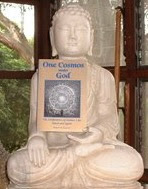
Here is our weekly repost from two years down and back. Again, when I review these things, it's often like I'm reading them for the first time, so while they may be old to you, they're new to me. I suppose it's a way of assimilating mysoph, which is a strange but necessary exercise. Anyway, I usually look for one that keeps my attention, which this one manages to do.
*****
The psychoanalyst James Grotstein proposes a “dual track” theory of human development, in which there is a separate developmental agenda for the self in isolation and the self in relation to others. Recent work in neurology has suggested that we not only have two cerebral hemispheres (left and right), but two consciousnesses, two very different ways of processing data and experience.
In our normal waking consciousness, one hemisphere subordinates the other, so that we have the subjective impression of a unified consciousness, but in reality, it is somewhat analogous to having two eyes or ears. For example, when they are properly functioning, we are not aware of having two eyes. However, the fact that we have two eyes with slightly different points of view creates the experience of visual depth. Likewise, thanks to having two ears, we can have the experience of a bitchin’ stereo.
The right brain allows us the experience of fusion with others, of oneness with creation, of membership in a larger group. But thanks to the left brain, we can have the experience of uniqueness, of our separateness from the group, of what is called individuation. The two hemispheres also think and process information in divergent ways, one in a holistic, translogical and analogical manner, the other in a linear, logical, and digital manner. One cannot understand religious metaphysics without a highly developed, right brain "poetical" sense.
Especially in the West, we have many excessively left-brained thinkers who derive their philosophies from their own handicapped existence. Here I am thinking of someone like the famous materialist Richard Dawkins, whose spiritually barren atheistic theology is all words and no music, and speaks to no one who is firing in both hemispheres.
This is why atheism so quickly devolves into bad theology. The “return of the repressed” guarantees that the shunned hemisphere will exact its vengeance on the philosopher who tries to naively reject it, exposing the illogic of his metaphysics. In fact, Gödel’s theorems may be thought of as the guarantor of a liberating higher Reason that transcends the logic-bound left-brain.
But it is obviously possible to lurch too far in the other direction as well, and to promulgate a philosophy that is almost entirely a product of right-hemisphere thinking detached from logic, such as Islamism, radical feminism, homosexual activism, etc.
In reality, the two hemispheres are not opposed but complementary, a reflection of the irreducible complementarity of relative existence. When I use the words “vertical” and “horizontal,” you should think of them as “empty categories” or mythsemantical placeholders that subsume many other irreducible complementarities in our existence, such as: wave/particle, whole/part, form/substance, male/female, mind/matter, exterior/interior, thinking/feeling, sensing/intuition, analysis/synthesis, group/individual, time/eternity, brahman/maya, Kirk/Spock. None of these dualities can be resolved in the phenomenal world, because the phenomenal world is their product, so to speak.
Thus, it is not so much that we have two brains, but that the different vertices of the two brains create a third thing that transcends either one alone. At least in a healthy individual. It is not that the two hemispheres should become fused or commingled, so to speak. Rather, there is a harmonious relationship between them. Normally we think of the repressive barrier between ego and unconscious as being vital to the maintenance of the ego. However, the boundary is just as vital for the sake of the unconscious, otherwise each world would destroy the other. "Unconscious" and "ego" are really just different points of view that are simultaneously present, like "God" and "Man."
In last Friday’s post, we spoke of Melanie Klein’s theory of the paranoid-schizoid (dispersive) and depressive (integrative) positions. Grotstein has added a third, which he calls the transcendent position, which represents a higher fusion of the dual tracks referenced above. In other words, these complementarities are not to be resolved by ignoring them or attempting to impose one over the other. Rather, they can only be resolved by moving in the opposite direction, toward the anterior, nonlocal wholeness “above,” of which the complementarities are a local manifestation:
“The two time-space worlds are incompatible and must be kept apart. This is the intercourse that is so sacred that it must not be known; it must always remain inscrutable.
“The act of psychic creation involves the most arcane, most mysterious union between two modes of ‘being’ and of ‘valuing’ the data of inner and outer experience. Their intercourse creates ‘thoughts.’ It can never be penetrated. The subject, being ineffable and inscrutable, does not lend itself to objectification but can reveal itself only in ‘transformations in O,’ with which we at best can become resonant in the transcendent position” (Grotstein). In identifying the transcendent position with “transformations in O,” this is another way of describing the O-->(k) directionality described in my book, from knowledge, to wisdom (n), and to being (¶).
Grotstein goes on to say that the transcendent position is not properly regarded as a stage per se, but an ongoing capability that must be won again and again: “Transcendent means having the ability to transcend our defensiveness, our pettiness, our guilt, our shame, our narcissism, our need for certainty, our strictures, in order to achieve or become ‘one with O,’ which I interpret as becoming one with our aliveness or our very being-ness.”
In the past, I have described this as playing along the infinite shore where the waves of eternity break upon the sands time. In fact, this is what I am attempting to do in most of my posts. If they “resonate” in you, that is probably why. You’re just smelling the salt air and Coppertone.
Many of the fine paradoxables of Jesus may be regarded as murmurandoms from the transcendent position. In fact, in considering who he was, how could they be otherwise? I should do a post on that....
It's fair to say that my book was an effort to write from the transcendent position, in order to resolve our complementary ways of knowing reality, the “scientific” and the “religious.” Remember, in the absence of the transcendent position, science merely becomes bad religion, while religion can become bad science.
Yesterday a reader hinted that I may be edging close to gnosticism, writing that “I believe I understand your point about overly literal interpretation of text obscuring the path to enlightenment/salvation, but it does seem a tad dismissive.” If so, that is not my intent. It is just that I am trying to avoid looking at religion with just the left or right hemisphere, but to do so from the transcendent position. Thus, if someone asks me if this or that event in the Bible is literally true, I cannot provide a simple answer. It’s much more complicated than that. The answer is not yes (with the right brain) or no (with the left), but a very different sort of “yes” that emanates from O. More of a yeah, baby!
In order to elaborate, I have to veer into another major area, and I don’t know whether to do it today or wait until tomorrow. Perhaps we’ll just lay down some of the broad themes here.
No, what's the rush? Mañana.....
Saturday, November 15, 2008


Friday, November 14, 2008
Our Precious Disembodied Fluids (11.29.11)
We still have a few things to cover in Temperance.  As usual, I'm not entirely sure how they relate to the main topic of the chapter, but they are nevertheless accurate and helpful.
UF points out that there are actually three primary modes of spiritual experience: vision, inspiration, and intuition; or perception, communication, and identification. "Vision presents and shows us spiritual things, inspiration infuses us with understanding of them, and intuition reveals to us their essence by way of assimilation with our essence." Or, to use a digestive metaphor, first you must recognize what to eat; then chew and swallow it; and finally metabolize and assimilate it, so that the two substances become one.
Alternatively, we could think of these modes as taking place on the planes of feeling, knowledge, and being, each of which has degrees of depth (and can only be artificially separated; think of the three modes as a dynamic trialectic). As I have mentioned before, for the average worshipper, religion can embody "metaphysics without knowledge." In other words, the metaphysics is implicate, but nevertheless true.
This is again why the most simpleminded creationist is nevertheless closer to the truth than the most sophisticated atheist. Such a person "feels" the truth, even if he cannot necessarily express it in way acceptable to the atheist, who is incapable of feeling truth to begin with. It should go without saying that there are saintly people who are not intellectuals, and that they know something the atheist doesn't.
UF notes that spiritual vision -- just like its physical analogue -- expands the horizon of one's being. All of our senses are actually different varieties of touch; for example, with vision, we are touching photons; with hearing, we are touching air vibrations; with olfaction, we are touching molecules floating in the air.
Just as our physical vision expands our subjective horizon -- even to the stars and planets -- so too does spiritual vision give access to realities that are not immediately present.
For example, when we read, say, Genesis or the Gospel of John, each of them helps us to see realities that are vertically "present," but might otherwise go undetected -- just as a person without vision (unless told) would know nothing about stars and planets. Scripture literally helps us "touch" these realities. But so too do other spiritual modes -- really, anything that directly communicates divine truth, love, or beauty. Often, as UF describes, this contact or "touch" will be accompanied by tears, which signify the "flow" between the two domains, the eternal and the temporal:
"The contact between image and likeness is experienced as inner weeping.... [T]he expression 'I am moved to tears' is only a reflection of what happens when image and likeness touch. They then mingle in tears -- and the inner current which results is the life of the human soul." I'm guessing that atheists have never wept upon encountering a transformative truth, but that's not surprising, for the tears again signify depth of experience, and nothing as shallow as atheism could ever produce such an effect. (To say nothing of the sacred guffah ha! experience known only to authentic Raccoons.)
There are tears of sorrow, of joy, of gratitude, of admiration, of compassion, of pride in one's children, of tenderness, of reconciliation, each having to do with the intensity of one's inner life, which "pours out" in the form of tears, either outwardly or "inwardly."
When is the last time you were moved to tears? What was that movement about? For me, it occurred just yesterday, while watching the film Becket. I'm not saying I was sobbing convulsively. In fact, you wouldn't have noticed anything, because it was mostly inward (we Godwins are men of steel). But while watching the ceremony where Becket is elevated to Archbishop, the holiness and sanctity of the occasion caused something to well up inside of me. The point is not so much to walk around crying all the time, but to notice these sometimes subtle movements within the soul, for that is your life.
So there is spiritual vision, or touch, which involves depth of feeling and gives access to a new realm of facts. Then there is spiritual inspiration, or communication, which involves depth of knowledge and understanding. It takes the facts given by vision and converts them to explicate knowledge. This is none other then O-->(n), or "gnosis."
At the same time, there is no depth without unity, and vice versa. Necessarily, as one's knowledge deepens one will begin to apprehend the interior cosmic unity, or the Logos, that makes intellectual unity possible to begin with. Contrast this with the absurd "horizontal unity" of the flatlanders, which is a metaphysical impossibility.
Now, vision has more to do with (↓), while inspiration has more to do with (↑). This is because, like our sensory vision, it is mostly a passive modality. We just open our eyes, and whoomp, there it is.
But inspiration, as UF defines it, requires more effort: not just tears, but sweat. We have spoken of tears. When is the last time you sweated to deepen your vision?
I well remember the first time this happened to me. It was in the spring of 1985, when I first encountered Bion. That awakened something in me and set me off on a wild nous chase, the details of which are unimportant. Mrs. G and I were living in sin in a one bedroom apartment with virtually no furniture, so I was sitting on the floor grappling with Bion, literally perspiring in a kind of intellectual fever that was full of implications which took years to sort out. You could say that it was my intellectual "big bang." (By the way, I am not recommending Bion to anyone, because the point is to find the person who introduces you to yourself; I am not a "Bionian.")
Speaking of Bion, in order to have inspirations, one's mind must be unsaturated: "the answer is the disease that kills curiosity." I was apparently a good candidate, for I had essentially learned nothing from kindergarten all the way through my undergraduate work. I had no answers, diseased or otherwise. It's just simple physics that if you want something to pour into you, your vessel should be relatively empty and capacious. Elsewhere UF writes that while nature abhors a vacuum, Spirit requires one.
UF has a good line: "Children know how to ask and dare to ask. Are they presumptuous? No, because each question that they pose is at the same time an avowal of their ignorance." Schuon said something to the effect that there is more light in a good question than most answers. You will note that our scientistic jester is full of bovine questions that harbor no light -- or even capacity for light -- at all.
UF describes inspiration as a "thinking together," and this is indeed what it is. Again, to use the example above, I was not simply "learning" Bion. Rather, we were "thinking together" in such a way that it sounded all sorts of latent themes within me -- and which were me.
So, to summarize for today, "say to yourself that you know nothing, and at the same time say to yourself that you are able to know everything, and -- armed with this healthy humility and this healthy presumption of children -- immerse yourself in the pure and strengthening element of the 'thinking together' of inspiration!"
 As usual, I'm not entirely sure how they relate to the main topic of the chapter, but they are nevertheless accurate and helpful.
UF points out that there are actually three primary modes of spiritual experience: vision, inspiration, and intuition; or perception, communication, and identification. "Vision presents and shows us spiritual things, inspiration infuses us with understanding of them, and intuition reveals to us their essence by way of assimilation with our essence." Or, to use a digestive metaphor, first you must recognize what to eat; then chew and swallow it; and finally metabolize and assimilate it, so that the two substances become one.
Alternatively, we could think of these modes as taking place on the planes of feeling, knowledge, and being, each of which has degrees of depth (and can only be artificially separated; think of the three modes as a dynamic trialectic). As I have mentioned before, for the average worshipper, religion can embody "metaphysics without knowledge." In other words, the metaphysics is implicate, but nevertheless true.
This is again why the most simpleminded creationist is nevertheless closer to the truth than the most sophisticated atheist. Such a person "feels" the truth, even if he cannot necessarily express it in way acceptable to the atheist, who is incapable of feeling truth to begin with. It should go without saying that there are saintly people who are not intellectuals, and that they know something the atheist doesn't.
UF notes that spiritual vision -- just like its physical analogue -- expands the horizon of one's being. All of our senses are actually different varieties of touch; for example, with vision, we are touching photons; with hearing, we are touching air vibrations; with olfaction, we are touching molecules floating in the air.
Just as our physical vision expands our subjective horizon -- even to the stars and planets -- so too does spiritual vision give access to realities that are not immediately present.
For example, when we read, say, Genesis or the Gospel of John, each of them helps us to see realities that are vertically "present," but might otherwise go undetected -- just as a person without vision (unless told) would know nothing about stars and planets. Scripture literally helps us "touch" these realities. But so too do other spiritual modes -- really, anything that directly communicates divine truth, love, or beauty. Often, as UF describes, this contact or "touch" will be accompanied by tears, which signify the "flow" between the two domains, the eternal and the temporal:
"The contact between image and likeness is experienced as inner weeping.... [T]he expression 'I am moved to tears' is only a reflection of what happens when image and likeness touch. They then mingle in tears -- and the inner current which results is the life of the human soul." I'm guessing that atheists have never wept upon encountering a transformative truth, but that's not surprising, for the tears again signify depth of experience, and nothing as shallow as atheism could ever produce such an effect. (To say nothing of the sacred guffah ha! experience known only to authentic Raccoons.)
There are tears of sorrow, of joy, of gratitude, of admiration, of compassion, of pride in one's children, of tenderness, of reconciliation, each having to do with the intensity of one's inner life, which "pours out" in the form of tears, either outwardly or "inwardly."
When is the last time you were moved to tears? What was that movement about? For me, it occurred just yesterday, while watching the film Becket. I'm not saying I was sobbing convulsively. In fact, you wouldn't have noticed anything, because it was mostly inward (we Godwins are men of steel). But while watching the ceremony where Becket is elevated to Archbishop, the holiness and sanctity of the occasion caused something to well up inside of me. The point is not so much to walk around crying all the time, but to notice these sometimes subtle movements within the soul, for that is your life.
So there is spiritual vision, or touch, which involves depth of feeling and gives access to a new realm of facts. Then there is spiritual inspiration, or communication, which involves depth of knowledge and understanding. It takes the facts given by vision and converts them to explicate knowledge. This is none other then O-->(n), or "gnosis."
At the same time, there is no depth without unity, and vice versa. Necessarily, as one's knowledge deepens one will begin to apprehend the interior cosmic unity, or the Logos, that makes intellectual unity possible to begin with. Contrast this with the absurd "horizontal unity" of the flatlanders, which is a metaphysical impossibility.
Now, vision has more to do with (↓), while inspiration has more to do with (↑). This is because, like our sensory vision, it is mostly a passive modality. We just open our eyes, and whoomp, there it is.
But inspiration, as UF defines it, requires more effort: not just tears, but sweat. We have spoken of tears. When is the last time you sweated to deepen your vision?
I well remember the first time this happened to me. It was in the spring of 1985, when I first encountered Bion. That awakened something in me and set me off on a wild nous chase, the details of which are unimportant. Mrs. G and I were living in sin in a one bedroom apartment with virtually no furniture, so I was sitting on the floor grappling with Bion, literally perspiring in a kind of intellectual fever that was full of implications which took years to sort out. You could say that it was my intellectual "big bang." (By the way, I am not recommending Bion to anyone, because the point is to find the person who introduces you to yourself; I am not a "Bionian.")
Speaking of Bion, in order to have inspirations, one's mind must be unsaturated: "the answer is the disease that kills curiosity." I was apparently a good candidate, for I had essentially learned nothing from kindergarten all the way through my undergraduate work. I had no answers, diseased or otherwise. It's just simple physics that if you want something to pour into you, your vessel should be relatively empty and capacious. Elsewhere UF writes that while nature abhors a vacuum, Spirit requires one.
UF has a good line: "Children know how to ask and dare to ask. Are they presumptuous? No, because each question that they pose is at the same time an avowal of their ignorance." Schuon said something to the effect that there is more light in a good question than most answers. You will note that our scientistic jester is full of bovine questions that harbor no light -- or even capacity for light -- at all.
UF describes inspiration as a "thinking together," and this is indeed what it is. Again, to use the example above, I was not simply "learning" Bion. Rather, we were "thinking together" in such a way that it sounded all sorts of latent themes within me -- and which were me.
So, to summarize for today, "say to yourself that you know nothing, and at the same time say to yourself that you are able to know everything, and -- armed with this healthy humility and this healthy presumption of children -- immerse yourself in the pure and strengthening element of the 'thinking together' of inspiration!"
Thursday, November 13, 2008
The Legion of Batboys: They're the Deiciders! (11.28.11)
Who is the third who walks always beside you?
When I count, there are only you and I together
But when I look ahead up the white road
There is always another one walking beside you
Gliding wrapt in a brown mantle, hooded
I do not know whether a man or a woman
-But who is that on the other side of you? --T.S. Eliot, The Waste Land
Meditations on the Tarot has a lengthy account of the nature of guardian angels. It's pretty straightupward, and I don't want to just rewordgitate what UF says. All I can really contribute to the deuscussion is that if you don't think you have a guardian angel, just fake it for awhile. There is no one lonelier than an angel with nothing to do. You might say they're a little... codependent.
As UF writes, "The Angel depends on man in his creative activity. If the human being does not ask for it, if he turns away from him, the Angel has no motive for creative activity. He can then fall into a state of consciousness where all his creative geniality remains in potential and does not manifest. It is a state of vegetation or 'twilight existence' comparable to sleep from the human point of view. An Angel who has nothing to exist for is a tragedy in the spiritual world."
I'm just going to reflect on whatever strikes my attention. I like this: "the formation of wings" depends upon "a current from above (↓) which moves to meet that from below (↑). Wings are formed only when the two currents -- that of human endeavor and that of grace -- meet and unite."
As such, all forms of radical secularism "can create only the wings of Icarus." One is immediately reminded of Novak's On Two Wings: Humble Faith and Common Sense at the American Founding, in that the American Founders -- perhaps because they were listening to the counsel of their better angels -- got the formula exactly right for our extraordinary "national flight" of the past two centuries. (I might add that our prophetic Founders also "created" our national Archangel, but that's another storey in the hierarchy.)
Again, when I say that the left in general and Obama in particular are "anti-American," I do not mean it in an insulting or polemical way. Rather, I mean it in this precise way, in that they wish to proceed on one wing, which will obviously cause our national flight to grind to a halt and leave us taxiing on the runway (and then taxed for it to boot).
When the left belowviates about "separation of church and state," what they really mean is the violent dismemberment of one of our wings. It is equally like cutting off the thumb to spite our hand. The hand will remain, but it won't be able to grasp much, certainly nothing of the vertical. If you've ever wondered why the writing of the left is, if nothing else, so boring, tedious, and uninspirational, this is why.
True, the left can develop wings after a fashion. But we all recognize these wings for what they are, for they are "the wings of a bat, i.e., those of darkness which are organs by means of which one can plunge into the depths of darkness." Most contemporary art and literature is of this nature -- just the further erosion of eros and its replacement with the false gods of their agapelessness. These autists cannot soar upward but only can sink downward and confuse it with flight. The Waste Land comes to mind:
And bats with baby faces in the violet light / Whistled, and beat their wings / And crawled head downward down a blackened wall / And upside down in air were towers / Tolling reminiscent bells, that kept the hours / And voices singing out of empty cisterns and exhausted wells.
You can flap and flap your two vestigial left wings of hope and change, but you will simply turn in a tight little spiral. You'll never achieve vertical liftoff. Nor will you grow, for you are trying to subsist on your own byproducts. Our new dog tries to do that... coprophagia, it's called. But you know what? The left's post-election shit-eating grin won't even last until Inauguration Day.
Our "vastly enlarged perspectives of knowledge should open up fresh vistas of religious faith" (Eliot), not close off the frontier of unKnowing. Remember, human knowledge is like a little expanding circle amidst the sea of Being. Thus, the more we extend our boundaries, the greater the area that we do not know. Thank God we know so much less than our belighted medieval forebears! To put it another way, we have so much more to unKnow in the romp of a single laughtime.
Hmm, here's a coincidence. Russell Kirk writes that no Christian belief is "more neglected today... than the concept of guardian angels," which is "no less credible than many other dogmas which Eliot had learned to accept.... Imperfect though it may be, evidence for the existence of intermediary spiritual beings is no less intelligible than the proofs for various theories of natural science.... [F]or him, there was nothing repugnant or incredible in conceiving of tutelary beings of another order than human."
Hey, why not? Kirk mentions Yeats, "who believed that some great dead man watches over every passionate living man of talents." I believe this. I believe that through a kind of "passionate resonance," we may enter the interior mansion of a great person and steal a bit of their mojo.
As I have mentioned in the past, I certainly endeavored to do this in the writing of my book. Among others, I placed photographs of Teilhard de Chardin, Sri Aurobindo, James Joyce, and Alfred North Whitehead over my desk, so that I could look to them for a little cosmic inspiration (↓). Even if you only reduce it to a kind of right-brain or unconscious demonenon, it still works. You really do become what you venerate. Which again is why ideologies such as scientism and Darwinism are so spritually catastrophic. You actually start to believe that stuff and end up batshit crazy. Unreal.
Who are those hooded hordes swarming
Over endless plains, stumbling in cracked earth
Ringed by the flat horizon only
What is the city over the mountains
Cracks and reforms and bursts in the violet air
Falling towers
Jerusalem Athens Alexandria
Vienna London
Unreal --Eliot
When I count, there are only you and I together
But when I look ahead up the white road
There is always another one walking beside you
Gliding wrapt in a brown mantle, hooded
I do not know whether a man or a woman
-But who is that on the other side of you? --T.S. Eliot, The Waste Land
Meditations on the Tarot has a lengthy account of the nature of guardian angels. It's pretty straightupward, and I don't want to just rewordgitate what UF says. All I can really contribute to the deuscussion is that if you don't think you have a guardian angel, just fake it for awhile. There is no one lonelier than an angel with nothing to do. You might say they're a little... codependent.
As UF writes, "The Angel depends on man in his creative activity. If the human being does not ask for it, if he turns away from him, the Angel has no motive for creative activity. He can then fall into a state of consciousness where all his creative geniality remains in potential and does not manifest. It is a state of vegetation or 'twilight existence' comparable to sleep from the human point of view. An Angel who has nothing to exist for is a tragedy in the spiritual world."
I'm just going to reflect on whatever strikes my attention. I like this: "the formation of wings" depends upon "a current from above (↓) which moves to meet that from below (↑). Wings are formed only when the two currents -- that of human endeavor and that of grace -- meet and unite."
As such, all forms of radical secularism "can create only the wings of Icarus." One is immediately reminded of Novak's On Two Wings: Humble Faith and Common Sense at the American Founding, in that the American Founders -- perhaps because they were listening to the counsel of their better angels -- got the formula exactly right for our extraordinary "national flight" of the past two centuries. (I might add that our prophetic Founders also "created" our national Archangel, but that's another storey in the hierarchy.)
Again, when I say that the left in general and Obama in particular are "anti-American," I do not mean it in an insulting or polemical way. Rather, I mean it in this precise way, in that they wish to proceed on one wing, which will obviously cause our national flight to grind to a halt and leave us taxiing on the runway (and then taxed for it to boot).
When the left belowviates about "separation of church and state," what they really mean is the violent dismemberment of one of our wings. It is equally like cutting off the thumb to spite our hand. The hand will remain, but it won't be able to grasp much, certainly nothing of the vertical. If you've ever wondered why the writing of the left is, if nothing else, so boring, tedious, and uninspirational, this is why.
True, the left can develop wings after a fashion. But we all recognize these wings for what they are, for they are "the wings of a bat, i.e., those of darkness which are organs by means of which one can plunge into the depths of darkness." Most contemporary art and literature is of this nature -- just the further erosion of eros and its replacement with the false gods of their agapelessness. These autists cannot soar upward but only can sink downward and confuse it with flight. The Waste Land comes to mind:
And bats with baby faces in the violet light / Whistled, and beat their wings / And crawled head downward down a blackened wall / And upside down in air were towers / Tolling reminiscent bells, that kept the hours / And voices singing out of empty cisterns and exhausted wells.
You can flap and flap your two vestigial left wings of hope and change, but you will simply turn in a tight little spiral. You'll never achieve vertical liftoff. Nor will you grow, for you are trying to subsist on your own byproducts. Our new dog tries to do that... coprophagia, it's called. But you know what? The left's post-election shit-eating grin won't even last until Inauguration Day.
Our "vastly enlarged perspectives of knowledge should open up fresh vistas of religious faith" (Eliot), not close off the frontier of unKnowing. Remember, human knowledge is like a little expanding circle amidst the sea of Being. Thus, the more we extend our boundaries, the greater the area that we do not know. Thank God we know so much less than our belighted medieval forebears! To put it another way, we have so much more to unKnow in the romp of a single laughtime.
Hmm, here's a coincidence. Russell Kirk writes that no Christian belief is "more neglected today... than the concept of guardian angels," which is "no less credible than many other dogmas which Eliot had learned to accept.... Imperfect though it may be, evidence for the existence of intermediary spiritual beings is no less intelligible than the proofs for various theories of natural science.... [F]or him, there was nothing repugnant or incredible in conceiving of tutelary beings of another order than human."
Hey, why not? Kirk mentions Yeats, "who believed that some great dead man watches over every passionate living man of talents." I believe this. I believe that through a kind of "passionate resonance," we may enter the interior mansion of a great person and steal a bit of their mojo.
As I have mentioned in the past, I certainly endeavored to do this in the writing of my book. Among others, I placed photographs of Teilhard de Chardin, Sri Aurobindo, James Joyce, and Alfred North Whitehead over my desk, so that I could look to them for a little cosmic inspiration (↓). Even if you only reduce it to a kind of right-brain or unconscious demonenon, it still works. You really do become what you venerate. Which again is why ideologies such as scientism and Darwinism are so spritually catastrophic. You actually start to believe that stuff and end up batshit crazy. Unreal.
Who are those hooded hordes swarming
Over endless plains, stumbling in cracked earth
Ringed by the flat horizon only
What is the city over the mountains
Cracks and reforms and bursts in the violet air
Falling towers
Jerusalem Athens Alexandria
Vienna London
Unreal --Eliot
Wednesday, November 12, 2008
More Than a Few Words From the Grand High Exalted Mystic Ruler (11.24.11)
I guess we're on to Temperance, which probably sounds like a boring aracanum, but it's not. It is the card of "integrated duality," which is actually rather thrilling, in a Coonish sort of way.
I apologize in advance for the length of this post, and for throwing in a lot of old material below. But much of it is "new to me," for reasons that will become clear. In any event, this works out well for me, because I have a long day ahead, and really should get going.
To exist is to live amidst polarity and tension, the ultimate tension heartache being the distance between image and likeness. It is this that creates the dynamic potential to transcend ourselves and "become what we are." The closing of this gap is the objective measure of your life.
As UF explains, the image represents our essential structure, while likeness represents the functional structure; the former is "timeless," while the latter can only be deployed in time. The image is indestructible and responsible for our freedom, since it is a spark of the Absolute. But the immortality of the likeness is "optional," in that "it is immortal only in proportion to the measure that it conforms to its image." For a variety of reasons, many people choose Death. But to paraphrase the outlaw Josey Wales, "dyin' ain't much of a living, boy," for it is like choosing prison for the image while imagining that the likeness roams free. But you are only free from yoursoph, stupid.
UF then goes into an extended meditation on the metaphysics of angels, which, in the overall scheme of things, are really nothing more than personifications of (↑) and (↓); in other words, they are "vertical emissaries," so to speak. Rabbi Steinsaltz's Thirteen Petalled Rose contains one of the most clear and concise explanations of angelology I've ever found, and it is very much compatible with what UF has to say. In fact, here is something I wrote almost three years ago:
"Steinsaltz notes that the soul [read: image] should not be thought of as a 'point' in space time. Rather, it is 'a continuous line of spiritual being, stretching from the general source of all the souls to beyond the specific body of a particular person.... and because the soul is not a single point in space, it should be viewed not as a single existence having one quality or character, but as many existences, on a variety of spiritual levels...'
In the past, I have used the analogy of a lampshade with many pinprick holes in it. From the outside it will look as if there are many individual lights, but in reality, they are all coming from a single "nonlocal" source.
In another way, it's analogous to these progressive bifocals I just got, which change the focal point depending upon where you point your eyes. Look up, and things that are near become out of focus, but look down, and the distant becomes blurry.
Steinsaltz discusses the distinction between the vertical and horizontal, which for me is the essence of any spiritual metaphysics. Again, in speaking of the vertical, of higher and lower, he is not speaking of an actual physical location. Vertically speaking, "to call a world higher signifies that it is more primary, more basic in terms of being close to a primal source of influence; while a lower world would be a secondary world -- in a sense, a copy."
Thus, viewed horizontally, we may trace the material cosmos back to a primordial event some 13.7 billion years ago. But this is only a horizontal explanation. Traditional metaphysics deals with the vertical causation of the cosmos, which is what confuses some people. From the vertical standpoint, this world is indeed a copy, as are human beings, of a divine prototype. The "logos" might be thought of as the model of all things, the nexus between the divine mind above and the creation here below. Looked at in this manner, the inexplicable beauty of the world is not somehow the outcome of horizontal cause and effect, which would be a ridiculous assertion. Rather beauty is the cause of the cosmos (among other nonlocal causes, such as Love and Truth).
Because of the ubiquitous vertical and horizontal influences, every aspect of human existence is made up of both matter and spirit, of form and essence. While we are fundamentally spiritual, we are unavoidably material, which sets up a host of interesting tensions and conflicts. The fall --or exile, if you like -- is indeed a vertical one, a declension from the divine repose of celestial bliss, down to this world of toil, conflict, uncertainty and ambiguity.
Steinsaltz writes that an angel is simply a "messenger" constituting a point of contact "between our world of action and the higher worlds. The angel is the one who effects transfers of the vital plenty between worlds. An angel's missions go in two directions: it may serve as an emissary of God downward..., and it may also serve as the one who carries things upwards from below, from our world to the higher worlds."
I ran it by Petey, but he was, I don't know, noncommittal. But that's not unusual. It's more like he's disinterested, or at least pretends to be so. The roll of the eyes, the impatient, audible exhalation, the way his little wings flutter, as if he's got something better to do....
I just searched the blog, and found some more interesting material. At least it is for me. You'll have to bear with me, because often it's as if I'm reading these things for the first time. Oh wait. I am reading it for the first time. Petey himself wrote this one a couple of years ago. Of himself, he wrote that:
"I'm here, but I'm not here. How to explain.... I'm always here in the same sense that all 200 or whatever it is crappy TV stations are always streaming into your house. They're what we might call 'implicate.' But you can only tap into one at a time, thereby making the implicate explicate. The multidimensional implicate order is anterior to the explicate order, so that what you folks call 'consensus reality' is more of a mutual agreement to limit the implicate order in a certain way. It's all about managing your existential anxiety, not getting at the Truth. If you want to get at the Truth, you're going to have to tolerate the anxiety of not knowing, not make the anxiety go away with some stupid scientistic-materialistic nonsense.
"You know the old crack -- 'if the doors of perception we cleansed, then everything would appear as it is, infinite.' It is such a monstrous conceit for humans to imagine that their puny minds can encompass the very reality that produced them! Ho!
"Three -- yes, there are higher and lower worlds. I guess this isn't obvious to a leftist, but if any of you saw the 'Live Earth' concert on TV, you know all about people who inhabit a lower world. Their language, their music, their feelings, their world view -- all emanate from a lower world. Ironically, most of them aren't even from the earth plane, but a notch or two below that.
"The point I'm making is that the words high and low 'refer only to the place of any particular world on the ladder of causality. To call a world higher signifies that it is more primary, more basic in terms of being close to a primal source of influence; while a lower world would be a secondary world -- in a sense, a copy. Yet the copy is not just an imitation but rather a whole system, with a more or less independent life of its own, its own variety of experience, characteristics and properties.'
"This is why the flatlanders -- scientists, atheists, materialists -- can become so enclosed in their abcircular illusions. In a way, their worldview is complete (on its own level), and yet, it's radically incomplete (with regard to the whole).
"I remember explaining this to Gödel, who is rather anal (to put it mildly), and sketched it out with ironyclad logic. I say 'irony,' because his ideas have been highjacked by the psycho-spiritual left to suggest that we cannot make absolute statements about reality, when Gödel and I were making the opposite point about the limitations of logic to express things we know damn well to be true. One such point is that things aren't true because they're logical but logical because they're true. Duh!
"If you have stayed with me this far, then you will understand that, just as there are evil beings, there are evil worlds. These are simply the 'space' inhabited by the evil beings. Wisdom is a space, or 'mansion.' So too, creativity, love, beauty, peace. You can sense it when you enter one of those mansions. You can also sense it when you are near one of those haunted mansions where the darklings reside.
"The closest I like to get to one of these mansions is memri.org, which makes the Islamic darkness visible to us on a daily basis. Can you not feel and sense the utterly dark abyss of that black hole, where light neither enters nor escapes? If not, you may want to contact an exorcist, for something has hijacked your moral vision. There are many such vertical abysses in the world. Bottomless pits of anti-Truth and anti-Beauty.
"Enough malevolent wishes and wicked deeds, and pretty soon you have created a closed world, cut off from the divine influence. As Steinsaltz describes it, 'the sinner is punished by the closing of the circle, by being brought into contact with the domain of evil he creates.... as long as man chooses evil, he supports and nurtures whole worlds and mansions of evil, all of them drawing upon the same human sickness of the soul.... as the evil flourishes and spreads over the world because of the deeds of men, these destructive angels become increasingly independent existences, making up a whole realm that feeds on and fattens on evil.'
"Four, being that I was once an ordinary embodied and enmentalled man just like you prior to the farming accident, I feel that I am fit to pronounce on this. Human beings live in a world of 'action,' but imagine that that's where all the action is. Not true.
"Allow me to explain. Or better yet, allow Steinsaltz to explain: 'The lower part of the world of action is what is known as as the "world of physical nature" and of more or less mechanical processes -- that is to say, the world where natural law prevails; while above this world of physical nature is another part of the same world which we may call the "world of spiritual action."
"Now, what these two realms have in common is the action of Man, since 'the human creature is so situated between them that he partakes of both. As part of the physical system of the universe, man is subordinate to the physical, chemical, and biological laws of nature; while from the standpoint of his consciousness, even while this consciousness is totally occupied with matters of a lower order, man belongs to the spiritual world, the world of ideas.... Every aspect of human existence is therefore made up of both matter and spirit.'
"Five, it is my nature to be a 'messenger, to constitute a permanent contact between [your] world of action and the higher worlds. The angel is the one who effects transfers of the vital plenty between worlds.'
"Six, 'An angel's missions go in two directions: it may serve as an emissary of God downward, to other angels and to creatures below the world of formation; and it may also serve as the one who carries things upwards from below, from our world to the higher worlds.' You might call us the transpersonal postal service for prayers and the like.
"Just to make it clear, it was not I who prompted Bob to steal the Holiday Inn flag back in 1980. There are 'subversive angels' that are actually created by the thoughts and actions of men. I believe Bob calls them 'mind parasites.' They are contingent objectifications from various vital-emotional domains. Up here we sometimes call them the 'tempters.' Either that, or the 'mesmerers.' The Holiday Inn incident was a fine example of a tempter tantrum fueled by what we call 'liquid courage.'
"Seven, it would be wrong to conclude on the basis of what I have just said that the difference between you and me is that you have a body and I don't. Rather, 'the soul of man is most complex and includes a whole world of different existential elements of all kinds, while the angel is a being of a single essence and therefore in a sense one-dimensional.' This is why you and I play such different roles in the cosmic economy. You actually have the tougher job, which is to say, because of your 'many-sidedness' and your 'capacity to to contain contradictions,' this makes it possible for you to 'rise to great heights,' but also to fuck up big time, neither of which is true for me. Rather, the angel is 'eternally the same; it is static, an unchanging existence,' 'fixed within rigid limits.''
"You might say that I am already 'whole' in space, whereas it is your vocation to become whole in time. Not easy, I realize.
"Eight, another way of saying it is that I do not evolve, but you can and must. In ether worlds, there is no evolution here in the vertical, only in the horizontal. In the absence of the horizontal, it's frankly a little boring here -- or as I put it in OCUG,
Only himsoph with nowhere to bewrong, hovering over the waters without a kenosis. Vishnu were here, but just His lux, God only knows only God, and frankly, ishwara monotheotenous -- no one beside him, no nous, same old shunyada yada yada.
I apologize in advance for the length of this post, and for throwing in a lot of old material below. But much of it is "new to me," for reasons that will become clear. In any event, this works out well for me, because I have a long day ahead, and really should get going.
To exist is to live amidst polarity and tension, the ultimate tension heartache being the distance between image and likeness. It is this that creates the dynamic potential to transcend ourselves and "become what we are." The closing of this gap is the objective measure of your life.
As UF explains, the image represents our essential structure, while likeness represents the functional structure; the former is "timeless," while the latter can only be deployed in time. The image is indestructible and responsible for our freedom, since it is a spark of the Absolute. But the immortality of the likeness is "optional," in that "it is immortal only in proportion to the measure that it conforms to its image." For a variety of reasons, many people choose Death. But to paraphrase the outlaw Josey Wales, "dyin' ain't much of a living, boy," for it is like choosing prison for the image while imagining that the likeness roams free. But you are only free from yoursoph, stupid.
UF then goes into an extended meditation on the metaphysics of angels, which, in the overall scheme of things, are really nothing more than personifications of (↑) and (↓); in other words, they are "vertical emissaries," so to speak. Rabbi Steinsaltz's Thirteen Petalled Rose contains one of the most clear and concise explanations of angelology I've ever found, and it is very much compatible with what UF has to say. In fact, here is something I wrote almost three years ago:
"Steinsaltz notes that the soul [read: image] should not be thought of as a 'point' in space time. Rather, it is 'a continuous line of spiritual being, stretching from the general source of all the souls to beyond the specific body of a particular person.... and because the soul is not a single point in space, it should be viewed not as a single existence having one quality or character, but as many existences, on a variety of spiritual levels...'
In the past, I have used the analogy of a lampshade with many pinprick holes in it. From the outside it will look as if there are many individual lights, but in reality, they are all coming from a single "nonlocal" source.
In another way, it's analogous to these progressive bifocals I just got, which change the focal point depending upon where you point your eyes. Look up, and things that are near become out of focus, but look down, and the distant becomes blurry.
Steinsaltz discusses the distinction between the vertical and horizontal, which for me is the essence of any spiritual metaphysics. Again, in speaking of the vertical, of higher and lower, he is not speaking of an actual physical location. Vertically speaking, "to call a world higher signifies that it is more primary, more basic in terms of being close to a primal source of influence; while a lower world would be a secondary world -- in a sense, a copy."
Thus, viewed horizontally, we may trace the material cosmos back to a primordial event some 13.7 billion years ago. But this is only a horizontal explanation. Traditional metaphysics deals with the vertical causation of the cosmos, which is what confuses some people. From the vertical standpoint, this world is indeed a copy, as are human beings, of a divine prototype. The "logos" might be thought of as the model of all things, the nexus between the divine mind above and the creation here below. Looked at in this manner, the inexplicable beauty of the world is not somehow the outcome of horizontal cause and effect, which would be a ridiculous assertion. Rather beauty is the cause of the cosmos (among other nonlocal causes, such as Love and Truth).
Because of the ubiquitous vertical and horizontal influences, every aspect of human existence is made up of both matter and spirit, of form and essence. While we are fundamentally spiritual, we are unavoidably material, which sets up a host of interesting tensions and conflicts. The fall --or exile, if you like -- is indeed a vertical one, a declension from the divine repose of celestial bliss, down to this world of toil, conflict, uncertainty and ambiguity.
Steinsaltz writes that an angel is simply a "messenger" constituting a point of contact "between our world of action and the higher worlds. The angel is the one who effects transfers of the vital plenty between worlds. An angel's missions go in two directions: it may serve as an emissary of God downward..., and it may also serve as the one who carries things upwards from below, from our world to the higher worlds."
I ran it by Petey, but he was, I don't know, noncommittal. But that's not unusual. It's more like he's disinterested, or at least pretends to be so. The roll of the eyes, the impatient, audible exhalation, the way his little wings flutter, as if he's got something better to do....
I just searched the blog, and found some more interesting material. At least it is for me. You'll have to bear with me, because often it's as if I'm reading these things for the first time. Oh wait. I am reading it for the first time. Petey himself wrote this one a couple of years ago. Of himself, he wrote that:
"I'm here, but I'm not here. How to explain.... I'm always here in the same sense that all 200 or whatever it is crappy TV stations are always streaming into your house. They're what we might call 'implicate.' But you can only tap into one at a time, thereby making the implicate explicate. The multidimensional implicate order is anterior to the explicate order, so that what you folks call 'consensus reality' is more of a mutual agreement to limit the implicate order in a certain way. It's all about managing your existential anxiety, not getting at the Truth. If you want to get at the Truth, you're going to have to tolerate the anxiety of not knowing, not make the anxiety go away with some stupid scientistic-materialistic nonsense.
"You know the old crack -- 'if the doors of perception we cleansed, then everything would appear as it is, infinite.' It is such a monstrous conceit for humans to imagine that their puny minds can encompass the very reality that produced them! Ho!
"Three -- yes, there are higher and lower worlds. I guess this isn't obvious to a leftist, but if any of you saw the 'Live Earth' concert on TV, you know all about people who inhabit a lower world. Their language, their music, their feelings, their world view -- all emanate from a lower world. Ironically, most of them aren't even from the earth plane, but a notch or two below that.
"The point I'm making is that the words high and low 'refer only to the place of any particular world on the ladder of causality. To call a world higher signifies that it is more primary, more basic in terms of being close to a primal source of influence; while a lower world would be a secondary world -- in a sense, a copy. Yet the copy is not just an imitation but rather a whole system, with a more or less independent life of its own, its own variety of experience, characteristics and properties.'
"This is why the flatlanders -- scientists, atheists, materialists -- can become so enclosed in their abcircular illusions. In a way, their worldview is complete (on its own level), and yet, it's radically incomplete (with regard to the whole).
"I remember explaining this to Gödel, who is rather anal (to put it mildly), and sketched it out with ironyclad logic. I say 'irony,' because his ideas have been highjacked by the psycho-spiritual left to suggest that we cannot make absolute statements about reality, when Gödel and I were making the opposite point about the limitations of logic to express things we know damn well to be true. One such point is that things aren't true because they're logical but logical because they're true. Duh!
"If you have stayed with me this far, then you will understand that, just as there are evil beings, there are evil worlds. These are simply the 'space' inhabited by the evil beings. Wisdom is a space, or 'mansion.' So too, creativity, love, beauty, peace. You can sense it when you enter one of those mansions. You can also sense it when you are near one of those haunted mansions where the darklings reside.
"The closest I like to get to one of these mansions is memri.org, which makes the Islamic darkness visible to us on a daily basis. Can you not feel and sense the utterly dark abyss of that black hole, where light neither enters nor escapes? If not, you may want to contact an exorcist, for something has hijacked your moral vision. There are many such vertical abysses in the world. Bottomless pits of anti-Truth and anti-Beauty.
"Enough malevolent wishes and wicked deeds, and pretty soon you have created a closed world, cut off from the divine influence. As Steinsaltz describes it, 'the sinner is punished by the closing of the circle, by being brought into contact with the domain of evil he creates.... as long as man chooses evil, he supports and nurtures whole worlds and mansions of evil, all of them drawing upon the same human sickness of the soul.... as the evil flourishes and spreads over the world because of the deeds of men, these destructive angels become increasingly independent existences, making up a whole realm that feeds on and fattens on evil.'
"Four, being that I was once an ordinary embodied and enmentalled man just like you prior to the farming accident, I feel that I am fit to pronounce on this. Human beings live in a world of 'action,' but imagine that that's where all the action is. Not true.
"Allow me to explain. Or better yet, allow Steinsaltz to explain: 'The lower part of the world of action is what is known as as the "world of physical nature" and of more or less mechanical processes -- that is to say, the world where natural law prevails; while above this world of physical nature is another part of the same world which we may call the "world of spiritual action."
"Now, what these two realms have in common is the action of Man, since 'the human creature is so situated between them that he partakes of both. As part of the physical system of the universe, man is subordinate to the physical, chemical, and biological laws of nature; while from the standpoint of his consciousness, even while this consciousness is totally occupied with matters of a lower order, man belongs to the spiritual world, the world of ideas.... Every aspect of human existence is therefore made up of both matter and spirit.'
"Five, it is my nature to be a 'messenger, to constitute a permanent contact between [your] world of action and the higher worlds. The angel is the one who effects transfers of the vital plenty between worlds.'
"Six, 'An angel's missions go in two directions: it may serve as an emissary of God downward, to other angels and to creatures below the world of formation; and it may also serve as the one who carries things upwards from below, from our world to the higher worlds.' You might call us the transpersonal postal service for prayers and the like.
"Just to make it clear, it was not I who prompted Bob to steal the Holiday Inn flag back in 1980. There are 'subversive angels' that are actually created by the thoughts and actions of men. I believe Bob calls them 'mind parasites.' They are contingent objectifications from various vital-emotional domains. Up here we sometimes call them the 'tempters.' Either that, or the 'mesmerers.' The Holiday Inn incident was a fine example of a tempter tantrum fueled by what we call 'liquid courage.'
"Seven, it would be wrong to conclude on the basis of what I have just said that the difference between you and me is that you have a body and I don't. Rather, 'the soul of man is most complex and includes a whole world of different existential elements of all kinds, while the angel is a being of a single essence and therefore in a sense one-dimensional.' This is why you and I play such different roles in the cosmic economy. You actually have the tougher job, which is to say, because of your 'many-sidedness' and your 'capacity to to contain contradictions,' this makes it possible for you to 'rise to great heights,' but also to fuck up big time, neither of which is true for me. Rather, the angel is 'eternally the same; it is static, an unchanging existence,' 'fixed within rigid limits.''
"You might say that I am already 'whole' in space, whereas it is your vocation to become whole in time. Not easy, I realize.
"Eight, another way of saying it is that I do not evolve, but you can and must. In ether worlds, there is no evolution here in the vertical, only in the horizontal. In the absence of the horizontal, it's frankly a little boring here -- or as I put it in OCUG,
Only himsoph with nowhere to bewrong, hovering over the waters without a kenosis. Vishnu were here, but just His lux, God only knows only God, and frankly, ishwara monotheotenous -- no one beside him, no nous, same old shunyada yada yada.
Tuesday, November 11, 2008
At the Innersection of Broadway and Sunset (11.23.11)
The next thing I'd like to discuss about the Death card is UF's account of what I refer to as (↑) and (↓) in my book. Both arrows are necessary for spiritual development, and various forms of heresy emphasize one to the exclusion of the other. But that's like emphasizing inspiration over expiration. It just won't work. In fact, you'll die.
Emphasis on (↑) alone leads to the construction of a "Tower of Babel." Emphasis on (↓) alone leads to the fatalism of Islamic world, or the belief in grace alone in the absence of works.
There are many contemporary spiritual approaches that emphasize the (↑), probably because they are too sophisticated to believe in God, and therefore grace, and therefore (↓). But they believe in "evolution," so they just apply it to the vertical, as if they may "will" their own transformation. I think I can sum up the entire "integral" movement with a single photo:

Is that unfair? You tell me. Nothing personal. I'm just trying to make some lighthearted fun in a petty and mean-spirited way. All I can say is that if I saw that huckster on my property, I'd call the cops, not sit down to tea... or Red Bull and tofu chips. He strikes me as the quintessence of (↑) to the exclusion of (↓) -- you know, Awaken the Giant Within: How to Take Immediate Control of Your Mental, Emotional, Physical and Financial Destiny! Unlimited Power: The New Science Of Personal Achievement. Live with Passion!: Stategies for Creating a Compelling Future.
Appalling. What a hideous pneumapath. But I suppose the oily snakesmen will always be with us, trying to put the bite on a new generation of rubes. Frankly, I find more wisdom in a single sentence of Bob (the real Bob, not the cheap imitation who blogs here).
Is that unfair? You tell me. I'm not trying to be a flame throwing blog-hard, just disinterestedly describing what I see with my own three eyes.
Even if "successful," the purely (↑) approach represents a catastrophic failure, for it is a kind of terrestrial victory at the cost of celestial death.
As UF describes it, this amounts to "the decision to remain remote from the Father. And it is precisely this which is death in a divine sense. Complete crystallization is therefore complete death from the divine point of view..." It is the fulfillment of the promise of the serpent, which is that "You will live remote from God and it will be I who shall attend to the uninterrupted continuation of your life in the horizontal, for I shall make up for the lack of divine wisdom and love by replacing them with the intellect and with psycho-physical electricity, which will be the source of your life."
Yes, says the serpent, I shall AWAKEN THE GIANT WITHIN! and give you UNLIMITED POWER!
UF makes a subtle point that the way of Christianity promises not just Life over Death, but Life over life -- horizontal life. The way of Tony Robbins promises horizontal life over life, which amounts to Death on stilts. The lessons of Genesis are not abstract or remote, but extremely practical and experience-near. In order to make the lesson more vivid, when you read of the serpent, perhaps you should imagine a snake with Tony Robbins' head. The horror....
The whole point of Christianity is the victory of the vertical over the horizontal, not a pseudo-victory of horizontal over horizontal. It is the victory "of radiation over crystallization." Which reminds me of the narrator's last line of Sunset Boulevard, which I watched again last night: Life, which can be strangely merciful, had taken pity on Norma Desmond. The dream she had clung to so desperately had enfolded her... (Crystallization is synonymous with enfoldment.)
That is such a brilliant film. Now that I think about it, it is all about crystallization, or about death in life. For that is what Norma is: a living death, which is again a monster. She no longer radiates as a "star," but is completely self-enfolded in her living death.
The film is even narrated by a dead man, who shares his sardonic insights: "There's nothing tragic about being fifty. Not unless you're trying to be twenty-five." "You don't yell at a sleepwalker -- he may fall and break his neck. That's it: she was still sleepwalking along the giddy heights of a lost career." "How could she breathe in that house full of Norma Desmonds? Around every corner, Norma Desmonds... more Norma Desmonds... and still more Norma Desmonds." Trying to stop the aging process doesn't really make you younger. Rather, it turns you into a corpse. It is not life, but death-resistance.
The dead chimp at the beginning is highly symbolic, for that is what a human being is in the absence of the Divine. Norma says, "I'd like the coffin to be white, and I want it specially lined with satin. White... or pink. Maybe red! Bright flaming red! Let's make it gay!"
Even the name: Sunset Boulevard. Not only does it convey the dying of the light, but in case you don't live here, Sunset Boulevard is a street that starts in bowels of Los Angeles, makes its way through Beverly Hills, and empties to the sea.
Getting sidetracked. Let us follow UF's advice: "let us no longer seek amongst the dead for he who is living, and above all let us not seek for immortal Life in the domain of death."
The spiritual ascent is everywhere the same, and always consists of purification, illumination, and union; or rejection, aspiration, and surrender. "This is the eternal way, and no one can invent or find another," not even Tony Robbins and Ken Wilber combined.
Yes, as UF says, you can divide and subdivide it "into thirty-three stages -- or even into ninety-nine," but it always comes back to that same dynamic and interlocking trinity that takes place on a moment-by-moment basis, for purification is illumination -- or consciousness of a Divine reality -- and union with the Divine Will. Likewise, illumination is purification of the intellect and union with the Divine Mind. And union is a purified heart, which is now the center of one's thought and being.
Or, to turn it around, "a non-illuminated gnostic would not be a gnostic, but rather an 'oddball'; a non-illuminated mage would be only a sorceror; and a non-illuminated philosopher would be either a complete skeptic or an amateur at 'intellectual play.'"
Emphasis on (↑) alone leads to the construction of a "Tower of Babel." Emphasis on (↓) alone leads to the fatalism of Islamic world, or the belief in grace alone in the absence of works.
There are many contemporary spiritual approaches that emphasize the (↑), probably because they are too sophisticated to believe in God, and therefore grace, and therefore (↓). But they believe in "evolution," so they just apply it to the vertical, as if they may "will" their own transformation. I think I can sum up the entire "integral" movement with a single photo:
Is that unfair? You tell me. Nothing personal. I'm just trying to make some lighthearted fun in a petty and mean-spirited way. All I can say is that if I saw that huckster on my property, I'd call the cops, not sit down to tea... or Red Bull and tofu chips. He strikes me as the quintessence of (↑) to the exclusion of (↓) -- you know, Awaken the Giant Within: How to Take Immediate Control of Your Mental, Emotional, Physical and Financial Destiny! Unlimited Power: The New Science Of Personal Achievement. Live with Passion!: Stategies for Creating a Compelling Future.
Appalling. What a hideous pneumapath. But I suppose the oily snakesmen will always be with us, trying to put the bite on a new generation of rubes. Frankly, I find more wisdom in a single sentence of Bob (the real Bob, not the cheap imitation who blogs here).
Is that unfair? You tell me. I'm not trying to be a flame throwing blog-hard, just disinterestedly describing what I see with my own three eyes.
Even if "successful," the purely (↑) approach represents a catastrophic failure, for it is a kind of terrestrial victory at the cost of celestial death.
As UF describes it, this amounts to "the decision to remain remote from the Father. And it is precisely this which is death in a divine sense. Complete crystallization is therefore complete death from the divine point of view..." It is the fulfillment of the promise of the serpent, which is that "You will live remote from God and it will be I who shall attend to the uninterrupted continuation of your life in the horizontal, for I shall make up for the lack of divine wisdom and love by replacing them with the intellect and with psycho-physical electricity, which will be the source of your life."
Yes, says the serpent, I shall AWAKEN THE GIANT WITHIN! and give you UNLIMITED POWER!
UF makes a subtle point that the way of Christianity promises not just Life over Death, but Life over life -- horizontal life. The way of Tony Robbins promises horizontal life over life, which amounts to Death on stilts. The lessons of Genesis are not abstract or remote, but extremely practical and experience-near. In order to make the lesson more vivid, when you read of the serpent, perhaps you should imagine a snake with Tony Robbins' head. The horror....
The whole point of Christianity is the victory of the vertical over the horizontal, not a pseudo-victory of horizontal over horizontal. It is the victory "of radiation over crystallization." Which reminds me of the narrator's last line of Sunset Boulevard, which I watched again last night: Life, which can be strangely merciful, had taken pity on Norma Desmond. The dream she had clung to so desperately had enfolded her... (Crystallization is synonymous with enfoldment.)
That is such a brilliant film. Now that I think about it, it is all about crystallization, or about death in life. For that is what Norma is: a living death, which is again a monster. She no longer radiates as a "star," but is completely self-enfolded in her living death.
The film is even narrated by a dead man, who shares his sardonic insights: "There's nothing tragic about being fifty. Not unless you're trying to be twenty-five." "You don't yell at a sleepwalker -- he may fall and break his neck. That's it: she was still sleepwalking along the giddy heights of a lost career." "How could she breathe in that house full of Norma Desmonds? Around every corner, Norma Desmonds... more Norma Desmonds... and still more Norma Desmonds." Trying to stop the aging process doesn't really make you younger. Rather, it turns you into a corpse. It is not life, but death-resistance.
The dead chimp at the beginning is highly symbolic, for that is what a human being is in the absence of the Divine. Norma says, "I'd like the coffin to be white, and I want it specially lined with satin. White... or pink. Maybe red! Bright flaming red! Let's make it gay!"
Even the name: Sunset Boulevard. Not only does it convey the dying of the light, but in case you don't live here, Sunset Boulevard is a street that starts in bowels of Los Angeles, makes its way through Beverly Hills, and empties to the sea.
Getting sidetracked. Let us follow UF's advice: "let us no longer seek amongst the dead for he who is living, and above all let us not seek for immortal Life in the domain of death."
The spiritual ascent is everywhere the same, and always consists of purification, illumination, and union; or rejection, aspiration, and surrender. "This is the eternal way, and no one can invent or find another," not even Tony Robbins and Ken Wilber combined.
Yes, as UF says, you can divide and subdivide it "into thirty-three stages -- or even into ninety-nine," but it always comes back to that same dynamic and interlocking trinity that takes place on a moment-by-moment basis, for purification is illumination -- or consciousness of a Divine reality -- and union with the Divine Will. Likewise, illumination is purification of the intellect and union with the Divine Mind. And union is a purified heart, which is now the center of one's thought and being.
Or, to turn it around, "a non-illuminated gnostic would not be a gnostic, but rather an 'oddball'; a non-illuminated mage would be only a sorceror; and a non-illuminated philosopher would be either a complete skeptic or an amateur at 'intellectual play.'"
Monday, November 10, 2008
The Death Cult and its Strange Nasolabial Gods (11.22.11)
High seriousness about [Wodehouse] brings to mind poor Professor Scully. This professor's attempt, in 1902, to describe a smile scientifically was quoted by Richard Usborne in his fine book Wodehouse at Work. Scully doggedly dissected "the drawing back and slight lifting of the corners of the mouth, which partially uncover the teeth, the curving of the naso-labial furrows".... Such an approach is not actively harmful, but it suffers from naso-labianism -- leaving the mystery of Wodehouse's genius intact.--Code of the Woosters (preface)
We're still in the middle of that old card, Death. UF properly relates the grim ferryman to mechanism and materialism, which are "not at all the realm of answers, but rather the graveyard for real questions." In other words, to embrace scientistic reductionism as a metaphysic (as opposed to a method) is to live as zombie. You're not really alive. You're just undead.
For example, just ask a typical victim of reductionosis -- as Julie attempted to do -- what a smile is. A purely horizontal person could in good faith respond that it involves "the contraction of muscles in the region of the mouth and cheeks, and this latter through electrical impulses transmitted through the nerves from the centre called the 'brain.'" But this would be like trying to understand a telephone conversation by analyzing the electrical impulses that pass within the wires. The most complete analysis will necessarily be completely inadequate. Such an approach hardly explains the smile, but simply provides the occasion for a metasmile.
The same is obviously true of the mind/brain relationship. Smiling is a manifestation of joy, or humor, or bemusement, which "set in motion both the muscles of the mouth and the electrical impulses of the nerves." As I mentioned somewhere in the book, every reductionistic explanation harbors a cognitively pathological dualism that results in one side of the dualism spilling over into the other side.
In other words, like a psychotic patient, the materialist's explanation is always put forth by that which is denied in the explanation. Making a question go away is not the same as having answered it. As UF points out, the question remains, but it is simply shifted from the conscious to the unconscious mind.
If you ever want to know why so called "rational" people believe in such weird things -- global warming, Obama worship, the designated hitter -- this is why. They descend into a kind of chaotic and disorganized form of unconscious thinking, because you can no more make the unconscious go away than you can make the sympathetic nervous system go away. All you can do is discipline and channel it, the same way you create electricity from a wild river.
You don't make the Colorado River go away. You build a damn, which is to say, a boundary condition, which harnesses the "lower" in order to allow for an emergent "higher." If I were a reductionist, perhaps I might say that this post is being typed on a computer, which is plugged into a socket, which is powered by Hoover Dam, which is just a big wall with holes in it, which is why this post is ultimately all wet.
Now, one of my main beefs with psychoanalysis is that it does a fine job of describing the lower vertical, but at the same time, tries to reduce the upper vertical to the lower. Only a handful of psychoanalysts don't do this, Bion being among them. With him, you retain all of the vast explanatory power of psychoanalysis without infringing upon the upper vertical, the domain of religion, mysticism, gnosis and magic.
As I mentioned above, the materialistic thinker always ends up unwittingly mired in a dark swamp of unconscious thinking. One of the purposes of religion is to provide a luminous framework for fruitfully thinking about -- or within -- the upper vertical. And in fact, it also does a fine job of structuring the lower vertical -- or at least it used to.
I'm thinking of all the extraordinary wisdom embodied, say, in the Talmud or in classical elucidations of the cardinal virtues and deadly sins. A while back we did a series on the esoteric meaning of the Ten Commandments. Same idea. Just as there is such a thing as a healthy body -- obviously -- there is also such a thing as a healthy soul and spirit. But if you deny the soul and spirit up front, then if you remain spiritually healthy, it will be by accident, not design.
So many decent morons of the left hypocritically retain "religious habits" with no religious belief. For example, they insist that marriage is sacred -- so sacred, in fact, that we should extend it to people for whom it is strictly impossible to be married, thereby undermining its very definition (which again, is only in the vertical; to reduce marriage to some sort of purely horizontal arrangement is to destroy it -- as well as the sacred itself).
It's analogous to saying, "eating salad is healthy. So healthy, in fact, that I will place my cat on a strict diet of fresh vegetables." Good logic. Wrong species. Which pretty much sums up the left. It reminds me of a great line from the Gary Shandling show, when his bitter agent says "our job would be so easy if it weren't for fucking talent." Leftism would be so great if if weren't for fucking humans! Humans are the problem. So let's give them more power over us!
Most people don't have the time or ability to be metaphysicians, which is one of the practical blessings of religion. If you eliminate religion, you'll just usher in bad metaphysics.
This is the true meaning of the culture war. The United States used to be one culture with two political parties. The two parties basically represented different groups of interests with the same underlying culture. But beginning in the 1960s, the Democrat party started to represent a new culture, which is not American, for American culture is rooted in Judeo-Christian principles, among other things. All culture is rooted in the cult, which is the "interior glue" that holds a people together and makes them "brothers."
Which leads us to ask: what is the interior glue that holds the nasolabians of the left together? What is the common interest, say, of the corrupt labor leader, the abortion activist, the dysfunctional Teachers' Union, and the homosexual agenda? What is their common cult? Who is the god to whom they all make their sacrifice?
I'll let you answer that question. UF makes the point that our vertical freedom is a miracle, by which he means something that transcends any purely mechanistic explanation. You might say that everything that isn't either chaotic or mechanical is a miracle, i.e., a vertical intervention.
And because of our freedom, we can see that the higher illumines the lower, not vice versa. In other words, in the absence of freedom, we could not know truth, because truth would be reduced to a kind of mechanical operation that excludes us, precisely. So, to say "truth" is to say "freedom" is to say "spirit" is to say "miracle":
"The minimum is only the reduced maximum and it is through the maximum that one understands the minimum, and not vice versa. It is consciousness which renders the mechanical and unconscious comprehensible, the latter being only consciousness reduced to a minimum, not vice versa. It is man who is the key to the biological evolution of Nature and not the primitive organic cell."
The point is, it is the most complete and final form that "illumines and explains the previous stages." Which is why man explains evolution, not vice versa. But what explains Man? Or is that too obvious?
Oops. Out of time. See you tomorrow.
We're still in the middle of that old card, Death. UF properly relates the grim ferryman to mechanism and materialism, which are "not at all the realm of answers, but rather the graveyard for real questions." In other words, to embrace scientistic reductionism as a metaphysic (as opposed to a method) is to live as zombie. You're not really alive. You're just undead.
For example, just ask a typical victim of reductionosis -- as Julie attempted to do -- what a smile is. A purely horizontal person could in good faith respond that it involves "the contraction of muscles in the region of the mouth and cheeks, and this latter through electrical impulses transmitted through the nerves from the centre called the 'brain.'" But this would be like trying to understand a telephone conversation by analyzing the electrical impulses that pass within the wires. The most complete analysis will necessarily be completely inadequate. Such an approach hardly explains the smile, but simply provides the occasion for a metasmile.
The same is obviously true of the mind/brain relationship. Smiling is a manifestation of joy, or humor, or bemusement, which "set in motion both the muscles of the mouth and the electrical impulses of the nerves." As I mentioned somewhere in the book, every reductionistic explanation harbors a cognitively pathological dualism that results in one side of the dualism spilling over into the other side.
In other words, like a psychotic patient, the materialist's explanation is always put forth by that which is denied in the explanation. Making a question go away is not the same as having answered it. As UF points out, the question remains, but it is simply shifted from the conscious to the unconscious mind.
If you ever want to know why so called "rational" people believe in such weird things -- global warming, Obama worship, the designated hitter -- this is why. They descend into a kind of chaotic and disorganized form of unconscious thinking, because you can no more make the unconscious go away than you can make the sympathetic nervous system go away. All you can do is discipline and channel it, the same way you create electricity from a wild river.
You don't make the Colorado River go away. You build a damn, which is to say, a boundary condition, which harnesses the "lower" in order to allow for an emergent "higher." If I were a reductionist, perhaps I might say that this post is being typed on a computer, which is plugged into a socket, which is powered by Hoover Dam, which is just a big wall with holes in it, which is why this post is ultimately all wet.
Now, one of my main beefs with psychoanalysis is that it does a fine job of describing the lower vertical, but at the same time, tries to reduce the upper vertical to the lower. Only a handful of psychoanalysts don't do this, Bion being among them. With him, you retain all of the vast explanatory power of psychoanalysis without infringing upon the upper vertical, the domain of religion, mysticism, gnosis and magic.
As I mentioned above, the materialistic thinker always ends up unwittingly mired in a dark swamp of unconscious thinking. One of the purposes of religion is to provide a luminous framework for fruitfully thinking about -- or within -- the upper vertical. And in fact, it also does a fine job of structuring the lower vertical -- or at least it used to.
I'm thinking of all the extraordinary wisdom embodied, say, in the Talmud or in classical elucidations of the cardinal virtues and deadly sins. A while back we did a series on the esoteric meaning of the Ten Commandments. Same idea. Just as there is such a thing as a healthy body -- obviously -- there is also such a thing as a healthy soul and spirit. But if you deny the soul and spirit up front, then if you remain spiritually healthy, it will be by accident, not design.
So many decent morons of the left hypocritically retain "religious habits" with no religious belief. For example, they insist that marriage is sacred -- so sacred, in fact, that we should extend it to people for whom it is strictly impossible to be married, thereby undermining its very definition (which again, is only in the vertical; to reduce marriage to some sort of purely horizontal arrangement is to destroy it -- as well as the sacred itself).
It's analogous to saying, "eating salad is healthy. So healthy, in fact, that I will place my cat on a strict diet of fresh vegetables." Good logic. Wrong species. Which pretty much sums up the left. It reminds me of a great line from the Gary Shandling show, when his bitter agent says "our job would be so easy if it weren't for fucking talent." Leftism would be so great if if weren't for fucking humans! Humans are the problem. So let's give them more power over us!
Most people don't have the time or ability to be metaphysicians, which is one of the practical blessings of religion. If you eliminate religion, you'll just usher in bad metaphysics.
This is the true meaning of the culture war. The United States used to be one culture with two political parties. The two parties basically represented different groups of interests with the same underlying culture. But beginning in the 1960s, the Democrat party started to represent a new culture, which is not American, for American culture is rooted in Judeo-Christian principles, among other things. All culture is rooted in the cult, which is the "interior glue" that holds a people together and makes them "brothers."
Which leads us to ask: what is the interior glue that holds the nasolabians of the left together? What is the common interest, say, of the corrupt labor leader, the abortion activist, the dysfunctional Teachers' Union, and the homosexual agenda? What is their common cult? Who is the god to whom they all make their sacrifice?
I'll let you answer that question. UF makes the point that our vertical freedom is a miracle, by which he means something that transcends any purely mechanistic explanation. You might say that everything that isn't either chaotic or mechanical is a miracle, i.e., a vertical intervention.
And because of our freedom, we can see that the higher illumines the lower, not vice versa. In other words, in the absence of freedom, we could not know truth, because truth would be reduced to a kind of mechanical operation that excludes us, precisely. So, to say "truth" is to say "freedom" is to say "spirit" is to say "miracle":
"The minimum is only the reduced maximum and it is through the maximum that one understands the minimum, and not vice versa. It is consciousness which renders the mechanical and unconscious comprehensible, the latter being only consciousness reduced to a minimum, not vice versa. It is man who is the key to the biological evolution of Nature and not the primitive organic cell."
The point is, it is the most complete and final form that "illumines and explains the previous stages." Which is why man explains evolution, not vice versa. But what explains Man? Or is that too obvious?
Oops. Out of time. See you tomorrow.
Saturday, November 08, 2008
Wakey Wakey: It's Mourning in America!
A chewy repost to repast upon, now with added poetic fiber...
"Niebuhr was right,” said Goethe, “when he saw a barbarous age coming. It is already here, we are in it, for in what does barbarism consist, if not in the failure to appreciate what is excellent?”
One of the “cult classics” of the modern conservative movement (which, ironically, is a century newer than modern progressivism, which begins way back with Marx) is Memoirs of a Superfluous Man, by Albert Jay Nock, first published in 1943. While there is a cheery and optimistic school of conservatism embodied in people such as Ronald Reagan and Rush Limbaugh, there is also a more pessimistic, even resigned, school of thought expressed by writers such as Nock, Richard Weaver, Russell Kirk, and T.S. Eliot.
In each of these men, there is a painful awareness of what we have already lost and can seemingly never regain. The former school is more forward looking and progressive, the latter more backward looking, romantic, and nostalgic. But it is a "spiritual" -- which is to say vertical -- gnostalgia, meaning that, on another level, it is a "memoir of the future," or a longing for the "changeless change" mentioned by Will in a comment yesterday. Eliot's earlier poems -- the ones leftists love -- are deeply pessimistic, while the later ones -- the ones that embarrass or befuddle secular critics -- attempt to convey this changeless change, which cannot be understood outside the context of a religious sensibility.
For example, Eliot's first major poem after his conversion to Christianity was Ash-Wednesday (1930). It goes a little like this:
Because I do not hope to turn again / Because I do not hope / Because I do not hope to turn / Desiring this man's gift and that man's scope / I no longer strive towards such things / (Why should the aged eagle stretch its wings?) / Why should I mourn / The vanished power of the usual reign?
Good question. Why should we? Interestingly, a uni-verse is "one turn." Eliot expresses a hopeless hope that he will cease turning, which very much reminds me of the metaphysics of Denys the Areopagite. From a vertical perspective, the "one turn" of the universe consists of God's immamentizing "procession" into creation, followed by the return of everything back to its divine source. If one lives within that vertical stream, it is a kind if changeless-change, like sailing on a vast sea with no markers to tell you exactly where are. Or, the markers are like clouds that streak by your window in an airplane. When the relative becomes properly relative, the Absolute comes into view. This is how Denys conceptualized it:
"Thus, the soul is turning together with the movement of God and his universe (from Latin uni-versus, 'one turn'). In her return back to Him, she turns with His own turning, she dances with Him in His thearchic dance, meaning a dancing around of the three hypostases [persons]. The Latin-writing Fathers used the expression 'circumincession'" (Wm. Riordan).
Elsewhere Riordan notes that the "divine yearning shows especially its unbeginning and unending nature traveling in an endless circle through the Good, from the Good, in the Good and to the Good, unerringly turning, ever on the same center, ever in the same direction, always proceeding, always remaining, always being restored to itself."
It was this knowa's ark of salvation and eternal "circle of redemption" that I was attempting to convey with the circular structure of my book, which you might say is "enstatically ecstatic." If you don't know about the circle, it hardly matters that you live your life upside down. Just now I was playing with future leader, and he was showing me the directions to a toy. The directions where upside down. I turned them rightside up, at which point their meaning suddenly emerged. But for him, it's all the same. For him, when shown the truth, "nothing happens." Just like our childlike scientistic jester.
Anyway, back to the old post. Nock was a spokesman for what he called the “Remnant." He wrote not for the uneducated -- much less the hopelessly overeducated, i.e., the tenured -- but for the "educable few,” the enlightened minority who “simply want to get at the plain truth of things.” For while we all know that the illiterate cannot read, that doesn't mean the literate can. Far from it. How many intellectuals actually know how to read the Bible? We should never confuse knowing psychology, or history, or religion, with understanding it. Most any ignoramus can be trained to become a university professor. Which is not to say that all professors are idiots, but that all idiots are ignorant of their ignorance and therefore halfway to tenure.
“You do not know, and will never know, who the remnant are, nor where they are, nor how many there are, nor what they are doing or will do. Two things you know, and no more; first, that they exist; and second, that they will find you.” You know, through the nonlocal attractor, which has local branches and arteries everywhere and when. It's always possible to "plug into" the gnostic grid, even in the most unsalutary coonfinement.
Of course, Nock wrote in the days before the internet, when it was more of a challenge to find each other. While there are not many of us, it is interesting that, just as soon as I hung up my cyber-shingle, we found each other. Naturally, this can never be a mass movement, so we, the Remnant, are placed in the awkward position of having to hitch our wagons to such odious and disreputable institutions as the Republican Party, but only because it is preferable to outright satan worship -- sometimes by a slim margin.
You know you are a member of the Remnant if you realize that a genetic man is merely the raw material for a human being; which is naturally to acknowledge that he is precious in his own way. But we proceed “first with the more obscure and difficult work of clearing and illuminating our own mind, and second, with what occasional help we may offer to others whose faith, like our own, is set more on the regenerative power of thought than on the uncertain achievements of premature action....”
Members of the Remnant “are everywhere; everywhere they are not so much resisting as quietly eluding and disregarding all social pressure which tends to mechanize their processes of observation and thought.” You might say that the Remnant is an order of Cosmic Raccoons “unassociated in any formal way, living singly or nearly so, and more or less as aliens, in all classes of our society...” Yes, you are a member of the vertical aristocracy, but you don’t make a big deal out of it.
Conservatism can be difficult to define, but William F. Buckley once characterized it as a paragon of essences towards which the phenomenology of the world is a continuing approximation. In other words, conservatism is a form of philosophical realism that appreciates that there is a source of truth higher than, and independent of, human beings -- an antecedent reality that can be perceived only by the awakened intellect, not the senses. (Which is why Queeg, for example, could never really be called a conservative.)
But for the postmodern barbarians of horizontal progressivism, the apparent exhausts the Real, which is why it is so fruitless to argue with its adherents. It is literally like arguing over the merits of Beethoven’s late string quartets with a dog, except that the worst dog nevertheless retains a noble instinct for adoration of its spiritual better, even if it cannot articulate the reasons for doing so.
I would add that this anterior noumenal reality is paradoxically the source, center, and destination of the phenomenal world. It is the cosmogonic vertical order, or principial reality, which it is the task of religious metaphysics to symbolically reveil and disclose, and spiritual practice to align ourselves with.
Thus, conservatism is progressive to the core, except that progress is measured in terms of fidelity to this divine-human template. In fact, this is the only meaningful definition of progress, because you cannot judge how well a thing is working in the absence of the goal it is trying to achieve.
What currently goes by the name of “progressivism” is a diabolical doctrine that defines vertical progress out of existence. It abolishes the real world of transcendent essences and measures progress in wholly horizontal terms, in relationship to that most fleeting, transient, and ungovernable of human modalities, desire. Thus, to the extent that there is a gap between the world and my wishes -- the way it is and the way I want it to be -- there is a frustrating lack of "progress." This is to live as an entitled child. In fact, to enter the kingdom of progressivism, one must "become as spoiled children, asking their Father for more stuff."
At the first turning of the second stair / I turned and saw below / The same shape twisted on the banister / Under the vapour in the fetid air / Struggling with the devil of the stairs who wears / The deceitful face of hope and of despair --Eliot
As such, the need for horizontal progress is infinite, in conformity with the combustible mixture of envy and imagination in the passive and somnolent Exterior Man. This in turn leads to the state of permanent rebellion, because the horizontal world can never satisfy the hungry ghosts of envy and entitlement, for in the absence of gratitude, none of the goods in our life can be assimilated. For as Richard Weaver put it, “when we attach more significance to feeling than thinking, we shall soon attach more to wanting than deserving.” America's progressive and truly revolutionary founders enunciated and liberated a system of timeless truths. But modern progressivism liberates only feelings, which amounts “to a riot which fizzles out with the gain or loss of its immediate object...” (Nock).
And this reversion to pure feeling is, of course, what is so frightening about secular leftism. To the Superior Man, even his own feelings are none of his business so long as they remain purely horizontal and untransformed by a vertical framework. Feelings are hardly denied, but they are spiritualized and placed in a human context. But to the Prince of this World, feelings are all-important, because feelings are the mental equivalent of touch, the most crude of our physical senses.
All beings who are awakened to the vertical are aware of the fact that -- in conformity with the axiom “as above, so below” -- there are vertical analogues to our five exterior senses. In fact, this is how the vertical is accessed, not through “seeing” but through vision, not listening but hearing, not touching but entering. Likewise, the truth of divine communication is self-evident by virtue of its spiritual perfume, as indicated by messages as diversely fragrant as the Psalms, the Gospel of John, the Tao Te Ching, or the Upanishads. Have you never known intellectual ecstasy?
Horizontal progress cannot be infinite for the simple reason that progress cannot be infinite. Rather, progress can only be measured in terms of an absolute standard that lies outside space and time. The “false infinite” of flatland progressivism is not conditioned from top to bottom, so there can be no higher or lower. Rather, there is only low and lower, until man sinks beneath himself over the horizon of linear history.
But for vertical man, to paraphrase Thoreau, his life is rich in proportion to the number of things he can do without. Our lives are defined not as what we have but who we are, but not in its horizontal sense. Rather, we must paradoxically become who we are, or transform the world by transforming ourselves. For it is written -- on my business card, as a matter of fact -- that you can only change the world one a-hole at a time. Timelessness takes time -- which is what time is for.
Evolution is always a saw-toothed function, so today we find ourselves a little closer to the mud, to the infra-human, to a postmodern neolithic age. Things will apparently have to get worse -- perhaps even much worse -- before they get better. While I try not to be pessimistic, sometimes it's hard not to bow before Petey’s meta-law, which is that bad everything drives out good everything. Or, as Mark Twain put it, “All I care to know is that a man is a human being; that is enough for me -- he can’t be any worse.”
To conclude on an uptimistic gnote, vertical man does not whine or complain, but polishes his character on the rocks of adversity. The Republican Party as an institution is almost without character at the moment. Thus, the perfect uppertunity to use what it deserves in these Dems of iniquity as a school of hardened nocks to evolve toward what it might have been.
"Niebuhr was right,” said Goethe, “when he saw a barbarous age coming. It is already here, we are in it, for in what does barbarism consist, if not in the failure to appreciate what is excellent?”
One of the “cult classics” of the modern conservative movement (which, ironically, is a century newer than modern progressivism, which begins way back with Marx) is Memoirs of a Superfluous Man, by Albert Jay Nock, first published in 1943. While there is a cheery and optimistic school of conservatism embodied in people such as Ronald Reagan and Rush Limbaugh, there is also a more pessimistic, even resigned, school of thought expressed by writers such as Nock, Richard Weaver, Russell Kirk, and T.S. Eliot.
In each of these men, there is a painful awareness of what we have already lost and can seemingly never regain. The former school is more forward looking and progressive, the latter more backward looking, romantic, and nostalgic. But it is a "spiritual" -- which is to say vertical -- gnostalgia, meaning that, on another level, it is a "memoir of the future," or a longing for the "changeless change" mentioned by Will in a comment yesterday. Eliot's earlier poems -- the ones leftists love -- are deeply pessimistic, while the later ones -- the ones that embarrass or befuddle secular critics -- attempt to convey this changeless change, which cannot be understood outside the context of a religious sensibility.
For example, Eliot's first major poem after his conversion to Christianity was Ash-Wednesday (1930). It goes a little like this:
Because I do not hope to turn again / Because I do not hope / Because I do not hope to turn / Desiring this man's gift and that man's scope / I no longer strive towards such things / (Why should the aged eagle stretch its wings?) / Why should I mourn / The vanished power of the usual reign?
Good question. Why should we? Interestingly, a uni-verse is "one turn." Eliot expresses a hopeless hope that he will cease turning, which very much reminds me of the metaphysics of Denys the Areopagite. From a vertical perspective, the "one turn" of the universe consists of God's immamentizing "procession" into creation, followed by the return of everything back to its divine source. If one lives within that vertical stream, it is a kind if changeless-change, like sailing on a vast sea with no markers to tell you exactly where are. Or, the markers are like clouds that streak by your window in an airplane. When the relative becomes properly relative, the Absolute comes into view. This is how Denys conceptualized it:
"Thus, the soul is turning together with the movement of God and his universe (from Latin uni-versus, 'one turn'). In her return back to Him, she turns with His own turning, she dances with Him in His thearchic dance, meaning a dancing around of the three hypostases [persons]. The Latin-writing Fathers used the expression 'circumincession'" (Wm. Riordan).
Elsewhere Riordan notes that the "divine yearning shows especially its unbeginning and unending nature traveling in an endless circle through the Good, from the Good, in the Good and to the Good, unerringly turning, ever on the same center, ever in the same direction, always proceeding, always remaining, always being restored to itself."
It was this knowa's ark of salvation and eternal "circle of redemption" that I was attempting to convey with the circular structure of my book, which you might say is "enstatically ecstatic." If you don't know about the circle, it hardly matters that you live your life upside down. Just now I was playing with future leader, and he was showing me the directions to a toy. The directions where upside down. I turned them rightside up, at which point their meaning suddenly emerged. But for him, it's all the same. For him, when shown the truth, "nothing happens." Just like our childlike scientistic jester.
Anyway, back to the old post. Nock was a spokesman for what he called the “Remnant." He wrote not for the uneducated -- much less the hopelessly overeducated, i.e., the tenured -- but for the "educable few,” the enlightened minority who “simply want to get at the plain truth of things.” For while we all know that the illiterate cannot read, that doesn't mean the literate can. Far from it. How many intellectuals actually know how to read the Bible? We should never confuse knowing psychology, or history, or religion, with understanding it. Most any ignoramus can be trained to become a university professor. Which is not to say that all professors are idiots, but that all idiots are ignorant of their ignorance and therefore halfway to tenure.
“You do not know, and will never know, who the remnant are, nor where they are, nor how many there are, nor what they are doing or will do. Two things you know, and no more; first, that they exist; and second, that they will find you.” You know, through the nonlocal attractor, which has local branches and arteries everywhere and when. It's always possible to "plug into" the gnostic grid, even in the most unsalutary coonfinement.
Of course, Nock wrote in the days before the internet, when it was more of a challenge to find each other. While there are not many of us, it is interesting that, just as soon as I hung up my cyber-shingle, we found each other. Naturally, this can never be a mass movement, so we, the Remnant, are placed in the awkward position of having to hitch our wagons to such odious and disreputable institutions as the Republican Party, but only because it is preferable to outright satan worship -- sometimes by a slim margin.
You know you are a member of the Remnant if you realize that a genetic man is merely the raw material for a human being; which is naturally to acknowledge that he is precious in his own way. But we proceed “first with the more obscure and difficult work of clearing and illuminating our own mind, and second, with what occasional help we may offer to others whose faith, like our own, is set more on the regenerative power of thought than on the uncertain achievements of premature action....”
Members of the Remnant “are everywhere; everywhere they are not so much resisting as quietly eluding and disregarding all social pressure which tends to mechanize their processes of observation and thought.” You might say that the Remnant is an order of Cosmic Raccoons “unassociated in any formal way, living singly or nearly so, and more or less as aliens, in all classes of our society...” Yes, you are a member of the vertical aristocracy, but you don’t make a big deal out of it.
Conservatism can be difficult to define, but William F. Buckley once characterized it as a paragon of essences towards which the phenomenology of the world is a continuing approximation. In other words, conservatism is a form of philosophical realism that appreciates that there is a source of truth higher than, and independent of, human beings -- an antecedent reality that can be perceived only by the awakened intellect, not the senses. (Which is why Queeg, for example, could never really be called a conservative.)
But for the postmodern barbarians of horizontal progressivism, the apparent exhausts the Real, which is why it is so fruitless to argue with its adherents. It is literally like arguing over the merits of Beethoven’s late string quartets with a dog, except that the worst dog nevertheless retains a noble instinct for adoration of its spiritual better, even if it cannot articulate the reasons for doing so.
I would add that this anterior noumenal reality is paradoxically the source, center, and destination of the phenomenal world. It is the cosmogonic vertical order, or principial reality, which it is the task of religious metaphysics to symbolically reveil and disclose, and spiritual practice to align ourselves with.
Thus, conservatism is progressive to the core, except that progress is measured in terms of fidelity to this divine-human template. In fact, this is the only meaningful definition of progress, because you cannot judge how well a thing is working in the absence of the goal it is trying to achieve.
What currently goes by the name of “progressivism” is a diabolical doctrine that defines vertical progress out of existence. It abolishes the real world of transcendent essences and measures progress in wholly horizontal terms, in relationship to that most fleeting, transient, and ungovernable of human modalities, desire. Thus, to the extent that there is a gap between the world and my wishes -- the way it is and the way I want it to be -- there is a frustrating lack of "progress." This is to live as an entitled child. In fact, to enter the kingdom of progressivism, one must "become as spoiled children, asking their Father for more stuff."
At the first turning of the second stair / I turned and saw below / The same shape twisted on the banister / Under the vapour in the fetid air / Struggling with the devil of the stairs who wears / The deceitful face of hope and of despair --Eliot
As such, the need for horizontal progress is infinite, in conformity with the combustible mixture of envy and imagination in the passive and somnolent Exterior Man. This in turn leads to the state of permanent rebellion, because the horizontal world can never satisfy the hungry ghosts of envy and entitlement, for in the absence of gratitude, none of the goods in our life can be assimilated. For as Richard Weaver put it, “when we attach more significance to feeling than thinking, we shall soon attach more to wanting than deserving.” America's progressive and truly revolutionary founders enunciated and liberated a system of timeless truths. But modern progressivism liberates only feelings, which amounts “to a riot which fizzles out with the gain or loss of its immediate object...” (Nock).
And this reversion to pure feeling is, of course, what is so frightening about secular leftism. To the Superior Man, even his own feelings are none of his business so long as they remain purely horizontal and untransformed by a vertical framework. Feelings are hardly denied, but they are spiritualized and placed in a human context. But to the Prince of this World, feelings are all-important, because feelings are the mental equivalent of touch, the most crude of our physical senses.
All beings who are awakened to the vertical are aware of the fact that -- in conformity with the axiom “as above, so below” -- there are vertical analogues to our five exterior senses. In fact, this is how the vertical is accessed, not through “seeing” but through vision, not listening but hearing, not touching but entering. Likewise, the truth of divine communication is self-evident by virtue of its spiritual perfume, as indicated by messages as diversely fragrant as the Psalms, the Gospel of John, the Tao Te Ching, or the Upanishads. Have you never known intellectual ecstasy?
Horizontal progress cannot be infinite for the simple reason that progress cannot be infinite. Rather, progress can only be measured in terms of an absolute standard that lies outside space and time. The “false infinite” of flatland progressivism is not conditioned from top to bottom, so there can be no higher or lower. Rather, there is only low and lower, until man sinks beneath himself over the horizon of linear history.
But for vertical man, to paraphrase Thoreau, his life is rich in proportion to the number of things he can do without. Our lives are defined not as what we have but who we are, but not in its horizontal sense. Rather, we must paradoxically become who we are, or transform the world by transforming ourselves. For it is written -- on my business card, as a matter of fact -- that you can only change the world one a-hole at a time. Timelessness takes time -- which is what time is for.
Evolution is always a saw-toothed function, so today we find ourselves a little closer to the mud, to the infra-human, to a postmodern neolithic age. Things will apparently have to get worse -- perhaps even much worse -- before they get better. While I try not to be pessimistic, sometimes it's hard not to bow before Petey’s meta-law, which is that bad everything drives out good everything. Or, as Mark Twain put it, “All I care to know is that a man is a human being; that is enough for me -- he can’t be any worse.”
To conclude on an uptimistic gnote, vertical man does not whine or complain, but polishes his character on the rocks of adversity. The Republican Party as an institution is almost without character at the moment. Thus, the perfect uppertunity to use what it deserves in these Dems of iniquity as a school of hardened nocks to evolve toward what it might have been.
Friday, November 07, 2008
To Sleep Perchance to Dream; To Die Perchance to Wake (11.21.11)
 Letter XIII, our old friend Death. What would life be without him?
This is another chapter that has a lot of ideas I've covered in previous posts, so I'll try not to be too deathly repetitive.
How do we think about death? One of the reasons it is difficult to think about, is that it is such a concrete fact -- just a big black wall over the subjective horizon. What do we really know about death? What can we say about it that isn't merely an abstract idea or dead metaphor?
At first blush, it seems that death is one of those existential parameters that the mind can never contain, but rather, contains us -- like time or sexuality. Perhaps this is one more reason why those two are closely linked (sex and death, out of which emerges their baby, knowledge).
In fact, if we didn't sexually reproduce, we wouldn't die, at least for any biological reason. Rather, we would live endlessly, except that it would be a horizontal endlessness, which is not to be confused with eternity (which is outside time). And without the boundary of death, we couldn't know nothing, which is the beginning of knowledge. Animals can only know something, but even then, they don't know that they know. Only man can know that he knows nothing, and therefore potentially everything.
UF says that it is this latter form of a purely biological pseudo-eternal life that the serpent promises when he tells Adam and Eve that "you shall not die." Thus, technically he wasn't lying, because a vertical lie may well be a horizontal truth, as our scientistic jester never stops teaching us. Although perhaps he finally has, since he hasn't commented in several days.
In my book, I wrote of the extreme unlikelihood that anything resembling human intelligence could ever have evolved elsewhere, for it is not just a matter of evolving "big brains." Far from it. Look at Noam Chomsky.
Rather, humanness emerges specifically because of the trimorphic situation of an immature and incomplete nervous system in dynamic rapport with an "empathic" mother and "protecting" father (and when I speak of "mother" and "father," I am doing so from the infant's archetypal perspective, wherein early empathy becomes mother, or is directed into that a priori archetype; in this view, mother emerges from baby, and then father from mother -- more on which below).
UF writes of the connection between, on the one hand, sleeping, forgetting, and death; and on the other, waking, remembering, and life. For example, psychoanalysis has long posited the idea that chronic insomnia can result from an inability to die to the day. You live your day, and then must let it go in the death of sleep. So many people cannot "let the day go." Instead, it intrudes upon their peaceful death, persecuting and tormenting them. Then, even worse, they dream -- or more often have nightmares -- by day.
For other people, they cannot die to the unconscious because of the monsters that lie there in in wait. This is a routine result of a traumatic childhood, of things that happened to them -- and more commonly, what didn't happen to them, in the form of a secure and "containing" relationship with the mother. For these individuals, they cannot "rest in peace," because their dream life is like a continuous horror movie, a "living death."
For that is what a monster is, isn't it -- a conflation of the categories of life and death? During Holloween week they showed all of the classic monster movies on TMC, and they all share this feature of living death or death living: Frankenstein, the Wolfman, Dracula, the Mummy. Perhaps this gives us a clue about death, i.e, that it is not so much the opposite of life, but a perverse or depraved form of it. You might say that Christmas celebrates life amidst death, while Halloween "celebrates" death in life. Probably no coincidence that the holiday has become much more popular with the increasing secularization of our culture, i.e., the death culture. It does nothing for me.
In fact, I remember reading a book -- here it is, Vampires, Burial, and Death -- that explains that most funeral rites evolved around concerns about making certain that the dead stayed that way -- that the corpse is not merely dead, but really most sincerely dead. (The book takes an academic and positivistic approach, so it's of limited usefulness except for the historical trivia, which is at times nevertheless fascinating.)
So, to sleep is to forget the day and awaken to the world of the Dreamer: "One forgets, one goes to sleep, and one dies." In turn, "One remembers, one awakes, and one is born."
In a previous post, I have discussed the idea that from a developmental perspective, one may turn Genesis on its head and see the infant-Adam as the creator of God and everything else.
In fact, from a certain perspective, this is how it must be, and to the extent that you fail to understand this distinction, you may well fail to appreciate the difference between God and infantile omnipotence. Not only is this conflation commonplace, but it might even be the norm. Certainly the Islamist god is indistinguishable from an enraged baby, while the infantile dreams of the left are suspiciously similar to those conjured by the omnipotent gods of the nursery.
Looked at in this way, the discovery of Adam and Eve -- or a Mother and Father separate from the baby -- is an insult to the baby's omnipotence. How dare Mommy and Daddy exist separate from my magical wishes! Therefore the baby-god banishes them from the infantile paradise, where the infant restores his "oneness with God." No coincidence therefore that the way back to paradise is blocked by a coterie of babies with flaming swords. (I should acknowledge that this idea was playgiarized from Grotstein. But I think I won't, for he is an insult to my omnipotence.)
To fall asleep is not just to give up everything, but to do so in the faith that everything will somehow be cleansed and transformed when we are reincarnated and reborn in the morning. So sleep has a sort of "digestive" or metabolic property; which must mean that death and forgetting do as well.
And in fact, one doesn't have to comb very far through the esoteric literature to discover this idea, that the initial postmortem state is very much analogous to the metabolic function of dreaming, except that it will range over our entire life, so that whatever was "inessential" is consigned to the flames, while what is essential lives in eternity. In any event, know that your life is being dreamt by forces far greater than yourself, and not just at night.
This could be an extremely lengthy sidetrack, so I think I'll just mention it briefly, but this is the whole point of Finnegans Wake, which is like a dream of all human history within the ultimate Dreamer (wake is a play on words, meaning the wake of death and the a-wake of resurrection and the Dreamer). Here's how Joseph Campbell expressed it:
"Finnegans Wake is a mighty allegory of the fall and resurrection of mankind. It is a strange book, a compound of fable, symphony, and nightmare -- a monstrous enigma beckoning imperiously from the shadowy pits of sleep. Its mechanics resemble those of the dream, a dream which has freed the author from the necessities of common logic and has enabled him to compress all periods of history, all phases of individual and racial development, into a circular design, of which every part is beginning, middle and end.... Joyce presents, develops, amplifies and recondenses nothing more nor less than the eternal dynamic implicit in birth, death, conflict, death, and resurrection."
Well, we didn't get very far into this chapter, did we? Time to die to the dreamer and awaken to the day. To be continued....
O Death, you old mahahasamadhi, show us your secret mannascrypt, your Divine Cosmodeity. Take us before and beyond this womentary maninfestation, reveal not the horizontal but our inmost upmost vertical bigending --The Book of Petey
Thursday, November 06, 2008
Hanging Around the Center of the Cosmos (11.18.11)
There is a key point on page 314 of MOTT, where UF discusses the difference between terrestrial and celestial gravitation: the former is centripetal and enfolds, while the latter is centrifugal and radiates. Perhaps a better way of saying it is that terrestrial gravitation hardens, compacts, and and deadens, while celestial gravitation liquifies, disperses, and sows.
Think of all the forms of gravitation that "hold people together." This is not metaphorical language, but literal, both individually and collectively. In fact, the word "religion" comes from the latin religare, "to bind." Religion in its lower sense becomes quite terrestrial, most notably in the Islamic world, where people are bound and compacted together in a common prison. Conversely, ideology can mimic religion in its higher sense, so that people can be bound together by a spirit of faux radiation -- the veneration of our moonbat messiah being a fine example. After all, he's only president of the government, not the nation; the nation is where we actually live, not the government (unless you're waiting in line at the post office or DMV).
On an individual basis, it's always a good idea to explore one's center of gravity. When we talk about "values," about the culture war, about political parties, we're really talking about very different centers of gravity. For example, for the leftist, the center of gravity is the compacted collective, or state; for the conservative liberal, it is the radiant individual. In fact, for the leftist -- since he is fully terrestrial -- his center of gravity is often politics, period.
This is why the left can always muster more raw political energy than the opposition, since it is their life. They're just going with the flow, whereas for the rest of us, politics is a distasteful distraction that we mainly engage in to prevent the left from destroying the country. To paraphrase Eliot, we have no hope of actually prevailing, only of perhaps recapturing and holding a little ground and then passing it on to the next generation.
Another danger of politics is that it tends to organize people around their hates. As a result, their center of gravity becomes that which they hate. Yesterday I was checking out some of the prominent left wing sites, and sure enough, they cannot let go of their hatred and bitterness. Most of the conservative sites were gracious and conciliatory in their reaction to the election, while the left just "can't let it go," so to speak. How could they? That astonishing level of irrational hatred is not going to just vanish into thin air. That's not how the mind works.
Again, this hatred -- or death instinct -- is their center of gravity. I caught a few moments of Bill Maher on Larry King last night. He was as bitter and snarling as ever. Does anyone imagine that a mere election could ever shift Maher's psychic poles, so that he is not a hardened homunculus of hatred? Truly, if he were to give up his resentment, he would no longer exist. It's what makes him feel alive -- not to mention superior to others (for infantile hatred partakes of omnipotence).
Yes, moonbat, I know what you're thinking. How is this any different from how Bob treats the left? One difference is that you are here. Why are you here, anyway? To help change your center of gravity toward O? Or simply to use me as a focus for your hatred and stupidity?
When evaluating a patient, it really comes down to identifying their center of gravity. Most any mental illness results from a false or relative center of gravity. What is a fetish? An obsession? A compulsion? A fixation? A phobia? A depression? Paranoia? Each of these serves to organize the mind around a false center, which limits intelligence and falsifies being. They cannot "radiate," only focus. Or, if they do radiate, it is in a diffuse and chaotic manner, certainly not toward the nonlocal attractor, O. Their psychic content just spills all over the place, like a toxic dump.
Why is a great artist great? Because his words, images, or music come from a deeper or higher center of gravity that helps reveal and deepen yours. The great mystery is how this center can be communicated with very simple language or just a few notes. A great jazz musician will communicate more with just his tone than a mediocre musician with thousands of notes.
My center of gravity is O, which in turn radiates to my family, friends and readers. In turn, I do not wish to be anyone's center of gravity, but rather, help them locate and amplify theirs. You shouldn't be looking at me, but through me.
In reality, what binds you and I is the mysterious third which we are looking at together. Even if perhaps I see it a little more clearly than some neocoons, you nevertheless don't stare at my finger, now do you? No, you try to focus upon what I am pointing at. Eventually it comes into view. You already sense it, or you wouldn't be here. It's just a matter of perfecting your senses.
Conversely, I can only assume that our scientistic jester keeps coming back because he wants us to see what he sees, and to share his center of gravity, which is dense matter. Don't worry, we see it. But again, we look through and beyond it, to what it is pointing at. In short, for us, matter is legible, like the page of a book. When we read we do not stare at the letters, but look through them to the meaning. I suppose one could argue that the "center" of MOTT is page 335, being that the book contains 670 pages. But in reality, its center is O, which is present on every page.
The Hanged Man "lives under the state of celestial gravitation," which is why he is both suspended and upside down. As UF writes, "the soul is suspended between heaven and earth." It is outside the world because it is inside O. This is "the zero point between the fields of terrestrial and celestial gravitation."
And to say that we are "upside down" means that for us, the "solid ground" is located above, while the realm below is an airy abstraction -- this is the abstract world of the scientistic atheist. Perhaps this is the reason why so many infertile eggheads are materialists, since materialism is purely "head knowledge," and just a shadowy caricature of the real thing.
In contrast, in our upside down state, knowledge follows will, which is to say faith. I'm starting to run out of time here, but I once knew a man who "fell in love with O." As his love deepened, so too did his faith. And as his faith in the unseen deepened, so too did his Obedience. Soon his feet "walked in O." And as his Obedience deepened, his head and heart followed his feet. Now he walks in a cloud of radiant unknowing, calmly placing one foot in front of the other.
Think of all the forms of gravitation that "hold people together." This is not metaphorical language, but literal, both individually and collectively. In fact, the word "religion" comes from the latin religare, "to bind." Religion in its lower sense becomes quite terrestrial, most notably in the Islamic world, where people are bound and compacted together in a common prison. Conversely, ideology can mimic religion in its higher sense, so that people can be bound together by a spirit of faux radiation -- the veneration of our moonbat messiah being a fine example. After all, he's only president of the government, not the nation; the nation is where we actually live, not the government (unless you're waiting in line at the post office or DMV).
On an individual basis, it's always a good idea to explore one's center of gravity. When we talk about "values," about the culture war, about political parties, we're really talking about very different centers of gravity. For example, for the leftist, the center of gravity is the compacted collective, or state; for the conservative liberal, it is the radiant individual. In fact, for the leftist -- since he is fully terrestrial -- his center of gravity is often politics, period.
This is why the left can always muster more raw political energy than the opposition, since it is their life. They're just going with the flow, whereas for the rest of us, politics is a distasteful distraction that we mainly engage in to prevent the left from destroying the country. To paraphrase Eliot, we have no hope of actually prevailing, only of perhaps recapturing and holding a little ground and then passing it on to the next generation.
Another danger of politics is that it tends to organize people around their hates. As a result, their center of gravity becomes that which they hate. Yesterday I was checking out some of the prominent left wing sites, and sure enough, they cannot let go of their hatred and bitterness. Most of the conservative sites were gracious and conciliatory in their reaction to the election, while the left just "can't let it go," so to speak. How could they? That astonishing level of irrational hatred is not going to just vanish into thin air. That's not how the mind works.
Again, this hatred -- or death instinct -- is their center of gravity. I caught a few moments of Bill Maher on Larry King last night. He was as bitter and snarling as ever. Does anyone imagine that a mere election could ever shift Maher's psychic poles, so that he is not a hardened homunculus of hatred? Truly, if he were to give up his resentment, he would no longer exist. It's what makes him feel alive -- not to mention superior to others (for infantile hatred partakes of omnipotence).
Yes, moonbat, I know what you're thinking. How is this any different from how Bob treats the left? One difference is that you are here. Why are you here, anyway? To help change your center of gravity toward O? Or simply to use me as a focus for your hatred and stupidity?
When evaluating a patient, it really comes down to identifying their center of gravity. Most any mental illness results from a false or relative center of gravity. What is a fetish? An obsession? A compulsion? A fixation? A phobia? A depression? Paranoia? Each of these serves to organize the mind around a false center, which limits intelligence and falsifies being. They cannot "radiate," only focus. Or, if they do radiate, it is in a diffuse and chaotic manner, certainly not toward the nonlocal attractor, O. Their psychic content just spills all over the place, like a toxic dump.
Why is a great artist great? Because his words, images, or music come from a deeper or higher center of gravity that helps reveal and deepen yours. The great mystery is how this center can be communicated with very simple language or just a few notes. A great jazz musician will communicate more with just his tone than a mediocre musician with thousands of notes.
My center of gravity is O, which in turn radiates to my family, friends and readers. In turn, I do not wish to be anyone's center of gravity, but rather, help them locate and amplify theirs. You shouldn't be looking at me, but through me.
In reality, what binds you and I is the mysterious third which we are looking at together. Even if perhaps I see it a little more clearly than some neocoons, you nevertheless don't stare at my finger, now do you? No, you try to focus upon what I am pointing at. Eventually it comes into view. You already sense it, or you wouldn't be here. It's just a matter of perfecting your senses.
Conversely, I can only assume that our scientistic jester keeps coming back because he wants us to see what he sees, and to share his center of gravity, which is dense matter. Don't worry, we see it. But again, we look through and beyond it, to what it is pointing at. In short, for us, matter is legible, like the page of a book. When we read we do not stare at the letters, but look through them to the meaning. I suppose one could argue that the "center" of MOTT is page 335, being that the book contains 670 pages. But in reality, its center is O, which is present on every page.
The Hanged Man "lives under the state of celestial gravitation," which is why he is both suspended and upside down. As UF writes, "the soul is suspended between heaven and earth." It is outside the world because it is inside O. This is "the zero point between the fields of terrestrial and celestial gravitation."
And to say that we are "upside down" means that for us, the "solid ground" is located above, while the realm below is an airy abstraction -- this is the abstract world of the scientistic atheist. Perhaps this is the reason why so many infertile eggheads are materialists, since materialism is purely "head knowledge," and just a shadowy caricature of the real thing.
In contrast, in our upside down state, knowledge follows will, which is to say faith. I'm starting to run out of time here, but I once knew a man who "fell in love with O." As his love deepened, so too did his faith. And as his faith in the unseen deepened, so too did his Obedience. Soon his feet "walked in O." And as his Obedience deepened, his head and heart followed his feet. Now he walks in a cloud of radiant unknowing, calmly placing one foot in front of the other.
Wednesday, November 05, 2008
Soul-Surfing On the Agitated Waves of the Day (11.17.11)

Now, on to Letter XII, Le Pendu, The Hanged Man. This, along with the Hermit, is a key archetype for Raccoons, as it speaks to the nonlocal habitat in which the Raccoon dwells, which is suspended roughly halfway between God and matter, give or take, i.e., the celestial and terrestrial planes.
UF says that this card "plunges us into the heart of the problem of the relationship between man and gravitation, and the conflicts that this relationship entails." Something analogous to gravity operates at all levels of the cosmos, both interior and exterior, from the solar system, to culture, to personal relationships, to the self, and even to mind parasites. In each case, there is an "attractive force" that draws subject and objects toward other subjects or objects, and also toward their own "center of gravity."
We are not so much interested in the attraction of objects as of subjects, for this is where the real mystery lies. For example, once you "locate" your true self, it will begin to attract the kinds of relationships and experiences it requires to grow. If you fail to live out of this "interior center," then no matter what happens to you in your life, it will be an incoherent stream of experiences with no possibility of synthesis into a higher unity.
Here again, this is why liberty is so critical to the articulation and development of the self. The self is something that pre-exists in the form of potential, but can only be known through experience. This implicit self must be free to choose the objects, relationships, and experiences it requires in order to "be." This is why one man's paradise can be another man's prison -- even a living death. This is why there can be no real spirituality in the absence of freedom, and in turn why leftism is intrinsically retrograde.
Vertically speaking, you might say that we live in the phase space between two great attractors, which I symbolize in the book as O and Ø. As such, there are two "final causes" that operate on us; you could even call them eros and thanatos, or love and death. The death-stream draws us down to the terminal moraine of our lower nature, which ultimately ends in death and dissolution. The life-stream pulls us in, up, and out, toward our nonlocal source above. Even the most cynical atheist cannot live -- not even for a moment -- without this life-stream, for it is what pulls him toward truth, or love, or meaning -- even toward his hatred of God! (since this hatred is rooted in a misguided love of truth).
UF agrees that "the domain of our freedom... shows the real and active presence of gravitation of a spiritual order." This is why people are attracted to God and religion to begin with, "for what is the phenomenon of religion if not the manifestation of spiritual gravitation towards God -- i.e., towards the centre of spiritual gravitation of the world?"
We cannot "see" gravity, any more than we can see the wind. However, we can obviously feel the effects of gravity and wind. On the interior plane, these effects are "subtle" but nevertheless clear, especially as one learns to "amplify" them and to live within this attractor space. It's as clear as "falling in love." No one had to teach me how to do that. I just went with the cosmic flow, straight into a brick wall... or was it an abyss? I suppose it was both.
But that was terrestrial love. Furthermore, it was a terrestrial love completely severed from its actual source, and fully located in the object of my affliction. Plus, it was thoroughly entangled with formidable mind parasites which also love in their fashion. Yes, as with everything else they use, they have to appropriate the love from elsewhere, but it feels real at the time.
Anyway, speaking of falling, UF situates mankind's fall within this space. I'm always trying to trancelight religious ideas into terms I can better grasp, and in this case, "there is nothing against the conception of the Fall of Adam as the passage from a spiritual gravitation system, whose centre is God, to a terrestrial gravitational system, whose centre is the serpent."
That's certainly how it feels to me. Don't you feel those twin pulls? And don't you remember as a child, the first awareness of the pull into darkness? I remember it distinctly. I think it repeats itself in different forms at different stages of life -- assuming you actually grow through different developmental stages beyond ego. Each stage has a central "temptation" that is an image of the first. In each case, we must choose the Light.
The Gospel designates the two attractors as "heaven" and "this world," or "the kingdom of God" and "the kingdom of the prince of this world." Or, we could again just call them O and Ø; or "slack" and "the conspiracy."
Likewise, this can be thought of as a sword that cuts mankind right down the middle, between the "children of this world" and "the children (or the sons) of light." Here again, standard issue cOOnvision allows us to know in an instant when we are in the presence of one or the other. It could not be more obvious, could it?
UF notes that there are actually three main categories, and I see that these correspond to the three gunas of Vedanta, which we won't get into. But there is the "carnal" (or vital) man who "lives in the grip of gravitation of 'this world' at the expense of the gravitation of 'heaven'; then there is the "psychic man" who "lives in equilibrium between the two fields"; then there is the spiritual or pneumatic man "who lives under the sway of the gravitation of 'heaven.'" One reason I no longer do psychotherapy is that I just can't deal with type #1. I don't even know where to begin. I have no interest in helping people better adapt to unreality -- which is what most people want.
Now, the Hanged Man "represents the condition of one in the life of whom gravitation from above has replaced that of below." In Raccoon terms, it is someone who has discovered his proper orientation, and sees the cosmos "inside out" and "upside down" relative to "the normals." In reality, we have merely reverted things to their proper place. And we are irresistibly attracted to the top.
There are numerous references to this in the Cosmobliteration section of the Coonifesto: no body crosses the phoenix line lest it be repossessed and amortized; reverse worldward descent and cross the bridge of darkness to the father shore; floating upstream along the ancient celestial trail, out from under the toilsome tablets of time; returning to the Oneself, borne again to the mysterious mamamatrix of our birthdeath; etc.
Well, I'm just about out of time. Lots of work to do. I'll leave you with this to ponder:
Now the words 'I am; do not be afraid' spoken by the one walking on the water amount to the statement: 'I am gravitation, and he who holds to me will never sink or be engulfed.... Thus there is another field of gravitation than that of death, and who unites himself with it can walk on water, i.e, transcend the agitated element of 'this world,' the electrical gravitational field of the serpent. --Meditations on the Tarot
Tuesday, November 04, 2008
Triumph of the Will: Let the Rot Begin (10.24.10)
Moving on from the Hermit,  we come now to Letter X, The Wheel of Fortune. We actually discussed this one a few weeks ago. In fact, that's what started this whole meditation on the Meditations. Also, in flipping through this chapter, I see the I've discussed most of these ideas in other contexts, and I don't want to repeat myself. So let's just move on to Letter XI, The Force.
This is a timely symbol for the events of the day, as the force of the left ascends on the political wheel of fortune. However, we can draw coonsolation from the fact that, being that leftism is a closed intellectual and spiritual system, it is already "on the way down," outward appearances to the contrary notwithstanding. In short, its end is in its beginning, as the poet said. The higher it ascends in its intoxicated reach for power, the further it will fall. The concrete fact of Obama shall soon enough kill the vaporous idea of Obama.
This passage by UF is perfectly apt today: "Plato has never had success as a revolutionary and never will do so. But Plato himself will always live throughout the centuries of human history... and will be in each century the companion of the young and old who love pure thought, seeking only the light which it comprises." In other words, you can never really have a "revolution" of people oriented to the white point of wisdom discussed in yesterday's post.
For one thing, it is an individual endeavor, not the sort of thing that could ever occur on a massive scale. And the left is a mass movement, which automatically condemns it to mediocrity and banality. It is led by a herd of elites who imagine themselves superior, but nothing could be more banal -- and self-contradictory -- than the idea of "mass excellence."
In contrast to Plato, Karl Marx has enjoyed over a century "of astonishing success and has revolutionized the world. He has swept away millions -- those who went to the barricades and trenches in civil wars, and those who went to the prisons, either as jailers or as prisoners."
Really, can you name another philosopher who has enjoyed such a literally smashing success in such a short span of time? But you -- yes, you there, "as a solitary human soul, a soul of depth and sobriety, what do you owe Karl Marx?"
I don't know yet. Ask me next April 15th.
The point is, "Plato illumines, whilst Marx sweeps away." Obviously, it is impossible to imagine a person of any spiritual stature getting caught up in the Obama hysteria. But it is equally impossible to imagine such a person being caught up in any kind of political hysteria. It is one of the reasons we can never match the diabolical energy of the left. Since the leftist is condemned to the horizontal world, he channels his spiritual energy into politics. As I wrote a couple of years ago,
"Regardless of what happens Tuesday, it shouldn’t greatly affect the spiritual equilibrium of the Superior Man, whose invisible combat will continue as usual. Indeed, this is what distinguishes us from the agitated multitude of horizontal men who locate their salvation in politics. Whatever the outcome, our lives will continue to center around our own perfection and salvation, not for narcissistic reasons, but for the simple reason that it is not possible to save others unless we have first saved ourselves. Needless to say, horizontal Republicans will not save us from horizontal Democrats.
"The project of the left is to make us all useful to the collective, when the only possible justification for the collective can lie in its usefulness to the individual -- again, not in a horizontal, egotistical sense, but in a vertical sense. Assuming that life has a transcendent purpose -- and you cannot be human and not make this assumption -- then the purpose of society should be to help human beings achieve this purpose -- i.e., to be useful to the Creator."
Hmm, I see that Bob foretold the cult of Obama:
"Horizontal man, in denying the vertical, necessarily replaces it with a counterfeit version that substitutes the collective for the One and human will for the Divine authority. Taken to its logical extreme, this manifests as the demagogue, the cult of personality, or the dictator-god who expresses the vitalistic will of the people. But all forms of leftism lie on this continuum. So much of the pandering of the left is merely totalitarianism in disguise -- a false absolute and a counterfeit vertical."
And there is no one so inflated with narcissistic hubris as the leftist social engineer who will save mankind from its own self-inflicted wounds. The leftist can give man everything but what he most needs, and in so doing, destroys the possibility of man. As Eliot said, he dreams of a system in which it will be unnecessary for anyone to be good.
Likewise, "the moment we talk about 'social conscience,' and forget about conscience, we are in moral danger." Eliminate the idea of moral struggle, and "you must expect human beings to become more and more vaporous" (Eliot). Since man is placed at the crossroads where he is free to choose between good and evil, this again eliminates man. You might say that for the leftist dreamer, man is strictly unnecessary. In fact, he just gets in the way. Humanity is reduced to "a manageable herd rather than a community of souls," which naturally includes the dead and unborn (Lockerd).
For horizontality goes hand in hand with exteriority and outwardness, which is the initial direction of the fall: first out, then down. Gravity takes care of the rest. Horizontal man is down and out, whereas our salvolution lies up and in. Animals are almost entirely exterior. Like the leftist, they do not actually live in the world, but in the closed system of their own neurology. Only man -- inexplicably and miraculously on any scientistic grounds -- can exit the closed system of his own neuro-ideology and enter higher worlds, worlds of truth, beauty, and moral goodness.
To be in contact with these higher worlds is to be Man. To neglect or deny these anterior worlds is to destroy man, precisely. It is to starve and suffocate man’s spirit by laying waste to his proper environment, the only environment in which he can actually grow into full manhood. You cannot replace the holy grail of Spirit with the lowly gruel of flatland materialism and expect it to feed the multitudes. Human beings do not draw their spiritual nourishment from outside but from above -- which in turn “spiritualizes” and sacralizes the horizontal.
Being what he is -- and isn’t -- horizontal man externalizes concerns about his self-inflicted soul murder, and obsesses over the future of "the planet" -- over speculative weather reports one hundred years hence.
But right now there is a hell and there is a hand basket, because we can clearly see both with our own third eyes. Furthermore, we can see exactly who is running with baskets in both hands. Look, it's Nancy Pelosi! Harry Reid! Barney Frank!
Again, vertical man never obsesses, let alone enters the state of perpetual hysteria of leftist man. As Eliot wrote, "we fight rather to keep something alive than in the expectation that anything will triumph." Nevertheless, vertical man naturally frets about the deteriorating conditions of the interior of the human world, and its seemingly unimpeded slide into barbarism, spiritual exhaustion, scientistic magic, neo-paganism, self-worship, the cult of the body, abstract materialism, and a vapid and rudderless subjectivism.
Such lost souls cannot discern the signs of the times, much less the direction of history. For them, history can be nothing more than a meaningless tale told by a tenured idiot, full of sound and fury but signifying a nice paycheck and adoring coeds. Horizontal man scoffs at spiritual reality on the peculiar grounds that it cannot exist, denying its presence with that which affirms it by virtue of its self-evident existence.
It is a truism that vertical man paradoxically lives very close to the ground, as he has internalized the cautionary tales of Eden, of Icarus, of Babel, and of various episodes of the Honeymooners. In contrast, horizontal man seizes what does not properly belong to him, not just recapitulating the fall but enshrining it in his ideology. It's no longer a bug but a feature.
But when you cast your vote for horizontal man, you are unwittingly chipping away at the foundation of the very tower in which horizontal man is privileged to sit despite his metaphysical ignorance. For in reality, we only have the luxury of superfluous and slumbering horizontal men because of the vertical men -- real men -- who came before and built the tower brick by brick (except for the cornerstone, which was not made by human hands).
Thus we can see our own possible future by casting our gaze at Europe, which is too high and top-heavy for its own long-forgotten foundations, and is well into the process of toppling into dust. For when horizontal man falls, he doesn’t actually fall far, only back down to the ground where vertical man awaits him.
Yes, we are exiled in time, but for vertical man, time does not alter the basic existential situation which religion is here to address. It is believed by our intellectually sterile and spiritually shallow elites that religion is no longer relevant. In so believing, they underscore their own irrelevance, for to paraphrase Schuon, they blame Truth for their own lack of qualification to understand and accept it. Suffice it to say that to be eternally young is to forever grow -- only inward and upward, toward the primordial light that has already defeated horizontal darkness, today and forever.
So render unto the horizontal the things that belong to the horizontal, but do not store your treasures there, where myths corrupt and chickens doth come home to roost. As always, be as wise as the horizontal serpents who stand on their bellies, but innocent as vertical doves who kneel on wings.
A secularist culture can only exist, so to speak, in the dark. It is a prison in which the human spirit confines itself when it is shut out of the wider world of reality. But as soon as the light comes, all the elaborate mechanism that has been constructed for living in the dark becomes useless. The recovery of spiritual vision gives man back his spiritual freedom. --Russell Kirk
 we come now to Letter X, The Wheel of Fortune. We actually discussed this one a few weeks ago. In fact, that's what started this whole meditation on the Meditations. Also, in flipping through this chapter, I see the I've discussed most of these ideas in other contexts, and I don't want to repeat myself. So let's just move on to Letter XI, The Force.
 This is a timely symbol for the events of the day, as the force of the left ascends on the political wheel of fortune. However, we can draw coonsolation from the fact that, being that leftism is a closed intellectual and spiritual system, it is already "on the way down," outward appearances to the contrary notwithstanding. In short, its end is in its beginning, as the poet said. The higher it ascends in its intoxicated reach for power, the further it will fall. The concrete fact of Obama shall soon enough kill the vaporous idea of Obama.
This passage by UF is perfectly apt today: "Plato has never had success as a revolutionary and never will do so. But Plato himself will always live throughout the centuries of human history... and will be in each century the companion of the young and old who love pure thought, seeking only the light which it comprises." In other words, you can never really have a "revolution" of people oriented to the white point of wisdom discussed in yesterday's post.
For one thing, it is an individual endeavor, not the sort of thing that could ever occur on a massive scale. And the left is a mass movement, which automatically condemns it to mediocrity and banality. It is led by a herd of elites who imagine themselves superior, but nothing could be more banal -- and self-contradictory -- than the idea of "mass excellence."
In contrast to Plato, Karl Marx has enjoyed over a century "of astonishing success and has revolutionized the world. He has swept away millions -- those who went to the barricades and trenches in civil wars, and those who went to the prisons, either as jailers or as prisoners."
Really, can you name another philosopher who has enjoyed such a literally smashing success in such a short span of time? But you -- yes, you there, "as a solitary human soul, a soul of depth and sobriety, what do you owe Karl Marx?"
I don't know yet. Ask me next April 15th.
The point is, "Plato illumines, whilst Marx sweeps away." Obviously, it is impossible to imagine a person of any spiritual stature getting caught up in the Obama hysteria. But it is equally impossible to imagine such a person being caught up in any kind of political hysteria. It is one of the reasons we can never match the diabolical energy of the left. Since the leftist is condemned to the horizontal world, he channels his spiritual energy into politics. As I wrote a couple of years ago,
"Regardless of what happens Tuesday, it shouldn’t greatly affect the spiritual equilibrium of the Superior Man, whose invisible combat will continue as usual. Indeed, this is what distinguishes us from the agitated multitude of horizontal men who locate their salvation in politics. Whatever the outcome, our lives will continue to center around our own perfection and salvation, not for narcissistic reasons, but for the simple reason that it is not possible to save others unless we have first saved ourselves. Needless to say, horizontal Republicans will not save us from horizontal Democrats.
"The project of the left is to make us all useful to the collective, when the only possible justification for the collective can lie in its usefulness to the individual -- again, not in a horizontal, egotistical sense, but in a vertical sense. Assuming that life has a transcendent purpose -- and you cannot be human and not make this assumption -- then the purpose of society should be to help human beings achieve this purpose -- i.e., to be useful to the Creator."
Hmm, I see that Bob foretold the cult of Obama:
"Horizontal man, in denying the vertical, necessarily replaces it with a counterfeit version that substitutes the collective for the One and human will for the Divine authority. Taken to its logical extreme, this manifests as the demagogue, the cult of personality, or the dictator-god who expresses the vitalistic will of the people. But all forms of leftism lie on this continuum. So much of the pandering of the left is merely totalitarianism in disguise -- a false absolute and a counterfeit vertical."
And there is no one so inflated with narcissistic hubris as the leftist social engineer who will save mankind from its own self-inflicted wounds. The leftist can give man everything but what he most needs, and in so doing, destroys the possibility of man. As Eliot said, he dreams of a system in which it will be unnecessary for anyone to be good.
Likewise, "the moment we talk about 'social conscience,' and forget about conscience, we are in moral danger." Eliminate the idea of moral struggle, and "you must expect human beings to become more and more vaporous" (Eliot). Since man is placed at the crossroads where he is free to choose between good and evil, this again eliminates man. You might say that for the leftist dreamer, man is strictly unnecessary. In fact, he just gets in the way. Humanity is reduced to "a manageable herd rather than a community of souls," which naturally includes the dead and unborn (Lockerd).
For horizontality goes hand in hand with exteriority and outwardness, which is the initial direction of the fall: first out, then down. Gravity takes care of the rest. Horizontal man is down and out, whereas our salvolution lies up and in. Animals are almost entirely exterior. Like the leftist, they do not actually live in the world, but in the closed system of their own neurology. Only man -- inexplicably and miraculously on any scientistic grounds -- can exit the closed system of his own neuro-ideology and enter higher worlds, worlds of truth, beauty, and moral goodness.
To be in contact with these higher worlds is to be Man. To neglect or deny these anterior worlds is to destroy man, precisely. It is to starve and suffocate man’s spirit by laying waste to his proper environment, the only environment in which he can actually grow into full manhood. You cannot replace the holy grail of Spirit with the lowly gruel of flatland materialism and expect it to feed the multitudes. Human beings do not draw their spiritual nourishment from outside but from above -- which in turn “spiritualizes” and sacralizes the horizontal.
Being what he is -- and isn’t -- horizontal man externalizes concerns about his self-inflicted soul murder, and obsesses over the future of "the planet" -- over speculative weather reports one hundred years hence.
But right now there is a hell and there is a hand basket, because we can clearly see both with our own third eyes. Furthermore, we can see exactly who is running with baskets in both hands. Look, it's Nancy Pelosi! Harry Reid! Barney Frank!
Again, vertical man never obsesses, let alone enters the state of perpetual hysteria of leftist man. As Eliot wrote, "we fight rather to keep something alive than in the expectation that anything will triumph." Nevertheless, vertical man naturally frets about the deteriorating conditions of the interior of the human world, and its seemingly unimpeded slide into barbarism, spiritual exhaustion, scientistic magic, neo-paganism, self-worship, the cult of the body, abstract materialism, and a vapid and rudderless subjectivism.
Such lost souls cannot discern the signs of the times, much less the direction of history. For them, history can be nothing more than a meaningless tale told by a tenured idiot, full of sound and fury but signifying a nice paycheck and adoring coeds. Horizontal man scoffs at spiritual reality on the peculiar grounds that it cannot exist, denying its presence with that which affirms it by virtue of its self-evident existence.
It is a truism that vertical man paradoxically lives very close to the ground, as he has internalized the cautionary tales of Eden, of Icarus, of Babel, and of various episodes of the Honeymooners. In contrast, horizontal man seizes what does not properly belong to him, not just recapitulating the fall but enshrining it in his ideology. It's no longer a bug but a feature.
But when you cast your vote for horizontal man, you are unwittingly chipping away at the foundation of the very tower in which horizontal man is privileged to sit despite his metaphysical ignorance. For in reality, we only have the luxury of superfluous and slumbering horizontal men because of the vertical men -- real men -- who came before and built the tower brick by brick (except for the cornerstone, which was not made by human hands).
Thus we can see our own possible future by casting our gaze at Europe, which is too high and top-heavy for its own long-forgotten foundations, and is well into the process of toppling into dust. For when horizontal man falls, he doesn’t actually fall far, only back down to the ground where vertical man awaits him.
Yes, we are exiled in time, but for vertical man, time does not alter the basic existential situation which religion is here to address. It is believed by our intellectually sterile and spiritually shallow elites that religion is no longer relevant. In so believing, they underscore their own irrelevance, for to paraphrase Schuon, they blame Truth for their own lack of qualification to understand and accept it. Suffice it to say that to be eternally young is to forever grow -- only inward and upward, toward the primordial light that has already defeated horizontal darkness, today and forever.
So render unto the horizontal the things that belong to the horizontal, but do not store your treasures there, where myths corrupt and chickens doth come home to roost. As always, be as wise as the horizontal serpents who stand on their bellies, but innocent as vertical doves who kneel on wings.
A secularist culture can only exist, so to speak, in the dark. It is a prison in which the human spirit confines itself when it is shut out of the wider world of reality. But as soon as the light comes, all the elaborate mechanism that has been constructed for living in the dark becomes useless. The recovery of spiritual vision gives man back his spiritual freedom. --Russell Kirk
Subscribe to:
Posts (Atom)
Theme Song