Saturday, June 21, 2008

And the Weird Light Shines in the Dorks, but the Dorks Don't Comprehend it

What is reality, anyway? Our paradigmatic science, physics, reduces the world to a few beautiful equations, but the equations don't tell us how to generate a world with them. In fact, they provide no factual content whatsoever for the world we actually encounter. So which world is the "real" world? The inconceivable quantum world undescribed by physics, the ponderable world we encounter with our senses, or the eternal world known only to the illuminated intellect?

Science is obviously a wonderful tool, but when it is elevated to a metaphysic it is remarkably empty of content and meaning, especially as it pertains to the meaning of our human journey, the Adventure of Consciousness. One of the implications of Gödel's theorems is that any logical or mathematical system will generate questions that are not answerable within the system. Ironically -- or perhaps "cluelessly" is a better word -- many postmodernists use Gödel to try to prove that all knowledge is therefore relative, but this was not Gödel's point at all.

Rather, Gödel -- and Petey has discussed this with him in great detail -- thought he had proved that Plato was essentially correct -- that there are things that are patently true but which cannot be proven with logic. There is a realm of ideas and archetypes that can only be known directly with the intellect properly so-called -- i.e., the nous, buddhi, or psychic being (Aurobindo's term).

This, of course, is the entire basis of religious knowledge. Our souls prove the existence of the Divine for the simple reason that they are so adequately proportioned to the Divine nature. We were built, so to speak, to know God. If we weren't so built, then we could not know or even conceive of him (except in an illusory sense), any more than a dog can conceive of music or Ray can escape his genetic programming. Nothing can account for the beauty and wonder of the soul except something even more beautiful and wondrous.

Science adequately describes the horizontal cosmos, which is to say, inadequately. In order to acquire an integral understanding of reality, the linear/temporal/horizontal view must be supplemented by the vertical, which is where revelation, myth, and metaphysics take over. Only these modes can take us beyond the horizon of knowability that afflicts your and myopic little ego. Myth and revelation bypass the ego by making an appeal to our lower and higher intuition, respectively, while metaphysics speaks directly to the timeless intellect which may know absolute truth absolutely, since it is in the image of the divine. These are built-in ways for us to see beyond the temporal illusions of our womentary maninfestation.

We might visualize reality as a circle containing a cross (better yet, a sort of spider web, with lines emanating from the center, along with concentric circles signifying the different worlds, or planes of intelligibility). Science describes the horizontal vector, but there is a second “ray of creation” that extends from the top down and then back up again. The downward descending energy is called the “ray of involution,” while the upward ascending one is called the “ray of evolution.” Of course, this is not the same as Darwinian evolution, which only describes change -- but not absolute progress, or progress toward the Absolute -- in the horizontal.

On the strict Darwinian view there is, of course, no such thing as progress, which is as it should be. While technically a “true” theory if we limit ourselves to the horizontal, it is obviously a false and limited understanding if we don’t supplement it with the vertical view of spiritual evolution. Strictly speaking, I can assure you there are no strict “Darwinians,” for even the belief in strict Darwinism takes one out of the strictly horizontal stream of Darwinism, into the realm of transcendent ideas. In short, the theory of pure Darwinism finds itself in the embarassing position of having to express itself in a medium it cannot account for, and make its appeals to a judge that cannot exist. D'oh!

Paradoxically, in order for us to exist and possess our own free will, God cannot "ex-ist" in the way atheists would apparently like him to. But it is not really a paradox, for a moment’s reflection will inform your intellect that if God doesn’t get out of the way, there can be no creation separate from him, no free beings. In other words, at the "top" of the vertical ray is the Absoloute. Even that is a bit misleading, for the top of the ray has a “face” we can see from our relative position, as well as an "interior" or "dark side" we cannot see (dark because the light would be too blinding).

The riddle of the human being is he is the only animal that is both what he is and what he is yet to be, not accidentally, but essentially. Only a human being can fail to become what and who he is, something proven to me every day in my work as a psychologist (and my becoming a freelance theologian has only heightened this awareness). We do not exist in the way that a star, a rock or an animal exists. An animal is what it is. Its nature and essence are fixed. But a human who is not perpetually becoming human is not a proper human at all. In other words, only human beings exist as both being and becoming. Unlike other animals, we have within us an essence that is both present and yet unrealized, and which it is the purpose of life to actualize and fulfill: to bring it from eternity into time and then back to eternity.

A seed does not have any choice in deciding what kind of tree it will become. A lizard doesn't wonder if perhaps it isn't living up to the ideals of real lizardiness, or whether there are better lizards out there. Only humans can fail to become what they are. Only human beings can actually become monsters, for a vile human being is far lower than a noble animal. No animal but the human being can be unfit for life and unworthy of the cosmos that belched him from the void.

The purpose of religion is to become human. Biology will only take you so far, which is not very far at all. A merely biological human being would also be a monster, a misfit, something grotesque. In our bones we know this. In Genesis, the first thing Adam and Eve realize upon attaining self-consciousness is their nakedness, of which they are ashamed. They know instantaneously -- one of those things we cannot not know -- that they are not like the other animals and that there is something shameful in behaving like one. Man has dignity and nobility, or he is not man, merely a hairless ape or an MSNBC anchor.

In so many ways the contemporary left presents a teaching that is completely at odds with our divine blueprint. “You and me baby ain't nothin' but mammals / So let's do it like they do on the Discovery Channel,” as the Bloodhound Gang put it. How did this monstrous inversion occur? It has nothing at all to do with classical liberalism, which was always rooted in the traditional virtues, those perennial truths of our humanness.

Contemporary liberalism has an entirely different intellectual genealogy than classical liberalism. A tipping point was reached in the 1960’s that caused the full cultural breach with traditional wisdom, and we have been reaping its disastrous consequences ever since. The battle in America between left and liberal continues, and its outcome will determine the future of the world, much more so than the war on Islamo-nazism. It is in this context that I object to LGF's alliance with the beasts and monsters.

For leftism, in all its forms, is a revolt. Specifically, it is a revolt against our divine-human nature alluded to above. With the cosmic inversion of 1960’s came the pervasive message that one could be an authentic human only by being subhuman, by rejecting all of society’s "hypocritical" mores and values. In fact, the word "hypocrisy" was redefined as a way to eliminate the realm of metaphysically real values by attacking those who are unable to live up to them (as if anyone but a saint could!). Famous leftists such as Herbert Marcuse and N.O. Brown taught that Western civilization was false, oppressive and inauthentic. Therefore -- in a complete inversion of the cosmic order -- the purpose of life was to become “unrepressed” and to overturn tradition, since the latter was simply an "illegitimate means of control and domination."

This is why the left cannot help aligning itself with movements -- no matter how vile or evil -- that further this goal of overturning Western values. It is why Michael Moore calls terrorists “freedom fighters,” why Cynthia Sheehan calls President Bush a terrorist, why Kos says “screw ‘em” to American “mercenaries” who are beheaded by Iraqi terrorists, why they sympathize with the Palestinians but demonize Israel, why they love Castro, Che, Sandinistas, Hugo Chavez, and now Obama.

At the heart of leftism is revolt, both aggressive and sexual. Unfortunately, with regard to the latter, they have clearly seized the advantage, and it is difficult to see how we could, as a society, ever return to sexual sanity. Ever since the 1960’s the left has succeeded in redefining sexual virtue as unrestrained sexual expression, which we see in the battle to preserve the definition of marriage. Again, it is a complete reversal. As Shelby Steele writes in White Guilt,

“The idea that a lack of sexual inhibition signified a deeper and more compassionate humanity became one of the more fabled ideals of the counterculture. Here casting aside one’s sexual inhibitions was a way of opening up to one’s deeper humanity and, thus, separating oneself from the dark human impulses to racism, sexism, and militarism that plagued the repressed, bourgeois world of one’s parents. At the center of the sixties consciousness was always this confluence of the personal and political where freedom from bourgeois repression was always somehow an aspect of social responsibility.”

The establishment does not require the rebel but the rebel requires the establishment, in the same way that the adolescent requires his parents to act out his rebellion. Therefore, leftism isn't just reactionary, but it is a dance of projective identification in which the leftist projects the most human parts of himself outside and then rebels against them. This is what allows him to live without conscious guilt (unconscious guilt is another matter), for the guilt is converted into the imaginary “right wing fascism,” the "psychic twin" that persecutes him.

For guilt was another thing that was thrown overboard in the 1960’s. Nothing is more “inauthentic” than feeling guilt for doing what comes naturally. But the absence of guilt is the measure of how far we have strayed from our divine blueprint. It is like our sense of physical pain, without which we would quickly damage our bodies beyond repair.

The same thing can happen with the soul, which cannot live without the guidance of a celestial ideal. Humans can either become less -- or all too -- human on their own or more human with a little nonlocal assistance. For it is folly to think that we can pick ourselves up by our own buddhastraps or fly inward and upward with our own Darwings.

****

Prayer of the Raccoon who is sophering with the Jesus willies:

Friday, June 20, 2008

Darwinists and Other Cosmic Egomaniacs (6.14.09)

How do we know with absolute certainty that reductionistic Darwinism cannot account for Man? Because we may know with absolute certainty.

And we may know with absolute certainty because the realm of the empirical ego -- which can more or less be explained on Darwinian grounds -- shades off to the transcendent interiority of the Self or Atman, of which it turns out that the ego is actually a sort of "emanation" or satellite.

In other words, the gap between ego and Self is another one of them ontological discontinuities that is infinite if viewed "from the bottom up." But if regarded "from the top down," then we see that the ego is a necessary feature of the cosmo-psychic economy. Just like maya herself, it "must be" if there is to be existence. In fact, you might say that the ego is a mirror of maya, or of the relative plane, just as the Self is the mirror of the Absolute.

In order to comprehend this more holistic cosmic economy, we must again abandon the mental fiction of logical atomism that forms the ego's point of view. In other words, if you are a materialist, it is simply because you are operating out of the material ego, so there is no surprise there. It's analogous to someone putting on red sunglasses and insisting that everything looks red. Of course it looks red. Of course our troll is an atheist. That is not a mystery but a banality, a logical necessity, just as someone with an insufficiently developed ego lives in a magical or malevolent world as a result of being swamped by the unconscious.

Now, our pardigmatic science, physics, proposes a model of reality which is literally impossible to picture in one's mind. Nor will we ever be able to picture it, for it is a not a human reality in the strict sense of the term. Not to get sidetracked, but I do need to emphasize that one of the reasons I am religious is because religion preserves the most intense forms of humanism, which is to say, of human knowledge about the human state, and its privileges and responsibilities.

To cite just one obvious example, the other day, one of the mutual readers of LGF and One Cosmos was also commenting on the increasing lurch into anti-intellectualism of the former, noting that his rabbi -- an eminent scholar -- had spent his entire life studying the Torah, and yet, had not even scratched its surface. I am sure that even someone as exalted as, say, Adin Stinsaltz, would echo the same sentiment.

But it takes no learning -- let alone, wisdom -- for a jackbooted mob of metaphysical yahoos to, as the reader put it, "pontificate with grand self-assuredness that they know fully what is meant in all the intricacies and layers of Torah and the rest of us believers are a bunch of deluded dummies. There's nothing to be said to such people." Indeed, like gleeful, deicidal three year-olds, they can tear down in the space of five minutes what it took 2500 years of spiritual genius to build.

But from whence comes the certainty on matters that far transcend their childlike, earthbound intellects? It comes from the transcendent absolute, only dissipated and "frozen" within the confines of the -- you guessed it -- quasi-animal ego.

For when someone asks if you "believe in Darwinism," let's be honest. They aren't asking if you believe in whatever the theory has been demonstrated to prove -- like a bacterium that learns a new trick. After all, Kos readers learn new tricks all the time. Rather, they are asking if you believe that it provides an all-encompassing explanation for human existence, and ultimately whether or not you are a theist. And to the extent that God exists, then Darwinism quite obviously cannot embody any kind of "total explanation." Not even close.

Again, even on logical grounds this is strictly forbidden, a la Gödel. Some people try to get around Gödel by artifically restricting the implications of his theorems, but they are not to be taken seriously. For no matter how much we learn about the human genome, our understanding will be either consistent or complete, but not both.

Along these lines, Rebecca Goldstein -- author of the excellent Incompleteness -- notes that "Gödel was a mathematical realist, a Platonist. He believed that what makes mathematics true is that it's descriptive -- not of empirical reality, of course, but of an abstract reality. Mathematical intuition is something analogous to a kind of sense perception. In his essay 'What Is Cantor's Continuum Hypothesis?', Gödel wrote that we're not seeing things that just happen to be true, we're seeing things that must be true. The world of abstract entities is a necessary world -- that's why we can deduce our descriptions of it through pure reason."

Again: things are not true because they are logical, but logical because they are true; our ability to use logic and math to describe the world is because they derive from something higher and eternal (more on which below).

Another passage from this interview is worth citing at length: Gödel's ambition was "to produce a mathematical result that would have meta-mathematical implications, or at least suggestions, about the nature of mathematics itself. It's as if a painter produces a picture that has something to say about the nature of beauty, perhaps even something to say about why beauty moves us. Mathematics forcefully raises meta-questions, since it is a priori, immune from empirical revision, necessary. How can we have knowledge of this sort? What's it about? The truths we learn about the spatio-temporal realm are all ultimately empirical; and they're contingent. They're not immune to empirical revision.... Mathematicians are cheap; they are thus cost-effective for universities -- which is another way of saying that mathematics is a priori.

"But this aprioricity and necessity present problems. What can necessary, a priori truths be about? Maybe they're about nothing at all, other than the formal systems we construct, mere consequences of manipulating symbols according to rules, as in chess. Platonism rejects this answer. It claims that mathematics is descriptive of abstract entities, of numbers and sets, that exist separately from our attempt to understand them through our mathematical systems. Platonism has always had a great appeal for mathematicians, because it grounds their sense that they're discovering rather than inventing truths."

Now, there is a way "beyond" the limitations of Gödel, but it obviously cannot reside in any form of empiricism, rationalism, materialism, reductionism, or Darwinism. In other words, we cannot escape Gödel "from below." But we can most certainly escape him "from above." Indeed, the very existence of certain mathematical truths proves that this is possible: again, the certainty of math cannot be derived from itself but from the certainty of the Platonic realm of which it is a "descent," so to speak. This is something which the neo-Platonists -- one thinks in particular of the immortal Plotinus -- emphasized.

Again, to repeat our thesis: How do we know with absolute certainty that reductionistic Darwinism cannot account for man? Because we may know with absolute certainty.

Now, one might say that the whole basis of the spiritual life involves "ascending" to the level of those Platonic truths that "cannot not be." This is again what religion is "all about." Some people understand this -- in fact, the vast majority of people -- whereas others -- we call them materialists, reductionists, Darwinists, The Tenured, Lizards, etc. -- are, for whatever tangled developmental or genetic reason, incapable of seeing it. On this they insist, a la our recent Wog. For them, blindness is just another variety of vision.

Goldstein makes an excellent point above, with the analogy of the painter who attempts "to produce a picture that has something to say about the nature of beauty," or "perhaps even something to say about why beauty moves us." This, don't you know, is precisely what I endeavor to do with words. And I know that I sometimes succeed at this, because every once in awhile we get a reader, such as Ray, who cannot see the painting. I know it's fun for you guys to knock him around, but the problem is, he doesn't know he's being knocked around, so where's the bloody pleasure in that?

This is why even Dupree doesn't participate (it's also because his step-brother, LaFayette, is visiting, but that's another story). I encourage you to chuckle at our trolls, not argue. Or at least make your points with lighthearted humor and wit (or haiku). This is the eternal Raccoon way. I don't want to say that this is a dispensation from the Thrice-Cleared Operating Thetan and Infallible One, but it's getting close.

The point is, Dupree only enjoys the clean kill, the arrow straight through the heart. I know that to some he appears mean-spirited or perhaps even "sadistic," but I can assure you that this is not the case (perhaps I should say that he is not only sadistic). Because what he wishes to kill is precisely that which is already half-dead, which is to say, the empirical ego. He wants you to rise on the stepping stones of your dead selves, to paraphrase someone. He wants to give you the wound that cannot be healed on its own level, so that you can reach up for the real medicine. He wants you to to taste the Supra-ontological essence with your own tongue. Mmm, yummy!

Here's a dense lila One Cosmos birthdei hologram addressed to your private particle. See if you can open its presence:

Ananda chance to sat down at the last resort and enjoy a little moksha (or maybe some bhakti) at somarise. Sorry, menyou have only one taste. Whoops, where'd ego?

There is only one thing that is truly proportioned to man's intellect, and that is the transcendent Absolute of which we are mirrors, links, and even deputies. Any philosophy short of this will inevitably produce a human body with no head. And folks, if you don't see a lot of headless people walking around our society, you might want to start by looking to see if your own head is properly attached and up in the clouds.

The only freedom that is proportioned to our nature is that which opens the gates towards the eternal Freedom we bear in the depths of our being, and not to that which betrays man's weakness -- especially collective man's -- to the powers of dissolution and spiritual suicide. --F. Schuon

Thursday, June 19, 2008

Darwinists and Their Cosmic Delusions of Adequacy

What a beautiful summary by reader Magnus Noorwegenkøønen. I wonder if the fact that English is not his first language makes his pronouncements all the more fresh and powerful? What's the word, Jeeves? Astringent. That's it. Tart and tangy. He reminds me of a Thelonious Monk piano solo; or maybe a Jackie McLean alto solo [it also occurs to me that if one is translating a thought into another language, the thought must come first and organize the words, whereas native speakers are likely to "be spoken" by language rather than truly using it to convey thought]:

"Materialism is not based on unbiased observation, but rather requires an active -- even intense -- EXPLAINING AWAY of much of everyday observed reality. Consciousness must first be explained as a property of neurons, conscience must be reduced to a kind of programming by parents, and love to a way of spreading and protecting our genes.

"Yet direct observation shows that consciousness and the invisible world are as real as the material world. We could just as easily explain the material world as an illusion made by our consciousness.

"Just like the physical world exists prior to our exploration of it, so do the higher worlds. This is easy to prove to anyone who goes there. But for those who wish they were mere animals, no proof is enough to convince them otherwise."

There is so much meaning packed into these words, that I scarcely know where to begin. Let me therefore start with a bobservation that was waiting there in my head when my eyes opened this morning, as it may or may not be relevant to the discussion: on Darwinist grounds, I can well understand why the flower is attractive to the bee. But why is it beautiful to man? After all, I am not attracted to a female chimp in heat with a swollen pink rump.

Scatter, of course, informs me that I really haven't lived, so long as I remain in this state of aesthetic ignorance. But try as I might, I can't see the situation from his point of view. Frankly -- and I would never tell him this -- but if I were forced to choose, I would prefer the unswollen monkey rump. Does that make me a "gay monkey?" I have no idea. I don't even want to think about it. Nevertheless, I'll get back to this topic later, for our access to the realm of beauty is a key that unlocks many cosmic mysteries.

Now our materialist troll -- and he is a genial troll, so I don't intend to bash him -- but our troll gave us the courtesy yesterday of responding to Petey's query of how and why a mere Darwinian machine would have a "passion for truth." Petey was hoping for something a little less self-refuting, but what can one expect of a materialist? It's a wonder they can think at all.

Anyway, he explained it as follows: Truth is "that which is in accord with reality," or "that which, when you stop believing in it, doesn't go away." As for why he cares about this, it is because he wishes to have a "useful map," presumably of those things that "don't go away," i.e., reality. But his passion is actually reduced to purely utilitarian grounds, as the ultimate purpose of the map is simply to be "useful." He didn't say what the map should be "useful for" -- and this gets a bit tautologous -- but presumably it should be useful for "mapping the things that don't go away," which for a Darwinist comes down to reproducing. To be honest, this is very close to what Scatter believes, although he also enjoys smoking cigars and watching Ellen. Go figure.

Now, the first thought that occurs to me is that everything within the scope of our senses "goes away." Nor am I the first monkey to make this depressing observation, as it was central to the Buddha's metaphysic. In this way of looking at things, you might say that all is impermanent with the exception of the observation that all is impermanent -- which is like one of those ju-jitsu koans or Jew-jitsu mishnahs that are intended to "provoke an ontological breach in our carapace of ignorance," as Schuon so accurately describes it.

Along these lines, I realize that many readers object to my compulsive upunishantics, but I have learned that there is a method to Petey's modernness, in that he is always trying to break through the codpiece -- ouch!, I mean carapace -- of language in order to provoke a guffah-HA! experience. Yes, there is a fine line between this and mere tomfoolery, but trust me, Petey is not just pulling your leg. Rather, he is tugging at your soul, so to speak. He wants you to laugh your way to the blank, which is to say, extinguish the ego, even if it is only for as long as the laughter lasts. But if you could only realize that your life is a big joke, then you would never stop laughing. This is what it means to be a stand-up cosmedian. I am not the first:

Hohohoho, Mister Finn, you're going to be Mister Finnagain! Hahahaha, Mister Funn, you're going to be fined again! But Cry not yet! There's many a smile to Nondum, with sytty maids per man, sir, and the park's so dark by kindlelight.

Anyway. Let's stay focused here. Back to Magnus's point: Direct observation shows that consciousness and the invisible world are as real as the material world. We could just as easily explain the material world as an illusion made by our consciousness. Just as the physical world exists prior to our exploration of it, so do the higher worlds. This is easy to prove to anyone who goes there. But for those who wish they were mere animals, no proof is enough to convince them otherwise.

By the way, there seems to be a persistent misunderstanding that I somehow object to natural selection, despite the fact that my book relies upon it to explain certain features of reality. It's just that I do not worship it as the ultimate explanation of our humanness, as it doesn't even come close to being sufficient to account for our entry into the invisible realm of "permanent features" alluded to by Magnus. In my book I did my best to circle this square by integrating the lower truth of natural selection with the higher truths of metaphysics.

Now, if one of these truths "has to go," then naturally, it would have to be natural selection, being that it is a very "transient" truth that only applies to a narrow slice of reality. As such, it can be seen how a certain kind of obtuse troll could regard this as obscurantism on my part -- as if, say, I would be rejecting natural selection in favor of young earth creationism, or some such nonsense.

No. I am simply following along the lines laid out by our troll, which is that I have a passion for truth, i.e., I wish to conform my being to that which is permanent and unchanging, and which will never "go away." And one reason it will never go away is that it was never created to begin with -- certainly not by natural selection, which by definition can only account for transient things.

If you will open your New Testavus for the Rest of Us to page 88, you will see another aspect of the book that has somehow escaped the notice of the the non-Coon world, and that is its simultaneously continuous and discontinuous basis, which -- like its circularity -- is intended to mirror and even "demonstrate" one of those "permanent truths" of reality. Please stay with me here, because this is important. This has nothing to do with "selling the book," since I still haven't earned a cent from it, nor do I expect to in my lifetime. Nevertheless, I hate to sound as if I am tooting my own horn. I'm sure 'Coons will understand.

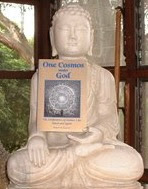
The full title of the book is One Cosmos Under God: The Unification of Matter, Life, Mind, and Spirit. As with most everything else about the book, this is intended to be "holographic," as it were. First of all, who could deny that the cosmos is One? Even scientists make this a priori assumption, even though no scientist has ever "seen" the cosmos, nor can it even be conceived or pictured in any scientific basis (for example, the quantum world is literally unimaginable; or, if you can imagine it, you haven't understood it). For one thing, as soon as the scientist investigates an aspect of the cosmos, he has drawn a line down the middle of it, even though he knows in his heart that the cosmos remains One on pain of his being unable to ever arrive at any general laws that apply throughout the cosmos.

Now, there are several obvious ontological discontinuities (e.g., matter-life-mind-spirit) in the cosmos; or let us say that they only appear discontinuous when looked upon under the aspect of scientific reductionism, or from "the bottom-up." Bear in mind that this is not a criticism; rather, it is just a built-in assumption of science. But scientists typically confuse method with ontology, so that without even knowing it, they naively construct an ontology in which a pseudo-property is created by their own method. In other words, they reify and project their own abstraction of the One back into the world, so that it appears to exist "in reality."

As the biologist Richard Lewontin describes it, "the properties we ascribe to our object of interest and the questions we ask about it reinforce the original metaphorical image and we miss aspects of the system that do not fit the metaphorical approximation." Thus, for example, when our troll suggests that he has a "passion for truth," what he really means is that he has an addiction to his metaphors. After all, if humans are cut off from the spiritual plane, they will find a graven image to worship on some lower level, thus endowing the relative with qualities of the absolute. You can't really be cut of from God, silly!

Similarly, "trouble arises," according to Robert Rosen, when we attempt to divide the universe into two parts so as to satisfy some property (such as "objectivity"), and end up with "some consequent of the property back into one or the other class as defined by the property." Again, materialists almost cannot help doing this. For as Magnus mentioned, I cannot think of a philosophy that is more abstract and artificial than materialism, and which requires us to explain away so much concrete reality.

Back to page 88. You will notice that the chapters of the book are simultaneously continuous and discontinuous, in that they are "discrete" and yet "overlap" in mid-sentence. For example, as biology transitions to psychology -- as we exit the world of the senses and Life opens out to Mind -- we "cross that radiant upper threshold and are witness to....

...BOO!!! another startling explosion -- or perhaps, implosion -- this time into a subjective space that was somehow awaiting the primate brains that had to learn to navigate, colonize, and eventually master it."

You see? It is just as Magnus says: Just as the physical world exists prior to our exploration of it, so do the higher worlds. This is easy to prove to anyone who goes there. But for those who wish they were mere animals, no proof is enough to convince them otherwise.

For -- to quote the Coonifesto -- "Just as the first singularity was an explosion into (and simultaneous creation of) material space-time, and the second singularity a discontinuous 'big bang' into the morphic space of biological possibility, this third singularity was an implosion into a trans-dimensional subjective space refracted through the unlikely lens of a primate brain" (apologies to Scatter).

Again, just as there are "permanent things" for the senses -- e.g., heat, cold, hard, soft, loud, quiet, etc. -- and permanent things to the rational mind -- e.g., mathematics, logic -- there are clearly permanent things on the spiritual plane, and it is precisely these that religion attempts to reveal to us and help us "conform ourselves" to. Does it always do so perfectly? Of course not, any more than our senses cannot be fooled, or the application of reason is capable of exhausting the Real.

Nevertheless, there is no question whatsoever that Revelation models these permanent metaphysical truths adequately, and that is all we can ask.

Wednesday, June 18, 2008

Religious Humanism vs. Darwinist Animalism

(not spell-checked yet -- may contain random mutations)

Perry writes that "Of the forces at work radically modifying the nature of Western and Christian civilization, there are those which are open and violent and easily discernible [e.g., the left, Islamism], and there are those which are covert and subtle and easily ambiguous." Reductionistic Darwinism falls more into the latter category, but it transitions to the former in the hands of demagogues and polemicists such as Dawkins, Harris, or Hitchens.

To paraphrase the Upanishads, the world is a mirror, a window or a door for the sage, a wall or "stopping point" for the spiritually untutored man, for whom reality "is what it is" and nothing more. And to plagiaphrase Richard Weaver.... Well, lets just list some bullet points that I placed at the back of the book:

--The world is intelligible and man is free.
--Without imagination, the world is simply a brute fact, with nothing to spiritualize it.
--Every group regarding itself as emancipated is convinced its predecessors were fearful of reality.
--When matter is placed over spirit, quantity is placed over quality. But quality is not just another quantity.
--In the scientistic flight from the center to the periphery, they become lost in details which cannot be understood; this downward pull puts an end to ideational life, and the world shrinks down to an image of our most crude way of knowing it.

Schuon describes the situation well: the scientific reductionist, like a machine, "has reversed the roles, turning its creators into its own creatures; it escapes the control of intelligence as such from the moment that it claims to define the nature of intelligence from the outside and below." People forget that the quantification of all knowledge "necessarily entails an inward impoverishment, unless accompanied by a spiritual science that re-establishes unity and maintains equilibrium."

This is one of the points I attempted to make at LGF, but to no avail. The bulk of commenters there seem to think that the "wall of separation" between church and state (itself a gross misunderstanding) must somehow extend to science and religion. Talk about a "wedge strategy"! But American schools are not failing because of "too much religion" (and by this I do not mean a religion, but simply a more sophisticated transcendental viewpoint that easily accommodates religion as such). To the contrary, our schools only began to fail after they were taken over by the radical secularists of the left. It could hardly be otherwise. What did you expect, wisdom?

For this reason, I will be sending the Gagboy to a religious school, for, among other reasons, I have no doubt whatsoever that he will receive a superior science education there. And this will be because he will be able to place science in a much grander divine-human context that imbues the scientific endeavor with real meaning. After all, there is a reason why America is 1) the most scientifically advanced nation, and 2) the most religious. The two fundamentally go together. They were never antagonistic -- at least not on a widespread basis -- until leftist activists came in with their radical agenda of draining science of any transcendent meaning and purpose, in order to advance their atheistic political religion.

Anyone who claims that their life is meaningful in the context of reductionistic Darwinism is strictly fooling themselves. I won't argue with them, because there is no reason to take them seriously for even a single moment. If they don't understand this, they are either stupid or intellectually dishonest. The same applies without qualification to morality, beauty, and truth. Obviously, I will not waste my time "debating" someone who simultaneously believes in Darwinism and truth, as if the transcendent absolute could ever be derived from matter.

I notice that the unsophisticated commenters at LGF also have a caricatured view of the scientific endeavor, as if it is a strictly mechanical process that results from "facts + induction" -- as if it requires no imaginative leaps, or an overarching paradigm in order to even perceive a fact! I cannot see that any of them are the least bit acquainted with the philosophy of science, e.g., people like Whitehead and Polanyi.

As Ben said, one stupidly arrogant commenter even said in response to one of my queries that he believed in "absolute facts" but not "absolute truth." How to even begin to respond to such sophistry? There is no fact that "speaks for itself," no experience that tells us what we are experiencing. To paraphrase Weaver, only by knowing little may we know much; logic depends on our "metaphysical dream," not vice versa. And it should go without saying that it is this Dream that unites men, not the logic. Nazis and Islamists are rational within the logic of their sick dreams.

Obviously, I don't think my huge mythunderstanding detracts one iota from scientific truth. To the contrary, the whole point is that it places scientific truth in a much wider and grander coontext that does indeed imbue science with the intrinsic meaning it otherwise lacks. For it places science in the context of the antecedent reality perceived by the higher intellect and not merely the senses. To deny this imaginative vision is to deny the unity that transcends experience, and therefore compels the acceptance of relativism, pure and simple.

This is the very real danger of reductionistic Darwinism, don't you see? Charles keeps harping on the scurrilous charge that Darwinism had something to do with nazi ideology, but that is somewhat beside the point. Rather, I would like someone to explain to me how reducing man to a mere replicating machine cannot inevitably, in the long run, lead to the abolition of Man as Such.

In my opinion, Charles is quite naive about the inevitable implications of such an intrinsically anti-human ideology. Indeed, I see the results all around me. The adverse changes in the culture over the past 40 years have been undeniable to anyone who has lived through them. Do I blame only reductionistic Darwinism? Of course not. I blame the general "materialization" of man, of which that is just a reflection. And materialization means dehumanization. Again, it is inevitable. Ideas matter!, especially the organizing ideas that make culture possible.

The word culture is derived from "cult." As all conservatives -- and no leftists -- understand, culture is something that grows "organically" through time. It is like a tree planted deep in the soil, that is nourished "vertically" by the divine-human revelation that gave birth to it, as it is "prolonged" in time. In turn, from the root we eventually see a trunk, branches, leaves, etc, all nourished by the spiritual sap that flows through the tree.

Scientistic materialists -- including the radical Darwinists -- are like defoliants, or people who would take an axe to this beautiful tree that has organically grown over the past 2000 years. Please, I am not being polemical here. When you mess with the fundamental vision that holds a culture together "from the inside," you are messing with the equivalent of nuclear physics on the collective human plane: an Adam smasher, if you will. You just have no idea what you will unloose from the bowels of hell.

And one thing you will unloose will be unbridled spirituality, no longer channeled or guided by the perennial truth of revelation to "contain" it. When this happens, genocide results. Again, to not understand this is so preposterously naive that it boggles my mind. First they came after the fetuses. Now the elderly. Who's next? Please, this is not hyperbole. Just read the works of Peter Singer, a man who is at least intellectually consistent. But under his ethical terms, I should have the right to kill him, because he clearly isn't a person in my book.

Perhaps it is my psychoanalytic training which makes me very aware of the thin membrane that separates man from his most primitive and regressive impulses, and which prevents man from seeing his fellow man as prey. But if my fellow man is not even a man, just a self-replicating animal.... To me, this looks like a nightmare come true -- like a living hell. And it will naturally require a leviathan state to keep these animal-machines in check, and perhaps that is the point.

Human beings do not live in world of sense-data. But the postmodern vertical barbarians do. In their small minds, they are "liberated" from the "childish mythologies" of the past. In this regard, such an impoverished scientism "is assuredly cut to the measure of modern man who conceived it and who is at the same time its product" (Schuon).

This isn't liberation but a special kind of tyranny, for to strip away the veils that simultaneously conceal and reveal the higher realms is to immerse oneself in "the ravages of immediacy" (Weaver). Ironically, it is knowledge of death, not life, because that is where the downward flight into matter inevitably leads. To paraphrase Weaver again (this is from my notes, so I'm not sure if it is a direct quote), "behind the veils is a reality of such commonplace that it is merely knowledge of death.... The raw stuff of life is precisely what the civilized man wishes to have refined."

And with the loss of transcendentals comes the loss of the human -- not to mention the hero, the saint, the sage. These are our fixed "vertical stars" that have always guided us up the ladder of ascent, but in the Darwinian paradigm, these are all illusions, pure and simple. Richard Dawkins is greater than Shankara. Chrisopher Hitchens is superior to Meister Eckhart. Ray Ingles is on a higher plane than Jesus.

If culture is to be understood, it must have a structure; if a structure, a hierarchy; if a hierarchy, an end. Nor is "infinite progress" possible. Rather, if a series is hierarchically ordered, it is conditioned from top to bottom and cannot be infinite; if it is infinite, then it cannot be conditioned from top to bottom. In other words, in the latter scenario, there is no higher and lower, just a kind of infinite horizontal dispersion in all directions.

No. Man, because he is man, may know the absolute within his own transcendent interiority, which paradoxically "contains" the infinite. Conversely, to deny this absolute is to deny man and to reject the measure of all knowledge: the uncreated intellect.

The world is not real, contrary to what the reductionists tell you. And when I say this, I mean "absolutely real," in that if it were absolutely real, then we couldn't be. Rather, we would be reduced to the "real nothing" beneath our feet, as opposed to the transcendent absolute above our heads: "The common illusion of an 'absolutely real' within relativity breeds philosophical sophistries, and in particular, an empiricist and experimental science wishing to unveil the metaphysical mystery of Existence." But to pursue this illusion is analogous to believing "that an animal endowed with sight were more capable than a blind man of understanding the mysteries of the world" (Schuon).

As Perry writes, "man is virtuous because God is Good." To the extent that the latter is not known, the former will eventually not be realized, for virtue is not mere behavior but consciousness of a reality. Nor will we know anything worthwhile, for we will have abolished the measure of all things, and thereby live long and meaningless lives that make up for in shallowness what they lack in depth.

*****

Related, as it is a reflection of the same dominant stupidity: at the University of Chicago, free market capitalism is as dangerous as God, and why not, since both are the quintessence of liberty?:

"Having a drudge like Lincoln call to reject a real intellect such as Friedman only underscores the leading affliction in the Groves of Academe today: Intellectual Insanity, a dread disease that cripples and kills minds that might otherwise have been used to ask the universe: 'Do you want fries with that?'"

Tuesday, June 17, 2008

Lizards and Mammals and Men, Oh My!

Yesterday while commenting at LGF, I couldn't help noticing how the reductionistic Darwinists practice a sort of inverse mysticism, in that they elevate what can only be ceaseless change into eternal truth. With reductionistic Darwinism, all is change; everything is "on the way" to something else that is equally temporary. In such a paradigm, not only can truth not exist, but we couldn't know it anyway; the quantification of knowledge undermines its only meaningful measure, which is the intellect in light of the Absolute.

In a way, this is a caricature of Buddhist metaphysics, as it too advances what amounts to a paradox, i.e., "all is flux," so that it is folly to become attached to the passing stream of maya. However, the Darwinists are missing a very important point, that being that it is possible to escape maya both from "above" and "below," and this makes all the difference, as the latter is actually a deeper plunge into its snares, a point that the -- let us say, less spiritually gifted -- LGF commenters never stop proving.

I'm currently reading this outstanding book on Buddhism by Schuon, and it makes this point with characteristic luminosity (the book is challenging in the usual Schuon way, so buyer beware; however, he really brings the subject alive for me in a way that the new-age Western Buddhists never do). I suppose I'll be posting on it in more detail later, but he points out that the saving renunciation of Buddhism "aims at preventing man from becoming imprisoned in an ephemeral illusion, from identifying himself with it and finally perishing with it; it aims at helping him free himself from the tyranny of dreams that leave no outlet."

In other words, the Buddhist transcends the flux of maya in order to know the eternal, the transcendent Absolute, whereas the Darwinist goes the other route and identifies eternity with matter. Naturally this makes no sense in a cosmos that is itself contingent and evolving, but there you go. Metaphysically consistent they are not. But they are angry. Not sure where that comes from, but I assume it is both a cause and consequence of the spiritual rut they're in. They all insist that their lives are just as fulfilled as the religious person, but one wonders how they could possibly know this, being that they a priori deny the vertical? They sure sound pretty bitter to this coonical pslackologist (check it out for yourself, if you're masochistic enough; I notice that Ben sailed by -- I waved at him, but he was vomiting over the side of the boat).

And markedly adolescent. Smells like the teen spirit of a false and grandiose nirvana, if you know what I mean. There is a rebellious streak in them that is very similar to the left (who also escape reality from "below," except in their case, instead of becoming Darwinian "monotheists" they descend into the fragmented polytheism of multiculturalism, moral relativism, deconstruction, etc.

In reality, they are two sides of the same worthless coin, just as, say, the Semitic and Eastern religions are two sides of an infinitely precious coin. I am disappointed that the head lizard can fall for this junk metaphysics -- just as he expressed disappointment in me -- but in my case I have an excuse, because I only want to be disappointed by the best. I do note that he clearly possesses a kind of peerless left brained, technological kind of intellect, and that may be the issue, for every gift carries a potential curse. Indeed, I may well be cursed with this dominant passion for wholeness and eternity, but if so, it's a blessed kind of curse. It beats walking, anyway.

Schuon writes that "When we contemplate a landscape, we absorb its main features without being distracted by details which, if they were too near, would imprison us as it were in their own special nature." Now, it goes without saying that any remotely advanced pneumanaut sees revelation as a whole and complete "spiritual system" that can only be comprehended inwardly. It is quite the opposite of Darwinism, which can only be understood outwardly, for the simple reason that it possesses no "inside."

And yet, we hear these metaphysical yahoos gratuitously affirming its truth with their own inside, a truth-bearing inside for which their theory can never account. At the same time -- and this would appear to be a logical corollary of their cosmic inversion -- they ask such "subtle" and "sophisticated" theological questions as: "Whom did the children of Adam and Eve marry?" Or "Who created the creator?" Or "If Jesus was God, why did he get baptized?" You can see how a certain type of intelligence is instantly converted to the most flagrant stupidity when it tries to grasp the higher planes within its own narrow orbit.

Again, a religious system applies to realms above, not below, the plane of maya. As Schuon explains, such a system is "a homogeneous ensemble of spiritual percepts, ordered in virtue of a metaphysical perspective. A traditional doctrine is never narrowly systematic, but it nonetheless constitutes a system, like every living organism or like the universe."

Which is again ironic, because the Darwinist pretends to understand "life," when life ipso facto exhibits the qualities of wholeness, interiority, non-linearity, internal connectedness, etc. And as I discussed at length in the Coonifesto, it does this because it mirrors the organismic nature of the cosmos, precisely. I will say it again: ordered totality is ontologically prior to natural selection. Which is why the laws of physics are a special case, not general. You prove this every time you voluntarily move your hand, bozo.

Again, reductionistic Darwinists seem to presuppose a paradigm of logical atomism, even though their empirical discoveries forbid it. For example, Harris writes that "The genome has been shown to act as a whole and not as a collection of separable effects." Or as the estimable Robert Rosen put it -- and he is probably my biggest influence in these purely biological matters, c.f. here and here; he is certainly no "Discovery Institute shill" -- the developing organism is

"governed and directed by the organized structure of the mature individual, which is immanent in every phase and differentiates itself in the process.... Each phase presents the whole, but in a different and contraposed degree of integration and articulation."

In any event, a divine revelation is the sine qua non of an "organismic system," only as applied to the spiritual plane. It can no more be comprehended in a linear, left-brained manner than can Consciousness or Life itself. "Traditions emerge from the Infinite like flowers; they can no more be fabricated than can the sacred which is their witness and their proof" (Schuon). They are alive -- and grant Life! -- something that is quite self-evident to the believer.

You might say that the unity of existence is "refracted" through each of its parts, or there could be no parts. Rather, in a universe of logical atomism, each part is its own private whole, so to speak -- like a collection of billiard balls. This is an example of absolute relativity, which is a contradiction, an absurdity, and an impossibility that even God could not create, for it would mean an infinite number of Gods.

One must try to imagine a gene pool table in which all the balls are members of one another; or which are internally related, not just externally related. So too with revelation -- for example, the deeply internal relationship between the Old and New testaments. Such deep truths cannot be conveyed in a literal sense; however, this is by no means to suggest that words cannot convey them. It's just that the words must simultaneously convey a presence and an absence that goes by the name of "mystery."

Mystery is not a negation, but a kind of dark plenitude that apparently completely eludes the myopic materialist, for whatever reason. Such truths are elliptical, suggestive, or provocative, and serve to "awaken" in the receptive soul a "resonant" response that signifies that the outer form corresponds with an inner certainty -- again, in a holisitc and non-linear way -- as a "flash of in-sight" or seeing the contours of the Within.

This inverts the cosmos (back right side-up), so one sees the emptiness of form and the form of emptiness, so to speak. It should go without saying that none of what I say applies to the non-Raccoon. Do not bother, because these truths are "not for you" -- through no fault of the Truth, I might add. Truth is like the sun. It's always there, irrespective of a reflective medium to "witness" it.

The discovery of this internal relationship on the human plane is none other than love, is it not? Marriage sanctifies this internal relationship, as the Two do not so much "become" one flesh, as realize it. And as the years go by, the two should deepen this realization of sanctified Oneness. Suffice it two say that neither billiard balls nor lizards fall in love. Or, to the extent that they do, its just a trick of the genes to get them to reproduce.

Watch the Darwinists be insulted by this admittedly infrahuman characterization, as if they do not pronounce the verdict upon themselves! For they are replicating machines, nothing more, but a lot less -- both biologically, but more tragically, intellectually and spiritually. Does this mean, like the Islamists, I want them dead? Hardly! I want them alive.

One cannot save a soul as one would pull someone out of the water, one can only rescue those who are willing to be rescued, and that is why it is ridiculous to reproach religions for not having succeeded in saving the world. --Frithjof Schuon

Monday, June 16, 2008

Blogging Under the Influence

As I said yesterday, I'll eventually get back to the ID thread. It's just that I wanted to complete the SA (Spiritual Ascent) thread before moving on. Or back around. Last things first, as the Wise Ones telos all the time.

For when you think about it -- and I'm thinking about it for the first time -- this would mirror the circular structure of the Coonifesto, which is to say, up and out of manifestion, only to circle down and back in again. This is the moment-to-moment ontological, or vertical, structure of reality. (There are many references to this circular structure sprinkled throughout The Spiritual Ascent, another weird coonfirmation that I was correct in following that nonlocal pattern; I'd love to go back and assemble all of them in one place.)

You see, one of the points of that bercircular structure was that it was supposed to convey the idea that one looks upon reality with "new eyes" once one reaches the highest state: first there is a mountain, then there is no mountain, then there is. The book ascends the mountain, only to reach the peak, where one discovers that there was never any mountain to begin with. (Helpful visual here.)

But then -- like any good bodhisaltva the earth -- we come back down and in to help others make amends meet in the muddle of their mount. "Once veiled by ignorance and later revealed, Reality looks as if newly realized. But it is not new" (Sri Ramana Maharshi). Same old same old, same shunyata-yada-yada.

I hope this isn't too dreadfully solipsistic! It's just that no one else will ever review the book at this depth, so it's left for its author to do so.

Anyway, when we return to our familiar locution at base camp, we see that it is the same mountain. But it now looks entirely different. So that would be the purpose of revisiting some of the material alluded to in last weekend's posts. As I said, I am way beyond using ID arguments to try to arrive at God. Rather, once you have confirmed for yourself that God exists -- and no mere logical argument could accomplish this -- then you understand that "intelligent design" is reducible to "intelligence" which is in turn reducible to "God." Of course the Divine intelligence radiates through manifested things.

How could it not? Foolish one, do you really pretend that random mutations are responsible for the transcendent beauty of the butterfly? Then too bad for you, buddy. You're still on the outside looking in, with your nous pressed against the glass dorkily. No, my friends, Beauty is like the sun: it acts without detours.... its ways are free, direct, incalculable; like love, to which it is closely connected, it can heal, unloose, appease, unite, or deliver through it's simple radiance (Schuon).

Ho! Let it be so, mischievous ones!

Another way of saying it is that from the lower, profane, perspective, everything is necessarily "inside out" -- which is why the things of time exist to begin with (ex-ist meaning to "stand out"). What I mean is that things that ex-ist for us only do so at God's in-sistence, comprende?

Likewise, to achieve Christ-consciousness would be to dwell fully within oneSelf, or to know the luminous interior Self of Being, or Light of light. But because modern men, as Schuon points out "live almost entirely for things of the senses," for that very reason they remain ignorant of the radiant interior. And that is where all the inaction is, baby! O the grievous vanity of the sub-Raccoon masses, who toil by day for no nocturnal reward! 'Scuse me, but they shall never kiss the sky!

"Reality" is "that by virtue of which we exist" (Schuon). In turn, renouncing the illusion -- or let us say, derivative nature -- of existence returns us to the Real. Or you could just say, "cleave to God and let the dead bury the tenured." Here, in Upper Tonga, we draw all of the contradictions and complementarities of the world into our compassionate bosom and "transmute them into radiant silence" (Schuon). Listen to the silence that surrounds my words, O nocturnal varmints! For Mystery is the penumbra of the Truth I unSay!

Alternatively, you could just say that the sage has transcended "fragmentary experience" (Schuon) in order to know things from the perspective of the Whole, which is to say, the Great Within. To achieve this is to become a Son of God or Cousin of Toots through adoption (or enough beer, in the case of the latter). And if you want to say I'm not a blogger but an "interior decorator," that would suit me fine. Either way, we are always attempting to transmit a passion for wholeness, or the view from eternity. So do not come after me with temporal arguments, trolls! For you are attempting to sever the ocean with your little sword of reason! So we have heard from the wise, the merciful, the unpredictable, Petey!

The point is, I haven't looked at Errol Harris's books in over a decade, even though they were instrumental at the time in helping push me up the mountain. They were an important wu wei station. So it would be kind of fun to take a fresh look at them from a new perspective and see how they hold up. In so doing, one thing I would now attempt to do is to place them in a traditionalist context, since I now recognize that as the higher, or more general, truth to which lower truths must conform.

But as I said, we still have a mountain before us, so we'll wait until we get to the top before we come back down and look at things with the scales removed from our I's and our I's from our skulls.

At the moment, we're attempting to realize what we know and integrate what we've experienced of the Divine. I see a helpful footnote on page 872: "Reality is not complete unless all of its three poles -- Being, Knowledge [or consciousness], Bliss (Sat-Chit-Ananda) -- are present." This roughly corresponds to Father-Son-Holy Spirit, or alternatively, to Light, Love and Power, or Mind, Heart and Life, or Father-Mother-Baby.

Ah, read the fine words of Swami Sivananda: "You can distinctly feel the shift of mind as it leaves its seat in the brain, attempting to return to its original seat; you realize that it has left its former channels to enter into new ones.... Its psychology is transformed. You now have a wholly new brain, a new heart, and noble sensations."

Think back, little Raccoon, to when you first stumbled upon this blog, and how far you've come! At first you did not know whether Bob was a fool, a freak, a knave, noodge, a kook, a crock, a crap-slinger, a schlemiel, a schmendrick! But now you know him to be all these things, and less! First there is a mountebank, then there is no mountebank, then who knows?! Ho!

Let us whisper across cyberspace "Coon to Coon." Sri Ramakrishna relates the story of the man who appeared completely intoxicated first thing in the morning after just one adult beverage. "But another man said, 'Why, he has been drinking all night!'"

For waking on firewater wasn't built in a day!

Well, I'd better sober up. Time for work.

Sunday, June 15, 2008

God, Intelligent Design, and Other Things that Cannot Not Be

Yes, I'm posting today. Why? Because I feel like it. Mrs. G. is leaving for mass, so I can keep going until Future Leader wakes up. Which could be any minute.

You may ask yourself, "that's strange. Why isn't Bob converting to Catholicism?" Well, perhaps I will someday. First of all, it's impossible for us to do it at the same time. Also, frankly, if I had my druthers, I think I would prefer something like Byzantine Catholicism, which seems to combine elements of Eastern Orthodoxy and Western Catholicism, which would be ideal for me. But it's not as if you can find one of those on every corner. Plus, it's a real commitment. You don't just run down the aisle and say "hallelujah, I'm saved." Look at Mrs. G. She has to attend 8:00 AM mass every Sunday for a full year before she even gets her decoder ring next Easter.

Anyway, at the end of yesterday's post I mentioned several books by the philosopher Errol Harris, which were instrumental in helping me to arrive at a total cosmic vision with no annoying shirttails hanging out the back. In reviewing his corpus, it looks like in recent years he might have taken a lurch into environmentalism and one-world government, but I cut him some slack, because I think he's like 100 years old.

Now, here is a man who has nothing whatsoever to do with the contemporary "intelligent design" debate, but was writing about these things in the 1950s. In this regard, I was totally convinced of the truth of what is now called ID way before it became a hot topic. The bottom line is that there are at least a dozen inviolable metaphysical reasons why reductionistic Darwinism cannot possibly be true, in that it cannot give an even minimally coherent and comprehensive account of human reality. The reasons are principial, not "accidental," meaning that they must be true. I first discovered these metaphysical principles, and only afterwards made the surprising discovery that these same principles are fully embodied in religious tradition, only given in symbolic and esoteric form.

To cite just one obvious example, Darwinism presupposes a certain very specific type of universe, and this is a universe that exhibits ontological wholeness rather than logical atomism. In other words, life presupposes wholeness; wholeness could never be built "from the bottom up," but must be woven into the very fabric of being. And wholeness is one of the necessary attributes of God, and therefore creation.

Another way of saying it is that ordered totality is logically prior to natural selection. It can only operate on existent wholes. Natural selection is really the progressive unfolding of a principe of order that is present not just in the organism, but in the cosmos. After all, to say "cosmos" is to say "ordered totality." Obviously, the ordered totality of biological organisms can only occur in a cosmos that is itself an ordered totality.

I should point out that Whitehead made similar arguments along these lines in the 1920s, recognizing that quantum physics revealed the nonlocal, organismic wholeness of reality; you could say that nonlocality is an artifact of wholeness, or that wholeness necessitates nonlocality. Either way, there is no way to eliminate the wholeness.

I would go much further than this, and say that the reason human beings have access to the Whole on the subjective plane, is that this interior space also obviously exhibits properties of wholeness. In fact, the human mind is quintessential in this regard, seeing as how a healthy mind instantaneously synthesizes literally countless synaptic connections to facilitate the emergence of a simple "I" or "I AM." There is a metaphysical reason why "I AM" is the name of God, as "I" refers to the prior space of ontological wholeness, while "AM" is its deployment in time and space; the former is nonlocal, the latter local.

Conversely, on the human subjective plane, pathology (mental illness) always involves some disturbance in the experience of wholeness. Words such as "schizoid," "schizophrenia," "bipolar," "paranoid" -- each of these categories describes a mind that is fundamentally at odds with itself. In fact, psychosis can often be conceptualized as a mind that his been torn into persecutory "bits" that cannot be synthesized, just as autism can be seen as a mind that cannot experience intersubjective unity with another mind.

Likewise, at the other end of the spectrum, the total unity of mystical experience speaks for itself. Such an experience would not be possible except in a cosmos that is fundamentally shot through with wholeness, so that each part is not just embedded in a network of relations, but has the whole within it -- the same way each part of the body contains the DNA of the totality.

That was brief. The Boy is starting to stir. Let me just throw in a few notes that I placed at the end of Harris's books. It is possible that they are at least partly his words, not mine.

"Time = the serial self-articulation of the whole."

"God's reality cannot be denied, as any such denial must rest on grounds which only God's reality can provide."

"Every proposition is contingent, but in order for this to be so, there is one fact that must be necessary, and that is the existence of the completed system."

"If we reason at all, it is on the basis of a systematized experience revealing the totally systematic nature of the Real. The perfected whole of knowledge and reality is, therefore, the necessary presupposition of all reasoning and proof. The denial of this reality is self-refuting. Without God's existence, all rational discourse is undermined."

"Natural selection sneaks in a principle of improvement by the 'selection effect' of the environment; however, this adds nothing, since all change is initiated randomly. Random = homogeneous, and there can be no homogeneous continuum."

"What the scientist takes on faith not even the philosopher can prove, for no proof of the ultimate rationality of the object of our thought is possible which does not assume what it has to prove."

Oh well. I can't possibly do justice to this subject in such a short space of time. Maybe I'll return to it later in the week.

Saturday, June 14, 2008

Intelligent Dasein

Here are a couple of posts from two years ago which I have combined. I would categorize this material as deeply redundant for long-time readers, so feel free to take the day off! File under Pearls Before Swine.

Dasein: the kind of existence that self-conscious human beings uniquely possess.

Horizontal folks -- flatland materialists, secular pneumapaths, left-brainers, MENSA members, et al -- love to sneer at religion and exalt the superiority of science or mere reason in understanding the world. But when they do this, they always deal with a caricature of religion based upon their own limited horizontal understanding. In this regard, they are very much like children or primitive people who cannot transcend their narrow cognitive horizons, and mock what they do not understand. As Dr. John Lennox said in his debate with Richard Dawkins, "I don't believe in the God you disbelieve in." While man, so long as he is a man, cannot help being religious, it is nevertheless striking how passionately Dawkins believes in his silly little anti-god.

It was said by someone that secular philosophy involves “a journey of many roads leading from nowhere to nothing.” It is interesting that 2500 years of thought has produced no consensus at all regarding even the most basic understanding of existence. Don’t get me wrong -- there is much to be gained from studying the great philosophers, if only because you can enter the mind of a formidable intellect attempting to grapple with the meaning of existence. But there is no purely human philosophy that cannot be disproven by another clever philosopher. [I would now say that philosophy inhabits a "middle area" between science and theology; if placed in this context, it can obviously be quite useful.]

In the final analysis, all of the philosophies devised by man are more or less failures. They all fall short in some critical way. Either they begin with unwarranted assumptions that cannot be justified by their philosophy -- i.e., they start at second base without having earned the right to be on first -- or they cut off their philosophy at an arbitrary point. If philosophy consists of “asking why,” they simply stop asking why at a certain juncture and then call it complete.

But no form of horizontal thought can be complete, for self-evident reasons. The divine plenitude spills over into reality like rays from the central sun. Various philosophers describe one of the rays but ignore the sun. The individual rays have their own relative validity, but none is ultimately superior or inferior to the others. This is why there is no agreement among the greatest philosophical minds that have ever lived -- indeed, they are often polar oppostes, such as realism vs. materialism or empiricism vs. rationalism.

Philosophy and science try to understand the sun by studying the rays, which is precisely why they generate metaphysical paradox and confusion. On the other hand, to study religion is to study the properties of the sun. Religion deals with perennial truths about the sun that cannot not be true, which is why it is so easy to prove the existence of God. It is much more difficult to prove how it is that humans can exist. However, once you understand the nature of the sun, this becomes possible as well. As a matter of fact, our mysterious inwardness -- our divine-human consciousness -- is one of the inevitable results of the eternal sun’s very nature, which is to spill over into time and share its absolute being with its various middling relativities.

Religion gives the name “God” to the knowable aspect of this divine sun. But just like everything else, humans can only know what they can know. Since we exist in the relative, any view of the absolute is necessarily going to be partial and incomplete. Even to “see the face of God” is nevertheless to see a “relative absolute,” because there is something behind the face we cannot see; behind the Son is the Father, so to speak. Since it is transcendent it is no-thing, but since it is immanent it is everything. It just depends on how you look or unlook at it.

Science can never account for the scientist, that is, for the human subject capable of knowing real truth. Again, it simply assumes the existence of truth-bearing scientists, as if this is not deeply philosophically problematic. How can the watered-down evolution of reductionistic Darwinism ever account for that? It can only pretend to do so, again, by confusing the rays with the sun. But to understand Darwinism is to have transcended it.

In order for relative existence to exist, the One must be split down the middle. Ultimately there is only God and God’s reflection, Creator and creation. The more distant from God, the more dim the reflection. Rumor has it that human beings are in the image of the Creator. Of course, the image is not the reality, it is only a four-dimensional facsimian. Religion as a verb involves transforming this image into a hyper-dimensional likeness. To intuit the image is to be called. To actualize it is to be born again. To become it is to die. Good riddance!

To know Truth is to die a little. Day by day, little by little, we must die. In order to live.

*****

Now, is it possible for religion to pose anything more than a rearguard action against the inevitable transformation of man from homo religiosus to homo scientificus? In the West, science so dominates our way of looking at the world that perhaps we don't realize the magnitude of the spiritual revolution (or devolution) this has entailed. While I endorse science (almost) without reservation, I do worry about its deleterious effect on the human soul when it is absurdly elevated to a metaphysic. To me, it is simply self-evident that the infrahuman metaphysic of reductionistic Darwinism, if embraced by all people, would eventually spell the end of Man as Such.

There are, of course, people who wish to keep science and religion entirely separate, which has the practical effect of elevating the scientistic worldview to a default state religion. On the other side are people who wish to conflate science and religion, which can end up debasing both. As I have said before, I am a believer in “intelligent design” for the same reason I am a believer in intelligence period. It is simply a necessary consequence of the existence of the Divine Intellect. In other words, I would never try to prove the existence of God through intelligent design; rather, vice versa. Obviously the world is uniquely intelligible to man's transcendent intellect.

But this is metaphysics, not science, and should not be taught as such, because it is higher than science, obviously not on the same low material plane. The problem is, Darwinism should be taught as science, not metaphysics, but virtually all of the middlebrow atheistic activists absurdly elevate it to a quasi-religious metaphysic that is logically self-refuting at every turn. In turn -- and I have noticed this, for example, in many threads at LGF -- militant atheists do indeed confuse Darwinism with metaphysics, and blindly defend it with the same belligerence as any "fundamentalist." Light simply cannot break through their hardened defenses.

It is true that there would be no atheists if all men were capable of understanding metaphysics. As pure truth, metaphysics is aimed at the nous, not the distorted and hypertrophied reasoning mind of the contemporary intellectual. Truth is true despite what may be proved or disproved with mere reason, which is a mechanical form of thought limited to drawing conclusions from premises. It has its place, but one of them is not the realm of primordial Truth per se. It is a banality to point out that the most important truths cannot be proved with reason. That doesn't make them any less true.

Tradition willfully attempts to maintain a purified faith in the teeth of the predations of a misguided scientism. There are certain particularly elevated and/or simple souls for whom this will suffice. But that probably represents less than two percent of the population on the high end, and perhaps a quarter of the population on the low end. That leaves at least seventy percent of the population generally spiritually adrift and untouched by metaphysical truth. How to reach them? For whatever reason, they have lost contact with the natural simplicity and nobility of their souls, so religion properly so-called no longer speaks to them as it was intended to. Thus they drift into materialism, or hedonism, or its twin sister, new-age spiritualism, with no grounding in the intrinsic meaning provided by authentic revelation and grace.

There is absolutely no contradiction between science and this latter form of religion, for they simply address different levels of reality. Religion easily accommodates science, while the reverse can never be true. Religion accommodates science for the same reason that our minds do. For our minds are designed to know truth, pure and simple, whether it is empirical truth, rational truth, artistic truth, moral truth, or metaphysical truth. Intelligence itself is prior to what it knows, and what it knows is truth (otherwise, “knowledge” is a meaningless, even absurd term). Therefore, intelligence is truth itself implanted within our soul.

As much as I respect tradition, I am very concerned about it reducing itself to a simple fideism, or faith, rather than appealing directly to the higher intellect. Again, there are gifted and simple people for whom this will suffice, but the great middling masses -- leftist dominated academia, the creators and purveyors of popular culture, media elites in the MSMistry of Truth -- entirely miss the boat in this regard. They are just intelligent enough to reject religion but not intelligent enough to understand it, and they obviously exercise a huge, dominant influence over the culture at large. How to win that battle?

The fact of the matter is that modernity has brought with it certain positive and undeniably precious developments, such as the sanctity of the individual and all this implies -- liberty, democracy, free markets, etc. But at the same time, a new kind of religion -- or rather, different inflection of the perennial religion -- is required for this new kind of person. This religion must be more inward because we have become more inward. In other words, cosmic evolution doesn’t just take place outwardly but inwardly, on the "subjective horizon." As a matter of fact, it is this evolution of the interior horizon that has always been the concern of religion, even if and when religion did not explicitly recognize it.

I’m somewhat embarrassed to admit it now, but when I began the task of writing my book, I thought that I was going to have to invent a new religion. In my hubris, I thought, well, times have changed, and we know so much more now than we did when the original revelations were handed down. What if we could design a new religion now, based upon everything we know about the universe?

It is actually a measure of God’s grace that my attempt to do this ultimately led me in exactly the opposite direction and saved me from trying to be L. Bob Gagdad. In all humility, I do believe this is because I approached the endeavor in all humility. In other words, I was motivated solely by the humble pursuit of truth, wherever it led me. There were no commercial motivations whatsoever (although it is probably another measure of God's grace that my publisher only later discovered this bitter economic reality). As a matter of fact -- I shouldn’t say this, but here goes -- I practiced meditation every day during the course of writing the book, and in so doing prayed for two things only: light, or understanding, and the ability to express it.

Now, I’m not nearly grandiose enough to say I succeeded (I won't presume to speak for Petey). Since the process is ongoing, there are a lot of little things I would now say differently in the book, and perhaps someday I'll re-read it and spell those out. But that’s not the point I’m trying to make. What I am saying is that if you really want to deeply understand religion -- and therefore, yourself -- you can. That’s what it’s here for. It’s not meant to be opaque, or absurd, or primitive, or outdated. Rather, no matter how intelligent or sophisticated you think you are, that kind of superficial intelligence really doesn't reach down (or up) to the deepest (or highest) part of your being. Religion expresses truths that cannot be proved in the ordinary way, for the simple reason that Truth is its own proof. Ultimately you do not comprehend it. It comprehends you. And that is a daily mirrorcle.

Further reading by a philosopher of science who gets it:


Friday, June 13, 2008

Combining Heavenly Know-How with Down to Earth Be-Who

Picking up where we lifted off yesterday, how does one realize what one knows and integrate what one has experienced of the Divine? As I mentioned in the Coonifesto, it's easy enough to have spiritual experiences (!?), but how do we make them "stick," or transform them from transient states into stable traits, or (¶)?

It's easy. We don't. Nor could we ever do so, any more than we could build a tree or grow a carrot or bake a creative thought from scratch. Philalethes: "The whole process which we employ closely resembles that followed by Nature in the bowels of the earth, except that it is much shorter." Think of a baby that grows up into a normal civilized human being. In so doing, he is compressing 13.7 billion years of cosmic evolution into 20 or 30 years. But why stop at normality? Why not go "all the way?"

Really, all we can do is create the conditions, and then get out of the way of the same energies that turned dirt into Dostoyevsky or mud into Mozart or sh** into Shakespeare -- which is what "right living" is all about. It reminds me of when people "try" to get pregnant. Often it only happens after they've given up. I've even heard it said that it's not uncommon for people to adopt a child, thinking they'll never get pregnant, only to become pregnant once they've given up hope.

I can't tell you how hopeless I am. No (temporal) ambition at all. No hope that things will ever change. No glorious ideas of a better future. Besides, now that everyone is famous, anonymity is the new celebrity. It's enough that I'm famous in the tiny Coonosphere. Anything beyond that would be infamy. "Let not him who desires this knowledge for the purpose of procuring wealth and pleasure think that he will ever attain to it" (The Sophic Hydrolith). I only ask: be it thy will that we be kept still knowing and loving thee, and that we may never fall away from this blest way of life (Hermes).

In my utterly hopeless condition, I try only to burrow more deeply into the present, and again, let the rest take care of the rust. Call it blind I AMbition. Let the dead bury the dead, and let the unborn.... let them do whatever they need to do to become born, but certainly don't abort them or feed them steroids. I don't put them on a timetable. They'll arrive at their own pace, so long as I take care of my deportment, which is to fertilize the present. In fact, Christian hope paradoxically arises specifically from a kind of liberating hopelessness about this world. To place your hope in the world is to misplace it. Thus the intrinsically luciferian nature of the Obama phenomenon (luciferian is not necessarily satanic; it is more the perversion of light, as opposed to its absence).

I live very simply, because a complicated life begins to place barriers between yourself and human reality, or your feet and the ground. At the moment, I'm reviewing the section in The Spiritual Ascent entitled Integration, and it has many helpful pointers along these lines. Again, you will find that the insights are universal and that they apply to all traditions, since each tradition is "composed" of Truth as such. Being that they are Timelessly True, they are as invariant vis-a-vis the human realm as the Platonic truths of mathematics are with regard to the physical plane.

For example, Hujwiri tells us from across the centuries that "the Sufi is he whose thought keeps pace with his foot, i.e., he is entirely present: his soul is where his body is, and his body is where his soul is, and his soul is where his foot is, and his foot is where his soul is. This is the sign of presence without absence."

Like so many passages in this book, this is the whole teaching boiled down to a single phrase. You could identify any number of biblical passages that say the same thing in a slightly different way, and I'm sure Nomo will. But let's stand back and look at the big picture: what is the whole point of Christianity? It is that God took on mankind, that the Ultimate Principle, the Absolute, is present here in the human flesh.

But it's one thing to "know" this, something else entirely to realize it. This is why the saints are so important, for they are the realization, or earthly fulfillment, of the doctrine. In turn, this is why we learn more from them by "watching them tie their boot-laces" than from their words per se; or, bear in mind that their communications will always consist of "words and music," and that one must have an ear attuned to the latter to gain the full benefit from the former. Or, put it this way: the truth can be told in such a way as to become a lie, due to the unworthiness of the container. Again, the dreadful Deepak Chopra comes to mind.

By the way, one reason I was attracted to Sri Aurobindo was that his philosophy is very much this worldly. Enlightenment must not only take place in the body, but it must transform the body, i.e., recalcitrant matter, which is "resistant" to being spiritualized, so to speak. Again, think of how easy it is to have a spiritual experience "above" the body. But when you come back down, you're left with the same unreformed physical being, i.e., certain dense and mindless patterns that seem "opaque" to the light.

It's much, much more challenging to just be a regular guy in this world, and to sharpen your realization against the rocks of adversity. This is why I never trust "professional gurus" who not only don't have a real job, but are very likely unemployable due to the extent of their cosmic narcissism. Jesus was a carpenter. He worked with his hands and with natural materials. If you meet the Buddha on the road, first take a look at his hands. If you don't see callouses, or at least some dirt under the fingernails -- worse yet, if you see a manicure -- walk away.

This is why it was so easy for me to see the parallels between Aurobindo and Christianity, because in a way, Aurobindo is Vedanta with a Christian twist, while esoteric Christianity is a sort of "Christian yoga." In both cases, the focus is again on embodiment. The point is not to "escape" this embodiment, but to incarnate fully. Our incarnation is God's.... I don't know what the word would be, but it is analogous to saying that our inspiration is his expiration. God exwholes into us, we inwhole God, and this is how we oxidize the blood that courses through the arteries of the cosmos. Real Men take their realization into marriage, into child rearing, into work, into the constant battle that is this world. The world is a test that never ends. Like Michael Jordan, God puts his shorts on one leg at a time, despite his incredible vertical leap.

Thy will be done, on earth as it is in heaven. Here again, there is the upper vertical and the lower vertical, the celestial and the terrestrial, spirit and body, heaven and earth. It's easy enough for God's will to be done "above," where it is done "automatically," so to speak. The trick is how we allow it to be done in the herebelow, for there are many layers of influence between the top and bottom. Again, it's more a matter of getting out of the way, isn't it? Benjamin Whichcote: "Our Conversation is in Heaven, according to the Measure and Degree of our present State and Condition.... When we set ourselves to do the Will of God here, then Heaven is come down into the World..."

We mustn't wait until we are dead. Meister Eckhart: "This may well happen while the soul is in the body. I say more: while yet in the body a soul may reach oblivion of its travail not to remember it again." In other words, there can be a kind of egobliteration and "resurrection" in this life, or at least its "first fruits." For any transcendence is evidence of all transcendence, which is to say transcendence of all -- which is another way of saying resurrection, or at least rebirth.

William Law: "What could man have to do with the perfection of God as the rule of his life, unless the truth and reality of the divine nature was in him?" The Russian Pilgrim: "It is possible for man to get back to that primitive contemplative state in which he issued from the hands of his Creator." Why? Because you weren't issued in the past; rather, you are issued afresh each moment. You know, make your resurrections in advance, and don't forget your peaceport.... De-part and bewholed like in them seers' dialogues of old, then aim your eros for the heart of the world!

Hakuin goes even further -- it's not only senseless to wait until death for the tome of your life, but it is the most culpable negligence. It's a kind of philosophical malpractice. It's worse than a crime, it is a cosmic blunder.

Nope. "He that beholds the sun of righteousness arising upon the horizon of his soul with healing in its wings, and chasing away all that misty darkness" -- such a regular feller cares not "to pry into heaven's secrets, and to search the hidden rolls of eternity, there to see the whole plot of his salvation; for he views it transacted upon the inward stage of his own soul, and reflecting upon himself, he may behold a heaven opened from within, and a throne set up in his soul, and an almighty Saviour sitting upon it, and reigning within him.... It is not an airy speculation of heaven as a thing to come that can satisfy his hungry desires, but the real possession of it even in this life" (John Smith the Platonist).

Amen for a child's job! (And vice versa.)

Theme Song

Theme Song