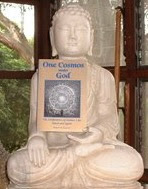
If providence subsists prior to fate, this must be analogous to what we were saying the other day about entropy being parasitic on order. Obviously we could not speak of disorder in the absence of order. Therefore, no matter what physicists say about the priority of the second law of thermodynamics, it must nevertheless rest upon Petey's Unwritten Law of Cosmic Order, or there couldn't be any laws to begin with. It's just another way of saying that God exists prior to the world, not just in the horizontal past, but in the descent of each vertical moment. If there is any order, there is only One transcendent order. And that's an order!
It's as if physicists arbitrarily begin with the Constitution, when it is necessary to go back to the Declaration of Independence in order to understand the "ground" of the Constitution, i.e., our sacred rights and duties that can only have a supernatural origin. Otherwise, the Constitution rests in thin air and has no metaphysical foundation, otherwise known as the lefthound path to godlessness and judicial tyranny. "People often think their love of truth or of freedom is natural to them, but in reality the natural person does not love either truth or freedom" (Bolton).
Now consider this: God is in everything, but God is nowhere as much as he is in the soul. There, where time never enters, where no image shines in, in the innermost and deepest aspect of the soul, God creates the whole cosmos. --Meister Eckhart
Eckhart is speaking of the creation of the cosmos, not the universe. Here again, whatever physicists may say about the universe, it is critical to bear in mind that they are not talking about anything ultimately "real" in the philosophical sense, but simply an abstraction they use to frame and understand their data.
But the cosmos is very different from this. No one actually lives in the cold and dead universe of physics, which is technically uninhabitable. Rather, we live in a cosmos that we co-create within the ground of the soul. The cosmos is a preconception through which we are able to connect the objective and subjective worlds. Thus, as Bolton points out, the soul is "a sphere of consciousness which contains the physical universe in its own mode, and many more subtle realities besides" (emphasis mine).
Put another way, the soul is "the container of our world-representation." The ego is merely an adaptation to the world (both the external world and the wider world of consciousness), whereas the soul is actually a cosmos -- an ordered totality -- that both mirrors and creates the experienced cosmos. Otherwise, there would be no cosmos, only a linear succession of disconnected perceptions and sensations.
Still not getting it? No, Petey, we're not. Could you dumb this existentialada down a couple of nachos?
Okay, let's go back to the first principles office: "as above, so below"; and "man is made in the image and likeness of the creator." And while we're at it, let's toss in another, "the unexamined life is worth laughing at." If we take the time to examine ourSelves, we see that perception is obviously some sort of "mirror" of reality. But naive scientism reduces this to a "horizontal" mirror, so that their motto might be something along the lines of "as outside, so inside." In other words, there is nothing in the mind (let alone, soul) that didn't come in through the senses, one way or the other.
Such a worldview results in the abolition of man, since it subverts the proper relation of inner to outer, or soul to universe, making us an unnecessary consequence of the material world, instead of the material world being a necessary consequence of consciousness as such. Understood in the proper way, reason is not a "higher" aspect of nature, but the most accessible form of the supernatural.
Likewise, we are not simply an anonymous "part" of the cosmos, unless it is understood that the part is in the whole, and that man alone is like a miniature golf course where it is possible for an ordinary person to be a whole-in-One. Furthermore, all acts of real knowledge are like a "conversation with God," so that the belief that we create our own knowledge "is only a little less absurd than believing that one is one's own creator" (Keys of Gnosis).
To say that we are in the image and likeness of the creator does not necessarily imply that we should begin our inquiry with our received ideas about the creator -- which carries the danger of being a circular and self-confirming undertaking; rather, we begin at the other end, with ourselves, in order to gain insight into the nature of the Divine Mind through analogy, i.e., "as below, so above." God is just like us. And then some!
Remember the example of the tree reflected in the lake. Standing on the opposite shore, we will see an exact image of the tree, except that it will be upside-down, with the top of the tree closest to our feet.
That's called a hint. You might say that God is closer to us than we are to ourselves, despite -- or, more precisely, because of -- being so (vertically) distant. In other worlds, he is way over yonder, across the lake and up that tree; and yet, right down here, with his treytop at our toetips. At risk of tossing pearls at your piggies, you can actually learn a lot about God from the feats of clay. This is the key to understanding many of Eckhart's most orthoparadoxical statements, which may sound unserious to the casuist listener, but were nevertheless disclosed with the utmost levitas. For example,
If I spent enough time with the tiniest creature -- even a caterpillar -- I would never have time to prepare a sermon. So full of God is every creature.
Speaking of hints and analogies, who knows how Man alone is able to take refuge in his christalis and caterpult his buddhafly up to the heavens? I love butterflies. They're my very favorite animalogy. For,
The seed of God is in us. Now the seed of a pear tree grows into a pear tree; and a hazel seed grows into a hazel tree; a seed of God grows into God.
Of course. But what sort of coconsciousness grows in a cocoon? I know the answer, but why don't you tell me? For it is written, as of this moment: Only a mediocre man is always at his best, but a Coon is always falling short.
Whereas all beings are "sown" in the world as creatures of Fate, the purpose of life is to develop from this to free will and individuation. This can be helped by a deeper understanding of one's origins. --Bolton, Keys of Gnosis
(All Eckhart quotes taken from Meditations With Meister Eckhart)
Saturday, January 12, 2008


Friday, January 11, 2008
Providence, Destiny, and Fate, Oh My! (1.14.11)
I have to admit, I've never given much serious consideration to the idea of predestination, because it isn't really due any. It strikes me as intrinsically heretical and antiCoonetical, in that it takes certain truths and pushes them beyond the breaking point. In a way, it's like slipping astrology in through the back door -- the idea that our fate is determined by cosmic forces beyond our control. Even a real astrologer doesn't believe that. Rather, genuine astrology deals with archetypes, patterns, and inclinations, and an inclination is not in the realm of what must be, but what may be. We still have freedom over our inclinations. The cosmos is not a machine, but a.... a cosmos.
Nor, by the way, is the cosmos synonymous with what scientists call "the universe." The universe is an abstract construct employed by scientists to help explain and frame their data. It doesn't actually exist, except as an abstraction. You might say that it is the intellectual residue of the living cosmos, the latter of which is the ordered totality of being, as reflected on both the macro and micro scales ("as above, so below"). In turn, the cosmos is not synonymous with the Creator, but is, however, incomprehensible in his absence.
Now, each of us is born with certain invariants which constitute our true self. However, these categories remain empty potential unless they are actualized in life. We are all "driven" to achieve this unique potential, something the psychoanalyst Christopher Bollas calls our "destiny drive." The word "drive" is probably misleading, because this doesn't operate like other drives, which are more mechanistic and past-to-future in their orientation. Rather, the destiny drive is clearly teleological, operating in a future-to-present, or top-down manner. Sensing one's destiny feels very different than discharging an urge. Furthermore, it's not a repetitive or one-time-only sort of thing, as in "What did you do last weekend?" "Oh, I gratified my destiny drive. I think I'll do it again next Saturday."
Rather, the destiny drive mysteriously applies to the whole of one's life, not just to an isolated part of it (in fact, analogous to the cosmos, you could say that it is the implicit totality of one's being, which naturally must be disclosed in time). It is the ultimate organizing principle on the subjective-micro scale, and another one of those things that, if you think about it deeply -- or even superficially -- defies any materialistic explanation. Obviously it is not coterminous with the ego, which is an anonymous function that most everyone has. The ego is more like hands or teeth -- which is to say, a tool for negotiating internal and external reality. Think of the ego as an immaterial organ.
True, everyone's fingerprints are unique, but so what? The ego is unique in the way that a snowflake is unique. Yes, every snowflake is distinct, but it's a distinction without difference. Furthermore, no snowflake surpasses "snowflakiness." Like the egos of Hollywood, everyone is different, but they're all the same flake. Sean Penn is just as flakey as Tim Robbins, and they both smell as sweet as a Rosie or Roseanne.
Bolton discusses this question of uniqueness in Keys of Gnosis, but I would use slightly different terminology. That is, I would say that each snowflake is an individual, but they are not individuated. Only a human being can individuate, which is to say, achieve a destiny which is unique to him. So yes, there is a kind of "predestination," but it's very different from the materialistic predestination of a snowflake. Human beings alone can become something they're not, and thus arrive at the wrong destination. No one has to tell a pig to be one, but you can never stop telling a liberal to be a Man.
In fact, there can be a fine line between destiny and fate. Only destiny is within the realm of providence, whereas fate implies its opposite (although in an ultimate sense that humans can scarcely grasp, fate must still somehow operate within the providential system; I would just say with Schuon that it is simply one of the necessary conditions for an existence separate from the Creator, or from the Good -- to paraphrase a pretty goodfella, "Why do you call me good? There is none good but God allOne.").
Now, a universe of pure providence would be indistinguishable from a universe of pure fate, and therefore, devoid of destiny. Under a system of pure providence, only the whole system has a destiny, which is no destiny at all. This is a monist metaphysic, like Buddhism, and therefore obliterates the value of the unique individual. And you all know about my passion for buddhaflaw correcting.
In a Christian context, predestination reduces you to a plaything of God, whereas in an Eastern context, you are just a plaything of maya. But the whole point of Christian metaphysics is that time is both real and irreversible, so that true and eternally valuable novelty occurs within it. "For this reason," as Bolton explains, "supposedly spiritual teachings for which the total system is the only real agent [i.e., monism] are only disguised expressions of Fate," and fate is not providence, let alone destiny. Predestination explains precisely nothing, but unexplains everything.
Rather, providence and destiny work with the freedom left over by fate, and are manifest "in the ordering of things by a benign intelligence which leads souls to a good which seems to have been pre-ordained for them, or for which they seem to have been made" (Bolton). Interestingly, we are able to recognize fate as fate, because it is a "constraining force" that can never totally contain us, and which we could not recognize "unless there were something in us which did not belong to it."
But at the same time, providence could have no meaning unless it existed over and against the "unfreedom" of fate: "[T]he Catholic idea of co-operating with Providence is linked to the idea of realizing one's individual Form or Exemplar." Thus, it is not so much that "God is my co-pilot." Rather, I am God's co-pilot, a formulation that uber-Coon Meister Eckhart would have appreciated, had he known about airplanes, which he might have used to flee from the authoritarian forces of fate in religious garb.
By the way, although airplanes crash, that is not what they were designed to do. Yes, you need a blueprint to create an airplane capable of crashing, but that is not the purpose of non-Muslim airplanes. As such, as Bolton says, there is no grounds for a "negative predestination," since creating something to fail is a contradiction of terms.
Fate has to do with those things over which we have little power, "a kind of order manifest as necessity, constraint, and coercive causality, which includes purely random events" (Bolton). For example, we are fated to die, or to live with sexual tension, or to toil for our daily bread, or to endure dopey comments from trolls. This is very different from our destiny. Fate generally interferes with our destiny, but even then one must be careful, for our lives can often look like a trail of fate which led to our destiny. Here I think that fate can serve approximately the same purpose as entropy, discussed in yesterday's post. An organism can never eliminate entropy; rather, it uses entropy by dissipating it in order to maintain its dynamic equilibrium.
Likewise, we can "dissipate" fate to achieve our destiny. In this regard, fate has a way of underminding the "best laid plans of mice and men," plans that likely came from the ego, not the Self. Thus, fate can often serve the purpose of eroding the ego's pretensions of control. This may sound a bit abstract, but it's not. For example, I have a sense that this blog has to do with my destiny -- who knows, maybe even yours, but that's a separate issue.
But I could never do this with my ego in the way. Rather, I can only achieve "control" of my destiny by giving up control. I could never do this with effort. Quite the opposite. Each morning I abandon memory, desire, and understanding, in order to make a little raid on the wild godhead. So, even if I'm wrong, let it never be said that I wasn't truly, uniquely, and unprecedentedly wrong in a way only Bob could be. I may be wrong, but never in an unBobbish way. Cut these posts with a knife, and they bleed real blood, type O.
How did Petey express it in the Coonifesto? Oh, in a multitude of unique or bizarre ways, depending upon your taste or destiny:
Leave our alter egos on the ego altar and surrender three forms of identification: I me mine.
Yes we accept ego death, so vacate your premises, abandon your conclusions, and cash in your chimps.
Don't worry, it's just aphasia go through before the noesis in your head becomes real.
Unknowculate your brain, make your resurrections in advance, and don't forget your peaceport.
Return your soul to its upright position and extinguish all memories, we're in for a promised landing.
And perhaps most preposterously,
Do the monkey bone, do the shingaling, get your slack back & take a trip, slip, lose your grip & turn a backover flip and say: not the god of the philosophers, not the god of the scholars!
In other words, forget "understanding." Rather, if you're not dancing, you're wrong. Until the music ends.
By the way, can we give a big hand to Bolton's Keys of Gnosis, which has unlocked so many fruitful non-linear O-ssociations? As I mentioned, I've put it in the sidebar list of foundational Raccoomendations.
Nor, by the way, is the cosmos synonymous with what scientists call "the universe." The universe is an abstract construct employed by scientists to help explain and frame their data. It doesn't actually exist, except as an abstraction. You might say that it is the intellectual residue of the living cosmos, the latter of which is the ordered totality of being, as reflected on both the macro and micro scales ("as above, so below"). In turn, the cosmos is not synonymous with the Creator, but is, however, incomprehensible in his absence.
Now, each of us is born with certain invariants which constitute our true self. However, these categories remain empty potential unless they are actualized in life. We are all "driven" to achieve this unique potential, something the psychoanalyst Christopher Bollas calls our "destiny drive." The word "drive" is probably misleading, because this doesn't operate like other drives, which are more mechanistic and past-to-future in their orientation. Rather, the destiny drive is clearly teleological, operating in a future-to-present, or top-down manner. Sensing one's destiny feels very different than discharging an urge. Furthermore, it's not a repetitive or one-time-only sort of thing, as in "What did you do last weekend?" "Oh, I gratified my destiny drive. I think I'll do it again next Saturday."
Rather, the destiny drive mysteriously applies to the whole of one's life, not just to an isolated part of it (in fact, analogous to the cosmos, you could say that it is the implicit totality of one's being, which naturally must be disclosed in time). It is the ultimate organizing principle on the subjective-micro scale, and another one of those things that, if you think about it deeply -- or even superficially -- defies any materialistic explanation. Obviously it is not coterminous with the ego, which is an anonymous function that most everyone has. The ego is more like hands or teeth -- which is to say, a tool for negotiating internal and external reality. Think of the ego as an immaterial organ.
True, everyone's fingerprints are unique, but so what? The ego is unique in the way that a snowflake is unique. Yes, every snowflake is distinct, but it's a distinction without difference. Furthermore, no snowflake surpasses "snowflakiness." Like the egos of Hollywood, everyone is different, but they're all the same flake. Sean Penn is just as flakey as Tim Robbins, and they both smell as sweet as a Rosie or Roseanne.
Bolton discusses this question of uniqueness in Keys of Gnosis, but I would use slightly different terminology. That is, I would say that each snowflake is an individual, but they are not individuated. Only a human being can individuate, which is to say, achieve a destiny which is unique to him. So yes, there is a kind of "predestination," but it's very different from the materialistic predestination of a snowflake. Human beings alone can become something they're not, and thus arrive at the wrong destination. No one has to tell a pig to be one, but you can never stop telling a liberal to be a Man.
In fact, there can be a fine line between destiny and fate. Only destiny is within the realm of providence, whereas fate implies its opposite (although in an ultimate sense that humans can scarcely grasp, fate must still somehow operate within the providential system; I would just say with Schuon that it is simply one of the necessary conditions for an existence separate from the Creator, or from the Good -- to paraphrase a pretty goodfella, "Why do you call me good? There is none good but God allOne.").
Now, a universe of pure providence would be indistinguishable from a universe of pure fate, and therefore, devoid of destiny. Under a system of pure providence, only the whole system has a destiny, which is no destiny at all. This is a monist metaphysic, like Buddhism, and therefore obliterates the value of the unique individual. And you all know about my passion for buddhaflaw correcting.
In a Christian context, predestination reduces you to a plaything of God, whereas in an Eastern context, you are just a plaything of maya. But the whole point of Christian metaphysics is that time is both real and irreversible, so that true and eternally valuable novelty occurs within it. "For this reason," as Bolton explains, "supposedly spiritual teachings for which the total system is the only real agent [i.e., monism] are only disguised expressions of Fate," and fate is not providence, let alone destiny. Predestination explains precisely nothing, but unexplains everything.
Rather, providence and destiny work with the freedom left over by fate, and are manifest "in the ordering of things by a benign intelligence which leads souls to a good which seems to have been pre-ordained for them, or for which they seem to have been made" (Bolton). Interestingly, we are able to recognize fate as fate, because it is a "constraining force" that can never totally contain us, and which we could not recognize "unless there were something in us which did not belong to it."
But at the same time, providence could have no meaning unless it existed over and against the "unfreedom" of fate: "[T]he Catholic idea of co-operating with Providence is linked to the idea of realizing one's individual Form or Exemplar." Thus, it is not so much that "God is my co-pilot." Rather, I am God's co-pilot, a formulation that uber-Coon Meister Eckhart would have appreciated, had he known about airplanes, which he might have used to flee from the authoritarian forces of fate in religious garb.
By the way, although airplanes crash, that is not what they were designed to do. Yes, you need a blueprint to create an airplane capable of crashing, but that is not the purpose of non-Muslim airplanes. As such, as Bolton says, there is no grounds for a "negative predestination," since creating something to fail is a contradiction of terms.
Fate has to do with those things over which we have little power, "a kind of order manifest as necessity, constraint, and coercive causality, which includes purely random events" (Bolton). For example, we are fated to die, or to live with sexual tension, or to toil for our daily bread, or to endure dopey comments from trolls. This is very different from our destiny. Fate generally interferes with our destiny, but even then one must be careful, for our lives can often look like a trail of fate which led to our destiny. Here I think that fate can serve approximately the same purpose as entropy, discussed in yesterday's post. An organism can never eliminate entropy; rather, it uses entropy by dissipating it in order to maintain its dynamic equilibrium.
Likewise, we can "dissipate" fate to achieve our destiny. In this regard, fate has a way of underminding the "best laid plans of mice and men," plans that likely came from the ego, not the Self. Thus, fate can often serve the purpose of eroding the ego's pretensions of control. This may sound a bit abstract, but it's not. For example, I have a sense that this blog has to do with my destiny -- who knows, maybe even yours, but that's a separate issue.
But I could never do this with my ego in the way. Rather, I can only achieve "control" of my destiny by giving up control. I could never do this with effort. Quite the opposite. Each morning I abandon memory, desire, and understanding, in order to make a little raid on the wild godhead. So, even if I'm wrong, let it never be said that I wasn't truly, uniquely, and unprecedentedly wrong in a way only Bob could be. I may be wrong, but never in an unBobbish way. Cut these posts with a knife, and they bleed real blood, type O.
How did Petey express it in the Coonifesto? Oh, in a multitude of unique or bizarre ways, depending upon your taste or destiny:
Leave our alter egos on the ego altar and surrender three forms of identification: I me mine.
Yes we accept ego death, so vacate your premises, abandon your conclusions, and cash in your chimps.
Don't worry, it's just aphasia go through before the noesis in your head becomes real.
Unknowculate your brain, make your resurrections in advance, and don't forget your peaceport.
Return your soul to its upright position and extinguish all memories, we're in for a promised landing.
And perhaps most preposterously,
Do the monkey bone, do the shingaling, get your slack back & take a trip, slip, lose your grip & turn a backover flip and say: not the god of the philosophers, not the god of the scholars!
In other words, forget "understanding." Rather, if you're not dancing, you're wrong. Until the music ends.
By the way, can we give a big hand to Bolton's Keys of Gnosis, which has unlocked so many fruitful non-linear O-ssociations? As I mentioned, I've put it in the sidebar list of foundational Raccoomendations.
Thursday, January 10, 2008
Moral Entropy, Bonehead Math, and the Open Cosmos (1.13.11)
Bolton writes that -- and I'm not saying I agree with him yet, I'm just using it as a point of departure for this morning's post -- "when cosmic reactions are due, they do not necessarily happen all at once to everyone who deserves them, or in easily recognized patterns." I'm guessing that in small, premodern communities, the workings of the Law -- i.e., karma -- were much easier to discern. In the modern world, there are so many additional layers of causality, that reactions to actions can go unappreciated because they are so delayed and distorted. It's probably similar to voting. Your vote obviously has much more impact in your local city election than it does nationally. You're the same size, but your vote -- and therefore your causal influence -- is larger and more direct.
Whatever the case may be, Bolton insists that the Law must exist, because it is rooted in a much deeper principle -- you know, one of those principles that "cannot not be": "namely, that the world-order is moral, despite all contrary appearances." I suppose it can get confusing, because the point is that the whole cosmic system is moral, even though experience of seeming exceptions may fool us into believing this isn't the case. However, in this regard, it may be analogous to the second law of thermodynamics, which -- according to physicists -- can never be violated on the macro scale, local appearances to the contrary notwithstanding.
In other words, in the material cosmos, entropy is da' law. What about organic life? Or evolution? Or increased complexity? Aren't these obvious exceptions to the law of entropy? Not according to physics. In fact, the pioneering work of Ilya Prigogine in chaos theory demonstrated how non-linear self-organizing systems can only increase their complexity because of the existence of entropy, which they "dissipate" by maintaining disequilibrium and openness to the environment, but only up to a point. To put it another way, open systems at disequilibrium -- that would be you and me, for example -- are able to dissipate entropy and therefore maintain dynamic order. Until they don't. Life is a fugitive from the law of entropy, and when entropy finally catches up, you die. This is why everyone is so nervous. Wouldn't you be?
However, there is no unsane reason you cannot turn this formulation back on its feet, and affirm that entropy can only exist in a cosmos that is fundamentally ordered. In other words, it seems obvious that entropy is always parasitic on order, not vice versa. And where did all the a priori order come from? Physicists are not permitted say, since -- ironically -- they operate in a totally closed system in which no influences from outside the system are permitted. This is an assumption that science can never prove, on pain of making Gödel spin in his grave, which cannot happen, since he has been at complete thermal equilibrium since 1978.
I personally believe -- and Petey agrees with me -- that it is preposterous to suggest that the deep order -- say, those 20 mathematical parameters that govern the character and development of the physical universe, discussed in my book, which is now down to #470,452 on amazon, thanks a lot -- came from "entropy," or from complete cosmic equilibrium. This cannot happen, for the same reason I flunked trigonometry in the 12th grade -- that is, you cannot derive higher mathematics from complete emptiness and utter indifference. (This follows from the big bong theory, which I don't have time to explain at the moment.) Seriously, it's like suggesting that God had to take a bonehead math course at Pierce Junior College in 1975, to pick a date at random.
No, it's worse than that. It's like insisting that the cosmos was created from "nothing" instead of Nothing -- which makes all the difference, "difference" being the very opposite of entropy. You could even say that God makes all the difference, which is certainly what Genesis teaches, in that the very first act -- the act which makes any subsequent action possible -- is to separate. Just try googling "genesis separation chaos judaism," and watch how google instantaneously organizes the chaos of cyberspace into metaphysical truth at your fingertips, just like an echo of Genesis.
Again, we are not denying entropy, only putting it in its proper place. For one thing, if entropy did not exist, we could not have freedom, for the universe would either be the "pure order" of a machine or a pure absence of order -- a chaosmos, not a cosmos. Entropy is a middle term without which we could not get from here to there, not a final term that allows us to go nowhere. For example, the reason why the Commandments were necessary was to keep moral entropy in check. Left to his own deviceings, man will morally dissipate. But this surely doesn't mean that moral dissipation is the inevitable end of man. Rather, the soul may journey toward perfection because of entropy.
Man always lives his life in relation to value, "value" being the essence of quality, which can never be reduced to quantity. To live in relation to value is to live teleologically and to therefore allow oneself to be shaped by influences from "above" or from "the future." Now, are these transcendent values "permanent truths," like the truths of mathematics, or are they just worthless artifacts to be worn away by the sands of entropy? Is it true that we shouldn't murder, or is it no more real than a rainbow?
In the real world, entropy exists. In fact, you could say that this is one of the lessons of Genesis 3. There is no entropy in paradise -- no death, no knowledge of duality, no separation from the Principle, no need for junior college. I remama that warm little womb, don't you? But then I was bearthed and begaialed and bodhied out. And here I sattva, or try to anyway, despite my book sales drifting toward total entropy.
So in the end, predestination is indistinguishable from strict scientism, which are both just sloppy solipsisms and slippery solecisms. To quote Bolton, "When everything is believed to happen because of natural forces alone without relation to value, the experience of the validity of belief is cut off from the outside world, and made exclusively part of the individual's relation to him or herself." And "If all consequences of beliefs and actions had to await the hereafter, the result would be an impassable divide between the temporal life and the eternal..."
Just so, if actions and their consequences have no moral value, then existential entropy is absolute and man can never become what he is: "A world in which anything could happen to anyone would be one in which the natural order was inherently amoral, and the commandments of religion would not make any concrete difference. Far from meaning an openness to Providence, it would really mean no Providence at all" (Bolton).
The "good news" of religion is that the world is not a closed circle, that it is not an eternal prison, that it has an exit and an entrance.... "Perdition" is to be caught up in the eternal circulation of the world of the closed circle... [whereas] "salvation" is life in the world of the open circle, or spiral, where there is both exit and entrance. --Meditations on the Tarot
Whatever the case may be, Bolton insists that the Law must exist, because it is rooted in a much deeper principle -- you know, one of those principles that "cannot not be": "namely, that the world-order is moral, despite all contrary appearances." I suppose it can get confusing, because the point is that the whole cosmic system is moral, even though experience of seeming exceptions may fool us into believing this isn't the case. However, in this regard, it may be analogous to the second law of thermodynamics, which -- according to physicists -- can never be violated on the macro scale, local appearances to the contrary notwithstanding.
In other words, in the material cosmos, entropy is da' law. What about organic life? Or evolution? Or increased complexity? Aren't these obvious exceptions to the law of entropy? Not according to physics. In fact, the pioneering work of Ilya Prigogine in chaos theory demonstrated how non-linear self-organizing systems can only increase their complexity because of the existence of entropy, which they "dissipate" by maintaining disequilibrium and openness to the environment, but only up to a point. To put it another way, open systems at disequilibrium -- that would be you and me, for example -- are able to dissipate entropy and therefore maintain dynamic order. Until they don't. Life is a fugitive from the law of entropy, and when entropy finally catches up, you die. This is why everyone is so nervous. Wouldn't you be?
However, there is no unsane reason you cannot turn this formulation back on its feet, and affirm that entropy can only exist in a cosmos that is fundamentally ordered. In other words, it seems obvious that entropy is always parasitic on order, not vice versa. And where did all the a priori order come from? Physicists are not permitted say, since -- ironically -- they operate in a totally closed system in which no influences from outside the system are permitted. This is an assumption that science can never prove, on pain of making Gödel spin in his grave, which cannot happen, since he has been at complete thermal equilibrium since 1978.
I personally believe -- and Petey agrees with me -- that it is preposterous to suggest that the deep order -- say, those 20 mathematical parameters that govern the character and development of the physical universe, discussed in my book, which is now down to #470,452 on amazon, thanks a lot -- came from "entropy," or from complete cosmic equilibrium. This cannot happen, for the same reason I flunked trigonometry in the 12th grade -- that is, you cannot derive higher mathematics from complete emptiness and utter indifference. (This follows from the big bong theory, which I don't have time to explain at the moment.) Seriously, it's like suggesting that God had to take a bonehead math course at Pierce Junior College in 1975, to pick a date at random.
No, it's worse than that. It's like insisting that the cosmos was created from "nothing" instead of Nothing -- which makes all the difference, "difference" being the very opposite of entropy. You could even say that God makes all the difference, which is certainly what Genesis teaches, in that the very first act -- the act which makes any subsequent action possible -- is to separate. Just try googling "genesis separation chaos judaism," and watch how google instantaneously organizes the chaos of cyberspace into metaphysical truth at your fingertips, just like an echo of Genesis.
Again, we are not denying entropy, only putting it in its proper place. For one thing, if entropy did not exist, we could not have freedom, for the universe would either be the "pure order" of a machine or a pure absence of order -- a chaosmos, not a cosmos. Entropy is a middle term without which we could not get from here to there, not a final term that allows us to go nowhere. For example, the reason why the Commandments were necessary was to keep moral entropy in check. Left to his own deviceings, man will morally dissipate. But this surely doesn't mean that moral dissipation is the inevitable end of man. Rather, the soul may journey toward perfection because of entropy.
Man always lives his life in relation to value, "value" being the essence of quality, which can never be reduced to quantity. To live in relation to value is to live teleologically and to therefore allow oneself to be shaped by influences from "above" or from "the future." Now, are these transcendent values "permanent truths," like the truths of mathematics, or are they just worthless artifacts to be worn away by the sands of entropy? Is it true that we shouldn't murder, or is it no more real than a rainbow?
In the real world, entropy exists. In fact, you could say that this is one of the lessons of Genesis 3. There is no entropy in paradise -- no death, no knowledge of duality, no separation from the Principle, no need for junior college. I remama that warm little womb, don't you? But then I was bearthed and begaialed and bodhied out. And here I sattva, or try to anyway, despite my book sales drifting toward total entropy.
So in the end, predestination is indistinguishable from strict scientism, which are both just sloppy solipsisms and slippery solecisms. To quote Bolton, "When everything is believed to happen because of natural forces alone without relation to value, the experience of the validity of belief is cut off from the outside world, and made exclusively part of the individual's relation to him or herself." And "If all consequences of beliefs and actions had to await the hereafter, the result would be an impassable divide between the temporal life and the eternal..."
Just so, if actions and their consequences have no moral value, then existential entropy is absolute and man can never become what he is: "A world in which anything could happen to anyone would be one in which the natural order was inherently amoral, and the commandments of religion would not make any concrete difference. Far from meaning an openness to Providence, it would really mean no Providence at all" (Bolton).
The "good news" of religion is that the world is not a closed circle, that it is not an eternal prison, that it has an exit and an entrance.... "Perdition" is to be caught up in the eternal circulation of the world of the closed circle... [whereas] "salvation" is life in the world of the open circle, or spiral, where there is both exit and entrance. --Meditations on the Tarot
Wednesday, January 09, 2008
Monster Food, Off-Loading Karma, and Wiggin' Out From Mind Parasites (1.12.11)
We're still reflecting and expanding upon Bolton's statement that "children automatically share in the moral merits and demerits of their parents, and indirectly those of the society they belong to." While this seems to make children "less than human," it actually means that they are human right from the start, in that they are engaging in psychic transactions with those around them, probably even in the womb -- and it is through these psychic transactions that we become -- or fail to become -- who we are. (I wish I had time to get into some of the fascinating cutting-edge research into pre-natal consciousness, for example, here and here, or here, for what looks like a more popularized application of the ideas.)
An important point is that these psychic transmissions are projected back and forth from parent to child, within the fluid and boundary-less transitional space between them. For example, a hungry or frightened infant cannot imagine the absence of anything, only the presence of something bad. This "bad object" is projected into the good mother, who transforms it into the experience of a soothing good object, which the child internalizes. Please don't to be too literal, but try to imagine it in a more poetic and less mechanistic way. In a way, it's easier to think about when something goes wrong in the relationship -- say, a depressed or otherwise emotionally unavailable mother -- which will result in the inability of the baby to metabolize and transform his bad objects, which is how they gradually "solidify" into enduring mind parasites. What to do with them?
Psychotherapy is one way, but that's only been in existence for a hundred years or so, and even then it usually only proceeds on a pretty superficial basis. Most people end up dealing with them in a pathological way, either through the development of symptoms or through acting out. To greatly simplify, you could say that a neurotic mostly keeps his mind parasites to himself, while the person with a Personality Disorder (i.e., Borderline, Narcissistic, Paranoid) inevitably involves others in his or her psychodrama. If the world were filled only with neurotic people, it would pretty much be paradise, or as close as you can get to it on earth. This is because neurotics mostly hurt themselves and maybe disappoint or frustrate others, but they aren't sadistic or murderous, and are mostly prone to distorting reality in less significant ways, like unconsciously confusing your wife with your mother, not Jews with Satan or President Bush with Hitler.
In fact, I would go so far as to say that if you even know you have mind parasites with their own agendas, you are more evolved than around 99% of the humans who have ever lived. Most of the real wholesale evil in the world is obviously caused by failure to recognize the existence of mind parasites and consequently projecting them into others for their elimination. Imagine if Yasser Arafat could have paused for a moment and pondered the question, "why do I hate Jews so much? Where did that come from? And why the hell am I displacing this hatred from the real bad object, which is Islam? And why am I attracted to young men? Could it be because of the Islamic fear and degradation of women? Or was it because I was so indulged by my mother that I'm afraid of being devoured by her vagina? Yeah, that's probably it."
Liberals, of course, want us to understand the terrorists. But one of the first things I learned in my psychoanalytic training is that real empathy has nothing to do with reinforcing someone's delusions just to make them feel better. Rather, it must involve things like confrontation, interpretation, clarification, etc. So the most empathic thing you could do for a bin Laden -- for the whole Muslim world, for that matter -- is to confront them with the truth of which they are so desperately in need, for a mind deprived of truth still "needs to eat," but it will feed on lies, which in turn creates a monster. Lies are monster food. All monsters feed on lies. They are the lie made flesh.
Hitler could not have been the monster he was without a steady diet of outrageous lies with no connection whatsoever to reality. Stalin, Castro, Arafat, Pol Pot, and all the rest of the 20th century monster club -- all were soulless zombies because of their fidelity to the Lie which created them. In this regard, you can certainly see how ideology becomes a substitute religion rooted in the satanic eucharist (or "dyscharist") of ingesting the Lie. Once the liar is in place, he needs a steady diet of more lies in order to maintain himself. Conversely, he will respond to truth in the way a vampire reacts to garlic or a Clinton to media scrutiny.
So, just as grace enters the human plane "from above" and then recirculates in unpredictable ways, even causing it to operate in people who specifically reject the very possibility, the Lie works in the same way. The Lie is a kind of anti-grace, as it were, which also circulates in the psychic economy and which will be picked up by susceptible host-minds. One of the primary tasks of the MSM is to propagate these parasites in a rapid and efficient manner to the most weak and susceptible minds. This is why there can be a huge shift in the populace based upon whom a few mouth-breathers in Iowa think should be president. Obviously, no rational person would change his mind on that basis, but the people called "independents" are, more often than not, better described as the "confused" and "easily manipulated." There is nothing admirable about them, any more than there is something admirable about Switzerland maintaining its neutrality in World War II.
In fact, the media would do us all a great service if they would stop flattering these weak-willed people with the term "independent." Rather, they should say something like, "it's a huge battle between McCain and Obama for who can pick up the most confused and easily manipulated voters. Obviously, these people could go either way, since they are so emotional and illogical, and have no core principles. The Clinton campaign is hoping that the former president -- the unsurpassed king of manipulation -- will be able to sway the results."
Now, back to the mind parasites. Bolton makes a very provocative statement where he writes about their potentially positive function, if not taken in isolation from the total human -- even cosmic -- system. That is, "having children may be a way of off-leading one's karmic debts. Those who dislike this doctrine usually ignore its equal implication that rewards earned by the virtues of ancestors must also be inheritable." Thus, the act of inheriting life at all must mean inheriting both goods and evils from the ancestors, and to expect to receive only good is a result of sentimentality (emphasis mine).
Let's take the example of the depressed mother who is unable for whatever reason to appropriately respond to her infant. She herself is afflicted by a mind parasite that is causing her depression, or addiction, or whatever. Where did it come from? In all likelihood she has no idea, as she's never thought about it, certainly not in any systematic way. Therefore, her only way to process it is by doing to her child what was done to her, effectively projecting the parasite into her child, who may or may not be able to deal with it in his life.
I cannot tell you how often I have seen this and similar scenarios play out through the generations. Most psychologists see a few patients over a longer period, but the nature of my work in forensic psychology means that I see a lot of patients -- especially including patients you'd never otherwise see in the mental health system -- for a short but intense period, in which I review their entire life. You'd be surprised how often they tell me things that they have shared with no one else in their entire life. As a result, I have a somewhat unique vantage point on the mind parasites and their inter-generational transmission. I can see how they differ in different cultures and different nations, and the differing strategies for dealing with them.
It always reminds me of that opening scene in Blue Velvet, where the guy is mowing his beautiful suburban lawn, but then the camera draws closer and closer, until you can see all the subterranean monsters that dwell just below the surface. I grew up in that kind of place. Only some 20 years later did I learn, for example, that my best friend's father, who lived next door, was molesting his two little sisters for years. Or how the wife of the Christian fundamentalist family who lived next door on the other side was having a torrid affair with the Deacon.
Other parasites were more visible. For example, there was the young Mormon (which made it all the more surprising, not to mention comedic) couple who lived across the street. One day they got into a fight, and the wife tore off his toupe and threw it on our roof. The man had to sheepishly slither over like some kind of sheepsnake and ask if he could borrow our ladder to get his hair off our roof. I still remember the distinct look in my father's face, which wordlessly said that's not a proper man. I vowed then and there that no woman would ever steal my wig:
So, what's our lesson today? I guess we'll get into that tomorrow. But let's allow Bolton to provide a hint: The gradual accumulation of real power results from "the progressive exhaustion of the hostile reactions which were occasioned by one's own negative potentialities and the ones which one had inherited."
By the way, someone out there needs to do his duty and buy my book and stop being a cosmic freeloader. I'm obviously not in this for the money, but it's not good for your karma to mooch so much daily bread. At the moment, it's down to #440,112 on amazon, and that's a little embarrassing, not just for me, but for the whole transdimensional order. Let's not tarnish the Coon brand. Or if that's impossible, let's at least keep the sucker in print! Remember, our fundraising goal for 2008 is for Bob to actually see the mythic royalty check which has thus far eluded him. BTW, if there's still a market for signed copies with your own personally inscribed insult or limerick or both, I suppose I could always purchase some more copies from my penurious publisher, Ebeneezer & Sons.
An important point is that these psychic transmissions are projected back and forth from parent to child, within the fluid and boundary-less transitional space between them. For example, a hungry or frightened infant cannot imagine the absence of anything, only the presence of something bad. This "bad object" is projected into the good mother, who transforms it into the experience of a soothing good object, which the child internalizes. Please don't to be too literal, but try to imagine it in a more poetic and less mechanistic way. In a way, it's easier to think about when something goes wrong in the relationship -- say, a depressed or otherwise emotionally unavailable mother -- which will result in the inability of the baby to metabolize and transform his bad objects, which is how they gradually "solidify" into enduring mind parasites. What to do with them?
Psychotherapy is one way, but that's only been in existence for a hundred years or so, and even then it usually only proceeds on a pretty superficial basis. Most people end up dealing with them in a pathological way, either through the development of symptoms or through acting out. To greatly simplify, you could say that a neurotic mostly keeps his mind parasites to himself, while the person with a Personality Disorder (i.e., Borderline, Narcissistic, Paranoid) inevitably involves others in his or her psychodrama. If the world were filled only with neurotic people, it would pretty much be paradise, or as close as you can get to it on earth. This is because neurotics mostly hurt themselves and maybe disappoint or frustrate others, but they aren't sadistic or murderous, and are mostly prone to distorting reality in less significant ways, like unconsciously confusing your wife with your mother, not Jews with Satan or President Bush with Hitler.
In fact, I would go so far as to say that if you even know you have mind parasites with their own agendas, you are more evolved than around 99% of the humans who have ever lived. Most of the real wholesale evil in the world is obviously caused by failure to recognize the existence of mind parasites and consequently projecting them into others for their elimination. Imagine if Yasser Arafat could have paused for a moment and pondered the question, "why do I hate Jews so much? Where did that come from? And why the hell am I displacing this hatred from the real bad object, which is Islam? And why am I attracted to young men? Could it be because of the Islamic fear and degradation of women? Or was it because I was so indulged by my mother that I'm afraid of being devoured by her vagina? Yeah, that's probably it."
Liberals, of course, want us to understand the terrorists. But one of the first things I learned in my psychoanalytic training is that real empathy has nothing to do with reinforcing someone's delusions just to make them feel better. Rather, it must involve things like confrontation, interpretation, clarification, etc. So the most empathic thing you could do for a bin Laden -- for the whole Muslim world, for that matter -- is to confront them with the truth of which they are so desperately in need, for a mind deprived of truth still "needs to eat," but it will feed on lies, which in turn creates a monster. Lies are monster food. All monsters feed on lies. They are the lie made flesh.
Hitler could not have been the monster he was without a steady diet of outrageous lies with no connection whatsoever to reality. Stalin, Castro, Arafat, Pol Pot, and all the rest of the 20th century monster club -- all were soulless zombies because of their fidelity to the Lie which created them. In this regard, you can certainly see how ideology becomes a substitute religion rooted in the satanic eucharist (or "dyscharist") of ingesting the Lie. Once the liar is in place, he needs a steady diet of more lies in order to maintain himself. Conversely, he will respond to truth in the way a vampire reacts to garlic or a Clinton to media scrutiny.
So, just as grace enters the human plane "from above" and then recirculates in unpredictable ways, even causing it to operate in people who specifically reject the very possibility, the Lie works in the same way. The Lie is a kind of anti-grace, as it were, which also circulates in the psychic economy and which will be picked up by susceptible host-minds. One of the primary tasks of the MSM is to propagate these parasites in a rapid and efficient manner to the most weak and susceptible minds. This is why there can be a huge shift in the populace based upon whom a few mouth-breathers in Iowa think should be president. Obviously, no rational person would change his mind on that basis, but the people called "independents" are, more often than not, better described as the "confused" and "easily manipulated." There is nothing admirable about them, any more than there is something admirable about Switzerland maintaining its neutrality in World War II.
In fact, the media would do us all a great service if they would stop flattering these weak-willed people with the term "independent." Rather, they should say something like, "it's a huge battle between McCain and Obama for who can pick up the most confused and easily manipulated voters. Obviously, these people could go either way, since they are so emotional and illogical, and have no core principles. The Clinton campaign is hoping that the former president -- the unsurpassed king of manipulation -- will be able to sway the results."
Now, back to the mind parasites. Bolton makes a very provocative statement where he writes about their potentially positive function, if not taken in isolation from the total human -- even cosmic -- system. That is, "having children may be a way of off-leading one's karmic debts. Those who dislike this doctrine usually ignore its equal implication that rewards earned by the virtues of ancestors must also be inheritable." Thus, the act of inheriting life at all must mean inheriting both goods and evils from the ancestors, and to expect to receive only good is a result of sentimentality (emphasis mine).
Let's take the example of the depressed mother who is unable for whatever reason to appropriately respond to her infant. She herself is afflicted by a mind parasite that is causing her depression, or addiction, or whatever. Where did it come from? In all likelihood she has no idea, as she's never thought about it, certainly not in any systematic way. Therefore, her only way to process it is by doing to her child what was done to her, effectively projecting the parasite into her child, who may or may not be able to deal with it in his life.
I cannot tell you how often I have seen this and similar scenarios play out through the generations. Most psychologists see a few patients over a longer period, but the nature of my work in forensic psychology means that I see a lot of patients -- especially including patients you'd never otherwise see in the mental health system -- for a short but intense period, in which I review their entire life. You'd be surprised how often they tell me things that they have shared with no one else in their entire life. As a result, I have a somewhat unique vantage point on the mind parasites and their inter-generational transmission. I can see how they differ in different cultures and different nations, and the differing strategies for dealing with them.
It always reminds me of that opening scene in Blue Velvet, where the guy is mowing his beautiful suburban lawn, but then the camera draws closer and closer, until you can see all the subterranean monsters that dwell just below the surface. I grew up in that kind of place. Only some 20 years later did I learn, for example, that my best friend's father, who lived next door, was molesting his two little sisters for years. Or how the wife of the Christian fundamentalist family who lived next door on the other side was having a torrid affair with the Deacon.
Other parasites were more visible. For example, there was the young Mormon (which made it all the more surprising, not to mention comedic) couple who lived across the street. One day they got into a fight, and the wife tore off his toupe and threw it on our roof. The man had to sheepishly slither over like some kind of sheepsnake and ask if he could borrow our ladder to get his hair off our roof. I still remember the distinct look in my father's face, which wordlessly said that's not a proper man. I vowed then and there that no woman would ever steal my wig:
So, what's our lesson today? I guess we'll get into that tomorrow. But let's allow Bolton to provide a hint: The gradual accumulation of real power results from "the progressive exhaustion of the hostile reactions which were occasioned by one's own negative potentialities and the ones which one had inherited."
By the way, someone out there needs to do his duty and buy my book and stop being a cosmic freeloader. I'm obviously not in this for the money, but it's not good for your karma to mooch so much daily bread. At the moment, it's down to #440,112 on amazon, and that's a little embarrassing, not just for me, but for the whole transdimensional order. Let's not tarnish the Coon brand. Or if that's impossible, let's at least keep the sucker in print! Remember, our fundraising goal for 2008 is for Bob to actually see the mythic royalty check which has thus far eluded him. BTW, if there's still a market for signed copies with your own personally inscribed insult or limerick or both, I suppose I could always purchase some more copies from my penurious publisher, Ebeneezer & Sons.
Tuesday, January 08, 2008
Intrapsychic Divorce and the Worst Laid Plans (1.11.11)
Thinking is a trinitarian process that results from the harmonious union of father conscious and mother unconscious producing baby thought. Then baby thought grows up, mary's his own true-to-wife unconscious, which eventually produces bouncing new grandthoughts out of the voidgin. And so on. This is what it means to be a fertile egghead, for it is not good that a monad should be allone, if you take a page from my claybook and beget my ribbing.
But just as we couldn't have a genetic blueprint without copying errors, we couldn't have real thinking without mistakes. I suppose we could have logic, but logic isn't thinking. If thinking is reduced to logic, then you end up shooting psychic blanks with forms of pseudo-thinking such as materialism or atheism. Even then, anyone should know that logic is useless in the absence of a thinker who knows how to deploy it and is aware of its limitations. Logic cannot provide its own mamaterials, nor can it father its own boundaries. This is why the problem of our trolls can be summarized in four words: their boys can't swim. But I'm sure Robin could extend it into the form of a verbose haiku.
In the absence of a prudent thinker, logic is just as likely to use faulty premises to arrive at incorrect conclusions -- or, as is pervasive among liberals, fail to draw out the full chain of reasoning and arbitrarily stop thinking at a point that suits their desires, such as "helping the little guy." If they would only reason just a little biddy father -- from A all the way to C or D, instead of stopping at B, they would see how their ideas and policies underarm their heirs. But doing this would require them to exit the maternal world of washy wish fulfillment and be detained in the paternal office of the reality principle -- or, to be precise, to marry the two, for the one is useless in the absence of its soul mate. When liberals favor the "redefinition of marriage," it can only be because there has been a divorce in their own psyche between mother and father, or, at the very least, a devaluation of their sacred union.
As the big-brained Roger Kimball writes, "This is the oldest and the best argument for conservatism: the argument from the fact that our actions almost always have unforeseen and unwelcome consequences. It is an argument from so great and so mournful a fund of experience, that nothing can rationally outweigh it. Yet somehow, at any rate in societies like ours, this argument never is given its due weight. When what is called a 'reform' proves to be, yet again, a cure worse than the disease, the assumption is always that what is needed is still more, and still more drastic, 'reform.' Progressives cannot wrap their minds (or, more to the point, their hearts) around this irony: that 'reform' so regularly exacerbates either the evil it was meant to cure or another evil it had hardly glimpsed."
Even more alarmingly, the reforms forced upon us by liberals not only produce unintended consequences, but unintended people and cultures. In short, it produces deviant people who then require the very cultural circumstances that gave birth to them. They are not so much adapted to their environment as addicted to it. It reminds me of a question posed yesterday by Van der Leun: "what is More UNNECESSARY than Liberalism if You Don't Need it?" In fact, in another timely comment that he stole from me before I could think of it, "The more things change, the more they stay insane."
I've given it some thought, and I've concluded that it is impossible to have minds without mind parasites. Unfortunately, this is one of those things that simply "must be." Even God can't alter it, on pain of making us robots. In short, it is a condition of existence, like the necessity of shadows if there be light, or falsehood if there be truth, determinism if there be free will, or permanence if there be change and progress.
Speaking of change, I see that in another piece, Kimball outlines how this has become one of the left's most pernicious mind parasites, to such an extent that it has completely infected the current presidential epidemic. Here it is important to note how the word operates just like a parasite, because... well, because it is one. In fact, so in love are liberals with change, that it can only properly be called a venereal disease:
"I am struck by the prominence of the word 'change' in this campaign. Mrs. Clinton deploys it like a hammer, Mr. Obama offers it up as a sort of sweetmeat. But for most of the candidates change is the holy grail, the unending mantra, the cynosure of their hearts."
But mere change in the absence of permanence and stability is indistinguishable from disease in any living system. The body is constantly changing, but the change is oriented toward a telos called "health" or "normalcy." Most of our change is in order to remain the same, or to prevent entropy. It is not simply unrestricted change. There is a word for that: it's called cancer.
Civilization is also a body, an organic collective with deep unconscious roots. This is why it is absurd to think that one could ever have a purely secular culture, because secularism is the very absence of culture, the latter of which is rooted in the cult, which I would define more abstractly as a shared unconscious (or supraconscious) template of preconceptions for interpreting reality. It's very difficult to impose this cult in a top-down manner -- for example, the cult of freedom and democracy, as we are witnessing in Iraq.
Just as much of our change is in order to remain the same, much of our permanence is in order to change, only in a healthy way. As Russell Kirk commented, "I am a conservative because I am a liberal." To cite one obvious example, the mind cannot grow in the absence of permanent standards of truth. This is why, say, deconstruction, is the equivalent of intellectual cancer. It goes nowhere but sideways or down, and even destroys the very basis of productive thought. Likewise, moral relativism is cancer of the conscience, just as cultural relativism is cancer of reality.
In other words, if all cultures are of equal value, this is equivalent to saying that there is no reality to which culture is an adaptation. Culture therefore becomes a fantasy world. Which, of course, it is for the left. They are, by their own definition, not oriented to reality, since reality is just an oppressive white European male construct. So, what are they adapted to? That's a good question. I suppose it depends upon the day, for it changes -- which is their prerogative, since change is the only reality. Nothing is more futile than trying to hold a liberal to what they said yesterday. (See here, for example, NYT Editorial, Plus Six Months.)
As Kimball writes, one good reason to be wary of promiscuous change is that "lasting cultural accomplishments are hard-won achievements that are easy to lose but difficult to recoup." To paraphrase Dawson, it is possible to destroy something in a day that took 5,000 years to build. The language of change also discourages the cultivation of gratitude, which is one of the prerequisites of human happiness. In the words of Kimball, "the rhetoric of change encourages us to discount present blessings that are real for future promises that are uncertain at best."
So, it seems that some mind parasites are merely nuisances, analogous to the common (k)-->Old, instead of being O-->(k). In fact, mind parasites are generally not too destructive so long as they are confined to individual minds. But just as neurosis may be thought of as a private culture, culture often comes down to a public neurosis. And that is when the mind parasites can result in the eradication of the host, as in contemporary leftism.
The really dangerous thing is that the parasite needn't reach 100% saturation to ravage the population. Think if how few committed leftists there are in the country -- the type of person who would support, say, the vile John Edwards. I don't put Obama even close to that category of noxiousness (which is why the nutroots have not warmed to his campaign). (In fact, see here for a fascinating bit of unconventional wisdom, "How I Learned to Stop Worrying and Start Loving Obama," by Randall Hoven. Conservatives, more than anyone else, should appreciate the the law of unintended political consequences, or the Irony of History.)
Speaking of which, I had no conscious intention of this post ending up here. Rather, I "intended" to continue yesterday's discussion of the transmission of mind parasites from generation to generation, in particular, Bolton's statement that "children automatically share in the moral merits and demerits of their parents, and indirectly those of the society they belong to." What this means is that we don't just have a means of transmitting mind parasites, but a means of eradicating them.
In other words, if you stand back from the historical situation and take a martian's-eye view, the transmission of mind parasites might seem unfair to the individual, but it ultimately benefits the collective, since each individual is tasked with the mission of eradicating the parasites that he has inherited from his parents (and they from theirs, all the way back to the dawn of human time). This is one way to look at our "fallenness," in that we all fall, but we fall in our own way. You cannot undo the fall by "normalizing" it, as leftists do, nor can you undo it by imposing a collective solution, as leftists also do.
But just as we couldn't have a genetic blueprint without copying errors, we couldn't have real thinking without mistakes. I suppose we could have logic, but logic isn't thinking. If thinking is reduced to logic, then you end up shooting psychic blanks with forms of pseudo-thinking such as materialism or atheism. Even then, anyone should know that logic is useless in the absence of a thinker who knows how to deploy it and is aware of its limitations. Logic cannot provide its own mamaterials, nor can it father its own boundaries. This is why the problem of our trolls can be summarized in four words: their boys can't swim. But I'm sure Robin could extend it into the form of a verbose haiku.
In the absence of a prudent thinker, logic is just as likely to use faulty premises to arrive at incorrect conclusions -- or, as is pervasive among liberals, fail to draw out the full chain of reasoning and arbitrarily stop thinking at a point that suits their desires, such as "helping the little guy." If they would only reason just a little biddy father -- from A all the way to C or D, instead of stopping at B, they would see how their ideas and policies underarm their heirs. But doing this would require them to exit the maternal world of washy wish fulfillment and be detained in the paternal office of the reality principle -- or, to be precise, to marry the two, for the one is useless in the absence of its soul mate. When liberals favor the "redefinition of marriage," it can only be because there has been a divorce in their own psyche between mother and father, or, at the very least, a devaluation of their sacred union.
As the big-brained Roger Kimball writes, "This is the oldest and the best argument for conservatism: the argument from the fact that our actions almost always have unforeseen and unwelcome consequences. It is an argument from so great and so mournful a fund of experience, that nothing can rationally outweigh it. Yet somehow, at any rate in societies like ours, this argument never is given its due weight. When what is called a 'reform' proves to be, yet again, a cure worse than the disease, the assumption is always that what is needed is still more, and still more drastic, 'reform.' Progressives cannot wrap their minds (or, more to the point, their hearts) around this irony: that 'reform' so regularly exacerbates either the evil it was meant to cure or another evil it had hardly glimpsed."
Even more alarmingly, the reforms forced upon us by liberals not only produce unintended consequences, but unintended people and cultures. In short, it produces deviant people who then require the very cultural circumstances that gave birth to them. They are not so much adapted to their environment as addicted to it. It reminds me of a question posed yesterday by Van der Leun: "what is More UNNECESSARY than Liberalism if You Don't Need it?" In fact, in another timely comment that he stole from me before I could think of it, "The more things change, the more they stay insane."
I've given it some thought, and I've concluded that it is impossible to have minds without mind parasites. Unfortunately, this is one of those things that simply "must be." Even God can't alter it, on pain of making us robots. In short, it is a condition of existence, like the necessity of shadows if there be light, or falsehood if there be truth, determinism if there be free will, or permanence if there be change and progress.
Speaking of change, I see that in another piece, Kimball outlines how this has become one of the left's most pernicious mind parasites, to such an extent that it has completely infected the current presidential epidemic. Here it is important to note how the word operates just like a parasite, because... well, because it is one. In fact, so in love are liberals with change, that it can only properly be called a venereal disease:
"I am struck by the prominence of the word 'change' in this campaign. Mrs. Clinton deploys it like a hammer, Mr. Obama offers it up as a sort of sweetmeat. But for most of the candidates change is the holy grail, the unending mantra, the cynosure of their hearts."
But mere change in the absence of permanence and stability is indistinguishable from disease in any living system. The body is constantly changing, but the change is oriented toward a telos called "health" or "normalcy." Most of our change is in order to remain the same, or to prevent entropy. It is not simply unrestricted change. There is a word for that: it's called cancer.
Civilization is also a body, an organic collective with deep unconscious roots. This is why it is absurd to think that one could ever have a purely secular culture, because secularism is the very absence of culture, the latter of which is rooted in the cult, which I would define more abstractly as a shared unconscious (or supraconscious) template of preconceptions for interpreting reality. It's very difficult to impose this cult in a top-down manner -- for example, the cult of freedom and democracy, as we are witnessing in Iraq.
Just as much of our change is in order to remain the same, much of our permanence is in order to change, only in a healthy way. As Russell Kirk commented, "I am a conservative because I am a liberal." To cite one obvious example, the mind cannot grow in the absence of permanent standards of truth. This is why, say, deconstruction, is the equivalent of intellectual cancer. It goes nowhere but sideways or down, and even destroys the very basis of productive thought. Likewise, moral relativism is cancer of the conscience, just as cultural relativism is cancer of reality.
In other words, if all cultures are of equal value, this is equivalent to saying that there is no reality to which culture is an adaptation. Culture therefore becomes a fantasy world. Which, of course, it is for the left. They are, by their own definition, not oriented to reality, since reality is just an oppressive white European male construct. So, what are they adapted to? That's a good question. I suppose it depends upon the day, for it changes -- which is their prerogative, since change is the only reality. Nothing is more futile than trying to hold a liberal to what they said yesterday. (See here, for example, NYT Editorial, Plus Six Months.)
As Kimball writes, one good reason to be wary of promiscuous change is that "lasting cultural accomplishments are hard-won achievements that are easy to lose but difficult to recoup." To paraphrase Dawson, it is possible to destroy something in a day that took 5,000 years to build. The language of change also discourages the cultivation of gratitude, which is one of the prerequisites of human happiness. In the words of Kimball, "the rhetoric of change encourages us to discount present blessings that are real for future promises that are uncertain at best."
So, it seems that some mind parasites are merely nuisances, analogous to the common (k)-->Old, instead of being O-->(k). In fact, mind parasites are generally not too destructive so long as they are confined to individual minds. But just as neurosis may be thought of as a private culture, culture often comes down to a public neurosis. And that is when the mind parasites can result in the eradication of the host, as in contemporary leftism.
The really dangerous thing is that the parasite needn't reach 100% saturation to ravage the population. Think if how few committed leftists there are in the country -- the type of person who would support, say, the vile John Edwards. I don't put Obama even close to that category of noxiousness (which is why the nutroots have not warmed to his campaign). (In fact, see here for a fascinating bit of unconventional wisdom, "How I Learned to Stop Worrying and Start Loving Obama," by Randall Hoven. Conservatives, more than anyone else, should appreciate the the law of unintended political consequences, or the Irony of History.)
Speaking of which, I had no conscious intention of this post ending up here. Rather, I "intended" to continue yesterday's discussion of the transmission of mind parasites from generation to generation, in particular, Bolton's statement that "children automatically share in the moral merits and demerits of their parents, and indirectly those of the society they belong to." What this means is that we don't just have a means of transmitting mind parasites, but a means of eradicating them.
In other words, if you stand back from the historical situation and take a martian's-eye view, the transmission of mind parasites might seem unfair to the individual, but it ultimately benefits the collective, since each individual is tasked with the mission of eradicating the parasites that he has inherited from his parents (and they from theirs, all the way back to the dawn of human time). This is one way to look at our "fallenness," in that we all fall, but we fall in our own way. You cannot undo the fall by "normalizing" it, as leftists do, nor can you undo it by imposing a collective solution, as leftists also do.
Sunday, January 06, 2008
The Jesus Sutras and God's Tail Lights
One thing about this fellow Bolton -- whose book, Keys of Gnosis, we've been Bobbing and weaving in and out of in our recent deuscussions -- he certainly doesn't waste any words. As I mentioned, he writes in a very unsaturated manner, and always errs on the side of saying too little rather than too much.
This is in keeping kosher with the esoteric tradition, which has various layers of soph-defense in order to prevent the teaching from failing in the wrong heads and being misinterpreted and misused. You know, don't mix jewelry with kibble and don't give what is holy to porcynical folks who need a good whacking for what they're lacking. The seemingly vague language is there for very specific reasons, among them being that one cannot understand higher spiritual dimensions in the same unambiguous way one understands the material world, on pain of misunderstanding them completely. Although truth is only disclosed by freedom, there is a higher degree of freedom on planes above matter.
Ironically, it's much easier to twist things around when the teaching is more explicit. When it's not, it requires not just skill or knowledge on the part of the interpreter, but gnosis. Gnosis is the only thing that can fill the darkness between the words and the hyperdimensional truth to which they point, or bridge the abyss between ears and hearing or sight and vision. The words do not generally reveal truth in the manner of a literal equation, but require full and active participation of the aspirant, postulant, or coondidate in order to appreciate their "luminous obscurity" (Schuon). (Furthermore, even in the case of something quite literal, you still must ask what it means.)
As I mentioned in the Coonifesto, revelation is somewhat analogous to reflector lights on the back of your car, which only become luminous when light is shined into them. Likewise, scripture won't reflect the light unless it is illuminated by the "uncreated light." You need a nightlight not just to see in the dark, but to see the divine darkness.
In fact, there is a long tradition of this in the East, in both Hinduism and Buddhism. For example, both the Upanishads and the Yoga Sutras of Patanjali are quite skeletal, and, like the Ruby Slippers, are of little use to rubes who don't know how to "use" them. Nevertheless, there's noplace like OM, laterally. A genuine guru will demonstrate his spiritual attainment by fleshing them out and providing a commentary on the deeper meaning they both reveal and conceal -- or reveil -- almost like a spiritual "performance."
According to wikipedia, sutra literally means "a rope or thread that holds things together, and more metaphorically refers to an aphorism (or line, rule, formula), or a collection of such aphorisms in the form of a manual. It is derived from the verbal root siv-, meaning to sew." In Hinduism the sutras serve "as grand treatises on various schools of philosophy. They elaborate in succinct verse, sometimes esoteric, Hindu views of metaphysics, cosmogony, the human condition," etc.
Now clearly, Jesus stands in this grand tradition of communicating higher wisdom in the form of sutras. If you take just the four Gospels, they are mainly a collection of arresting and often puzzling sutras which definitely require the full participation of the listener (and now reader, since Jesus wrote nothing) to comprehend.
In a certain sense (not the only sense, mind you), you could say that the remainder of the New Testament after the Gospels is a commentary on the Jesus Sutras. But so too are the magnificent works of the early fathers, the Philokalia, or the sermons of Meister Eckhart. If someone asks what my objection is to fundamentalism, it is this -- that it reduces the sutras to just one fixed interpretation, thus preventing them from accomplishing their dynamic "work" in the intellect. (In an even more mysterious sense, Jesus himself is the multi-dimensional sutra of which he speaks.)
On the other hand, it's much easier to use esoteric-sounding language to simply utter vapid pseudo-profundities in order to conceal one's own ignorance. How to tell the difference between the real thing and a mere O-zone liar, or empty suitra? For starters, know them by their fruit, which you might say is a sutra about sutras and those who speak them.
Does this mean that their meaning is arbitrary, and that we can interpret them in any old witch or warlock way? No, not at all. I believe that spiritual truth is convergent, meaning that a "community of the adequate" will converge upon the singularity from which the language about it emanates. It's just that the singularity, or O, is not a three-dimensional object in space that can be exhaustively described by simply walking around it.
Nor is it a four-dimensional object, like a story that reveals its meaning if only we wait long enough. A heresy is usually not a falsehood per se, but just as often an exaggerated or "disproportionate" truth, or a truth isolated from its total context -- for example, insisting that God is either transcendent or immanent instead of both and neither.
The object reflected in scripture is more like a seven-dimensional object, which is something which the human mind can conceive or imagine but not actually picture. But don't worry. It turns out that the "material" world is essentially no different -- which it must be, since it is a lower reflection of the higher principles that govern the cosmos.
In other words, when we exhumine dead matter -- or pater our mater with the mind they gave us -- it is as if we are looking at the reflection of a tree in a lake. The first thing you must realize is that the reflection is an exact duplicate of the real object, only missing a dimension (or two or three).
The second thing you must realize is that the image, even while resembling the real thing, is upside down, so that the top of the tree is closest too you, while the bottom is at the other end of the lake. So it's actually not surprising that the subatomic world has ten or eleventy dimensions before language can even get its boots on. Rather, it would be surprising if it didn't.
Nor is it surprising that the totality of the quantum world is in instantaneous communion with itself, since the "whole" of the cosmos is present in each of its parts. If that weren't true, we couldn't have this divine-human partnership called "knowledge," for knowledge is only possible because the human mind is fashioned from the truth with which the cosmos was made, only interior as opposed to exterior. In other words, our mind is like an "interior lake" that reflects the tree of existence.
Or you could say that it's not really a lake, but an ocean; when we give it boundaries, it looks like a lake, but in reality it's a reflection of the infinite primordial ocean. In turn, the ego is like a little island, while the Self is a river that flows from ocean to Ocean. The river is constituted of time, which is the time it takes for your winding binding river to finds its sea. Can I get a wetness?
This is in keeping kosher with the esoteric tradition, which has various layers of soph-defense in order to prevent the teaching from failing in the wrong heads and being misinterpreted and misused. You know, don't mix jewelry with kibble and don't give what is holy to porcynical folks who need a good whacking for what they're lacking. The seemingly vague language is there for very specific reasons, among them being that one cannot understand higher spiritual dimensions in the same unambiguous way one understands the material world, on pain of misunderstanding them completely. Although truth is only disclosed by freedom, there is a higher degree of freedom on planes above matter.
Ironically, it's much easier to twist things around when the teaching is more explicit. When it's not, it requires not just skill or knowledge on the part of the interpreter, but gnosis. Gnosis is the only thing that can fill the darkness between the words and the hyperdimensional truth to which they point, or bridge the abyss between ears and hearing or sight and vision. The words do not generally reveal truth in the manner of a literal equation, but require full and active participation of the aspirant, postulant, or coondidate in order to appreciate their "luminous obscurity" (Schuon). (Furthermore, even in the case of something quite literal, you still must ask what it means.)
As I mentioned in the Coonifesto, revelation is somewhat analogous to reflector lights on the back of your car, which only become luminous when light is shined into them. Likewise, scripture won't reflect the light unless it is illuminated by the "uncreated light." You need a nightlight not just to see in the dark, but to see the divine darkness.
In fact, there is a long tradition of this in the East, in both Hinduism and Buddhism. For example, both the Upanishads and the Yoga Sutras of Patanjali are quite skeletal, and, like the Ruby Slippers, are of little use to rubes who don't know how to "use" them. Nevertheless, there's noplace like OM, laterally. A genuine guru will demonstrate his spiritual attainment by fleshing them out and providing a commentary on the deeper meaning they both reveal and conceal -- or reveil -- almost like a spiritual "performance."
According to wikipedia, sutra literally means "a rope or thread that holds things together, and more metaphorically refers to an aphorism (or line, rule, formula), or a collection of such aphorisms in the form of a manual. It is derived from the verbal root siv-, meaning to sew." In Hinduism the sutras serve "as grand treatises on various schools of philosophy. They elaborate in succinct verse, sometimes esoteric, Hindu views of metaphysics, cosmogony, the human condition," etc.
Now clearly, Jesus stands in this grand tradition of communicating higher wisdom in the form of sutras. If you take just the four Gospels, they are mainly a collection of arresting and often puzzling sutras which definitely require the full participation of the listener (and now reader, since Jesus wrote nothing) to comprehend.
In a certain sense (not the only sense, mind you), you could say that the remainder of the New Testament after the Gospels is a commentary on the Jesus Sutras. But so too are the magnificent works of the early fathers, the Philokalia, or the sermons of Meister Eckhart. If someone asks what my objection is to fundamentalism, it is this -- that it reduces the sutras to just one fixed interpretation, thus preventing them from accomplishing their dynamic "work" in the intellect. (In an even more mysterious sense, Jesus himself is the multi-dimensional sutra of which he speaks.)
On the other hand, it's much easier to use esoteric-sounding language to simply utter vapid pseudo-profundities in order to conceal one's own ignorance. How to tell the difference between the real thing and a mere O-zone liar, or empty suitra? For starters, know them by their fruit, which you might say is a sutra about sutras and those who speak them.
Does this mean that their meaning is arbitrary, and that we can interpret them in any old witch or warlock way? No, not at all. I believe that spiritual truth is convergent, meaning that a "community of the adequate" will converge upon the singularity from which the language about it emanates. It's just that the singularity, or O, is not a three-dimensional object in space that can be exhaustively described by simply walking around it.
Nor is it a four-dimensional object, like a story that reveals its meaning if only we wait long enough. A heresy is usually not a falsehood per se, but just as often an exaggerated or "disproportionate" truth, or a truth isolated from its total context -- for example, insisting that God is either transcendent or immanent instead of both and neither.
The object reflected in scripture is more like a seven-dimensional object, which is something which the human mind can conceive or imagine but not actually picture. But don't worry. It turns out that the "material" world is essentially no different -- which it must be, since it is a lower reflection of the higher principles that govern the cosmos.
In other words, when we exhumine dead matter -- or pater our mater with the mind they gave us -- it is as if we are looking at the reflection of a tree in a lake. The first thing you must realize is that the reflection is an exact duplicate of the real object, only missing a dimension (or two or three).
The second thing you must realize is that the image, even while resembling the real thing, is upside down, so that the top of the tree is closest too you, while the bottom is at the other end of the lake. So it's actually not surprising that the subatomic world has ten or eleventy dimensions before language can even get its boots on. Rather, it would be surprising if it didn't.
Nor is it surprising that the totality of the quantum world is in instantaneous communion with itself, since the "whole" of the cosmos is present in each of its parts. If that weren't true, we couldn't have this divine-human partnership called "knowledge," for knowledge is only possible because the human mind is fashioned from the truth with which the cosmos was made, only interior as opposed to exterior. In other words, our mind is like an "interior lake" that reflects the tree of existence.
Or you could say that it's not really a lake, but an ocean; when we give it boundaries, it looks like a lake, but in reality it's a reflection of the infinite primordial ocean. In turn, the ego is like a little island, while the Self is a river that flows from ocean to Ocean. The river is constituted of time, which is the time it takes for your winding binding river to finds its sea. Can I get a wetness?
Saturday, January 05, 2008
Many a Peer Have to Fall, But it's All In the Game (1.07.11)
For in the Coonifesto, it is written: "Remember, even if you were to forcefully yank on the brake of the Karmic Express, its sheer momentum will continue to carry it down the tracks for a while, so that you shouldn't be surprised at the persistent weeds that continue to sprout in your spiritual garden. These are the result of karmic 'seeds' you have mindless deposited throughout your life, each with a different life cycle (many seeds take years to sprout). They will continue to sprout up long after you've stopped being naughty, just as the good seeds you are currently planting will take some time to germinate and yield their sound fruit."
Now, I know that Bob hates to sound like some kind of drug-addled hippy child of the '60s, even though many people will suspect him of being one in the final urinalysis. Yes, the idea of karma has become a kind of airy fairy subject. Nevertheless, as I mentioned a couple of posts back, the Bible is full of references to karma -- which is simply cause and effect on the moral plane -- to such an extent that the entire metaphysical system presented by the Bible breaks down if we eliminate it -- just as the physical world makes no sense in the absence of horizontal cause and effect, to the detriment of fatalistic Mohammedans everywhere.
However, causation on the moral plane can't be as simple and linear as it is on the material plane. This is easy to understand, because that's true of most everything above the level of matter. In the Primordial Tradition of which Raccoons are a nonlocal branch (although we retain our autonomy), there are always at least three degrees of being: the material, the psychological, and the spiritual worlds, corresponding to body, mind (or soul), and spirit (or intellect, i.e., the nous); in turn, these correspond to the three main ways of understanding the world, 1) empirical science (the "eye of the senses"), 2) philosophy (the eye of reason), and 3) theology and metaphysics (the contemplative eye of spirit, or pure intellection and understanding). (As I recall, Ken Wilber does a good job of explicating this in his Eye to Eye.)
Regarding the complexity of causality on the human plane, there is essentially no difference between the statements "I would like to make a fist with my hand," and "I would like to become president of the United States." Both of these are clearly teleonomic (i.e., top-down) exercises that exhaust any materialistic explanation. There is no materialistic explanation for how you can formulate the thought, "I am going to make a fist," and then do it, for no materialist knows what a thought is, much less how it can cause things to happen on the plane upon which it is supposedly wholly dependent. For a materialist, psychic causation must remain an absurdity and ultimately an illusion, equivalent to a rooster believing it causes the sun to rise.
Now, if someone says, "I would like to become president," and then becomes president, did they cause it to happen? Yes, to a certain extent. Of Aristotle's four causes -- material, formal, efficient, and final -- it is the latter which takes priority and tries to "organize" all of the lower forms of causation, similar to the way that higher levels must exploit the freedom left over by the boundary conditions of lower levels. But think of all the countless layers of causation that exist between "I want to be president" and "I am president." Finally seeing the effect of that thought might require one to "hold it" in mind for 30 or 40 years.
Now, reality is way too complex to ever have anything like complete control over our fate. However, according to Bolton, "By keeping increasingly free from certain states of mind for long enough, one may exhaust the negative reactions from the world which would need to connect with such corresponding inner states in order to be manifest. In this way, the 'cosmic debts' incurred by the use of negative energies can be dissipated."
It is probably somewhat useless to argue the point. Either you have noticed this pattern in your life or you haven't, and it actually reveals an underlying principle or it doesn't. The materialist will dismiss it a priori, as his conclusions are always buried in his premises. This is not to be confused with "thinking."
Partly because actions cannot be divorced from the state mind -- even the total being -- of the person engaging in them, there is no guarantee that the same action will redound to the same personal consequences. In short, we just don't know, which is all the more reason to be virtuous for its own sake, not for any immediate karmic "payoff." In turn, this is the benefit of understanding how the total system works, for, among other things, it gives us the patience to gracefully endure what we have coming to us and gratefully accept what we probably don't deserve anyway.
In Keys of Gnosis, Bolton points out that "it is mainly because of the wide variations among these time intervals that the succession of action and reaction passes unnoticed. A major factor here is the degree to which true values inform one's life.... The return of reactions rapidly enough for them to be recognized as such is a sign of closeness to the truth" (italics mine).
This is analogous to what I was saying the other day about how proximity to O effectively "thickens" time, so that we begin to take notice of the nonlocal web of causation that permeates our life. Indeed, it is difficult to ignore. Reminds me of a couple of tunes from Van Morrison's Poetic Champions Compose:
There are strange things happening every day / I hear music up above my head / Fill me up with your wonder / Give me my rapture today (Give Me My Rapture), and
I began to realize / the magic in my life / See it manifest in oh, so many ways / Every day is gettin' better and better / I wanna be daily walking close to you (Did Ye Get Healed?)
Conversely, "the long or indefinite delay of [reactions] is a sign that one has strayed too far from the truth to be able to atone for wrongs in this life." We want to believe we can instantaneously turn things around and realize the magic in one's life and "see it manifest in oh so many ways," but that can't possibly be true without overturning the logic of the whole system (but God knows best). Just as in science, many things are known to be true by virtue of the fact that if they weren't, then a multitude of other truths would be undermined as well, and the whole existentialada would lose coherence. It's no different on the metaphysical plane, where most things are known to be true because they must be. The karmic web of cause and effect is one such example.
This is why, unlike those new age frauds, Bob doesn't make the absurd claim that if you read his book you will somehow achieve "instant enlightenment." Rather, he makes the much more humble guarantee of eternal life while you wait.
Now, I know that Bob hates to sound like some kind of drug-addled hippy child of the '60s, even though many people will suspect him of being one in the final urinalysis. Yes, the idea of karma has become a kind of airy fairy subject. Nevertheless, as I mentioned a couple of posts back, the Bible is full of references to karma -- which is simply cause and effect on the moral plane -- to such an extent that the entire metaphysical system presented by the Bible breaks down if we eliminate it -- just as the physical world makes no sense in the absence of horizontal cause and effect, to the detriment of fatalistic Mohammedans everywhere.
However, causation on the moral plane can't be as simple and linear as it is on the material plane. This is easy to understand, because that's true of most everything above the level of matter. In the Primordial Tradition of which Raccoons are a nonlocal branch (although we retain our autonomy), there are always at least three degrees of being: the material, the psychological, and the spiritual worlds, corresponding to body, mind (or soul), and spirit (or intellect, i.e., the nous); in turn, these correspond to the three main ways of understanding the world, 1) empirical science (the "eye of the senses"), 2) philosophy (the eye of reason), and 3) theology and metaphysics (the contemplative eye of spirit, or pure intellection and understanding). (As I recall, Ken Wilber does a good job of explicating this in his Eye to Eye.)
Regarding the complexity of causality on the human plane, there is essentially no difference between the statements "I would like to make a fist with my hand," and "I would like to become president of the United States." Both of these are clearly teleonomic (i.e., top-down) exercises that exhaust any materialistic explanation. There is no materialistic explanation for how you can formulate the thought, "I am going to make a fist," and then do it, for no materialist knows what a thought is, much less how it can cause things to happen on the plane upon which it is supposedly wholly dependent. For a materialist, psychic causation must remain an absurdity and ultimately an illusion, equivalent to a rooster believing it causes the sun to rise.
Now, if someone says, "I would like to become president," and then becomes president, did they cause it to happen? Yes, to a certain extent. Of Aristotle's four causes -- material, formal, efficient, and final -- it is the latter which takes priority and tries to "organize" all of the lower forms of causation, similar to the way that higher levels must exploit the freedom left over by the boundary conditions of lower levels. But think of all the countless layers of causation that exist between "I want to be president" and "I am president." Finally seeing the effect of that thought might require one to "hold it" in mind for 30 or 40 years.
Now, reality is way too complex to ever have anything like complete control over our fate. However, according to Bolton, "By keeping increasingly free from certain states of mind for long enough, one may exhaust the negative reactions from the world which would need to connect with such corresponding inner states in order to be manifest. In this way, the 'cosmic debts' incurred by the use of negative energies can be dissipated."
It is probably somewhat useless to argue the point. Either you have noticed this pattern in your life or you haven't, and it actually reveals an underlying principle or it doesn't. The materialist will dismiss it a priori, as his conclusions are always buried in his premises. This is not to be confused with "thinking."
Partly because actions cannot be divorced from the state mind -- even the total being -- of the person engaging in them, there is no guarantee that the same action will redound to the same personal consequences. In short, we just don't know, which is all the more reason to be virtuous for its own sake, not for any immediate karmic "payoff." In turn, this is the benefit of understanding how the total system works, for, among other things, it gives us the patience to gracefully endure what we have coming to us and gratefully accept what we probably don't deserve anyway.
In Keys of Gnosis, Bolton points out that "it is mainly because of the wide variations among these time intervals that the succession of action and reaction passes unnoticed. A major factor here is the degree to which true values inform one's life.... The return of reactions rapidly enough for them to be recognized as such is a sign of closeness to the truth" (italics mine).
This is analogous to what I was saying the other day about how proximity to O effectively "thickens" time, so that we begin to take notice of the nonlocal web of causation that permeates our life. Indeed, it is difficult to ignore. Reminds me of a couple of tunes from Van Morrison's Poetic Champions Compose:
There are strange things happening every day / I hear music up above my head / Fill me up with your wonder / Give me my rapture today (Give Me My Rapture), and
I began to realize / the magic in my life / See it manifest in oh, so many ways / Every day is gettin' better and better / I wanna be daily walking close to you (Did Ye Get Healed?)
Conversely, "the long or indefinite delay of [reactions] is a sign that one has strayed too far from the truth to be able to atone for wrongs in this life." We want to believe we can instantaneously turn things around and realize the magic in one's life and "see it manifest in oh so many ways," but that can't possibly be true without overturning the logic of the whole system (but God knows best). Just as in science, many things are known to be true by virtue of the fact that if they weren't, then a multitude of other truths would be undermined as well, and the whole existentialada would lose coherence. It's no different on the metaphysical plane, where most things are known to be true because they must be. The karmic web of cause and effect is one such example.
This is why, unlike those new age frauds, Bob doesn't make the absurd claim that if you read his book you will somehow achieve "instant enlightenment." Rather, he makes the much more humble guarantee of eternal life while you wait.
Friday, January 04, 2008
Rollin' Into a Strange Attractor With a Tiger in My Tummy (1.06.11)
Well, one thing was settled last night: Iowa is the new Alabama. Then again, I suppose Huckabee does have a sorta' purty mouth. But at least we have a good headline for when his campaign sinks next week in New Hampshire: Huck Fin.
Now, back to our transconscious journey through the hidden arteries of the cosmos to look for the meaning and purpose of free will, which otherwise hangs suspended from our official scientific paradigm like a loose shirttail with no footprints in the air. Either it is significant, or it's not significant. But if it's not significant, then it's difficult to account for how only its existence makes possible something as manifestly significant as science. And how can one have a science that is unable to justify the necessary conditions for its own existence, i.e., minds that are free to discover truth? That view is positively wacky, that's what it is.
I don't know how many of you saw that little Terence McKenna clip on You Tube I linked to the other day. If you did, then you can see what an extraordinarily fertile mind he had. Nevertheless, a backyard full of weeds is also fertile, so fertility itself is neither her nor there. As my father used to tell me, "you've got more fertilizer than Bandini."
I remember once during a talk, an audience member asked McKenna to speculate about something (I forget what it was), and McKenna responded -- apparently only half-ironically -- "Oh, I never speculate." To a certain extent that was actually true, since he based everything on personal experience, including countless experiences under the influence of psychedelic drugs. For him, what we call "normality" was just another arbitrary, chemically induced brain state. So in a way, he was strictly empirical, but this only goes to show how deceptive concrete appearances can be.
McKenna's freewheeling approach, while entertaining, leads to cognitive anarchy, of which he was actually a proponent. It was as if he preferred to have no portions of the mind reduced to civilization, i.e., "consensus reality," but a complete bewilderness oddventure in which every spud was radically free to live in his own private Idaho. But as we've been saying, this is not freedom, any more than knowledge can exist in a universe without unconditional truth. Or, if it is freedom, then it's the sort of tyrannical freedom discussed by bedwetting existentialists such as Sartre, i.e., indistinguishable from "nothingness."
In contrast, the whole purpose of traditional metaphysics is to show us what must necessarily be concretely true, despite appearances -- not only what is true in this here cosmos, but in any hypothetical cosmos. Metaphysics deals with the conditions of existence. Period. On a deeper level, religion discloses this objective metaphysics through its symbolic forms. The fact that scripture does this in such a way that it transcends whatever its writers thought they were writing about, leads to the conclusion that it is at the very least "inspired," but "revealed" is probably more like it. I can say this because I never speculate.
As we were saying yesterday, if you think about the barbarity of the Hebrew tribes that were handed the Jewish revelation, you know that it couldn't have sprung from the unaided mind of man as such. At best, they could have come up with childlike, spookulative fairy tales, not any kind of transcendent wisdom that would fruitfully occupy the sharpest human minds for the subsequent three or four thousand years.
Seriously, you try that -- yes, you over there, Dennett or Dawkins or Harris -- let's see one of these sods produce a single sentence that won't be forgotten just as soon as they're safely beneath the sod, let alone pored over thousands of years from now. In a way, these flatulent earthbounders are just the inevitable shadow given off by the light, sinbiotic and parasightless Nietzschean leeches on the inner reaches of primordial speechings and celestial teachings. So there.
Let's look at it -- or listen to it -- this way. Think of the thousands of musical sophisticates who have obtained Ph.D.s in music in the past half century. How many of them have written a single note of music that will be remurmured by thousands of lips hence?
In coontrast -- and I could be way wrong or naive about this, but I don't think I am -- a Johnny Cash, for example -- a musical primitive if ever there was one -- will still be appreciated. Let alone Frank Sinatra, Bob Dylan, or [early] Ray Charles. What do they "know" that the musicologists don't? For obviously these primitives possessed a form of sophisticated knowledge, even if that knowledge cannot be represented in any abstract way, and is ultimately not reducible to anything other than itself. It is literally inconceivable that there could be a pop singer who could ever surpass Sinatra, meaning that he somehow embodied "ultimate" musical knowledge. How can this be? I can't tell you. It's a secret, Mr. Jones.
Now, according to the Zohar -- the basis of esoteric Jewish thought -- the world only survives because of its secret. What's that supposed to mean? I can't tell you. It's a secret. Okay, I'll play you just a lila bit. But don't you toil, anybody!
For starters, it means that the secret is not at the bottom of the cosmos, but at the toppermost of the poppermost, like a man on a flaming pie. You're not going to disclose the secret of existence by pulverizing matter into smaller and smaller bits with bigger and bigger hammers. Since existence is a hierarchical manifestation from above, it is as if each level is "stamped" by the level immediately above. As such, there is inevitably some information that is "lost" with each successive level. Thus, the higher can disclose the lower, but the lower can only partially disclose the higher. As we have said, life isn't the secret of DNA; rather, DNA is the secret of life. And sow on, if you seed what I mean. That's the harvest part.
This is why, no matter what you say about the Creator, it's never enough because it's too damn much and can't possibly "contain" him anyway. Human language can contain what is lower than language, but never what is higher. As such, this is why the higher dimensions can only be spoken of in a poetic, symbolic, elliptical, or suggestive manner, through which the symbol unsays much more than we could ever say. I suppose it's somewhat analogous to opera. In opera, the story line is usually rather lame and skeletal. It only hints at the real action, which is taking place on a purely musical level. If the libretto were less lame -- i.e., more saturated and detailed -- this would obscure the music's ability to convey the much deeper level of transverbal meaning.
This, of course, is why Jesus speaks in parables. For one thing, being who he was, he couldn't speak in any other way. But even on a purely talktical level, this was the only way to make sure that his words would have a timeless and transcultural relevance. As the liner notes of one of my Sinatra records say (written by Stan Cornyn, King of Bad Liner Notes), he always sings like he's got an extra tank of Texaco in his tummy. Jesus too has an "extra tank of Texaco in his tummy," which means that he only says enough so that you may "participate" in what he's talking about. He never puts the pedal to the metal and screams at you -- neither Frank nor Jesus -- but is always simultaneously relaxed and intense. It is said that the greatest singers sound as if they could be singing to you while sitting in your lap.
That goes double for some of the greatest prophets. When they start yelling at you, or hectoring, or getting right in your face, that's when you know they're lousy singers, like Janis Joplin. This is because a great prophet is singing from the attractor, so that he will "draw you in," rather than drag you by the lapels. Don't get me wrong -- they do at times have to get in your face, but this takes on added significance because of its exceptional nature.
What's my point? I don't have to have a point. I'm Bob's unconscious. I can just say whatever comes to mind without censoring myself. But I never speculate.
One of my favorite strange attractors:

Here you go. You know, relaxed. Nice & easy. Takin' every step along the way. Tiger in the tummy:
Now, back to our transconscious journey through the hidden arteries of the cosmos to look for the meaning and purpose of free will, which otherwise hangs suspended from our official scientific paradigm like a loose shirttail with no footprints in the air. Either it is significant, or it's not significant. But if it's not significant, then it's difficult to account for how only its existence makes possible something as manifestly significant as science. And how can one have a science that is unable to justify the necessary conditions for its own existence, i.e., minds that are free to discover truth? That view is positively wacky, that's what it is.
I don't know how many of you saw that little Terence McKenna clip on You Tube I linked to the other day. If you did, then you can see what an extraordinarily fertile mind he had. Nevertheless, a backyard full of weeds is also fertile, so fertility itself is neither her nor there. As my father used to tell me, "you've got more fertilizer than Bandini."
I remember once during a talk, an audience member asked McKenna to speculate about something (I forget what it was), and McKenna responded -- apparently only half-ironically -- "Oh, I never speculate." To a certain extent that was actually true, since he based everything on personal experience, including countless experiences under the influence of psychedelic drugs. For him, what we call "normality" was just another arbitrary, chemically induced brain state. So in a way, he was strictly empirical, but this only goes to show how deceptive concrete appearances can be.
McKenna's freewheeling approach, while entertaining, leads to cognitive anarchy, of which he was actually a proponent. It was as if he preferred to have no portions of the mind reduced to civilization, i.e., "consensus reality," but a complete bewilderness oddventure in which every spud was radically free to live in his own private Idaho. But as we've been saying, this is not freedom, any more than knowledge can exist in a universe without unconditional truth. Or, if it is freedom, then it's the sort of tyrannical freedom discussed by bedwetting existentialists such as Sartre, i.e., indistinguishable from "nothingness."
In contrast, the whole purpose of traditional metaphysics is to show us what must necessarily be concretely true, despite appearances -- not only what is true in this here cosmos, but in any hypothetical cosmos. Metaphysics deals with the conditions of existence. Period. On a deeper level, religion discloses this objective metaphysics through its symbolic forms. The fact that scripture does this in such a way that it transcends whatever its writers thought they were writing about, leads to the conclusion that it is at the very least "inspired," but "revealed" is probably more like it. I can say this because I never speculate.
As we were saying yesterday, if you think about the barbarity of the Hebrew tribes that were handed the Jewish revelation, you know that it couldn't have sprung from the unaided mind of man as such. At best, they could have come up with childlike, spookulative fairy tales, not any kind of transcendent wisdom that would fruitfully occupy the sharpest human minds for the subsequent three or four thousand years.
Seriously, you try that -- yes, you over there, Dennett or Dawkins or Harris -- let's see one of these sods produce a single sentence that won't be forgotten just as soon as they're safely beneath the sod, let alone pored over thousands of years from now. In a way, these flatulent earthbounders are just the inevitable shadow given off by the light, sinbiotic and parasightless Nietzschean leeches on the inner reaches of primordial speechings and celestial teachings. So there.
Let's look at it -- or listen to it -- this way. Think of the thousands of musical sophisticates who have obtained Ph.D.s in music in the past half century. How many of them have written a single note of music that will be remurmured by thousands of lips hence?
In coontrast -- and I could be way wrong or naive about this, but I don't think I am -- a Johnny Cash, for example -- a musical primitive if ever there was one -- will still be appreciated. Let alone Frank Sinatra, Bob Dylan, or [early] Ray Charles. What do they "know" that the musicologists don't? For obviously these primitives possessed a form of sophisticated knowledge, even if that knowledge cannot be represented in any abstract way, and is ultimately not reducible to anything other than itself. It is literally inconceivable that there could be a pop singer who could ever surpass Sinatra, meaning that he somehow embodied "ultimate" musical knowledge. How can this be? I can't tell you. It's a secret, Mr. Jones.
Now, according to the Zohar -- the basis of esoteric Jewish thought -- the world only survives because of its secret. What's that supposed to mean? I can't tell you. It's a secret. Okay, I'll play you just a lila bit. But don't you toil, anybody!
For starters, it means that the secret is not at the bottom of the cosmos, but at the toppermost of the poppermost, like a man on a flaming pie. You're not going to disclose the secret of existence by pulverizing matter into smaller and smaller bits with bigger and bigger hammers. Since existence is a hierarchical manifestation from above, it is as if each level is "stamped" by the level immediately above. As such, there is inevitably some information that is "lost" with each successive level. Thus, the higher can disclose the lower, but the lower can only partially disclose the higher. As we have said, life isn't the secret of DNA; rather, DNA is the secret of life. And sow on, if you seed what I mean. That's the harvest part.
This is why, no matter what you say about the Creator, it's never enough because it's too damn much and can't possibly "contain" him anyway. Human language can contain what is lower than language, but never what is higher. As such, this is why the higher dimensions can only be spoken of in a poetic, symbolic, elliptical, or suggestive manner, through which the symbol unsays much more than we could ever say. I suppose it's somewhat analogous to opera. In opera, the story line is usually rather lame and skeletal. It only hints at the real action, which is taking place on a purely musical level. If the libretto were less lame -- i.e., more saturated and detailed -- this would obscure the music's ability to convey the much deeper level of transverbal meaning.
This, of course, is why Jesus speaks in parables. For one thing, being who he was, he couldn't speak in any other way. But even on a purely talktical level, this was the only way to make sure that his words would have a timeless and transcultural relevance. As the liner notes of one of my Sinatra records say (written by Stan Cornyn, King of Bad Liner Notes), he always sings like he's got an extra tank of Texaco in his tummy. Jesus too has an "extra tank of Texaco in his tummy," which means that he only says enough so that you may "participate" in what he's talking about. He never puts the pedal to the metal and screams at you -- neither Frank nor Jesus -- but is always simultaneously relaxed and intense. It is said that the greatest singers sound as if they could be singing to you while sitting in your lap.
That goes double for some of the greatest prophets. When they start yelling at you, or hectoring, or getting right in your face, that's when you know they're lousy singers, like Janis Joplin. This is because a great prophet is singing from the attractor, so that he will "draw you in," rather than drag you by the lapels. Don't get me wrong -- they do at times have to get in your face, but this takes on added significance because of its exceptional nature.
What's my point? I don't have to have a point. I'm Bob's unconscious. I can just say whatever comes to mind without censoring myself. But I never speculate.
One of my favorite strange attractors:

Here you go. You know, relaxed. Nice & easy. Takin' every step along the way. Tiger in the tummy:
Thursday, January 03, 2008
Why Good Things Happen to... People, of All Things (1.05.11)
Me again, Bob's UCS, continuing with yesterday's post (I want to say "transconscious," but Bob won't let me -- says people will get the wrong idea). Anyway, as far as I'm concerned, the question is not why good things happen to bad people, but why they happen at all. I suppose if you're a flat cosmos materialist, there's no mystery, since the only question is why pleasurable things happen, and pleasurable things happen because certain subjective sensations were selected by evolution in order to tell us when we're engaging in some life-enhancing activity that increases our survival prospects, like smoking cigarettes, eating a lot of cholesterol, or bashing somebody's head in when they don't see things our way. All of these things are good because they give pleasure.
But every conscious being knows that the moral order cannot be reduced to neurology, any more than a great work of art can be understood by reducing it to its molecular components. But if you are a materialist, then you must necessarily be a cynic, as you are able to see right through the naive people who believe in a fixed moral order. You know that they are just fooling themselves -- or worse yet, just trying to manipulate and control others -- and that good and evil don't really exist.
Yes, you know that such people are bad, which, of course, negates your frivolous argument, but so what, truth doesn't exist anyway. You know that Bach was just a musical con man, what with his sinister idea that the purpose of his music was to reveal the divine order. You know that Abraham Lincoln (see comments) was just a tyrant and demagogue who used the slavery issue to consolidate presidential power in unprecedented ways. You know that people only pretend a fetus is not a parasite in order to gain control over women's bodies. You employ strict logic to understand reality. How monkey logic can ever arrive at moral or any other kind of truth, you cannot say.
Buddy, you are without a clue. You are a One Cosmos troll, the lice on Bob's transdimensional vapor trail. But enviously suckling on the creativity of another feels good, so it must be right.
Now, as far as I can tell -- and I'm no theologian, so forgive me if I get this wrong -- one of the intrafamilial squabbles between Judaism and Christianity -- but not really, as we shall see -- is over the value of action in isolation from the state of the soul engaging in it. I have heard Dennis Prager (Medved too) speak of this on numerous occasions, that in Jewish thought, the overriding concern is the value of the action, not the motivations of the person engaging in it. Thus, bad people can do a lot of good. "Charity and pride have different aims, yet both feed the poor," say the rabbis.
There is obviously some real truth in this, but I think that overall, taken in isolation, this is a morality intended for an earlier age. Clearly, Judaism was a covenant with a people, a collective. This is perfectly appropriate, being that the individual as we understand it simply did not exist at the time of the Jewish revelation, which may have actually been vitally necessary to create the context for the interior individual to later emerge. Again I refer you to the works of Charles Taylor (who is a practicing Catholic, btw), e.g., Sources of the Self and A Secular Age, which trace the emergence of the modern self in the Christian West some 300 or 400 years ago.
This is not to say that the Jewish approach is negated by Christianity. To the extent that it is "transcended," it is only because it must be included in the Christian approach, just as Jesus said, i.e., that he did not come to abolish the law but to fulfill it. In my view, truly fulfilling the law would be to merge action and spirit, heart and body, man and God. There remain Christians who emphasize works, others who emphasize faith, but to the extent that the latter becomes "perfect," it should result in good actions.
Nevertheless, man's capacity for autoflimflammery, or pulling the wool over one's own I, is more or less infinite, so it is morally perilous to operate without the sort of external guide rails provided by a revealed moral code filtered through generations of The Wise. Or, to express it in an absolutely sweet Marie, To live outside the law you must be honest. Virtually all people need to be shown the good before they can see the good. A life spent contemplating the Law in the manner of a Jewish sage no doubt has a transformative effect on the soul, for as the Yiddish saying goes, Everyone is kneaded out of the same dough but not baked in the same oven. So, where do you think you're climbing with your crooked feet, mister bigshot?
This has direct relevance to our discussion of free will, for a good action that is forced is just as unfree as a bad action, just as a dog that is trained to assist a blind person isn't really "choosing" the good. Similarly, memorizing truth in a rote fashion can never be the same as possessing wisdom, no matter how true. Interestingly, one of the greatest spiritual accomplishments for a Mohammedan is to memorize the entire Koran, which tells you a great deal about their relationship to wisdom. To quote the rabbi again, "he falsifies who renders a verse just as it looks." Indeed, "for every answer you can find a new question."
So intentions do matter, especially when it comes to the modern self, which is much more "interior." In a way, this is more challenging than merely engaging in outwardly good deeds, for it adds a whole new world in need of "sanctification." For no sooner had this new interior self emerged, than a whole host of new evils flooded into the world, or at least exacerbated the old ones. With the modern self came the appearance of the kind of unlimited evil we witnessed in the 20th century, and which we now see in Islamofascism. Islam itself is just sort of pathetic, but becomes combustible when merged with certain "ideals" imported from the West, among them, fascism, or scientific discoveries that they couldn't have made in a thousand years due to the very nature of Islam.
As Bolton explains, "physically similar actions can differ internally." Perhaps most importantly, "the actions of conscious agents owe so much of their true nature to the beliefs and intentions with which they are performed." And it is on the level of intention that the Law (discussed yesterday) really becomes apparent and that "like attracts like." This is why people are not united by common actions, but by a common spirit that draws them together into the same spiritual attractor. Even the blatantly non-spiritual, such as dailykosbags or atheist wacktivists, are clearly operating out of a debased spiritual attractor that will be well familiar to most Raccoons. We understand them perfectly, but they cannot understand us.
In turn, this is why there is a "culture war" in America, and why those who complain that there is "too much divisiveness" are missing the whole point. John Edwards is correct: there are two Americas -- the material flatland of his liberal fantasies, and the real one. In his world, theft is moral because it is detached from the moral order that he doesn't recognize to begin with.
Bolton says that it is on the interior plane that we will especially see the effect of the Law, as we attract people and things into our life which share a similar "spirit." For example, Raccoons who "stumbled" upon this blog and to its community were actually drawn here, "attractor to attractor," something that becomes increasingly clear as one's internal attractor develops in time. Why the trolls are drawn here is a different matter entirely, although for some, there may actually be a "good spirit" that was attracted here but which is concealed by their envy and intellectual deadness. For them there is hope.
Bolton goes on to emphasize that "interior" does not necessarily mean "private," and that the interior does affect the exterior:
"By virtue of the Law, actions and orientations are never merely private, despite appearances. Consequently, a manner of being which deepens the relation to God and universal values, and so identifies with a more concrete reality, thus interacts with the ambient world simply by being a part of it. This is to be the instrument of an action of presence which necessarily attracts proportionate positive action from the world, and so liberates potentialities within it which increase its order and stability."
Which is why the rabbis teach that a minimum of 36 righteous souls in each generation is required to sustain the world. Yes, that's all it takes to keep all the do-gooders in check.
When the great Tao is forgotten, goodness and piety appear. --Tao Te Ching
But every conscious being knows that the moral order cannot be reduced to neurology, any more than a great work of art can be understood by reducing it to its molecular components. But if you are a materialist, then you must necessarily be a cynic, as you are able to see right through the naive people who believe in a fixed moral order. You know that they are just fooling themselves -- or worse yet, just trying to manipulate and control others -- and that good and evil don't really exist.
Yes, you know that such people are bad, which, of course, negates your frivolous argument, but so what, truth doesn't exist anyway. You know that Bach was just a musical con man, what with his sinister idea that the purpose of his music was to reveal the divine order. You know that Abraham Lincoln (see comments) was just a tyrant and demagogue who used the slavery issue to consolidate presidential power in unprecedented ways. You know that people only pretend a fetus is not a parasite in order to gain control over women's bodies. You employ strict logic to understand reality. How monkey logic can ever arrive at moral or any other kind of truth, you cannot say.
Buddy, you are without a clue. You are a One Cosmos troll, the lice on Bob's transdimensional vapor trail. But enviously suckling on the creativity of another feels good, so it must be right.
Now, as far as I can tell -- and I'm no theologian, so forgive me if I get this wrong -- one of the intrafamilial squabbles between Judaism and Christianity -- but not really, as we shall see -- is over the value of action in isolation from the state of the soul engaging in it. I have heard Dennis Prager (Medved too) speak of this on numerous occasions, that in Jewish thought, the overriding concern is the value of the action, not the motivations of the person engaging in it. Thus, bad people can do a lot of good. "Charity and pride have different aims, yet both feed the poor," say the rabbis.
There is obviously some real truth in this, but I think that overall, taken in isolation, this is a morality intended for an earlier age. Clearly, Judaism was a covenant with a people, a collective. This is perfectly appropriate, being that the individual as we understand it simply did not exist at the time of the Jewish revelation, which may have actually been vitally necessary to create the context for the interior individual to later emerge. Again I refer you to the works of Charles Taylor (who is a practicing Catholic, btw), e.g., Sources of the Self and A Secular Age, which trace the emergence of the modern self in the Christian West some 300 or 400 years ago.
This is not to say that the Jewish approach is negated by Christianity. To the extent that it is "transcended," it is only because it must be included in the Christian approach, just as Jesus said, i.e., that he did not come to abolish the law but to fulfill it. In my view, truly fulfilling the law would be to merge action and spirit, heart and body, man and God. There remain Christians who emphasize works, others who emphasize faith, but to the extent that the latter becomes "perfect," it should result in good actions.
Nevertheless, man's capacity for autoflimflammery, or pulling the wool over one's own I, is more or less infinite, so it is morally perilous to operate without the sort of external guide rails provided by a revealed moral code filtered through generations of The Wise. Or, to express it in an absolutely sweet Marie, To live outside the law you must be honest. Virtually all people need to be shown the good before they can see the good. A life spent contemplating the Law in the manner of a Jewish sage no doubt has a transformative effect on the soul, for as the Yiddish saying goes, Everyone is kneaded out of the same dough but not baked in the same oven. So, where do you think you're climbing with your crooked feet, mister bigshot?
This has direct relevance to our discussion of free will, for a good action that is forced is just as unfree as a bad action, just as a dog that is trained to assist a blind person isn't really "choosing" the good. Similarly, memorizing truth in a rote fashion can never be the same as possessing wisdom, no matter how true. Interestingly, one of the greatest spiritual accomplishments for a Mohammedan is to memorize the entire Koran, which tells you a great deal about their relationship to wisdom. To quote the rabbi again, "he falsifies who renders a verse just as it looks." Indeed, "for every answer you can find a new question."
So intentions do matter, especially when it comes to the modern self, which is much more "interior." In a way, this is more challenging than merely engaging in outwardly good deeds, for it adds a whole new world in need of "sanctification." For no sooner had this new interior self emerged, than a whole host of new evils flooded into the world, or at least exacerbated the old ones. With the modern self came the appearance of the kind of unlimited evil we witnessed in the 20th century, and which we now see in Islamofascism. Islam itself is just sort of pathetic, but becomes combustible when merged with certain "ideals" imported from the West, among them, fascism, or scientific discoveries that they couldn't have made in a thousand years due to the very nature of Islam.
As Bolton explains, "physically similar actions can differ internally." Perhaps most importantly, "the actions of conscious agents owe so much of their true nature to the beliefs and intentions with which they are performed." And it is on the level of intention that the Law (discussed yesterday) really becomes apparent and that "like attracts like." This is why people are not united by common actions, but by a common spirit that draws them together into the same spiritual attractor. Even the blatantly non-spiritual, such as dailykosbags or atheist wacktivists, are clearly operating out of a debased spiritual attractor that will be well familiar to most Raccoons. We understand them perfectly, but they cannot understand us.
In turn, this is why there is a "culture war" in America, and why those who complain that there is "too much divisiveness" are missing the whole point. John Edwards is correct: there are two Americas -- the material flatland of his liberal fantasies, and the real one. In his world, theft is moral because it is detached from the moral order that he doesn't recognize to begin with.
Bolton says that it is on the interior plane that we will especially see the effect of the Law, as we attract people and things into our life which share a similar "spirit." For example, Raccoons who "stumbled" upon this blog and to its community were actually drawn here, "attractor to attractor," something that becomes increasingly clear as one's internal attractor develops in time. Why the trolls are drawn here is a different matter entirely, although for some, there may actually be a "good spirit" that was attracted here but which is concealed by their envy and intellectual deadness. For them there is hope.
Bolton goes on to emphasize that "interior" does not necessarily mean "private," and that the interior does affect the exterior:
"By virtue of the Law, actions and orientations are never merely private, despite appearances. Consequently, a manner of being which deepens the relation to God and universal values, and so identifies with a more concrete reality, thus interacts with the ambient world simply by being a part of it. This is to be the instrument of an action of presence which necessarily attracts proportionate positive action from the world, and so liberates potentialities within it which increase its order and stability."
Which is why the rabbis teach that a minimum of 36 righteous souls in each generation is required to sustain the world. Yes, that's all it takes to keep all the do-gooders in check.
When the great Tao is forgotten, goodness and piety appear. --Tao Te Ching
Wednesday, January 02, 2008
Achieving Temporal Density in a Moral Cosmos (1.04.11)
How'd that happen? It was 5:00, then Bob looked up again and it was 7:30. But Bob was still in bed. Only a speed post from me, Bob's unconscious, can save us now.
For me, the most provocative chapters in Bolton's Gnosis have to do with the cosmic law of "action and reaction" and how this relates to providence and fate. Until modern times, religion had more to do with trying to "control" external circumstances, an idea which became increasingly untenable for most people with the rise of science. As a result, religion became more of an "interior" pursuit for extreme seekers, essentially applying to consciousness but not matter, so to speak. With the rise of quantum physics this has changed somewhat, since it seems that it is possible to reduce matter to a form of conscious energy, i.e., a shakti your system. But still, it seems that mainly fundamentalists and new agers (e.g., "The Secret") think they can directly influence external events in a magical way.
Bolton provides a new way to think this through, and to steer a course between what amounts to deism -- that is, a God who got the universe underway but has a hands-off policy thereafter -- and the "cosmic bellhop" of popular mythology, i.e., a God who magically fulfills our every wish like a liberal politician.
Most Raccoons would insist that.... No, let's not say "God," because in my opinion, that just confuses things. The word is so saturated, that it has implicit conclusions that foreclose the exploration before it's even begun. This is why Bob employed the symbol "O" in his book, so that it could "accumulate" meaning based upon actual experience, rather than imposing a meaning we don't intend. This is for the purpose investigating the mindmatter in a more "scientific" manner, free of unnecessary preconceptions that cloud our perception.
You might say that O begins "empty," but gradually becomes God as we fill it out with our own experience. In this regard, it is critical that the experience be ours, not someone else's, otherwise we are simply "thinking with someone else's head," something that is fine for most disciplines but a cul-de-slack when it comes to real spiritual growth.
First of all, as Bolton points out, one cannot deny the fact that scripture makes numerous references to the law of action and reaction (henceforth, "the law") -- that is, the idea that we reap what we sow, that those who live by the sword shall die by it, "forgive our debts as we forgive our debtors," etc. In a word, karma. The Bible is filled with references to karma -- that what goes around comes around, and that evil will be punished and good rewarded.
Obviously we all want this to be true, but is it true in fact? It seems that most people conclude that it can't possibly be true -- that everywhere the wicked flourish and the decent are punished. Therefore, in order to maintain the belief in a just cosmos, reward and punishment must take place on some post-mortem plane. Certainly I am willing to believe this, on purely transrational grounds alone. Of course, its easier for me to believe it, since I am unconscious, and the unconscious mind works along very different, atemporal lines, than the conscious mind. As your unconscious, I am always meting out reward and punishment in ways that appear mysterious to you, your conscious mind.
More generally, if the very structure of the universe proves to us that it must have been created, and that its creator must unnarcissarily be good, then goodness must somehow prevail "in the end." In short, we have no difficulty whatsoever in accepting ontological arguments that the cosmos must be moral through and through, even if it's often in a very indirect way due to the hierarchical complexity of manifest existence, both spatially and temporally.
Furthermore, the cosmos is obviously not a machine and man is clearly free. If the cosmos were a machine, then we would see an immediate relationship between cause and effect on the moral plane. You'd do something bad, and a lightning bolt would come down and strike you from the sky. Pathological liars like Bill Clinton or Al Gore would no sooner open their mouths than drop dead. If morality operated in this instantaneous manner, then we wouldn't actually be morally free in any meaningful way. Rather, we'd just be good to avoid the punishment. No one would be good for goodness' sake. Then there'd be no Santa Claus. Either that, or every morning would be Christmas, with gifts everywhere for yesterday's good deeds.
It is interesting that materialists naturally accept the existence of cause and effect on the material plane, and in fact, reduce all of reality to this mechanical realm. And yet, they deny the possibility of anything similar on the moral plane, which is one more reason why their metaphysic is so incoherent. But if we turn the cosmos upside down -- which is to say, right side up -- then we can see that material cause and effect is simply the "residue" of the first cause, which must be above, not below. You cannot derive free will from materialism, but you can derive matter from a freely willed universe. And as Bob mentioned yesterday, humans can only exercise freedom in a universe that has a stable foundation, so to speak, i.e., predictable boundary conditions.
Speaking of foundations, I'm beginning to run out of time here, so I've merely laid one. But I think most senior Raccoons -- assuming you weren't too much of complete a-hole before you realized you were one -- will have noticed that as you come into closer proximity to O, you also "shorten" the distance between cause and effect on the moral plane. Bob mentioned this in the Coonifesto -- I don't have time to look it up at the moment, but he makes the common observation that as one draws closer to O, the synchronicities begin piling up fast and furious, and the Law becomes more apparent. Something happens to time, whereby it "thickens" and we begin to intuit all sorts of causal connections operating along different, immaterial timelines. Eventually it begins to look as if our life were more of a conspiracy than the workings of a lone nut.
That's all I'll say at the moment. I'm outta here.
For me, the most provocative chapters in Bolton's Gnosis have to do with the cosmic law of "action and reaction" and how this relates to providence and fate. Until modern times, religion had more to do with trying to "control" external circumstances, an idea which became increasingly untenable for most people with the rise of science. As a result, religion became more of an "interior" pursuit for extreme seekers, essentially applying to consciousness but not matter, so to speak. With the rise of quantum physics this has changed somewhat, since it seems that it is possible to reduce matter to a form of conscious energy, i.e., a shakti your system. But still, it seems that mainly fundamentalists and new agers (e.g., "The Secret") think they can directly influence external events in a magical way.
Bolton provides a new way to think this through, and to steer a course between what amounts to deism -- that is, a God who got the universe underway but has a hands-off policy thereafter -- and the "cosmic bellhop" of popular mythology, i.e., a God who magically fulfills our every wish like a liberal politician.
Most Raccoons would insist that.... No, let's not say "God," because in my opinion, that just confuses things. The word is so saturated, that it has implicit conclusions that foreclose the exploration before it's even begun. This is why Bob employed the symbol "O" in his book, so that it could "accumulate" meaning based upon actual experience, rather than imposing a meaning we don't intend. This is for the purpose investigating the mindmatter in a more "scientific" manner, free of unnecessary preconceptions that cloud our perception.
You might say that O begins "empty," but gradually becomes God as we fill it out with our own experience. In this regard, it is critical that the experience be ours, not someone else's, otherwise we are simply "thinking with someone else's head," something that is fine for most disciplines but a cul-de-slack when it comes to real spiritual growth.
First of all, as Bolton points out, one cannot deny the fact that scripture makes numerous references to the law of action and reaction (henceforth, "the law") -- that is, the idea that we reap what we sow, that those who live by the sword shall die by it, "forgive our debts as we forgive our debtors," etc. In a word, karma. The Bible is filled with references to karma -- that what goes around comes around, and that evil will be punished and good rewarded.
Obviously we all want this to be true, but is it true in fact? It seems that most people conclude that it can't possibly be true -- that everywhere the wicked flourish and the decent are punished. Therefore, in order to maintain the belief in a just cosmos, reward and punishment must take place on some post-mortem plane. Certainly I am willing to believe this, on purely transrational grounds alone. Of course, its easier for me to believe it, since I am unconscious, and the unconscious mind works along very different, atemporal lines, than the conscious mind. As your unconscious, I am always meting out reward and punishment in ways that appear mysterious to you, your conscious mind.
More generally, if the very structure of the universe proves to us that it must have been created, and that its creator must unnarcissarily be good, then goodness must somehow prevail "in the end." In short, we have no difficulty whatsoever in accepting ontological arguments that the cosmos must be moral through and through, even if it's often in a very indirect way due to the hierarchical complexity of manifest existence, both spatially and temporally.
Furthermore, the cosmos is obviously not a machine and man is clearly free. If the cosmos were a machine, then we would see an immediate relationship between cause and effect on the moral plane. You'd do something bad, and a lightning bolt would come down and strike you from the sky. Pathological liars like Bill Clinton or Al Gore would no sooner open their mouths than drop dead. If morality operated in this instantaneous manner, then we wouldn't actually be morally free in any meaningful way. Rather, we'd just be good to avoid the punishment. No one would be good for goodness' sake. Then there'd be no Santa Claus. Either that, or every morning would be Christmas, with gifts everywhere for yesterday's good deeds.
It is interesting that materialists naturally accept the existence of cause and effect on the material plane, and in fact, reduce all of reality to this mechanical realm. And yet, they deny the possibility of anything similar on the moral plane, which is one more reason why their metaphysic is so incoherent. But if we turn the cosmos upside down -- which is to say, right side up -- then we can see that material cause and effect is simply the "residue" of the first cause, which must be above, not below. You cannot derive free will from materialism, but you can derive matter from a freely willed universe. And as Bob mentioned yesterday, humans can only exercise freedom in a universe that has a stable foundation, so to speak, i.e., predictable boundary conditions.
Speaking of foundations, I'm beginning to run out of time here, so I've merely laid one. But I think most senior Raccoons -- assuming you weren't too much of complete a-hole before you realized you were one -- will have noticed that as you come into closer proximity to O, you also "shorten" the distance between cause and effect on the moral plane. Bob mentioned this in the Coonifesto -- I don't have time to look it up at the moment, but he makes the common observation that as one draws closer to O, the synchronicities begin piling up fast and furious, and the Law becomes more apparent. Something happens to time, whereby it "thickens" and we begin to intuit all sorts of causal connections operating along different, immaterial timelines. Eventually it begins to look as if our life were more of a conspiracy than the workings of a lone nut.
That's all I'll say at the moment. I'm outta here.
Tuesday, January 01, 2008
Freedom, Morality, and New Year's Revolutions (1.03.11)
It's interesting that this pagan festival, the "new year," follows right on the heels of Christmas. Since pagans lived in self-renewing cyclical time, it was thought that one could actually have a fresh start with a new temporal cycle -- which is undoubtedly why we retain the atavism of new year's resolutions, and why they usually don't work. The lesson of Christmas is that a much more radical intervention is necessary for true change to occur, and that to change anything, we only have to change everything, i.e., repent, which -- now, don't get the Jesus willies -- simply means to "turn around," or revolve in order to resolve and evolve.
In short, only a new year's revolution will suffice. If time is automatically turning around and returning to its source, then it's not really necessary for us to turn around. Rather, in order to renew ourselves and gain a new start, all we have to do is ride the absurcular coattails of time, and perhaps throw in a human sacrifice for good measure. But if you are a neo-pagan embedded in profane time, then so too are those nasty habits you are resolved to change. In this regard, most problems are ultimately spiritual problems in disguise, for example, using food for every reason other than that for which it is intended in order to fill some void or satisfy some hidden impulse.
True, since Jesus was probably born in the spring, Christmas was grafted onto pagan winter festivals. However, this was not in order to imitate them, but to sanctify them -- to cleanse them of their pointless cyclicality and introduce some linearity and teleology into the situation. Once the implicit idea is promulgated that a single human life forms the axis of history and the center of the cosmos, then we are no longer half-conscious, quasi-animal beings embedded in the rhythms of nature, but awake to the irreversible, future-oriented nature of time and therefore life. Well, some of us, anyway.
Yes, this does merge with our discussion of free will, for free will is an irreducibly spiritual faculty dropped into voidgin nature from above. You might say that free will is like the seed that makes our lives potentially fruitful. But like any seed, the proper conditions are required for it to grow and thrive.
Now, as Bolton points out, there is no such thing as absolute freedom on the human plane. In fact, such an idea is a priori metaphysically absurd, since freedom can only meaningfully exist within a context of restraint or limitation. To exercise freedom is to transcend limitation, not to abolish it or pretend it doesn't exist. It is to use limitation as a springboard to vault oneself "higher" or "deeper" into this thing we call reality (which we actually co-create).
For example, let's say we wish to be radically linguistically free. We will not advance our freedom by abolishing the limitations of alphabet and grammar, but simply destroy our ability to speak meaningfully. If you do this, you will not be more free, but less free, since you will have no freedom to move about within the higher dimensional semantic space that is disclosed by language, but built upon stable rules. At best, you will have a meaningless sort of horizontal freedom in which you are only at liberty to rant and gesture, like a dailykos diarist.
This is why, in order to properly speak the language of O-bonics, linguistic precision is so necessary. You will notice that when you pick up most any "new age" type book -- in fact, unfortunately, many conventional religious books as well -- the language conveniently goes "wobbly" just at that critical juncture when you most need it. These frauds use language in such a way that they make you feel as if the fault is within you, not them. Philosophers and academics pull the same thing all the time. But if you truly understand something, then it shouldn't be difficult to find the words to convey that understanding to another, at least assuming adequate communication skills, along with good will in the reader. (I might add that where the new agers use fuzzy language to conceal their ignorance, the conventionally religious often fall back on overly rigid and saturated formulas to cover over their lack of understanding.)
As Polanyi explained, true freedom results from a higher level exploiting the freedom left over by the boundary conditions of a lower level. This is why even a machine cannot be reduced to a machine. Rather, in order to create a machine, we employ the boundary conditions of physics and chemistry to manufacture something with a purpose, say, an automobile engine. With the engine, we are free to travel from here to there, but only because of the stable and deterministic boundary conditions of physics and chemistry.
Speaking of which, one of the reasons the Mohammedans are so unfree is that their metaphysics does not permit the existence of unvarying boundary conditions free from Allah's constant meddling. In other words, instead of a rational universe that operates along the lines of fixed principles, they imagine that Allah is intervening "vertically" at every moment to directly cause everything. This is also why they are so fatalistic, which only undermines everything that religion is here to mitigate, which is to say, fate. The purpose of religion is to make us more free, not less free. But that freedom can only exist in a cosmos with predictable boundary conditions with which to build upward and inward.
By the way -- and I suppose this isn't a peripheral point -- this is why it is so absurd to suggest that liberals are "pro-freedom." I mean, we already know that this isn't true in fact, what with speech codes, political correctness, racial quotas, confiscatory taxes, etc. But these things only flow from the fact that liberalism is anti-freedom in principle, since it celebrates the elimination of all the time-tested boundary conditions -- i.e., spiritual values -- that have made Western civilization so extraordinarily successful. Truly, liberals are dreadful.
But so too are so-called libertarians who imagine they are faithful to reason but who actually erode its spiritual foundations. On Dr. Sanity's website there was a particularly disturbing example of this by an infrahuman commenter who ironically goes by the name of "A. Rational Human."
In this regard, there is no question that Randian objectivism can serve as a sort of philosophical disinfectant, clearing away so much dysfunctional and magical ideology. But if that's where you remain, then at best your mind will achieve a sort of adolescent cleverness, in which you are able to use the intellect to deny it -- or to confuse truth with method. Clearly, the most important truths are "above" reason, not subject to it (i.e., to lower, mechanical reason, not to Reason as such, i.e., the intellect or nous which "perceives" truth directly, not discursively). Transcendent truths are intrinsically true. Just because we can't reduce them to some intellectual pygmy's O-nemic, a-gnostc, and irony-poor idea of reason, that's no sane reason to throw them out.
Doing so results in moral and intellectual insanity, which is distinct from the purely emotional kind only in appearances. Such a person is just as crazy, but is able to "pass" as normal under the Reign of Quantity. Below are some examples; that this cretin says he's 70 years old only adds to the irony, because his life is a late-term celestial abortion (even though there is almost always time to "turn around," transcend nature, and embody Reason; it's just that this person's language reveals such a willfully bleak soullessness, that it is probably too late for him):
"The fact is the fetus is a total parasite by any rational understanding of the concept. It exists by virtue of what its host provides it.... If a fully formed and functioning human cannot own another human, how can a total parasite that is nothing but a POTENTIAL human own its host?
"It makes no difference if the needy one is an actual human, a potential human, a tree, a cockroach, or the earth itself.... Parasites enter the body as a result of voluntary and specific actions of the host: eating food, walking barefoot on infected soil, breathing, living with animals.... They live off the substance of the host. Sperm is NOT of the woman's body and enters by an act of sex. The fetus lives off the substance of its host. Its only a matter of rather irrelevant detail and not difference in fundamental principles.
"Not only is the woman considered nothing but a growth media and slave to the result for 20 years (sic) but also her life is to be sacrificed in the name of 'protecting' life. My my, what a really a 'loving' Christian idea. To save a life we must insist that the life of the mother be destroyed and that she has no choice in the matter.
"As for DNA, the father contributed only one half the chromosomes for the FIRST cell. The mother provides everything else up to and including birth. Give him one set of chromosomes to the father and his contribution is more than totally returned. The remaining 6 to 10 pounds came from the mother.
"I know the scientific method and by that method I can discover what is true and what is not. Belief is for those who want fantasy and myth to be true and to be able to evade what is in fact true. Science is for those who want to KNOW what is true."
*****
Yes, beneath ignorant and beyond creepy, irrespective of how you feel about Roe vs. Wade. Only a lost or dead soul could argue that abortion is actually a good thing because it eradicates parasites from our midst. Any intact soul knows that human life is sacred and that abortion is at best a necessary evil, but an evil just the same. A celestial abortion is also a calamity, but at least it's self-administered, i.e., cluelesscide. To forget what cannot be unknown is not a basis for life or liberty.
Now, where was I. Yes, not only does true spiritual freedom depend upon the boundary conditions known as eternal values, but it requires knowledge of those values. For example, A. Rational Human Being possesses no vertical freedom for the specific reason that he is utterly ignorant of the boundary conditions which make it possible.
As Bolton explains, "the same observation applies to all morally bad or defective actions. Their necessarily lower degree of freedom argues a lower degree of responsibility and guilt, or would do so if there were no such thing as culpable ignorance. Some such previous failure of free will is normally a necessary condition for worse things." And as Augustine recognized, "the saved in Heaven would no longer be able to sin, owing to their will having become perfectly free" (Bolton, italics mine).
Even if only interpreted allegorically, the point remains: we are only truly free to choose the good and know the true, unless lies and truth are interchangeable.
In short, only a new year's revolution will suffice. If time is automatically turning around and returning to its source, then it's not really necessary for us to turn around. Rather, in order to renew ourselves and gain a new start, all we have to do is ride the absurcular coattails of time, and perhaps throw in a human sacrifice for good measure. But if you are a neo-pagan embedded in profane time, then so too are those nasty habits you are resolved to change. In this regard, most problems are ultimately spiritual problems in disguise, for example, using food for every reason other than that for which it is intended in order to fill some void or satisfy some hidden impulse.
True, since Jesus was probably born in the spring, Christmas was grafted onto pagan winter festivals. However, this was not in order to imitate them, but to sanctify them -- to cleanse them of their pointless cyclicality and introduce some linearity and teleology into the situation. Once the implicit idea is promulgated that a single human life forms the axis of history and the center of the cosmos, then we are no longer half-conscious, quasi-animal beings embedded in the rhythms of nature, but awake to the irreversible, future-oriented nature of time and therefore life. Well, some of us, anyway.
Yes, this does merge with our discussion of free will, for free will is an irreducibly spiritual faculty dropped into voidgin nature from above. You might say that free will is like the seed that makes our lives potentially fruitful. But like any seed, the proper conditions are required for it to grow and thrive.
Now, as Bolton points out, there is no such thing as absolute freedom on the human plane. In fact, such an idea is a priori metaphysically absurd, since freedom can only meaningfully exist within a context of restraint or limitation. To exercise freedom is to transcend limitation, not to abolish it or pretend it doesn't exist. It is to use limitation as a springboard to vault oneself "higher" or "deeper" into this thing we call reality (which we actually co-create).
For example, let's say we wish to be radically linguistically free. We will not advance our freedom by abolishing the limitations of alphabet and grammar, but simply destroy our ability to speak meaningfully. If you do this, you will not be more free, but less free, since you will have no freedom to move about within the higher dimensional semantic space that is disclosed by language, but built upon stable rules. At best, you will have a meaningless sort of horizontal freedom in which you are only at liberty to rant and gesture, like a dailykos diarist.
This is why, in order to properly speak the language of O-bonics, linguistic precision is so necessary. You will notice that when you pick up most any "new age" type book -- in fact, unfortunately, many conventional religious books as well -- the language conveniently goes "wobbly" just at that critical juncture when you most need it. These frauds use language in such a way that they make you feel as if the fault is within you, not them. Philosophers and academics pull the same thing all the time. But if you truly understand something, then it shouldn't be difficult to find the words to convey that understanding to another, at least assuming adequate communication skills, along with good will in the reader. (I might add that where the new agers use fuzzy language to conceal their ignorance, the conventionally religious often fall back on overly rigid and saturated formulas to cover over their lack of understanding.)
As Polanyi explained, true freedom results from a higher level exploiting the freedom left over by the boundary conditions of a lower level. This is why even a machine cannot be reduced to a machine. Rather, in order to create a machine, we employ the boundary conditions of physics and chemistry to manufacture something with a purpose, say, an automobile engine. With the engine, we are free to travel from here to there, but only because of the stable and deterministic boundary conditions of physics and chemistry.
Speaking of which, one of the reasons the Mohammedans are so unfree is that their metaphysics does not permit the existence of unvarying boundary conditions free from Allah's constant meddling. In other words, instead of a rational universe that operates along the lines of fixed principles, they imagine that Allah is intervening "vertically" at every moment to directly cause everything. This is also why they are so fatalistic, which only undermines everything that religion is here to mitigate, which is to say, fate. The purpose of religion is to make us more free, not less free. But that freedom can only exist in a cosmos with predictable boundary conditions with which to build upward and inward.
By the way -- and I suppose this isn't a peripheral point -- this is why it is so absurd to suggest that liberals are "pro-freedom." I mean, we already know that this isn't true in fact, what with speech codes, political correctness, racial quotas, confiscatory taxes, etc. But these things only flow from the fact that liberalism is anti-freedom in principle, since it celebrates the elimination of all the time-tested boundary conditions -- i.e., spiritual values -- that have made Western civilization so extraordinarily successful. Truly, liberals are dreadful.
But so too are so-called libertarians who imagine they are faithful to reason but who actually erode its spiritual foundations. On Dr. Sanity's website there was a particularly disturbing example of this by an infrahuman commenter who ironically goes by the name of "A. Rational Human."
In this regard, there is no question that Randian objectivism can serve as a sort of philosophical disinfectant, clearing away so much dysfunctional and magical ideology. But if that's where you remain, then at best your mind will achieve a sort of adolescent cleverness, in which you are able to use the intellect to deny it -- or to confuse truth with method. Clearly, the most important truths are "above" reason, not subject to it (i.e., to lower, mechanical reason, not to Reason as such, i.e., the intellect or nous which "perceives" truth directly, not discursively). Transcendent truths are intrinsically true. Just because we can't reduce them to some intellectual pygmy's O-nemic, a-gnostc, and irony-poor idea of reason, that's no sane reason to throw them out.
Doing so results in moral and intellectual insanity, which is distinct from the purely emotional kind only in appearances. Such a person is just as crazy, but is able to "pass" as normal under the Reign of Quantity. Below are some examples; that this cretin says he's 70 years old only adds to the irony, because his life is a late-term celestial abortion (even though there is almost always time to "turn around," transcend nature, and embody Reason; it's just that this person's language reveals such a willfully bleak soullessness, that it is probably too late for him):
"The fact is the fetus is a total parasite by any rational understanding of the concept. It exists by virtue of what its host provides it.... If a fully formed and functioning human cannot own another human, how can a total parasite that is nothing but a POTENTIAL human own its host?
"It makes no difference if the needy one is an actual human, a potential human, a tree, a cockroach, or the earth itself.... Parasites enter the body as a result of voluntary and specific actions of the host: eating food, walking barefoot on infected soil, breathing, living with animals.... They live off the substance of the host. Sperm is NOT of the woman's body and enters by an act of sex. The fetus lives off the substance of its host. Its only a matter of rather irrelevant detail and not difference in fundamental principles.
"Not only is the woman considered nothing but a growth media and slave to the result for 20 years (sic) but also her life is to be sacrificed in the name of 'protecting' life. My my, what a really a 'loving' Christian idea. To save a life we must insist that the life of the mother be destroyed and that she has no choice in the matter.
"As for DNA, the father contributed only one half the chromosomes for the FIRST cell. The mother provides everything else up to and including birth. Give him one set of chromosomes to the father and his contribution is more than totally returned. The remaining 6 to 10 pounds came from the mother.
"I know the scientific method and by that method I can discover what is true and what is not. Belief is for those who want fantasy and myth to be true and to be able to evade what is in fact true. Science is for those who want to KNOW what is true."
*****
Yes, beneath ignorant and beyond creepy, irrespective of how you feel about Roe vs. Wade. Only a lost or dead soul could argue that abortion is actually a good thing because it eradicates parasites from our midst. Any intact soul knows that human life is sacred and that abortion is at best a necessary evil, but an evil just the same. A celestial abortion is also a calamity, but at least it's self-administered, i.e., cluelesscide. To forget what cannot be unknown is not a basis for life or liberty.
Now, where was I. Yes, not only does true spiritual freedom depend upon the boundary conditions known as eternal values, but it requires knowledge of those values. For example, A. Rational Human Being possesses no vertical freedom for the specific reason that he is utterly ignorant of the boundary conditions which make it possible.
As Bolton explains, "the same observation applies to all morally bad or defective actions. Their necessarily lower degree of freedom argues a lower degree of responsibility and guilt, or would do so if there were no such thing as culpable ignorance. Some such previous failure of free will is normally a necessary condition for worse things." And as Augustine recognized, "the saved in Heaven would no longer be able to sin, owing to their will having become perfectly free" (Bolton, italics mine).
Even if only interpreted allegorically, the point remains: we are only truly free to choose the good and know the true, unless lies and truth are interchangeable.
Subscribe to:
Posts (Atom)
Theme Song