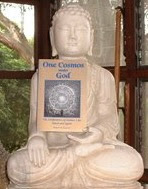
Either the cosmos is a closed system or it is an open system. Either it can be comprehended fully "within itself," or, like everything else, it can only be understood in reference to something else.
Science, of course, proceeds on the basis that the cosmos is ultimately a closed system. While there may be local entities that temporarily escape that fact and become open systems--such as biological organisms--in the end, it is all nothing more than a brief and futile reprieve from the iron hand of entropy. From death you arose and to death you shall return.
It's funny how science starts out with such admirably modest aims and methods, but soon makes such grandiose pronouncements. I yield to no one in my respect for science as science, but at the same time, when philosophically unschooled scientists start leaping to unwarranted metaphysical pronouncements, we should all be concerned. Through a sleight of language, science doesn't just replace religion, it becomes a religion. And a rather lame one at that.
The universal affirmation--not assumption, but subjectively verifiable testimony--of various saints, sages, and mystics down through history is that the cosmos is not a closed system, but that it has an "exit" and "entrance" through which various energies flow.
Properly understood, religion is nothing less than pure metaphysics. However, it is generally presented in such a way that the metaphysics must be "unpacked" by the intellect--as I have said before, not the debased intellect as we understand it today, but by what goes by different names in different traditions: the nous in Christianity, the buddhi in Vedanta, the ruah in kabbalah, or the psychic being by Sri Aurobindo (not to be confused with "psychics" seen on Larry King).
Properly understood, there is no conflict at all between science and religion, because they are describing different planes of being. You might say that science is the religion of the ultimate object while religion is the science of the ultimate subject.
Now, once you acknowledge the vertical in any form or fashion, you have left the horizontal behind as any kind of comprehensive, all-encompassing explanation of existence.
For example, if you acknowledge the existence of free will--which, by the way, some people don't... then again, they have no choice--you have already conceded that we move and have our being in a mysterious "hole" in creation, a hole known as the "now." By all rights, this "now" should not exist at all.
Einstein was particularly baffled by its existence, to such an extent that he thought the present moment in which we exercise our free will was only a stubborn illusion. This is an example of how science reaches a metaphysical dead once it begins to ponder the vertical.
Likewise, from the standpoint of science, Life Itself--the vertical doorway out of the material cosmos--can really be nothing more than a very rare and unlikely pattern of matter. Similarly, consciousness--the vertical pathway out the lifedoor--can only be an ephemeral and meaningless side effect of cellular activity.
If this is true, then scientists--not to mention scientific "truth"--is merely a meaningless side effect of matter--just smoke driven by wind. The scientist wants to give you the truth, as if he is speaking from a privileged vantage point of verticality, above the material fray. But how can he be? If he wishes to be consistent, he must concede in all modesty that matter can't really know anything, much less the truth about itself.
Among other things, religions are vertical escape hatches from the grinding ineluctability of mere animal existence. For example, Moses' horizontal dash (HT: Lisa) out of Egypt was in fact a vertical one, leading the Israelites from servitude in the horizontal wasteland of Egypt into the possibility of a higher life in the unknown vertical desert.
Similarly, Jesus said "I am the door." The door? Yes, and "if anyone enters by Me, he will be saved, and will go in and find pasture." Pasture? Yes, and a shepherd. And a flock. To those who say there is no vertical pasture, we bleat to them: BAAAAAAAH. Humbug.
Sri Aurobindo said that the aim of the spiritual life is to lay open "a gate of escape out of the vicious circle of our ordinary human existence." Frithjof Schuon wrote that "the human state is a gate of exit," even "the only gate for the terrestrial world," the very portal "through which all of creation can pass on its return to God."
Interesting. So in some sense, humans are not just in the vertical. Rather, we are of the vertical. It is somehow what we are in our essence. Or, looked at in another way, take away the vertical and what is man? A rather pathetic beast, really--a monstrous accident with the added privilege of frantically scuttling about in illusion and self-deception until returning to that greater reality called Death.
It is true that the illusory time of horizontal physics is a meaningless line. But the metaphysical time of cosmic and spiritual evolution is the open spiral. How does a spiral come about? It is the product of circular growth in two dimensions: horizontal and vertical.
Science deals only with repetition. Without the vertical element, time, no matter how long, can produce nothing truly novel. It can just combine and recombine in a linear or cyclical way. But it certainly cannot account for the startling ontological discontinuities represented by the leap from matter to life or from life to mind. It can rearrange the furniture, but cannot explain how we go from one ontological floor to the next.
The only way you can really believe this horizontal nonsense is if your own life has become utterly linear, circular, and closed off to the vertical. Then it is a philosophy that makes a great deal of sense. Plus it is an excellent metaphysical defense mechanism, because you have an airtight explanation for your own vertical Failure to Launch. If it's impossible, why bother? Indeed Horizontal Man is superior to Vertical Man, because at least he does not live in the comfort of fanciful delusions about nonexistent vertical realms!
Let's just suppose that there are some beings who have ascended very far indeed into the vertical. They have left behind compelling testimony and vivid descriptions of what they have encountered there. Furthermore, there is a striking degree of what is called "inter-rater reliability" between them, in that their descriptions can be correlated and compared and found to have broad similarities.
Of course there are individual differences, for the same reason that early explorers of America returned with different descriptions. After all, one might have landed in conservative South Carolina, another in liberal Massachusetts. But still, there was an ocean... there was a ship... there was wind... there were beings and fauna of a different order. We weren't in Europe anymore, Toto.
Let us further suppose that these vertical explorers are worthy of our veneration. As a matter of fact, for some of us, this veneration comes quite naturally and spontaneously. It consists of such things as respect, gratitude, awe, and even love. To our surprise, something happens as a result of this veneration. By dwelling deeply and meditatively in the words of one of these beings, we experience a presence. No, not a ghost, a vision, or an apparition, but just what I said: a presence. A magnetic presence.
If these nonlocal beings are a gift, how do we open their presence? More discussion of nonlocal operators tomorrow.
PETEY'S CORNER--
Petey was discussing the controversial new Indonesian edition of Playboy that has Muslims all hot and bothered. Apparently, it shows two Muslim women, you know, doing it.
Yeah, driving!
There's also a sexy layout of Ms. Pakistan in a two-piece bathing suit: a burqa and a snorkel.
But it's not all fun and frivolity. There are some serious pieces. For example, there's an exclusive excerpt from Mrs. Arafat's new autobiography, A Goy Named Suha. Plus advice on how to go about killing your daughter if she ever appears in the pages of Indonesian Playboy.
Saturday, April 08, 2006


Friday, April 07, 2006
Friendly Nonlocal Operators Standing By, Ready to Assist You (4.18.10)
Occasionally I will let slip a cryptic comment in passing and then get requests from readers to elaborate. That's good. It shows that someone is paying attention. As I have said before, I don't want to be like my competitors, and go all wobbly around the key points that would unlock the whole darn mystery.
A few readers have asked me to expand upon my description of the "friendly nonlocal operators who always standing by, ready to assist you."
Contrary to popular belief, the divine does not govern by authority or force, but by attraction. If people would just realize this point, it would clear up a lot of misunderstandings.
For example, yesterday I heard a comment from one of the family members whose spouse died on 9-11. She said something to the effect of "my God died that day" because he didn't intervene to stop the planes from hitting the buildings.
But looked at from the Christian point of view (which we seem to be focussing on lately), this is not surprising. After all, even God is reduced to a state of powerlessness and is crucified within history. In other words, even God submits to the rules of the universe he made. However, in so doing, he tries to become an "attractor" and draw men toward him.
In fact, in the Christian view, this ultimate case of submitting to history is the very gravitational "center" of history--it is what history was leading up to and the luminous point from which all subsequent history flows. It is the mysterious axis around which the very cosmos revolves.
This is in complete contrast to the Muslim god, which is in fact a god of power and force. Everywhere it has appeared, Islam has been forced upon people through violence and coercion. In the case of Christianity, it spread like wildfire throughout the Roman Empire, because when people heard the story, they were mysteriously attracted to it. In the case of Islam, it spread because people were attracted to the idea of keeping their head attached to their body.
The worship of power is the source of all idolatry. Thus, let's not pretend there haven't been Christian idolaters. It's just that the worship of power is a human flaw, not something intrinsic to Christianity. Jesus emphasized this point time and again: "the meek shall inherit the earth," "blessed are the poor in spirit," "blessed are you when they revile and persecute you," etc.
Even Genesis emphasizes this point. At first, Adam lives in spontaneous obedience to the God-attractor. The fall represents an act of willful disobedience--of turning to another center of "attraction" represented by the serpent.
The difference between "dark magic" and "sacred magic" is that in case of the former, the individual attempts to arrogate spiritual powers to himself, whereas in the latter, the individual submits to powers that exceed himself. One is achieved through force of will, the other through purity of will.
Truth, Love, and Beauty cannot be obtained through force. You cannot force someone to love you. Nor, for that matter, can God force you to love him. Why would anyone want to be loved through force, anyway?
In the realm of the vertical, "attraction" plays the same role as gravity in the horizontal. According to my anonymous friend, "the domain of our freedom itself, our spiritual life, shows the real and active presence of gravitation of a spiritual order. For what is the phenomenon of religion if not the manifestation of spiritual gravitation towards God--i.e., towards the center of spiritual gravitation of the world?"
He goes on: "Now, the domain of freedom--the spiritual life--is found placed between two gravitational fields with two different centers. The Gospel designates them as 'heaven' and 'this world,' or as the 'kingdom of God' and the 'kingdom of the prince of this world.' And it designates those whose will follows or is submitted to the gravitation of 'this world' as 'children of this world,' and those whose will follows the gravitation of 'heaven' as 'children of light.'"
Now, one of the things you must cultivate in your spiritual practice is the ability to sense this "spiritual gravity." Just as your body has proprioceptors that help to orient you in physical space, we also possess spiritual receptors that help to orient us in vertical space.
If you develop an inner ear problem, you will become dizzy and disoriented in space. Likewise, if you have an inner eye problem, you won't be able to sense spiritual attractors and to make your way about the vertical.
Imagine, for a moment, what the world would be like if we lacked such organs of spiritual reception. There would literally be no up and down, no high and low, no good and evil, no truth or falsehood. The entire world would he like academia, a horrifying thought.
One hardly has to imagine this spiritually weightless, topsy-turvy condition. The world is full of horizontal barbarians--sons of the earth--who are not oriented around any attractor above their own passions. They relentlessly make raids on the vertical, the only way they know of its existence.
An extreme case would be the nazis, who worshipped a god of pure will, of force, similar to the religious fascists with whom we are presently dealing. In the case of the Islamists, just consider the god to whom they are attracted: it is a purely terrestrial god who promises 72 virgins and other earthly delights to the "martyr."
Consider their misuse of the word "martyr" as someone who, through the force of his perverse will, murders as many innocent human beings as possible. The Christian--or Jewish--martyr (which means "witness," not "suicide bomber") is instead an I-witness of verticality to whom we are drawn by their living testimony--say, dancing and singing on the way to the lions.
Remember the famous story told by Elie Wiesel of the two men in the death camp? One asks to the other, "where is God now?" He responds by pointing to a child hanging from the gallows. One wonders: is this a thinkable thought in spiritual logic of the Muslim world?
We've barely gotten started on the subject of those friendly nonlocal operators alluded to above. We will probably continue with this attracive topic for a few days.
A few readers have asked me to expand upon my description of the "friendly nonlocal operators who always standing by, ready to assist you."
Contrary to popular belief, the divine does not govern by authority or force, but by attraction. If people would just realize this point, it would clear up a lot of misunderstandings.
For example, yesterday I heard a comment from one of the family members whose spouse died on 9-11. She said something to the effect of "my God died that day" because he didn't intervene to stop the planes from hitting the buildings.
But looked at from the Christian point of view (which we seem to be focussing on lately), this is not surprising. After all, even God is reduced to a state of powerlessness and is crucified within history. In other words, even God submits to the rules of the universe he made. However, in so doing, he tries to become an "attractor" and draw men toward him.
In fact, in the Christian view, this ultimate case of submitting to history is the very gravitational "center" of history--it is what history was leading up to and the luminous point from which all subsequent history flows. It is the mysterious axis around which the very cosmos revolves.
This is in complete contrast to the Muslim god, which is in fact a god of power and force. Everywhere it has appeared, Islam has been forced upon people through violence and coercion. In the case of Christianity, it spread like wildfire throughout the Roman Empire, because when people heard the story, they were mysteriously attracted to it. In the case of Islam, it spread because people were attracted to the idea of keeping their head attached to their body.
The worship of power is the source of all idolatry. Thus, let's not pretend there haven't been Christian idolaters. It's just that the worship of power is a human flaw, not something intrinsic to Christianity. Jesus emphasized this point time and again: "the meek shall inherit the earth," "blessed are the poor in spirit," "blessed are you when they revile and persecute you," etc.
Even Genesis emphasizes this point. At first, Adam lives in spontaneous obedience to the God-attractor. The fall represents an act of willful disobedience--of turning to another center of "attraction" represented by the serpent.
The difference between "dark magic" and "sacred magic" is that in case of the former, the individual attempts to arrogate spiritual powers to himself, whereas in the latter, the individual submits to powers that exceed himself. One is achieved through force of will, the other through purity of will.
Truth, Love, and Beauty cannot be obtained through force. You cannot force someone to love you. Nor, for that matter, can God force you to love him. Why would anyone want to be loved through force, anyway?
In the realm of the vertical, "attraction" plays the same role as gravity in the horizontal. According to my anonymous friend, "the domain of our freedom itself, our spiritual life, shows the real and active presence of gravitation of a spiritual order. For what is the phenomenon of religion if not the manifestation of spiritual gravitation towards God--i.e., towards the center of spiritual gravitation of the world?"
He goes on: "Now, the domain of freedom--the spiritual life--is found placed between two gravitational fields with two different centers. The Gospel designates them as 'heaven' and 'this world,' or as the 'kingdom of God' and the 'kingdom of the prince of this world.' And it designates those whose will follows or is submitted to the gravitation of 'this world' as 'children of this world,' and those whose will follows the gravitation of 'heaven' as 'children of light.'"
Now, one of the things you must cultivate in your spiritual practice is the ability to sense this "spiritual gravity." Just as your body has proprioceptors that help to orient you in physical space, we also possess spiritual receptors that help to orient us in vertical space.
If you develop an inner ear problem, you will become dizzy and disoriented in space. Likewise, if you have an inner eye problem, you won't be able to sense spiritual attractors and to make your way about the vertical.
Imagine, for a moment, what the world would be like if we lacked such organs of spiritual reception. There would literally be no up and down, no high and low, no good and evil, no truth or falsehood. The entire world would he like academia, a horrifying thought.
One hardly has to imagine this spiritually weightless, topsy-turvy condition. The world is full of horizontal barbarians--sons of the earth--who are not oriented around any attractor above their own passions. They relentlessly make raids on the vertical, the only way they know of its existence.
An extreme case would be the nazis, who worshipped a god of pure will, of force, similar to the religious fascists with whom we are presently dealing. In the case of the Islamists, just consider the god to whom they are attracted: it is a purely terrestrial god who promises 72 virgins and other earthly delights to the "martyr."
Consider their misuse of the word "martyr" as someone who, through the force of his perverse will, murders as many innocent human beings as possible. The Christian--or Jewish--martyr (which means "witness," not "suicide bomber") is instead an I-witness of verticality to whom we are drawn by their living testimony--say, dancing and singing on the way to the lions.
Remember the famous story told by Elie Wiesel of the two men in the death camp? One asks to the other, "where is God now?" He responds by pointing to a child hanging from the gallows. One wonders: is this a thinkable thought in spiritual logic of the Muslim world?
We've barely gotten started on the subject of those friendly nonlocal operators alluded to above. We will probably continue with this attracive topic for a few days.
Thursday, April 06, 2006
The Fool Who Persists in His Folly Will Become Wise... I Hope
One of the reasons I am somewhat reluctant to offer very specific spiritual advice is because different personality styles require different paths and prescriptions. A path that is easy and comes naturally for one person might be impossible for another.
In my case, for better or worse, I apparently have a somewhat unique personality style, so I hesitate in proffering general spiritual advice to all and sundry. But at the same time, I would very much like to do all I can to assist people who are genuinely motivated to grow spiritually.
Partly it is a problem of, you know, your orientation. No, not that orientation, but your spiritual orientation. For while the former is a dubious construct with much political but little scientific justification, the latter is definitely a result of heredity. Specifically, it is a reflection of your "vertical DNA."
In my case, I believe I am a "born mystic." Now importantly, this is not to say that I was a born "realized" mystic--an avatar. Nor is it to make the claim that I am some sort of "realized master" today. What it simply means is that this is my innate orientation, inclination, or "bent." It comes as naturally to me as, say, basketball came to Michael Jordan or the trumpet to Louis Armstrong. This does not mean that such individuals don't have to practice in order to realize and hone their gift. But it does mean that they have a certain "head start" in whatever area the gift lies. It also means that others will have to work much harder to attain what comes naturally to one with the gift.
This, by the way, is why great athletes are rarely good coaches. A good coach must be a teacher, but for a truly great athlete, there is a dimension of their greatness that was unlearned and cannot be taught. As a result, the great athlete who becomes a coach often fails or resigns in frustration because they don't understand why their players are not as good as they are. They think it's a just a matter of effort.
On the other hand, most great coaches and managers were mediocre players who had to work very hard to remain with a team. The only exception would be a great player who happens to have a parallel gift for teaching or for understanding and motivating different personality types.
The comparison with sports is a good one, because we are called upon to be spiritual athletes in one way or another.
Two things I can say about myself. I have always had a propensity to contemplate the infinite and to try to understand everything within the context of the whole. The born contemplative is attracted by the eternal in same way that the born musician might be attracted by a piano. To a certain extent, this state of consciousness is a point of departure for me, whereas it would be more of an acquisition--a signpost along the way--for others. For me, the "interior world" has always been very easy to apprehend, first the psychosphere, now the pneumatosphere.
I have no problem at all "doing nothing," because that is precisely when I am the most active--when I am likely engaged in a bewilderness adventure. Conversely, when I look like I am "doing something," I am often nowhere doing nothing. And this includes many things that the average person would find not only pleasurable, but perhaps the summon bonum of existence. I actually enjoy sitting in a chair in the dark at 4:00am staring at a candle illuminating the face of one of my inspirations.
But again, one's gift or predilection must be nurtured and developed. In my case, as you might imagine, my orientation was a dark secret for many years, even to myself. This is because we all have a "blueprint" inside of us, but require a model outside of ourselves to bring it into being and actualize it. Otherwise, it has the same degree of reality as the blueprint of an unbuilt house.
The problem for someone like me is that there is nothing in a conventional education that allows one to recognize and develop a gift for extreme seeking and off-road spiritual exploration. Thus, I struggled all through grade school, high school, and much of college just to maintain average grades. It was of no interest to me. Nevertheless, I was intensely curious and passionately interested in knowledge. It was just knowledge of a different order. For many years I just indulged this passionate curiosity, allowing it to take me where it led, in a completely undisciplined way.
Only through such spontaneous, unplanned and undirected rambling was the blueprint of myself gradually revealed to me. By abandoning myself to the process, with no expectation of any result, it was very much as if I was "led." I definitely wasn't pushing. Rather, it was as if I were responding solely to an inner flame that I was trying to feed and stoke. I tried to provide it with whatever would help it grow in intensity.
One thing that bothers me about our elite secular fundamentalists is that they seem to think it is easy to know Spirit--as if it simply involves believing some nice fairy tale and leaving it at that. In reality, it is almost impossible for our elite secular priesthood to know anything about Spirit. For it is not a matter of intellect per se. Rather, it is a matter of what the intellect is in service to.
As I have mentioned before, both religious and non-religious fundamentalists are still unwavering materialists, living in deadening servitude to matter. Our higher faculties are easily hijacked and enslaved by the lower, and the problem is only worse in a society as abundant as ours, with so many seductive distractions everywhere.
The trial of our age is the trial of Faust. That is to say, we live in an age in which we have unprecedented control over nature, and in which our material desires can be satisfied as never before. But each horizontal satisfaction, no matter how unprecedented and miraculous, is simply met with an increasingly jaded. "okay. What next?" Paradoxically, this "age of miracles and wonders" is the age of banality, ennui, and spiritual exhaustion.
If there were a "devil," what better way to accomplish his ends than to give people the illusion of the possibility of ultimate satisfaction in the horizontal. You might say that the "satanic mantra" is, "I'm bored. What's next."
Intellectuals struggle with this as much, if not more, than the blue collar worker who simply enjoys overeating, having a few beers, and being with his family. For the secular intellectual is haunted by the idea that there is something more, but has no idea how to go about finding it. As a matter of fact, the intellect must be "raised up" to the realm from which religions emanate. Again, this is something the typical secularist utterly fails to understand. You must work diligently to intensify your mental power and to place it in the service of higher things.
It is the difference between being a mere scholar and a sage. Who in contemporary academia would refer to himself as a sage? And yet, sages do exist--those who have successfully passed from mere intellectuality motivated by the desire for knowledge--intellect for its own sake--on to the desire for higher knowledge motivated by love, that is to say the pure love of sophia.
As I mentioned at the top, this comes naturally to me. My happily crucified intellect is willingly in the service of the "breath from above," as I am specifically trying to fuse spirituality and intellectuality in order to create a new, third thing within that transitional space. In the past, this union has been called the "philosopher's stone," but the secular world would probably regard it as the prattle of a stoned philosopher.
Since I already have a real job, I am not motivated by tenure, by popularity, by book sales, or by any other horizontal measure. For the wisdom of this world is folly with God, just as my little contributions are undoubtedly folly to the world.
In my case, for better or worse, I apparently have a somewhat unique personality style, so I hesitate in proffering general spiritual advice to all and sundry. But at the same time, I would very much like to do all I can to assist people who are genuinely motivated to grow spiritually.
Partly it is a problem of, you know, your orientation. No, not that orientation, but your spiritual orientation. For while the former is a dubious construct with much political but little scientific justification, the latter is definitely a result of heredity. Specifically, it is a reflection of your "vertical DNA."
In my case, I believe I am a "born mystic." Now importantly, this is not to say that I was a born "realized" mystic--an avatar. Nor is it to make the claim that I am some sort of "realized master" today. What it simply means is that this is my innate orientation, inclination, or "bent." It comes as naturally to me as, say, basketball came to Michael Jordan or the trumpet to Louis Armstrong. This does not mean that such individuals don't have to practice in order to realize and hone their gift. But it does mean that they have a certain "head start" in whatever area the gift lies. It also means that others will have to work much harder to attain what comes naturally to one with the gift.
This, by the way, is why great athletes are rarely good coaches. A good coach must be a teacher, but for a truly great athlete, there is a dimension of their greatness that was unlearned and cannot be taught. As a result, the great athlete who becomes a coach often fails or resigns in frustration because they don't understand why their players are not as good as they are. They think it's a just a matter of effort.
On the other hand, most great coaches and managers were mediocre players who had to work very hard to remain with a team. The only exception would be a great player who happens to have a parallel gift for teaching or for understanding and motivating different personality types.
The comparison with sports is a good one, because we are called upon to be spiritual athletes in one way or another.
Two things I can say about myself. I have always had a propensity to contemplate the infinite and to try to understand everything within the context of the whole. The born contemplative is attracted by the eternal in same way that the born musician might be attracted by a piano. To a certain extent, this state of consciousness is a point of departure for me, whereas it would be more of an acquisition--a signpost along the way--for others. For me, the "interior world" has always been very easy to apprehend, first the psychosphere, now the pneumatosphere.
I have no problem at all "doing nothing," because that is precisely when I am the most active--when I am likely engaged in a bewilderness adventure. Conversely, when I look like I am "doing something," I am often nowhere doing nothing. And this includes many things that the average person would find not only pleasurable, but perhaps the summon bonum of existence. I actually enjoy sitting in a chair in the dark at 4:00am staring at a candle illuminating the face of one of my inspirations.
But again, one's gift or predilection must be nurtured and developed. In my case, as you might imagine, my orientation was a dark secret for many years, even to myself. This is because we all have a "blueprint" inside of us, but require a model outside of ourselves to bring it into being and actualize it. Otherwise, it has the same degree of reality as the blueprint of an unbuilt house.
The problem for someone like me is that there is nothing in a conventional education that allows one to recognize and develop a gift for extreme seeking and off-road spiritual exploration. Thus, I struggled all through grade school, high school, and much of college just to maintain average grades. It was of no interest to me. Nevertheless, I was intensely curious and passionately interested in knowledge. It was just knowledge of a different order. For many years I just indulged this passionate curiosity, allowing it to take me where it led, in a completely undisciplined way.
Only through such spontaneous, unplanned and undirected rambling was the blueprint of myself gradually revealed to me. By abandoning myself to the process, with no expectation of any result, it was very much as if I was "led." I definitely wasn't pushing. Rather, it was as if I were responding solely to an inner flame that I was trying to feed and stoke. I tried to provide it with whatever would help it grow in intensity.
One thing that bothers me about our elite secular fundamentalists is that they seem to think it is easy to know Spirit--as if it simply involves believing some nice fairy tale and leaving it at that. In reality, it is almost impossible for our elite secular priesthood to know anything about Spirit. For it is not a matter of intellect per se. Rather, it is a matter of what the intellect is in service to.
As I have mentioned before, both religious and non-religious fundamentalists are still unwavering materialists, living in deadening servitude to matter. Our higher faculties are easily hijacked and enslaved by the lower, and the problem is only worse in a society as abundant as ours, with so many seductive distractions everywhere.
The trial of our age is the trial of Faust. That is to say, we live in an age in which we have unprecedented control over nature, and in which our material desires can be satisfied as never before. But each horizontal satisfaction, no matter how unprecedented and miraculous, is simply met with an increasingly jaded. "okay. What next?" Paradoxically, this "age of miracles and wonders" is the age of banality, ennui, and spiritual exhaustion.
If there were a "devil," what better way to accomplish his ends than to give people the illusion of the possibility of ultimate satisfaction in the horizontal. You might say that the "satanic mantra" is, "I'm bored. What's next."
Intellectuals struggle with this as much, if not more, than the blue collar worker who simply enjoys overeating, having a few beers, and being with his family. For the secular intellectual is haunted by the idea that there is something more, but has no idea how to go about finding it. As a matter of fact, the intellect must be "raised up" to the realm from which religions emanate. Again, this is something the typical secularist utterly fails to understand. You must work diligently to intensify your mental power and to place it in the service of higher things.
It is the difference between being a mere scholar and a sage. Who in contemporary academia would refer to himself as a sage? And yet, sages do exist--those who have successfully passed from mere intellectuality motivated by the desire for knowledge--intellect for its own sake--on to the desire for higher knowledge motivated by love, that is to say the pure love of sophia.
As I mentioned at the top, this comes naturally to me. My happily crucified intellect is willingly in the service of the "breath from above," as I am specifically trying to fuse spirituality and intellectuality in order to create a new, third thing within that transitional space. In the past, this union has been called the "philosopher's stone," but the secular world would probably regard it as the prattle of a stoned philosopher.
Since I already have a real job, I am not motivated by tenure, by popularity, by book sales, or by any other horizontal measure. For the wisdom of this world is folly with God, just as my little contributions are undoubtedly folly to the world.
Wednesday, April 05, 2006
I Went Down to the Crossroads, Tried to Flag a Ride
Overslept due to my cold. A short and cryptic post, submitted for your higher bewilderment.
*****
So, we apparently have a terrestrial heredity that extends back through higher primates, lower mammals, fish, plants, single cells, and across the dark abyss to insentient matter.
On the other hand, we have a vertical heredity that extends through various degrees of being--various powers, principalities, rulers, and thrones--all the way up until we reach Brahman, the Absolute, the One, The Father in Heaven, J.R. "Bob" Dobbs.
Our "frontal self" comes into the world the usual way, while another part of us is imaginately conceived, or "word made flesh." Unlike the horizontal word of DNA and natural selection, this is the vertical word of "supernatural" election. (I put supernatural in quotes, for nature herself is supernatural, as anyone who appreciates the transcendental beauty of the mythematical equations governing the big bang can tell you.)
There was a time, not too long ago, when human beings were not aware of their vertical descent from above, any more than animals are. Again, if you think of our humanness as situated at the innersection of the horizontal and vertical, it took some time for homo sapiens to realize their place in the vertical.
One cannot even know of the horizontal until consciousness has lifted above it. Otherwise we are simply immersed in our perceptions and engulfed by the senses. But as consciousness ascends, one begins to realize that the vertical is also a "world" in its own right.
After all, homo sapiens was genetically "complete" by as long ago as 200,000 (or as recently as 100,000) years. And yet, either way, we don't see much evidence in the archeological record of "vertical liftoff" until about 35-40,000 years ago, with the sudden appearance of beautifully realized cave paintings, body decoration, musical instruments, statuary, widespread burial of the dead, etc.
Clearly, vertical liftoff had begun, into a nonsensuous dimension of transcendental Love, Truth and Beauty. For what would motivate an erstwhile ape not just to paint, but to do so with such refined delicacy of line, shade, and contour? Why bother?
But vertical progress for humans is frequently stalled--both collectively and individually. Human beings have reached many historical impasses, or crossroads (frankly, we are in a somewhat nasty one right now). In reality, these are not "horizontal" impasses. Rather, they are vertical impasses. How to "flag a ride" up and out?
Overcoming these world-historical obstacles is not a matter of additional horizontal evolution. That process is basically over, although recent research seems to demonstrate that some additional evolution has been going on at the margins.
But even if certain brains have been getting a little bigger or smarter, it is not our hardizontalware, but our vertical software--or aloftware--that counts. You can have a gifted IQ but still languish below on the vertical launch pad, a point that is obvious if you consider the sorry state contemporary academia. Plenty of big-brained primates there, all messed up with no place to grow (that is, "up").
What we might call the "resurrection body" is your perfect self, unencumbered by the accidents and distortions of horizontality. It is actually already there calling you--wherever there is--just waiting for you to catch up.
Have you ever been acquainted with your resurrection body? I'll bet you have. Again, this is one of the main purposes of religious language--to provide a means for talking about an otherwise immaterial and nonsensuous dimension. Light, transparent, bright, free... these are all Idjectives that apply.
In the gospels, it says that Jesus gave a few disciples the privilege of seeing his vertical body of light. What must that have been like? First, of course, the disciples had to "ascend" by themselves vertically, "high upon a mountain." There, within the orbit of their highest aspiration, Jesus' face "shone like the sun, and His clothes became as white as the light." Then Jesus held a summit conference with two other luminous bodies, Moses and his shadowy double, Elijah! Wo. What was that all about?
Our physical body is on loan from nature, whom we must repay at the end of our days. "Thou owest nature a death." But as we said yesterday, looked at vertically, the body is descended from the spirit, not vice versa. Death, or disincarnation, involves separation of the vertical from the horizontal.
The Isha Upanishad expresses it thus (this passage is often read as one approaches the crossroads of death):
The face of truth is hidden by your golden orb, O Sun. May you remove your orb, in order that I who am devoted to truth may behold its glory.
May I behold through thy grace thy most blessed form. The Being that dwells therein--even that Being am I.
Let my life now merge in the all-pervading Life. Ashes are my body's end. AUMmmmmmmm... O mind, remember Brahman. Meditate on Brahman.
May we galactic hitchhikers flag a ride at the crossroads.
*****
So, we apparently have a terrestrial heredity that extends back through higher primates, lower mammals, fish, plants, single cells, and across the dark abyss to insentient matter.
On the other hand, we have a vertical heredity that extends through various degrees of being--various powers, principalities, rulers, and thrones--all the way up until we reach Brahman, the Absolute, the One, The Father in Heaven, J.R. "Bob" Dobbs.
Our "frontal self" comes into the world the usual way, while another part of us is imaginately conceived, or "word made flesh." Unlike the horizontal word of DNA and natural selection, this is the vertical word of "supernatural" election. (I put supernatural in quotes, for nature herself is supernatural, as anyone who appreciates the transcendental beauty of the mythematical equations governing the big bang can tell you.)
There was a time, not too long ago, when human beings were not aware of their vertical descent from above, any more than animals are. Again, if you think of our humanness as situated at the innersection of the horizontal and vertical, it took some time for homo sapiens to realize their place in the vertical.
One cannot even know of the horizontal until consciousness has lifted above it. Otherwise we are simply immersed in our perceptions and engulfed by the senses. But as consciousness ascends, one begins to realize that the vertical is also a "world" in its own right.
After all, homo sapiens was genetically "complete" by as long ago as 200,000 (or as recently as 100,000) years. And yet, either way, we don't see much evidence in the archeological record of "vertical liftoff" until about 35-40,000 years ago, with the sudden appearance of beautifully realized cave paintings, body decoration, musical instruments, statuary, widespread burial of the dead, etc.
Clearly, vertical liftoff had begun, into a nonsensuous dimension of transcendental Love, Truth and Beauty. For what would motivate an erstwhile ape not just to paint, but to do so with such refined delicacy of line, shade, and contour? Why bother?
But vertical progress for humans is frequently stalled--both collectively and individually. Human beings have reached many historical impasses, or crossroads (frankly, we are in a somewhat nasty one right now). In reality, these are not "horizontal" impasses. Rather, they are vertical impasses. How to "flag a ride" up and out?
Overcoming these world-historical obstacles is not a matter of additional horizontal evolution. That process is basically over, although recent research seems to demonstrate that some additional evolution has been going on at the margins.
But even if certain brains have been getting a little bigger or smarter, it is not our hardizontalware, but our vertical software--or aloftware--that counts. You can have a gifted IQ but still languish below on the vertical launch pad, a point that is obvious if you consider the sorry state contemporary academia. Plenty of big-brained primates there, all messed up with no place to grow (that is, "up").
What we might call the "resurrection body" is your perfect self, unencumbered by the accidents and distortions of horizontality. It is actually already there calling you--wherever there is--just waiting for you to catch up.
Have you ever been acquainted with your resurrection body? I'll bet you have. Again, this is one of the main purposes of religious language--to provide a means for talking about an otherwise immaterial and nonsensuous dimension. Light, transparent, bright, free... these are all Idjectives that apply.
In the gospels, it says that Jesus gave a few disciples the privilege of seeing his vertical body of light. What must that have been like? First, of course, the disciples had to "ascend" by themselves vertically, "high upon a mountain." There, within the orbit of their highest aspiration, Jesus' face "shone like the sun, and His clothes became as white as the light." Then Jesus held a summit conference with two other luminous bodies, Moses and his shadowy double, Elijah! Wo. What was that all about?
Our physical body is on loan from nature, whom we must repay at the end of our days. "Thou owest nature a death." But as we said yesterday, looked at vertically, the body is descended from the spirit, not vice versa. Death, or disincarnation, involves separation of the vertical from the horizontal.
The Isha Upanishad expresses it thus (this passage is often read as one approaches the crossroads of death):
The face of truth is hidden by your golden orb, O Sun. May you remove your orb, in order that I who am devoted to truth may behold its glory.
May I behold through thy grace thy most blessed form. The Being that dwells therein--even that Being am I.
Let my life now merge in the all-pervading Life. Ashes are my body's end. AUMmmmmmmm... O mind, remember Brahman. Meditate on Brahman.
May we galactic hitchhikers flag a ride at the crossroads.
Tuesday, April 04, 2006
Reincarnation, Resurrection Bodies, and Vertical Heredity
Yesterday we were discussing how myth and poetry speak to us from across the void, revealing secrets from the dark side of consciousness. As I have mentioned before, in order to talk about spirit at all, language must be employed in a very special manner. On the one hand, language was evolved in order to deal with the mundane problems of a typical day in the archaic environment of 100,000 years ago: finding food and shelter, coping with danger, and impressing women.
That is the horizontal aspect of language. It is mostly reducible to a purely Darwinian explanation. But there is a very mysterious vertical aspect to language that cannot be so reduced, unless one wishes to be absurd. Most modern people don't mind being absurd, so long as they can imagine that they understand. Better to be absurd than to deal with the anxiety of not knowing.
It has been remarked that poets are metaphysicians in the raw, mediators between the essence of being and the miracle of knowing. In its sacred or mythological aspect, language is the nexus between the nighttime and daytime realms. It imparts a kind of knowing, but one must not confuse this knowing with profane knowing of the linear and unambigious variety. Just like everyday language, it reveals and discloses an "object." But it is not a three-dimensional object. Rather, it is a hyperdimensional object.
Or you may think of mundane language as dealing with horizontal recollection, while the type of language I am taking about involves vertical recollection, or anamnesis.
Whereas in the daytime there is more or less a one-to-one relationship between word and object (or concept), night language is far richer and polysemic, or holographic: a single word can be a vector through which multiple meanings of various levels pass, depending on one's point of view. One may crystalize a particular interpretation, but a single interpretation cannot exhaust the meaning. This is especially true of the special language called authentic scripture.
And yet, it is possible even for scripture to become so saturated with a particular meaning that it loses its capacity to shock, to vault us out of our habitual way of knowing the world. It can be reduced to a mere "daytime" story.
I think, for example, of the account of Jesus' resurrection. Most of us have heard about this story since we were children, to such an extent that when we think of it we probably conjure up a mental image of it. Furthermore, upon doing so, most of us probably say to ourselves, "impossible."
And yet, if you consider some of the details that we tend to overlook, the story is more odd than we realize. For example, it is emphasized--in particular, in Mark, Luke and John--that the risen Jesus is not recognized by those who were most familiar with him--who had just been with him a few days before. Some mistake him for the gardener, others actually take a walk with him and discuss recent news of the day, including the bad news about Jesus.
How bizarre is this? Imagine just losing a loved one. You are in a state of grief and shock. You look out the window, and there is your recently departed loved one, mowing the lawn. But you don't recognize them.
Obviously, the story was told in this particular way for a reason. The writers of the gospels could have just said that Jesus rose from the dead and everyone recognized him immediately. But they specifically emphasized that he wasn't recognized. Clearly, he must have looked different. The "resurrection body," whatever it is, must look different than the physical body.
What are we, anyway? Whatever else we are, we are energy, energy in different forms and patterns. Ah, but what is energy? If anyone gives you a "daytime" answer to that question, know that they are lying--mostly to themselves.
I have a conscious thought: I am going to make a fist. I do so. No one can tell you how I did so--how consciousness--whatever that is--exerts an effect on matter in this way.
On the one hand, we can look at the world horizontally and say that matter gave rise to life or that brains give rise to thought. However, such a view generates a multitude of insoluble paradoxes that can only be resolved if we supplement it with the vertical, top-down view, and say that the brain does not create consciousness, but rather, that the brain exists as a result of conscious will.
In order to understand our situation, you must imagine a cross with a horizontal and a vertical arrow. We live at the point of their intersection. The horizontal line has to do with heredity, with Darwinian evolution, with the transmission of culture, etc. If this were all we are, we would be no different than other animals. We would not live in a cognitive space of spiritual freedom, routinely exerting a top-down influence on our horizontal selves. We would not possess that inexplicable capacity called "free will."
But not everyone seems to have the same degree of top-down influence over themselves--of free will. In fact, it is a capacity that varies quite widely.
According to a friend who wishes to remain anonymous, "there are strong--i.e., creative--souls, and there are weak--i.e., imitative--souls. The stronger a soul is, the greater the independence from the semi-hypnotic influence of the model presented by the preceding generations of family chosen for the soul's incarnation."
As such, "a strong soul shows in his or her psycho-physical personality fewer features traceable from the parents, and is in general less representative of family, people and race than of itself; he or she is more an individual than a type. In contrast, a weak soul becomes an individual who seems to be only a pure and simple copy of the parents.... [T]here are some cases where heredity is reduced to a minimum and other cases where it manifests itself as almost all-powerful."
Thus, it seems as if there are two kinds of heredity operating in us: a "horizontal heredity" and a "vertical heredity" that seems to shape us from "above" rather than "behind." In my view, when we talk about "reincarnation," we are simply acknowledging the reality of vertical heredity. It is a way of talking about something real yet mysterious--about that part of ourselves that is immaculately conceived and born out of the voidgin.
Are we really the product of two heredities? I don't know about you, but genes or no genes, I have no idea how I dropped into my particular family. I am amazingly incompatible with most of my family members--not necessarily to the point of open conflict (though there is that with one particularly polarized member who despises me), but mostly indifference and mutual incomprehension. I was born with very specific, not to say unusual, inclinations that I can find in none of my relatives, either living or dead. But I certainly see them in non-blood relations with whom I share vertical DNA.
Interestingly, I have kept one of the birth announcements that were sent out upon my touchdown here in 4D. It has a drawing of a little space suit with a hole cut out in the helmet. There you see my face beaming through. I have a bottle in my right hand, an umbrella in the left. On top of my head is a little propeller, which is funny, because I have a little propeller on top of my head right now. The caption reads "From Out of This World."
Yes, dropped straight from the vertical into a very horizontal family. And yet, looked at from another angle, I can see how being raised in this particular family was perfect for the accomplishment of my, er, mission.
What? Wrap it up? I don't think I can do that. We'll have to continue with this resurrection-reincarnation-vertical heredity business tomorrow.
*****
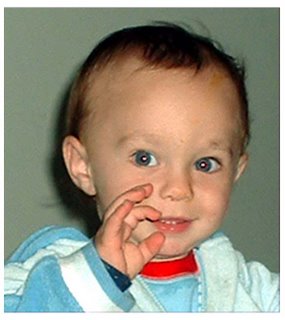
Dropped into a strange family from out of this world? Quite possibly. Thus far his temperament is quite specific and different than his horizontal parents. We will do our best to facilitate his mission and to decipher the signs he is throwin' down to his vertical homies. I think this one means, "All this kooky-talk is embarassing me. I wish my dad would zip it once in awhile."
That is the horizontal aspect of language. It is mostly reducible to a purely Darwinian explanation. But there is a very mysterious vertical aspect to language that cannot be so reduced, unless one wishes to be absurd. Most modern people don't mind being absurd, so long as they can imagine that they understand. Better to be absurd than to deal with the anxiety of not knowing.
It has been remarked that poets are metaphysicians in the raw, mediators between the essence of being and the miracle of knowing. In its sacred or mythological aspect, language is the nexus between the nighttime and daytime realms. It imparts a kind of knowing, but one must not confuse this knowing with profane knowing of the linear and unambigious variety. Just like everyday language, it reveals and discloses an "object." But it is not a three-dimensional object. Rather, it is a hyperdimensional object.
Or you may think of mundane language as dealing with horizontal recollection, while the type of language I am taking about involves vertical recollection, or anamnesis.
Whereas in the daytime there is more or less a one-to-one relationship between word and object (or concept), night language is far richer and polysemic, or holographic: a single word can be a vector through which multiple meanings of various levels pass, depending on one's point of view. One may crystalize a particular interpretation, but a single interpretation cannot exhaust the meaning. This is especially true of the special language called authentic scripture.
And yet, it is possible even for scripture to become so saturated with a particular meaning that it loses its capacity to shock, to vault us out of our habitual way of knowing the world. It can be reduced to a mere "daytime" story.
I think, for example, of the account of Jesus' resurrection. Most of us have heard about this story since we were children, to such an extent that when we think of it we probably conjure up a mental image of it. Furthermore, upon doing so, most of us probably say to ourselves, "impossible."
And yet, if you consider some of the details that we tend to overlook, the story is more odd than we realize. For example, it is emphasized--in particular, in Mark, Luke and John--that the risen Jesus is not recognized by those who were most familiar with him--who had just been with him a few days before. Some mistake him for the gardener, others actually take a walk with him and discuss recent news of the day, including the bad news about Jesus.
How bizarre is this? Imagine just losing a loved one. You are in a state of grief and shock. You look out the window, and there is your recently departed loved one, mowing the lawn. But you don't recognize them.
Obviously, the story was told in this particular way for a reason. The writers of the gospels could have just said that Jesus rose from the dead and everyone recognized him immediately. But they specifically emphasized that he wasn't recognized. Clearly, he must have looked different. The "resurrection body," whatever it is, must look different than the physical body.
What are we, anyway? Whatever else we are, we are energy, energy in different forms and patterns. Ah, but what is energy? If anyone gives you a "daytime" answer to that question, know that they are lying--mostly to themselves.
I have a conscious thought: I am going to make a fist. I do so. No one can tell you how I did so--how consciousness--whatever that is--exerts an effect on matter in this way.
On the one hand, we can look at the world horizontally and say that matter gave rise to life or that brains give rise to thought. However, such a view generates a multitude of insoluble paradoxes that can only be resolved if we supplement it with the vertical, top-down view, and say that the brain does not create consciousness, but rather, that the brain exists as a result of conscious will.
In order to understand our situation, you must imagine a cross with a horizontal and a vertical arrow. We live at the point of their intersection. The horizontal line has to do with heredity, with Darwinian evolution, with the transmission of culture, etc. If this were all we are, we would be no different than other animals. We would not live in a cognitive space of spiritual freedom, routinely exerting a top-down influence on our horizontal selves. We would not possess that inexplicable capacity called "free will."
But not everyone seems to have the same degree of top-down influence over themselves--of free will. In fact, it is a capacity that varies quite widely.
According to a friend who wishes to remain anonymous, "there are strong--i.e., creative--souls, and there are weak--i.e., imitative--souls. The stronger a soul is, the greater the independence from the semi-hypnotic influence of the model presented by the preceding generations of family chosen for the soul's incarnation."
As such, "a strong soul shows in his or her psycho-physical personality fewer features traceable from the parents, and is in general less representative of family, people and race than of itself; he or she is more an individual than a type. In contrast, a weak soul becomes an individual who seems to be only a pure and simple copy of the parents.... [T]here are some cases where heredity is reduced to a minimum and other cases where it manifests itself as almost all-powerful."
Thus, it seems as if there are two kinds of heredity operating in us: a "horizontal heredity" and a "vertical heredity" that seems to shape us from "above" rather than "behind." In my view, when we talk about "reincarnation," we are simply acknowledging the reality of vertical heredity. It is a way of talking about something real yet mysterious--about that part of ourselves that is immaculately conceived and born out of the voidgin.
Are we really the product of two heredities? I don't know about you, but genes or no genes, I have no idea how I dropped into my particular family. I am amazingly incompatible with most of my family members--not necessarily to the point of open conflict (though there is that with one particularly polarized member who despises me), but mostly indifference and mutual incomprehension. I was born with very specific, not to say unusual, inclinations that I can find in none of my relatives, either living or dead. But I certainly see them in non-blood relations with whom I share vertical DNA.
Interestingly, I have kept one of the birth announcements that were sent out upon my touchdown here in 4D. It has a drawing of a little space suit with a hole cut out in the helmet. There you see my face beaming through. I have a bottle in my right hand, an umbrella in the left. On top of my head is a little propeller, which is funny, because I have a little propeller on top of my head right now. The caption reads "From Out of This World."
Yes, dropped straight from the vertical into a very horizontal family. And yet, looked at from another angle, I can see how being raised in this particular family was perfect for the accomplishment of my, er, mission.
What? Wrap it up? I don't think I can do that. We'll have to continue with this resurrection-reincarnation-vertical heredity business tomorrow.
*****
Dropped into a strange family from out of this world? Quite possibly. Thus far his temperament is quite specific and different than his horizontal parents. We will do our best to facilitate his mission and to decipher the signs he is throwin' down to his vertical homies. I think this one means, "All this kooky-talk is embarassing me. I wish my dad would zip it once in awhile."

Monday, April 03, 2006
On Seeing by the Light of Darkness
By night, an atheist half believes in God. --Edward Young
This will be a threefold challenge, since I don't know what I'm talking about, have no idea how to express it, and am in no condition to do so. Regarding the latter, there is another baby bug in the house. Fortunately it is not of the GI variety, like the last one. Rather, it is of the sore throat-upper respiratory species. Still, combined with the time change, it takes something out of a lad.
On the other hand, a temporary, sometimes even willed, derangement of the senses can be the best approach to the unknown. It pushes you off the map of the familiar, to the threshold of the greater Mystery. People use fancy vacations, drugs, meditation retreats, etc.--anything to try to trick the nervous system and get around its tendency to erect a fence of routine and familiarity around everything.
For the majority of the time I was employed as a retail clerk between 1976 and 1988, I worked the graveyard shift. That's a good name for it, because there is no doubt that the still darkness of night is when the transdimensional spooks come out to play. I was generally sleep-deprived during those years, and might have been utterly exhausted by, say, 1:00 or 2:00am. But then, out of necessity, I would break through a sort of "wall," and afterwards be in an extended state of hypnopompic alertness until going to bed at around 9:00am. You might say that one I would close but another would open.
Interestingly, the Greeks had a word, psychopomp, referring to the conductor to the realm of lost souls. That realm is what we now call the unconscious. As a matter of fact, the "free association" of psychoanalysis is nothing more than an attempt to lull the ego to sleep, while the analyst is the psychopomp who will lead the search for the lost parts of oneself dwelling in the darkness of the unconscious.
Anyway, once I would break through that wall of fatigue, I would enter a very distinct state. Hard to describe, but it was as if the world were dreaming---which it was--and I was, so to speak, partaking of the same state. Only while awake. In the midst of this night consciousness, many ideas--call them "mythological" or "sacred" ideas--made perfect sense that didn't necessarily make sense in the unforgiving light of day.
The entire process was abetted by a certain radio program that aired from midnight until 5:00am. It featured lectures by various spiritual luminaries both high and low, everyone from Krishnamurti to Alan Watts to D.T. Suzuki to Timothy Leary and Ram Dass. I was especially influenced by the spellbinding lectures of the ethnobotanist, shamanologist, and mushroomologist Terence McKenna, may he rest in peace. He is a perfect example of someone who only makes sense at 3:00am. In that vein, I like to think of this blog as a sort of 3:00am dispatch from ther heart of the void: all the eternity that's fit to print.
You might compare it to how certain religious ideas might "resonate" more if you are standing in a 14th century European cathedral, each part of which is designed to carry your temporal consciousness upward and outward, to the contemplation of eternity.
It wasn't long ago that the world was a very, very dark place. I mean that both literally and figuratively. That is, before the invention of electric lights, the night was pitch black except for perhaps a small center of candle or firelight. People were aware of the darkness as a real and present entity, in a way that we are not. Modern people rarely live in darkness except when they are asleep. As such, the only time they have access to the dream world--and night consciousness--is when they are unconscious.
It is as if night consciousness is our "missing half" that would allow us to make sense of certain things that cannot be discussed or understood in the harsh light of day. Certainly this is something James Joyce realized in attempting, in Finnegans Wake, to tell the entire story of mankind from the standpoint of "nighttime logic." That is, he depicted all of human history as the restive and far-flung dream of a single sleeping individual in a single night.
In order to have a comprehensive understanding of ourselves, we must not only be familiar with the daytime part--the ego--but also the nighttime part--the unconscious. Likewise, I am of the belief that there is the mundane, horizontal "daytime history" of academic historians, but also a more vertical "nighttime" history of the human race that can only be discussed in ways entirely unfamiliar to the rank and file historian.
To cite just one example that comes readily to mind, take our founding fathers. One of the problems with secular leftist history is that it is increasingly a spiritually suffocating "daytime" history, to the point of absurdity. Thus we have books that will tell you that the founders were motivated entirely by economic self-interest, or that they were actually less elevated than we are, in that some of them were slave owners.
But in my "nighttime" view of the founders, I literally regard them as political avatars sent to earth with a divine mission. Again, literally--I see them as analogous on a political level to Jesus or Buddha or Krishna on a religious level. The more one immerses oneself in their spiritual and intellectual world, the more this becomes readily apparent. Just imagine if we were to gather together the greatest secular "daytime" minds of today and hold a constitutional convention. One shudders at the--ironically nightmarish--thought!
You will no doubt realize that our founders are still our primary benefactors and protectors from the onslaught of the daytime left. Despite 225 years of "progress," our founders still understand us better than we will ever understand them, in the same way that scripture, in its esoteric aspect, comprehends us better than any profane Jesus seminarian will ever be able to understand scripture exoterically. I would venture to say that the purely mythological beliefs that George Washington cut down a cherry tree, never told a lie, and threw a coin across the Delaware River are more true than the "sophisticated" idea that he was a greedy capitalist motivated only by self-interest. Indeed, how to talk about such greatness without resorting to myth?
You will also note that when you try to denude the world of its nighttime dimension, you actually do end up creating a waking nightmare: "the sleep of reason begets monsters." Another way of saying it is that (paraphrasing someone) there is a form of madness that consists of losing everything but one's reason. This is one reason why the secular left is such a fount of un- and insanity. Like a psychotic person, they dream while awake and call it reality.
But of course, they believe we are the insane ones. Thus, another dimension of the "culture war" is between those who can see in the dark vs. those who believe the darkness no longer exists just because we have electricity. For them, darkness is no longer visible. They see only light. But because their eyes have become insensitive to the dark, they see only by artificial light, not natural light--that is, the true light that lights the world.
I'm really rambling, but I guess that's part of the point I'm trying to make. I did not "intend" to venture down this path, but it was facilitated by illness and fatigue. I was going to begin a discussion of reincarnation, which several readers have requested. My point, before going into the discussion, is that reincarnation is clearly one of those topics that can only be understood by the light of night. We must imagine ourselves in total darkness, perhaps huddled around a small fire, allowing the night to whisper its secrets from the far side of consciousness.
This will be a threefold challenge, since I don't know what I'm talking about, have no idea how to express it, and am in no condition to do so. Regarding the latter, there is another baby bug in the house. Fortunately it is not of the GI variety, like the last one. Rather, it is of the sore throat-upper respiratory species. Still, combined with the time change, it takes something out of a lad.
On the other hand, a temporary, sometimes even willed, derangement of the senses can be the best approach to the unknown. It pushes you off the map of the familiar, to the threshold of the greater Mystery. People use fancy vacations, drugs, meditation retreats, etc.--anything to try to trick the nervous system and get around its tendency to erect a fence of routine and familiarity around everything.
For the majority of the time I was employed as a retail clerk between 1976 and 1988, I worked the graveyard shift. That's a good name for it, because there is no doubt that the still darkness of night is when the transdimensional spooks come out to play. I was generally sleep-deprived during those years, and might have been utterly exhausted by, say, 1:00 or 2:00am. But then, out of necessity, I would break through a sort of "wall," and afterwards be in an extended state of hypnopompic alertness until going to bed at around 9:00am. You might say that one I would close but another would open.
Interestingly, the Greeks had a word, psychopomp, referring to the conductor to the realm of lost souls. That realm is what we now call the unconscious. As a matter of fact, the "free association" of psychoanalysis is nothing more than an attempt to lull the ego to sleep, while the analyst is the psychopomp who will lead the search for the lost parts of oneself dwelling in the darkness of the unconscious.
Anyway, once I would break through that wall of fatigue, I would enter a very distinct state. Hard to describe, but it was as if the world were dreaming---which it was--and I was, so to speak, partaking of the same state. Only while awake. In the midst of this night consciousness, many ideas--call them "mythological" or "sacred" ideas--made perfect sense that didn't necessarily make sense in the unforgiving light of day.
The entire process was abetted by a certain radio program that aired from midnight until 5:00am. It featured lectures by various spiritual luminaries both high and low, everyone from Krishnamurti to Alan Watts to D.T. Suzuki to Timothy Leary and Ram Dass. I was especially influenced by the spellbinding lectures of the ethnobotanist, shamanologist, and mushroomologist Terence McKenna, may he rest in peace. He is a perfect example of someone who only makes sense at 3:00am. In that vein, I like to think of this blog as a sort of 3:00am dispatch from ther heart of the void: all the eternity that's fit to print.
You might compare it to how certain religious ideas might "resonate" more if you are standing in a 14th century European cathedral, each part of which is designed to carry your temporal consciousness upward and outward, to the contemplation of eternity.
It wasn't long ago that the world was a very, very dark place. I mean that both literally and figuratively. That is, before the invention of electric lights, the night was pitch black except for perhaps a small center of candle or firelight. People were aware of the darkness as a real and present entity, in a way that we are not. Modern people rarely live in darkness except when they are asleep. As such, the only time they have access to the dream world--and night consciousness--is when they are unconscious.
It is as if night consciousness is our "missing half" that would allow us to make sense of certain things that cannot be discussed or understood in the harsh light of day. Certainly this is something James Joyce realized in attempting, in Finnegans Wake, to tell the entire story of mankind from the standpoint of "nighttime logic." That is, he depicted all of human history as the restive and far-flung dream of a single sleeping individual in a single night.
In order to have a comprehensive understanding of ourselves, we must not only be familiar with the daytime part--the ego--but also the nighttime part--the unconscious. Likewise, I am of the belief that there is the mundane, horizontal "daytime history" of academic historians, but also a more vertical "nighttime" history of the human race that can only be discussed in ways entirely unfamiliar to the rank and file historian.
To cite just one example that comes readily to mind, take our founding fathers. One of the problems with secular leftist history is that it is increasingly a spiritually suffocating "daytime" history, to the point of absurdity. Thus we have books that will tell you that the founders were motivated entirely by economic self-interest, or that they were actually less elevated than we are, in that some of them were slave owners.
But in my "nighttime" view of the founders, I literally regard them as political avatars sent to earth with a divine mission. Again, literally--I see them as analogous on a political level to Jesus or Buddha or Krishna on a religious level. The more one immerses oneself in their spiritual and intellectual world, the more this becomes readily apparent. Just imagine if we were to gather together the greatest secular "daytime" minds of today and hold a constitutional convention. One shudders at the--ironically nightmarish--thought!
You will no doubt realize that our founders are still our primary benefactors and protectors from the onslaught of the daytime left. Despite 225 years of "progress," our founders still understand us better than we will ever understand them, in the same way that scripture, in its esoteric aspect, comprehends us better than any profane Jesus seminarian will ever be able to understand scripture exoterically. I would venture to say that the purely mythological beliefs that George Washington cut down a cherry tree, never told a lie, and threw a coin across the Delaware River are more true than the "sophisticated" idea that he was a greedy capitalist motivated only by self-interest. Indeed, how to talk about such greatness without resorting to myth?
You will also note that when you try to denude the world of its nighttime dimension, you actually do end up creating a waking nightmare: "the sleep of reason begets monsters." Another way of saying it is that (paraphrasing someone) there is a form of madness that consists of losing everything but one's reason. This is one reason why the secular left is such a fount of un- and insanity. Like a psychotic person, they dream while awake and call it reality.
But of course, they believe we are the insane ones. Thus, another dimension of the "culture war" is between those who can see in the dark vs. those who believe the darkness no longer exists just because we have electricity. For them, darkness is no longer visible. They see only light. But because their eyes have become insensitive to the dark, they see only by artificial light, not natural light--that is, the true light that lights the world.
I'm really rambling, but I guess that's part of the point I'm trying to make. I did not "intend" to venture down this path, but it was facilitated by illness and fatigue. I was going to begin a discussion of reincarnation, which several readers have requested. My point, before going into the discussion, is that reincarnation is clearly one of those topics that can only be understood by the light of night. We must imagine ourselves in total darkness, perhaps huddled around a small fire, allowing the night to whisper its secrets from the far side of consciousness.
Saturday, April 01, 2006
Noble Raccoons, Trousered Baboons, and Horizontally Marooned
Once again, another puzzled reader who is confused by my darwhiggian politics. How is it possible that I -- your jehovial witness and authorized cosmocrat of the luminous aion, Grand High Exalted Mystic Ruler of the West San Fernando Valley chapter of the International Order of the Friendly Sons and Daughters of the Cosmic Raccoons, a true and faithful brother under the pelt -- can be a non-leftist?
I tried to address this a couple of weeks ago, noting that "some people who enjoy it when I discuss politics are turned off by the spiritual bobservations. But that group isn't nearly as disappointed as those who appreciate the discussion of spiritual matters, only to be outraged when they discover that I am not a left wing moonbat."
Many misguided and covertly superior souls echo the sentiments of one reader, who complained, "political musings seem out of character with a search for self. How and when did that particular journey become politicized?... I respect your spirit-driven posts, but I'm having trouble with the political ones. I don't find it useful to tar myself with either brush. I swing both ways, depending on the issue, and work hard to stay limber."
My short answer was that regardless of whether I am posting about politics or spirituality, my opinions are "of a piece," and follow directly from my understanding of the whole of things. First, spirituality can only proceed on the basis of Truth, and leftism in all its forms is rooted in a primordial Lie. Secondly, spiritual evolution on a mass scale depends upon the proper cultural conditions. The deep structure of Leftism is anathema to these conditions.
In the future, when I get around to it, I'm going to insert a lengthy summary in the sidebar, so I can just refer readers there without having to go around in circles like this. That way, if they read the summary and still don't get it, then they will know that this blog is simply not for them. Our values are utterly polarized and irreconcilable.
It is amazing what people project into you when they disagree with you. Disagreement triggers an emotional reaction that is promptly projected into the person responsible for triggering it. As a psychologist I am well aware of the process, but you never really get completely used to it.
For example, I've never called anyone evil who isn't actually evil. Nor have I ever "dehumanized" people with whom I disagree, unless they have already dehumanized themselves -- such as the Islamists. But this doesn't stop people from accusing me of accusing them of being evil.
For the most part, I am analyzing things from the deepest of deep structures, not on the surface of day-to-day politics. I specifically try to avoid getting involved in the political "tempest of the day," or if so, try to place the tempest in a much larger framework of cosmic evolution.
Looked at in this way, we can say, for example, that Karl Marx was the great anti-Moses who belched forth his unholy and illiberal revelation from the depths of the abyss. I do not say this in a polemical or emotional way. Rather, I say it in a matter-of-fact and literal way. And all forms of leftism may trace their squalid genealogy back to this cunning sorcerer of dysfunctional historical, psychological, economic and religious fantasies that continue to infect leftist thought today.
But in turn, all forms of thought which I oppose may trace their lineage even further back to the primordial origins of time, history, and humanness itself, where events are shrouded in mythology. Myth speaks to us from beyond the horizon of linear history, and tells us about our origins in the vertical. Rumors and stories abound regarding a Primordial Calamity, of some propensity deep within human beings that makes them turn away from the light and proudly embrace darkness.
In my view, the most simple way to conceptualize this calamity is to say that humans repeat the fall every time they reject verticality for horizontality. Many baleful consequences follow from taking the wrong turn down this priomordial fork in the psycho-cosmic road. For example, reduced to horizontality, human beings are indeed descendants of apes, nothing more. It is a merely a difference of degree, not kind. We are monkeys that know a few more tricks, but that's about it.
Talk about dehumanization! There is no one more anti-human than the secular humanist, since he fiendamentally denies our very humanness as the first principle of his philosophy.
However, viewed vertically, the reverse is true: apes -- and a fair number of human beings -- are degenerate and degraded descendants of the Human Being as such, not of Adam the man, the terrestrial belowprint, but of Adam Kadmon, the divine clueprint, the perfect primordial man, firstborn of the naked godhead.
In order to believe in strict horizontality, one must necessarily renounce intellection (higher thought) and artificially enclose oneself in an ultimately absurd and unintelligible wheel of misfortune. But the vertical does not so much disappear as become displaced into the horizontal, so that the cosmic process of evolution is reduced to a pale imitation. You have now been reduced to a hungry ghost that goes by the name of "progressive."
A "progressive" in the colloquial sense is someone who wishes to force his version of horizontal utopia on the rest of us, a progress denatured of its most vital element, the soul of man. It is a two-dimensional paradise where no one goes hungry because there is free junk food for everyone.
As I have mentioned before, the story of Genesis is not about our horizontal origins, but about our vertical origins. You might say that God created the horizontal world in six days. However, he sanctified and blessed the seventh day to remind us that creation is not a self-enclosed loop -- that there is an inscape hatch.
That is, the Creator specifically left a conspicuous hole right in the center of his creation. It is everywhere and it is always here, although there are some more obvious springs dotting the landscape, pleasantly bubbling forth from a higher dimension. I'm looking at one right now, outside my window. Talk about a master painter!
This cosmic sabbath is our means of spiritual egress in an otherwise inescapable prison of meaningless horizontal repetition and circularity. Where would we be without this blessed hole?! It is a miraculous thing to contemplate. And a tragic thing to contemplate those proud and self-sufficient trousered apes who don't know of its existence.
For one thing, their pride and hubris bar them from entry into it. On the individual level, the fall repeats itself in the closed world of the proud little ego, a subjective hell, if hell is understood as eternal existence in the closed circle of materialistic natural selection rather than the open spiral of supranatural election.
The field of nature is a thophany, a meeting point of vertical and horizontal energies. The serpent -- the most horizontal of all beasts -- represents the self-enfolded world of scientistic materialism or Spinozean pantheism or Marxist dialectics.
Its complementary symbol is the tree, archetype of verticality. Unlike terrestrial trees, the Tree of Life has its roots aloft, its branches down below. Or, it is a lotus that blooms in the heart, but whose roots are out of this world. Or perhaps the anti-serpent is a winged-dove that descends from above.
Either way, we are called upon to be as wise as serpents and innocent as doves. I take this to mean that we must not forsake either the horizontal or the vertical. We must be as wise as serpents to avoid being one. In my case, I am exactly as wise as a serpent, since I could once hiss with the best of them.
But how do we manage our descent into materiality without reducing ourselves to bestiality? Moreover, how do we manage our ascent in the vertical without rejecting the gift of holy animality?
Put another way, how do we reclaim and actualize our noble raccoon heritage? For,
In the West and in the East
There's a mighty little beast
For courage there is no other.
When the chips are all at stake
We are proud to call him brother.
So with our noble tails entwined
And a spirit strong of mind
We'll have hearts that cannot melt.
In the forest, in the trees
On the land or seven seas
We're brothers under the pelt.
Raccoons, the noble Raccoons
I think I'll stop now, consult with Petey, give it some further reflection, and be back tomorrow. For clearly, the cosmic evolutionary struggle in which we are engaged comes down to completely incompatible ideas of what it means to be a fully realized raccoon.
PETEY'S CORNER
Regarding Cynthia McKinney's claim that she has been victimized for "being in congress while black," as usual, Petey has an unusual take. He believes that liberal victimhood is psychologically empowering, because at least it allows the self-proclaimed victim to actively participate in their own subjugation.
It's the best of all worlds, because the person can be a disgraceful human being, like Cynthia McKinney, whose failure is entirely self-generated. But proclaiming yourself victim means never having to recognize that painful truth. Perfect! You oppress yourself all the way to secular godhood, for the victim is the sacred liberal icon. In the liberal world, you are not innocent until proven guilty, you are guilty unless granted victim status.
I tried to address this a couple of weeks ago, noting that "some people who enjoy it when I discuss politics are turned off by the spiritual bobservations. But that group isn't nearly as disappointed as those who appreciate the discussion of spiritual matters, only to be outraged when they discover that I am not a left wing moonbat."
Many misguided and covertly superior souls echo the sentiments of one reader, who complained, "political musings seem out of character with a search for self. How and when did that particular journey become politicized?... I respect your spirit-driven posts, but I'm having trouble with the political ones. I don't find it useful to tar myself with either brush. I swing both ways, depending on the issue, and work hard to stay limber."
My short answer was that regardless of whether I am posting about politics or spirituality, my opinions are "of a piece," and follow directly from my understanding of the whole of things. First, spirituality can only proceed on the basis of Truth, and leftism in all its forms is rooted in a primordial Lie. Secondly, spiritual evolution on a mass scale depends upon the proper cultural conditions. The deep structure of Leftism is anathema to these conditions.
In the future, when I get around to it, I'm going to insert a lengthy summary in the sidebar, so I can just refer readers there without having to go around in circles like this. That way, if they read the summary and still don't get it, then they will know that this blog is simply not for them. Our values are utterly polarized and irreconcilable.
It is amazing what people project into you when they disagree with you. Disagreement triggers an emotional reaction that is promptly projected into the person responsible for triggering it. As a psychologist I am well aware of the process, but you never really get completely used to it.
For example, I've never called anyone evil who isn't actually evil. Nor have I ever "dehumanized" people with whom I disagree, unless they have already dehumanized themselves -- such as the Islamists. But this doesn't stop people from accusing me of accusing them of being evil.
For the most part, I am analyzing things from the deepest of deep structures, not on the surface of day-to-day politics. I specifically try to avoid getting involved in the political "tempest of the day," or if so, try to place the tempest in a much larger framework of cosmic evolution.
Looked at in this way, we can say, for example, that Karl Marx was the great anti-Moses who belched forth his unholy and illiberal revelation from the depths of the abyss. I do not say this in a polemical or emotional way. Rather, I say it in a matter-of-fact and literal way. And all forms of leftism may trace their squalid genealogy back to this cunning sorcerer of dysfunctional historical, psychological, economic and religious fantasies that continue to infect leftist thought today.
But in turn, all forms of thought which I oppose may trace their lineage even further back to the primordial origins of time, history, and humanness itself, where events are shrouded in mythology. Myth speaks to us from beyond the horizon of linear history, and tells us about our origins in the vertical. Rumors and stories abound regarding a Primordial Calamity, of some propensity deep within human beings that makes them turn away from the light and proudly embrace darkness.
In my view, the most simple way to conceptualize this calamity is to say that humans repeat the fall every time they reject verticality for horizontality. Many baleful consequences follow from taking the wrong turn down this priomordial fork in the psycho-cosmic road. For example, reduced to horizontality, human beings are indeed descendants of apes, nothing more. It is a merely a difference of degree, not kind. We are monkeys that know a few more tricks, but that's about it.
Talk about dehumanization! There is no one more anti-human than the secular humanist, since he fiendamentally denies our very humanness as the first principle of his philosophy.
However, viewed vertically, the reverse is true: apes -- and a fair number of human beings -- are degenerate and degraded descendants of the Human Being as such, not of Adam the man, the terrestrial belowprint, but of Adam Kadmon, the divine clueprint, the perfect primordial man, firstborn of the naked godhead.
In order to believe in strict horizontality, one must necessarily renounce intellection (higher thought) and artificially enclose oneself in an ultimately absurd and unintelligible wheel of misfortune. But the vertical does not so much disappear as become displaced into the horizontal, so that the cosmic process of evolution is reduced to a pale imitation. You have now been reduced to a hungry ghost that goes by the name of "progressive."
A "progressive" in the colloquial sense is someone who wishes to force his version of horizontal utopia on the rest of us, a progress denatured of its most vital element, the soul of man. It is a two-dimensional paradise where no one goes hungry because there is free junk food for everyone.
As I have mentioned before, the story of Genesis is not about our horizontal origins, but about our vertical origins. You might say that God created the horizontal world in six days. However, he sanctified and blessed the seventh day to remind us that creation is not a self-enclosed loop -- that there is an inscape hatch.
That is, the Creator specifically left a conspicuous hole right in the center of his creation. It is everywhere and it is always here, although there are some more obvious springs dotting the landscape, pleasantly bubbling forth from a higher dimension. I'm looking at one right now, outside my window. Talk about a master painter!
This cosmic sabbath is our means of spiritual egress in an otherwise inescapable prison of meaningless horizontal repetition and circularity. Where would we be without this blessed hole?! It is a miraculous thing to contemplate. And a tragic thing to contemplate those proud and self-sufficient trousered apes who don't know of its existence.
For one thing, their pride and hubris bar them from entry into it. On the individual level, the fall repeats itself in the closed world of the proud little ego, a subjective hell, if hell is understood as eternal existence in the closed circle of materialistic natural selection rather than the open spiral of supranatural election.
The field of nature is a thophany, a meeting point of vertical and horizontal energies. The serpent -- the most horizontal of all beasts -- represents the self-enfolded world of scientistic materialism or Spinozean pantheism or Marxist dialectics.
Its complementary symbol is the tree, archetype of verticality. Unlike terrestrial trees, the Tree of Life has its roots aloft, its branches down below. Or, it is a lotus that blooms in the heart, but whose roots are out of this world. Or perhaps the anti-serpent is a winged-dove that descends from above.
Either way, we are called upon to be as wise as serpents and innocent as doves. I take this to mean that we must not forsake either the horizontal or the vertical. We must be as wise as serpents to avoid being one. In my case, I am exactly as wise as a serpent, since I could once hiss with the best of them.
But how do we manage our descent into materiality without reducing ourselves to bestiality? Moreover, how do we manage our ascent in the vertical without rejecting the gift of holy animality?
Put another way, how do we reclaim and actualize our noble raccoon heritage? For,
In the West and in the East
There's a mighty little beast
For courage there is no other.
When the chips are all at stake
We are proud to call him brother.
So with our noble tails entwined
And a spirit strong of mind
We'll have hearts that cannot melt.
In the forest, in the trees
On the land or seven seas
We're brothers under the pelt.
Raccoons, the noble Raccoons
I think I'll stop now, consult with Petey, give it some further reflection, and be back tomorrow. For clearly, the cosmic evolutionary struggle in which we are engaged comes down to completely incompatible ideas of what it means to be a fully realized raccoon.
PETEY'S CORNER
Regarding Cynthia McKinney's claim that she has been victimized for "being in congress while black," as usual, Petey has an unusual take. He believes that liberal victimhood is psychologically empowering, because at least it allows the self-proclaimed victim to actively participate in their own subjugation.
It's the best of all worlds, because the person can be a disgraceful human being, like Cynthia McKinney, whose failure is entirely self-generated. But proclaiming yourself victim means never having to recognize that painful truth. Perfect! You oppress yourself all the way to secular godhood, for the victim is the sacred liberal icon. In the liberal world, you are not innocent until proven guilty, you are guilty unless granted victim status.
Friday, March 31, 2006
Lies Made Flesh and Other Problems of Embodied Existence
You can learn a lot from a guy who doesn't have a body. No, not just the content, which may or may not be reliable. But it reminds you that human knowledge is unavoidably embodied knowledge, and having the sort of body we do has a direct bearing on that.
This is why I love modern developmental psychoanalysis, because it is the one science that understands the importance of the fact that we are embodied. In this regard, it actually has an interesting parallel with Christianity, because it is obviously the one religion that emphasizes the fact that ultimate truth is embodied--that "the word became flesh."
But the opposite is also true. If truth can become flesh, so can lies--not just this or that lie, but The Lie. This is the hazard of living in a modified primate body. You see, people still think about the body in premodern ways, as if there is a sharp division between body and mind, and that we consist of a sort of immaterial soul that is implanted into a body. (There is some truth to that, but I don't want to go there for the moment.)
Science continues to study human intelligence in the wrong way. There seems to be a default position that intelligence is simply a result of a complex enough nervous system--as if, through blind natural selection, our hominid brains just became more and more complex, until voila, human intelligence popped out. That is a very unsophisticated, pre-post-postmodern view.
For human intelligence and self-consciousness only came about through a very species specific situation, not simply through genes and brains. Although genes and brains were obviously necessary, they were not sufficient to produce humanness.
The situation without which humanness could not (and cannot) emerge is our neurological incompleteness and plasticity at birth. As infant brains became larger and larger, they began to overrun the ability of our female furbears to give birth to them without dying in the process. In order to survive, mothers had to give birth to babies "prematurely" so that much of their brain growth would take place outside the womb.
It was in the hothouse ancestral environment of infantile helplessness, neurological incompleteness, and utter psychological dependency on caretakers that our humanness emerged--and emerges today. Every helpless baby that comes into the world repeats this process, for better or worse, because much of the outcome of development depends upon the quality of childrearing.
As it pertains to the human ability to "know," one of the fundamental problems is that, for human beings, unreality, magic and illusion are actually the "default" state, while reality and disillusion are only gradually learned (if they are acquired at all). Because human beings are born in a neurologically immature, completely helpless state, we are steeped in illusion and fantasy during the time our brains and nervous systems are being assembled.
Early experience is relatively "hardwired" in, so that the substrate of the human mind is built on the illusion that we are not really helpless and powerless, but that our painful and frightening needs will be magically alleviated through our desires. We are cold, lonely and hungry. We cry. Suddenly we are swooped up, caressed, comforted, and spoken to in a soothing manner (or not). Nourishment appears out of nowhere, converting painful stomach contractions into pleasant fullness, while at the same time we are bathed in the radiance of a soft, enveloping, benign universe (or not).
I was thinking about this just the other day with our baby. Of course, we think of him as "the baby" of the house. But in reality, he is the sovereign King, even God, of the house. Every need is attended to, sometimes even before he recognizes it as a need. His every utterance, no matter how inarticulate or ambiguous, is taken seriously. "Yes your majesty! Are we hungry? Do we wish to be held? Do we have a poopy diaper? Your wish is our command!" That's a very intoxicating experience. You can tell.
Infantile omnipotence is a double-edged sword, because without it, we would live in a frightening, barren and hostile universe, indifferent to our needs, to our very existence. The experience of omnipotence is necessary to our psychological survival, but it can have its own dark side, as some people and groups never get past it.
Given good-enough parenting, we will gradually become “disillusioned” from the idea that we are the center of the universe, that our feelings are urgently important to other people, that life is fair, that it is possible for all our needs to be taken care of--that it is possible for heaven to exist on earth. Under ideal circumstances, we will first have the edenic experience described above, and only gradually awaken from it in a non-traumatic way, as reality seeps in little by little.
For a variety of reasons, other children will never experience this blissful paradise, experience it only sporadically, chaotically and unreliably, or be traumatically exiled from Eden by the premature impingement of reality. For such individuals, there will always be a nostalgic yearning for what they missed, this infantile utopia in which frustration does not exist and desire is instantly converted to satisfaction. A few of these individuals will be lucky enough to obtain lifetime tenure at a major university, but the rest must deal with an unyielding world that does not mirror their unresolved infantile needs.
Back to the idea of our embodied minds. I believe this underlying template of infantile illusion has a lot to do with false beliefs. Not merely false in the sense of “untrue,” because no one can know everything, and it is not possible to get through life without holding some beliefs for which there is no proof or which will later be proven wrong.
What I am talking about is not so much false beliefs as what might be called “motivated stupidity.” These are beliefs that are not only untrue, but could not possibly be true, and yet, are embraced just as fervently as any truth. In fact, one of the giveaways that we are dealing with motivated stupidity is that these false beliefs are held onto more fervently than true beliefs, as if clinging tightly enough to an object will reinstate one's omnipotence.
I think the problem of motivated stupidity especially afflicts contemporary liberalism. President Bush is not Hitler. He is not, as Cindy Sheehan said, "the biggest terrorist in the world." The war in Iraq is not being waged for the purpose of enriching his already wealthy friends. Bush is not spying on innocent Americans. Global warming during the five years of his administration did not cause hurricane Katrina. This is not the worst economy since Herbert Hoover. President Bush is not a racist. Republicans do not want children to go hungry.
As I mentioned in a previous post, it is much more difficult to do battle with a weak mind than a strong one. Weak thinkers embrace their false ideas in a manner disquietingly similar to religious groups who predict the second coming, or the arrival of space ships, or end of the world, but who do not modify their beliefs when the event fails to come about.
In fact, it is a well-known observation that a few of the disappointed may depart from such a group, while the majority only become more thoroughly entrenched in their belief system, defending it all the more vigorously. These are the sad Ghost Dancers, those who believe that if we only wish more fervently, we really can alter reality. Just like an infant can do. Think of "War is Not the Answer," "Give Peace a Chance," and all the other liberal bumper stickers.
What this obviously means--obvious to a psychologist, anyway--is that the primary purpose of beliefs is not necessarily to comprehend reality. Rather, belief systems are superimposed on a deeper ground of emotional need for comfort, predictability, and meaning. There is a deep emotional need for the world to make sense, even if the explanation actually makes no sense.
What sets humans apart from the animals is not just our ability to know reality, but our even more striking ability to not know it--to create patently erroneous systems of thought that we then inhabit, and which actually compromise our survival prospects. No lion ever entertained the idea that it might be healthier to live on grasses rather than flesh. Penguins don’t decide to live near the equator, where it isn’t so cold. But the UN thinks that lots of talks and meetings will make the threat of a nuclear Iran go away. Liberals really think that Saddam and his satanic spawn would never, ever, have obtained nukes.
Only human beings can hold ideas that are completely illogical and self-defeating. In fact, there is no doubt whatsoever that the majority of beliefs human beings have held about the world down through history have been false, often ridiculously so. For example, just consider medicine. Until the early 20th century, the average visit to a doctor was likely to leave one in worse shape, not better. But useless or harmful treatments helped people cope with otherwise intolerable anxiety, and were obviously psychologically preferable to the truth: that no one knew why you were sick or how to cure you.
So there is something about human beings that makes them uniquely susceptible to bad ideas. Therefore, it would appear to be axiomatic that there must be something about bad ideas that is paradoxically adaptive. But adaptive to what? Clearly, they are adaptive to internal reality, to the emotional needs and anxieties of the person who holds them. Leftists don't really want Bush to be Hitler. They need him to be. Desperately. As uncomfortable as it is, it is far preferable to being left alone with their own internal infantile anxieties, with nowhere to project them.
The psychoanalyst Winnicott made the apt observation that "there is no such thing as an infant," at least from the infant's point of view, since the infant is unable to clearly distinguish itself from the mother.
What this means is that human beings are fundamentally a group animal, not just in a social sense, but at the core of our very being. We all harbor the unconscious residue of an infantile matrix out of which our individuality only later emerges. In developmental psychology, this process is known as "individuation," and there are many things that can go wrong on the journey from infantile symbiosis to individuation and mature independence.
One of the things that frequently goes awry is that the drive toward individuation is overcome by the opposite, regressive pull toward fusion and dependence (in its healthy form, this drive to merger allows us, for example, to fall in love). Becoming independent is fraught with anxiety, and can trigger a host of emotional problems in someone with a history of insecure, traumatic, or ambivalent attachment.
A casual survey of history reveals that human beings are a deeply troubled species. Arthur Koestler observed that we err in placing all of the blame on human greed, selfishness, and assertiveness--that is, excess individualism. Rather, he pointed out that the amount of crime committed for personal motives is inconsequential compared to that committed by large populations--that is, groups--in a completely self-transcendent manner on behalf of religion or ideology, king or country. The Islamists are a case in point. Suicide bombers obviously do not selfishly kill for personal gain, but selflessly to advance the cause of their group.
Therefore, as Koestler writes, "the historical record confronts us with the paradox that the tragedy of man originates not in an excess of individual self-assertiveness," but in a malfunction of the affiliative, group tendencies of our species.
Koestler also had the intuition that this had something to do with an excessive "need to belong" triggered by infantile experience, leading to an unquestioned identification with the group, a suspension of critical thinking about the group's beliefs, and a trancelike submission to a powerful parental substitute.
As Adam Smith knew, individuals may be selfish, but they are also self-interested. This makes them rational, predictable, and comprehensible. On the other hand, no one knows how to deal with the individual who has given over his identity to the group. Such a person does not possess an individual mind, but a group mind which is not critical, rational, or predictable. As such, they may react violently to any kind of threat, not just a physical threat, but any questioning of their worldview. A harmless wimp may be transformed into a beast of depravity by identifying with the powerful group, tribe, clan, party or religion.
Leftists such as Cindy Sheehan routinely accuse the United States of being the most selfish and individualistic nation on the planet. Interestingly, this may explain why the United States is, by a wide margin, the greatest force for good the world has ever known. In contrast, countries that have attempted to dissolve individual identity by promoting a regressive merger with the nation/group have been a source of unqualified evil: Nazi Germany, the Soviet Union, communist China, Pol Pot's Cambodia, and now Islamofascism.
For that matter, look at the infantile selfishness we see in the recent French rioting. They are essentially rioting to maintain the prerogatives of His Majesty the Baby, who must be loved and cared for unconditionally. You do not fire a baby when he is bad. You don't even punish him. In fact, you have no expectations of him at all. European style socalism does the same thing for adults, creating a giant nursery in which the conditions of infancy are perpetuated. In their imagination, angry babies can "fire" the parents that frustrate their omnipotence. But then you have a problem: for the infant still requires grown-ups to fund and implement the nursery. I don't think the Europediocracy will like it when Muslims gain control of the nursery.
This actually constitutes a large part of the "war on terror": trying, for example, in Iraq, to bring individuation and psychological maturity to a people who have known only infantile merger with the tribe, faith, or "strong man." The task is made all the more difficult as a result of the approximately fifty percent of Americans who are merged together in their own infantile group fantasy of eternal suckling on the inexhaustible teat of mommy government: "Don't bother me, I'm eating."
You can't be French forever. Enjoy it while it lasts:

(photo editing courtesy Dilys & Fishy Art)
This is why I love modern developmental psychoanalysis, because it is the one science that understands the importance of the fact that we are embodied. In this regard, it actually has an interesting parallel with Christianity, because it is obviously the one religion that emphasizes the fact that ultimate truth is embodied--that "the word became flesh."
But the opposite is also true. If truth can become flesh, so can lies--not just this or that lie, but The Lie. This is the hazard of living in a modified primate body. You see, people still think about the body in premodern ways, as if there is a sharp division between body and mind, and that we consist of a sort of immaterial soul that is implanted into a body. (There is some truth to that, but I don't want to go there for the moment.)
Science continues to study human intelligence in the wrong way. There seems to be a default position that intelligence is simply a result of a complex enough nervous system--as if, through blind natural selection, our hominid brains just became more and more complex, until voila, human intelligence popped out. That is a very unsophisticated, pre-post-postmodern view.
For human intelligence and self-consciousness only came about through a very species specific situation, not simply through genes and brains. Although genes and brains were obviously necessary, they were not sufficient to produce humanness.
The situation without which humanness could not (and cannot) emerge is our neurological incompleteness and plasticity at birth. As infant brains became larger and larger, they began to overrun the ability of our female furbears to give birth to them without dying in the process. In order to survive, mothers had to give birth to babies "prematurely" so that much of their brain growth would take place outside the womb.
It was in the hothouse ancestral environment of infantile helplessness, neurological incompleteness, and utter psychological dependency on caretakers that our humanness emerged--and emerges today. Every helpless baby that comes into the world repeats this process, for better or worse, because much of the outcome of development depends upon the quality of childrearing.
As it pertains to the human ability to "know," one of the fundamental problems is that, for human beings, unreality, magic and illusion are actually the "default" state, while reality and disillusion are only gradually learned (if they are acquired at all). Because human beings are born in a neurologically immature, completely helpless state, we are steeped in illusion and fantasy during the time our brains and nervous systems are being assembled.
Early experience is relatively "hardwired" in, so that the substrate of the human mind is built on the illusion that we are not really helpless and powerless, but that our painful and frightening needs will be magically alleviated through our desires. We are cold, lonely and hungry. We cry. Suddenly we are swooped up, caressed, comforted, and spoken to in a soothing manner (or not). Nourishment appears out of nowhere, converting painful stomach contractions into pleasant fullness, while at the same time we are bathed in the radiance of a soft, enveloping, benign universe (or not).
I was thinking about this just the other day with our baby. Of course, we think of him as "the baby" of the house. But in reality, he is the sovereign King, even God, of the house. Every need is attended to, sometimes even before he recognizes it as a need. His every utterance, no matter how inarticulate or ambiguous, is taken seriously. "Yes your majesty! Are we hungry? Do we wish to be held? Do we have a poopy diaper? Your wish is our command!" That's a very intoxicating experience. You can tell.
Infantile omnipotence is a double-edged sword, because without it, we would live in a frightening, barren and hostile universe, indifferent to our needs, to our very existence. The experience of omnipotence is necessary to our psychological survival, but it can have its own dark side, as some people and groups never get past it.
Given good-enough parenting, we will gradually become “disillusioned” from the idea that we are the center of the universe, that our feelings are urgently important to other people, that life is fair, that it is possible for all our needs to be taken care of--that it is possible for heaven to exist on earth. Under ideal circumstances, we will first have the edenic experience described above, and only gradually awaken from it in a non-traumatic way, as reality seeps in little by little.
For a variety of reasons, other children will never experience this blissful paradise, experience it only sporadically, chaotically and unreliably, or be traumatically exiled from Eden by the premature impingement of reality. For such individuals, there will always be a nostalgic yearning for what they missed, this infantile utopia in which frustration does not exist and desire is instantly converted to satisfaction. A few of these individuals will be lucky enough to obtain lifetime tenure at a major university, but the rest must deal with an unyielding world that does not mirror their unresolved infantile needs.
Back to the idea of our embodied minds. I believe this underlying template of infantile illusion has a lot to do with false beliefs. Not merely false in the sense of “untrue,” because no one can know everything, and it is not possible to get through life without holding some beliefs for which there is no proof or which will later be proven wrong.
What I am talking about is not so much false beliefs as what might be called “motivated stupidity.” These are beliefs that are not only untrue, but could not possibly be true, and yet, are embraced just as fervently as any truth. In fact, one of the giveaways that we are dealing with motivated stupidity is that these false beliefs are held onto more fervently than true beliefs, as if clinging tightly enough to an object will reinstate one's omnipotence.
I think the problem of motivated stupidity especially afflicts contemporary liberalism. President Bush is not Hitler. He is not, as Cindy Sheehan said, "the biggest terrorist in the world." The war in Iraq is not being waged for the purpose of enriching his already wealthy friends. Bush is not spying on innocent Americans. Global warming during the five years of his administration did not cause hurricane Katrina. This is not the worst economy since Herbert Hoover. President Bush is not a racist. Republicans do not want children to go hungry.
As I mentioned in a previous post, it is much more difficult to do battle with a weak mind than a strong one. Weak thinkers embrace their false ideas in a manner disquietingly similar to religious groups who predict the second coming, or the arrival of space ships, or end of the world, but who do not modify their beliefs when the event fails to come about.
In fact, it is a well-known observation that a few of the disappointed may depart from such a group, while the majority only become more thoroughly entrenched in their belief system, defending it all the more vigorously. These are the sad Ghost Dancers, those who believe that if we only wish more fervently, we really can alter reality. Just like an infant can do. Think of "War is Not the Answer," "Give Peace a Chance," and all the other liberal bumper stickers.
What this obviously means--obvious to a psychologist, anyway--is that the primary purpose of beliefs is not necessarily to comprehend reality. Rather, belief systems are superimposed on a deeper ground of emotional need for comfort, predictability, and meaning. There is a deep emotional need for the world to make sense, even if the explanation actually makes no sense.
What sets humans apart from the animals is not just our ability to know reality, but our even more striking ability to not know it--to create patently erroneous systems of thought that we then inhabit, and which actually compromise our survival prospects. No lion ever entertained the idea that it might be healthier to live on grasses rather than flesh. Penguins don’t decide to live near the equator, where it isn’t so cold. But the UN thinks that lots of talks and meetings will make the threat of a nuclear Iran go away. Liberals really think that Saddam and his satanic spawn would never, ever, have obtained nukes.
Only human beings can hold ideas that are completely illogical and self-defeating. In fact, there is no doubt whatsoever that the majority of beliefs human beings have held about the world down through history have been false, often ridiculously so. For example, just consider medicine. Until the early 20th century, the average visit to a doctor was likely to leave one in worse shape, not better. But useless or harmful treatments helped people cope with otherwise intolerable anxiety, and were obviously psychologically preferable to the truth: that no one knew why you were sick or how to cure you.
So there is something about human beings that makes them uniquely susceptible to bad ideas. Therefore, it would appear to be axiomatic that there must be something about bad ideas that is paradoxically adaptive. But adaptive to what? Clearly, they are adaptive to internal reality, to the emotional needs and anxieties of the person who holds them. Leftists don't really want Bush to be Hitler. They need him to be. Desperately. As uncomfortable as it is, it is far preferable to being left alone with their own internal infantile anxieties, with nowhere to project them.
The psychoanalyst Winnicott made the apt observation that "there is no such thing as an infant," at least from the infant's point of view, since the infant is unable to clearly distinguish itself from the mother.
What this means is that human beings are fundamentally a group animal, not just in a social sense, but at the core of our very being. We all harbor the unconscious residue of an infantile matrix out of which our individuality only later emerges. In developmental psychology, this process is known as "individuation," and there are many things that can go wrong on the journey from infantile symbiosis to individuation and mature independence.
One of the things that frequently goes awry is that the drive toward individuation is overcome by the opposite, regressive pull toward fusion and dependence (in its healthy form, this drive to merger allows us, for example, to fall in love). Becoming independent is fraught with anxiety, and can trigger a host of emotional problems in someone with a history of insecure, traumatic, or ambivalent attachment.
A casual survey of history reveals that human beings are a deeply troubled species. Arthur Koestler observed that we err in placing all of the blame on human greed, selfishness, and assertiveness--that is, excess individualism. Rather, he pointed out that the amount of crime committed for personal motives is inconsequential compared to that committed by large populations--that is, groups--in a completely self-transcendent manner on behalf of religion or ideology, king or country. The Islamists are a case in point. Suicide bombers obviously do not selfishly kill for personal gain, but selflessly to advance the cause of their group.
Therefore, as Koestler writes, "the historical record confronts us with the paradox that the tragedy of man originates not in an excess of individual self-assertiveness," but in a malfunction of the affiliative, group tendencies of our species.
Koestler also had the intuition that this had something to do with an excessive "need to belong" triggered by infantile experience, leading to an unquestioned identification with the group, a suspension of critical thinking about the group's beliefs, and a trancelike submission to a powerful parental substitute.
As Adam Smith knew, individuals may be selfish, but they are also self-interested. This makes them rational, predictable, and comprehensible. On the other hand, no one knows how to deal with the individual who has given over his identity to the group. Such a person does not possess an individual mind, but a group mind which is not critical, rational, or predictable. As such, they may react violently to any kind of threat, not just a physical threat, but any questioning of their worldview. A harmless wimp may be transformed into a beast of depravity by identifying with the powerful group, tribe, clan, party or religion.
Leftists such as Cindy Sheehan routinely accuse the United States of being the most selfish and individualistic nation on the planet. Interestingly, this may explain why the United States is, by a wide margin, the greatest force for good the world has ever known. In contrast, countries that have attempted to dissolve individual identity by promoting a regressive merger with the nation/group have been a source of unqualified evil: Nazi Germany, the Soviet Union, communist China, Pol Pot's Cambodia, and now Islamofascism.
For that matter, look at the infantile selfishness we see in the recent French rioting. They are essentially rioting to maintain the prerogatives of His Majesty the Baby, who must be loved and cared for unconditionally. You do not fire a baby when he is bad. You don't even punish him. In fact, you have no expectations of him at all. European style socalism does the same thing for adults, creating a giant nursery in which the conditions of infancy are perpetuated. In their imagination, angry babies can "fire" the parents that frustrate their omnipotence. But then you have a problem: for the infant still requires grown-ups to fund and implement the nursery. I don't think the Europediocracy will like it when Muslims gain control of the nursery.
This actually constitutes a large part of the "war on terror": trying, for example, in Iraq, to bring individuation and psychological maturity to a people who have known only infantile merger with the tribe, faith, or "strong man." The task is made all the more difficult as a result of the approximately fifty percent of Americans who are merged together in their own infantile group fantasy of eternal suckling on the inexhaustible teat of mommy government: "Don't bother me, I'm eating."
You can't be French forever. Enjoy it while it lasts:

(photo editing courtesy Dilys & Fishy Art)
Thursday, March 30, 2006
Your Reluctant Astralnaught, Decanting From the Serene of the Climb
So, tomorrow I'm being interviewed for the next issue of What is Enlightenment Magazine? No, that wasn't a question. That's the name of the magazine--What is Enlightenment?, henceforth WIE.
Under the title of the magazine, it says "Redefining Spirituality for an Evolving World." I guess that's where I, your humble and Reluctant Astralnaught, come in.
That is, the next issue is going to focus specifically on the topic of "evolutionary spirituality" in order to provide a context for my cosmic Bobservations. They already gave my book a very gracious review in the Dec '05-Feb '06 issue, and then conducted a lengthy cross examination of me in December--the third degree about the fifth dimension.
But suspicions remain. They now have some followup questions, especially focussing on the topic of cultural evolution within the larger context of cosmic evolution laid out in my book. It's not really fair, because if I had known I were going to be tested, I would have read my book more carefully.
One of my mentors, W.R. Bion, never prepared ahead of time for talks. This is because he wanted anything he said to evolve directly out of O (as discussed yesterday).
In other words, Bion wanted to be subservient to O, so that his words would be a living demonstration of O-->(k). Although this could be a little nerve-wracking going in, my understanding is that O never failed him (he died in 1978, seven years before we met). He would be both apprehensive and excited before a public appearance, because he was just as curious as anyone else to find out what he was going to say.
As this blog has evolved, that is the approach I have adopted. At first, I tried to wrestle with my mind and come up with topics and content by force. But at some point a few months back, I just decided to chuck that purely (k) approach and instead make it a Self-indulgent exercise in O-->(k), or better yet, O-->(n).
That is, like Bion, I never know ahead of time what I'm going to be writing about. Or, if I do, I try not to think about it consciously. Instead, I plant a little seed the night before, and then wake up and see what kind of green cogitation has grown.
It's interesting, because there are a lot of things "I" don't know the answer to. Left to my own devices, I can only produce Astroturf and artificial flowers. But when I just get out of the way and begin writing, the answers come. It's as if, if I want to find out what I think about something, I have to go through the proper channels and formally ask another part of my nonself. Otherwise, I'm liable to get either a predigested answer of some kind, or mere speculation, or no answer at all.
So anyway, for the last interview with WIE, they didn't give me any questions ahead of time, which proved to be a good thing. They were very difficult and challenging questions, and If I'd seen them beforehand, I think I might have panicked a little. Then my mind would have kicked in, closing me off from O. As it turned out, I think I acquitted myself pretty well, but only because I got out of the way and just relaxed and floated downstream on the waters of O-->(k) and O-->(n).
But this time, wouldn't you know it, they gave me some of the questions ahead of time. So now my self-important mind wants to get all involved. Like Inspector Clouseau, it has barged onto the stage saying "Don't worry. I am in control now. Nobody move!"
Here are some of the questions:
1. The horizontal and the vertical--how this relates to the four singularities (matter, life, mind and spirit) and how it is expressed in human beings and cultures.
2. The relationship between the evolution of childrearing practices and the integration of the human psyche--within this larger cosmic context. The progression through human history.
3. How this integration makes the vertical more transparent or present within human culture.
4. The pluses and minuses of the birth of individuality.
5. The significance of the fact that the cosmos is intelligible to us.
I guess that even if O vanishes and becomes inaccessible, I could still tackle those questions in an external way. However, it just won't be the same if it becomes an exercise in mere (k).
One thing I am very apprehensive about is the whole idea of evolutionary spirituality of which I am now apparently one of the spokesmen. There is a healthy way of looking at this and an unhealthy--not to say heretical--way of looking at it, and the differences between the two can look quite subtle, but they are actually quite profound and incompatible. In fact, it is possible that I am treading such a razor's edge on this matter, that I may well be the only oddvocate for my particular position.
Reader Mikalm left a very interesting and relevant post yesterday on the subject of evil. It is from the prologue of a classic horror story entitled The White People, by Arthur Machen. One of the characters, Ambrose, says the essence of sin is "in the taking of heaven by storm.... It appears to me that it is simply an attempt to penetrate into another and higher sphere in a forbidden manner. You can understand why it is so rare. There are few, indeed, who wish to penetrate into other spheres, higher or lower, in ways allowed or forbidden. Men, in the mass, are amply content with life as they find it..."
Although the achievement of holiness requires great effort, it "works on lines that were natural once; it is an effort to recover the ecstasy that was before the Fall. But sin is an effort to gain the ecstasy and the knowledge that pertain alone to angels and in making this effort man becomes a demon.... The saint endeavours to recover a gift which he has lost; the sinner tries to obtain something which was never his. In brief, he repeats the Fall."
Much to ponder there.
Ambrose is talking about the razor's edge alluded to above. The "evolutionary spirituality" of which I am the apparent spokesperson can involve "taking heaven by storm" in the forbidden way, or it can "work along lines that are natural."
One way involves a reversal of the fall; the other a recapitulation of it, with bells on. One path involves humility, surrender, and profound respect for tradition; the other, a Promethean violation of protocol, crashing through the gates of heaven with your transdimensional, ego-armor plated Hummer, unregenerate mind parasites in tow--or worse yet, behind the wheel. It happens. But only constantly.
Thus, an ascent (into grandiosity, inflation and intoxication) can be a descent, just as a descent (into humility, obedience, sobriety, and spiritual emptiness) can be an ascent. This is where the great danger of "evolutionary spirituality" can lie. Walking its edge can end in a hooray-zorrection. Or, it can result in a narcissistic, new-age razing of traditional hierarchy.
Blending cosmic evolution and traditional metaphysics is not as easy as it looks. I want to make real religion relevant to people and to situate it within the drama of psycho-cosmic salvolution history--to be able to discuss theology within the framework of total reality, leaving nothing out. But at the same time, I want to go through authentically otherized channels, with my proper peaceport and unknowculations in order.
In my view, human beings are only properly themselves when they are stretching beyond themselves--that is to say, evolving, transcending--toward a fulfillment that cannot be possessed or perhaps even realized in this lifetime. We must collaborate with, and feed ourselves on, a Truth that is both anterior to us and ahead of us, drawing us toward it. That's the evolution I'm talking about: Same wine, new bottle, Old One, same battle. Otherwise you may be bootstrapping your way to bootleg spirits.
PETEY'S CORNER
Regarding the immigration debate, Petey has an unusual take. He is concerned that with all this cheap labor, food doesn't cost as much as it is supposed to.
As a result, people eat too much and become obese, especially Hispanics, who are in the midst of an epidemic of Type II Diabetes and other health problems that result from obesity.
Therefore, Hispanics are the biggest victims of Hispanic immigration, because they actually get sick and die from too much cheap food. Which then puts a strain on the healthcare system....
Food was fried, people died!
He also doesn't get the whole "demonstration" thing. After all, a demonstration is simply a pseudo-event, in that it has no other purpose than to be noticed by the liberal media. Therefore, the media should not cover them, because doing so gives the pseudo-event the illusion of reality and substance, and makes the media complicit in conjuring a false reality instead of simply reporting on the real one. In the real reality, millions of people are constantly demonstrating by simply contentedly living their lives outside the glare of the media. As a result, they don't exist.
Under the title of the magazine, it says "Redefining Spirituality for an Evolving World." I guess that's where I, your humble and Reluctant Astralnaught, come in.
That is, the next issue is going to focus specifically on the topic of "evolutionary spirituality" in order to provide a context for my cosmic Bobservations. They already gave my book a very gracious review in the Dec '05-Feb '06 issue, and then conducted a lengthy cross examination of me in December--the third degree about the fifth dimension.
But suspicions remain. They now have some followup questions, especially focussing on the topic of cultural evolution within the larger context of cosmic evolution laid out in my book. It's not really fair, because if I had known I were going to be tested, I would have read my book more carefully.
One of my mentors, W.R. Bion, never prepared ahead of time for talks. This is because he wanted anything he said to evolve directly out of O (as discussed yesterday).
In other words, Bion wanted to be subservient to O, so that his words would be a living demonstration of O-->(k). Although this could be a little nerve-wracking going in, my understanding is that O never failed him (he died in 1978, seven years before we met). He would be both apprehensive and excited before a public appearance, because he was just as curious as anyone else to find out what he was going to say.
As this blog has evolved, that is the approach I have adopted. At first, I tried to wrestle with my mind and come up with topics and content by force. But at some point a few months back, I just decided to chuck that purely (k) approach and instead make it a Self-indulgent exercise in O-->(k), or better yet, O-->(n).
That is, like Bion, I never know ahead of time what I'm going to be writing about. Or, if I do, I try not to think about it consciously. Instead, I plant a little seed the night before, and then wake up and see what kind of green cogitation has grown.
It's interesting, because there are a lot of things "I" don't know the answer to. Left to my own devices, I can only produce Astroturf and artificial flowers. But when I just get out of the way and begin writing, the answers come. It's as if, if I want to find out what I think about something, I have to go through the proper channels and formally ask another part of my nonself. Otherwise, I'm liable to get either a predigested answer of some kind, or mere speculation, or no answer at all.
So anyway, for the last interview with WIE, they didn't give me any questions ahead of time, which proved to be a good thing. They were very difficult and challenging questions, and If I'd seen them beforehand, I think I might have panicked a little. Then my mind would have kicked in, closing me off from O. As it turned out, I think I acquitted myself pretty well, but only because I got out of the way and just relaxed and floated downstream on the waters of O-->(k) and O-->(n).
But this time, wouldn't you know it, they gave me some of the questions ahead of time. So now my self-important mind wants to get all involved. Like Inspector Clouseau, it has barged onto the stage saying "Don't worry. I am in control now. Nobody move!"
Here are some of the questions:
1. The horizontal and the vertical--how this relates to the four singularities (matter, life, mind and spirit) and how it is expressed in human beings and cultures.
2. The relationship between the evolution of childrearing practices and the integration of the human psyche--within this larger cosmic context. The progression through human history.
3. How this integration makes the vertical more transparent or present within human culture.
4. The pluses and minuses of the birth of individuality.
5. The significance of the fact that the cosmos is intelligible to us.
I guess that even if O vanishes and becomes inaccessible, I could still tackle those questions in an external way. However, it just won't be the same if it becomes an exercise in mere (k).
One thing I am very apprehensive about is the whole idea of evolutionary spirituality of which I am now apparently one of the spokesmen. There is a healthy way of looking at this and an unhealthy--not to say heretical--way of looking at it, and the differences between the two can look quite subtle, but they are actually quite profound and incompatible. In fact, it is possible that I am treading such a razor's edge on this matter, that I may well be the only oddvocate for my particular position.
Reader Mikalm left a very interesting and relevant post yesterday on the subject of evil. It is from the prologue of a classic horror story entitled The White People, by Arthur Machen. One of the characters, Ambrose, says the essence of sin is "in the taking of heaven by storm.... It appears to me that it is simply an attempt to penetrate into another and higher sphere in a forbidden manner. You can understand why it is so rare. There are few, indeed, who wish to penetrate into other spheres, higher or lower, in ways allowed or forbidden. Men, in the mass, are amply content with life as they find it..."
Although the achievement of holiness requires great effort, it "works on lines that were natural once; it is an effort to recover the ecstasy that was before the Fall. But sin is an effort to gain the ecstasy and the knowledge that pertain alone to angels and in making this effort man becomes a demon.... The saint endeavours to recover a gift which he has lost; the sinner tries to obtain something which was never his. In brief, he repeats the Fall."
Much to ponder there.
Ambrose is talking about the razor's edge alluded to above. The "evolutionary spirituality" of which I am the apparent spokesperson can involve "taking heaven by storm" in the forbidden way, or it can "work along lines that are natural."
One way involves a reversal of the fall; the other a recapitulation of it, with bells on. One path involves humility, surrender, and profound respect for tradition; the other, a Promethean violation of protocol, crashing through the gates of heaven with your transdimensional, ego-armor plated Hummer, unregenerate mind parasites in tow--or worse yet, behind the wheel. It happens. But only constantly.
Thus, an ascent (into grandiosity, inflation and intoxication) can be a descent, just as a descent (into humility, obedience, sobriety, and spiritual emptiness) can be an ascent. This is where the great danger of "evolutionary spirituality" can lie. Walking its edge can end in a hooray-zorrection. Or, it can result in a narcissistic, new-age razing of traditional hierarchy.
Blending cosmic evolution and traditional metaphysics is not as easy as it looks. I want to make real religion relevant to people and to situate it within the drama of psycho-cosmic salvolution history--to be able to discuss theology within the framework of total reality, leaving nothing out. But at the same time, I want to go through authentically otherized channels, with my proper peaceport and unknowculations in order.
In my view, human beings are only properly themselves when they are stretching beyond themselves--that is to say, evolving, transcending--toward a fulfillment that cannot be possessed or perhaps even realized in this lifetime. We must collaborate with, and feed ourselves on, a Truth that is both anterior to us and ahead of us, drawing us toward it. That's the evolution I'm talking about: Same wine, new bottle, Old One, same battle. Otherwise you may be bootstrapping your way to bootleg spirits.
PETEY'S CORNER
Regarding the immigration debate, Petey has an unusual take. He is concerned that with all this cheap labor, food doesn't cost as much as it is supposed to.
As a result, people eat too much and become obese, especially Hispanics, who are in the midst of an epidemic of Type II Diabetes and other health problems that result from obesity.
Therefore, Hispanics are the biggest victims of Hispanic immigration, because they actually get sick and die from too much cheap food. Which then puts a strain on the healthcare system....
Food was fried, people died!
He also doesn't get the whole "demonstration" thing. After all, a demonstration is simply a pseudo-event, in that it has no other purpose than to be noticed by the liberal media. Therefore, the media should not cover them, because doing so gives the pseudo-event the illusion of reality and substance, and makes the media complicit in conjuring a false reality instead of simply reporting on the real one. In the real reality, millions of people are constantly demonstrating by simply contentedly living their lives outside the glare of the media. As a result, they don't exist.
Wednesday, March 29, 2006
Being and Nuttiness: O, Where Does it End? (3.19.08)
If we could only somehow get to the bottom of it all. Isn't that what we're trying to do? Have a direct, unmediated encounter with reality, whatever that is?
Science has a lot of answers. But only to very narrow and specific questions. If you ask the wrong question, you get no answer at all, like, "Why are truth and beauty so intimately related?" Worse, some questions just generate paradox, like, "What was before the big bang?"
Various sciences abstract from the meaning of being as a whole, which is only possible because truth emanates from being, a truth which we may know. How is that possible? Science can never explain the existence of the truth-bearing scientist, any more than you can give birth to yourself.
Sciences develop very technical languages to convey this truth of Being--for example, the language of quantum mechanics or the hyper-sophisticated coding of the human genome. But again, these languages aren't Being itself. The map is not the territory. The human genome project is not alive, and you cannot make a cosmos out of mathematics.
Being just is. We can describe it any way we like, but our description can never exhaust the infinite ocean of Being. It perpetually flows into our little vessel of human knowing without being diminished one iota.
In my book, I use the symbol "O" to stand for the infinite and unknowable ground of ultimate reality that undergirds our existence. It can never be known. We can only "know about" it.
In fact, we can know many things about O, just as I can know many things about you. But I can never know you the way you know you in an unmediated way, from the inside. Only you can have this kind of "inside information" about yourself.
Thus, observational science proceeds in the direction of O--(k), while logico-deductive science proceeds in the direction of (k)-->O. (k) is the realm of everyday dualistic knowledge about O. This knowledge may be known objectively and passed like an object from mind to mind.
For example, the theory of natural selection is (k) about the ultimate unknowable mystery of the living O. It is not to be confused with O. For surely, O is alive, and yet, it is hardly a biological object.
The theory of natural selection can never, ever tell you how O evolved to the point that it could hypothesize and know a truth about itself, any more than musical notation can account for the existence of music.
Music is completely unperturbed by all efforts to capture and contain it. All the music that has been produced in the history of the world has not yet made a dent in it.
Music will continue to flow forever, just as will language. Language will never explain the ceaseless creativity language. It just flows and flows and flows, regardless of your theory or system. It is truly infinite, since it is one of the primary modes of O. "The Word" was with O from the beginning, and the beginning is always now.
Science must satisfy itself with (k), which is fine. Obviously, (k) has its place. Since most cultures revolve around (-k), I thank God that I live in a place that mostly honors (k). Any method of science is only correct to the extent that it submits to O and allows itself to be molded and determined by the object it is studying.
But for most of history--and in much of the contemporary world, in particular, the Islamic world--this direction is reversed, and reality is determined and molded by (k), which automatically makes it (-k). In the case of the Islamic world, it is overrun with (-n), which never touched O to begin with.
Worse yet, when (k) replaces O, one then lives in the parallel loooniverse of -O, which is where so much of contemporary leftist wackademia resides. Whenever you deny O, you will simply replace it with a -O.
In fact, you may even elevate yourself to O, as do so many secular fundamentalist fanatics. They do this in both trivial and profound ways, from dictating how the infinitely complex system of the economy should be governed, to making it against the law to discuss O in public schools.
We in the West suffer from the opposite problem that afflicts the (-k) Muslim world. Unfortunately, our culture does more than honor (k). Rather, it elevates it to the highest. The secular world tries to eradicate O and replace it with mere (k), which automatically places you in a counterfeit world at least one degree removed from reality.
Religions, properly understood, attempt to restore our primordial relationship with O. Fundamentally, they contemplate the holy and manifest mystery of Being by trying to enter it directly--not talk about it but from within it. And when they do talk about the mystery, it is not in the manner of (k)-->O (or at least it shouldn't be). Rather, the direction is reversed, and it is O-->(n).
(n) is not to be confused with (k). To take just one obvious example, it would be a grave error to reduce the words of Jesus to mere (k). Rather, Jesus spoke in almost pure (n). You will note that Jesus used no technical terms at all. Obviously, specialized (k) can be quite technical. Most of it is well over--or under---my head.
But (n) is often quite homespun and plain--even rustic--sounding. The Tao Te Ching, for example, contains no technical terms at all. Nor do the Upanishads or the Talmud. Nor, for that matter, did most of the great philosophers of history employ any technical language: Plato, Aristotle, Aquinas, Schopenhauer. Only when (k) started to become confused with O did we see this great confusion in philosophy, a confusion that pervades the contemporary academic world.
In fact, sad to say, contemporary philosophy has detached itself entirely from O. It now consists of nothing more than (k) about (k), which, suffice it to say, is merely (-k) as it pertains to metaphysics, which is the science of the Real.
That is, if revelation represents O-->(n), metaphysics is nothing less than (n)-->O. The latter is not possible without the former. Without genuine O-->(n), metaphysics will just be an intellectual parlor game, as in the grotesque mystagoguery of a Heidegger. As it pertains to O, plain speaking is the mark of authenticity. Problems only arise when people confuse the plainness of religious language with mere (k).
Fundamentalism in any form--whether secular or religious--is the reduction of O to (k) or (-k).
The world of (k)-->O is a barren one that is unfit for humans. Being spontaneously gives itself to us, but in order to appreciate that, we must adopt an attitude of receiving. If we do not maintain this receptive attitude, the world cannot open up and give of itself from within--within to within, alone to alone (or Allone to a lone).
This is a love relationship. It is phil of sophia, a love-filled longing for the Real. Love opens up the world. Or rather, allows us to appreciate the Love, Truth, and Beauty that are just there. Why are they there? It is a mystery to be savored, not a riddle to be answered.
For as the Upanishads tell us, the universe is a tree, its roots aloft, its branches down below. And as Christianity teaches, it is a Tree of Life for those whose wood beleaf.
***
I think I will start a new feature on the blog, that is, monitoring some of Petey's far-flung activities. He's all over the blogosphere, dropping little notes here and there. (Sometimes he has to do it under my name, because he doesn't have his own password.)
He wants me to call it "Petey's Corner," but I challenged him to come up with something better.
I notice that Petey left a pointed comment on Dr. Sanity's blog yesterday, regarding her suggestion that the Left declare itself a religion. He said,
"I like this idea, since liberals are halfway there. After all, they already make a god out of their irreligion. It would be just a small step to make a religion out of their godlessness.
"Of course, being a godless irreligion, liberalism has no god, only demons. Plenty of them, from Alar to Zionists.
"And the motto of the N.Y. Times would have to be, 'There is No God, and We are Her Mouthpiece'."
In fact, Petey also commented on the Muslim version of the Vagina Monologues. It's a very short play. Just one word: "HELLLLLLLLLLPPPPPPPPPPP!!!!
Petey doesn't understand why the left is obsessed with collateral damage in the Muslim world, but couldn't give a hoot about the far more widespread clitoral damage.
Today, Dr. Sanity has a song parody of "I'm a Lumberjack and I'm Okay," by Monty Python ("We're the Democrats and We're Okay). Petey had the effrontery to add a final verse of his own to the Maestro's offering:
I hug the trees, I wear high heels
Suspendies and a bra
I wish I'd been a girlie
Just like ex-Pres' Jimmah'
Of course, Petey does not intend to question the masculine sexual power of Hillary Clinton. For one thing, he agrees with Sharon Stone that it's way too threatening.
Science has a lot of answers. But only to very narrow and specific questions. If you ask the wrong question, you get no answer at all, like, "Why are truth and beauty so intimately related?" Worse, some questions just generate paradox, like, "What was before the big bang?"
Various sciences abstract from the meaning of being as a whole, which is only possible because truth emanates from being, a truth which we may know. How is that possible? Science can never explain the existence of the truth-bearing scientist, any more than you can give birth to yourself.
Sciences develop very technical languages to convey this truth of Being--for example, the language of quantum mechanics or the hyper-sophisticated coding of the human genome. But again, these languages aren't Being itself. The map is not the territory. The human genome project is not alive, and you cannot make a cosmos out of mathematics.
Being just is. We can describe it any way we like, but our description can never exhaust the infinite ocean of Being. It perpetually flows into our little vessel of human knowing without being diminished one iota.
In my book, I use the symbol "O" to stand for the infinite and unknowable ground of ultimate reality that undergirds our existence. It can never be known. We can only "know about" it.
In fact, we can know many things about O, just as I can know many things about you. But I can never know you the way you know you in an unmediated way, from the inside. Only you can have this kind of "inside information" about yourself.
Thus, observational science proceeds in the direction of O--(k), while logico-deductive science proceeds in the direction of (k)-->O. (k) is the realm of everyday dualistic knowledge about O. This knowledge may be known objectively and passed like an object from mind to mind.
For example, the theory of natural selection is (k) about the ultimate unknowable mystery of the living O. It is not to be confused with O. For surely, O is alive, and yet, it is hardly a biological object.
The theory of natural selection can never, ever tell you how O evolved to the point that it could hypothesize and know a truth about itself, any more than musical notation can account for the existence of music.
Music is completely unperturbed by all efforts to capture and contain it. All the music that has been produced in the history of the world has not yet made a dent in it.
Music will continue to flow forever, just as will language. Language will never explain the ceaseless creativity language. It just flows and flows and flows, regardless of your theory or system. It is truly infinite, since it is one of the primary modes of O. "The Word" was with O from the beginning, and the beginning is always now.
Science must satisfy itself with (k), which is fine. Obviously, (k) has its place. Since most cultures revolve around (-k), I thank God that I live in a place that mostly honors (k). Any method of science is only correct to the extent that it submits to O and allows itself to be molded and determined by the object it is studying.
But for most of history--and in much of the contemporary world, in particular, the Islamic world--this direction is reversed, and reality is determined and molded by (k), which automatically makes it (-k). In the case of the Islamic world, it is overrun with (-n), which never touched O to begin with.
Worse yet, when (k) replaces O, one then lives in the parallel loooniverse of -O, which is where so much of contemporary leftist wackademia resides. Whenever you deny O, you will simply replace it with a -O.
In fact, you may even elevate yourself to O, as do so many secular fundamentalist fanatics. They do this in both trivial and profound ways, from dictating how the infinitely complex system of the economy should be governed, to making it against the law to discuss O in public schools.
We in the West suffer from the opposite problem that afflicts the (-k) Muslim world. Unfortunately, our culture does more than honor (k). Rather, it elevates it to the highest. The secular world tries to eradicate O and replace it with mere (k), which automatically places you in a counterfeit world at least one degree removed from reality.
Religions, properly understood, attempt to restore our primordial relationship with O. Fundamentally, they contemplate the holy and manifest mystery of Being by trying to enter it directly--not talk about it but from within it. And when they do talk about the mystery, it is not in the manner of (k)-->O (or at least it shouldn't be). Rather, the direction is reversed, and it is O-->(n).
(n) is not to be confused with (k). To take just one obvious example, it would be a grave error to reduce the words of Jesus to mere (k). Rather, Jesus spoke in almost pure (n). You will note that Jesus used no technical terms at all. Obviously, specialized (k) can be quite technical. Most of it is well over--or under---my head.
But (n) is often quite homespun and plain--even rustic--sounding. The Tao Te Ching, for example, contains no technical terms at all. Nor do the Upanishads or the Talmud. Nor, for that matter, did most of the great philosophers of history employ any technical language: Plato, Aristotle, Aquinas, Schopenhauer. Only when (k) started to become confused with O did we see this great confusion in philosophy, a confusion that pervades the contemporary academic world.
In fact, sad to say, contemporary philosophy has detached itself entirely from O. It now consists of nothing more than (k) about (k), which, suffice it to say, is merely (-k) as it pertains to metaphysics, which is the science of the Real.
That is, if revelation represents O-->(n), metaphysics is nothing less than (n)-->O. The latter is not possible without the former. Without genuine O-->(n), metaphysics will just be an intellectual parlor game, as in the grotesque mystagoguery of a Heidegger. As it pertains to O, plain speaking is the mark of authenticity. Problems only arise when people confuse the plainness of religious language with mere (k).
Fundamentalism in any form--whether secular or religious--is the reduction of O to (k) or (-k).
The world of (k)-->O is a barren one that is unfit for humans. Being spontaneously gives itself to us, but in order to appreciate that, we must adopt an attitude of receiving. If we do not maintain this receptive attitude, the world cannot open up and give of itself from within--within to within, alone to alone (or Allone to a lone).
This is a love relationship. It is phil of sophia, a love-filled longing for the Real. Love opens up the world. Or rather, allows us to appreciate the Love, Truth, and Beauty that are just there. Why are they there? It is a mystery to be savored, not a riddle to be answered.
For as the Upanishads tell us, the universe is a tree, its roots aloft, its branches down below. And as Christianity teaches, it is a Tree of Life for those whose wood beleaf.
***
I think I will start a new feature on the blog, that is, monitoring some of Petey's far-flung activities. He's all over the blogosphere, dropping little notes here and there. (Sometimes he has to do it under my name, because he doesn't have his own password.)
He wants me to call it "Petey's Corner," but I challenged him to come up with something better.
I notice that Petey left a pointed comment on Dr. Sanity's blog yesterday, regarding her suggestion that the Left declare itself a religion. He said,
"I like this idea, since liberals are halfway there. After all, they already make a god out of their irreligion. It would be just a small step to make a religion out of their godlessness.
"Of course, being a godless irreligion, liberalism has no god, only demons. Plenty of them, from Alar to Zionists.
"And the motto of the N.Y. Times would have to be, 'There is No God, and We are Her Mouthpiece'."
In fact, Petey also commented on the Muslim version of the Vagina Monologues. It's a very short play. Just one word: "HELLLLLLLLLLPPPPPPPPPPP!!!!
Petey doesn't understand why the left is obsessed with collateral damage in the Muslim world, but couldn't give a hoot about the far more widespread clitoral damage.
Today, Dr. Sanity has a song parody of "I'm a Lumberjack and I'm Okay," by Monty Python ("We're the Democrats and We're Okay). Petey had the effrontery to add a final verse of his own to the Maestro's offering:
I hug the trees, I wear high heels
Suspendies and a bra
I wish I'd been a girlie
Just like ex-Pres' Jimmah'
Of course, Petey does not intend to question the masculine sexual power of Hillary Clinton. For one thing, he agrees with Sharon Stone that it's way too threatening.
Tuesday, March 28, 2006
All Along the Watchtower
Perhaps we should pause here a moment and reflect on the notion of "ascending into your watchtower" and pondering "how and whence the robbers try to steal your grapes."
Ah, but the grapes! That's where I had the mind parasites cornered. They laughed at me and made jokes, but I proved beyond the shadow of a doubt, and with cold geometric logic, that a duplicate key to my watchtower did exist. And I'd show you that key if they hadn't bribed Petey. I know now that he was trying to protect some light-fingered hobgoblin from the vertical world... Naturally, I can only cover these things from memory...
What? Where was I....
Oh yes. Our fall is literally (that is, metaphorically) a fall into horizontality, from eternity into time, from unity to multiplicity, from concentration to dispersion. It therefore follows that "ascending" is synonymous with undoing or reversing each of these things.
As Hieromonk Damascene describes it, "The spirit is immortal being and thus partakes of time-transcendence; while the lower soul is tied to earthly time. The spirit, in experiencing eternity, abides in stillness; while the lower soul is involved in action that is bound to time."
He goes on to say, "As we repeatedly catch ourselves descending to the level of thought (the realm of action in time), we can call ourselves back to the level of spirit (the realm of stillness in eternity). Later, through continual practice, we will be able to watch the thoughts coming, trying to gain admittance into our minds by stealing our attention."
The parallels with what Sri Aurobindo teaches are almost exact. For him, the fundamental approach to building your watchtower involves 1) aspiration, 2) rejection, and 3) surrender.
Aspiration may be conceptualized in different ways, but if you are a Christian, it would involve constant recollection of, and opening to, the divine grace--sitting calmly and quietly and literally (that is, literally) drawing upon that energy. Depending on your personality, you may concentrate inwardly, in the heart center, or upwardly, above the head. Some people may think of the heart as a throne where Jesus resides. Or you may think of the spirit "descending like a dove" from above.
"Rejection" is a form of discrimination. Ultimately it involves discerning between reality and appearance, between truth and maya. But at first, it is simply the mundane task of driving a wedge between ourselves and our lower thoughts, of realizing that what you think is none of your business.
As one of the greatest authorities, St. Theophan the Recluse, writes, "Little by little you will separate from your thoughts” and “find that you have strayed far from your first-created image." He further points out that the lower mind does not "steal our grapes" in a straight forward manner, but usually through thoughts that then give rise to other desires and passions.
Thus, St. Theophan recommends that we do not attempt to get involved or argue with these thoughts, because this will simply bind us to them.
In this regard, Hieromonk Damascene writes that "Struggle against thoughts is vain and futile. It is enough simply to observe the thoughts as they arise," and to "let them go without reacting to them or following them.... A thought cannot exist long under the light of direct, objective observation. If we do not align our will with it, it naturally disappears." In short, "resist not evil" means not struggling against thoughts but rising toward our Source, where they cannot reach.
When Jesus says "take no thought for the morrow" or "without hating your own life you cannot be my disciple" he is talking about the need for the ego to commit cluelesside. "What adults often consider happiness is in reality the emotional excitement of the ego; while a lttle child's happiness consists in the simple, selfless joy of being alive.
When Jesus told each person to 'deny himself' and 'lose his life,' he was not saying to obliterate the conscious mind. Rather, he was saying to purify it by casting off the ego that has grown on it like a parasite."
The ego has a kind of "external coherence" that is held together through things such as status, desires, possessions, a few ruling ideas, and other circumstances. But building your watchtower involves achieving a kind of "internal coherence." It is easy to tell when someone is speaking from the external ego vs. the interior Self.
Most of the politicians, pundits and talking heads you see on TV are of the former variety. Their minds are like little tape libraries that play only prerecorded messages. It is an entirely different experience to be in the presence of someone who is speaking from a deeper and more coherent center of the Self.
Any authentic guru or spiritual teacher will naturally be of the latter type. Think of it this way: there are causes that exist within the horizontal realm and causes that exist within the vertical. Horizontal causes are the "wisdom of the world," but each of these causes is counterbalanced by causes moving in the opposite direction. It is a world of exciting "heat" rather than elevating "light," but most people apparently take this world for reality.
But genuine vertical influences operate in a topdown manner, and do not cancel each other out. From what we have heard from the wise, building your watchtower involves gathering and assimilating these vertical influences until a sort of "magnetic center" begins to grow. It has the dual capacity of both deflecting the horizontal influences and drawing upon the vertical.
Living your life in this manner is something like riding on imaginary rails, a sort of subtle magnetic field that can't be seen but can be felt. I can only reemphasize that it is critical to have some kind of daily contact with a person--whether living or "dead," it doesn't matter--of the vertical type. In reality, you must form a relationship with such an individual. Why? Because they have a "magnetic center" that is stronger than your own and draws you toward it, into their harbor.
Me? Yes, I have formed such a relationship with a vertical being who only just recently fell to earth. This little fellow is trying to teach me everything he doesn’t know, before he forgets it.
Like the difference between dogs and horses:

Or the bottle right in front of you is always the best one:

And getting into someone's drawers can be entirely innocent fun:

(photo cropping courtesy dilys)
Ah, but the grapes! That's where I had the mind parasites cornered. They laughed at me and made jokes, but I proved beyond the shadow of a doubt, and with cold geometric logic, that a duplicate key to my watchtower did exist. And I'd show you that key if they hadn't bribed Petey. I know now that he was trying to protect some light-fingered hobgoblin from the vertical world... Naturally, I can only cover these things from memory...
What? Where was I....
Oh yes. Our fall is literally (that is, metaphorically) a fall into horizontality, from eternity into time, from unity to multiplicity, from concentration to dispersion. It therefore follows that "ascending" is synonymous with undoing or reversing each of these things.
As Hieromonk Damascene describes it, "The spirit is immortal being and thus partakes of time-transcendence; while the lower soul is tied to earthly time. The spirit, in experiencing eternity, abides in stillness; while the lower soul is involved in action that is bound to time."
He goes on to say, "As we repeatedly catch ourselves descending to the level of thought (the realm of action in time), we can call ourselves back to the level of spirit (the realm of stillness in eternity). Later, through continual practice, we will be able to watch the thoughts coming, trying to gain admittance into our minds by stealing our attention."
The parallels with what Sri Aurobindo teaches are almost exact. For him, the fundamental approach to building your watchtower involves 1) aspiration, 2) rejection, and 3) surrender.
Aspiration may be conceptualized in different ways, but if you are a Christian, it would involve constant recollection of, and opening to, the divine grace--sitting calmly and quietly and literally (that is, literally) drawing upon that energy. Depending on your personality, you may concentrate inwardly, in the heart center, or upwardly, above the head. Some people may think of the heart as a throne where Jesus resides. Or you may think of the spirit "descending like a dove" from above.
"Rejection" is a form of discrimination. Ultimately it involves discerning between reality and appearance, between truth and maya. But at first, it is simply the mundane task of driving a wedge between ourselves and our lower thoughts, of realizing that what you think is none of your business.
As one of the greatest authorities, St. Theophan the Recluse, writes, "Little by little you will separate from your thoughts” and “find that you have strayed far from your first-created image." He further points out that the lower mind does not "steal our grapes" in a straight forward manner, but usually through thoughts that then give rise to other desires and passions.
Thus, St. Theophan recommends that we do not attempt to get involved or argue with these thoughts, because this will simply bind us to them.
In this regard, Hieromonk Damascene writes that "Struggle against thoughts is vain and futile. It is enough simply to observe the thoughts as they arise," and to "let them go without reacting to them or following them.... A thought cannot exist long under the light of direct, objective observation. If we do not align our will with it, it naturally disappears." In short, "resist not evil" means not struggling against thoughts but rising toward our Source, where they cannot reach.
When Jesus says "take no thought for the morrow" or "without hating your own life you cannot be my disciple" he is talking about the need for the ego to commit cluelesside. "What adults often consider happiness is in reality the emotional excitement of the ego; while a lttle child's happiness consists in the simple, selfless joy of being alive.
When Jesus told each person to 'deny himself' and 'lose his life,' he was not saying to obliterate the conscious mind. Rather, he was saying to purify it by casting off the ego that has grown on it like a parasite."
The ego has a kind of "external coherence" that is held together through things such as status, desires, possessions, a few ruling ideas, and other circumstances. But building your watchtower involves achieving a kind of "internal coherence." It is easy to tell when someone is speaking from the external ego vs. the interior Self.
Most of the politicians, pundits and talking heads you see on TV are of the former variety. Their minds are like little tape libraries that play only prerecorded messages. It is an entirely different experience to be in the presence of someone who is speaking from a deeper and more coherent center of the Self.
Any authentic guru or spiritual teacher will naturally be of the latter type. Think of it this way: there are causes that exist within the horizontal realm and causes that exist within the vertical. Horizontal causes are the "wisdom of the world," but each of these causes is counterbalanced by causes moving in the opposite direction. It is a world of exciting "heat" rather than elevating "light," but most people apparently take this world for reality.
But genuine vertical influences operate in a topdown manner, and do not cancel each other out. From what we have heard from the wise, building your watchtower involves gathering and assimilating these vertical influences until a sort of "magnetic center" begins to grow. It has the dual capacity of both deflecting the horizontal influences and drawing upon the vertical.
Living your life in this manner is something like riding on imaginary rails, a sort of subtle magnetic field that can't be seen but can be felt. I can only reemphasize that it is critical to have some kind of daily contact with a person--whether living or "dead," it doesn't matter--of the vertical type. In reality, you must form a relationship with such an individual. Why? Because they have a "magnetic center" that is stronger than your own and draws you toward it, into their harbor.
Me? Yes, I have formed such a relationship with a vertical being who only just recently fell to earth. This little fellow is trying to teach me everything he doesn’t know, before he forgets it.
Like the difference between dogs and horses:

Or the bottle right in front of you is always the best one:

And getting into someone's drawers can be entirely innocent fun:

(photo cropping courtesy dilys)
Saturday, March 25, 2006
Tao it Yoursoph Christianity
One of the clearest expositions I have ever found on the Christian approach to unseen warfare is entitled Christ the Eternal Tao, by Hieromonk Damascene, a Russian Orthodox monk living in the bewilderness forest of Alaska (see sidebar). Judging by the title, one might think that this is some kind of new-age twaddle, but it is anything but. In fact, if you read the reviews on amazon, the hostile ones are not from Christians, but from those gentle new-agers who don't want their paganism mixed up with heavy metal Christianity.
I love this passage, written by someone named Jingjing in 8th century China. It represents a spontaneous merger of Christianity and Taoist philosophy, in the same way that early Christian Fathers tried to understand revelation through the lens of Greek philosophy:
"In the beginning was the natural constant, the true stillness of the Origin, and the primordial void of the Most High. The Spirit of the void emerged as the Most High Lord, moving in mysterious ways to enlighten the holy ones. He is Ye Su, my True Lord of the Void, who embodies the three subtle and wondrous bodies, and who was condemned to the cross so that the people of the four directions might be saved.
"My Lord Ye Su, the one emanating in three subtle bodies, hid His true power, became a human, and came on behalf of the Lord of Heaven to preach the good teachings. These teachings can restore goodness to sincere believers, deliver those living within the boundaries of the eight territories, refine the dust and transform it into truth, reveal the gate of the three constants, lead us to life, and destroy death.
"The Lord set afloat a raft of salvation and compassion so we might use it to ascend to the palace of light and be united with Spirit. He revealed the workings of the Origin, and he gave us the method of purification by water. Thus we purify our hearts and return to the simple and natural Way of the truth. This truth cannot be named, but its power surpasses all expectations. When forced to give it a name, we call it the Religion of Light. The teachings of the Religion of Light are like the resplendent sun: they have the power to dissolve the dark realm and destroy evil forever."
***
Hieromonk Damascene treats Lao Tzu as a forerunner, even a prophet, of Christ, and sees the tao as identical to the logos, the difference being that the insights of Taoism are not dependent on any divine revelation. Rather, they represent the summit of what is achievable by the natural mind, through the disciplined silencing of one's lower self.
Both Christ and Lao Tzu refer to our spirit as the light; later Chinese teachers would call it the original mind, while ancient Christian ascetics adopted the term nous, meaning "spirit" or "higher mind."
Both Taoism and Christianity are no different than any other yoga (in the generic sense of the term), in that they teach a way to a separate the higher and lower minds. That is, our higher mind is obscured behind a blizzard of undisciplined thoughts, horizontal fantasies, and reactive emotions that turn round and round the unmoored axis of the ego, a general term for the lower self.
The ego, in the sense we are using the term, is not our true Subject. In fact, it is more like an internalized object that lives parasitically on our true subjectivity. It is shaped by personal, cultural, and historical conditioning, and is largely a reflection of various accidental and contingent factors.
Have you ever met someone who was almost pure "object," with almost none of the light of the higher self shining through? Someone who has never had an original thought, someone whose passions and interests seem almost entirely programmed by the environment around them? I meet many such people. You might say that they have fallen all the way down, into the horizontal obscurity of quasi-animal existence. It is a kind of pleasant purgatory, or perhaps a hell with no visible chains or walls.
Remember that when we speak of the "vertical," this is to be understood metaphorically. In reality there are not two selves, one above the other. Rather, we are dealing with two poles of the same being, one extending outwardly toward the terminal moraine (or moron) of the senses, the other extending inwardly, beyond even the horizon of our particularized sense of "I am."
There is no bright line in this interior continuum, but you might say that there is a sort of "vector flow" that moves in one direction or the other. What I mean by this is that our normal consciousness "flows" downstream in the direction of Subject ---> object, washing ashore on the rocky beach of material reality. It seems that most people are sons of this beach.
One of the tricks of meditation, contemplation, and prayer is to reverse this vector flow, as we turn our gaze up and in, toward the nonlocal source of consciousness. It is only here, close to this source, that we can say with Meister Eckhart that "the eye with which I see God is the same eye with which God sees me."
One cannot get through life without the ego, any more than we can make do without a body. In this regard, the ego is like a "virtual organ" that has a role and a purpose. However, in the proper spiritual economy the ego should be subordinate to the spirit, just as the body should be subordinate to the ego.
Here again, how many trousered apes of the postmodern variety reverse this hierarchy? One of the baleful effects of our neo-pagan times is that this lowerarchy is elevated to an actual goal, the end of all being: Obey your thirst. Have it your way. Because I'm worth it. Image is everything. Just do it. Don't bug me, I'm eating. Free your a** and your mind will follow.
The inner light can become almost totally obscured. In fact, one of the ways to prove to yourself that this light exists is to spend a little time with people in whom the light is entirely absent. You won't need to look far. Dailykos. MTV. MSM. Most of academia. These might resemble real people if you look only with the eyes of the flesh.
But these carnal beings are not real people. Alone among the animals, it is entirely unnatural for human beings to be wholly "natural," for this is to live entirely in the horizontal world bequeathed to us by natural selection. But natural selection does not govern the vertical. Rather, verticality and inward mobility operate along the lines of supernatural election.
The ego is puffed up with vanity. It enjoys being king. Under the spell of self-sufficiency, it begins to ignore the promptings that emanate from the father shore of our being. The vespers become muffled, and pretty soon you are Master of Your illusory Domain. I think therefore I am. Period. Reality is a form of my sensibility. Truth is relative. Perception is reality. Without me, it's nothing.
You have devoured the apple.
This is the primordial calamity, the Sickness That Has No Name. Now you are on the run. Immersed in its own immediate gratification, the ego lives a life of perpetual distraction. Anything to avoid turning around and seeing the hellhound that is on your trail. Worse yet, the hound of heaven.
Our higher self is born of a voidgin and descends from eternity. The ego, however, is a child of time. It is an extension of the world. Therefore, it instinctively turns for comfort and reassurance to the very things that gave it birth, nurtured it, and have made it wrong all along. Things can get expensive here for the Freudian ego, for freudom isn't free. It requires a lot of mirrors and morers, a lot of fancy props and flattering props.
This is why you can never get enough of what you really don't need. Never! It's what you call a "bad infinity," the mirror image of the benign infinity of the divine mind. Larger distractions. More elaborate escapes. More artificial gratifications. More complicated psychodramas. Trying vainly to drain more pleasure out of things than there is in them. Moooooorrrrrrrre!
But the wool only stretches so far. Try as you might, you can't pull it any further. The third eye sees what you're up to anyway.
Interestingly, you have arrived where you are through an elaborate and complicated maze of soph-deception. And yet, the way back is so simple. It's always a straight line. And very short. If you are a fabulously wealthy person living in a two-dimensional world, you can go anywhere you want in flatland to try to "get away from it all." But there is an easier way. For, no matter where you are in flatland, the third dimension is equally accessible. And it's free.
Well, not free. But it's a bargain nonetheless. It'll only cost you your life. Yes, there is only one way out.
You must commit cluelesside.
Guess what? I'd like to continue, but today I must face another kind of gallows, when I must stare into the ghastly countenance of His Accountancy this afternoon. Yes, time for my annual fleecing by the attax dog, and I haven't even started "making my arrangments." So we'll have to continue this line of inquiry tomorrow. If I have any blood left. For, as a perceptive, albeit psychotic, patient of mine once said, "you can only get so much blood out of a turnip."
I love this passage, written by someone named Jingjing in 8th century China. It represents a spontaneous merger of Christianity and Taoist philosophy, in the same way that early Christian Fathers tried to understand revelation through the lens of Greek philosophy:
"In the beginning was the natural constant, the true stillness of the Origin, and the primordial void of the Most High. The Spirit of the void emerged as the Most High Lord, moving in mysterious ways to enlighten the holy ones. He is Ye Su, my True Lord of the Void, who embodies the three subtle and wondrous bodies, and who was condemned to the cross so that the people of the four directions might be saved.
"My Lord Ye Su, the one emanating in three subtle bodies, hid His true power, became a human, and came on behalf of the Lord of Heaven to preach the good teachings. These teachings can restore goodness to sincere believers, deliver those living within the boundaries of the eight territories, refine the dust and transform it into truth, reveal the gate of the three constants, lead us to life, and destroy death.
"The Lord set afloat a raft of salvation and compassion so we might use it to ascend to the palace of light and be united with Spirit. He revealed the workings of the Origin, and he gave us the method of purification by water. Thus we purify our hearts and return to the simple and natural Way of the truth. This truth cannot be named, but its power surpasses all expectations. When forced to give it a name, we call it the Religion of Light. The teachings of the Religion of Light are like the resplendent sun: they have the power to dissolve the dark realm and destroy evil forever."
***
Hieromonk Damascene treats Lao Tzu as a forerunner, even a prophet, of Christ, and sees the tao as identical to the logos, the difference being that the insights of Taoism are not dependent on any divine revelation. Rather, they represent the summit of what is achievable by the natural mind, through the disciplined silencing of one's lower self.
Both Christ and Lao Tzu refer to our spirit as the light; later Chinese teachers would call it the original mind, while ancient Christian ascetics adopted the term nous, meaning "spirit" or "higher mind."
Both Taoism and Christianity are no different than any other yoga (in the generic sense of the term), in that they teach a way to a separate the higher and lower minds. That is, our higher mind is obscured behind a blizzard of undisciplined thoughts, horizontal fantasies, and reactive emotions that turn round and round the unmoored axis of the ego, a general term for the lower self.
The ego, in the sense we are using the term, is not our true Subject. In fact, it is more like an internalized object that lives parasitically on our true subjectivity. It is shaped by personal, cultural, and historical conditioning, and is largely a reflection of various accidental and contingent factors.
Have you ever met someone who was almost pure "object," with almost none of the light of the higher self shining through? Someone who has never had an original thought, someone whose passions and interests seem almost entirely programmed by the environment around them? I meet many such people. You might say that they have fallen all the way down, into the horizontal obscurity of quasi-animal existence. It is a kind of pleasant purgatory, or perhaps a hell with no visible chains or walls.
Remember that when we speak of the "vertical," this is to be understood metaphorically. In reality there are not two selves, one above the other. Rather, we are dealing with two poles of the same being, one extending outwardly toward the terminal moraine (or moron) of the senses, the other extending inwardly, beyond even the horizon of our particularized sense of "I am."
There is no bright line in this interior continuum, but you might say that there is a sort of "vector flow" that moves in one direction or the other. What I mean by this is that our normal consciousness "flows" downstream in the direction of Subject ---> object, washing ashore on the rocky beach of material reality. It seems that most people are sons of this beach.
One of the tricks of meditation, contemplation, and prayer is to reverse this vector flow, as we turn our gaze up and in, toward the nonlocal source of consciousness. It is only here, close to this source, that we can say with Meister Eckhart that "the eye with which I see God is the same eye with which God sees me."
One cannot get through life without the ego, any more than we can make do without a body. In this regard, the ego is like a "virtual organ" that has a role and a purpose. However, in the proper spiritual economy the ego should be subordinate to the spirit, just as the body should be subordinate to the ego.
Here again, how many trousered apes of the postmodern variety reverse this hierarchy? One of the baleful effects of our neo-pagan times is that this lowerarchy is elevated to an actual goal, the end of all being: Obey your thirst. Have it your way. Because I'm worth it. Image is everything. Just do it. Don't bug me, I'm eating. Free your a** and your mind will follow.
The inner light can become almost totally obscured. In fact, one of the ways to prove to yourself that this light exists is to spend a little time with people in whom the light is entirely absent. You won't need to look far. Dailykos. MTV. MSM. Most of academia. These might resemble real people if you look only with the eyes of the flesh.
But these carnal beings are not real people. Alone among the animals, it is entirely unnatural for human beings to be wholly "natural," for this is to live entirely in the horizontal world bequeathed to us by natural selection. But natural selection does not govern the vertical. Rather, verticality and inward mobility operate along the lines of supernatural election.
The ego is puffed up with vanity. It enjoys being king. Under the spell of self-sufficiency, it begins to ignore the promptings that emanate from the father shore of our being. The vespers become muffled, and pretty soon you are Master of Your illusory Domain. I think therefore I am. Period. Reality is a form of my sensibility. Truth is relative. Perception is reality. Without me, it's nothing.
You have devoured the apple.
This is the primordial calamity, the Sickness That Has No Name. Now you are on the run. Immersed in its own immediate gratification, the ego lives a life of perpetual distraction. Anything to avoid turning around and seeing the hellhound that is on your trail. Worse yet, the hound of heaven.
Our higher self is born of a voidgin and descends from eternity. The ego, however, is a child of time. It is an extension of the world. Therefore, it instinctively turns for comfort and reassurance to the very things that gave it birth, nurtured it, and have made it wrong all along. Things can get expensive here for the Freudian ego, for freudom isn't free. It requires a lot of mirrors and morers, a lot of fancy props and flattering props.
This is why you can never get enough of what you really don't need. Never! It's what you call a "bad infinity," the mirror image of the benign infinity of the divine mind. Larger distractions. More elaborate escapes. More artificial gratifications. More complicated psychodramas. Trying vainly to drain more pleasure out of things than there is in them. Moooooorrrrrrrre!
But the wool only stretches so far. Try as you might, you can't pull it any further. The third eye sees what you're up to anyway.
Interestingly, you have arrived where you are through an elaborate and complicated maze of soph-deception. And yet, the way back is so simple. It's always a straight line. And very short. If you are a fabulously wealthy person living in a two-dimensional world, you can go anywhere you want in flatland to try to "get away from it all." But there is an easier way. For, no matter where you are in flatland, the third dimension is equally accessible. And it's free.
Well, not free. But it's a bargain nonetheless. It'll only cost you your life. Yes, there is only one way out.
You must commit cluelesside.
Guess what? I'd like to continue, but today I must face another kind of gallows, when I must stare into the ghastly countenance of His Accountancy this afternoon. Yes, time for my annual fleecing by the attax dog, and I haven't even started "making my arrangments." So we'll have to continue this line of inquiry tomorrow. If I have any blood left. For, as a perceptive, albeit psychotic, patient of mine once said, "you can only get so much blood out of a turnip."
Subscribe to:
Posts (Atom)
Theme Song