Before getting into today's post, I would like to mention how gratifying it has been to receive some of the positive comments from readers, both publicly and privately. It means a lot to me to know that a certain class of readers has somehow managed to stumble upon the blog, because I wasn't sure that such people existed prior to starting it. I am not embarrassed to say that my book will never sell many copies. That isn't why I wrote it. My only hope was that it would somehow reach those people who might benefit from it, both now and after I'm gone.
Given its unorthodox nature, it still amazes me that any publisher took on the project at all, but it was actually published by the very first one I sent it to. And even they--bless their hearts--expressed some misgivings about publishing a book that started in mid-sentence with a little psychotic fairy tale, used different fonts at the beginning and end, and had no proper endings for the individual chapters. I guess I've never told the story of how the book came to be. If you will indulge me for a moment, I think I'll relate that tale here, before getting into the substance of today's post. I wouldn't do so unless I thought it was more generally instructive about the way things work. You know, synchronicity, and all that.
Again, I wrote the book without ever giving a thought as to whether it would ever be published and who might do the publishing. I then read a book that had been put out by my eventual publisher, Paragon House. It was actually published by a small subdivision, an imprint called Omega Books. I noticed that the editor of Omega Books was a man named John White. Where did I know that name? Ah yes! I went to my bookshelf and pulled down an old book of his that I had read many years ago, an anthology entitled The Highest State of Consciousness (since then republished as What is Enlightenment?), which I probably purchased in the early 1980's, but was originally published in 1972. Anyway, I opened the book and noticed that White had dedicated the book to A.L.P. and H.C.E.
I suppose that most people wouldn't know who A.L.P. and H.C.E. were, but I surely did. They are Anna Livia Plurabelle and Humphrey Chimpden Earwicker of Finnegans Wake, the former representing the universal archetype of femininity, the latter representing the universal masculine. Like me, this man White was a fan of James Joyce's incomprehensible masterpiece Finnegans Wake! And of higher states of consciousness! Plus the book has a chapter about Sri Aurobindo. Surely he will appreciate my book, in particular, the Joycean prologue and epilogue that are modeled after Finnegans Wake. To put it another way, if he doesn't get it, that will be a pretty good indication that no on else will either.
So I stuck the manuscript in an envelope and promptly forgot about it. Six months later I get a profusely apologetic phone call from the man himself, deferentially treating me like the reincarnation of James Joyce. Of course I'll publish the book! If Paragon doesn't want it, I'll find a way to do it myself! He explained that I had sent the manuscript to the main office in Minnesota, but that he operates out of New Hampshire. Somehow it had been hung up in Minnesota all that time. He had just received the package, and I guess it's safe to say that to this day he remains my most enthusiastic supporter. He specifically mentioned that he was determined to publish the book even if no one else besides he and I got the metaphysical humor. (It turns out that White was Ken Wilber's first literary agent, and managed to get Wilber's first book, The Spectrum of Consciouness, published after something like twenty five rejections. That book, of course, went on the be a massive success, and made Wilber the 800 pound gorilla of the far-flung--including some things you'd like to fling far--world of consciousness studies.)
I don't know. The whole sequence of events still strikes me as pretty odd. Now I just noticed another weird synchronictiy. I'm thumbing through The Highest State of Consciousness, and I see at the end of the introduction White writes, "Man appears to be constructed in the manner of Yeats' intersecting gyres or as a miniature model of the doughnut-shaped Van Allen radiation belt surrounding our planet. A local vortex in a sea of energy.... The aura of mystics and the stylized halo of saints is then explainable" as a visible manifestation of spiritual purity, of "their lack of interfering vibrations from confused thought processes." Remember my inexplicable post last Sunday, "Is the Cosmos a Fractal Torus?" Until today, I had no idea that Yeats and White also thought so. And I thought I was eccentric. I'm not even original.
Anyway, one of the reasons why I can't imagine my book becoming hugely popular is that it's not the sort of thing that can ever spread like wildfire from hand to hand and mouth to mouth. That is, even if one person gets a lot out of the book, it is quite likely that they will not know a single individual in their life to whom they could unreservedly recommend it. I personally wouldn't think of recommending the book to most of the rank-and-file (not to mention the rank and foul) earthlings I know, whether friends, relatives, neighbors, or coworkers. If it comes up at all, I actually dissuade most people from reading it, because it's just not meant for everyone.
I joke about it, but the blog actually does get many more hits when I post about politics. However, the people who are drawn only to the politics would eventually be alienated anyway by the esotericism. One of the reasons why I enjoy the feedback is that it is a relief to know that there are others of Our Kind out there. After all, we are an odd breed. Clearly we are strangers wandering the debased secular world of infrahuman entertainment and pseudointellectual philosophical materialism. And although sympathetic with them, we are not fully comfortable in the world of the other half, either--the conventionally religious (this is not intended as a slight, just a matter of affinity). But we are frankly creeped out by the untraditionalists, the born-again pagans of the "new age" world, which largely consists of a marketing scam for magical thinking and self-aggrandizement.
So where do we fit in? We are Mr. and Missfits, condemned to wander the lonely desert of cyberspace with only the occasional virtual oasis dotting the infinite mindscape. I don't know about you, but I am relieved to know that there is even one other person similar to me. Then, at the very least, it's a folie a deux. Or should that be deus?
Reader Will--who is a scary example of someone who thinks just like me--highlighted what is actually at the foundation of the ancient Christian approach to spiritual growth (although they surely wouldn't have flattered themselves by calling it "growth"), that is, watchfulness. Watchfulness is the key to everything--I believe it is the very last instruction Jesus gives to his disciples before he is yanked up by the Roman machine. In the garden at Gethsemane, he clearly and unambiguously urges them--not parable style--to watch and pray. This statement may be interpreted as the last exoteric statement made by the living Jesus, while It is accomplished may be regarded as his last esoteric statement. They are unified in his very last recorded words in the Book of John, You follow me.
Will points out that interior watchfulness "is the key regarding the primary fight against evil. The New Testament, particularly Matthew, is replete with references to 'staying awake', which certainly in one context could be taken as a rejoinder to remain self-vigilant." Exactly. In this regard, esoteric Christian practices are extremely similar to Yoga and Buddhism, in that they aspire to achieve inner silence, stillness, and openness through the systematic practice of watchfulness. This actually represents true prayer according to Bishop Kallistos Ware:
"To achieve silence: this is of all things the hardest and the most decisive in art of prayer. Silence is not merely a negative--a pause between words, a temporary cessation of speech--but, properly understood, it is highly positive: an attitude of attentive alertness, of vigilance, and above all of listening. The man who has attained hesychia, inward stillness or silence, is par excellence the one who listens. He listens to the voice of prayer in his own heart, and he understands that this voice is not his but that of another speaking within him." Or, as I cryptically expressed it at the end of my book, "he who hesychasts is lost," meaning that you--your ego--must become lost in the silence of God.
Will adds that we must also "imagine" ourselves "into spiritual increase." This use of imagination is a term of art, not to be confused with the lower, dreamlike imagination. This lower form of imagination is somnolent, passive, and present in beasts. It is the opposite of "watch and pray." Much spiritual warfare specifically involves the struggle against this hypnotic state in which most human beings will spend their entire lives. The noetic use of imagination is oriented in a direction diametrically opposed to this, and involves actively gathering and assimilating forces and influences emanating from a higher world, not the lower one.
Will further points out that "we can expect a firestorm of resistance, which is what happens when we pick up the cross, or in Eastern terms, 'activate our karma'." Mind parasites that were "hitherto happy to remain in the unconscious where [they] could make us dance to [their] tune, rise to the surface and give us holy hell in one form or another. Ego wants full control again and it will do what it can to dismay, terrify, depress, cajole, flatter, even sympathize with us in an effort to seize the reins again. And at a certain point in the process, I think, we have to begin dealing with evil as universal archetype, not merely as a personalized set of failings. Any would-be pilgrim who harbors a romanticism re this quickening process is going to be 100% disabused of the notion."
Yes. This reminds me of a remark once made by my best teacher in graduate school, the esteemed Dr. Panajian. Someone asked if he recommended psychoanalysis for something or other. Dr. Panajian responded that he would not. "I only offer psychoanalysis. I would never recommend it."
Likewise, I would never recommend spiritual practice (or my book, for that matter). If they are meant for you, you will know it.
We end with another comment left by reader Rorschach regarding a painful relationship with an atheist friend of long-standing. As I have mentioned before, it is wrong to think of atheism as a non-spiritual belief system. In point of fact, obligatory atheism is definitely a spiritual state. It is nothing more and nothing less than a frank confession of ignorance of the higher planes of being. It serves no purpose whatsoever to get into an argument or debate with such an individual. They do not know because they cannot know. Just take their word for it and move on.
Rorschach points out that "He is not insane or evil; purely rational and honorable as a human being." No doubt true, but there is a particular form of madness that involves losing everything but one's reason (I forget who said that originally). Rorschach says that the essential dilemma is "fear falling in his esteem if I admit to honest belief in God." Here I can only refer you back to what was said above regarding watching, praying, and achieving inner silence. It is relatively easy to do this privately, much more difficult to maintain this zone of silence--the impregnable Interior Monastery--while in the world. This is what you must be able to do in the presence of your friend--to have a spiritual force field that simply repels his energies that will perpetually try to provoke your own mind parasites. He is an occasion for you to learn inner silence under in vivo conditions, while real bullets are flying.
Actually, we conclude with reader Sal, who made the excellent point that "sanctification is a lifelong affair--with the purgative, illuminative and unitive stages recurring cyclically." This is such a good point that I will probably have to leave it until tomorrow to expand upon, but this is exactly right. All spiritual practices may be ultimately reduced to the trinity of purification, illumination, and union. However, it is a mistake to think of it as a linear process. Rather, like that other trinity, it is a fractally recurring, upwardly spiraling pattern with each part inside the other parts. If you want to know the truth, if you could somehow represent it visually, it would look something like Yeats' intersecting gyres or as a miniature model of the doughnut-shaped Van Allen radiation belt surrounding our planet, something I didn't know until about half an hour ago. I'll explain more tomorrow. If anyone is still out there.
Saturday, March 11, 2006


Friday, March 10, 2006
Autoexorcism, Neurosimplicity, and Seeking With One I Open (3.11.08)
Rather than get into an academic discussion of Eastern Orthodox practices, I think I'll just present my own understanding of spiritual warfare and show how much overlap there is with ancient Christianity. I've noticed that I tend to dry up when I don't just wing it and speak or write from my own experience. In fact, the decision to simply report my own uncensored thoughts has been instrumental in making blogging a much more enjoyable experience for me, while having the added benefit of driving readers away. Therefore, if I write something stupid or embarrassing, fewer people will know about it.
Plus, I don't intend to sound elitist, but frankly, the kind of spiritual practice we're talking about is plainly not for everyone. The Mysteries aren't intended to be vulgarized and dispensed to any yahoo with an open hand and empty head, regardless of merit or sincerity. And they certainly weren't meant to be eagerly groped and pawed over by the grubby fingers of new age barbarians who reduce the most sublime knowledge to its ego (or usually sub-ego) level equivalent.
History is littered with caricatures of spirit. I have in my hand a hideous but typical example, in the form of a catalog I received in the mail a couple of days ago from company called Sounds True. I bring this up not just for valid purposes of mockery and ridicule, but to emphasize that there is actually great spiritual danger in treating these matters so lightly. Explore Higher States of Consciousness with this In-Home Audio Training Series (do not try at home). The Mandala Healing Kit: Spark Your Sacred Geometry (for people who can't spark euclidean geometry). Loveland: Music For Dreaming and Awakening (Dreaming or awakening? Make up your mind!). The Advanced Manifestation Program: Upgrade the Way You Think--And Live (upgrade only works if you start off really stupid). Take Charge of Your Life at The Quantum Level (since you obviously can't deal with reality on this level). Explore Non-Ordinary Reality with the Wisdom Tool of the Shaman. (Bend over for that last one.)
The hucksters who propagate this debased nonsense have nothing whatsoever to do with authentic spirituality. They are poseurs and flatterers pretending to be as dense as their followers so their followers can feel as clever as them. A real teacher is more likely to drive you away than to make outrageous promises and ask for your money. This is why I usually recommend that people work within an established religious framework. Sure, it's less glamorous, like indexing instead of trying to find some exotic or risky way to beat the stock market. Yes, there are some people who can do that, and there are some spiritual practitioners who are able to operate outside the lines. But doing so requires an abundance of caution--not less discipline, but more. As Bob Dylan sang, to live outside the law, you must be honest. You must know your own limitations, because Reality will eventually bring you to heel. Me? As I have mentioned before, I flunked out of business school. Almost all of my investments are in index funds.
Ronald Reagan once said words to the effect that "the solutions are simple, but not simplistic." As a matter of fact, simple is hard. Complexity is easy. Most people are very complex, especially the intelligent ones. Their intelligence just gives them more skill at pulling the wool over their own eyes. People are full of unconscious wormholes, psychic envelopes, secret lives, hidden compulsions, ulterior motives, and auto-hypnotic delusions. They appear deep, but deep down they tend to be very shallow. For mysticism is nothing more than the art of living with one's whole being at a deeper level.
Macarius, a fourth century church father, discusses the problem of mind parasites weaving their way into the unconscious in a most vivid and arresting manner: "When the prince of wickedness and his angels burrow there, and make paths and thoroughfares there, on which the powers of Satan walk into your mind and thoughts, are you not in hell, a tomb, a sepulcher, a dead man towards God?"
Well?
Before we can enter the pneumatosphere, we must begin by clearly recognizing the hopelessly fragmented, dispersed and fallen situation we find ourselves in, and wishing sincerely to turn it around. Everything else depends upon this first recognition. It is, as written by Gregory Nazianzen, to realize that we are "an animal en route to another native land," "halfway between greatness and nothingness." Call it repentance, metanoia, or just plain disgust, but it is the beginning of the process of reorienting our life around an altogether different center of gravity. We begin to objectively observe our thoughts and emotions, which is the opening salvo of spiritual warfare. It is to formally declare war on the forces in your psyche that pull you down and drag you out, from the depth to the surface, from the center to the periphery.
Denys the Areopagite wrote that "the higher we ascend, the more our words are straitened by the fact that what we understand is seen more and more altogether in a unifying and simplifying way." As "reason ascends from the lower to the transcendent, the more it ascends the more it is contracted, and when it has completely ascended it will become completely speechless, and be totally united with the Inexpressible." From lower complexity to higher simplicity. True science--including spiritual science--is the reduction of multiplicity to unity.
Have you ever met a simple, straightforward person with no agenda? Someone who is honest, transparent, and grounded, and doesn't change from day to day, depending on their mood?
Achieving this is actually the preliminary spadework of spiritual practice. You might say that it is both alpha and omega, because it is both cause and outcome. To put it another way, it begins as an efficient cause but eventually becomes a final cause. You begin by pushing, but eventually you will feel yourself pulled. What might be called the "spiritual dynamic" involves a combination of our own ceaseless efforts and the recognition that our unaided efforts will get us nowhere. As Bishop Kallistos Ware writes, "without God's grace we can do nothing; but without our voluntary cooperation God will do nothing."
Here's one for you to ponder. Basil the Great, a fourth century church father, said "A mind which is not dispersed among external things, returns to itself, and from itself ascends to God by an unerring path." Was it not Matthew who wrote, "if thine eye be single, thy whole body shall be full of light"? Yes, if thine "I" be single, many felicitous things follow. Somehow, verticality is a function of centration, of getting all of your I's on the same page.
Just to show you how much overlap there is, I will leave you with a couple of quotes from Sri Aurobindo: "What we are now, or rather what we perceive as ourselves and so call, is only an ignorant partial and superficial formulation of our nature. It is not our whole self; it is not even our real self; it is a little representative personality.... There is a secret soul in us that is our true person.... to unveil that soul and that self is one of the most important movements of Yoga."
The lower mind consists mostly of "a customary crowd or round of sensations, desires, hopes, feelings, and satisfactions." Such a person "respects what belongs to the domain of mind mostly for its utility for the support, comfort, use, satisfaction and entertainment of his phsyical and sensational existence." He regards the higher as "a superfluous but pleasant luxury of imaginations, feelings and thought-abstractions, not as inner realities...."
But "Mind is a passage, not a culmination": "Destiny in the rigid sense applies only to the outer being so long as it lives in the Ignorance.... But as soon as one enters the path of spiritual life, this old predetermined destiny begins to recede. There comes in a new factor, the Divine Grace, the help of a higher Divine Force other than the force of Karma.... It is here that the hostile forces playing on the weaknesses of the past nature strive to prevent the rapidity of the progress and to postpone the fulfillment."
In short, while the initial task is to turn from complexity to simplicity, from fragmentation to unity, there are forces within us that naturally wish to preserve their prerogatives and maintain the status quo. Hence the need for spiritual warfare--for inner vigilance, for watchfulness, for facing oneself, for separating from those things that separate us from spirit, for building the Inner Citadel, more on which tomorrow since I'm out of time.
Plus, I don't intend to sound elitist, but frankly, the kind of spiritual practice we're talking about is plainly not for everyone. The Mysteries aren't intended to be vulgarized and dispensed to any yahoo with an open hand and empty head, regardless of merit or sincerity. And they certainly weren't meant to be eagerly groped and pawed over by the grubby fingers of new age barbarians who reduce the most sublime knowledge to its ego (or usually sub-ego) level equivalent.
History is littered with caricatures of spirit. I have in my hand a hideous but typical example, in the form of a catalog I received in the mail a couple of days ago from company called Sounds True. I bring this up not just for valid purposes of mockery and ridicule, but to emphasize that there is actually great spiritual danger in treating these matters so lightly. Explore Higher States of Consciousness with this In-Home Audio Training Series (do not try at home). The Mandala Healing Kit: Spark Your Sacred Geometry (for people who can't spark euclidean geometry). Loveland: Music For Dreaming and Awakening (Dreaming or awakening? Make up your mind!). The Advanced Manifestation Program: Upgrade the Way You Think--And Live (upgrade only works if you start off really stupid). Take Charge of Your Life at The Quantum Level (since you obviously can't deal with reality on this level). Explore Non-Ordinary Reality with the Wisdom Tool of the Shaman. (Bend over for that last one.)
The hucksters who propagate this debased nonsense have nothing whatsoever to do with authentic spirituality. They are poseurs and flatterers pretending to be as dense as their followers so their followers can feel as clever as them. A real teacher is more likely to drive you away than to make outrageous promises and ask for your money. This is why I usually recommend that people work within an established religious framework. Sure, it's less glamorous, like indexing instead of trying to find some exotic or risky way to beat the stock market. Yes, there are some people who can do that, and there are some spiritual practitioners who are able to operate outside the lines. But doing so requires an abundance of caution--not less discipline, but more. As Bob Dylan sang, to live outside the law, you must be honest. You must know your own limitations, because Reality will eventually bring you to heel. Me? As I have mentioned before, I flunked out of business school. Almost all of my investments are in index funds.
Ronald Reagan once said words to the effect that "the solutions are simple, but not simplistic." As a matter of fact, simple is hard. Complexity is easy. Most people are very complex, especially the intelligent ones. Their intelligence just gives them more skill at pulling the wool over their own eyes. People are full of unconscious wormholes, psychic envelopes, secret lives, hidden compulsions, ulterior motives, and auto-hypnotic delusions. They appear deep, but deep down they tend to be very shallow. For mysticism is nothing more than the art of living with one's whole being at a deeper level.
Macarius, a fourth century church father, discusses the problem of mind parasites weaving their way into the unconscious in a most vivid and arresting manner: "When the prince of wickedness and his angels burrow there, and make paths and thoroughfares there, on which the powers of Satan walk into your mind and thoughts, are you not in hell, a tomb, a sepulcher, a dead man towards God?"
Well?
Before we can enter the pneumatosphere, we must begin by clearly recognizing the hopelessly fragmented, dispersed and fallen situation we find ourselves in, and wishing sincerely to turn it around. Everything else depends upon this first recognition. It is, as written by Gregory Nazianzen, to realize that we are "an animal en route to another native land," "halfway between greatness and nothingness." Call it repentance, metanoia, or just plain disgust, but it is the beginning of the process of reorienting our life around an altogether different center of gravity. We begin to objectively observe our thoughts and emotions, which is the opening salvo of spiritual warfare. It is to formally declare war on the forces in your psyche that pull you down and drag you out, from the depth to the surface, from the center to the periphery.
Denys the Areopagite wrote that "the higher we ascend, the more our words are straitened by the fact that what we understand is seen more and more altogether in a unifying and simplifying way." As "reason ascends from the lower to the transcendent, the more it ascends the more it is contracted, and when it has completely ascended it will become completely speechless, and be totally united with the Inexpressible." From lower complexity to higher simplicity. True science--including spiritual science--is the reduction of multiplicity to unity.
Have you ever met a simple, straightforward person with no agenda? Someone who is honest, transparent, and grounded, and doesn't change from day to day, depending on their mood?
Achieving this is actually the preliminary spadework of spiritual practice. You might say that it is both alpha and omega, because it is both cause and outcome. To put it another way, it begins as an efficient cause but eventually becomes a final cause. You begin by pushing, but eventually you will feel yourself pulled. What might be called the "spiritual dynamic" involves a combination of our own ceaseless efforts and the recognition that our unaided efforts will get us nowhere. As Bishop Kallistos Ware writes, "without God's grace we can do nothing; but without our voluntary cooperation God will do nothing."
Here's one for you to ponder. Basil the Great, a fourth century church father, said "A mind which is not dispersed among external things, returns to itself, and from itself ascends to God by an unerring path." Was it not Matthew who wrote, "if thine eye be single, thy whole body shall be full of light"? Yes, if thine "I" be single, many felicitous things follow. Somehow, verticality is a function of centration, of getting all of your I's on the same page.
Just to show you how much overlap there is, I will leave you with a couple of quotes from Sri Aurobindo: "What we are now, or rather what we perceive as ourselves and so call, is only an ignorant partial and superficial formulation of our nature. It is not our whole self; it is not even our real self; it is a little representative personality.... There is a secret soul in us that is our true person.... to unveil that soul and that self is one of the most important movements of Yoga."
The lower mind consists mostly of "a customary crowd or round of sensations, desires, hopes, feelings, and satisfactions." Such a person "respects what belongs to the domain of mind mostly for its utility for the support, comfort, use, satisfaction and entertainment of his phsyical and sensational existence." He regards the higher as "a superfluous but pleasant luxury of imaginations, feelings and thought-abstractions, not as inner realities...."
But "Mind is a passage, not a culmination": "Destiny in the rigid sense applies only to the outer being so long as it lives in the Ignorance.... But as soon as one enters the path of spiritual life, this old predetermined destiny begins to recede. There comes in a new factor, the Divine Grace, the help of a higher Divine Force other than the force of Karma.... It is here that the hostile forces playing on the weaknesses of the past nature strive to prevent the rapidity of the progress and to postpone the fulfillment."
In short, while the initial task is to turn from complexity to simplicity, from fragmentation to unity, there are forces within us that naturally wish to preserve their prerogatives and maintain the status quo. Hence the need for spiritual warfare--for inner vigilance, for watchfulness, for facing oneself, for separating from those things that separate us from spirit, for building the Inner Citadel, more on which tomorrow since I'm out of time.
Thursday, March 09, 2006
Mano-a-Manotheism: Spiritual Warfare, Part 1.5
I had intended to get straight into some of the practical differences between ancient and modern Christianity. However, we had so many outstanding comments yesterday that I would first like to address them before formally declaring war on satan and discussing the ins and outs of spiritual warfare. Plus, I will have more time tomorrow than I do today for what is a rather large topic, that is, the practice of "unseen combat" that is is so central to Orthodox Christianity.
One of the things I find so intriguing about these practices is that they bear so much similarity to certain Vedantic practices that I have long embraced. I may have time to start the discussion today. We'll see how it goes. I've noticed that a post can only be so long before readers get a little intimidated and either skim it or read just the first and last paragraph. How do I know this? I don't. But Petey knows all. Don't try to fool him.
New contributor Will made a number of incisive points yesterday, some of which I already addressed in the comments. He also made a subtle point that is at the heart of my own overall cosmic ontology. With regard to the early church suppressing gnosticism and emphasizing dogma, reason and the intellect, he properly notes that this has hardly been a bad thing, especially when placed in its psychohistorical context. For surely, if you were alive at most any time prior to the
Enlightenment, you would not say that the world was primarily lacking in spiritual gnosis, but that what it most ached for was reason.
We, of course, take reason for granted, but it was a very long and painful time coming. And you may have noticed that it has still not arrived for large swaths of humanity. Ask yourself: what does the Islamic world most need in order to evolve? More people with their butts in the air, trying to hear the voice of God? Or might they benefit more from having a few people who have actually stably evolved into Piaget's stage of Formal Operations thinking? In other words, more people capable of abstract logic?
This same problem plagued India until quite recently. India is perhaps the most religious place on the planet, but its psychological and material progress were stymied for hundreds of years due to the absence of a rational theology that dealt equally with interior and exterior reality. Ever since the pivotal figure of Shankara in the early ninth century, India held to the idea that only interior reality was ultimately real, and that external reality represented maya, or illusion. They continued to be a dysfunctional country even after independence because of their immediate adoption of socialism, which is just a debased form of gnosis, as discussed by the philosopher Voegelin. But just look at the incredible power they have unleashed in the last decade or two by finally coming around to a philosophy of rational market principles. We are now seeing perhaps the most rapid and unprecedented transformation of a people in history, as they move from a subsistence economy to a wealth-creating machine.
Of course, now they may soon face the spiritual danger that the United States has been dealing with, especially over the past 50 years, that is, not poverty but abundance. The few pockets of true poverty that remain are mostly self-inflicted, and in any event, pose no existential threat to the United States. Abundance, however, is a different matter. It is very easy to dismiss the world as maya and spend your days meditating when life veritably sucks anyway. Much more difficult when faced with the infinite temptations of our horizontal pleasure dome.
The U.S. and India actually have much in common, as we are the most religious developed country, while India has always been the most religious country, period. (We're talking real religion here, not pseudo-religions such as Islam; as Will properly notes, Islam "is NOT part of the Judaic/Christian historical continuum" and does not in its present form fit in with the general progression of mankind; like Will, I believe that, at best, it embodies a psychohistorically earlier form of religiosity, like paganism--a necessary evil on the way to deeper understanding.)
It is easy for gnosis to exclude reason and for reason to eclipse gnosis. The trick is to balance them. This, of course, is exactly what Sri Aurobindo attempted to do. Having obtained a thoroughly modern education at Cambridge, he specifically tried to update Shankara and make Hindu metaphysics compatible with modernity. My own book is a humble (or grandiose... one of those two... I forget which) attempt to bring together reason and gnosis--not reduce one to the other, but to synthesize them at a higher level.
Will goes on to observe that "the world as a whole needs more reason. Reason and the intellect, after all, do hone individuality, which is a necessary step in the spiritual progression. We have to be separated from nature before we can return to it. Once our individuality is sharpened, once we are separated from the herd, then we can begin to explore the meaning of the One-ness, not as unconscious units of the herd, but as true, creative individuals--which is what, I believe, the Creator wants of us."
Here again, this is exactly my philosophy. As I have mentioned before, reality is One, but it is not a homogeneous one but a complex and hierarchical One. You cannot realize or recapture this One by devolving backwards, merging, and being swallowed up by the collective. This is the project of the Islamists. For them, life is too complex. Let's eliminate the complexity and recapture the oneness by traveling back, oh, say a millennium or so. That is the low way to unity. My way is the High Way. It means realizing unity at a higher level--not destroying complexity but embracing it and synthesizing it. Not ridding the world of science and reason, as the Islamists want to do, nor waging war on the spirit, as secular leftists are doing.
This is why the war on terror is fundamentally a two-front war: it is simultaneously a war on the vertical barbarians of islam and of the international left. This is why we see what might as well be a formal alliance between the left and the Islamists. The Islamists certainly recognize it and play that card for all it's worth.
Will also observed that "the wonderful thing is that the Christian scriptures contain both the exoteric and the esoteric--the gold of the esoteric is just under the surface, once one is ready for it. Hmm, almost as if it had been planned that way, you think?"
Indeed. This is one of the things that haunts my understanding of Christianity. Most people who come to Christianity presumably do so based upon hearing the story of the gospels and having a sort of spiritual "a ha" experience that more or less falls under the heading of being "born again." But for me it has been the opposite path. That is, I was not initially attracted to the literal component at all, but was increasingly astonished by the sophisticated intellectual and metaphysical teaching.
But this raises an interesting issue that I continue to grapple with. That is, to my everlasting surprise, I have discovered in Christianity this incredible penumbra of Truth. You know what a penumbra is, right? When you look at an eclipse, it's the area of illumination around the circle of darkness, as the moon covers the sun. In other words, I am discovering this profound penumbra of Truth, but where is it coming from? What is that Light behind the dark circle in the middle? Now that is a mystery, because it is obviously the risen Jesus. How can the penumbra be true but its source be false? The lower intellect cannot resolve this problem. It can only make one side or the other go away.
With regard to dogma, Brother Bartleby notes that "the early Church had to face what every organization has to face, becoming organized. You read it in Paul's letters: how do you gather a group of folks and maintain some sort of cohesion? The Church took the easy out--dogma. It was their only way to get all the scattered bishops onto the same page, for without oversight, they were all teaching their own brand of Christianity."
True, the early fathers may have been scrambling for some sense of unity to which all Christians could assent. But still, their efforts were pretty impressive. This is one of the key beliefs of Orthodoxy--that the early fathers and councils were divinely inspired in what they accepted and rejected, and how they worked out the theological problems implicit in the diversity of scripture. Remember, one cannot in reality just look to the New Testament, as Protestants do, and say that everything else, such as belief in the trinity, is "extra-biblical." For in reality, the Bible is extra-Biblical! Even by the time it was written, many theological decisions had already been made by the church, and certainly its canonization was purely the church's doing. What is so remarkable is not what they got wrong, but how much they got right.
It reminds me of the many reissued CDs such as The Beatles Anthology that contain all of the alternate takes and remixes that are clearly inferior to what was released at the time. Almost never does an alternate version equal the official release, even though the artists and producers were pressed for time and simply making decisions "on the fly" in order to get the product to market. Even there, it is as if such aesthetic decisions are "guided" by unseen hands.
Brother Bartleby makes a valid point that "today we all have access to more of the early writings than even the early bishops had. And we can read. And we can think. And I think we can come to Jesus in a way that organizations cannot duplicate, we can come to Him in ways that the apostles came to Him... I think the days of the church as enforcer of dogma have passed, it is just that the word hasn't got out yet."
While I strongly agree with the spirit of what Brother Bartleby is saying, I have also gradually come to a much greater respect for our spiritual forebears, and would now be very cautious about simply assuming that I know better. I don't think it's a matter of either/or, but balance. I liken it to jazz, where the "dogma" of intense discipline and fidelity to tradition leads to a higher level of "spontaneous composition" in the form of improvisation. Improvisation does not occur as a result of eliminating form, but internalizing it and creatively "playing" with it.
Finally, Nick observes that "one of the main distinctions between orthodox and esoteric Christianity has always been the existence or otherwise of the historical Jesus. Some esotericists and historians... felt that the life of Christ is predominantly allegorical and therefore we need not insist on the historical existence of Jesus of Nazareth. This is my position also, and one that has prevented me having any active involvement in the Anglican church in which I grew up. There is not one single wing of the church of any denomination that allows for strict allegorical interpretation of scripture, and hence this excludes a significant number of seekers from any participation in the church."
I'm running short on time here. I would simply reemphasize the existence of that darn penumbra--pentecostalumbra?--alluded to above. I might add that I now regard literalism in a rather different light which I have touched on in recent weeks. That is, I believe the literal component of Christianity is vital, not just for reasons of dogma and continuity, but because it engages a very different part of our mind that transcends ordinary reason. This actually encompasses the larger portion of our mind, which does not obey the dictates of Aristotelian logic, but instead operates along the lines of what is called symmetrical logic. Assent to literalism can actually be a wonderful liberation into the domain of symmetrical logic. In short, these literal beliefs may not be so much informational as transformational. So I don't have a big problem with literalism. Just don't take me literally when I say that.
Well, I've run out of time. More on spiritual warfare tomorrow.
One of the things I find so intriguing about these practices is that they bear so much similarity to certain Vedantic practices that I have long embraced. I may have time to start the discussion today. We'll see how it goes. I've noticed that a post can only be so long before readers get a little intimidated and either skim it or read just the first and last paragraph. How do I know this? I don't. But Petey knows all. Don't try to fool him.
New contributor Will made a number of incisive points yesterday, some of which I already addressed in the comments. He also made a subtle point that is at the heart of my own overall cosmic ontology. With regard to the early church suppressing gnosticism and emphasizing dogma, reason and the intellect, he properly notes that this has hardly been a bad thing, especially when placed in its psychohistorical context. For surely, if you were alive at most any time prior to the
Enlightenment, you would not say that the world was primarily lacking in spiritual gnosis, but that what it most ached for was reason.
We, of course, take reason for granted, but it was a very long and painful time coming. And you may have noticed that it has still not arrived for large swaths of humanity. Ask yourself: what does the Islamic world most need in order to evolve? More people with their butts in the air, trying to hear the voice of God? Or might they benefit more from having a few people who have actually stably evolved into Piaget's stage of Formal Operations thinking? In other words, more people capable of abstract logic?
This same problem plagued India until quite recently. India is perhaps the most religious place on the planet, but its psychological and material progress were stymied for hundreds of years due to the absence of a rational theology that dealt equally with interior and exterior reality. Ever since the pivotal figure of Shankara in the early ninth century, India held to the idea that only interior reality was ultimately real, and that external reality represented maya, or illusion. They continued to be a dysfunctional country even after independence because of their immediate adoption of socialism, which is just a debased form of gnosis, as discussed by the philosopher Voegelin. But just look at the incredible power they have unleashed in the last decade or two by finally coming around to a philosophy of rational market principles. We are now seeing perhaps the most rapid and unprecedented transformation of a people in history, as they move from a subsistence economy to a wealth-creating machine.
Of course, now they may soon face the spiritual danger that the United States has been dealing with, especially over the past 50 years, that is, not poverty but abundance. The few pockets of true poverty that remain are mostly self-inflicted, and in any event, pose no existential threat to the United States. Abundance, however, is a different matter. It is very easy to dismiss the world as maya and spend your days meditating when life veritably sucks anyway. Much more difficult when faced with the infinite temptations of our horizontal pleasure dome.
The U.S. and India actually have much in common, as we are the most religious developed country, while India has always been the most religious country, period. (We're talking real religion here, not pseudo-religions such as Islam; as Will properly notes, Islam "is NOT part of the Judaic/Christian historical continuum" and does not in its present form fit in with the general progression of mankind; like Will, I believe that, at best, it embodies a psychohistorically earlier form of religiosity, like paganism--a necessary evil on the way to deeper understanding.)
It is easy for gnosis to exclude reason and for reason to eclipse gnosis. The trick is to balance them. This, of course, is exactly what Sri Aurobindo attempted to do. Having obtained a thoroughly modern education at Cambridge, he specifically tried to update Shankara and make Hindu metaphysics compatible with modernity. My own book is a humble (or grandiose... one of those two... I forget which) attempt to bring together reason and gnosis--not reduce one to the other, but to synthesize them at a higher level.
Will goes on to observe that "the world as a whole needs more reason. Reason and the intellect, after all, do hone individuality, which is a necessary step in the spiritual progression. We have to be separated from nature before we can return to it. Once our individuality is sharpened, once we are separated from the herd, then we can begin to explore the meaning of the One-ness, not as unconscious units of the herd, but as true, creative individuals--which is what, I believe, the Creator wants of us."
Here again, this is exactly my philosophy. As I have mentioned before, reality is One, but it is not a homogeneous one but a complex and hierarchical One. You cannot realize or recapture this One by devolving backwards, merging, and being swallowed up by the collective. This is the project of the Islamists. For them, life is too complex. Let's eliminate the complexity and recapture the oneness by traveling back, oh, say a millennium or so. That is the low way to unity. My way is the High Way. It means realizing unity at a higher level--not destroying complexity but embracing it and synthesizing it. Not ridding the world of science and reason, as the Islamists want to do, nor waging war on the spirit, as secular leftists are doing.
This is why the war on terror is fundamentally a two-front war: it is simultaneously a war on the vertical barbarians of islam and of the international left. This is why we see what might as well be a formal alliance between the left and the Islamists. The Islamists certainly recognize it and play that card for all it's worth.
Will also observed that "the wonderful thing is that the Christian scriptures contain both the exoteric and the esoteric--the gold of the esoteric is just under the surface, once one is ready for it. Hmm, almost as if it had been planned that way, you think?"
Indeed. This is one of the things that haunts my understanding of Christianity. Most people who come to Christianity presumably do so based upon hearing the story of the gospels and having a sort of spiritual "a ha" experience that more or less falls under the heading of being "born again." But for me it has been the opposite path. That is, I was not initially attracted to the literal component at all, but was increasingly astonished by the sophisticated intellectual and metaphysical teaching.
But this raises an interesting issue that I continue to grapple with. That is, to my everlasting surprise, I have discovered in Christianity this incredible penumbra of Truth. You know what a penumbra is, right? When you look at an eclipse, it's the area of illumination around the circle of darkness, as the moon covers the sun. In other words, I am discovering this profound penumbra of Truth, but where is it coming from? What is that Light behind the dark circle in the middle? Now that is a mystery, because it is obviously the risen Jesus. How can the penumbra be true but its source be false? The lower intellect cannot resolve this problem. It can only make one side or the other go away.
With regard to dogma, Brother Bartleby notes that "the early Church had to face what every organization has to face, becoming organized. You read it in Paul's letters: how do you gather a group of folks and maintain some sort of cohesion? The Church took the easy out--dogma. It was their only way to get all the scattered bishops onto the same page, for without oversight, they were all teaching their own brand of Christianity."
True, the early fathers may have been scrambling for some sense of unity to which all Christians could assent. But still, their efforts were pretty impressive. This is one of the key beliefs of Orthodoxy--that the early fathers and councils were divinely inspired in what they accepted and rejected, and how they worked out the theological problems implicit in the diversity of scripture. Remember, one cannot in reality just look to the New Testament, as Protestants do, and say that everything else, such as belief in the trinity, is "extra-biblical." For in reality, the Bible is extra-Biblical! Even by the time it was written, many theological decisions had already been made by the church, and certainly its canonization was purely the church's doing. What is so remarkable is not what they got wrong, but how much they got right.
It reminds me of the many reissued CDs such as The Beatles Anthology that contain all of the alternate takes and remixes that are clearly inferior to what was released at the time. Almost never does an alternate version equal the official release, even though the artists and producers were pressed for time and simply making decisions "on the fly" in order to get the product to market. Even there, it is as if such aesthetic decisions are "guided" by unseen hands.
Brother Bartleby makes a valid point that "today we all have access to more of the early writings than even the early bishops had. And we can read. And we can think. And I think we can come to Jesus in a way that organizations cannot duplicate, we can come to Him in ways that the apostles came to Him... I think the days of the church as enforcer of dogma have passed, it is just that the word hasn't got out yet."
While I strongly agree with the spirit of what Brother Bartleby is saying, I have also gradually come to a much greater respect for our spiritual forebears, and would now be very cautious about simply assuming that I know better. I don't think it's a matter of either/or, but balance. I liken it to jazz, where the "dogma" of intense discipline and fidelity to tradition leads to a higher level of "spontaneous composition" in the form of improvisation. Improvisation does not occur as a result of eliminating form, but internalizing it and creatively "playing" with it.
Finally, Nick observes that "one of the main distinctions between orthodox and esoteric Christianity has always been the existence or otherwise of the historical Jesus. Some esotericists and historians... felt that the life of Christ is predominantly allegorical and therefore we need not insist on the historical existence of Jesus of Nazareth. This is my position also, and one that has prevented me having any active involvement in the Anglican church in which I grew up. There is not one single wing of the church of any denomination that allows for strict allegorical interpretation of scripture, and hence this excludes a significant number of seekers from any participation in the church."
I'm running short on time here. I would simply reemphasize the existence of that darn penumbra--pentecostalumbra?--alluded to above. I might add that I now regard literalism in a rather different light which I have touched on in recent weeks. That is, I believe the literal component of Christianity is vital, not just for reasons of dogma and continuity, but because it engages a very different part of our mind that transcends ordinary reason. This actually encompasses the larger portion of our mind, which does not obey the dictates of Aristotelian logic, but instead operates along the lines of what is called symmetrical logic. Assent to literalism can actually be a wonderful liberation into the domain of symmetrical logic. In short, these literal beliefs may not be so much informational as transformational. So I don't have a big problem with literalism. Just don't take me literally when I say that.
Well, I've run out of time. More on spiritual warfare tomorrow.
Wednesday, March 08, 2006
Hand to Hand Combat Without Hands, Part One
I've been feeling so nauseous that I forget where we are in the cosmos. Something having to do with Christianity--whether it is simply a black and white matter of salvation resulting from belief in a certain doctrine, or whether it is actually more complicated than that. Specifically, whether Christianity might represent a "vertical" path with degrees of realization ending in mystical union.
The version of Christianity that most of us are introduced to as children is generally the former variety. While no doubt fine for many--again, I am by no means denigrating the person of humble and sincere faith--I remember having serious misgivings about it as soon as I began attending Sunday school at the age of five or so. Instead of providing me with religious instruction, as my mother intended, it had the practical effect of turning me into perhaps the world's youngest atheist. As it so happened, the certainty of my atheism only relented somewhat when the Beatles began publicizing their interest in transcendental meditation in 1967-68, when I was 11 or 12. This left an indelible impression on me. Finally I was hearing something, however vulgar and garbled, that spoke to me about the vertical. Even as a young gagboy, I was especially impressed that the most famous and powerful cultural figures of the 20th century--people whom I idealized as gods--should (apparently, anyway) so quickly see through the illusory trap of wealth and fame, and want to devote their lives to something higher and deeper.
Just as an aside, it shows you the importance of the public behavior of famous people. It doesn't matter what celebrities do in their private lives, so long as we don't know about it, but if they would only conduct themselves with dignity and nobility in public, as they once did, it would undoubtedly have a positive effect on the people who look up to them, even if the celebrity in question is a rotten hypocrite. People do need positive role models--people to look up to--even if the role models secretly have feet of clay. Now the only lesson taught by celebrities is "don't be a hypocrite. Be the authentically selfish and narcissistic bastard you really are, for all the world to see."
At any rate, I had an early metaphysical template that revolved around anti-Christianity, atheism, and infatuation with most any nonwestern form of spirituality, so long as it did not involve God. Slowly, as I began to immerse myself in the study of what is called the "perennial philosophy"--the idea that each religion represents a different path ascending to the same destination--I began to see how Christianity might fit in. But still, I generally regarded it as a needlessly mythological and inferior representation of the more pure metaphysics of the East.
I don't remember exactly when it was, but it was probably only about six or seven years ago that I really began to turn this around. I won't bore you with all the details, but something in (or out of) me told me that I had to study Christianity from the very ground up. Instead of beginning with the watered down gruel that we are given in the 20th century and working backward, I needed to go back to the very beginning and find out how it all came about.
I was especially fascinated with the period between Jesus' death in approximately 33 AD and the official establishment of Christianity as a state religion some 300 years later. 300 years is a very long time. Exactly what did the earliest Christians believe? Why did they believe it? What were their practices? Was this a secret mystery cult with esoteric techniques of spiritual transformation? Why did they happily dance and sing on their way to being tortured and slaughtered by the Romans? Most mysteriously, exactly how did it come to pass that a fringe movement that should have ended with Jesus' anonymous and ignominious death eventually spread like wildfire and conquer the most powerful empire on the planet? That doesn't just happen. And yet, he said it would happen--that his words would somehow be preached in every corner of the earth. If you were alive at the time, you would have said that the chances of this happening would be no higher than zero.
Catholicism generally takes its bearings from Augustine, in the sense that everything before leads up to him and everything after flows from him. But he's already into the fifth century--he died in 430. That's 400 years from the death of Jesus. As most people know, the original Christian church eventually split in half by the year 1000 or so, into its Roman Catholic and Eastern Orthodox varieties. But in reality, the basis of that split was present much, much earlier than that, really from the very beginning. For the sake of time, I'm going to oversimplify here, but the differences can be detected almost from the very outset, and by the time of Augustine they were quite marked. And I would define those differences, in the broadest sense, as being exterior vs. interior, horizontal vs. vertical, and mystical/gnostic (in its non-heretical sense) vs. intellectual/theological.
This is not to say that the East was free of dogma and the West free of gnosis--only to highlight a certain emphasis, or inflection, that has maintained itself to this day. In fact, I would suggest that the later Protestant rebellion was at bottom an attempt to recapture the religious immediacy and intensity that had been de-emphasized by the Western church. They weren't seeking less intensity but a more intense religious experience that seemed to be denied them by dogma, corruption, and authority.
Although there is naturally much overlap, the East tends to look to a very different set of church fathers than the West, and by the fifth century we see a pretty clear split between the rational theology of Augustine and the mystical theology of the great Denys the Areopagite, a central figure through which all later Christian mysticism runs.
Interestingly, in the Eastern rite, what are called the "sacraments" in the West are referred to as "the mysteries." Now, I may well be treading on thin ice here, getting into something about which I am unqualified to speak, and I would certainly welcome our dear reader, Dilys, to correct me if the mood strikes her. But I believe in the East it is fair to say that there is a de-emphasis on the atonement theory--of Jesus simply being a substitute sacrifice for your own sorry hide--and more of an emphasis on what is called theosis, or the realization of the two perfected natures in the individual, in the fashion of Jesus. This is not to meddle with the basic idea of salvation of the believer, only to emphasize that it is possible on this side of manifestation to realize the higher possibilities that salvation intrinsically entails. Grace is still freely given and cannot be manufactured by any worldly techniques. However, there are things we can do to "get out of the way" and therefore "amplify" the grace that is already present.
Upon Jesus' death, it is said that the veil of the temple was rent vertically from top to bottom. In ancient Judaism, there was a veil that separated the "holiest of holies," the formless, inexpressible mystery of God, from the faithful. Only the high priest could traverse that boundary and confront the mystery of mysteries. But if that veil was rent upon Jesus' death, the implication is that it is now somehow accessible to all of us.
Importantly, it does not mean that there isn't still a sharp distinction between this and that side of the ultimate mystery. It just means exactly what it says--that a certain veil has been removed. One still has to know how to enter it. That is what spiritual combat is all about, which I had hoped to discuss today, but which will have to wait until tomorrow. And please bear in mind that I will only be discussing these matters in the most general sense, because they are not things to be treated causally, nor are they to be indiscriminately tossed out to all and sundry. No, you are not a swine. But you know the cyber-swine are out there, and you know what they do with pearls. What I hope to do is simply throw out a rope for others to pick up if they are truly called to do so. Under the circumstances it would be highly inappropriate for me to do more than that.
The version of Christianity that most of us are introduced to as children is generally the former variety. While no doubt fine for many--again, I am by no means denigrating the person of humble and sincere faith--I remember having serious misgivings about it as soon as I began attending Sunday school at the age of five or so. Instead of providing me with religious instruction, as my mother intended, it had the practical effect of turning me into perhaps the world's youngest atheist. As it so happened, the certainty of my atheism only relented somewhat when the Beatles began publicizing their interest in transcendental meditation in 1967-68, when I was 11 or 12. This left an indelible impression on me. Finally I was hearing something, however vulgar and garbled, that spoke to me about the vertical. Even as a young gagboy, I was especially impressed that the most famous and powerful cultural figures of the 20th century--people whom I idealized as gods--should (apparently, anyway) so quickly see through the illusory trap of wealth and fame, and want to devote their lives to something higher and deeper.
Just as an aside, it shows you the importance of the public behavior of famous people. It doesn't matter what celebrities do in their private lives, so long as we don't know about it, but if they would only conduct themselves with dignity and nobility in public, as they once did, it would undoubtedly have a positive effect on the people who look up to them, even if the celebrity in question is a rotten hypocrite. People do need positive role models--people to look up to--even if the role models secretly have feet of clay. Now the only lesson taught by celebrities is "don't be a hypocrite. Be the authentically selfish and narcissistic bastard you really are, for all the world to see."
At any rate, I had an early metaphysical template that revolved around anti-Christianity, atheism, and infatuation with most any nonwestern form of spirituality, so long as it did not involve God. Slowly, as I began to immerse myself in the study of what is called the "perennial philosophy"--the idea that each religion represents a different path ascending to the same destination--I began to see how Christianity might fit in. But still, I generally regarded it as a needlessly mythological and inferior representation of the more pure metaphysics of the East.
I don't remember exactly when it was, but it was probably only about six or seven years ago that I really began to turn this around. I won't bore you with all the details, but something in (or out of) me told me that I had to study Christianity from the very ground up. Instead of beginning with the watered down gruel that we are given in the 20th century and working backward, I needed to go back to the very beginning and find out how it all came about.
I was especially fascinated with the period between Jesus' death in approximately 33 AD and the official establishment of Christianity as a state religion some 300 years later. 300 years is a very long time. Exactly what did the earliest Christians believe? Why did they believe it? What were their practices? Was this a secret mystery cult with esoteric techniques of spiritual transformation? Why did they happily dance and sing on their way to being tortured and slaughtered by the Romans? Most mysteriously, exactly how did it come to pass that a fringe movement that should have ended with Jesus' anonymous and ignominious death eventually spread like wildfire and conquer the most powerful empire on the planet? That doesn't just happen. And yet, he said it would happen--that his words would somehow be preached in every corner of the earth. If you were alive at the time, you would have said that the chances of this happening would be no higher than zero.
Catholicism generally takes its bearings from Augustine, in the sense that everything before leads up to him and everything after flows from him. But he's already into the fifth century--he died in 430. That's 400 years from the death of Jesus. As most people know, the original Christian church eventually split in half by the year 1000 or so, into its Roman Catholic and Eastern Orthodox varieties. But in reality, the basis of that split was present much, much earlier than that, really from the very beginning. For the sake of time, I'm going to oversimplify here, but the differences can be detected almost from the very outset, and by the time of Augustine they were quite marked. And I would define those differences, in the broadest sense, as being exterior vs. interior, horizontal vs. vertical, and mystical/gnostic (in its non-heretical sense) vs. intellectual/theological.
This is not to say that the East was free of dogma and the West free of gnosis--only to highlight a certain emphasis, or inflection, that has maintained itself to this day. In fact, I would suggest that the later Protestant rebellion was at bottom an attempt to recapture the religious immediacy and intensity that had been de-emphasized by the Western church. They weren't seeking less intensity but a more intense religious experience that seemed to be denied them by dogma, corruption, and authority.
Although there is naturally much overlap, the East tends to look to a very different set of church fathers than the West, and by the fifth century we see a pretty clear split between the rational theology of Augustine and the mystical theology of the great Denys the Areopagite, a central figure through which all later Christian mysticism runs.
Interestingly, in the Eastern rite, what are called the "sacraments" in the West are referred to as "the mysteries." Now, I may well be treading on thin ice here, getting into something about which I am unqualified to speak, and I would certainly welcome our dear reader, Dilys, to correct me if the mood strikes her. But I believe in the East it is fair to say that there is a de-emphasis on the atonement theory--of Jesus simply being a substitute sacrifice for your own sorry hide--and more of an emphasis on what is called theosis, or the realization of the two perfected natures in the individual, in the fashion of Jesus. This is not to meddle with the basic idea of salvation of the believer, only to emphasize that it is possible on this side of manifestation to realize the higher possibilities that salvation intrinsically entails. Grace is still freely given and cannot be manufactured by any worldly techniques. However, there are things we can do to "get out of the way" and therefore "amplify" the grace that is already present.
Upon Jesus' death, it is said that the veil of the temple was rent vertically from top to bottom. In ancient Judaism, there was a veil that separated the "holiest of holies," the formless, inexpressible mystery of God, from the faithful. Only the high priest could traverse that boundary and confront the mystery of mysteries. But if that veil was rent upon Jesus' death, the implication is that it is now somehow accessible to all of us.
Importantly, it does not mean that there isn't still a sharp distinction between this and that side of the ultimate mystery. It just means exactly what it says--that a certain veil has been removed. One still has to know how to enter it. That is what spiritual combat is all about, which I had hoped to discuss today, but which will have to wait until tomorrow. And please bear in mind that I will only be discussing these matters in the most general sense, because they are not things to be treated causally, nor are they to be indiscriminately tossed out to all and sundry. No, you are not a swine. But you know the cyber-swine are out there, and you know what they do with pearls. What I hope to do is simply throw out a rope for others to pick up if they are truly called to do so. Under the circumstances it would be highly inappropriate for me to do more than that.
Tuesday, March 07, 2006
Mind and Spirit: What Man Has Finally Put Asunder, Let No Religion Indiscriminately Join Together Again
A couple of interesting questions yesterday that were too complex and important to deal with in a brief comment. First Kahntheroad asks about "the sequence of attempting a spiritual pursuit. You've proposed before that psychoanalysis is an important, if not essential, element for spiritual growth. Is it a prerequisite? Is it fruitless to even bother seeking out the vertical when one is still bogged down with mind parasites and other unresolved horizontal issues? And to what extent must these be resolved, or tempered? Or is it possible for an intense spiritual experience to turn the tide, so to speak?"
Again, being that we are three-part beings composed of body, mind (psyche or soul), and spirit, it makes sense to me that all three have to be addressed in a serious spiritual practice. But unfortunately, just as the secular world has reduced spirit to psyche, the religious world tends to elevate soul to spirit. I don't think it's helpful to conflate these categories.
It is obvious with respect to your body, isn't it? You could be like a Christian Scientist, refuse medicine, and rely only upon prayer (spirit) to cure your illnesses (body). Sure, it might work once in a blue moon, but I think you're much better off going to a doctor. Why conflate the physical and spiritual?
This is not to say there is no relationship between the two. Obviously there is. This is what hatha yoga is all about--the recognition that spiritual growth takes place within a body, so that we must do everything possible to make the body a healthy, sensitive and robust vehicle for that. Hatha yoga has become quite debased these days, but it is not supposed to be understood outside a specifically sacred and spiritual context. It has a goal, a higher purpose, and it is not just to HAVE TIGHTER BUNS IN FOURTEEN DAYS!, worthy though that goal might be.
So ultimately everything is One, but that doesn't mean there aren't distinctions within the One. It's a complex and hierarchical One, not a simple and homogeneous one.
Now bear in mind that it has only been in the last 100 years that we have known anything about the unconscious and about the developmental nature of the human psyche. It always amuses me when I hear pseudo-intellectuals dismiss Freud as irrelevant, when he--or at least the tradition founded by him--has never been more relevant. People criticize Freud as if the field has not evolved since his death in 1939, but that's like criticizing contemporary physics based on something Isaac Newton got wrong.
It is impossible to go into a detailed explication of modern "object relations" psychoanalysis here, but suffice it to say that our psyche is a thoroughly intersubjective structure that evolves in the "space" between the plastic and still not complete nervous system we are born with and our early caretakers. Neuroscientist Gerald Edelman's theory of "neural Darwinism" describes how human beings are born with a vast overabundance of neurons that are either reinforced or ruthlessly weeded out during our first two years of life, depending upon the experiences we have. Neurons that "fire together, wire together," while neurons that don't fire at all just die away, never to return. (A deep but accessible summary of the state-of-the-art research into neuro-developmental psychoanalysis is found at the top of the list of books on the sidebar, The Developing Mind: How Relationships and the Brain Interact to Shape Who We Are, by Dan Siegel; my book, in order to keep the length manageable, has only a summary of the summary.)
This is one of the key ideas of modern psychoanalysis--that early experience, both good and bad, does indeed get "hardwired" into the psyche. This is how, as first recognized by an earlier psychoanalytic pioneer, Erik Erikson, our capacity for "basic trust" can be somewhat set in stone from the very outset. If as infants we are responded to in a loving and empathic manner, then quite naturally we develop a background psychological context that regards the world in a similar way--as a benign and non-threatening place that can take care of our needs. Likewise, even just a "bad fit" between mother and infant can color this background context and make the world appear vaguely threatening, disappointing, or dangerous for the rest of one's life. This has obvious implications for how we will perceive the spiritual realm, for the same reason that our physical health will have an influence on how our minds work.
With even just this limited explanation in hand, is it not obvious how the psychological realm habitually interferes with the ability to properly deal with the spiritual? For example, you may have noticed that I have a few angry and hostile readers (who shall remain nameless) in whom I believe that a sensitive individual can see this confusion quite transparently. Or just look at history! Inquisitions, burning heretics, human sacrifice, jihads, fear and compulsion as the primary means of religious instruction, florid visions of hell that are just the terrified recollections of an emotionally abandoned or abused infant writ large--it has almost been the norm to have considerable confusion between the spiritual and the psychological.
But now, from our privileged historical vantage point, we are able to differentiate between these realms. Remember, one of the hallmarks of modernity is a separation of various realms that were all blended in the past--and continue to be blended in the Islamic world. That is, prior to the enlightenment, we can see that there was no clear differentiation between the political, religious, artistic, and scientific realms. The church was not just involved in the realm of spirit, but was deeply entangled in politics, determined what was acceptable for science, and dictated what was appropriate in art.
A big part of evolution involves both increased differentiation and complexity, but also a higher synthesis and unity. In our day, we tend to have the opposite problem of the pre-enlightenment world, in that we have satisfactorily divided everything up and placed it in its proper little department. But how do we put it all together again? How do we recover the lost unity, not by going backward, as the Islamists want to do, but by moving forward, into a re-synthesis of knowledge?
This is what my book humbly endeavors to do. While retaining respect for the separation of various domains, I attempt to show how everything might be related on a higher level. I'm not saying that my approach is the only way. Clearly, it is more a "vision," or perhaps even a juggling "performance" than a clear-cut and unambiguous philosophical system. But to return to Khantheroad's question, I believe that any total system of reality must include the spiritual, but must at the same time draw a clear distinction between the spiritual and psychological.
So how does this play out in practical terms? Yes, I do believe that most people can benefit from at least a short course of psychoanalytic psychotherapy. In my opinion, it is by far the most fruitful and far-reaching explanation for human behavior and motivation that has ever been devised. I really don't think anything else comes close. This doesn't mean five days a week, lying on the couch and free-associating for five years. But it does mean gaining some insight into how your mind actually works, so that it doesn't contaminate and hijack the spiritual process, as it almost inevitably will.
Kahntheroad asks, "is it fruitless to even bother seeking out the vertical when one is still bogged down with mind parasites and other unresolved horizontal issues?" No. For me to suggest that would be quite out of bounds, as there are always hidden factors involved in spiritual growth--a grace from above--that can work in mysterious and unpredictable ways. But the whole point is that it's not an either/or situation. There is absolutely no reason why one cannot do both. Remember, pre-enlightenment thinking conflated the spiritual and psychological, while we moderns artificially separate them too sharply.
"Is it possible for an intense spiritual experience to turn the tide, so to speak?" I suppose it does happen, but I do not believe it is the norm. History is replete with examples of people who have had intense spiritual experiences that did nothing to resolve their unconscious conflicts. So we have homosexual pedophile priests, pastors and preachers of all kinds who express their bottomless narcissism on TV, angry religious trolls on my blog who use me as a stand-in for their own unresolved issues, various gurus who find that their sex drive is completely uncontainable once they leave their cave and see a photograph of Jessica Alba (in that case, perhaps somewhat understandable), etc.
Moving on to Bryan's question, he noted that the conflict between esoteric (inner) and exoteric (outer) Christianity is what drove him away from Christianity altogether and toward Buddhism. This, of course, is a quite common experience among both Jews and Christians in the West, since nowhere do we generally encounter the deep sapiential and mystical dimensions of Christianity. This is sadly true, and I used to believe it myself until quite recently.
When I began writing my book, it probably had a somewhat--perhaps even blatant--anti-Christian bias. Looking back on how things played out, I do believe that I was lead by some sort of "Christian spirit" to revise that view. I was rather mysteriously lead to exactly the sources I needed, when I needed them, in such a manner that the whole thing almost seemed to be scripted. It's a little difficult to explain my entire belief system in this context, but suffice it to say that I now consider Christianity--rightly understood--to embody the highest esoteric wisdom, even though I remain what might be called a "poly-monotheist." That is, I don't believe in blending and confusing the great religious traditions, as the new-agers tend to do. Still, I think of each legitimate esoteric tradition as capable of taking one to the highest peak. The various trails that ascend the mountain are all separate and distinct--only at the peak do they converge. For most people it is best to stay on one particular trail. Furthermore, the path of mystical ascent is clearly not for everyone. It is a calling, a vocation. Moreover, you do not call it--it calls you.
I would like to discuss further what I discovered about Christianity that makes it so special to me, but I probably shouldn't do that now, because I've already gone on too long. Suffice it to say that there is no reason whatsoever to think that one must necessarily turn to the Orient--toward Buddhism or Hinduism--to travel the path of mystical ascent. Or as I expressed it in the book, "Ascent you a son, amen for a child's job." Tomorrow I'll try to explain what was meant by that puzzling remark. If Petey will tell me.
Again, being that we are three-part beings composed of body, mind (psyche or soul), and spirit, it makes sense to me that all three have to be addressed in a serious spiritual practice. But unfortunately, just as the secular world has reduced spirit to psyche, the religious world tends to elevate soul to spirit. I don't think it's helpful to conflate these categories.
It is obvious with respect to your body, isn't it? You could be like a Christian Scientist, refuse medicine, and rely only upon prayer (spirit) to cure your illnesses (body). Sure, it might work once in a blue moon, but I think you're much better off going to a doctor. Why conflate the physical and spiritual?
This is not to say there is no relationship between the two. Obviously there is. This is what hatha yoga is all about--the recognition that spiritual growth takes place within a body, so that we must do everything possible to make the body a healthy, sensitive and robust vehicle for that. Hatha yoga has become quite debased these days, but it is not supposed to be understood outside a specifically sacred and spiritual context. It has a goal, a higher purpose, and it is not just to HAVE TIGHTER BUNS IN FOURTEEN DAYS!, worthy though that goal might be.
So ultimately everything is One, but that doesn't mean there aren't distinctions within the One. It's a complex and hierarchical One, not a simple and homogeneous one.
Now bear in mind that it has only been in the last 100 years that we have known anything about the unconscious and about the developmental nature of the human psyche. It always amuses me when I hear pseudo-intellectuals dismiss Freud as irrelevant, when he--or at least the tradition founded by him--has never been more relevant. People criticize Freud as if the field has not evolved since his death in 1939, but that's like criticizing contemporary physics based on something Isaac Newton got wrong.
It is impossible to go into a detailed explication of modern "object relations" psychoanalysis here, but suffice it to say that our psyche is a thoroughly intersubjective structure that evolves in the "space" between the plastic and still not complete nervous system we are born with and our early caretakers. Neuroscientist Gerald Edelman's theory of "neural Darwinism" describes how human beings are born with a vast overabundance of neurons that are either reinforced or ruthlessly weeded out during our first two years of life, depending upon the experiences we have. Neurons that "fire together, wire together," while neurons that don't fire at all just die away, never to return. (A deep but accessible summary of the state-of-the-art research into neuro-developmental psychoanalysis is found at the top of the list of books on the sidebar, The Developing Mind: How Relationships and the Brain Interact to Shape Who We Are, by Dan Siegel; my book, in order to keep the length manageable, has only a summary of the summary.)
This is one of the key ideas of modern psychoanalysis--that early experience, both good and bad, does indeed get "hardwired" into the psyche. This is how, as first recognized by an earlier psychoanalytic pioneer, Erik Erikson, our capacity for "basic trust" can be somewhat set in stone from the very outset. If as infants we are responded to in a loving and empathic manner, then quite naturally we develop a background psychological context that regards the world in a similar way--as a benign and non-threatening place that can take care of our needs. Likewise, even just a "bad fit" between mother and infant can color this background context and make the world appear vaguely threatening, disappointing, or dangerous for the rest of one's life. This has obvious implications for how we will perceive the spiritual realm, for the same reason that our physical health will have an influence on how our minds work.
With even just this limited explanation in hand, is it not obvious how the psychological realm habitually interferes with the ability to properly deal with the spiritual? For example, you may have noticed that I have a few angry and hostile readers (who shall remain nameless) in whom I believe that a sensitive individual can see this confusion quite transparently. Or just look at history! Inquisitions, burning heretics, human sacrifice, jihads, fear and compulsion as the primary means of religious instruction, florid visions of hell that are just the terrified recollections of an emotionally abandoned or abused infant writ large--it has almost been the norm to have considerable confusion between the spiritual and the psychological.
But now, from our privileged historical vantage point, we are able to differentiate between these realms. Remember, one of the hallmarks of modernity is a separation of various realms that were all blended in the past--and continue to be blended in the Islamic world. That is, prior to the enlightenment, we can see that there was no clear differentiation between the political, religious, artistic, and scientific realms. The church was not just involved in the realm of spirit, but was deeply entangled in politics, determined what was acceptable for science, and dictated what was appropriate in art.
A big part of evolution involves both increased differentiation and complexity, but also a higher synthesis and unity. In our day, we tend to have the opposite problem of the pre-enlightenment world, in that we have satisfactorily divided everything up and placed it in its proper little department. But how do we put it all together again? How do we recover the lost unity, not by going backward, as the Islamists want to do, but by moving forward, into a re-synthesis of knowledge?
This is what my book humbly endeavors to do. While retaining respect for the separation of various domains, I attempt to show how everything might be related on a higher level. I'm not saying that my approach is the only way. Clearly, it is more a "vision," or perhaps even a juggling "performance" than a clear-cut and unambiguous philosophical system. But to return to Khantheroad's question, I believe that any total system of reality must include the spiritual, but must at the same time draw a clear distinction between the spiritual and psychological.
So how does this play out in practical terms? Yes, I do believe that most people can benefit from at least a short course of psychoanalytic psychotherapy. In my opinion, it is by far the most fruitful and far-reaching explanation for human behavior and motivation that has ever been devised. I really don't think anything else comes close. This doesn't mean five days a week, lying on the couch and free-associating for five years. But it does mean gaining some insight into how your mind actually works, so that it doesn't contaminate and hijack the spiritual process, as it almost inevitably will.
Kahntheroad asks, "is it fruitless to even bother seeking out the vertical when one is still bogged down with mind parasites and other unresolved horizontal issues?" No. For me to suggest that would be quite out of bounds, as there are always hidden factors involved in spiritual growth--a grace from above--that can work in mysterious and unpredictable ways. But the whole point is that it's not an either/or situation. There is absolutely no reason why one cannot do both. Remember, pre-enlightenment thinking conflated the spiritual and psychological, while we moderns artificially separate them too sharply.
"Is it possible for an intense spiritual experience to turn the tide, so to speak?" I suppose it does happen, but I do not believe it is the norm. History is replete with examples of people who have had intense spiritual experiences that did nothing to resolve their unconscious conflicts. So we have homosexual pedophile priests, pastors and preachers of all kinds who express their bottomless narcissism on TV, angry religious trolls on my blog who use me as a stand-in for their own unresolved issues, various gurus who find that their sex drive is completely uncontainable once they leave their cave and see a photograph of Jessica Alba (in that case, perhaps somewhat understandable), etc.
Moving on to Bryan's question, he noted that the conflict between esoteric (inner) and exoteric (outer) Christianity is what drove him away from Christianity altogether and toward Buddhism. This, of course, is a quite common experience among both Jews and Christians in the West, since nowhere do we generally encounter the deep sapiential and mystical dimensions of Christianity. This is sadly true, and I used to believe it myself until quite recently.
When I began writing my book, it probably had a somewhat--perhaps even blatant--anti-Christian bias. Looking back on how things played out, I do believe that I was lead by some sort of "Christian spirit" to revise that view. I was rather mysteriously lead to exactly the sources I needed, when I needed them, in such a manner that the whole thing almost seemed to be scripted. It's a little difficult to explain my entire belief system in this context, but suffice it to say that I now consider Christianity--rightly understood--to embody the highest esoteric wisdom, even though I remain what might be called a "poly-monotheist." That is, I don't believe in blending and confusing the great religious traditions, as the new-agers tend to do. Still, I think of each legitimate esoteric tradition as capable of taking one to the highest peak. The various trails that ascend the mountain are all separate and distinct--only at the peak do they converge. For most people it is best to stay on one particular trail. Furthermore, the path of mystical ascent is clearly not for everyone. It is a calling, a vocation. Moreover, you do not call it--it calls you.
I would like to discuss further what I discovered about Christianity that makes it so special to me, but I probably shouldn't do that now, because I've already gone on too long. Suffice it to say that there is no reason whatsoever to think that one must necessarily turn to the Orient--toward Buddhism or Hinduism--to travel the path of mystical ascent. Or as I expressed it in the book, "Ascent you a son, amen for a child's job." Tomorrow I'll try to explain what was meant by that puzzling remark. If Petey will tell me.
Monday, March 06, 2006
The Adventure of Consciousness
Recently we've had a number of readers who sometimes vehemently disagreed with my conception of God, based upon an experience that they have had of "the one God," specifically the Christian God. Now, I do not doubt their experience, and at no point have I (or would I ever) argue that someone's experience is not their experience.
I used to be very interested in such "peak experiences," thinking that they must represent the sine qua non of spiritual development. But as I have seen my own life and mind become gradually transformed over the years, I have become much more interested in the issue of altered traits rather than altered states.
When I first began my spiritual practice, I assumed that I was looking for some sort of dramatic experience, an exalted spiritual rubicon that I would cross and never look back, like the sudden satori of Zen or moksha of Hinduism. True, I did have some such experiences, but I now think of them more as "lures" to demonstrate the validity of my search and keep me on the path, as opposed to being some kind of final deustination. (For those who have the book, I use the symbol (!?) for these experiences that most anyone, even the most hardened atheist, will have at least once in their life--when the veil is rent, so to speak, and you are offered a "metaphysical freebie" that conclusively shows you that the apparent does not exhaust the real.)
Now, if I criticize "fundamentalism" or literalism, please realize that I do so from a friendly and sympathetic position. For example, I happen to believe that a fundamentalist who thinks that the world was created by God in six days is actually much, much closer to the truth than any doctrine that leaves the divine mind out of the equation.
But as you know, in contemporary America there is much talk of the "born again" experience. You were a fallen creature wandering satan's horizontal playground, had a personal experience of the risen Jesus, and were saved. End of story.
I see at least a couple of serious potential pitfalls with this view. First of all, it reduces what I believe is an ongoing evolution to an either/or situation, with no clear appreciation of the unfolding nature of spiritual growth, and how difficult it is: that one must engage in spiritual warfare with body, mind and spirit, not just once, but every day.
Moreover, the individualistic experience of being "saved" can and does easily lead to a paralyzing narcissistic inflation. You know God's will. You are saved. Others are not. Having once been a leftist, I can testify as to how irritating such talk is to them. It is actually an invitation to not be taken seriously. Which is fine. Jesus said that Christians would be persecuted in his name. But I think there's a better way that doesn't in the least compromise Christian teachings.
In fact, I believe this notion of sudden and permanent salvation is a modern twist that often involves a bit of frank heresy. Spiritual satisfaction actually risks drawing one further away from God. For me at least, there must always be a sharp line between creator and created. It is because of the dynamic tension involved in inhabiting that middle position, or "transitional space," that spiritual growth can take place: blessed are the poor in spirit, for theirs is the kingdom of God. But when our point of departure is an intellectual certitude of absolute salvation, truly, that is just an invitation for unresolved personal issues to rush into the breach--issues that have never been properly dealt with through the type of "spiritual warfare" exhaustively described by the ancient fathers and such modern luminaries as Theophan the Recluse.
How else to explain how so many "saved" people continue ot behave so badly? They were given an altered state, but it did not necessarily lead to any altered traits. Of course I am not talking about everyone. But I would certainly suggest that it is a majority. I would bet that very few Christians understand just how sophisticated are the ancient techniques of spiritual warfare, or even that such a thing exists.
Again, as I have mentioned before, traditional metaphysics teaches that human beings are composed of no less than three distinct parts: body, mind (or soul), and spirit. Each of these is subject to constant growth and change. Obviously that applies to our bodies. And we can also see that it applies to the mind, in that this is what conventional education and self-improvement are all about. But since the enlightenment, we have tended to conflate soul and spirit, with disastrous consequences; spirit has actually been reduced to soul, so that there is no recognition that spiritual growth runs along its own track. Most people stop learning anything truly new by the time they are 25 or 30. Worse, the vast majority experience no spiritual growth at all. Even the best of them are stuck in the lower intellect, as if that is all there is.
As you know, one of my favorite places to study left wing secular pneumapathology is huffingtonpost.com. It offers such a wealth of the varieties of spiritual illness that it is irresistible. A couple of days ago there was an article by Cenk Uygur, entitled The Liberation of Meaninglessness that exemplifies what it is like to be of reasonable--probably above average--intelligence, but to be absolutely enclosed in a spiritually primitive, animal-like existence. Truly, like an ape with a slightly more sophisticated brain, suffering from a sort of invincible blindness to any reality that transcends his immediate senses. In fact, most Darwinians would have no objection to the characterization of being glorified apes.
Bear in mind that this most certainly represents "sophisticated" contemporary leftist thought. It is the kind of thought that makes them feel so confidently superior to the religious. Uygur asks, for example, "What are we waiting for? What--heaven? Hell? You have got to be kidding me. Please don't tell me that you are wasting the one precious life you have waiting around for the fairytales of our ancestors. Our ancestors thought the stars were holes in the sky. They thought the Earth was flat, that the Sun revolved around us and that there is a man with a gray beard up in the sky."
Fascinating. On the one hand, he recognizes that life is infinitely precious. Few people are so spiritually blind that they cannot see that. But in the next breath he says that "We are infinitesimally small. We are miniscule animals on a tiny planet circling a small star in a giant galaxy. There are at least 200 billion stars just like ours in our galaxy alone. And there are anywhere between 10 to 100 billion other galaxies. When you zoom out from a single person to the Earth to our sun to the 200 billion other stars in our galaxy and to the billions of other galaxies, you realize we are entirely irrelevant."
Do you see the confusion? Once you collapse the realm of the soul and the spirit, you inhabit an impoverished "flatland" in which everything is equivalent to everything else. Life--which is clearly higher than matter--is violently reduced to mere matter, no different than one of the billions of stars--or atoms or rocks, for that matter.
Uygur confuses what is more fundamental with what is more significant, which is exactly what his metaphysic condemns him to do from the outset. The conclusion is loaded into the premise, and the premise results from his own spiritual blindness, now elevated to a form of great intellectual courage. He assures us that human beings are "a cosmic joke." (Odd that these people are called "humanists.") Our brief presence in the cosmos "doesn't even qualify as a hiccup in time.... The insignificance of that period time within 15 billion years cannot be overstated. Our lives go by quicker than a cosmic second. We are so small as to be nearly nonexistent. Yet we are led to believe that we are the center of the damn universe. Everything we do is so important. We lead these careful, guilt-ridden, cautious lives only to die abruptly and disappear into cosmic insignificance."
Do you see how this man is promulgating the first incorrect philosophy that the yahoos who wrote the Bible dispensed with on page one? It is called cosmolatry. That is, this man is suggesting that the material cosmos is the highest and greatest, just because it preceded our arrival. It is ultimate--in its wake we are completely insignificant.
In fact, it was in order to prevent human beings from going down that primitive and spiritually vapid road--cosmolatry is hardly a modern or postmodern philosophy, but a very primitive one--that the Bible states "In the beginning God created the heavens and the earth." In other words, the rug is pulled out from primitive cosmolatry right from he outset: there is something higher and greater than the material cosmos, as awesome as the comsos may appear to the untutored senses. It is just another creation of something greater, something far transcending it. To coin a phrase, it is "one cosmos under God," not equivalent to God.
As I have mentioned before, it is ironic that secular atheists are even more fundamental than the most fundamental fundamentalist. Thus Uygur contemptuously dismisses religion by reducing it to its most base understanding. If we could talk to one of the writers of the Bible today, they would say "We wrote that woman came from the rib of man because we had no fucking idea where women came from. You've traced back the origin of life and you're still wondering if we knew something you don't know? We were practically cavemen. We knew less science than your average third grader now."
Although the cosmos is entirely meaningless, Uygur presumes to instruct us how to have a meaningful life, not realizing that his metaphysic rules this out a priori. He says, "There is something liberating about meaninglessness. We are cosmically insignificant, so who cares what we do?.... For the love of God, just please live the life you want to live, not the one you think you should live." "Enjoy yourself without infringing on others. Hedonism is not the answer [hmm. why not?]. But a stodgy, unadventurous life isn't either."
A stodgy, unadventurous life. That's what Uyger's life would represent to me, an awful imprisonment in maya, in the world of the animal senses and the lower mind, with no possibility of exodus into vertical liberation. In reality, the spiritual life is the only adventure that is: the awesome adventure of consciousness into God. There are ways to miss out on this adventure, both religious and secular. And that, my friends, would be a wasted and meaningless life--a celestial abortion, if you want to know the truth.
UPDATE--
As a consequence of the inability to distinguish between the higher and lower, the secular liberal temple of the Oscar ceremony confers one of its highest awards upon the infrahuman. From the invaluable American Digest, via larwyn):
"With the THREE 6 MAFIA scheduled to serenade the clotted cream of our culture tonight at the Oscars with their moving ode..., "You Know It's Hard Out Here for a Pimp," one wonders exactly what songs THREE 6 MAFIA might be called upon to perform as an encore at the after parties should they win.
"Checking the group's impressive catalogue it could be one, or more, or perhaps all of the following masterpieces:
Blow A Nigga's Ass Off
Fuck That Nigga
Fuck Dat Shit
Get Buck Muthafucka (Original)
Long And Hard (Original)
No I'm Not Dat Nigga
Hoes Can Be Like Niggas
From Da Back
Fuck Y'all Hoes
Mafia Niggaz
Weak Azz Bitch
Jealous Ass Bitches
Beatem To Da Floor
Put Cha D. In Her Mouth
Pussy Got Ya Hooked
Slob On My Knob
or the immortal,
Slob On My Knob (Pt. II)
[Because there was so much more to say.]
"Given the climate of the Academy today, any one of these might indeed be Oscar material in and of itself. But given the proclivities of the Academy today, my money's on either one of the last two as the songs much in demand wherever our glitterati gather tonight after the show."
*****
Fascinating. We know that liberals are obsessed with race. No one seems to consider that this might be a reaction formation or unconscious attempt to "undo" feelings of condescension and superiority. Thus, racial superiority returns through the back door in the form of racial quotas, hate crime legislation, speech codes--and in awards such as this, elevating the bestial to the sublime.
It reminds me of George Clooney's moral grandstanding last night about how enlightened the Hollywood nitwiterati have always been in the fight against racism. In point of fact, a film like To Kill a Mockingbird might more accurately be described as a self-congratulatory exercise in trying to atone for the degrading way that Hollywood had generally depicted blacks prior to that. In a return to form, they once again joyously celebrate their portrayal of blacks as subhuman gutterati. Liberals used to fight for abolition. Now they fight for the Abolition of Man.
I used to be very interested in such "peak experiences," thinking that they must represent the sine qua non of spiritual development. But as I have seen my own life and mind become gradually transformed over the years, I have become much more interested in the issue of altered traits rather than altered states.
When I first began my spiritual practice, I assumed that I was looking for some sort of dramatic experience, an exalted spiritual rubicon that I would cross and never look back, like the sudden satori of Zen or moksha of Hinduism. True, I did have some such experiences, but I now think of them more as "lures" to demonstrate the validity of my search and keep me on the path, as opposed to being some kind of final deustination. (For those who have the book, I use the symbol (!?) for these experiences that most anyone, even the most hardened atheist, will have at least once in their life--when the veil is rent, so to speak, and you are offered a "metaphysical freebie" that conclusively shows you that the apparent does not exhaust the real.)
Now, if I criticize "fundamentalism" or literalism, please realize that I do so from a friendly and sympathetic position. For example, I happen to believe that a fundamentalist who thinks that the world was created by God in six days is actually much, much closer to the truth than any doctrine that leaves the divine mind out of the equation.
But as you know, in contemporary America there is much talk of the "born again" experience. You were a fallen creature wandering satan's horizontal playground, had a personal experience of the risen Jesus, and were saved. End of story.
I see at least a couple of serious potential pitfalls with this view. First of all, it reduces what I believe is an ongoing evolution to an either/or situation, with no clear appreciation of the unfolding nature of spiritual growth, and how difficult it is: that one must engage in spiritual warfare with body, mind and spirit, not just once, but every day.
Moreover, the individualistic experience of being "saved" can and does easily lead to a paralyzing narcissistic inflation. You know God's will. You are saved. Others are not. Having once been a leftist, I can testify as to how irritating such talk is to them. It is actually an invitation to not be taken seriously. Which is fine. Jesus said that Christians would be persecuted in his name. But I think there's a better way that doesn't in the least compromise Christian teachings.
In fact, I believe this notion of sudden and permanent salvation is a modern twist that often involves a bit of frank heresy. Spiritual satisfaction actually risks drawing one further away from God. For me at least, there must always be a sharp line between creator and created. It is because of the dynamic tension involved in inhabiting that middle position, or "transitional space," that spiritual growth can take place: blessed are the poor in spirit, for theirs is the kingdom of God. But when our point of departure is an intellectual certitude of absolute salvation, truly, that is just an invitation for unresolved personal issues to rush into the breach--issues that have never been properly dealt with through the type of "spiritual warfare" exhaustively described by the ancient fathers and such modern luminaries as Theophan the Recluse.
How else to explain how so many "saved" people continue ot behave so badly? They were given an altered state, but it did not necessarily lead to any altered traits. Of course I am not talking about everyone. But I would certainly suggest that it is a majority. I would bet that very few Christians understand just how sophisticated are the ancient techniques of spiritual warfare, or even that such a thing exists.
Again, as I have mentioned before, traditional metaphysics teaches that human beings are composed of no less than three distinct parts: body, mind (or soul), and spirit. Each of these is subject to constant growth and change. Obviously that applies to our bodies. And we can also see that it applies to the mind, in that this is what conventional education and self-improvement are all about. But since the enlightenment, we have tended to conflate soul and spirit, with disastrous consequences; spirit has actually been reduced to soul, so that there is no recognition that spiritual growth runs along its own track. Most people stop learning anything truly new by the time they are 25 or 30. Worse, the vast majority experience no spiritual growth at all. Even the best of them are stuck in the lower intellect, as if that is all there is.
As you know, one of my favorite places to study left wing secular pneumapathology is huffingtonpost.com. It offers such a wealth of the varieties of spiritual illness that it is irresistible. A couple of days ago there was an article by Cenk Uygur, entitled The Liberation of Meaninglessness that exemplifies what it is like to be of reasonable--probably above average--intelligence, but to be absolutely enclosed in a spiritually primitive, animal-like existence. Truly, like an ape with a slightly more sophisticated brain, suffering from a sort of invincible blindness to any reality that transcends his immediate senses. In fact, most Darwinians would have no objection to the characterization of being glorified apes.
Bear in mind that this most certainly represents "sophisticated" contemporary leftist thought. It is the kind of thought that makes them feel so confidently superior to the religious. Uygur asks, for example, "What are we waiting for? What--heaven? Hell? You have got to be kidding me. Please don't tell me that you are wasting the one precious life you have waiting around for the fairytales of our ancestors. Our ancestors thought the stars were holes in the sky. They thought the Earth was flat, that the Sun revolved around us and that there is a man with a gray beard up in the sky."
Fascinating. On the one hand, he recognizes that life is infinitely precious. Few people are so spiritually blind that they cannot see that. But in the next breath he says that "We are infinitesimally small. We are miniscule animals on a tiny planet circling a small star in a giant galaxy. There are at least 200 billion stars just like ours in our galaxy alone. And there are anywhere between 10 to 100 billion other galaxies. When you zoom out from a single person to the Earth to our sun to the 200 billion other stars in our galaxy and to the billions of other galaxies, you realize we are entirely irrelevant."
Do you see the confusion? Once you collapse the realm of the soul and the spirit, you inhabit an impoverished "flatland" in which everything is equivalent to everything else. Life--which is clearly higher than matter--is violently reduced to mere matter, no different than one of the billions of stars--or atoms or rocks, for that matter.
Uygur confuses what is more fundamental with what is more significant, which is exactly what his metaphysic condemns him to do from the outset. The conclusion is loaded into the premise, and the premise results from his own spiritual blindness, now elevated to a form of great intellectual courage. He assures us that human beings are "a cosmic joke." (Odd that these people are called "humanists.") Our brief presence in the cosmos "doesn't even qualify as a hiccup in time.... The insignificance of that period time within 15 billion years cannot be overstated. Our lives go by quicker than a cosmic second. We are so small as to be nearly nonexistent. Yet we are led to believe that we are the center of the damn universe. Everything we do is so important. We lead these careful, guilt-ridden, cautious lives only to die abruptly and disappear into cosmic insignificance."
Do you see how this man is promulgating the first incorrect philosophy that the yahoos who wrote the Bible dispensed with on page one? It is called cosmolatry. That is, this man is suggesting that the material cosmos is the highest and greatest, just because it preceded our arrival. It is ultimate--in its wake we are completely insignificant.
In fact, it was in order to prevent human beings from going down that primitive and spiritually vapid road--cosmolatry is hardly a modern or postmodern philosophy, but a very primitive one--that the Bible states "In the beginning God created the heavens and the earth." In other words, the rug is pulled out from primitive cosmolatry right from he outset: there is something higher and greater than the material cosmos, as awesome as the comsos may appear to the untutored senses. It is just another creation of something greater, something far transcending it. To coin a phrase, it is "one cosmos under God," not equivalent to God.
As I have mentioned before, it is ironic that secular atheists are even more fundamental than the most fundamental fundamentalist. Thus Uygur contemptuously dismisses religion by reducing it to its most base understanding. If we could talk to one of the writers of the Bible today, they would say "We wrote that woman came from the rib of man because we had no fucking idea where women came from. You've traced back the origin of life and you're still wondering if we knew something you don't know? We were practically cavemen. We knew less science than your average third grader now."
Although the cosmos is entirely meaningless, Uygur presumes to instruct us how to have a meaningful life, not realizing that his metaphysic rules this out a priori. He says, "There is something liberating about meaninglessness. We are cosmically insignificant, so who cares what we do?.... For the love of God, just please live the life you want to live, not the one you think you should live." "Enjoy yourself without infringing on others. Hedonism is not the answer [hmm. why not?]. But a stodgy, unadventurous life isn't either."
A stodgy, unadventurous life. That's what Uyger's life would represent to me, an awful imprisonment in maya, in the world of the animal senses and the lower mind, with no possibility of exodus into vertical liberation. In reality, the spiritual life is the only adventure that is: the awesome adventure of consciousness into God. There are ways to miss out on this adventure, both religious and secular. And that, my friends, would be a wasted and meaningless life--a celestial abortion, if you want to know the truth.
UPDATE--
As a consequence of the inability to distinguish between the higher and lower, the secular liberal temple of the Oscar ceremony confers one of its highest awards upon the infrahuman. From the invaluable American Digest, via larwyn):
"With the THREE 6 MAFIA scheduled to serenade the clotted cream of our culture tonight at the Oscars with their moving ode..., "You Know It's Hard Out Here for a Pimp," one wonders exactly what songs THREE 6 MAFIA might be called upon to perform as an encore at the after parties should they win.
"Checking the group's impressive catalogue it could be one, or more, or perhaps all of the following masterpieces:
Blow A Nigga's Ass Off
Fuck That Nigga
Fuck Dat Shit
Get Buck Muthafucka (Original)
Long And Hard (Original)
No I'm Not Dat Nigga
Hoes Can Be Like Niggas
From Da Back
Fuck Y'all Hoes
Mafia Niggaz
Weak Azz Bitch
Jealous Ass Bitches
Beatem To Da Floor
Put Cha D. In Her Mouth
Pussy Got Ya Hooked
Slob On My Knob
or the immortal,
Slob On My Knob (Pt. II)
[Because there was so much more to say.]
"Given the climate of the Academy today, any one of these might indeed be Oscar material in and of itself. But given the proclivities of the Academy today, my money's on either one of the last two as the songs much in demand wherever our glitterati gather tonight after the show."
*****
Fascinating. We know that liberals are obsessed with race. No one seems to consider that this might be a reaction formation or unconscious attempt to "undo" feelings of condescension and superiority. Thus, racial superiority returns through the back door in the form of racial quotas, hate crime legislation, speech codes--and in awards such as this, elevating the bestial to the sublime.
It reminds me of George Clooney's moral grandstanding last night about how enlightened the Hollywood nitwiterati have always been in the fight against racism. In point of fact, a film like To Kill a Mockingbird might more accurately be described as a self-congratulatory exercise in trying to atone for the degrading way that Hollywood had generally depicted blacks prior to that. In a return to form, they once again joyously celebrate their portrayal of blacks as subhuman gutterati. Liberals used to fight for abolition. Now they fight for the Abolition of Man.
Sunday, March 05, 2006
Is the Cosmos a Fractal Torus? (And Other Idol Speculations)
Light blogging today as a result of heavy nausea. And not the usual existential kind. The contagious baby kind. Woo! Nasty. We tried quarantining him, but no luck. He escaped:

Bro. Bartleby left a link to an interesting website that provides examples of maps of visual complexity. I looked through the maps, trying to find something that reminded me of how I visualize the cosmos -- I'm not sure why, but I do -- as a sort of hyperdimensional toroidal fractal klein bottle with God in the middle. So I googled "fractal toroid klein bottle" and found the following idol (courtesy Gavin Kistner):

Then it struck me how similar the pattern is to the Gustave Dore engraving from the Divine Comedy on the cover of my book. While I specifically chose this cover, I didn't consciously do so with the fractal toroid pattern in mind. In other words, I wasn't trying to be allegheirical:
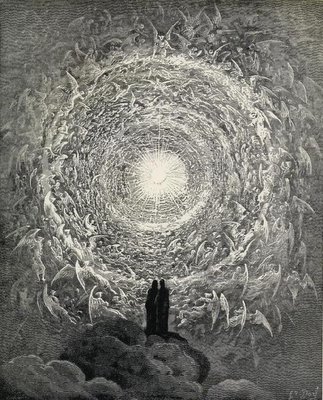
So there you go. Just like Richard Doofus in Close Encounters of the Third Kind.
(BTW, that's Petey on the right, goosing me from behind, saying "see, I told you it looked like a donut.")

Bro. Bartleby left a link to an interesting website that provides examples of maps of visual complexity. I looked through the maps, trying to find something that reminded me of how I visualize the cosmos -- I'm not sure why, but I do -- as a sort of hyperdimensional toroidal fractal klein bottle with God in the middle. So I googled "fractal toroid klein bottle" and found the following idol (courtesy Gavin Kistner):

Then it struck me how similar the pattern is to the Gustave Dore engraving from the Divine Comedy on the cover of my book. While I specifically chose this cover, I didn't consciously do so with the fractal toroid pattern in mind. In other words, I wasn't trying to be allegheirical:

So there you go. Just like Richard Doofus in Close Encounters of the Third Kind.
(BTW, that's Petey on the right, goosing me from behind, saying "see, I told you it looked like a donut.")
Saturday, March 04, 2006
Is Anything Really Evolving Except Our Own Cosmic Narcissism?
Reader Hoarhey asked a most provocative question yesterday. I read it right before going to bed, and it was so multi-faceted and full of possibilities that it kept me up. Well, not really. Nothing interferes with my sleep. However, I was thinking about it as I fell asleep, I woke up with thoughts about it running through my mind, and I even dreamt about it. Why was I standing on the clothes dryer? What was that brown recluse spider doing in the rafters? Why was my little son down below, trying to reach up? Why the brass column? (Now, now, keep it clean.)
Back to Hoarhey's question. He asked, "Perhaps you could flesh out your theory of evolutionary consciousness with some examples of people currently who have evolved beyond those who have come before. I myself am having a hard time locating any. I would be hard pressed to compare any of the many historical Spiritualists which you list daily in your blog with someone like Deeprock Chakra and see anything but de-volution. Or lets take politicians of say 2 or 3 hundred years ago who in my opinion, had a pretty good grasp on the shortcomings of human nature and cosmic cause and effect and compare them with the likes of a Hillary Clinton or a Chuck Schumer. Am I incorrect that we seem to be currently stuck in a narcissistic backwater?"
I believe that in previous posts over the past five months I have addressed these issues in various ways, but I will attempt a recap here.
Addressing that last question first, yes, in many ways we are stuck in a world-historical narcissistic eddy. It is one of the things we will have to overcome if evolution is to continue. A few months back I wrote a piece entitled The Luxury of Narcissism, in which I attempted to address this issue from the widest possible world-historical angle. You should probably go back and read the whole thing. One of my main conclusions was that the reason people appear to be so much more narcissistic today may simply be because they can be. Human beings have always had narcissistic strivings, but only with our previously undreamt of levels of widespread leisure, comfort and affluence are these strivings able to be indulged in a way that would have been unavailable even to kings and princes in the past:
"In other words, before 100 years ago (and even 60 or 70 years ago), people were too busy working, subsisting, and dealing with pain, illness and early death to be particularly self-absorbed. Perhaps there was so much more awareness of the frailty of life that it didn’t occur to most people to exalt something as ephemeral as the individual self. In a way, the transcendence of religion came naturally, as there was no reason to elevate our brief sojourn in this vale of tears to the ultimate experience. Until the early 20th century, the average person could expect to be in intense and excruciating pain at some point in his life, and perhaps often in life, because there were no powerful analgesics that were widely available. Very few diseases could actually be cured well into the 20th century."
"By the 'roaring twenties,' all of the important countercultural [read: narcissistic] ideas and values that would later dominate the post 1960’s world were in play among the well-to-do. However, their inevitable spread through the rest of the population was delayed, first by the Great Depression of the 1930’s, then by World War II and the Korean War. Therefore, until the mid 1950’s, people of necessity had to 'concentrate more on economic survival and domesticity than on self-expression and self-gratification, which most, in any event, could not afford.'"
Now, back to Hoarhey's question. First of all, we cannot look at the problem in terms of years or decades. Rather, the minimum unit of measurement of the type of spiritual and psychological progress I am talking about would have to be centuries. As I have mentioned before, we cannot even really view it from within history, but instead have to take a sort of "martian's eye view" of world history, which chronicles the catastrophic and unexpected emergence of human self-consciousness: of troublesome thoughts and what to do about them. Really, we have to look at the whole 40,000 year chunk of history + prehistory, which is what I attempted to do in my book. Furthermore, we have to realize that this evolution will be a saw-toothed function, as we push forward and slide backward.
For example, The Old Testament candidly documents just how difficult it was for the ancient Hebrews to spiritually progress from polytheistic barbarism into the higher Truth of monotheism. Here we were dealing with what was then clearly the leading edge of spiritual evolution--the Jewish people--and yet, they had to do battle with their own atavistic tendencies to make sacrifices to Moloch, to a false god. Nothing has changed since then with regard to the basic dynamic. It's just that we are all chosen and Moloch goes by different names.
If there was one part of my book I wish I could have expanded, it would have been the too brief survey of history entitled Adapting to History: Why the Past is So Tense. But in order to do justice to the topic it would have taken a complete book--or many complete books, actually. Obviously I had to speak in generalizations and regard large swaths of history as cognitive "fly-over country," so to speak. But the main point I wanted the reader to come away with is that collective psycho-spiritual evolution has clearly been occurring if only you look at human beings from a wide enough angle. There was a time when all peoples practiced human sacrifice. There was a time that slavery was universal. There was a time when animals and children--not to mention women--were not treated with dignity or empathy. Etc. Truly, history was in a world-historical eddy until just three or four hundred years ago, going virtually nowhere until the emergence of free markets, science, democracy, and individualism.
In fact, there was a time--not too long ago--when one simply did not live long enough to evolve in the way I am talking about. You were born, you started performing backbreaking, menial work as soon as you were able, you suffered through a lot of pain, famine, disease, and loss, and then you croaked when you were 30, 40, or 50 if you were lucky. You were also likely illiterate, with no real ability to think abstractly. In order to experience some of the harsh and cruel conditions of the past, we needn't travel backward in time. For example, as I have discussed before, the "war on terror" is, in the final analysis, a war between psychoclasses--between our own psychological past and present.
There is so much more to say about the issues raised by Hoarhey. One critical point is the presumptive narcissism of saying that we are "better" or "higher" than our forebears--or our contemporaries, for that matter. This would appear to be a clear invitation to narcissism, and in many ways it is. This is what fuels both the fantasies of the new age movement, but also, sadly, the highly atavistic form of conventional "churchianity" that dominates most people's spiritual understanding.
In my book I proposed a method to determine the level of psychological evolution of any given culture or individual. It is quite simple, really, but I think you will find that it has universal applicability and that it has a built-in means of overriding the ubiquitous narcissistic impulse. It steers a middle course between conservatives or traditionalists who believe in an invariant human nature that has not changed since mankind first appeared, and the leftist tendency to "immamentize" the spiritual and to measure progress in wholly material terms.
Specifically, I said that the two key measurements of psycho-spiritual evolution were integration and actualization. The former may be thought of as a horizontal function, the latter a vertical one. Integration has to do with psychological "wholeness," that is, how well we are able to integrate split-off aspects of the psyche, or what I have called "mind parasites." Clearly, for example, the Arab middle east is a place where we see a transparent lack of psychological integration. Instead, we see unconscious acting out everywhere we look--rampant paranoia, systematic abuse of women and children, confusion of fantasy and reality, untamed envy, dysregulated shame, etc. You don't have to go too far back in history before you see that this lack of psychological integration was the norm. It was not pleasant living in the middle ages, much less ancient Greece or Rome. (And please, we're talking about the average mentality, not individual exceptions; in all places and times, there have been individuals who obviously achieved the highest levels of aesthetic, spiritual and metaphysical insight.)
The second measure of evolution is actualization. Here again, this could be an invitation to narcissism, but not if you look at it in the way I intended. That is, traditional metaphysics maintains that human beings have a threefold nature that includes body, mind (or soul) and spirit. Our modern understanding has unfortunately conflated soul and spirit, but the one is personal and horizontal, the other more universal and vertical. The latter is our objective self that is capable of objective knowledge. It is the intellect properly understood, not in its debased current form; the contemporary "intellectual" is generally anything but. I am talking about the part of us that grows with spiritual development, called the nous by the ancient Christian fathers, the "psychic being" in Sri Aurobindo's yoga. All traditions recognize it; it is our "spiritual blueprint," to be distinguished from our lower self, or ego, which is largely a result of genetics, culture and family. It is the part of us that can know the truth, the truth that can set us free and save us. If it is not distinguished from the lower self, then that is where much trouble arises: "clowns to the left of me, jokers to the right," as the song goes.
This post has probably already gone on too long. I will have to continue it tomorrow. If anyone’s interested.
Back to Hoarhey's question. He asked, "Perhaps you could flesh out your theory of evolutionary consciousness with some examples of people currently who have evolved beyond those who have come before. I myself am having a hard time locating any. I would be hard pressed to compare any of the many historical Spiritualists which you list daily in your blog with someone like Deeprock Chakra and see anything but de-volution. Or lets take politicians of say 2 or 3 hundred years ago who in my opinion, had a pretty good grasp on the shortcomings of human nature and cosmic cause and effect and compare them with the likes of a Hillary Clinton or a Chuck Schumer. Am I incorrect that we seem to be currently stuck in a narcissistic backwater?"
I believe that in previous posts over the past five months I have addressed these issues in various ways, but I will attempt a recap here.
Addressing that last question first, yes, in many ways we are stuck in a world-historical narcissistic eddy. It is one of the things we will have to overcome if evolution is to continue. A few months back I wrote a piece entitled The Luxury of Narcissism, in which I attempted to address this issue from the widest possible world-historical angle. You should probably go back and read the whole thing. One of my main conclusions was that the reason people appear to be so much more narcissistic today may simply be because they can be. Human beings have always had narcissistic strivings, but only with our previously undreamt of levels of widespread leisure, comfort and affluence are these strivings able to be indulged in a way that would have been unavailable even to kings and princes in the past:
"In other words, before 100 years ago (and even 60 or 70 years ago), people were too busy working, subsisting, and dealing with pain, illness and early death to be particularly self-absorbed. Perhaps there was so much more awareness of the frailty of life that it didn’t occur to most people to exalt something as ephemeral as the individual self. In a way, the transcendence of religion came naturally, as there was no reason to elevate our brief sojourn in this vale of tears to the ultimate experience. Until the early 20th century, the average person could expect to be in intense and excruciating pain at some point in his life, and perhaps often in life, because there were no powerful analgesics that were widely available. Very few diseases could actually be cured well into the 20th century."
"By the 'roaring twenties,' all of the important countercultural [read: narcissistic] ideas and values that would later dominate the post 1960’s world were in play among the well-to-do. However, their inevitable spread through the rest of the population was delayed, first by the Great Depression of the 1930’s, then by World War II and the Korean War. Therefore, until the mid 1950’s, people of necessity had to 'concentrate more on economic survival and domesticity than on self-expression and self-gratification, which most, in any event, could not afford.'"
Now, back to Hoarhey's question. First of all, we cannot look at the problem in terms of years or decades. Rather, the minimum unit of measurement of the type of spiritual and psychological progress I am talking about would have to be centuries. As I have mentioned before, we cannot even really view it from within history, but instead have to take a sort of "martian's eye view" of world history, which chronicles the catastrophic and unexpected emergence of human self-consciousness: of troublesome thoughts and what to do about them. Really, we have to look at the whole 40,000 year chunk of history + prehistory, which is what I attempted to do in my book. Furthermore, we have to realize that this evolution will be a saw-toothed function, as we push forward and slide backward.
For example, The Old Testament candidly documents just how difficult it was for the ancient Hebrews to spiritually progress from polytheistic barbarism into the higher Truth of monotheism. Here we were dealing with what was then clearly the leading edge of spiritual evolution--the Jewish people--and yet, they had to do battle with their own atavistic tendencies to make sacrifices to Moloch, to a false god. Nothing has changed since then with regard to the basic dynamic. It's just that we are all chosen and Moloch goes by different names.
If there was one part of my book I wish I could have expanded, it would have been the too brief survey of history entitled Adapting to History: Why the Past is So Tense. But in order to do justice to the topic it would have taken a complete book--or many complete books, actually. Obviously I had to speak in generalizations and regard large swaths of history as cognitive "fly-over country," so to speak. But the main point I wanted the reader to come away with is that collective psycho-spiritual evolution has clearly been occurring if only you look at human beings from a wide enough angle. There was a time when all peoples practiced human sacrifice. There was a time that slavery was universal. There was a time when animals and children--not to mention women--were not treated with dignity or empathy. Etc. Truly, history was in a world-historical eddy until just three or four hundred years ago, going virtually nowhere until the emergence of free markets, science, democracy, and individualism.
In fact, there was a time--not too long ago--when one simply did not live long enough to evolve in the way I am talking about. You were born, you started performing backbreaking, menial work as soon as you were able, you suffered through a lot of pain, famine, disease, and loss, and then you croaked when you were 30, 40, or 50 if you were lucky. You were also likely illiterate, with no real ability to think abstractly. In order to experience some of the harsh and cruel conditions of the past, we needn't travel backward in time. For example, as I have discussed before, the "war on terror" is, in the final analysis, a war between psychoclasses--between our own psychological past and present.
There is so much more to say about the issues raised by Hoarhey. One critical point is the presumptive narcissism of saying that we are "better" or "higher" than our forebears--or our contemporaries, for that matter. This would appear to be a clear invitation to narcissism, and in many ways it is. This is what fuels both the fantasies of the new age movement, but also, sadly, the highly atavistic form of conventional "churchianity" that dominates most people's spiritual understanding.
In my book I proposed a method to determine the level of psychological evolution of any given culture or individual. It is quite simple, really, but I think you will find that it has universal applicability and that it has a built-in means of overriding the ubiquitous narcissistic impulse. It steers a middle course between conservatives or traditionalists who believe in an invariant human nature that has not changed since mankind first appeared, and the leftist tendency to "immamentize" the spiritual and to measure progress in wholly material terms.
Specifically, I said that the two key measurements of psycho-spiritual evolution were integration and actualization. The former may be thought of as a horizontal function, the latter a vertical one. Integration has to do with psychological "wholeness," that is, how well we are able to integrate split-off aspects of the psyche, or what I have called "mind parasites." Clearly, for example, the Arab middle east is a place where we see a transparent lack of psychological integration. Instead, we see unconscious acting out everywhere we look--rampant paranoia, systematic abuse of women and children, confusion of fantasy and reality, untamed envy, dysregulated shame, etc. You don't have to go too far back in history before you see that this lack of psychological integration was the norm. It was not pleasant living in the middle ages, much less ancient Greece or Rome. (And please, we're talking about the average mentality, not individual exceptions; in all places and times, there have been individuals who obviously achieved the highest levels of aesthetic, spiritual and metaphysical insight.)
The second measure of evolution is actualization. Here again, this could be an invitation to narcissism, but not if you look at it in the way I intended. That is, traditional metaphysics maintains that human beings have a threefold nature that includes body, mind (or soul) and spirit. Our modern understanding has unfortunately conflated soul and spirit, but the one is personal and horizontal, the other more universal and vertical. The latter is our objective self that is capable of objective knowledge. It is the intellect properly understood, not in its debased current form; the contemporary "intellectual" is generally anything but. I am talking about the part of us that grows with spiritual development, called the nous by the ancient Christian fathers, the "psychic being" in Sri Aurobindo's yoga. All traditions recognize it; it is our "spiritual blueprint," to be distinguished from our lower self, or ego, which is largely a result of genetics, culture and family. It is the part of us that can know the truth, the truth that can set us free and save us. If it is not distinguished from the lower self, then that is where much trouble arises: "clowns to the left of me, jokers to the right," as the song goes.
This post has probably already gone on too long. I will have to continue it tomorrow. If anyone’s interested.
Wednesday, March 01, 2006
Selected Excerpts from Mommy is a Democrat
The other day, Dr. Sanity posted on the new children's book Mommy is a Moonbat, er, Democrat. Frankly I think she was being a little rough on it, writing that "The platitudes served up in this book with such reckless abandon" will "more than adequately contribute to the ongoing destruction of our children's critical thinking capabilities by creating a painless shortcut to rational thought."
Ouch.
I don't usually disagree with Dr. Sanity, but I actually had the opportunity to read the whole book in context, and it's not as bad as you might think. Here are a few gems pulled out at random:
--Ask not what your country can do for you. Instead, organize a demonstration and demand it.
--Behind every great man is a privileged heterosexual woman. Or, a fabulous gay guy, an accomplished bisexual, or perhaps someone who is transgendered, queer, "questioning," intersexed, or just curious, or possibly an animal companion. Of course, this is not to cast judgment on great asexual beings or loners-by-choice who have no one behind them.
--It's not how you play the game, so long as no one wins or loses and gets their feelings hurt.
--A fool and someone else's money can solve any societal problem (The Democratic Credo).
--If life gives you lemons, file a class action suit against Sunkist.
--Always remember you're above average, just like everyone else.
--A person is known by the company he boycotts.
--When the going gets tough, the tough start leaking.
--Beggars can't be choosers. Rather, they're now called "homeless."
--Boys will be boys until government provides subsidized ritalin for every one of them.
--Regardless of your background, any American who really works hard at it can still be a victim.
Ouch.
I don't usually disagree with Dr. Sanity, but I actually had the opportunity to read the whole book in context, and it's not as bad as you might think. Here are a few gems pulled out at random:
--Ask not what your country can do for you. Instead, organize a demonstration and demand it.
--Behind every great man is a privileged heterosexual woman. Or, a fabulous gay guy, an accomplished bisexual, or perhaps someone who is transgendered, queer, "questioning," intersexed, or just curious, or possibly an animal companion. Of course, this is not to cast judgment on great asexual beings or loners-by-choice who have no one behind them.
--It's not how you play the game, so long as no one wins or loses and gets their feelings hurt.
--A fool and someone else's money can solve any societal problem (The Democratic Credo).
--If life gives you lemons, file a class action suit against Sunkist.
--Always remember you're above average, just like everyone else.
--A person is known by the company he boycotts.
--When the going gets tough, the tough start leaking.
--Beggars can't be choosers. Rather, they're now called "homeless."
--Boys will be boys until government provides subsidized ritalin for every one of them.
--Regardless of your background, any American who really works hard at it can still be a victim.
Tuesday, February 28, 2006
The Word Made Fresh and The Weird Made Flesh (2.28.11)
Let's begin with two stipulations, one very old, the other of more recent vintage, treating them not as religious statements per se but metaphysical ones:
In the beginning God created the heavens and the earth,
and
In the beginning was the the Word, and the Word was with God, and the Word was God.... All things were made through Him, and without Him nothing was made that was made.
What the heck, in the spirit of multiculturalism, and in the effort to increase our depth of vision with an extra I, let's toss another bon mot into the mix, this from the opening of the Isha Upanishad: In the heart of all things, of whatever there is in the universe, dwells the Lord.
What does it mean, "In the beginning, God created the heavens and the earth"? As I have mentioned before, I believe that it has to do with the creation of the most fundamental duality of the cosmos. This duality can be viewed from many angles, but it can be summarized by saying that "in the beginning God created the vertical and the horizontal," for this duality subsumes the irreducible (irreducible in terms that can be thought about) categories of quality and quantity, interior and exterior, eternity and time, whole and part, implicate and explicate, subject and object. In each instance we are dealing with a "limit case" beyond which thought cannot traverse. In fact, the one side of the dualism necessitates the other and represents the conditions of thought. Nothing "mental" can be made without the vertical/horizontal duality as a precondition.
With the second statement we introduce an unexpected twist: In the beginning was the Word, or Logos. Moreover, this Word was with God, implying that it was there "before the beginning," before the great dualistic creative activity of the first statement. Indeed, if the Word is God, this can be the only logical conclusion.
This then apparently raises language to a most exalted status. But clearly not if we merely look at it in the usual way. It's so easy to take language for granted, when in reality we are dealing with something that is frankly magic. In fact, the very same Biblical passage cautions us about this, pointing out that the light of the Word "shines in the darkness and the darkness did not comprehend it." Or, to put it in the slightly saltier terms expressed in the Book of Petey, "the weird light shines in the dark, but the dorks don't get it. For truly, the weirdness was spread all through the world, and yet, the world basically kept behaving as if this were just your ordinary, standard-issue cosmos."
One additional point would appear relevant. From Genesis 1:26 and 27 we read "Then God said 'Let Us make man in Our image, according to Our likeness'.... So God created man in His own image; in the image of God He created him; male and female he created them." We are particularly interested in how our capacity for creativity might mirror the primordial creative activity of the Divine Mind.
So, what is language, anyway? What is a word? As a matter of fact, a word is a very special thing, because only it has the capacity of bridging the dualistic worlds introduced by primordial creation. Apparently words can do this because they are somehow prior to the great duality and therefore partake of both heaven and earth, above and below, vertical and horizontal.
The literal meaning of the word "symbol" is to "throw together" or across, as if words are exterior agents that join together two disparate things. But the Biblical view would suggest that langauge actually has this "throwing together" capacity because it somehow subtends the world on an interior level: language is what the world is made of, so it shouldn't surprise us that with it we can see all kinds of deep unities in the cosmos. The unities are there just waiting to be discovered, and language is our tool for doing that.
"In the beginning" of human consciousness there is also a fundamental duality--or dialectic--between the conscious (horizontal) and unconscious (vertical) minds. It is incorrect to visualize the mind in spatial terms as a sort of unconscious space below, with a line separating it from the conscious mind above. In reality, each moment of consciousness involves a generative, ceaselessly flowing "translation," or unfolding, of multi-dimensional, nonlocal mental space that cannot be thought about into a local, linear, and particularized expression that can be thought about.
Again, in a healthy person there is a fluid and generative dialectic between these two realms. But many things can go wrong with that process--in fact, most forms of psychopathology have to do with the person being caught up and entangled on one end or the other. I don't have time to get into that now, but suffice it to say that there are some people--let's call them the obsessive-compulsives--who live their lives wading in the shallow, rocky shoreline of the conscious side, while others--let's call them hysterics and borderlines--get lost in the storm-tossed sea of the unconscious side. Again, the key is a dialectical rapport between the two dimensions. That's where you are really "alive." And much of that aliveness has to do with language, that secret key to the universe.
For what is a word? What is so special about language? Again, a word easily serves as an emissary between the two worlds. On the one hand, a word refers to something particular in space and time--a cup, a tree, a dog. On the other hand, a word is by definition an abstraction with no localized or localizable being: we only recognize cup or tree or dog because they are a function of cupness, treeness or doginess. Therefore, words are the local tools of the translating function of vertical into horizontal being, of infinite into finite, of eternity into time--if we know how to use them. If we do not live in the dark.
Speaking of which, I've been typing this post--like all my recent posts--in the darkness of the dawn. They say that dawn is the friend of the muses. I suppose that is because at dawn we still have one foot in the waters of our night-sea journey into the multidmensional dream world. Perhaps my posts only make sense at dawn and cannot withstand the harsh light of daytime logic. In any event, that blanding light is now shining through my window, signalling to me that I am once again late for my daily horizontal exhile. But I'll be back. Back to the beginning tomorrow morning, where we will plot another raid on the formless infinite, and attempt to translate it into terms we can think about.
In the beginning God created the heavens and the earth,
and
In the beginning was the the Word, and the Word was with God, and the Word was God.... All things were made through Him, and without Him nothing was made that was made.
What the heck, in the spirit of multiculturalism, and in the effort to increase our depth of vision with an extra I, let's toss another bon mot into the mix, this from the opening of the Isha Upanishad: In the heart of all things, of whatever there is in the universe, dwells the Lord.
What does it mean, "In the beginning, God created the heavens and the earth"? As I have mentioned before, I believe that it has to do with the creation of the most fundamental duality of the cosmos. This duality can be viewed from many angles, but it can be summarized by saying that "in the beginning God created the vertical and the horizontal," for this duality subsumes the irreducible (irreducible in terms that can be thought about) categories of quality and quantity, interior and exterior, eternity and time, whole and part, implicate and explicate, subject and object. In each instance we are dealing with a "limit case" beyond which thought cannot traverse. In fact, the one side of the dualism necessitates the other and represents the conditions of thought. Nothing "mental" can be made without the vertical/horizontal duality as a precondition.
With the second statement we introduce an unexpected twist: In the beginning was the Word, or Logos. Moreover, this Word was with God, implying that it was there "before the beginning," before the great dualistic creative activity of the first statement. Indeed, if the Word is God, this can be the only logical conclusion.
This then apparently raises language to a most exalted status. But clearly not if we merely look at it in the usual way. It's so easy to take language for granted, when in reality we are dealing with something that is frankly magic. In fact, the very same Biblical passage cautions us about this, pointing out that the light of the Word "shines in the darkness and the darkness did not comprehend it." Or, to put it in the slightly saltier terms expressed in the Book of Petey, "the weird light shines in the dark, but the dorks don't get it. For truly, the weirdness was spread all through the world, and yet, the world basically kept behaving as if this were just your ordinary, standard-issue cosmos."
One additional point would appear relevant. From Genesis 1:26 and 27 we read "Then God said 'Let Us make man in Our image, according to Our likeness'.... So God created man in His own image; in the image of God He created him; male and female he created them." We are particularly interested in how our capacity for creativity might mirror the primordial creative activity of the Divine Mind.
So, what is language, anyway? What is a word? As a matter of fact, a word is a very special thing, because only it has the capacity of bridging the dualistic worlds introduced by primordial creation. Apparently words can do this because they are somehow prior to the great duality and therefore partake of both heaven and earth, above and below, vertical and horizontal.
The literal meaning of the word "symbol" is to "throw together" or across, as if words are exterior agents that join together two disparate things. But the Biblical view would suggest that langauge actually has this "throwing together" capacity because it somehow subtends the world on an interior level: language is what the world is made of, so it shouldn't surprise us that with it we can see all kinds of deep unities in the cosmos. The unities are there just waiting to be discovered, and language is our tool for doing that.
"In the beginning" of human consciousness there is also a fundamental duality--or dialectic--between the conscious (horizontal) and unconscious (vertical) minds. It is incorrect to visualize the mind in spatial terms as a sort of unconscious space below, with a line separating it from the conscious mind above. In reality, each moment of consciousness involves a generative, ceaselessly flowing "translation," or unfolding, of multi-dimensional, nonlocal mental space that cannot be thought about into a local, linear, and particularized expression that can be thought about.
Again, in a healthy person there is a fluid and generative dialectic between these two realms. But many things can go wrong with that process--in fact, most forms of psychopathology have to do with the person being caught up and entangled on one end or the other. I don't have time to get into that now, but suffice it to say that there are some people--let's call them the obsessive-compulsives--who live their lives wading in the shallow, rocky shoreline of the conscious side, while others--let's call them hysterics and borderlines--get lost in the storm-tossed sea of the unconscious side. Again, the key is a dialectical rapport between the two dimensions. That's where you are really "alive." And much of that aliveness has to do with language, that secret key to the universe.
For what is a word? What is so special about language? Again, a word easily serves as an emissary between the two worlds. On the one hand, a word refers to something particular in space and time--a cup, a tree, a dog. On the other hand, a word is by definition an abstraction with no localized or localizable being: we only recognize cup or tree or dog because they are a function of cupness, treeness or doginess. Therefore, words are the local tools of the translating function of vertical into horizontal being, of infinite into finite, of eternity into time--if we know how to use them. If we do not live in the dark.
Speaking of which, I've been typing this post--like all my recent posts--in the darkness of the dawn. They say that dawn is the friend of the muses. I suppose that is because at dawn we still have one foot in the waters of our night-sea journey into the multidmensional dream world. Perhaps my posts only make sense at dawn and cannot withstand the harsh light of daytime logic. In any event, that blanding light is now shining through my window, signalling to me that I am once again late for my daily horizontal exhile. But I'll be back. Back to the beginning tomorrow morning, where we will plot another raid on the formless infinite, and attempt to translate it into terms we can think about.
Monday, February 27, 2006
Down the Rabbit Hole to the Threshold of the Unglishable
It is no great accomplishment to hear a voice in the head. The accomplishment is to make sure that it is telling you the truth. --Terence McKenna
So true. My unincarnated co-conspirator Petey talks a good game, but as you know, he can get very evasive when you try to pin him down. Are you being literal? Metaphorical? Symbolic? Allegorical? Obnoxious? Was that a joke? Hey, where did you go?
Anyway, have you ever have that exalted feeling that you've stumbled upon the key to the world enigma? That you've crashed through the doorways of the divine imagination and glimpsed the eschaton in all its naked glory? That you've been deputized by the Aion to disclose its inner secret, only to forget what it was when you wake up the next morning sober?
As you can see from my recent posts, I've been thinking very hard about certain spiritual matters that I had previously had to place on the back burner, partly due to the demands of trying to blog about the deep psychological structure of horizontal politics on a daily basis. In fact, I did this in violation of my own advice found on page 234 of my book: "It is critical to consume the proper spiritual 'food' and cut back on the graven mass media images that draw you into the 'tempest of the day.'" These things "resonate at a certain frequency that will awaken a sympathetic response in you if you are not vigilant." Therefore, "you must 'wean yourself from the momentary' (Kierkegaard) and make sure you give yourself each day your daily transubstantial bread."
I suppose that's one thing I've been trying to do with the blog lately--provide a quiet little vertical roadside diner where people can come and visit amidst the roiling insanity of the world. I will still write about politics from time to time, but we are in such good hands with ShrinkWrapped and Dr. Sanity in that regard. They probably don't even realize how important their work is. They are doing something truly novel--something that has never successfully been done in the past. You'd think it would be easy, but most past attempts to apply psychological principles to culture, politics and history have been either hopelessly shallow or ridiculously transparent agenda-driven twaddle produced by vaguely Marxist hack-, wack,- and attackademics. For that reason, psychohistory quickly discredited itself and no one took it seriously. ShrinkWrapped, Dr. Sanity, and others are virtually resurrecting this moribund field, whether they know it or not. The discipline is full of potential pitfalls, and it takes a wise and self-aware person to avoid them, because it is easily prone to excesses--explaining too much, or simply tarring your ideological enemies with a pathological brush. They do neither.
Where was I? Oh yes. The spiritual explorations. As I mentioned, since I liberated myself somewhat from the day-to-day political trench warfare, I've been able to focus like the proverbial laser beam on certain problems that I essentially had to set aside after I finished my book in 2004. The very same week I submitted the final correction of the galleys I was diagnosed with Type I diabetes--how's that for timing?--and didn't feel very well, both physically and psychologically, for a number of months. I think the more "finely tuned" your physical instrument is, the more you notice subtle changes in your body, not to mention the gross changes brought about by having had your blood sugar deranged for who knows how many months.
Then, a few months later, the birth of my first child at the age of 49. Normally that wouldn't be a big deal, but with the diabetes, it introduced a new stressor into the situation that I hadn't planned on. I'm not complaining. It's just that I really have to take care of myself if I want to be around for some of those precious moments, like when he drops out of high school or steals his first car.
One of the things that makes me "believe in" the spiritual is that when you sincerely and humbly think about it, you get results. Once I began opening myself up to the problems I'd been thinking about, ideas and theories started pouring in. This also happened in the writing of my book. Solutions to problems don't exactly come from "thinking" or "problem solving" per se. Rather, you have to immerse yourself in a problem and wait for the answer to come. Where does it come from? I don't know. You could say "the unconscious," but I think that just begs the question, because if the unconscious is capable of such feats, we have to come up with a better name than "un" conscious, because it's very conscious. It may be "non" but it's certainly not "un" conscious. Actually, it's a different mode of consciousness.
Not only that--and here's the weird part, but it's true--it doesn't seem to work just "inside" but "outside" your so-called mind, as if you are a point in a nonlocal field that extends both inside and out. Obviously, many people have had this experience, most notably Carl Jung, who called it "synchronicity." Here again, it doesn't so much matter what causes it, so long as you notice that it does happen. In my case, subtle intuitions that point me this way and that, leading me along an invisible trail that shows me what I've been looking for. It's not as if "answers" are provided. Rather, it's more like a missing key is given--a key that exactly fits the problematic "lock" you've been thinking about.
If you look at all my recent posts, we've covered a lot of ground, but much of it revolves around the problems I've been working on, specifically, how to "build a more perfect logos," as Terence McKenna put it. That is, I'm trying to come up with a way to more effectively describe and communicate the "super conscious" world, in the same way Freud did with the unconscious. In so doing, some critical answers---or at least previously hidden signs pointing to potential answers--have been falling into my lap.
Unfortunately, I'm flat out of time. I will explain more in tomorrow's post.
*No time to spiel check today, so forgive any typos in my spiel.
So true. My unincarnated co-conspirator Petey talks a good game, but as you know, he can get very evasive when you try to pin him down. Are you being literal? Metaphorical? Symbolic? Allegorical? Obnoxious? Was that a joke? Hey, where did you go?
Anyway, have you ever have that exalted feeling that you've stumbled upon the key to the world enigma? That you've crashed through the doorways of the divine imagination and glimpsed the eschaton in all its naked glory? That you've been deputized by the Aion to disclose its inner secret, only to forget what it was when you wake up the next morning sober?
As you can see from my recent posts, I've been thinking very hard about certain spiritual matters that I had previously had to place on the back burner, partly due to the demands of trying to blog about the deep psychological structure of horizontal politics on a daily basis. In fact, I did this in violation of my own advice found on page 234 of my book: "It is critical to consume the proper spiritual 'food' and cut back on the graven mass media images that draw you into the 'tempest of the day.'" These things "resonate at a certain frequency that will awaken a sympathetic response in you if you are not vigilant." Therefore, "you must 'wean yourself from the momentary' (Kierkegaard) and make sure you give yourself each day your daily transubstantial bread."
I suppose that's one thing I've been trying to do with the blog lately--provide a quiet little vertical roadside diner where people can come and visit amidst the roiling insanity of the world. I will still write about politics from time to time, but we are in such good hands with ShrinkWrapped and Dr. Sanity in that regard. They probably don't even realize how important their work is. They are doing something truly novel--something that has never successfully been done in the past. You'd think it would be easy, but most past attempts to apply psychological principles to culture, politics and history have been either hopelessly shallow or ridiculously transparent agenda-driven twaddle produced by vaguely Marxist hack-, wack,- and attackademics. For that reason, psychohistory quickly discredited itself and no one took it seriously. ShrinkWrapped, Dr. Sanity, and others are virtually resurrecting this moribund field, whether they know it or not. The discipline is full of potential pitfalls, and it takes a wise and self-aware person to avoid them, because it is easily prone to excesses--explaining too much, or simply tarring your ideological enemies with a pathological brush. They do neither.
Where was I? Oh yes. The spiritual explorations. As I mentioned, since I liberated myself somewhat from the day-to-day political trench warfare, I've been able to focus like the proverbial laser beam on certain problems that I essentially had to set aside after I finished my book in 2004. The very same week I submitted the final correction of the galleys I was diagnosed with Type I diabetes--how's that for timing?--and didn't feel very well, both physically and psychologically, for a number of months. I think the more "finely tuned" your physical instrument is, the more you notice subtle changes in your body, not to mention the gross changes brought about by having had your blood sugar deranged for who knows how many months.
Then, a few months later, the birth of my first child at the age of 49. Normally that wouldn't be a big deal, but with the diabetes, it introduced a new stressor into the situation that I hadn't planned on. I'm not complaining. It's just that I really have to take care of myself if I want to be around for some of those precious moments, like when he drops out of high school or steals his first car.
One of the things that makes me "believe in" the spiritual is that when you sincerely and humbly think about it, you get results. Once I began opening myself up to the problems I'd been thinking about, ideas and theories started pouring in. This also happened in the writing of my book. Solutions to problems don't exactly come from "thinking" or "problem solving" per se. Rather, you have to immerse yourself in a problem and wait for the answer to come. Where does it come from? I don't know. You could say "the unconscious," but I think that just begs the question, because if the unconscious is capable of such feats, we have to come up with a better name than "un" conscious, because it's very conscious. It may be "non" but it's certainly not "un" conscious. Actually, it's a different mode of consciousness.
Not only that--and here's the weird part, but it's true--it doesn't seem to work just "inside" but "outside" your so-called mind, as if you are a point in a nonlocal field that extends both inside and out. Obviously, many people have had this experience, most notably Carl Jung, who called it "synchronicity." Here again, it doesn't so much matter what causes it, so long as you notice that it does happen. In my case, subtle intuitions that point me this way and that, leading me along an invisible trail that shows me what I've been looking for. It's not as if "answers" are provided. Rather, it's more like a missing key is given--a key that exactly fits the problematic "lock" you've been thinking about.
If you look at all my recent posts, we've covered a lot of ground, but much of it revolves around the problems I've been working on, specifically, how to "build a more perfect logos," as Terence McKenna put it. That is, I'm trying to come up with a way to more effectively describe and communicate the "super conscious" world, in the same way Freud did with the unconscious. In so doing, some critical answers---or at least previously hidden signs pointing to potential answers--have been falling into my lap.
Unfortunately, I'm flat out of time. I will explain more in tomorrow's post.
*No time to spiel check today, so forgive any typos in my spiel.
Sunday, February 26, 2006
On Seeing the Depth of the Cosmos With Your Own Three Eyes
Psychologists don't actually know much about consciousness. However, one thing we do know--or should know, anyway--is that it is not a bag. And yet, in thinking about the nature of consciousness, this seems to be the default setting of most psychologists--as if consciousness is a sort of empty container where mental events take place and are stored. In many respects, this is simply a projection--"injection," actually--and reification of our perception of three dimensional space. But it's the other way around. Three dimensional space is a projection of the mind.
In many ways, human psychological development can be thought of as a conquest of dimensionality. (Don’t get bogged down in a literal understanding here--this is a mental exercise to facilitate understanding.) For example, the psychotic mind inhabits a "zero dimension" of pure mathematical symmetry. It is a world of infinite meaninglessness, with no floor or center, just a roiling panorama of catastrophic, uncategorizable novelty. Symbols are equivalent to what they symbolize and the terror is endless, because there is nothing to contain it.
The autistic mind may be thought of as one-dimensional. It knows no depth, only points of sensory contact with objects that are known by their feel and texture--hard, soft, rough, smooth. For them, a communicative expression does not emerge from the human face. Rather, it is simply a bizarre collection of disconnected points--a nose here, an eye there, a curved mouth down there. The points are not synthesized into an internal representation of the emotional depth or interior of the other. The psychologist Frances Tustin wrote about how autistic defenses can operate in neurotic adults as well, for example, in certain repetitive rituals such as "rocking." These rituals help to contain an anxiously fragmented mind by focusing on some limited sensory perception. Without it, the mind might slip into the terrifying chaos of zero dimensions.
Once we reach two dimensions, we are in the realm of something more recognizably human. This was called by Melanie Klein the "paranoid schizoid position," and more people inhabit it than you might realize. It is the world of extreme, forced splitting into diametrically opposed emotional categories of good and bad. This type of two-dimensional thinking pervades the Islamic world.
For example, just yesterday there was a link on LGF to a transcript on Memri.org of a film seminar on Iranian TV by Professor Hasan Bolkhari, entitled "Tom and Jerry - A Jewish Conspiracy to Improve the Image of Mice, because Jews Were Termed 'Dirty Mice' in Europe." This man is a "professor," and yet, his mind clearly does not operate like yours or mine. Rather, it is simply a caricature of depth, when it is actually operating in the two-dimensional world of extreme splitting.
The professor soberly discourses on how "the Jewish Walt Disney Company gained international fame" with their Tom and Jerry cartoon (for the record, a Hanna Barbera creation). He goes on to suggest that the main motivation "for making this very appealing cartoon was to erase a certain derogatory term that was prevalent in Europe." That is, "If you study European history, you will see who was the main power to hoard money and wealth.... In most cases, it is the Jews. Perhaps that was one of the reasons which caused Hitler to begin the anti-Semitic trend... "
In his two dimensional mind, the Professor observes that "No ethnic group or people operates in such a clandestine manner as the Jews." In fact, "This ultimately led to Hitler's hatred and resentment." Therefore, in nazi Germany, "Jews were degraded and termed 'dirty mice'," so Tom and Jerry had to be made "in order to change the Europeans' perception of mice."
Obviously, this type of two-dimensional thinking is not confined to the Muslim world. In America we have many of our own two-dimensional professors, such as Noam Chomsky, Ward Churchill, and Juan Cole. Their minds are like utterly predictable calculating machines. Whatever data you put into them, they spit out the same results: U.S. bad, everyone else good.
Only with the emergence of the transitional space proper are we dealing with the creative use of three-dimensional psychological space. This is the imaginal space that emerges between an infant and his or her loving caretakers. But this creative and dynamic space is often hijacked and reduced to two dimensions as a result of the malign imagination of internalized mind parasites.
The fourth dimension adds time to the mix. This is called the "depressive position," a term of art that does not imply clinical depression per se, but the capacity to form stable relationships that endure through time. One of the reasons it is “depressive” is that it involves transcending the omnipotent psychological defenses of the lower dimensions. For example, a borderline patient is not in the depressive position. Rather, when they become angry at a loved one, they instantly convert the loved one into the category of all bad. Not only are they bad now, but they have always been, and always will be, bad. In a very real sense, time and history have been destroyed. The feeling creates the reality.
Perhaps you have noticed when you shift from one dimension to another. For example, depression clearly involves a loss of dimensionality. One of its most striking characteristics is that the world seems to lose a vital dimension of depth. Suddenly it is flat, lifeless, and devoid of the meaning that can only be located and experienced in the higher dimensions. Moreover, many psychological defense mechanisms operate by plunging the individual into a lower dimension. I call these “dimensional defenses." For example, there might well be unpleasant meanings and psychological realities located in the fourth dimension--indeed, there usually are. One way to avoid them is to descend into a lower dimension where those meanings cannot be located or "entertained."
I didn't mean for this to be a discourse on psychological development. For one things, these are my own theories, and I doubt if many psychologists would subscribe to them. But any way you look at it, this is as far as conventional psychology can take you--into the four-dimensional space of the depressive position. It's what most people would call "reality."
But neither internal nor external reality are limited to four dimensions. This is pure projection, an artifact of our evolved nervous systems. For example, if you could ask a worm how many dimensions there are in the world, they would undoubtedly say two. Ask a bacterium, and they'd probably say one. Ask most humans, and you get four.
But in my opinion, one of the things that spiritual development involves first and foremost is the ongoing conquest of dimensionality---of higher dimensional space. One way to think about it is that the conquest of each dimension brings with it a new degree of freedom. Think about that insane Iranian professor. How free is he really? In reality, he's free to move in only two directions: Muslim good, Jew evil. Same with Noam Chomsky, at least insofar as his mind touches on politics. His mind is free in only two directions. Conclusions are preordained. He's on a railroad track.
Now several of my readers have pointed out a useful analogy for spiritual experience, one that I myself have used in the past. That is, they compare it to those "Magic Eye" pictures, which look like a bunch of random two-dimensional dots until you relax your gaze, and suddenly a three dimensional object emerges from the page, floating there in the space before you.
Yes. This is an excellent analogy. Genuine spiritual insight involves dwelling in what appear to be meaningless clues, out of which suddenly emerges spiritual "vision." It is there. You "see" it. But that doesn't mean others will see it as well. For example, when I read the Book of Genesis, spiritual insight after insight tumble forth from the pages. But a two-, three- or four-dimensional scientific or religious literalist will simply see something concrete: somebody dividing light and dark or water and land. Some people walking around in a garden. A tree you're not supposed to touch. Etc.
In the past, I have touched on the idea of spiritual experience taking place on the shoreline between the infinite and the finite, between time and eternity. Consider the fact that we have two biological eyes or ears that are set slightly apart. Because each of the two organs has a slightly different vertex, we are able to see and hear stereoscopically or stereophonically. If you have only one good ear, you can't experience stereo, only mono.
Now, suppose we have a "third eye" or a "third ear." What would reality look like from that perspective? As a matter of fact, it is our "third eye" that sees into eternity. If you want, you can even think of it as a right-brain phenomena. That is, the left brain experiences things in sequence, while the right brain experiences them "all at once."
There is a way of living in which these two modes--the lower and higher eyes--harmoniously coexist to facilitate the emergence of additional dimensions of depth--of not being shipwrecked on the rocks of time, or of being lost in eternity, but somehow experiencing time in eternity and eternity within time.
I tried my best to capture this in my book. That is, if our perception of spatial depth comes from our integration of different points of view, depth may be thought of as a function of the number of perspectives that are integrated in an experience or perception. In my book, I tried to integrate as many points of view as possible--scientific, cosmological, biological, psychological, developmental, neurological, philosophical, spiritual, religious, mystical, etc.
I am hardly the only person who has had the experience of the deep unity that subtends--or supertends--the surface multiplicity of the world. As a matter of fact, it's more common than you think. I'm just trying to develop a language to talk about it. Just as we have Euclidean geometry to describe external space, we need to invent a geometry of higher dimensional spiritual space. It's one of the things I'm working on. So if my ideas appear half baked, that’s why. In reality, they’re more like 30-40% baked at this point.
In many ways, human psychological development can be thought of as a conquest of dimensionality. (Don’t get bogged down in a literal understanding here--this is a mental exercise to facilitate understanding.) For example, the psychotic mind inhabits a "zero dimension" of pure mathematical symmetry. It is a world of infinite meaninglessness, with no floor or center, just a roiling panorama of catastrophic, uncategorizable novelty. Symbols are equivalent to what they symbolize and the terror is endless, because there is nothing to contain it.
The autistic mind may be thought of as one-dimensional. It knows no depth, only points of sensory contact with objects that are known by their feel and texture--hard, soft, rough, smooth. For them, a communicative expression does not emerge from the human face. Rather, it is simply a bizarre collection of disconnected points--a nose here, an eye there, a curved mouth down there. The points are not synthesized into an internal representation of the emotional depth or interior of the other. The psychologist Frances Tustin wrote about how autistic defenses can operate in neurotic adults as well, for example, in certain repetitive rituals such as "rocking." These rituals help to contain an anxiously fragmented mind by focusing on some limited sensory perception. Without it, the mind might slip into the terrifying chaos of zero dimensions.
Once we reach two dimensions, we are in the realm of something more recognizably human. This was called by Melanie Klein the "paranoid schizoid position," and more people inhabit it than you might realize. It is the world of extreme, forced splitting into diametrically opposed emotional categories of good and bad. This type of two-dimensional thinking pervades the Islamic world.
For example, just yesterday there was a link on LGF to a transcript on Memri.org of a film seminar on Iranian TV by Professor Hasan Bolkhari, entitled "Tom and Jerry - A Jewish Conspiracy to Improve the Image of Mice, because Jews Were Termed 'Dirty Mice' in Europe." This man is a "professor," and yet, his mind clearly does not operate like yours or mine. Rather, it is simply a caricature of depth, when it is actually operating in the two-dimensional world of extreme splitting.
The professor soberly discourses on how "the Jewish Walt Disney Company gained international fame" with their Tom and Jerry cartoon (for the record, a Hanna Barbera creation). He goes on to suggest that the main motivation "for making this very appealing cartoon was to erase a certain derogatory term that was prevalent in Europe." That is, "If you study European history, you will see who was the main power to hoard money and wealth.... In most cases, it is the Jews. Perhaps that was one of the reasons which caused Hitler to begin the anti-Semitic trend... "
In his two dimensional mind, the Professor observes that "No ethnic group or people operates in such a clandestine manner as the Jews." In fact, "This ultimately led to Hitler's hatred and resentment." Therefore, in nazi Germany, "Jews were degraded and termed 'dirty mice'," so Tom and Jerry had to be made "in order to change the Europeans' perception of mice."
Obviously, this type of two-dimensional thinking is not confined to the Muslim world. In America we have many of our own two-dimensional professors, such as Noam Chomsky, Ward Churchill, and Juan Cole. Their minds are like utterly predictable calculating machines. Whatever data you put into them, they spit out the same results: U.S. bad, everyone else good.
Only with the emergence of the transitional space proper are we dealing with the creative use of three-dimensional psychological space. This is the imaginal space that emerges between an infant and his or her loving caretakers. But this creative and dynamic space is often hijacked and reduced to two dimensions as a result of the malign imagination of internalized mind parasites.
The fourth dimension adds time to the mix. This is called the "depressive position," a term of art that does not imply clinical depression per se, but the capacity to form stable relationships that endure through time. One of the reasons it is “depressive” is that it involves transcending the omnipotent psychological defenses of the lower dimensions. For example, a borderline patient is not in the depressive position. Rather, when they become angry at a loved one, they instantly convert the loved one into the category of all bad. Not only are they bad now, but they have always been, and always will be, bad. In a very real sense, time and history have been destroyed. The feeling creates the reality.
Perhaps you have noticed when you shift from one dimension to another. For example, depression clearly involves a loss of dimensionality. One of its most striking characteristics is that the world seems to lose a vital dimension of depth. Suddenly it is flat, lifeless, and devoid of the meaning that can only be located and experienced in the higher dimensions. Moreover, many psychological defense mechanisms operate by plunging the individual into a lower dimension. I call these “dimensional defenses." For example, there might well be unpleasant meanings and psychological realities located in the fourth dimension--indeed, there usually are. One way to avoid them is to descend into a lower dimension where those meanings cannot be located or "entertained."
I didn't mean for this to be a discourse on psychological development. For one things, these are my own theories, and I doubt if many psychologists would subscribe to them. But any way you look at it, this is as far as conventional psychology can take you--into the four-dimensional space of the depressive position. It's what most people would call "reality."
But neither internal nor external reality are limited to four dimensions. This is pure projection, an artifact of our evolved nervous systems. For example, if you could ask a worm how many dimensions there are in the world, they would undoubtedly say two. Ask a bacterium, and they'd probably say one. Ask most humans, and you get four.
But in my opinion, one of the things that spiritual development involves first and foremost is the ongoing conquest of dimensionality---of higher dimensional space. One way to think about it is that the conquest of each dimension brings with it a new degree of freedom. Think about that insane Iranian professor. How free is he really? In reality, he's free to move in only two directions: Muslim good, Jew evil. Same with Noam Chomsky, at least insofar as his mind touches on politics. His mind is free in only two directions. Conclusions are preordained. He's on a railroad track.
Now several of my readers have pointed out a useful analogy for spiritual experience, one that I myself have used in the past. That is, they compare it to those "Magic Eye" pictures, which look like a bunch of random two-dimensional dots until you relax your gaze, and suddenly a three dimensional object emerges from the page, floating there in the space before you.
Yes. This is an excellent analogy. Genuine spiritual insight involves dwelling in what appear to be meaningless clues, out of which suddenly emerges spiritual "vision." It is there. You "see" it. But that doesn't mean others will see it as well. For example, when I read the Book of Genesis, spiritual insight after insight tumble forth from the pages. But a two-, three- or four-dimensional scientific or religious literalist will simply see something concrete: somebody dividing light and dark or water and land. Some people walking around in a garden. A tree you're not supposed to touch. Etc.
In the past, I have touched on the idea of spiritual experience taking place on the shoreline between the infinite and the finite, between time and eternity. Consider the fact that we have two biological eyes or ears that are set slightly apart. Because each of the two organs has a slightly different vertex, we are able to see and hear stereoscopically or stereophonically. If you have only one good ear, you can't experience stereo, only mono.
Now, suppose we have a "third eye" or a "third ear." What would reality look like from that perspective? As a matter of fact, it is our "third eye" that sees into eternity. If you want, you can even think of it as a right-brain phenomena. That is, the left brain experiences things in sequence, while the right brain experiences them "all at once."
There is a way of living in which these two modes--the lower and higher eyes--harmoniously coexist to facilitate the emergence of additional dimensions of depth--of not being shipwrecked on the rocks of time, or of being lost in eternity, but somehow experiencing time in eternity and eternity within time.
I tried my best to capture this in my book. That is, if our perception of spatial depth comes from our integration of different points of view, depth may be thought of as a function of the number of perspectives that are integrated in an experience or perception. In my book, I tried to integrate as many points of view as possible--scientific, cosmological, biological, psychological, developmental, neurological, philosophical, spiritual, religious, mystical, etc.
I am hardly the only person who has had the experience of the deep unity that subtends--or supertends--the surface multiplicity of the world. As a matter of fact, it's more common than you think. I'm just trying to develop a language to talk about it. Just as we have Euclidean geometry to describe external space, we need to invent a geometry of higher dimensional spiritual space. It's one of the things I'm working on. So if my ideas appear half baked, that’s why. In reality, they’re more like 30-40% baked at this point.
Subscribe to:
Posts (Atom)
Theme Song




