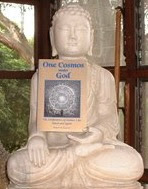
We suggested a few posts ago that the Spirit is God's own wild card, and it seems that many of the mysteries of the cosmos come down to the influence of (↓): life, subjectivity, freedom, creativity, transcendence, teleology.
Can the same principle be responsible for such a diverse list? I don't know, Bob -- it sounds a bit vague and jumbled, as if the Spirit is just the same old "God of the gaps" covering over our ignorance.
Maybe, but I suspect there is indeed a deep relationship between O and (↓), because absent the latter we could never know of the former, but rather, would be sealed in immanence -- like a bad case of metaphysical autism.
Besides, perhaps (↓) is the God of the gaps -- beginning with the "gap" between Father and Son. Earlier in the book Kärkkäinen suggests that "pneumatology is present in all theological topics," and come to think of it, the Aphorist himself says
Only God can fill even the tiniest gap.
So maybe we're on to something. It goes to the old problem of the One and the Many, because to say many is to say gaps between things, and yet, absent the underlying oneness we could never even know of the maniness -- the many manies would not be intelligible to Intelligence.
The Aphorist also says that
Monism is an attitude that violates half of the experience.
And that
Every discontinuity is an approximation of pure materiality to time.
Which implies that the mysterious experience of Experience accounts for the continuity -- and indeed is Continuity as such -- but we'll have to think this through, or at least leave this seedling for now and hope that something sprouts from it in the course of the post. Did someone say seed?
A seed of God grows into God (Eckhart).
I wonder if the following aphorism has some relevance to our subject, that
The most important thing in philosophy is the line that demarcates the territory of a mystery. The anonymous person who first said: the individual is ineffable, did something more important than one who envisions a bold speculation.
At any rate, the theologian Jürgen Moltmann "highlights the critical role of the Spirit of God in giving birth and sustaining life," aiming "to create a pneumatology that does not exclude any area of life" (Kärkkäinen, emphasis mine).
Eckhart would like to jump in again:
From all eternity God lies on a maternity bed giving birth. The essence of God is birthing.
In fact, he has much to say about the divine birth in the soul, which strongly implies a feminine aspect of the Spirit, a subject to which we will return below right now:
We are all meant to be mothers of God.
"Blessed is the fruit of Bob's womb"? That sounds more than a bit sacrilegious. Hey, don't look at me. Blame the Maestro:
Pay attention now to where this birth takes place: this eternal birth takes place in the soul, totally in the manner it takes place in eternity.
Eckhart asks
What good is it to me if this eternal birth of the divine Son takes place unceasingly but does not take place within myself?
So hail Bob, who may or may not be full of it.
Moltmann also adverts to the relationship between the Spirit and the miracle of subjectivity, of the revelation of
God's immanence in human experience, and in the transcendence of human beings in God. Because God's Spirit is present in human beings, the human spirit is self-transcendently aligned toward God.
Thy will be done, and all that. An alignment -- over the Gap -- of wills.
As to its role in the mystery of creation, Moltmann writes of "the Spirit of God as the power of creation and the wellspring of life":
Every experience of a creation of the Spirit is hence also an experience of the Spirit itself. Every true experience of the self becomes also an experience of the divine spirit of life in the human being. Every lived moment can be lived in the inconceivable closeness of God in the Spirit.
Here again, there is no closeness without the Gap, the Spirit being what closes Gap, precisely. In one of his more famous formulations, Eckhart writes that
The eye with which I see God is the same eye with which God sees me.
Seeing at once implies distance and yet a unity in the distance. Physicists, for example, can see all the way back to the moment of the creation of the cosmos, i.e., the background radiation of the big bang.
But you needn't be acquainted with physics to see even before the big bang, to its vertical ground and source in the womb of O, which gives birth to the cosmos. The cosmos is a creature, and "Every creature is a word of God" (Eckhart). And "God creates all things but he does not stop creating."
Hardly. For "creatures are always being created and in the process of beginning to be created." Ultimately, "Being is God's circle and in this circle all creatures exist." Moreover, "All creatures are interdependent," which means that the Gap is both real and a kind of illusion.
Gosh, we've covered an awful lot of goround. Let's leave something for tomorrow's now.