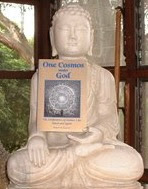
But concern with the beginning and beyond practically defines man. Certainly it seems to coincide with his emergence -- or at least we know of no culture that doesn't engage in the implicit metaphysics of mytho-speculation in order to situate itself in the cosmos.
The beginning and the beyond are permanent features of man's existence. There is paradox here, somewhat similar to Kant's distinction between phenomena (appearances) and noumenon (reality). We know the latter exists, even if we can't say anything about it (and I'm not saying I agree with him; this is for pedagogic purposes only). Our inborn logic -- or just the implicit logic of speech itself -- suggests to us that there had to be a beginning. But since no one was there to witness it, we fill the scotoma with mythical content, up to and including the vulgar and desiccated myths of scientism.
I recently tried to read a book that addresses this subject, called Why Does the World Exist?, by Jim Holt. However, I couldn't get through it due to the author's willful knaveté about the subject. In dismissing religion with an unearned smugness worthy of the tenured, he falls into the biggest myth of them all -- that science can tell us anything about the beyond. Science by definition tells us only about the within (or, more accurately, about things "inside" the cosmos). It certainly implies -- necessitates, actually -- a beyond, but can only point there and never possibly reach or contain it.
The author also has the annoying habit of projecting his own attitudes into others, for example, suggesting that for believers, "there is no such thing as the 'mystery of existence.'" While there are no doubt people who drain existence of mystery, it is foolish to reflexively attribute this to religion instead of human nature, or to pretend that doctrinaire materialists and other subtheists don't do the same.
To even ask if "science will someday explain not only how the world is, but why the world is," is to ask a meaningless question. It's as if the man never heard of Gödel.
Which can't be the case, since he made the index. Let's see how Holt gets around him. He includes a couple of statements by Gödel, who wrote of mathematical objects that we do indeed "have something like a perception... despite their remoteness from sense experience," and that "I don't see any reason why we should have less confidence in this kind of perception, i.e., in mathematical intuition, than in sense perception."
He helpfully suggests that Gödel (who eventually became psychotic) "also believed in the existence of ghosts," which means, ironically, that Holt is trying to avoid the conclusions of the most important logician of the 20th century via the commonplace logical fallacy of ad hominem.
With such brilliant reasoning we could equally deny the theory of relativity because Einstein married his first cousin. Besides, what kind of person doesn't know the theory that you can't marry your relatives?
It just goes downhill from there, never confronting the issue of how it is even possible for science to know why the world exists if Gödel is correct that no logical system can be both complete and consistent. Furthermore, it is only because Gödel is correct that we can even ask the question. In other words, we ask it because it is a spontaneous response to a nonlocal reality we all intuit.
However, I only made it to p. 77, so it is possible that the author outgrows his cognitive Ønanism thereafter. Doubtful though, since the last sentence defers to Bierce's famous definition of philosophy: "A route of many roads leading from nowhere to nothing." That being the case, the book ends precisely where it begins, but not in a good way, if you catch my drift nudge nudge wink wink.
All in all, the book reminds me of a couple of snide-splitting Laphorisms: "Nothing makes clearer the limits of science than the scientist’s opinions about any topic that is not strictly related to his profession." And "Whoever appeals to any science in order to justify his basic convictions inspires distrust of his honesty or his intelligence."
To take just one particularly glaring example, scientists talk about a "cosmos" or "universe" as if it is an obvious fact instead of an implicit assumption. Voegelin actually devotes a chapter to this subject, noting that "Constructs concerning the structure of the physical universe as a whole cannot be empirically validated. Why, then, do physicists engage again and again in their construction?"
Boredom? Loneliness?
No,"The only possible answer to this question seems to be that physicists are men who as human beings feel obliged to develop an image of the universe." In other words, just like the restavus from time immemorial, they can't help creating the testavus "of a mytho-speculative symbol that will satisfy our desire to know the structure of the universe in which we live."
In this regard they resemble the Rodeo Clown Media, who are so drenched in ideology while pretending to themselves that they are somehow "objective" or neutral. Which means that their myth is never subjected to critical scrutiny, and remains as unexamined as their lives. Such nullible individuals somehow manage to simultaneously max out both cynicism and credulity.
Bottom line: physics "does not furnish the means for the meaningful construction of mytho-speculative symbols." Rather -- and this should be soph-evident -- "from physics follows nothing but physics" (Voegelin).
Indeed, just as from logic follows nothing but logic, or from biology nothing but biology, or psychology nothing but psychology.
In reality, man transcends -- or participates in the transcendence -- of all these lesser disciplines and perspectives. Which is why he can not only spend his life indulging in the human privilege of wondering why the world exists, but get some very helpful pointers along the way (which are only everywhere).
To be clear, man can and does have a vision of the whole, but not because of anything reducible to nature. Unless we bear in mind the aphorism, Let us beware of discourse where the adjective “natural” without quotation marks abounds: somebody is deceiving himself, or wants to deceive us (Don Colacho).
Got kind of sidetracked before getting to the essence of the nub of the gist of the beating heart of the matter. To be continued...