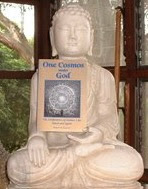
New topic: Robert Bolton's very important The One and the Many, which I read a couple of months ago, but only now have time (I hope -- it's going to be a busy month) to review. This book made a huge impression on me at the time, and the least I can do is try to remember why.
That's no joke. As I've mentioned before, the purpose of reviewing these books -- some of which require ten, twenty, thirty or more posts -- is to actually assimilate their content. This is especially important with books of this caliber, which are not merely "books" but "transmissions," so to speak.
In other words, it is not just information that is being conveyed, but a whole plane of being, without which the information makes no sense. It's analogous to when you must first download an application in order to do something with your computer (and always be careful about what you download -- one must beware of hidden viruses, especially retroviruses that only manifest later).
And when I say "assimilate," I mean this quite literally. It is analogous to eating, which somehow results in the pizza or apple or broccoli weaving itself into your own substance.
How does this actually happen? Who knows. But there is a certain sequence one must follow: preparation, taking in, chewing, swallowing, breaking down, digesting, etc. And there are things that can go wrong -- deeply wrong -- at each one of these stages. It would require too much of a sidetrack to get into details, but this is one of the bases of Melanie Klein's theories of psychological development, which formed the basis of Bion's thought.
For example, in therapy, you give the patient an "interpretation," which is like a kind of psychic/emotional food intended to result in growth. But what will the patient do with it? You have no control over that. And you'd be amazed at the range of possibilities that deviate from "assimilating" and "understanding."
Some people spit it out immediately. Others swallow it so quickly without chewing, that there's no time to think about it, and then they ask for more (which excludes gratitude). Others are so emotionally starving that they just want to be fed more interpretations for the feelings of intimacy with the therapist-mother (thinking about the interpretation would imply too much separation). Others store it in their cheek, and then chew on it by themselves only after they have safely left the session. Others swallow it, but vomit it out afterwards. Some are hungry again an hour later ("Chinese psychiatry"). Some bring their own food to the session, and try to feed the therapist. Some pretend that they feed themselves, and that they do not require anything from the outside. Some accept the nutrition, but not the generous spirit in which it is given, splitting off the one from the other. Some devalue it as a toxic poison; others idealize it as manna; and so on.
Yes, it probably sounds crazy until you see it in practice. Then you realize that it is crazy.
The subtitle of Bolton's book is A Defense of Theistic Religion. Why "theistic religion?" Isn't that a pleonasm, a redundancy? No, not at all. For Bolton is a dissenter within the Traditionalist camp, which, as we have noted in the past, sees a "transcendent unity of religion," but at the cost of essentially downgrading the personal God to a secondary principle (if you're not yet familiar with Schuon's metaphysics, don't worry -- everything will become clear as we proceed).
That is, the Guenon-Schuon school of Traditionalism reconciles the major orthodox revelations by essentially situating them within a closet nondual (advaita) Vedanta. Therefore, their first principle is the "beyond being" of the nirguna brahman, in which personal identity is completely swallowed up and obliterated. If you dine with the Brahman, bring a long spoon!
Indeed, there's no way of getting around it: not only are you on the side of maya -- or cosmic illusion -- but so is the personal God. Both you and God are ultimately absorbed in the One; which, to extend our little gastrointestinal metaphor, is a little like eating the pizza and becoming the pizza instead of vice versa. For this is the ultimate goal of traditional yogic practice: to throw oneself under the cosmic bus, and merge with the Infinite. No self, no problem.
Now, I've greatly simplified the nondual position, but nevertheless, there is no way to reconcile it with a metaphysic that places the personal God at the top of the cosmic hierarchy. Only one approach can be the absolutely correct one. It is in this context that Bolton's book is "a defense of theistic religion." However, as we shall see, the arguments he puts forth cut both ways, into nondualism on the one hand, and materialism on the other.
In fact, one of Bolton's most provocative insights is that nondualism is ironically a kind of approach to religion that is intellectually acceptable to the soul who has been so shaped by modern materialism that it can no longer accept traditional religion. For nondualism and materialism share the underlying commonality of being intrinsically monistic, whereas Christianity is intrinsically dualistic (and actually trinitarian, but we'll get to that later). In a way, nondualism is a mirror image of materialism, for neither has a place for the individual human soul as a truly real reality.
Another important point raised by Bolton is that nondualism isn't actually the only interpretation of the Vedas, let alone the predominant one. That is, there are dualistic interpretations of the Vedas that are compatible with Western religion, most notably, in Ramanuja, who came a couple hundred years after Shankara, and disagreed with the latter's radical nondualism. I used to think that Ramanuja was a kind of degeneration from Shankara, whereas now I would consider him an evolution to a higher and deeper understanding.
Well, I don't think I have time to actually get into the book this morning. Just consider this a desultory preramble. To be continued...
Wednesday, December 02, 2009


Tuesday, December 01, 2009
Fairy Tales of the Dead & Tenured
If the number of comments is any indication, interest in this debate with myself seems to be losing its fire, so let's trundle to the phoenix line. There are only four more arguments. Maybe we can quickly reduce them to ashes, and move on.
Oldbob says that Christianity teaches that the heart of man is "totally corrupt," and asks how then could religion not be marked by cruel practices and incredible beliefs?
Excuse me. Your point being? I believe the question answers itself: man is indeed not only "a" problem, but the problem; and not just with regard to religion, but in, oh, let's say, climate science. Weathergate is only the latest version of Applegate, of man eliminating certain inconvenient data in order to make himself a god, or obtain tenure, or rake in grant money, or win an Oscar, etc.
In fact, as I pointed out in my book, man is actually the only problem in the entire cosmos, is he not? Before the appearance of man, there were truly no problems (I hate to agree with the radical environmentalists, but they've obviously incorporated a warped version of the Fall into their neopagan religion). And I don't often find myself agreeing with Stalin, but surely he was right about his guiding credo: no man, no problem. The problem is, without the problem of man, there are no solutions either, least of all genocide.
Speaking of which, I'm currently reading a wonderful new book by George Nash (who wrote the classic The Conservative Intellectual Movement in America Since 1945), Reappraising the Right: The Past & Future of American Conservatism. Among other virtues, it's full of pithy little gems such as this one by George Gilder, which sounds like it could have come straight from Petey's piehole: "Our greatest and only resource is the miracle of human creativity in a relation of openness to the divine." Or, you could simply say O --> (¶).
Or how about this beaut: Conservatism is "ultimately and essentially spiritual in character. The personal virtues it celebrates... require an 'openness to transcendence' and acceptance of the God-given nature of things.... [C]onservatism properly understood is not only a philosophy of government but of self-government," not simply a meditation "on what to think but on how to live." Not just a philosophy of liberty, but of what to do with it, for if freedom does not converge on truth and virtue, it is nothing. Just so -- and for the same reason -- "Man is what he is, or else he is nothing" (Schuon). God or nothing. Take your pick.
Not just what to think, but how to live. Does this not replace reams of superfluous left wing books, bumper stickers, and baccalaureates? For the essential difference between contemporary conservatism and vulgar leftism is that the former is interior and interiorizing while the latter is exterior and exteriorizing. Thus, conservatism is humanizing, while leftism is literally "animalizing."
And this inevitably follows from the metaphysical relativism of the left, which fragments into a multitude of omnipotent victims, all buffeted by exterior circumstances, with no spiritual locus of control and therefore human dignity. For the left, God is not dead. Nor is he the victim, who is more like the saint or prophet; rather, he is the creator of victims, for the power to confer victimhood is the royal road to leftist control. Victims are the bridge between political theory and political power. No victims, no left. Conversely, a world of "people who know how to properly live" would render the left utterly superfluous. Ironically, like a waterwheel, their power is generated by man's perpetual fall.
Oldbob next says that even if free will is used to account for moral evil, it cannot be the basis for natural evils such as birth defects and other tragedies. Yes, this is true enough. Free will does not account for accidents "below" the human realm. So why are there such things?
Frankly, I have never regarded this as a big mystery. Everything inevitably deviates from its ideal, or there would be no possibility of freedom, truth, and beauty. To ask "why is there evil?" is to affirm that there is good. Freedom and necessity are the warp and weft of the fabric of being, and again, nothing could go right unless there were the possibility of it going wrong. This is earth, not heaven. Thus we hope for "Thy will to be done," herebelow as it is thereabove.
Hoo boy. Where to begin?: "Morality cannot be based on religion.... It is our own moral insight which tells us if anything is worthy of worship. How do we know that God is good if we do not know before hand what good is?"
Well, we do know beforehand what good is, and it is not thanks to the random copying errors of natural selection. To suggest the latter is to abolish morality, precisely.
Again, I do not mind that there are scientistic Darwinians who elevate random error to the ultimate truth. It only bothers me that they do not have the courage of their absence of convictions, and instead steal from Christian morality, as if it is normative for the human species of their dark fantasies (I mean, as if morality is normative, not stealing).
All forms of existentialism -- which is to say those doctrines that reduce essence to existence, spirit to matter, and humanness to selfish genes -- postulate "a definition of the world that is impossible if existentialism itself is possible." Again, if Darwinism is true, it is false, for it allows for no adeqation to a transcendent but ontologically real dimension of moral absolutes.
Lastly, a brief diatribe on "the bizarre idea of immortality." Why bizarre? Here are some of the human realities that are truly bizarre and unexpected in a supposedly dead and closed material cosmos: life, consciousness, love, truth, beauty, virtue, selflessness, saintliness, poetry, music, humor, children. In the face of these realities that open us to the transcendent, it is the concept of absolute mortality that is bizarre and in need of explanation. Who said this is a fundamentally dead cosmos, anyway? I guess dead men do tell tales. Call it "perish and publish."
Farewell, Oldbob. See you in a couple of decades.
Oldbob says that Christianity teaches that the heart of man is "totally corrupt," and asks how then could religion not be marked by cruel practices and incredible beliefs?
Excuse me. Your point being? I believe the question answers itself: man is indeed not only "a" problem, but the problem; and not just with regard to religion, but in, oh, let's say, climate science. Weathergate is only the latest version of Applegate, of man eliminating certain inconvenient data in order to make himself a god, or obtain tenure, or rake in grant money, or win an Oscar, etc.
In fact, as I pointed out in my book, man is actually the only problem in the entire cosmos, is he not? Before the appearance of man, there were truly no problems (I hate to agree with the radical environmentalists, but they've obviously incorporated a warped version of the Fall into their neopagan religion). And I don't often find myself agreeing with Stalin, but surely he was right about his guiding credo: no man, no problem. The problem is, without the problem of man, there are no solutions either, least of all genocide.
Speaking of which, I'm currently reading a wonderful new book by George Nash (who wrote the classic The Conservative Intellectual Movement in America Since 1945), Reappraising the Right: The Past & Future of American Conservatism. Among other virtues, it's full of pithy little gems such as this one by George Gilder, which sounds like it could have come straight from Petey's piehole: "Our greatest and only resource is the miracle of human creativity in a relation of openness to the divine." Or, you could simply say O --> (¶).
Or how about this beaut: Conservatism is "ultimately and essentially spiritual in character. The personal virtues it celebrates... require an 'openness to transcendence' and acceptance of the God-given nature of things.... [C]onservatism properly understood is not only a philosophy of government but of self-government," not simply a meditation "on what to think but on how to live." Not just a philosophy of liberty, but of what to do with it, for if freedom does not converge on truth and virtue, it is nothing. Just so -- and for the same reason -- "Man is what he is, or else he is nothing" (Schuon). God or nothing. Take your pick.
Not just what to think, but how to live. Does this not replace reams of superfluous left wing books, bumper stickers, and baccalaureates? For the essential difference between contemporary conservatism and vulgar leftism is that the former is interior and interiorizing while the latter is exterior and exteriorizing. Thus, conservatism is humanizing, while leftism is literally "animalizing."
And this inevitably follows from the metaphysical relativism of the left, which fragments into a multitude of omnipotent victims, all buffeted by exterior circumstances, with no spiritual locus of control and therefore human dignity. For the left, God is not dead. Nor is he the victim, who is more like the saint or prophet; rather, he is the creator of victims, for the power to confer victimhood is the royal road to leftist control. Victims are the bridge between political theory and political power. No victims, no left. Conversely, a world of "people who know how to properly live" would render the left utterly superfluous. Ironically, like a waterwheel, their power is generated by man's perpetual fall.
Oldbob next says that even if free will is used to account for moral evil, it cannot be the basis for natural evils such as birth defects and other tragedies. Yes, this is true enough. Free will does not account for accidents "below" the human realm. So why are there such things?
Frankly, I have never regarded this as a big mystery. Everything inevitably deviates from its ideal, or there would be no possibility of freedom, truth, and beauty. To ask "why is there evil?" is to affirm that there is good. Freedom and necessity are the warp and weft of the fabric of being, and again, nothing could go right unless there were the possibility of it going wrong. This is earth, not heaven. Thus we hope for "Thy will to be done," herebelow as it is thereabove.
Hoo boy. Where to begin?: "Morality cannot be based on religion.... It is our own moral insight which tells us if anything is worthy of worship. How do we know that God is good if we do not know before hand what good is?"
Well, we do know beforehand what good is, and it is not thanks to the random copying errors of natural selection. To suggest the latter is to abolish morality, precisely.
Again, I do not mind that there are scientistic Darwinians who elevate random error to the ultimate truth. It only bothers me that they do not have the courage of their absence of convictions, and instead steal from Christian morality, as if it is normative for the human species of their dark fantasies (I mean, as if morality is normative, not stealing).
All forms of existentialism -- which is to say those doctrines that reduce essence to existence, spirit to matter, and humanness to selfish genes -- postulate "a definition of the world that is impossible if existentialism itself is possible." Again, if Darwinism is true, it is false, for it allows for no adeqation to a transcendent but ontologically real dimension of moral absolutes.
Lastly, a brief diatribe on "the bizarre idea of immortality." Why bizarre? Here are some of the human realities that are truly bizarre and unexpected in a supposedly dead and closed material cosmos: life, consciousness, love, truth, beauty, virtue, selflessness, saintliness, poetry, music, humor, children. In the face of these realities that open us to the transcendent, it is the concept of absolute mortality that is bizarre and in need of explanation. Who said this is a fundamentally dead cosmos, anyway? I guess dead men do tell tales. Call it "perish and publish."
Farewell, Oldbob. See you in a couple of decades.
Monday, November 30, 2009
Veiling and Reveiling God and Reality
no time to spell-check....
Five more arguments to go before we're finished abusing Oldbob. For what it's worth, one of them contains a topical reference that leads me to believe this crockument is older than I had thought -- perhaps from 1980 or thereabouts. So that's a relief. At least I wasn't so dense for as long as I had thought. Nevertheless, this cannot detract from the timelessness of the arguments -- which is to say, timelessly bad.
The next one is actually quite important, not for its own sake, but for its counter-argument, which is probably too subtle for Oldbob to comprehend. He claims that "The mystic brings his theological beliefs to the mystical experience; he does not derive them from it." Now, the first thing one would say in response is, "how would you know? Here's a tip: you might want to actually undergo the experience before propounding sand on it."
Part of what Oldbob says is no doubt true. But it is a banality at best, more likely a barbarism. It is a barbarism because, as Richard Weaver discusses in Ideas Have Consequences -- and I'll just paraphrase from memory, so I can move this along -- it is a characteristic of barbarians, most especially postmodern ones, to insist that reality can be grasped "barehanded," so to speak, without all of the civilizing veils that give it substance and depth. This is to substitute "fact" for truth.
But contrary to what materialists would assert, the spiritual adventure is not an escape from the world but a pilgrimage to God on the very forms that constitute the ladder of ascent. Yes, a ladder is just a form, but try climbing out of a rathole without one. You can try to lift yourself by your own buddhastraps, but you won't get far.
Not sure if this is an actual quote from Weaver, or me paraphrasing: "Every group regarding itself as emancipated is convinced that its predecessors were fearful of reality, looking upon the veils of decency as obstructions that it will strip aside. But behind the veils is a reality of such commonplace that it is merely knowledge of death." It creates a tyrannical flatland with no way out, since there is no way in and up, no Realsymbols to serve as bridges between worlds.
Let's dumb this down a few notches, so that even Oldbob might understand. What if we banned clothing -- those phony and hypocritical veils of decency -- so that everyone walked around naked. Would this enhance the experience we call "intimacy," or would it detract from it?
Obviously the latter. In the absence of clothing -- and its removal -- there can be no real physical intimacy, for there is no intimacy to reveal. Similarly, promiscuity is not just an absence of intimacy, but a defense against it. Like pornography, it is the negation of real intimacy; by showing everything, it reveals nothing.
Theodore Dalrymple made the same point about incontinent emotional display in his Our Culture, What's Left of It. He writes that "A crude culture makes a coarse people, and private refinement cannot long survive public excess." The absence of emotional restraint to which Dalrymple refers does not liberate; rather, it enslaves one to the lowest order of reality, since it abolishes all of the others in its blind quest for "authenticity." Depth is cashed in for mere sensation.
There is nothing wrong with sensation per se, but when it is stripped of its human context, it becomes something less than human. A refined sensation is no longer the same thing as a raw sensation, any more than a lighting bolt is the same as the electricity that runs your computer. Context -- which is to say, form -- is everything. The soul -- another form -- is not merely an inconvenience between you and your appetites.
Elsewhere Dalrymple observes that the "loss of a sense of shame means a loss of privacy; a loss of privacy means a loss of intimacy; and a loss of intimacy means a loss of depth. There is, in fact, no better way to produce a shallow and superficial people than to let them live their lives entirely in the open, without concealment of anything."
For example, that pervert who apparently kissed another man on national television last week would no doubt argue that he was striking a blow for greater "openness," or some such nonsense, when he was actually destroying one more veil of decency that makes privacy, intimacy, and depth possible. I could add that the left in general is shameless -- and proud of it -- but of course you knew that already.
Appearances do not always deceive; sometimes -- especially as they pertain to "revealed" appearances -- the appearance is the reality, or at least a point of entry into it. Imagine someone arguing that we could have the pure experience of "art" if only we could eliminate all of these deceptive paintings, poems and symphonies. No doubt some postmodern painters and composers have tried. As Andy Warhol said, "art is what you can get away with," just as for Deepak and his ilk, spirituality is what you can get away with.
Five more arguments to go before we're finished abusing Oldbob. For what it's worth, one of them contains a topical reference that leads me to believe this crockument is older than I had thought -- perhaps from 1980 or thereabouts. So that's a relief. At least I wasn't so dense for as long as I had thought. Nevertheless, this cannot detract from the timelessness of the arguments -- which is to say, timelessly bad.
The next one is actually quite important, not for its own sake, but for its counter-argument, which is probably too subtle for Oldbob to comprehend. He claims that "The mystic brings his theological beliefs to the mystical experience; he does not derive them from it." Now, the first thing one would say in response is, "how would you know? Here's a tip: you might want to actually undergo the experience before propounding sand on it."
Part of what Oldbob says is no doubt true. But it is a banality at best, more likely a barbarism. It is a barbarism because, as Richard Weaver discusses in Ideas Have Consequences -- and I'll just paraphrase from memory, so I can move this along -- it is a characteristic of barbarians, most especially postmodern ones, to insist that reality can be grasped "barehanded," so to speak, without all of the civilizing veils that give it substance and depth. This is to substitute "fact" for truth.
But contrary to what materialists would assert, the spiritual adventure is not an escape from the world but a pilgrimage to God on the very forms that constitute the ladder of ascent. Yes, a ladder is just a form, but try climbing out of a rathole without one. You can try to lift yourself by your own buddhastraps, but you won't get far.
Not sure if this is an actual quote from Weaver, or me paraphrasing: "Every group regarding itself as emancipated is convinced that its predecessors were fearful of reality, looking upon the veils of decency as obstructions that it will strip aside. But behind the veils is a reality of such commonplace that it is merely knowledge of death." It creates a tyrannical flatland with no way out, since there is no way in and up, no Realsymbols to serve as bridges between worlds.
Let's dumb this down a few notches, so that even Oldbob might understand. What if we banned clothing -- those phony and hypocritical veils of decency -- so that everyone walked around naked. Would this enhance the experience we call "intimacy," or would it detract from it?
Obviously the latter. In the absence of clothing -- and its removal -- there can be no real physical intimacy, for there is no intimacy to reveal. Similarly, promiscuity is not just an absence of intimacy, but a defense against it. Like pornography, it is the negation of real intimacy; by showing everything, it reveals nothing.
Theodore Dalrymple made the same point about incontinent emotional display in his Our Culture, What's Left of It. He writes that "A crude culture makes a coarse people, and private refinement cannot long survive public excess." The absence of emotional restraint to which Dalrymple refers does not liberate; rather, it enslaves one to the lowest order of reality, since it abolishes all of the others in its blind quest for "authenticity." Depth is cashed in for mere sensation.
There is nothing wrong with sensation per se, but when it is stripped of its human context, it becomes something less than human. A refined sensation is no longer the same thing as a raw sensation, any more than a lighting bolt is the same as the electricity that runs your computer. Context -- which is to say, form -- is everything. The soul -- another form -- is not merely an inconvenience between you and your appetites.
Elsewhere Dalrymple observes that the "loss of a sense of shame means a loss of privacy; a loss of privacy means a loss of intimacy; and a loss of intimacy means a loss of depth. There is, in fact, no better way to produce a shallow and superficial people than to let them live their lives entirely in the open, without concealment of anything."
For example, that pervert who apparently kissed another man on national television last week would no doubt argue that he was striking a blow for greater "openness," or some such nonsense, when he was actually destroying one more veil of decency that makes privacy, intimacy, and depth possible. I could add that the left in general is shameless -- and proud of it -- but of course you knew that already.
Appearances do not always deceive; sometimes -- especially as they pertain to "revealed" appearances -- the appearance is the reality, or at least a point of entry into it. Imagine someone arguing that we could have the pure experience of "art" if only we could eliminate all of these deceptive paintings, poems and symphonies. No doubt some postmodern painters and composers have tried. As Andy Warhol said, "art is what you can get away with," just as for Deepak and his ilk, spirituality is what you can get away with.
Sunday, November 29, 2009
The Quack Magic of Atheism
Let's send Oldbob packing, that he may sooner embark upon the surprising journey into his future, here among the living. Time to finish up with his lame but loud arguments for the non-existence of God, and move on to a new topic. Doctrinaire atheists and anti-Christian zealots can be clever, cute, nasty, and sometimes even intelligent, but they are rarely deep, nor will they ever be known for their wisdom, wisdom being a human commodity, and religion vouchsafing the very essence of integral humanism.
We begin with another charming absurdity that is hoisted by its own retardedness, "Every intellectual construction of man will reflect his own nature, and God is no exception." Okay, fair enough. Question. How does this assertion escape its own circular logic?
What, twenty five years later, and we're still waiting for Oldbob's answer. Amazingly, atheists still put forth variations of this crude argument, which means -- sadly -- that they are very likely the same person at 50 that they were at 25 (only worse, since, for human beings alone, failure to grow is a kind of living death). For this is the type of argument that comes out of a college bull session or Bill Maher panel, not any actual contact with, or adequation to, the subject it pretends to comprehend.
As usual, Schuon slices like a flippin' hammer: "Relativism reduces every element of absoluteness to relativity while making a completely illogical exception in favor of this reduction itself.... [I]ts initial absurdity lies in the implicit claim to be unique in escaping, as if by enchantment, from a relativity that is declared the only possibility."
Checkmate, you ankabiters.
Atheism is metaphysical magic. Religion is its opposite -- not to say that people don't inevitably incorporate magical and wishful thinking into their religion, man being what he is. There is surely a valid place for magic in the psyche, except that there are healthy and unhealthy expressions of it. A person robbed of magic would be a lifeless bore, a kind of dry "logic machine" who replaces truth with compulsive doubt. We love children because they are so spontaneously alive with the magic of existence. As they grow, they transcend the immediacy of this state, but (hopefully) do not eliminate it, or they end up like the dead and tenured.
Next, the inevitable attack on faith misconstrued: "Even saying that 'my belief is based on faith' takes on meaning only if I am able to define what it is that I have faith in."
Nonsense. Faith is simply a preluminary assent to that which one cannot possibly comprehend at the outset. Faith applies to every discipline, not just religion. Imagine a great artist -- Shakespeare, Beethoven, Dante -- whose work far exceeds our ability to fully appreciate its depths. Fortunately, there exist experts -- a "community of the adequate," living and dead -- whose testimony assures us that there is indeed a "there there" if only we allow ourselves to be shaped by the object instead of imposing our own preconceptions on it. Faith is simply openness to the Transcendent Other.
Next, another old canard: "It is clear that particular religious beliefs are mistaken, since all religions disagree and cannot all be right." First of all, this ignores the manner in which orthodox religions can be reconciled on the interior, esoteric plane (even if not fully eliminating certain important distinctions).
But even more basically, this is like saying that "it is clear that physics is mistaken, since relativity and quantum physics cannot be reconciled," or "it is clear that science is mistaken, since there is no way to reconcile the truths of psychology and neurology." Sometimes the opposite of a real Truth is a trivial one.
Another bonehead argument that is conveniently put forth by atheists: "I don't have to prove that God does not exist. Atheism is obligatory in the absence of any evidence for God's existence." Interesting word, "obligatory." Why is an animal obligated to anything, much less something as abstract as metaphysical truth that he cannot know anyway?
But in any event, since all cultures and the vast majority of human beings have always intuited the transcendent reality that surpasses them, it takes real chutzpah to simply ignore this experience as if it doesn't exist. Atheists are a tiny exception, not the rule. How did they get here -- especially if, as sociobiologists maintain, religion is "hardwired" (whatever that means) into our species? Once again, atheists escape their own verdict by an act of magic -- like an asexual person arguing that humans are hardwired for sex.
The next one out of the deck is the old "religion only existed because man was so ignorant" card. You know, "when I was a kid, I couldn't figure out how the presents got under the tree, therefore Santa must have come down the chimney."
But this no more invalidates Christmas than it does science. For example, try reading a history of medicine. Just because it had a lot of erroneous ideas a century ago, doesn't invalidate the field today. Indeed, one doesn't even have to go back that far. I remember ten years ago, doctors insisted that carbohydrates were good, and fats were bad. Now we know that it's much more complicated than that.
But even more generally, science didn't even emerge until the 17th century, and only in the Christian west. Prior to that -- and this is an argument Ken Wilber has elaborated at length -- it was as if various realms of human inquiry were mixed together, not just religion and what came to be called science, but politics, art, and pretty much everything else. This is not to condemn religion, since differentiation obviously requires time. It's like condemning the man because he was once a simple sperm and egg. In many respects, evolution is the higher unity of increased differentiation.
Thus, for example, today it is possible to unify science and religion in a much deeper way than was possible 300 years ago. Indeed, to fail to achieve this synthesis (let alone attack it) is not evolutionary, but explicitly anti-evolutionary, or regressive. The highest unities are always unities of opposites -- male-female, spirit-matter, mind-body, order-chaos, absolute-infinite, chance-necessity, etc.
Couldn't quite finish off Oldbob. He says "it's just a flesh wound." One more post to go.....
We begin with another charming absurdity that is hoisted by its own retardedness, "Every intellectual construction of man will reflect his own nature, and God is no exception." Okay, fair enough. Question. How does this assertion escape its own circular logic?
What, twenty five years later, and we're still waiting for Oldbob's answer. Amazingly, atheists still put forth variations of this crude argument, which means -- sadly -- that they are very likely the same person at 50 that they were at 25 (only worse, since, for human beings alone, failure to grow is a kind of living death). For this is the type of argument that comes out of a college bull session or Bill Maher panel, not any actual contact with, or adequation to, the subject it pretends to comprehend.
As usual, Schuon slices like a flippin' hammer: "Relativism reduces every element of absoluteness to relativity while making a completely illogical exception in favor of this reduction itself.... [I]ts initial absurdity lies in the implicit claim to be unique in escaping, as if by enchantment, from a relativity that is declared the only possibility."
Checkmate, you ankabiters.
Atheism is metaphysical magic. Religion is its opposite -- not to say that people don't inevitably incorporate magical and wishful thinking into their religion, man being what he is. There is surely a valid place for magic in the psyche, except that there are healthy and unhealthy expressions of it. A person robbed of magic would be a lifeless bore, a kind of dry "logic machine" who replaces truth with compulsive doubt. We love children because they are so spontaneously alive with the magic of existence. As they grow, they transcend the immediacy of this state, but (hopefully) do not eliminate it, or they end up like the dead and tenured.
Next, the inevitable attack on faith misconstrued: "Even saying that 'my belief is based on faith' takes on meaning only if I am able to define what it is that I have faith in."
Nonsense. Faith is simply a preluminary assent to that which one cannot possibly comprehend at the outset. Faith applies to every discipline, not just religion. Imagine a great artist -- Shakespeare, Beethoven, Dante -- whose work far exceeds our ability to fully appreciate its depths. Fortunately, there exist experts -- a "community of the adequate," living and dead -- whose testimony assures us that there is indeed a "there there" if only we allow ourselves to be shaped by the object instead of imposing our own preconceptions on it. Faith is simply openness to the Transcendent Other.
Next, another old canard: "It is clear that particular religious beliefs are mistaken, since all religions disagree and cannot all be right." First of all, this ignores the manner in which orthodox religions can be reconciled on the interior, esoteric plane (even if not fully eliminating certain important distinctions).
But even more basically, this is like saying that "it is clear that physics is mistaken, since relativity and quantum physics cannot be reconciled," or "it is clear that science is mistaken, since there is no way to reconcile the truths of psychology and neurology." Sometimes the opposite of a real Truth is a trivial one.
Another bonehead argument that is conveniently put forth by atheists: "I don't have to prove that God does not exist. Atheism is obligatory in the absence of any evidence for God's existence." Interesting word, "obligatory." Why is an animal obligated to anything, much less something as abstract as metaphysical truth that he cannot know anyway?
But in any event, since all cultures and the vast majority of human beings have always intuited the transcendent reality that surpasses them, it takes real chutzpah to simply ignore this experience as if it doesn't exist. Atheists are a tiny exception, not the rule. How did they get here -- especially if, as sociobiologists maintain, religion is "hardwired" (whatever that means) into our species? Once again, atheists escape their own verdict by an act of magic -- like an asexual person arguing that humans are hardwired for sex.
The next one out of the deck is the old "religion only existed because man was so ignorant" card. You know, "when I was a kid, I couldn't figure out how the presents got under the tree, therefore Santa must have come down the chimney."
But this no more invalidates Christmas than it does science. For example, try reading a history of medicine. Just because it had a lot of erroneous ideas a century ago, doesn't invalidate the field today. Indeed, one doesn't even have to go back that far. I remember ten years ago, doctors insisted that carbohydrates were good, and fats were bad. Now we know that it's much more complicated than that.
But even more generally, science didn't even emerge until the 17th century, and only in the Christian west. Prior to that -- and this is an argument Ken Wilber has elaborated at length -- it was as if various realms of human inquiry were mixed together, not just religion and what came to be called science, but politics, art, and pretty much everything else. This is not to condemn religion, since differentiation obviously requires time. It's like condemning the man because he was once a simple sperm and egg. In many respects, evolution is the higher unity of increased differentiation.
Thus, for example, today it is possible to unify science and religion in a much deeper way than was possible 300 years ago. Indeed, to fail to achieve this synthesis (let alone attack it) is not evolutionary, but explicitly anti-evolutionary, or regressive. The highest unities are always unities of opposites -- male-female, spirit-matter, mind-body, order-chaos, absolute-infinite, chance-necessity, etc.
Couldn't quite finish off Oldbob. He says "it's just a flesh wound." One more post to go.....
Thursday, November 26, 2009
President Calls for Fascist Theocracy
Charles the Queeg Johnson is right! This president doesn't even pretend to respect the Wall of Separation established for us by the modern Supreme Court:
I do therefore invite my fellow citizens in every part of the United States, and also those who are at sea and those who are sojourning in foreign lands, to set apart and observe the last Thursday of November next, as a day of Thanksgiving and Praise to our beneficent Father who dwelleth in the Heavens.
And I recommend to them that while offering up the ascriptions justly due to Him for such singular deliverances and blessings, they do also, with humble penitence for our national perverseness and disobedience, commend to His tender care all those who have become widows, orphans, mourners or sufferers in the lamentable civil strife in which we are unavoidably engaged, and fervently implore the interposition of the Almighty Hand to heal the wounds of the nation and to restore it as soon as may be consistent with the Divine purposes to the full enjoyment of peace, harmony, tranquillity and Union.
In testimony whereof, I have hereunto set my hand and caused the Seal of the United States to be affixed.
Done at the City of Washington, this Third day of October, in the year of our Lord one thousand eight hundred and sixty-three, and of the Independence of the Unites States the Eighty-eighth.
By the President: Abraham Lincoln
*****
And I'm especially grateful for medical science, without which neither he nor I would be here. So let's pray for the failure of our current President's profoundly irrational and destructive determination to socialize and thereby ruin the best health care in the world:


I do therefore invite my fellow citizens in every part of the United States, and also those who are at sea and those who are sojourning in foreign lands, to set apart and observe the last Thursday of November next, as a day of Thanksgiving and Praise to our beneficent Father who dwelleth in the Heavens.
And I recommend to them that while offering up the ascriptions justly due to Him for such singular deliverances and blessings, they do also, with humble penitence for our national perverseness and disobedience, commend to His tender care all those who have become widows, orphans, mourners or sufferers in the lamentable civil strife in which we are unavoidably engaged, and fervently implore the interposition of the Almighty Hand to heal the wounds of the nation and to restore it as soon as may be consistent with the Divine purposes to the full enjoyment of peace, harmony, tranquillity and Union.
In testimony whereof, I have hereunto set my hand and caused the Seal of the United States to be affixed.
Done at the City of Washington, this Third day of October, in the year of our Lord one thousand eight hundred and sixty-three, and of the Independence of the Unites States the Eighty-eighth.
By the President: Abraham Lincoln
*****
And I'm especially grateful for medical science, without which neither he nor I would be here. So let's pray for the failure of our current President's profoundly irrational and destructive determination to socialize and thereby ruin the best health care in the world:


Subscribe to:
Posts (Atom)
Theme Song