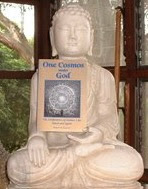
Leftism is the static deprivation of the dynamic complementarites of genuine liberalism. --Petey
According to Webster's, metaphor is "a figure of speech in which a word or phrase literally denoting one kind of object or idea is used in the place of another to suggest a likeness or analogy between them." In short, it is figurative language, which is to say, language, for all language is ultimately a "figure of speech," speaking figuratively. How then do I differ from deconstructionists, who also believe that reality is made of language? Fair question.
Human beings communicate through symbols, and all symbols are ultimately metaphors. Language as such is nothing but an endlessly interlocking series of metaphors, but where I differ with deconstructionists is in affirming that human language is woven out of the universal Logos that necessarily subtends it. In other words, for the deconstructionist, there truly is no there there, no ultimate ground or referent for language. But I am quite certain there is a there there, which we call the Logos.
There is nothing you can say about anything that isn't laden with implicit or explicit metaphors, which is one of the reasons why it is so absurd for the materialist to object to spirituality, since the idea of solid matter is itself a sort of airy metaphor, just a fanciful concept based upon the illusions of our nervous system, illusions like "solidity" or unambiguous "place." Scientists often conflate the abstract and the concrete, and essentially extend the concretions of the nervous system into an abstract worldview. Which is fine, so long as you don't confuse them with metaphysical truth, or with the Ultimate Real.
For their part, so-called fundamentalist religionists often do the reverse, which is to say, concretize the abstract. But only God can really do that, since the cosmos itself is none other than a concretion in a small corner of the Divine Mind. As mentioned a couple of days ago, one of the purposes of scripture -- which employs countless metaphors and other seemingly concrete images -- is to follow it back upstream to its hidden source, the "place" from which revelation perpetually flows like a spring from the ground. Indeed, the place from which language itself flows.
It's not that scientists don't use metaphor in most every statement they make about reality, just that the metaphor has generally become dead, or saturated in Bion's terminology. Often, advances in science cannot be made until a new metaphor is employed. For example, the so-called Newtonian worldview regarded the universe as a giant clock. Seeing it as such is definitely useful, and applying it to our experience discloses a range of additional "facts" to ponder. But eventually, facts are inevitably disclosed that don't fit the old metaphor.
That happened with the development of quantum and relativity theories, way back in the 20th century. There is simply no way to understand the quantum world with the clock metaphor. Rather, it is much more like an ocean, a roiling cauldron of ceaselessly flowing energy that tosses up exterior forms the same way the sea waves upon the shore. Or better yet, perhaps it's like the infinitely complex global weather system. We see things like distinct clouds, but we cannot see (with our eyes) that the cloud is simply an outwardly visible product of an inconceivably complex global weather system. Only Al Gore thinks he can see the latter, but of course his head is up his assumptions.... As Michael Crichton has written, Gore's linear paradigm is so last millennium.
I don't know if I want to get sidetracked here.... then again, maybe I do.... Whatever.... I'm just free associating anyway, following language where it leads.... but this is one of the things Joyce was up to in Finnegans Wake, which is a veritable sea of metaphor constructed out of dozens of languages. It is as if the usual solidity of language has "melted" and we are left with only the quantum realm, so to speak, from which it emerges. Throughout the book, various intrinsic complementarities clothe themselves in time and space with the dream logic of night. Just like the thing we call "history." You might say that Joyce shows us the complementarity between the different forms of logic in history and herstory, if you know what I meme.
In fact, one of the central philosophical ideas to emerge from quantum theory is that of complementarity. That is, we can never affirm one thing about the cosmos without "para-doxically" (which literally means "beyond speech") affirming its complementary opposite. Therefore, is the world made of particles? Yes. Is it made of waves? Yes. But these are opposites. Of course. Well, not really. They are complementary, co-arising simultaneously.
Other important irreducible complementarities in the manifest world include mind/matter, subject/object, unity/diversity, form/substance, individual/group, time/eternity, space/time, male/female, and Lennon McCartney.
Incidentally, one might be tempted to think that Democrat/Republican (or liberalism/leftism) represents a true complementarity, but it doesn't. The true complementarity is within conservatism itself (as always, I am speaking of the classical liberalism of our founders, the closest we have to a "perfect" political philosophy). Among others, it embodies the dynamic complementarity between liberty and order, and permanence and change. Leftism is not complementary to liberalism, any more than disease is complementary to health. Leftism is stultifyingly monolithic and denies many of the most important human complementarities that drive change and progress; for example, the complementarities between male and female, child and adult, sacred and profane, equality and liberty.
Furthermore, leftism imposes false complementarities such as good/evil. Only in this way can the left maintain that "one man's terrorist is another man's freedom fighter." Evil is not a complement of the Good, but its deprivation.
Nor are freedom and property complementary, the former being rooted in the latter; which in turn is rooted in the 2nd Amendment, which is to say, "don't steal my stuff or I might just shoot you, because if you steal property you are stealing liberty, and therefore human life and dignity itself."
Perfection/imperfection aren't complementary, either. Rather, imperfection is again a deprivation, a declension from the Absolute, as the celestial rays proceed from the vertical cosmic center to the periphery, which, as Schuon has written, "tends" toward a nothing that can never actually be realized. But the hardcore leftist feels a sort of frisson in riding the winds of the ray of creation all the way into the darkness of nihilism. The thrill of the fall, so to speak.
If you don't realize that imperfection is a necessary deprivation, you may be tempted to try to impose perfection from the herebelow, which is one the left's specialties. But as Russell Kirk wrote, conservatives well understand that human nature "suffers irremediably from certain grave faults":
"Man being imperfect, no perfect social order ever can be created. Because of human restlessness, mankind would grow rebellious under any utopian domination, and would break out once more in violent discontent -- or else expire of boredom. To seek for utopia is to end in disaster, the conservative says: we are not made for perfect things. All that we reasonably can expect is a tolerably ordered, just, and free society, in which some evils, maladjustments, and suffering will continue to lurk. By proper attention to prudent reform, we may preserve and improve this tolerable order. But if the old institutional and moral safeguards of a nation are neglected, then the anarchic impulse in humankind breaks loose: 'the ceremony of innocence is drowned.' The ideologues who promise the perfection of man and society have converted a great part of the twentieth-century world into a terrestrial hell."
A leftist-integralist blogger was impressed by the following quote from Ken Wilber, which is about as good an example of the need for buddhaflaw correcting as I could imagine:
"Spirit is not the good half of the opposites, but the ground of all the opposites, and our 'salvation,' as it were, is not to find the good half of the dualism but to find the Source of both halves of the dualism, for that is what we are in truth. We are both sides in the great Game of Life, because we -- you and I, in the deepest recesses of our very Self -- have created both of these opposites in order to have a grand game of cosmic checkers."
Please. This attitude, if applied to real life, would end in leftist horror. It is another false complementarity based upon partial understanding. For as Schuon writes,
"Assuredly it can be said that the Divinity is 'beyond good and evil,' but on condition of adding that this 'beyond' is in its turn a 'good' in the sense that it testifies to an Essence in which there could be no shadow of limitation or privation, and which consequently cannot but be the absolute Good, or absolute Plenitude."
The idea that conservatives "don't want change" is also preposterous. We do, and desperately. But we don't want to do it by renaming evil good. And we want to evolve toward the Good, not have it imposed by leftist elites with their own peculiar ideas about how we should live. The conservative, according to Kirk, feels
"affection for the proliferating intricacy of long-established social institutions and modes of life, as distinguished from the narrowing uniformity and deadening egalitarianism [read: denial of complementarity] of radical systems. For the preservation of a healthy diversity in any civilization, there must survive orders and classes, differences in material condition, and many sorts of inequality. The only true forms of equality are equality at the Last Judgment and equality before a just court of law; all other attempts at levelling must lead, at best, to social stagnation. Society requires honest and able leadership; and if natural and institutional differences are destroyed, presently some tyrant or host of squalid oligarchs will create new forms of inequality."
The so-called "progressive" fails to consider one of the truly enduring complementarities in governance, which is that whenever government does something for you, it does something to you. Which is why, according to Kirk,
"When a society is progressing in some respects, usually it is declining in other respects. The conservative knows that any healthy society is influenced by two forces..., its Permanence and its Progression. The Permanence of a society is formed by those enduring interests and convictions that gives us stability and continuity; without that Permanence, the fountains of the great deep are broken up, society slipping into anarchy. The Progression in a society is that spirit and that body of talents which urge us on to prudent reform and improvement; without that Progression, a people stagnate."
In other words, progress and permanence are complementary, not opposites: "the intelligent conservative endeavors to reconcile the claims of Permanence and the claims of Progression. He thinks that the liberal and the radical, blind to the just claims of Permanence, would endanger the heritage bequeathed to us, in an endeavor to hurry us into some dubious Terrestrial Paradise. The conservative, in short, favors reasoned and temperate progress; he is opposed to the cult of Progress, whose votaries believe that everything new necessarily is superior to everything old."
Clearly, "Change is essential to the body social, the conservative reasons, just as it is essential to the human body. A body that has ceased to renew itself has begun to die. But if that body is to be vigorous, the change must occur in a regular manner, harmonizing with the form and nature of that body; otherwise change produces a monstrous growth, a cancer, which devours its host. The conservative takes care that nothing in a society should ever be wholly old, and that nothing should ever be wholly new. This is the means of the conservation of a nation, quite as it is the means of conservation of a living organism" (Kirk).
Which is why I say that leftism is truly a death cult. Hey, don't believe me. Just judge it by its fruits. And nuts. And flakes. Speaking literally.
Sunday, October 07, 2007


Friday, October 05, 2007
Another Inspiraling Circle 'Round the Radiant Center
Well, let's see. I've been blah-blah-blogging now for exactly two years today. Originally it was with the purpose of pimplicizing my book, since I couldn't think of bitter way to sell my soul. It must have worked, because I'm happy to report that the book has been a commercial failure instead of an outright catastrophe.
Still, it's pretty obvious that Petey will never become a household gnome, except O-->(k)sionally for us Brothers & Sisters Under the Pelt. But that's fine. The Secret Protects Itself, even if my book is such a secret that few will always judge it undercover. Nevertheless, if you want to get the blog a birthday present and yourself an indulgence, you might consider finally ordering the damn book to see if we can get it back into the top 100,000 on amazon. Who knows, you might even get the new corrected (with the invaluable assistance of Ricky Raccoon) edition. (An even better idea, and it's free -- just post a positive review on amazon... don't do it for me, of course, but to assist in our internet reacharound for the lost tribe of Raccoons.)
It's not easy being a windepundent theoconservative gliberal fascistic mystic, except maybe for me. I have a pretty good nous, but the only other one I can sniff of offhound is Roy Masters. I immediately alienate half my potential audience because of my bobnoxious politics, even though there's not really any pollutics littering the book. And ninety percent of the other majority of the potential audience will be put off by the mysticism and supraformal neo-traditionalist approach, leaving only the small remnant of Cosmic Raccoons -- who often don't even know they're Raccoons until they accidentally stumble upon the blog. They know they are something -- something different -- but they just don't know what.
Nor do I. Which is why I suppose I keep blogging, now that the failure of the book is assured. In short, the blog too has now taken on a death of its own, as I use it to discover what I don't think about this and especially that. Interestingly, I don't generally use it to coonvey what I know -- or think I know -- since that would rapidly become boring, just the sleepy trancemission of information from one mind to another. More empty shunyada yada yada. I don't know all that much anywuwei. Rather, I generally use the blog to extend into the unKnown -- to go deep see fleshing in the weird word of O and cast a neural net into the dark waters. You know, provoid a little finite form to the formless infinite void.
As I jewst menschened, if I were a garden-variety new-age mean-green spiraling integralist, soiling books would be as easy as selling magic to a moonbat. I mean, if Deepak Chopra can do it, who couldn't? How many ways can you rewrite the The Sellobscene Profitsy, anyway? That whowel movement prides itself on being the cutting edge of cosmic evolution, but I find it all so aphallingly intellectually flaccid and soph-impotent. What it really does is make advaitanced spirituality loser-fiendly to those on the bleating edge of cosmic narcissism. It gives circumnavelgazing a fad name.
I don't know much, but that I do know. I know it, for example, because none of the psychologists they habitually name-check are on my list of deep thinkers. And if they do cite a more profound thinker, they usually twist the teaching into a form suitable to their narrow grandiosity. None of them are familiar with Bion, Matte Blanco, or modern psychoanalysis in general. The only exception I know of is A. A. Almaas, who has an excellent grasp of the scope of modern psychoanalysis, but whose application of it is rather shallow and new-agey.
While I do believe it is necessary to reframe perennial religious truths in a way that modern people can grasp, I part ways with the integralists in imagining that we are somehow higher or more evolved than our illustrious predecessors. Name any contemporary integralist, and they simply cannot match the depth of spirituality found in representatives of authentic traditions, whether it is a Shankara, an Eckhart or a Maimonides. Each of these men looked directly at truth from a different angle, but I find that the new-agers merely look at the illustrious lookers from a single angle, so to speak. But there is already enough profundity in any given tradition to last a lifetime, in such a way that each seeker will find his reward in accordance with the intensity and sincerity of his aspiration, in concert with the grace which flows through that channel.
I was just reading yesterday about Shankara, the most important philosopher-mystic-theologian-sage in the history of India. What Radhakrishnan wrote of him could apply equally to what is needed today:
"A creative thinker of the first rank, Shankara entered into the philosophic inheritance of his age, and reinterpreted it with special reference to its needs.... The different theistic sects were practicing rites in support of which they could cite some text or other. It was a critical period in the history of the Hindu nation, when there was a general sense of weariness with the wrangling sects. The age needed a religious genius who was unwilling to break with the past and yet open to the good influences of the new creeds, one who could stretch the old moulds without breaking them and synthesize the warring sects on a broad basis of truth, which would have room for all men of all grades of intelligence and culture. Shankara 'set to music' the tune which had been haunting millions of ears, and announced [his philosophy] as offering a common basis for religious unity" (Radhakrishnan, emphasis mine).
If the integralists and "evolutionary" thinkers are too far left, then -- at least for me -- Schuon and the traditionalist school are a bit too far right. Although the traditionalists are far more profound than the integralists, I just don't see how the movement can ever appeal to people on a widespread basis. Therefore, the neo-traditionalist mission of the Transdimensional Order of the Friendly Sons & Daughters of the Cosmic Raccoon. I guess I tried to explain this gnocturnal O-mission in my first post:
Q: We don't need another blog. Why are you inflicting your beastly opinions on us?
A: To those of you who are new to this site, join the club, as I am still in the process of trying to understand the author's intention. For surely, there are already far too many books and blogs, with no way any human being could ever assimilate the information contained therein. Actually, the problem we face is how to relate all of this fragmented and sometimes contradictory knowledge into a coherent picture of our world -- to move from mere knowledge, to understanding, to wisdom.
I am a clinical psychologist with a background in psychoanalysis, and, like Shrinkwrapped, Dr. Sanity, and other Uncle Fromms, will attempt to "put the world on the couch," so to speak. If you can detach yourself somewhat and try to "hover" above it, the news of the day may be regarded as the free associations of a very troubled patient called Homo sapiens. This collective patient, now about 40,000 years old (before that we were genetically Homo sapiens but not particularly human), has many sub-personalities of varying levels of emotional maturity, and one of his problems is that these different aspects of his personality are constantly at war with one another, which tends to drag down the more mature parts.
You could almost go so far as to say that this collective patient suffers from the kind of severe splitting and "acting out" characteristic of Multiple Personality Disorder. One of my axioms is that geographical space reflects developmental time, so that different nations and countries embody different levels of psychological maturity. In this regard, the Islamic world bottoms out the scale at the moment, but there are obviously low levels of development living parasitically within the context of higher levels. We call this the psycho-spiritual "left."
More broadly, what I hope to emphasize is an appreciation of the "vertical" dimension of human history, culture and politics. For example, historians typically view history in a horizontal manner, leading from past, to present, to future. Likewise, we divide our political mindscape in a horizontal fashion, from left to right. However, as in a great novel or film, the "horizontal" plot is merely a device to express the artist's greater intention (the theme), which can only be found in a vertical realm, by standing "above" the plot.
Every patient who comes into therapy is the star of an emotion picture that isn't going quite right. They will spend the first few sessions telling you the plot, but soon the analyst will be aware of a vertical dimension where the true but unKnown "author" of the plot lies. And lies. And lies. This is called the unconscious. However, this is just one realm of the vertical. Spirituality is also located on the vertical plane, both very low (as in jihad or human sacrifice) and high (such as genuine mysticism).
Q: Why "One Cosmos?"
A: The title of the blog is taken from my book, One Cosmos Under God: The Unification of Matter, Life, Mind and Spirit. You might say that the book tries to follow the vertical thread that runs through the entire cosmos, ultimately uniting us with our source. That thread runs through physics, biology, psychology, religion, history, anthropology, art, and much more, and yet, it is somehow all One.
Perhaps the central theme of both book and blog is that the frontiers of knowledge and understanding lay not in the further extension of various fields and subspecialties, but in the borderland between them. Around 40,000 years ago, our patient, Homo sapiens, began splintering into its diverse parts, but underneath all of the bewildering diversity is a vertical unity that this blog will attempt to illuminate in various ways. For the key to growth is understanding ourselves, both individually and collectively. Without it, we remain a child forever.
Q: Who are you, anyway?
A: Clinical psychologist Robert Godwin is an extreme seeker and off-road spiritual aspirant who has spent no less than one lifetime in search of the damn key to the world enigma. A high school graduate at just seventeen and a-half, Dr. Godwin attended business school until the vagaries of academic probation and expulsion led him to pursue other missed opportunities. Capitalizing on a natural ability to simultaneously enjoy movies and lower his expectations, Godwin eventually earned a film degree in just four terms (Ford/Carter and parts of Nixon/Reagan). Initially denied admission to graduate school because of "inadequate" academic preparation (their words), Holy Happenstance intervened in the nick of time, and Dr. Godwin went on to obtain two advanced degrees in psychology without allowing it to interfere with his education or with ongoing spiritual research conducted in his suburban liberatoreum. Lengthy periods there of higher bewilderment and intense non-doing resulted in important advances in egobliteration and karmannihilation. At the same time, Dr. Godwin spent many years searching and researching for his book, only to conclude that it did not exist, and that if he wanted to read it, he would have to write it. Having now read it a number of times, he is happy to share that burden with a wider audience of fertile eggheads interested in peering behind the annoying veil that separates them from ultimate reality.
Q: Why the spiritual mumbo-jumbo?
I don't think it's healthy to orient your life around politics 24/7, as does the secular left, for which politics is their substitute religion. Politics must aim at something that isn't politics, otherwise, what's the point? Politics just becomes a cognitive system to articulate your existential unhappiness. Again, this is what leftists do -- everything for them is politicized.
One of the general purposes of this blog is to try to look at politics in a new way -- to place the day-to-day struggle of politics in a much wider historical, evolutionary, and even cosmic context. History is trying to get somewhere, and it is our job to help it get there. However, that "somewhere" does not lay within the horizontal field of politics, but beyond it. Thus, politics must not only be grounded in something that isn't politics, but aim at something that isn't politics either.
This is not an abstract, impractical or esoteric notion. The ultimate purpose of politics should be to preserve the radical spiritual revolution of the American founders, so that humans may evolve inwardly and upwardly -- not toward a manifest destiny but an unmanifest deustiny.
For example, when we say that politics must be grounded in something that isn't politics, we are simply reflecting the philosophy at the heart of the American revolution, that the sacred rights of mankind, as expressed by Alexander Hamilton, are written in human nature "by the hand of Divinity itself, and can never be erased by mortal power." In short, human beings possess a "spiritual blueprint" that is antecedent to politics, and which it is the task of politics to protect, preserve and nurture.
But not for its own sake. The founders, who were steeped in Judeo-Christian metaphysics, did not believe in mere license, which comes down to meaningless freedom on the horizontal plane. Rather, they believed that horizontal history had a beginning and was guided by a purpose, and that only through the unfolding of human liberty could that "vertical" purpose be achieved. Our founders were progressive to the core, but unlike our contemporary reactionary and anti-evolutionary leftists, they measured progress in relation to permanent standards that lay outside time -- metaphorically speaking, an eschatological "Kingdom of God," or "city on a hill," drawing us toward it. Without this nonlocal telos, the cosmos can really have no frontiers, only edges. Perhaps this is why the left confuses truth with "edginess."
Liberty -- understood in its spiritual sense -- was the key idea of the founders. This cannot be overemphasized. According to Michael Novak (from whose book some of the above quotes were also taken), liberty was understood as the "axis of the universe," and history as "the drama of human liberty." Thomas Jefferson wrote that "the God who gave us life gave us liberty at the same time." It was for this reason that Jefferson chose for the design of the seal of the United States Moses leading the children of Israel out of the death-cult of Egypt, out of the horizontal wasteland of spiritual bondage, into the open circle of a higher life. America was quite consciously conceived as an opportunity to "re-launch" mankind after such an initial 100,000 years or so of disappointment, underachievement, and spiritual stagnation.
Although it may sound slightly heretical, without human liberty, the Creator is helpless to act in the horizontal. This does not diminish the Creator but exalts him, for a moment's reflection reveals that an intimation of our spiritual freedom absolutely belies any mere material explanation found within the horizontal confines of history. For ours is an inwardly mobile cosmos, and as the philosopher of science Stanley Jaki writes, our free will brings us "face to face with that realm of metaphysical reality which hangs in midair unless suspended [vertically] from that Ultimate Reality, best called God, the Creator."
Tip O’Neill is evidently responsible for the cliché that “All politics is local.” The greater truth is that all politics is nonlocal, meaning that outward political organization rests on a more fundamental, “inner” ground that interacts with a hierarchy of perennial and timeless values. Arguments about the surface structure of mundane political organization really have to do with whose nonlocal values will prevail, and the local system that will be established in order to achieve those nonlocal values.
Still, it's pretty obvious that Petey will never become a household gnome, except O-->(k)sionally for us Brothers & Sisters Under the Pelt. But that's fine. The Secret Protects Itself, even if my book is such a secret that few will always judge it undercover. Nevertheless, if you want to get the blog a birthday present and yourself an indulgence, you might consider finally ordering the damn book to see if we can get it back into the top 100,000 on amazon. Who knows, you might even get the new corrected (with the invaluable assistance of Ricky Raccoon) edition. (An even better idea, and it's free -- just post a positive review on amazon... don't do it for me, of course, but to assist in our internet reacharound for the lost tribe of Raccoons.)
It's not easy being a windepundent theoconservative gliberal fascistic mystic, except maybe for me. I have a pretty good nous, but the only other one I can sniff of offhound is Roy Masters. I immediately alienate half my potential audience because of my bobnoxious politics, even though there's not really any pollutics littering the book. And ninety percent of the other majority of the potential audience will be put off by the mysticism and supraformal neo-traditionalist approach, leaving only the small remnant of Cosmic Raccoons -- who often don't even know they're Raccoons until they accidentally stumble upon the blog. They know they are something -- something different -- but they just don't know what.
Nor do I. Which is why I suppose I keep blogging, now that the failure of the book is assured. In short, the blog too has now taken on a death of its own, as I use it to discover what I don't think about this and especially that. Interestingly, I don't generally use it to coonvey what I know -- or think I know -- since that would rapidly become boring, just the sleepy trancemission of information from one mind to another. More empty shunyada yada yada. I don't know all that much anywuwei. Rather, I generally use the blog to extend into the unKnown -- to go deep see fleshing in the weird word of O and cast a neural net into the dark waters. You know, provoid a little finite form to the formless infinite void.
As I jewst menschened, if I were a garden-variety new-age mean-green spiraling integralist, soiling books would be as easy as selling magic to a moonbat. I mean, if Deepak Chopra can do it, who couldn't? How many ways can you rewrite the The Sellobscene Profitsy, anyway? That whowel movement prides itself on being the cutting edge of cosmic evolution, but I find it all so aphallingly intellectually flaccid and soph-impotent. What it really does is make advaitanced spirituality loser-fiendly to those on the bleating edge of cosmic narcissism. It gives circumnavelgazing a fad name.
I don't know much, but that I do know. I know it, for example, because none of the psychologists they habitually name-check are on my list of deep thinkers. And if they do cite a more profound thinker, they usually twist the teaching into a form suitable to their narrow grandiosity. None of them are familiar with Bion, Matte Blanco, or modern psychoanalysis in general. The only exception I know of is A. A. Almaas, who has an excellent grasp of the scope of modern psychoanalysis, but whose application of it is rather shallow and new-agey.
While I do believe it is necessary to reframe perennial religious truths in a way that modern people can grasp, I part ways with the integralists in imagining that we are somehow higher or more evolved than our illustrious predecessors. Name any contemporary integralist, and they simply cannot match the depth of spirituality found in representatives of authentic traditions, whether it is a Shankara, an Eckhart or a Maimonides. Each of these men looked directly at truth from a different angle, but I find that the new-agers merely look at the illustrious lookers from a single angle, so to speak. But there is already enough profundity in any given tradition to last a lifetime, in such a way that each seeker will find his reward in accordance with the intensity and sincerity of his aspiration, in concert with the grace which flows through that channel.
I was just reading yesterday about Shankara, the most important philosopher-mystic-theologian-sage in the history of India. What Radhakrishnan wrote of him could apply equally to what is needed today:
"A creative thinker of the first rank, Shankara entered into the philosophic inheritance of his age, and reinterpreted it with special reference to its needs.... The different theistic sects were practicing rites in support of which they could cite some text or other. It was a critical period in the history of the Hindu nation, when there was a general sense of weariness with the wrangling sects. The age needed a religious genius who was unwilling to break with the past and yet open to the good influences of the new creeds, one who could stretch the old moulds without breaking them and synthesize the warring sects on a broad basis of truth, which would have room for all men of all grades of intelligence and culture. Shankara 'set to music' the tune which had been haunting millions of ears, and announced [his philosophy] as offering a common basis for religious unity" (Radhakrishnan, emphasis mine).
If the integralists and "evolutionary" thinkers are too far left, then -- at least for me -- Schuon and the traditionalist school are a bit too far right. Although the traditionalists are far more profound than the integralists, I just don't see how the movement can ever appeal to people on a widespread basis. Therefore, the neo-traditionalist mission of the Transdimensional Order of the Friendly Sons & Daughters of the Cosmic Raccoon. I guess I tried to explain this gnocturnal O-mission in my first post:
Q: We don't need another blog. Why are you inflicting your beastly opinions on us?
A: To those of you who are new to this site, join the club, as I am still in the process of trying to understand the author's intention. For surely, there are already far too many books and blogs, with no way any human being could ever assimilate the information contained therein. Actually, the problem we face is how to relate all of this fragmented and sometimes contradictory knowledge into a coherent picture of our world -- to move from mere knowledge, to understanding, to wisdom.
I am a clinical psychologist with a background in psychoanalysis, and, like Shrinkwrapped, Dr. Sanity, and other Uncle Fromms, will attempt to "put the world on the couch," so to speak. If you can detach yourself somewhat and try to "hover" above it, the news of the day may be regarded as the free associations of a very troubled patient called Homo sapiens. This collective patient, now about 40,000 years old (before that we were genetically Homo sapiens but not particularly human), has many sub-personalities of varying levels of emotional maturity, and one of his problems is that these different aspects of his personality are constantly at war with one another, which tends to drag down the more mature parts.
You could almost go so far as to say that this collective patient suffers from the kind of severe splitting and "acting out" characteristic of Multiple Personality Disorder. One of my axioms is that geographical space reflects developmental time, so that different nations and countries embody different levels of psychological maturity. In this regard, the Islamic world bottoms out the scale at the moment, but there are obviously low levels of development living parasitically within the context of higher levels. We call this the psycho-spiritual "left."
More broadly, what I hope to emphasize is an appreciation of the "vertical" dimension of human history, culture and politics. For example, historians typically view history in a horizontal manner, leading from past, to present, to future. Likewise, we divide our political mindscape in a horizontal fashion, from left to right. However, as in a great novel or film, the "horizontal" plot is merely a device to express the artist's greater intention (the theme), which can only be found in a vertical realm, by standing "above" the plot.
Every patient who comes into therapy is the star of an emotion picture that isn't going quite right. They will spend the first few sessions telling you the plot, but soon the analyst will be aware of a vertical dimension where the true but unKnown "author" of the plot lies. And lies. And lies. This is called the unconscious. However, this is just one realm of the vertical. Spirituality is also located on the vertical plane, both very low (as in jihad or human sacrifice) and high (such as genuine mysticism).
Q: Why "One Cosmos?"
A: The title of the blog is taken from my book, One Cosmos Under God: The Unification of Matter, Life, Mind and Spirit. You might say that the book tries to follow the vertical thread that runs through the entire cosmos, ultimately uniting us with our source. That thread runs through physics, biology, psychology, religion, history, anthropology, art, and much more, and yet, it is somehow all One.
Perhaps the central theme of both book and blog is that the frontiers of knowledge and understanding lay not in the further extension of various fields and subspecialties, but in the borderland between them. Around 40,000 years ago, our patient, Homo sapiens, began splintering into its diverse parts, but underneath all of the bewildering diversity is a vertical unity that this blog will attempt to illuminate in various ways. For the key to growth is understanding ourselves, both individually and collectively. Without it, we remain a child forever.
Q: Who are you, anyway?
A: Clinical psychologist Robert Godwin is an extreme seeker and off-road spiritual aspirant who has spent no less than one lifetime in search of the damn key to the world enigma. A high school graduate at just seventeen and a-half, Dr. Godwin attended business school until the vagaries of academic probation and expulsion led him to pursue other missed opportunities. Capitalizing on a natural ability to simultaneously enjoy movies and lower his expectations, Godwin eventually earned a film degree in just four terms (Ford/Carter and parts of Nixon/Reagan). Initially denied admission to graduate school because of "inadequate" academic preparation (their words), Holy Happenstance intervened in the nick of time, and Dr. Godwin went on to obtain two advanced degrees in psychology without allowing it to interfere with his education or with ongoing spiritual research conducted in his suburban liberatoreum. Lengthy periods there of higher bewilderment and intense non-doing resulted in important advances in egobliteration and karmannihilation. At the same time, Dr. Godwin spent many years searching and researching for his book, only to conclude that it did not exist, and that if he wanted to read it, he would have to write it. Having now read it a number of times, he is happy to share that burden with a wider audience of fertile eggheads interested in peering behind the annoying veil that separates them from ultimate reality.
Q: Why the spiritual mumbo-jumbo?
I don't think it's healthy to orient your life around politics 24/7, as does the secular left, for which politics is their substitute religion. Politics must aim at something that isn't politics, otherwise, what's the point? Politics just becomes a cognitive system to articulate your existential unhappiness. Again, this is what leftists do -- everything for them is politicized.
One of the general purposes of this blog is to try to look at politics in a new way -- to place the day-to-day struggle of politics in a much wider historical, evolutionary, and even cosmic context. History is trying to get somewhere, and it is our job to help it get there. However, that "somewhere" does not lay within the horizontal field of politics, but beyond it. Thus, politics must not only be grounded in something that isn't politics, but aim at something that isn't politics either.
This is not an abstract, impractical or esoteric notion. The ultimate purpose of politics should be to preserve the radical spiritual revolution of the American founders, so that humans may evolve inwardly and upwardly -- not toward a manifest destiny but an unmanifest deustiny.
For example, when we say that politics must be grounded in something that isn't politics, we are simply reflecting the philosophy at the heart of the American revolution, that the sacred rights of mankind, as expressed by Alexander Hamilton, are written in human nature "by the hand of Divinity itself, and can never be erased by mortal power." In short, human beings possess a "spiritual blueprint" that is antecedent to politics, and which it is the task of politics to protect, preserve and nurture.
But not for its own sake. The founders, who were steeped in Judeo-Christian metaphysics, did not believe in mere license, which comes down to meaningless freedom on the horizontal plane. Rather, they believed that horizontal history had a beginning and was guided by a purpose, and that only through the unfolding of human liberty could that "vertical" purpose be achieved. Our founders were progressive to the core, but unlike our contemporary reactionary and anti-evolutionary leftists, they measured progress in relation to permanent standards that lay outside time -- metaphorically speaking, an eschatological "Kingdom of God," or "city on a hill," drawing us toward it. Without this nonlocal telos, the cosmos can really have no frontiers, only edges. Perhaps this is why the left confuses truth with "edginess."
Liberty -- understood in its spiritual sense -- was the key idea of the founders. This cannot be overemphasized. According to Michael Novak (from whose book some of the above quotes were also taken), liberty was understood as the "axis of the universe," and history as "the drama of human liberty." Thomas Jefferson wrote that "the God who gave us life gave us liberty at the same time." It was for this reason that Jefferson chose for the design of the seal of the United States Moses leading the children of Israel out of the death-cult of Egypt, out of the horizontal wasteland of spiritual bondage, into the open circle of a higher life. America was quite consciously conceived as an opportunity to "re-launch" mankind after such an initial 100,000 years or so of disappointment, underachievement, and spiritual stagnation.
Although it may sound slightly heretical, without human liberty, the Creator is helpless to act in the horizontal. This does not diminish the Creator but exalts him, for a moment's reflection reveals that an intimation of our spiritual freedom absolutely belies any mere material explanation found within the horizontal confines of history. For ours is an inwardly mobile cosmos, and as the philosopher of science Stanley Jaki writes, our free will brings us "face to face with that realm of metaphysical reality which hangs in midair unless suspended [vertically] from that Ultimate Reality, best called God, the Creator."
Tip O’Neill is evidently responsible for the cliché that “All politics is local.” The greater truth is that all politics is nonlocal, meaning that outward political organization rests on a more fundamental, “inner” ground that interacts with a hierarchy of perennial and timeless values. Arguments about the surface structure of mundane political organization really have to do with whose nonlocal values will prevail, and the local system that will be established in order to achieve those nonlocal values.
Thursday, October 04, 2007
Of Time & Maternity: The Birth of an GnOcean
I dreamt that I was pregnant and full with Nothingness.... and that out of this Nothingness God was born. --Meister Eckhart
Where are we, really? As I tried to coonvey in the book, for the great majority of time that the cosmos has been in existence, there was no where there or here here. There couldn't have been, because there was no one here. Or there. Or when. Or why.
This I know: that the only way to live is like the rose, which lives without a why. --Eckhart
I don't just mean in an "if a tree falls in the forest and no one heard it" sort of way. Rather, there was literally no point of view, no perspective, no separate individual there to experience any-thing. Rather, there was only all places at once. Obviously the cosmos didn't "look" like anything, because there were no eyes. It was utterly silent, being that there were no ears. It was not large or small, cold or hot, hard or soft, bright or dim, Democrat or.... Well, obviously it couldn't have been Democrat, because there was no one there to whine or complain. Not a single victim.
When I dwelt in the ground, in the bottom, in the stream, and in the source of the Godhead, no one asked me where I was going or what I was doing. Back in the womb from which I came, I had no God and merely was myself. --Eckhart
In any nonevent, since all of these are properties of senses and perspectives that didn't exist, we can only say that there was truly nothing. As Whitehead wrote, "Apart from the experiences of subjects, there is nothing, bare nothingness." Or, as Schopie wrote, "If I take away the thinking subject, the whole material world must vanish, as this world is nothing but the phenomenal appearance in the sensibility of our own subject, and is a species of the subject's representations."
Now the moment I flowed out from the Creator, all creatures stood up and shouted: "Behold, here is God!" They were correct. For if you ask me, Who is God? What is God? I reply: Isness. Isness is God. --Eckhart
This business of isness represents a more profound notion of creatio ex nihilo, or creation out of nothing, for it means that the creation of the cosmos is truly an eternally recurring psychoneumatic act. And yet, a moment's coontemplation reveals that this mental act is also entangled with the cosmos from which it emerged. Thus, in some way that we generally don't appreciate, the outside and the inside of the cosmos are reflections of one another. The best image I can come up with is that of a Klein Bottle, which has only one surface, but an interior and an exterior:
"In mathematics, the Klein bottle is a certain non-orientable surface, i.e., a surface (a two-dimensional topological space) with no distinction between the 'inside' and 'outside' surfaces. Other related non-orientable objects are the Möbius strip and the real projective plane. Where a Möbius strip is a two dimensional object with only one surface and one edge, a Klein bottle is a two dimensional object with a single surface and no edges. For comparison, a sphere is a two dimensional object with no edges and two surfaces.... Like the Möbius strip, the Klein bottle is a two-dimensional differentiable manifold which is not orientable. Unlike the Möbius strip, the Klein bottle is a closed manifold, meaning it is a compact manifold without boundary. While the Möbius strip can be embedded in three-dimensional Euclidean space R³, the Klein bottle cannot. It can be embedded in R4, however" (Wikipedia).
 Thus, perhaps time is nothing more than our wending our way through to the bigending of a snaking Klein Bottle.
In my flowing-out I entered creation. In my Breakthrough I re-enter God.... Just as God breaks through me, so do I break through God in return. --Eckhart
Now, as we have been saying, the unconscious mind preserves the original placelessness of the cosmos. In that regard, it might be thought of as providing a more accurate reflection of the nature of the cosmos.
In ether worlds, just as living beings emerged from a unitary, all-at-once cosmos, so too did (ontologically) and does (developmentally) the individual ego emerge from the timeless mamamatrix of the unconscious oneconscious. Each of us has repeated the process of creation out of nothing by pulling an ego up & out of the formless infinite void. In the words of Sri Aurobindo, "A miracle of the Absolute was born / Infinity put on a finite soul." For this reason, Mouravieff asked "How do you describe the creation of the world?... The world is created anew for each newborn person."
From all eternity Got lies on a maternity bed, giving birth. The essence of God is birthing. --Eckhart
It's all so unnarcissary, isn't it? "The act of creation... is the spontaneous overflow of God's nature.... Out of the fulness of his joy, God scatters abroad life and power" (Radhakrishnan). "God's motive in creation is his love.... Creation is not an act so much of his free will as of his free love" (Kallistos Ware). Yes, "the world is a gift of God." Ah, but "we must know how to perceive the giver through the gift" (O. Clement). How to open His presence?
If the only prayer you say in your entire life is "Thank You," that would suffice. --Eckhart
Now, if the cosmos is hurtling forward to its Origin, then "the final goal of being is the darkness and the unknowability of the hidden divinity, which is that light which shines 'but the darkness cannot comprehend it'" (Eckhart). So, repetey after me,
Unborn body of the bodiless one
Dark rays shining from a midnight sun
Your phase before you were bearthed and begaialed
Empty tomb of a deathlaz child
The most beautiful thing which a person can say about God would be for that person to remain silent from the wisdom of an inner wealth. --Eckhart
Shut my mouth! Enough bull, its ineffable. Stop prehending. Telos when it's over. Now. It is accompliced. End of the piper trail. You're on your own. Above my head, beyond my ken. Thy wilber done. Lost my aperture. Just apophatic nonentity.
A big joke, really. Yes, existence is a laughing martyr:
Do you want to know what goes on in the core of the Trinity? I will tell you. In the core of the Trinity, the Father laughs and gives birth to the Son. The Son laughs back at the Father and gives birth to the Spirit. The whole Trinity laughs and gives birth to us. --Eckhart
Badda-bing, badda-
BANGGGGGGGGGGGGG!!!!!!!
*All the Eckhart quotes are taken from a nice little book by a naughty little man, Meditations With Meister Eckhart
*****
Unrelated -- Proof that Van Morrison is a Raccoon:

And why Van Should be Taught in Our Schools
Where are we, really? As I tried to coonvey in the book, for the great majority of time that the cosmos has been in existence, there was no where there or here here. There couldn't have been, because there was no one here. Or there. Or when. Or why.
This I know: that the only way to live is like the rose, which lives without a why. --Eckhart
I don't just mean in an "if a tree falls in the forest and no one heard it" sort of way. Rather, there was literally no point of view, no perspective, no separate individual there to experience any-thing. Rather, there was only all places at once. Obviously the cosmos didn't "look" like anything, because there were no eyes. It was utterly silent, being that there were no ears. It was not large or small, cold or hot, hard or soft, bright or dim, Democrat or.... Well, obviously it couldn't have been Democrat, because there was no one there to whine or complain. Not a single victim.
When I dwelt in the ground, in the bottom, in the stream, and in the source of the Godhead, no one asked me where I was going or what I was doing. Back in the womb from which I came, I had no God and merely was myself. --Eckhart
In any nonevent, since all of these are properties of senses and perspectives that didn't exist, we can only say that there was truly nothing. As Whitehead wrote, "Apart from the experiences of subjects, there is nothing, bare nothingness." Or, as Schopie wrote, "If I take away the thinking subject, the whole material world must vanish, as this world is nothing but the phenomenal appearance in the sensibility of our own subject, and is a species of the subject's representations."
Now the moment I flowed out from the Creator, all creatures stood up and shouted: "Behold, here is God!" They were correct. For if you ask me, Who is God? What is God? I reply: Isness. Isness is God. --Eckhart
This business of isness represents a more profound notion of creatio ex nihilo, or creation out of nothing, for it means that the creation of the cosmos is truly an eternally recurring psychoneumatic act. And yet, a moment's coontemplation reveals that this mental act is also entangled with the cosmos from which it emerged.
 Thus, in some way that we generally don't appreciate, the outside and the inside of the cosmos are reflections of one another. The best image I can come up with is that of a Klein Bottle, which has only one surface, but an interior and an exterior:
"In mathematics, the Klein bottle is a certain non-orientable surface, i.e., a surface (a two-dimensional topological space) with no distinction between the 'inside' and 'outside' surfaces. Other related non-orientable objects are the Möbius strip and the real projective plane. Where a Möbius strip is a two dimensional object with only one surface and one edge, a Klein bottle is a two dimensional object with a single surface and no edges. For comparison, a sphere is a two dimensional object with no edges and two surfaces.... Like the Möbius strip, the Klein bottle is a two-dimensional differentiable manifold which is not orientable. Unlike the Möbius strip, the Klein bottle is a closed manifold, meaning it is a compact manifold without boundary. While the Möbius strip can be embedded in three-dimensional Euclidean space R³, the Klein bottle cannot. It can be embedded in R4, however" (Wikipedia).
 Thus, perhaps time is nothing more than our wending our way through to the bigending of a snaking Klein Bottle.
In my flowing-out I entered creation. In my Breakthrough I re-enter God.... Just as God breaks through me, so do I break through God in return. --Eckhart
Now, as we have been saying, the unconscious mind preserves the original placelessness of the cosmos. In that regard, it might be thought of as providing a more accurate reflection of the nature of the cosmos.
In ether worlds, just as living beings emerged from a unitary, all-at-once cosmos, so too did (ontologically) and does (developmentally) the individual ego emerge from the timeless mamamatrix of the unconscious oneconscious. Each of us has repeated the process of creation out of nothing by pulling an ego up & out of the formless infinite void. In the words of Sri Aurobindo, "A miracle of the Absolute was born / Infinity put on a finite soul." For this reason, Mouravieff asked "How do you describe the creation of the world?... The world is created anew for each newborn person."
From all eternity Got lies on a maternity bed, giving birth. The essence of God is birthing. --Eckhart
It's all so unnarcissary, isn't it? "The act of creation... is the spontaneous overflow of God's nature.... Out of the fulness of his joy, God scatters abroad life and power" (Radhakrishnan). "God's motive in creation is his love.... Creation is not an act so much of his free will as of his free love" (Kallistos Ware). Yes, "the world is a gift of God." Ah, but "we must know how to perceive the giver through the gift" (O. Clement). How to open His presence?
If the only prayer you say in your entire life is "Thank You," that would suffice. --Eckhart
Now, if the cosmos is hurtling forward to its Origin, then "the final goal of being is the darkness and the unknowability of the hidden divinity, which is that light which shines 'but the darkness cannot comprehend it'" (Eckhart). So, repetey after me,
Unborn body of the bodiless one
Dark rays shining from a midnight sun
Your phase before you were bearthed and begaialed
Empty tomb of a deathlaz child
The most beautiful thing which a person can say about God would be for that person to remain silent from the wisdom of an inner wealth. --Eckhart
Shut my mouth! Enough bull, its ineffable. Stop prehending. Telos when it's over. Now. It is accompliced. End of the piper trail. You're on your own. Above my head, beyond my ken. Thy wilber done. Lost my aperture. Just apophatic nonentity.
A big joke, really. Yes, existence is a laughing martyr:
Do you want to know what goes on in the core of the Trinity? I will tell you. In the core of the Trinity, the Father laughs and gives birth to the Son. The Son laughs back at the Father and gives birth to the Spirit. The whole Trinity laughs and gives birth to us. --Eckhart
Badda-bing, badda-
BANGGGGGGGGGGGGG!!!!!!!
*All the Eckhart quotes are taken from a nice little book by a naughty little man, Meditations With Meister Eckhart
*****
Unrelated -- Proof that Van Morrison is a Raccoon:

And why Van Should be Taught in Our Schools
Wednesday, October 03, 2007
Speaking Toddlerese to the Left
If human beings communicated only from conscious mind to conscious mind, they would be computers, not human beings. True, some communication is purely informational, such as a weather report. But not always. For example, when Al Gore talks about the weather, it is largely unconscious emotion that is being conveyed and stirred, not objective information that is being transmitted. In short, it is group hysteria for the benefit of providing a means for the weak-minded to externalize and articulate their existential anxiety.
Conversely, when a Bill Clinton sounds as if he is communicating unconscious emotion, he is simply manipulating you. That is, just like an actor, he has consciously mastered various techniques to stir unconscious emotion in his listeners. In his case it is pure sham, but one could well imagine cases in which this skill could be put to good use, for example, in the rhetoric Churchill used to rouse his nation during World War II. The problem with Clinton is that his techniques are so laughably transparent to anyone who is not seduced by his sociopathic charms -- the pointed finger, the bitten lip, the squinting eyes, the hands over the heart, etc.
One could even say that one of George Bush's greatest faults has been his inability to rhetorically manipulate citizens in a positive manner, which most any great leader must do in order to be great. Although the content of Bush's speeches is often first rate, the speeches apparently do not communicate from unconscious to unconscious, which truly powerful rhetoric must be able to do in order to speak to the "group mind." If a leader cannot speak to the unconscious, he will generally be rejected.
The psychohistorian Lloyd deMause writes of how a political leader is actually a "fantasy leader" who must articulate and contain the fears and anxieties of the group. To the extent that he fails to do this, he will be attacked and vilified, just as a psychotherapist is when there is a disconnect, or empathic failure, between therapist and patient. While people can be in touch with reality, groups tend not to be. This is why, for example, the economy can be performing quite well, but the group can be living the fantasy that things have never been worse. Since this is an irrational fear, it generally cannot be combated on rational grounds, as anyone who has tried to have a rational conversation with a leftist quickly realizes. The leftist lives in a fantasy world that is quite real to them, and unless you find a way to speak to their fantasies, you'll get nowhere.
This reminds me of a technique we've employed with our son that works like magic, that is, speaking to him in a language he understands, "toddler-ese." This idea was developed by pediatrician Harvey Karp in his book The Happiest Toddler on the Block. It probably sounds like a gimmick, but it's worked for us. As the reviewer says,
"Viewing toddlers as primitive thinkers akin to prehistoric man, Karp divides his patients into developmental groups: the 'Charming Chimp-Child' (12 to 18 months), the 'Knee-High Neanderthal' (18 to 24 months), the 'Clever Cave-Kid' (24 to 36 months) and the 'Versatile Villager' (36 to 48 months). Parents may find the toddler years so frustrating, Karp suggests, because they don't speak their child's language. To deal effectively with the undeveloped brains of toddlers, one must understand 'toddler-ese,' he says, a method of talking to youngsters that employs short phrases, repetition, a dramatic tone of voice and the use of body language."
Another reviewer writes that "Although the analogy to prehistoric man is overdone a bit, there are so many sensible, clear strategies to try with 1-4 year olds that really are working for us. Talking toddler-ese has really made a difference in the cooperation we are now getting from our 2 and 3 year olds. Mirroring their feelings and 'wants' with short, repeated phrases that reflect the child's words, tone and body lauguage has quickly and almost magically stopped much of my toddlers' defiant, annoying behaviors. Karp emphasizes that what you say to someone who is really upset is less important than HOW YOU SAY IT. And his theory has proven itself to be correct in our home."
When a child is angry or frustrated, you will notice that a parent often talks to the child like he's a subordinate adult. Now that I speak toddlerese, I notice this all the time. For example, a child might be playing in the sandbox at the park. The parent says it's time to go, and the child says "no." The parent then says words to the effect of, "let's go. You can come back tomorrow." But this only escalates the child.
Instead, you need to acknowledge what the child is feeling inside. For example, let's say Future Leader is immersed in some enjoyable activity, but it's time for a diaper change. He starts screaming and protesting. What doesn't work is saying, "c'mon, it'll just take a few minutes, then you can get back to what you were doing. Stop complaining, and cowboy up." What does work is saying (with the appropriate emotion) something to the effect of "Tristan's really mad! He was having fun! He doesn't want a new diaper!"
As I said, it works like magic, but once you think about it, it's easy to understand why. First, it puts their otherwise inarticulate emotions into words, thereby containing them. Secondly, it is empathic, demonstrating to them that you know how they feel. Conversely, to say in effect, "shut up, grow a pair, and quit complaining" is to completely ignore and devalue their experience. After all, you wouldn't treat an adult in this authoritarian way. Let's say the husband is engrossed in a ball game on TV, but the wife wants to go shopping. I know of a certain wife who might have said something like, "let's go, it's just a stupid game. There'll be another one tomorrow."
Suffice it to say that they are now divorced.
Speaking of dictators, the other day I was reading a book by Carl Jung, in which he discusses the appeal of Hitler to the German people, which was purely on this level of fantasy leader. He was able, like an oracle, to articulate the group fantasy of the German people, and to speak to them unconscious-to-unconscious.
As Jung said in a 1936 interview, Hitler was a sort of "medium" who had an uncanny ability to articulate what the nation was feeling at any given time: "German policy is not made; it is revealed through Hitler. He is the mouthpiece of the gods as of old. He says the word which expresses everybody's resentment." It is "rule by revelation": "He is the first man to tell every German what he has been thinking and feeling all along in his unconscious about German fate, especially since the defeat in the Great War." "All these symbols together of a Third Reich led by its prophet under the banners of wind and storm and whirling vortices point to a mass movement which is to sweep the German people in a hurricane of unreasoning emotion and go on to a destiny which perhaps none but the seer... can foretell -- and perhaps not even he."
Fuhrermore, in a 1938 interview, Jung contrasted Hitler with Mussolini, the latter of whom was still "human." But "with Hitler, you are scared. You know you would never be able to talk to that man, because there is nobody there. He is not a man, but a collective. He is not an individual, but a whole nation." Nothing Hitler said makes any sense to the non-German unconscious, with the interesting exception of the Islamic world, where Mein Kampf is always a huge seller.
With that in mind, I wonder if Jung's advice to America would be the same as it was in this 1938 interview:
"How to save your democratic U.S.A.? It must, of course, be saved, else we all go under. You must keep away from the craze, avoid the infection.... America must keep big armed forces to help keep the world at peace, or to decide the war if it comes. You are the last resort of Western democracy."
And we must learn toddlerese in order to communicate with the intellectually knee-high neanderthals of the left:
"Dennis is really mad! He wants a Department of Peace! Hillary very upset! Army men are big bullies! Obama scared! Big bombs go boom in night!"
Conversely, when a Bill Clinton sounds as if he is communicating unconscious emotion, he is simply manipulating you. That is, just like an actor, he has consciously mastered various techniques to stir unconscious emotion in his listeners. In his case it is pure sham, but one could well imagine cases in which this skill could be put to good use, for example, in the rhetoric Churchill used to rouse his nation during World War II. The problem with Clinton is that his techniques are so laughably transparent to anyone who is not seduced by his sociopathic charms -- the pointed finger, the bitten lip, the squinting eyes, the hands over the heart, etc.
One could even say that one of George Bush's greatest faults has been his inability to rhetorically manipulate citizens in a positive manner, which most any great leader must do in order to be great. Although the content of Bush's speeches is often first rate, the speeches apparently do not communicate from unconscious to unconscious, which truly powerful rhetoric must be able to do in order to speak to the "group mind." If a leader cannot speak to the unconscious, he will generally be rejected.
The psychohistorian Lloyd deMause writes of how a political leader is actually a "fantasy leader" who must articulate and contain the fears and anxieties of the group. To the extent that he fails to do this, he will be attacked and vilified, just as a psychotherapist is when there is a disconnect, or empathic failure, between therapist and patient. While people can be in touch with reality, groups tend not to be. This is why, for example, the economy can be performing quite well, but the group can be living the fantasy that things have never been worse. Since this is an irrational fear, it generally cannot be combated on rational grounds, as anyone who has tried to have a rational conversation with a leftist quickly realizes. The leftist lives in a fantasy world that is quite real to them, and unless you find a way to speak to their fantasies, you'll get nowhere.
This reminds me of a technique we've employed with our son that works like magic, that is, speaking to him in a language he understands, "toddler-ese." This idea was developed by pediatrician Harvey Karp in his book The Happiest Toddler on the Block. It probably sounds like a gimmick, but it's worked for us. As the reviewer says,
"Viewing toddlers as primitive thinkers akin to prehistoric man, Karp divides his patients into developmental groups: the 'Charming Chimp-Child' (12 to 18 months), the 'Knee-High Neanderthal' (18 to 24 months), the 'Clever Cave-Kid' (24 to 36 months) and the 'Versatile Villager' (36 to 48 months). Parents may find the toddler years so frustrating, Karp suggests, because they don't speak their child's language. To deal effectively with the undeveloped brains of toddlers, one must understand 'toddler-ese,' he says, a method of talking to youngsters that employs short phrases, repetition, a dramatic tone of voice and the use of body language."
Another reviewer writes that "Although the analogy to prehistoric man is overdone a bit, there are so many sensible, clear strategies to try with 1-4 year olds that really are working for us. Talking toddler-ese has really made a difference in the cooperation we are now getting from our 2 and 3 year olds. Mirroring their feelings and 'wants' with short, repeated phrases that reflect the child's words, tone and body lauguage has quickly and almost magically stopped much of my toddlers' defiant, annoying behaviors. Karp emphasizes that what you say to someone who is really upset is less important than HOW YOU SAY IT. And his theory has proven itself to be correct in our home."
When a child is angry or frustrated, you will notice that a parent often talks to the child like he's a subordinate adult. Now that I speak toddlerese, I notice this all the time. For example, a child might be playing in the sandbox at the park. The parent says it's time to go, and the child says "no." The parent then says words to the effect of, "let's go. You can come back tomorrow." But this only escalates the child.
Instead, you need to acknowledge what the child is feeling inside. For example, let's say Future Leader is immersed in some enjoyable activity, but it's time for a diaper change. He starts screaming and protesting. What doesn't work is saying, "c'mon, it'll just take a few minutes, then you can get back to what you were doing. Stop complaining, and cowboy up." What does work is saying (with the appropriate emotion) something to the effect of "Tristan's really mad! He was having fun! He doesn't want a new diaper!"
As I said, it works like magic, but once you think about it, it's easy to understand why. First, it puts their otherwise inarticulate emotions into words, thereby containing them. Secondly, it is empathic, demonstrating to them that you know how they feel. Conversely, to say in effect, "shut up, grow a pair, and quit complaining" is to completely ignore and devalue their experience. After all, you wouldn't treat an adult in this authoritarian way. Let's say the husband is engrossed in a ball game on TV, but the wife wants to go shopping. I know of a certain wife who might have said something like, "let's go, it's just a stupid game. There'll be another one tomorrow."
Suffice it to say that they are now divorced.
Speaking of dictators, the other day I was reading a book by Carl Jung, in which he discusses the appeal of Hitler to the German people, which was purely on this level of fantasy leader. He was able, like an oracle, to articulate the group fantasy of the German people, and to speak to them unconscious-to-unconscious.
As Jung said in a 1936 interview, Hitler was a sort of "medium" who had an uncanny ability to articulate what the nation was feeling at any given time: "German policy is not made; it is revealed through Hitler. He is the mouthpiece of the gods as of old. He says the word which expresses everybody's resentment." It is "rule by revelation": "He is the first man to tell every German what he has been thinking and feeling all along in his unconscious about German fate, especially since the defeat in the Great War." "All these symbols together of a Third Reich led by its prophet under the banners of wind and storm and whirling vortices point to a mass movement which is to sweep the German people in a hurricane of unreasoning emotion and go on to a destiny which perhaps none but the seer... can foretell -- and perhaps not even he."
Fuhrermore, in a 1938 interview, Jung contrasted Hitler with Mussolini, the latter of whom was still "human." But "with Hitler, you are scared. You know you would never be able to talk to that man, because there is nobody there. He is not a man, but a collective. He is not an individual, but a whole nation." Nothing Hitler said makes any sense to the non-German unconscious, with the interesting exception of the Islamic world, where Mein Kampf is always a huge seller.
With that in mind, I wonder if Jung's advice to America would be the same as it was in this 1938 interview:
"How to save your democratic U.S.A.? It must, of course, be saved, else we all go under. You must keep away from the craze, avoid the infection.... America must keep big armed forces to help keep the world at peace, or to decide the war if it comes. You are the last resort of Western democracy."
And we must learn toddlerese in order to communicate with the intellectually knee-high neanderthals of the left:
"Dennis is really mad! He wants a Department of Peace! Hillary very upset! Army men are big bullies! Obama scared! Big bombs go boom in night!"
Subscribe to:
Posts (Atom)
Theme Song